
Judge, 1888-12 · page 13 of 51
Judge — December 1888 — page 13: what you’re looking at
What you’re looking at
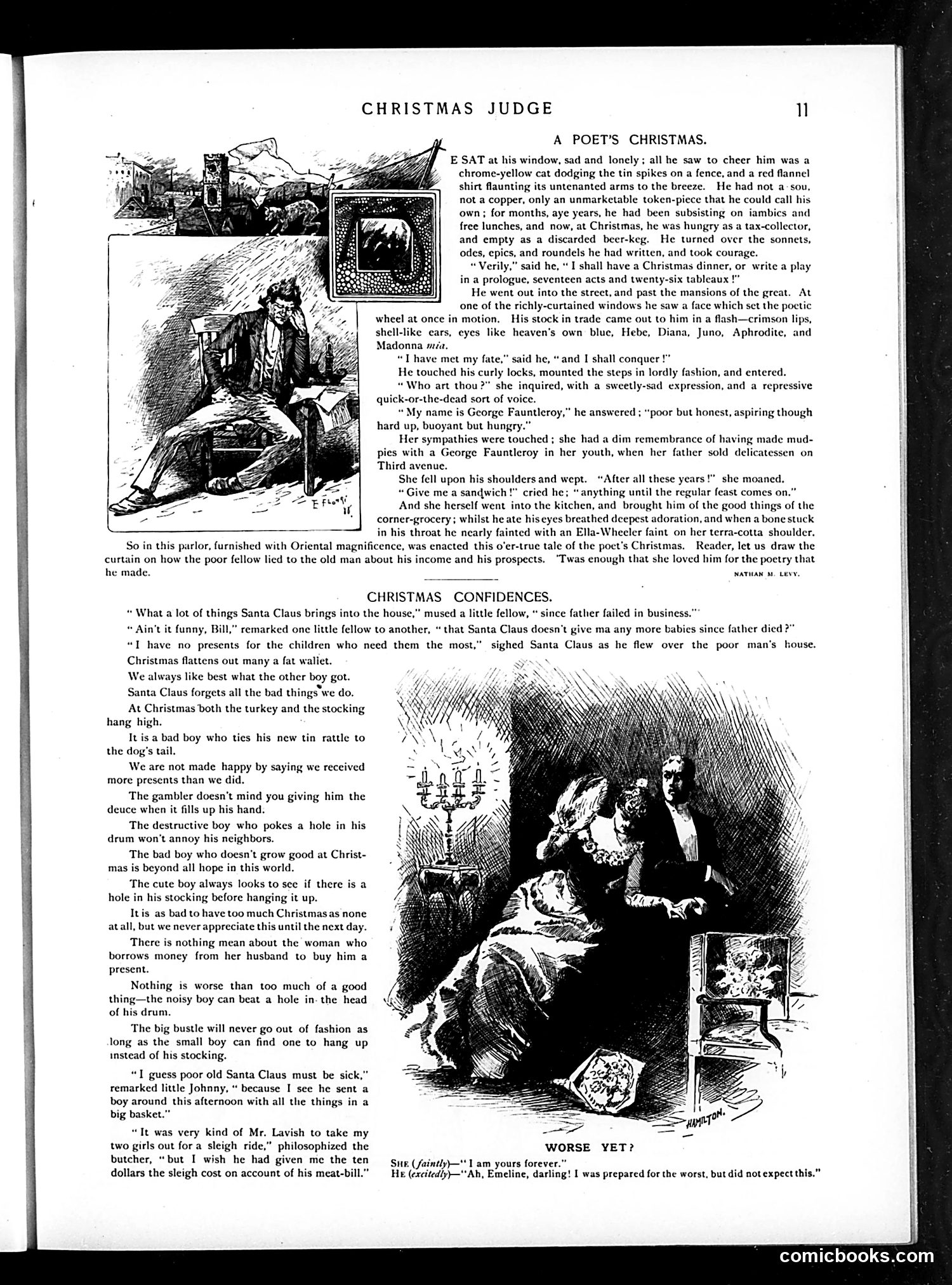
This page contains two satirical pieces about Christmas and poverty: **"A Poet's Christmas"** (top) mocks starving artists. A impoverished poet, subsisting on "iambics and free lunches," spots a wealthy woman and pursues her romantically, fabricating a respectable identity ("George Fauntleroy"). She recognizes him from childhood and feeds him—the joke being he wins her through deception and hunger rather than genuine feeling. The satire targets both the pretensions of struggling artists and the gullibility of sentimental wealthy women. **"Christmas Confidences"** (bottom) presents brief cynical observations about Christmas and class. Children note that Santa brings fewer gifts since their father's business failure or death; Santa pities the poor. The aphorisms satirize how Christmas reveals economic inequality and how material abundance doesn't guarantee happiness—commentary on Gilded Age wealth disparities. Both pieces use dark humor to critique social conditions: poverty among intellectuals, economic instability affecting families, and the disconnect between Christmas ideals and harsh reality.
📄 Transcribed text from this page (OCR, searchable)
Machine-transcribed from the original scan — historical spelling and the odd misread are preserved.
CHRISTMAS JUDGE ll A POET’S CHRISTMAS. E SAT at his window, sad and lonely; all he saw to cheer him was a chrome-yellow cat dodging the tin spikes on a fence, and a red flannel shirt flaunting its untenanted arms to the breeze. He had not a-sou, not a copper, only an unmarketable token-piece that he could call his own; for months, aye years, he had been subsisting on iambics and free lunches, and now, at Christmas, he was hungry as a tax-collector, and empty as a discarded beer-keg. He turned over the sonnets, odes, epics, and roundels he had written, and took courage. “Verily,” said he, “I shall have a Christmas dinner, or write a play in a prologue, seventeen acts and twenty-six tableaux !” He went out into the strect, and past the mansions of the great. At one of the richly-curtained windows 1 1 face which set the poctic wheel at once in motion. His stock in trade came out to him in a flash—crimson lips, shell-like ears, eyes like heaven's own bluc, Hebe, Diana, Juno, Aphrodite, and Madonna mia, “T have met my fate,” said he, “and I shall conquer !" He touched his curly locks, mounted the steps in lordly fashion, and entered. “Who art thou?” she inquired, with a sweetly-sad expression, and a repressive quick-or-the-dead sort of voice. “My name is George Fauntleroy,” he answered ; “poor but honest, aspiring though hard up, buoyant but hungry.” Her sympathies were touched ; she had a dim remembrance of having made mud- pies with a George Fauntleroy in her youth, when her father sold delicatessen on Third avenue. She fell upon his shoulders and wept. “After all these years!" she moaned. “Give me a sandwich !" cried he; “anything until the regular feast comes on.” And she herself went into the kitchen, and brought him of the good things of the corner-grocery; whilst he ate his eyes breathed deepest adoration, and when a bone stuck in his throat he nearly fainted with an Ella-Wheeler faint on her terra-cotta shoulder. So in this parlor, furnished with Oriental magnificence, was enacted this o’er-true tale of the poct’s Christmas. Reader, let us draw the curtain on how the poor fellow lied to the old man about his income and his prospects. “Twas enough that she loved him for the poetry that he made. NATHAN A LEVY, CHRISTMAS CONFIDENCES. “ What a lot of things Santa Claus brings into the house,” mused a little fellow, “ since father failed in business.” * Ain't it funny, Bill,” remarked onc little fellow to another, “ that Santa Claus doesn’t give ma any more babies since father died ?” “IT have no presents for the children who need them the most,” sighed Santa Claus as he flew over the poor man’s Christmas flattens out many a fat wallet. We always like best what the other boy got. Santa Claus forgets all the bad things'we do. At Christmas both the turkey and the stocking hang high. It is a bad boy who ties his new tin rattle to the dog's tail. We are not made happy by saying we received more presents than we did. The gambler doesn’t mind you giving him the deuce when it fills up his hand. The destructive boy who pokes a hole in his drum won't annoy his neighbors. The bad boy who doesn’t grow good at Christ- mas is beyond all hope in this world. The cute boy always looks to sce if there is a hole in his stocking before hanging it up. Itis as bad to have too much Christmas as none atall, but we never appreciate this until the next day. There is nothing mean about the woman who borrows money from her husband to buy him a present. Nothing is worse than too much of a good thi the noisy boy can beat a hole in- the head of his drum. The big bustle will never go out of fashion as long as the small boy can find one to hang up instead of his stocking. “I guess poor old Santa Claus must be sick,” remarked little Johnny, “ because I see he sent a boy around this afternoon with all the things in a big basket.” “It was very kind of Mr. Lavish to take my two girls out fora sleigh ride,” philosophized the WORSE YET? butcher, “but I wish he had given me the ten Sur. (faintly)—"' | am yours forever.” dollars the sleigh cost on account of his meat-bill.” He (excitedly)—"Ah, Emeline, darling! | was prepared for the worst, but did not expect this.” J comicbooks.com