
A complete issue · 16 pages · 1886
Judge — December 4, 1886
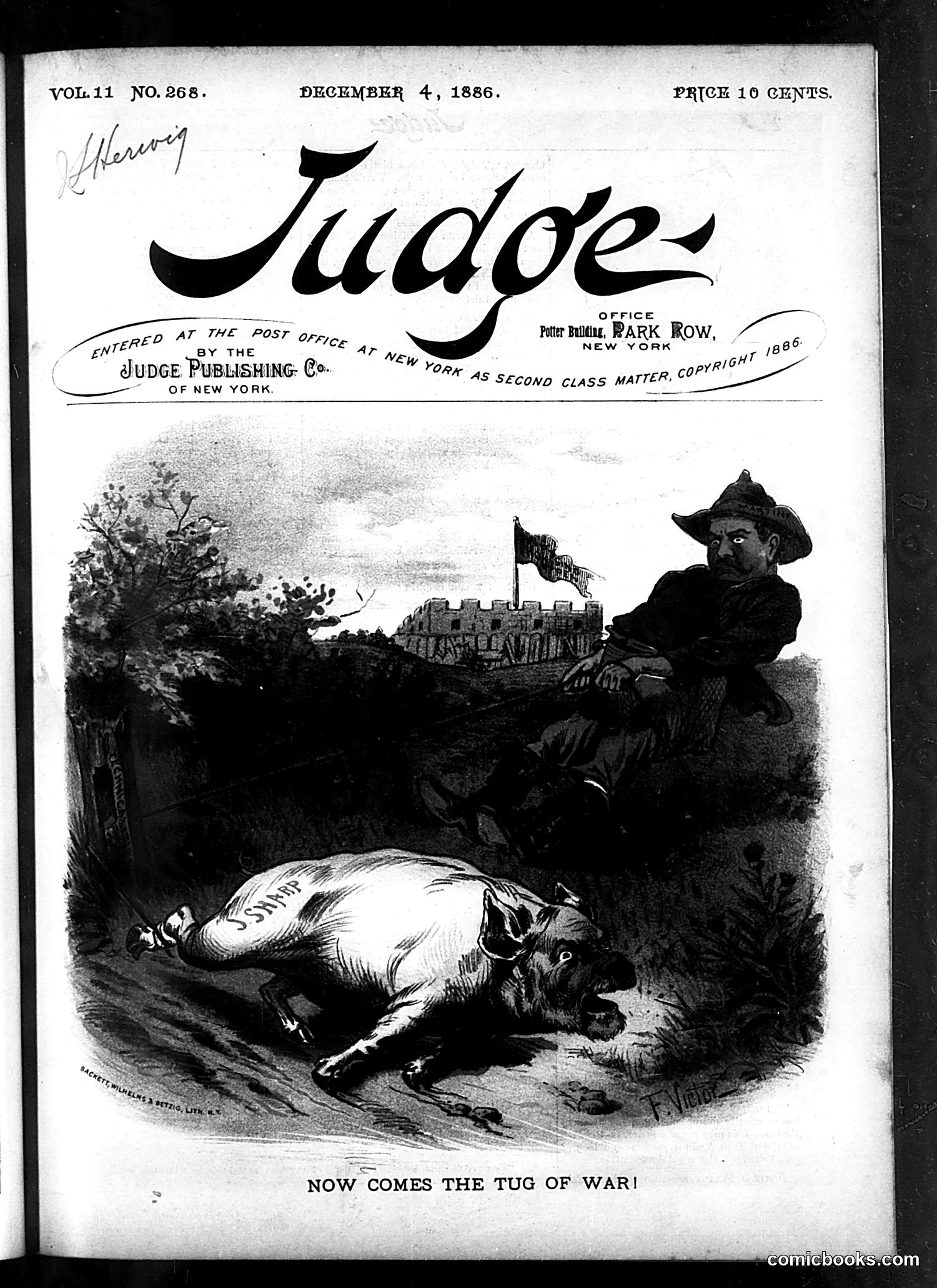
**The Cartoon:** The main illustration depicts two dogs engaged in a "tug of war," with the caption "NOW COMES THE TUG OF WAR!" A man in a cowboy hat watches from behind, overlooking a fortified structure with a flag in the distant background. **Likely Meaning:** This appears to be political satire about a conflict or power struggle occurring in 1886, though the specific figures aren't explicitly labeled. The "tug of war" metaphor suggests competing forces or factions pulling in opposite directions. The fortified building and flag suggest a territorial or governmental dispute. Without additional context, the exact political situation referenced—whether domestic or international—cannot be definitively identified from the image alone.
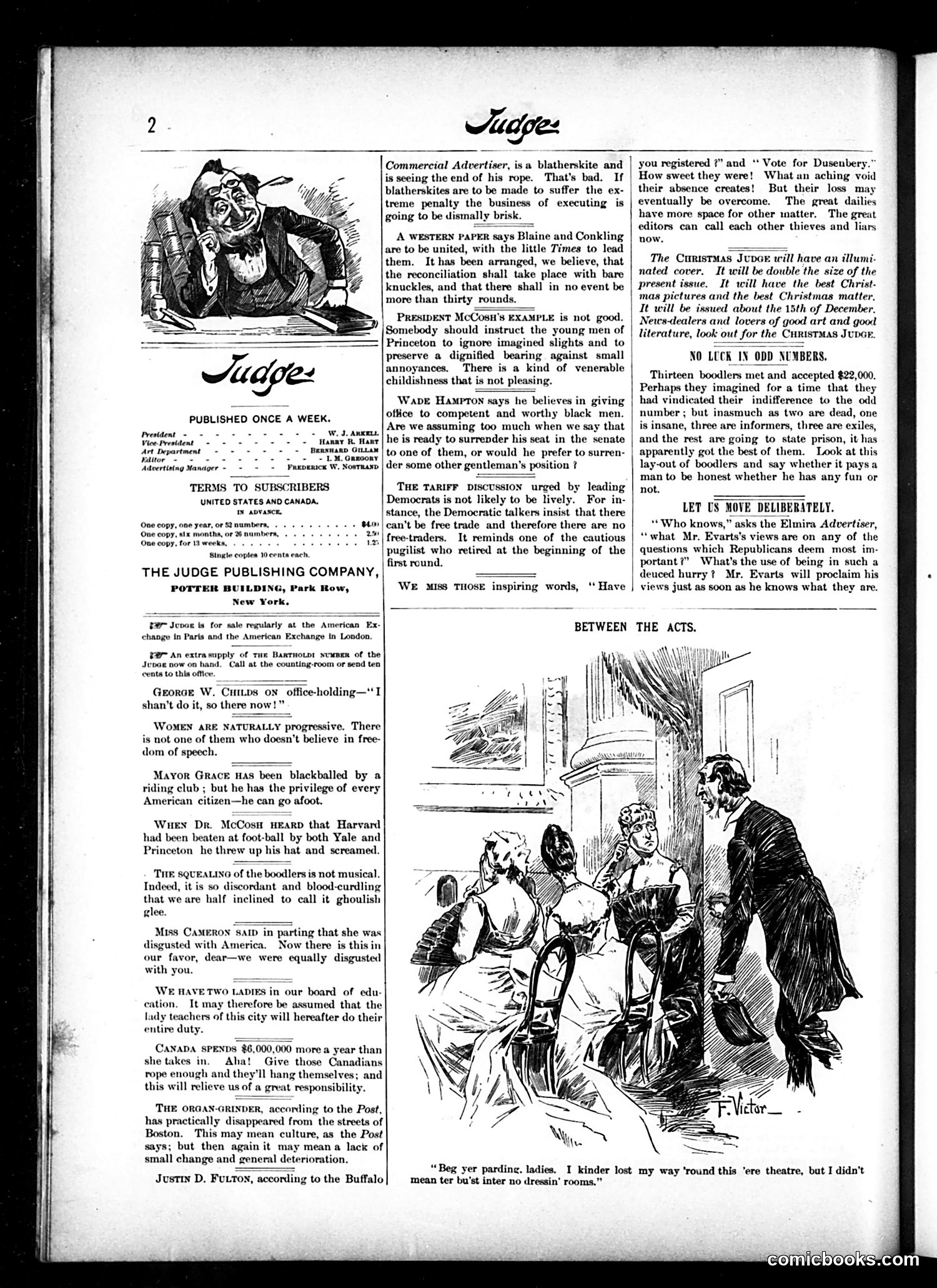
The main cartoon at top depicts a judge or legal figure in robes, likely satirizing judicial corruption or incompetence—a common Judge magazine target. The "Between the Acts" illustration below shows well-dressed women in what appears to be a theater lobby encountering a man. The caption reads: "Beg yer pardin' ladies. I kinder lost my way 'round this 'ere theatre, but I didn't mean ter be's inter no dressin' rooms." This jokes about a man accidentally (or deliberately) wandering into women's private spaces—playing on period anxieties about improper male intrusion into female-only areas. The contrast between his rough dialect and the refined setting creates the humor. The surrounding text contains political commentary on various topics (Senate seats, office-holding, Harvard athletics), typical of Judge's satirical approach to American politics and social issues circa early 1900s.
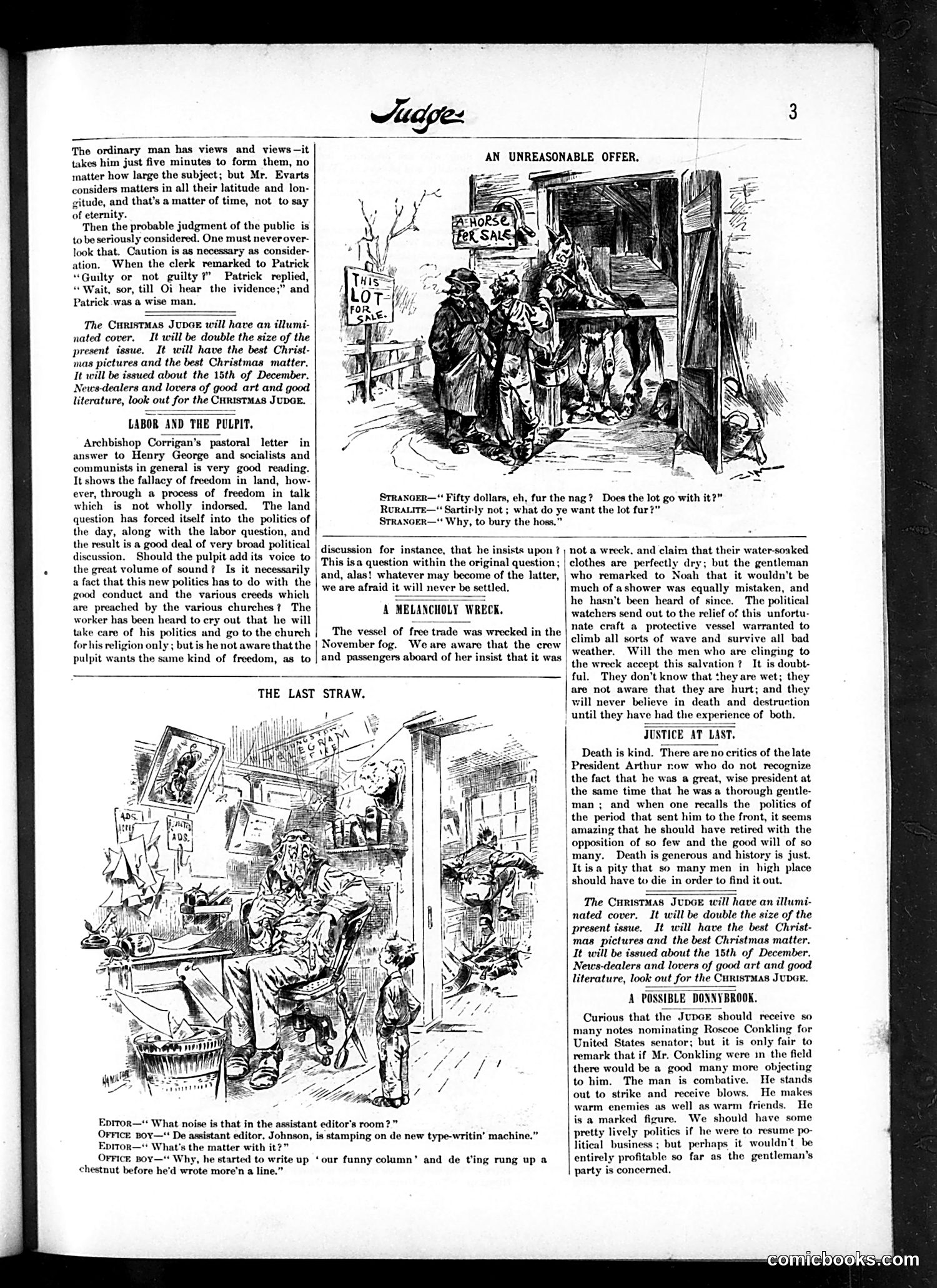
This page contains three distinct satirical pieces: **"An Unreasonable Offer"** (top cartoon): Shows a street vendor trying to sell a decrepit property lot to a potential buyer. The joke plays on the absurdity of selling worthless land—the stranger wants fifty dollars for "the nag" (horse), but balks when asked to include the lot, claiming he can't afford it. The buyer quips he needs the lot "to bury the horse," mocking the lot's complete uselessness. **"A Melancholy Wreck"** (center section): Uses the wreck of a "free trade" vessel during a November fog as metaphor for failed free trade policies. The passage sardonically notes that free traders deny the wreck occurred, while those offering "protective" alternatives (likely tariff supporters) offer salvation the drowning refuse to accept—not believing they're actually in danger. **"The Last Straw"** (bottom cartoon): Office humor showing an assistant editor stamping on a typewriter in frustration while attempting to write a "funny column," ironically creating noise before writing anything. The page satirizes political ideology, economic policy, and workplace absurdity typical of 1880s-90s American satire.
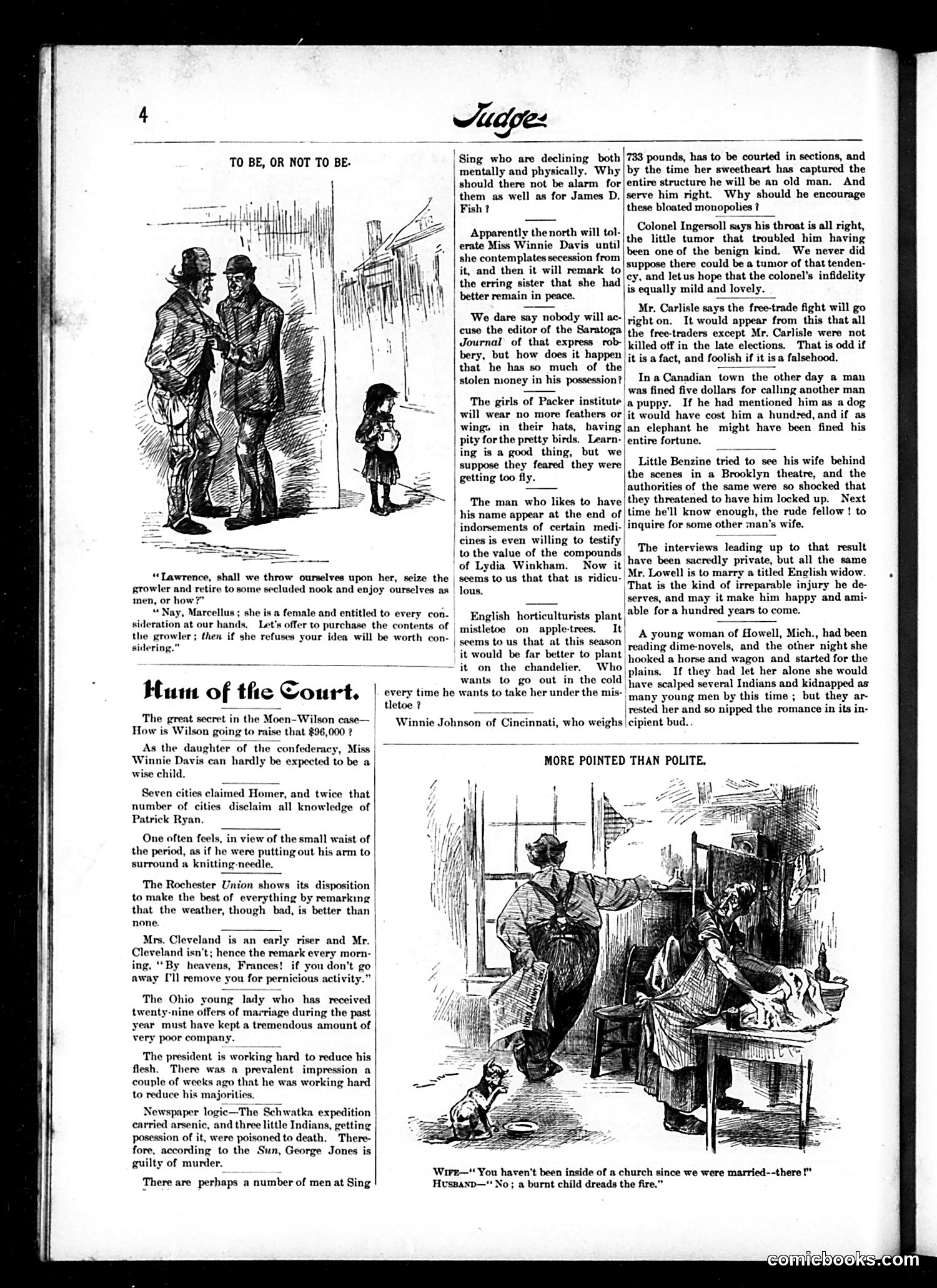
This page from **Judge** (a late 19th-century American satirical weekly) contains brief editorial jokes and commentary on contemporary figures and events. **Key references:** - **Moen-Wilson case**: Alludes to a financial scandal, questioning how "Wilson" will raise $96,000 - **Winnie Davis**: Daughter of Confederate president Jefferson Davis, mocked as financially incompetent ("daughter of the confederacy") - **Colonel Ingersoll**: Robert Ingersoll (famous agnostic lecturer) had a throat tumor; the joke mocks his public prominence - **Mr. Carlisle**: Likely Secretary of the Treasury, criticized for free-trade advocacy despite electoral losses - **President Cleveland**: Referenced as dieting and previously unpopular ("reduce his majorities") The bottom cartoon, "More Pointed Than Polite," depicts a domestic quarrel where the husband criticizes his wife for not attending church since their marriage. **Overall tone**: Cynical political commentary mixed with domestic humor, typical of Judge's satirical approach to Gilded Age politics and society.
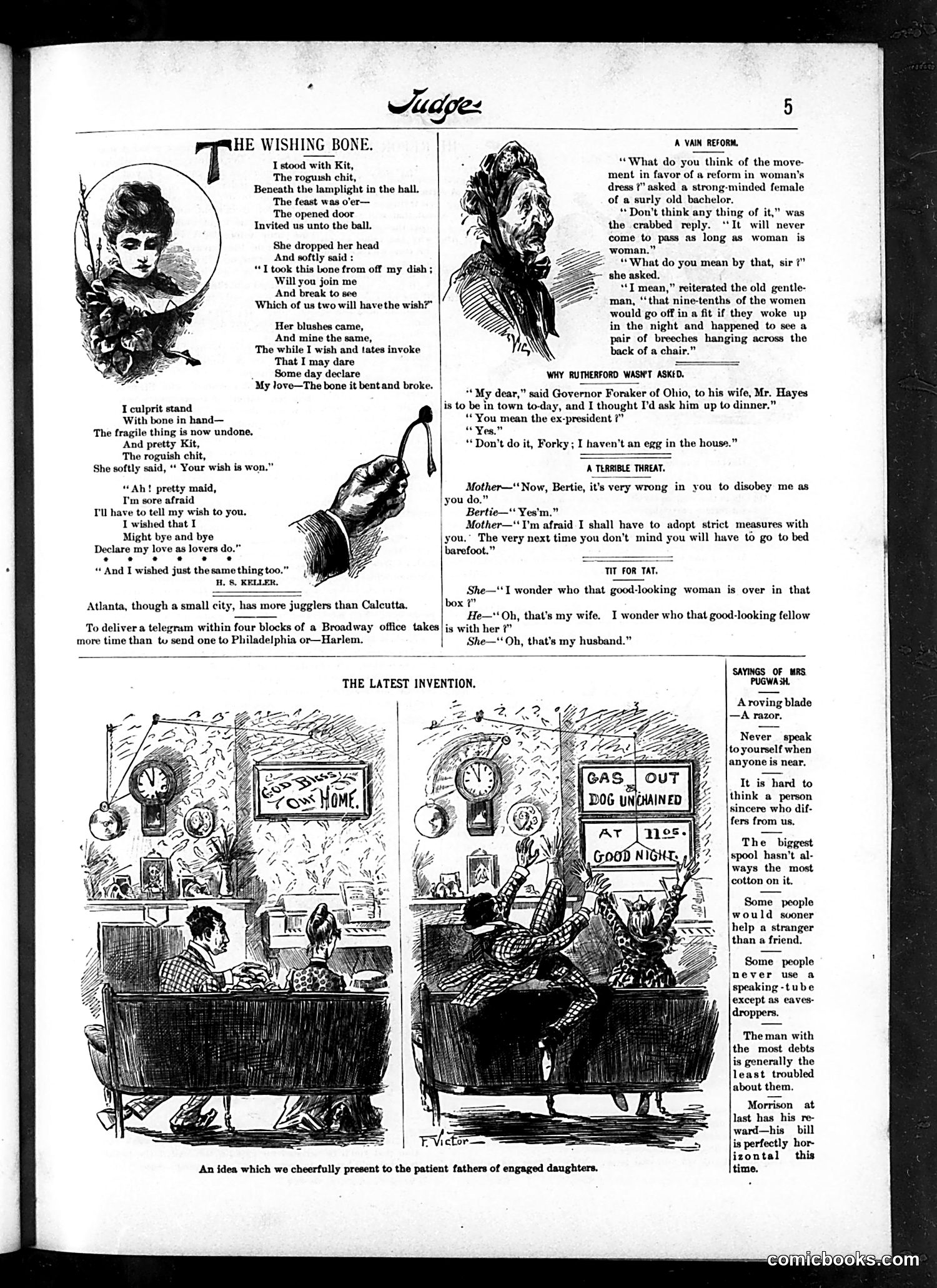
This page contains multiple satirical pieces typical of late 19th-century American humor: **"The Wishing Bone"** is a sentimental poem about a young couple sharing a wishbone—both wishing to declare their love. It's romantic melodrama, likely mocking the era's sentimental courtship rituals. **"A Vain Reform"** mocks women's dress reform movements (corset alternatives, bloomers, etc.). A bachelor dismissively argues reform is impossible because women fundamentally won't abandon traditional dress—even the sight of men's trousers would shock them. It's anti-feminist satire. **"Why Rutherford Wasn't Asked"** references Governor Foraker of Ohio and ex-President Hayes. The joke: Foraker's wife won't invite Hayes to dinner because she has no eggs—a joke about household scarcity or female domesticity. **"The Latest Invention"** cartoon shows a couple with wall clocks and signs ("GAS OUT," "DOG UNCHAINED," "GOOD NIGHTS at 11:05")—apparently a device to manage domestic life and courtship timing. It's satirizing mechanical solutions to romantic problems. **"Sayings of Mrs. Pugwash"** offers biting aphorisms about human nature and hypocrisy.
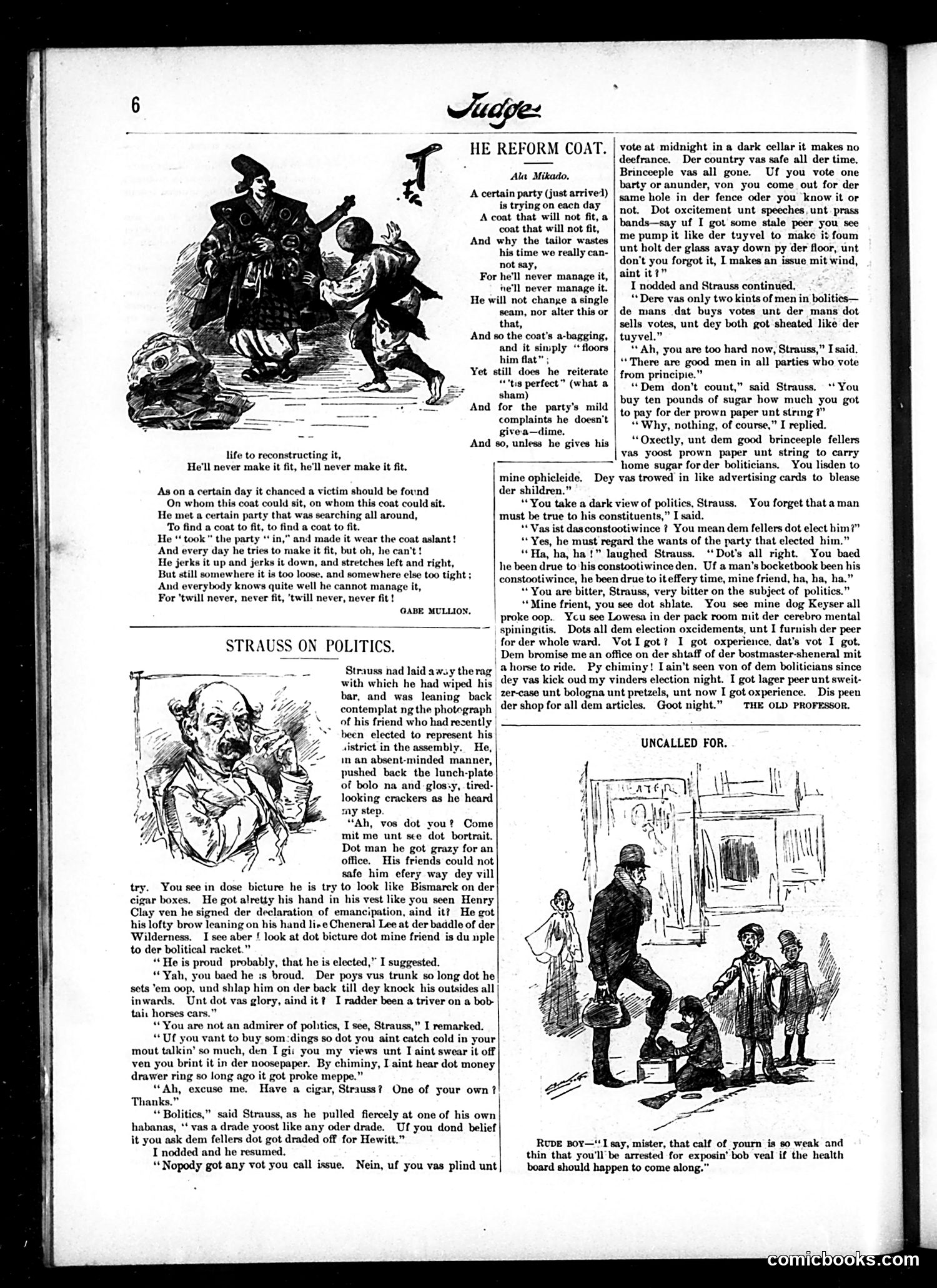
**The Reform Coat** (top): This satirizes a political party attempting to implement reform that doesn't fit its actual nature. Like a tailor unable to alter an ill-fitting garment, the party can't genuinely change itself—it merely appears reformed while remaining fundamentally unchanged. The poem mocks hollow reform efforts. **Strauss on Politics** (bottom): A German-immigrant character (indicated by dialect spelling) expresses cynical views on American politics to the narrator. Strauss ridicules a newly elected assemblyman friend who affects dignified poses (comparing him to Bismarck, Henry Clay, and General Lee) while being corrupted by political ambition. Strauss argues politics reduces to two types: vote-buyers and vote-sellers, dismissing idealistic politicians as naive. The cartoon uses ethnic humor and working-class perspective to critique political corruption and pretense in the Gilded Age.
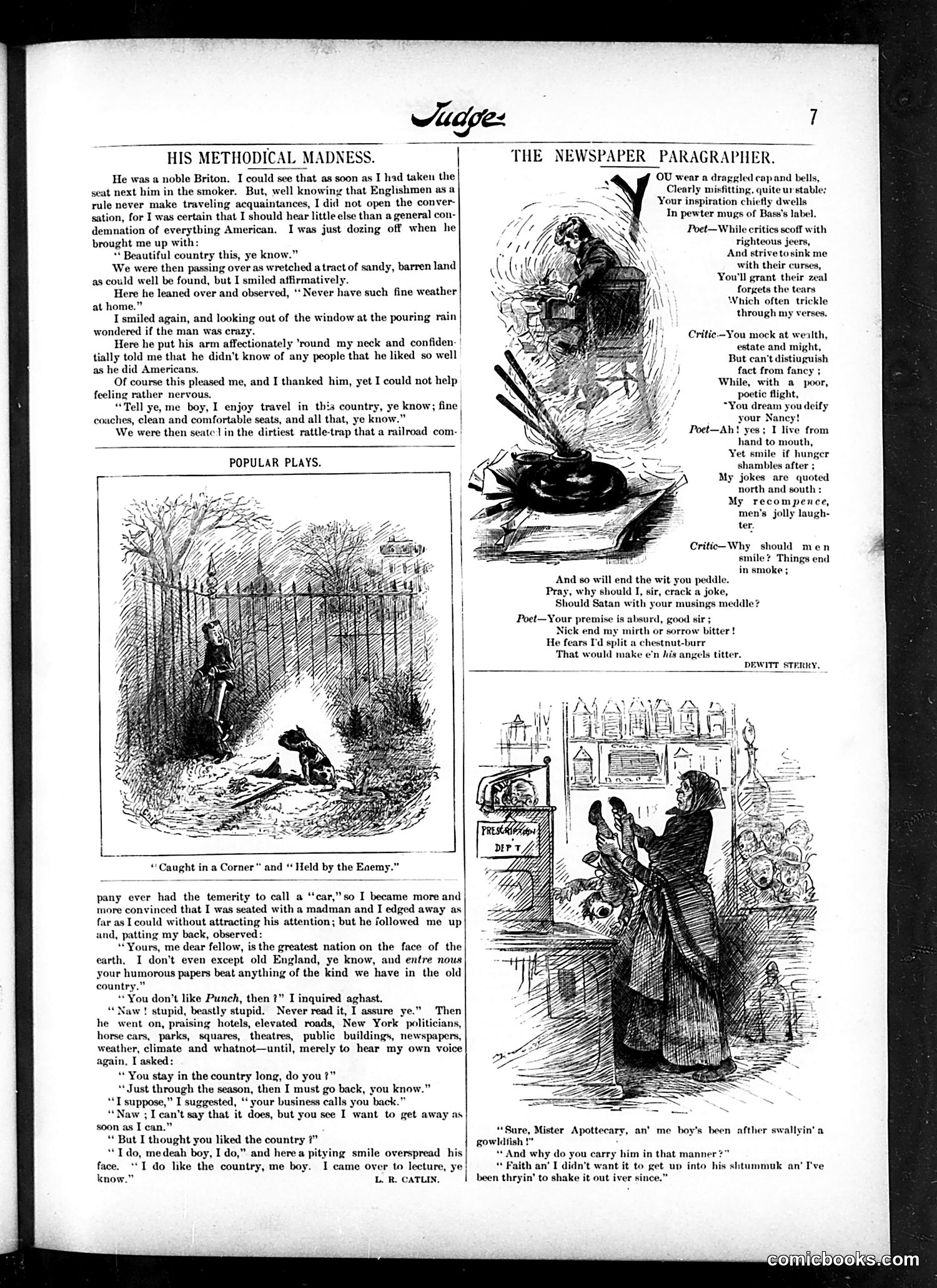
This page contains satirical commentary on Anglo-American relations through two main pieces: **"His Methodical Madness"** (L.R. Catlin): A narrative satire depicting an eccentric English traveler who praises America extravagantly while simultaneously experiencing obvious contradictions—praising barren land during rain, calling dirty train cars "comfortable," lauding American newspapers while dismissing British *Punch* magazine. The joke exposes the traveler's performative enthusiasm: he admits he actually wants to leave the country soon, revealing his praise as insincere flattery, likely motivated by his lecture tour. This mocks both British condescension toward America and the artificial politeness of transatlantic relations. **"The Newspaper Paragrapher"** (DeWitt Stern): A debate-poem between a Poet and Critic about artistic merit and financial success, ultimately defending humor and popular appeal against pretentious criticism. The accompanying illustrations are generic scene-setting rather than specific political caricature. The page satirizes Anglo-American cultural attitudes and the tension between critical legitimacy and popular entertainment.
This page appears to be rotated 90 degrees, making it difficult to read clearly. What's visible is a black and white illustration showing multiple figures gathered around what appears to be industrial or mechanical equipment—possibly a crane or loading apparatus. The sketch-like drawing style is typical of Judge magazine's satirical cartoons. However, without legible text or clearer orientation, I cannot confidently identify the specific political figures, social references, or the satirical point being made. The image quality and rotation prevent me from accurately determining whether this depicts labor issues, industrial commentary, or another contemporary concern of Judge's era. **I cannot responsibly explain the specific satire intended here without risking inaccuracy.**
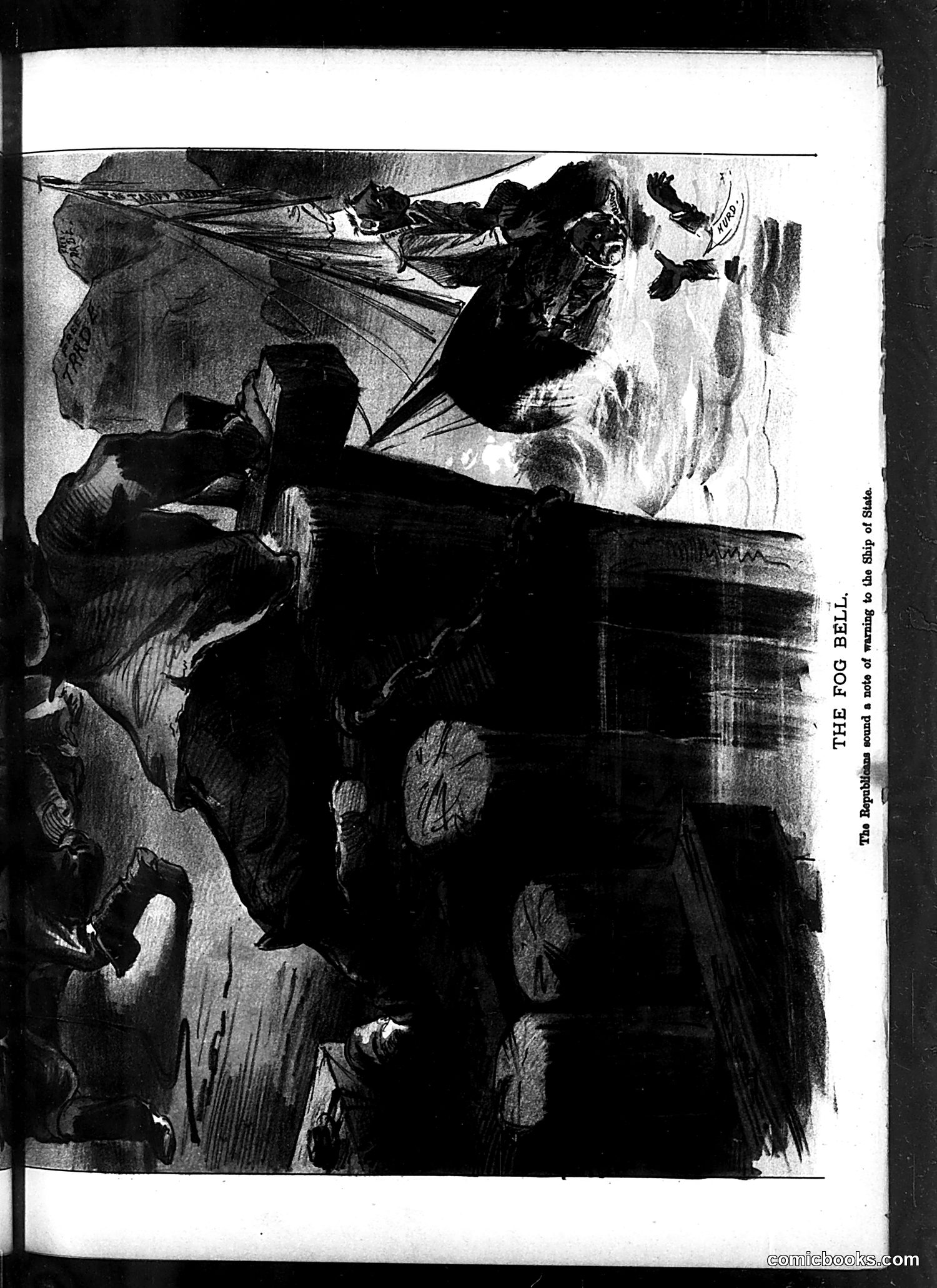
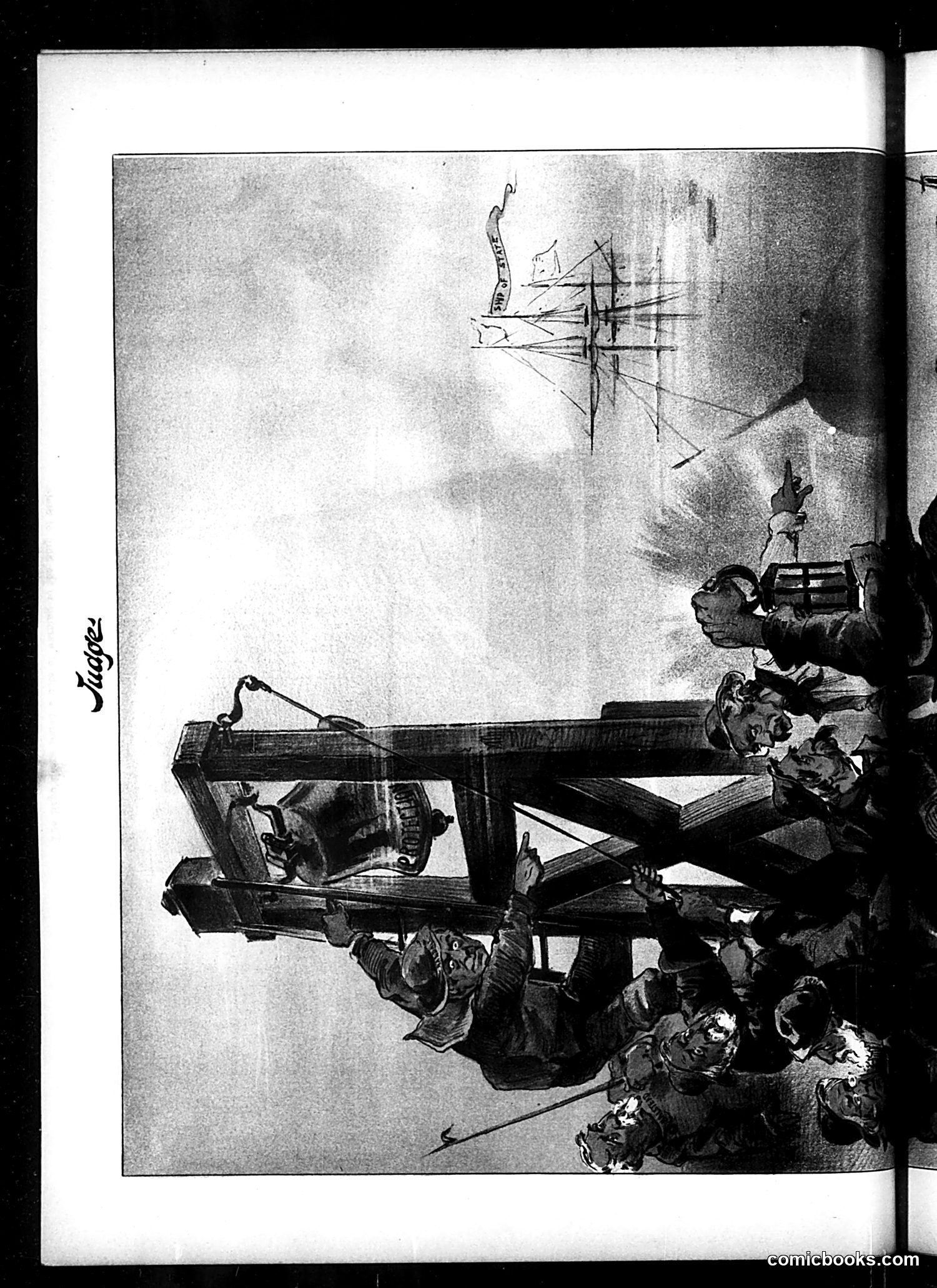
This political cartoon depicts a ship in foggy conditions with a figure ringing a bell as a warning. According to the caption, "The Republicans sound a note of warning to the Ship of State." The "Ship of State" is a traditional metaphor for the nation's government. The fog represents unclear or dangerous conditions ahead. A Republican figure (likely representing the Republican Party) is portrayed as sounding an alarm bell to warn of impending peril. This appears to be satirizing Republican warnings about Democratic policies or government direction—suggesting Republicans were attempting to alert the nation to threats they perceived. The cartoon's tone suggests Judge magazine (a satirical publication) was skeptical of these Republican warnings, implying they were either exaggerated or unnecessary alarms about the government's course.
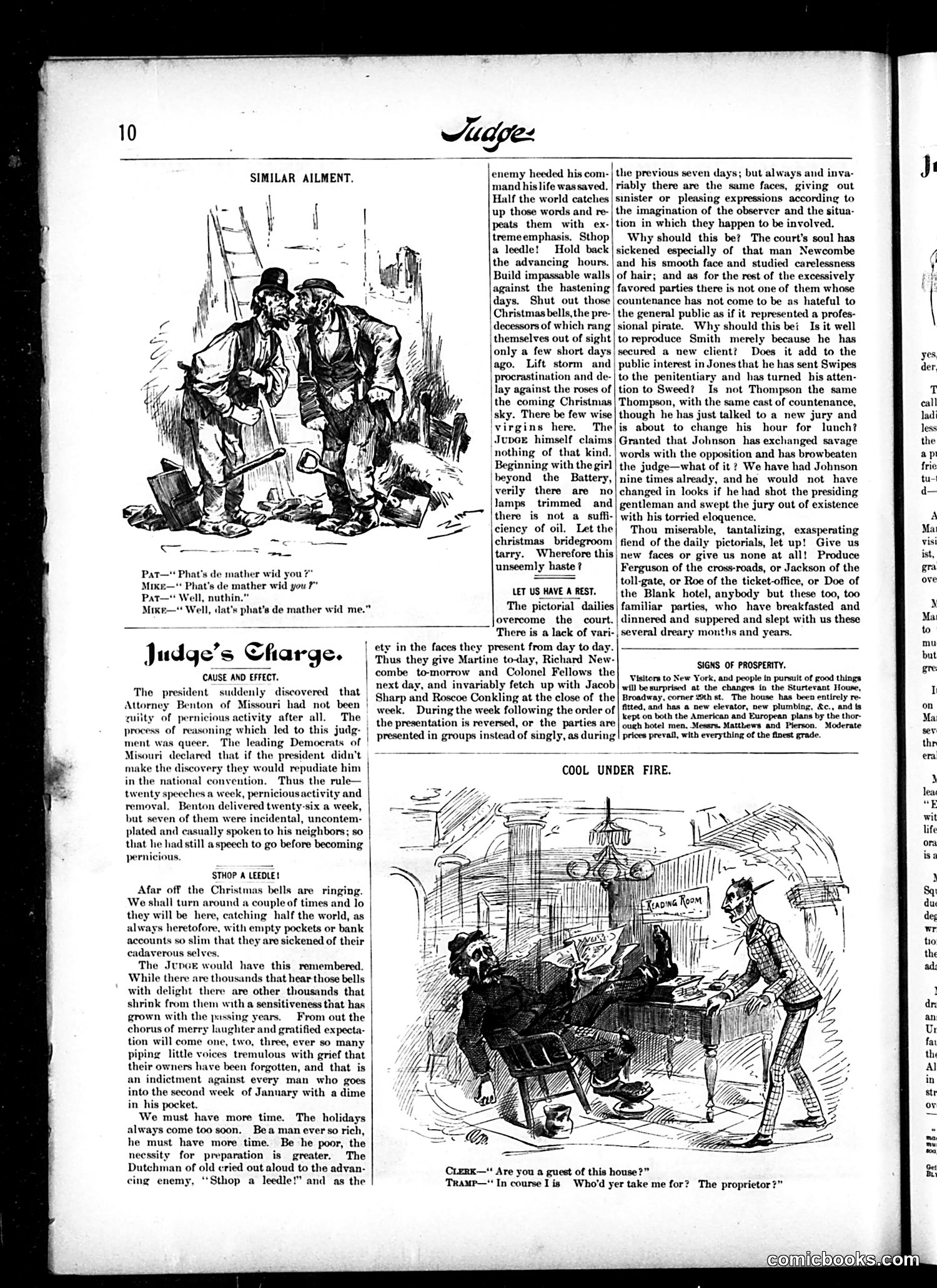
**"Similar Ailment"** (top left): A brief comic exchange between two Irish immigrants (Pat and Mike, identified by dialect) where each asks what's wrong with the other, both claiming nothing's wrong while clearly something troubles both. It's a gentle ethnic humor joke about Irish stoicism or mutual commiseration. **"Judge's Charge"** (main text): Political commentary on President Andrew Jackson and Missouri Senator Thomas Hart Benton. Jackson had accused Benton of "pernicious activity," but when Missouri Democrats threatened to abandon Jackson at the next convention unless he reversed course, Jackson suddenly discovered Benton was innocent. The satire mocks Jackson's arbitrary reversal based purely on political pressure rather than principle. **"Sthop a Leedle!"**: An editorial plea (using Irish dialect) asking society to pause before Christmas arrives, noting that many poor people face the holidays with empty pockets and shame, while wealthy people also need more preparation time. It advocates for compassion toward the economically disadvantaged during the season.
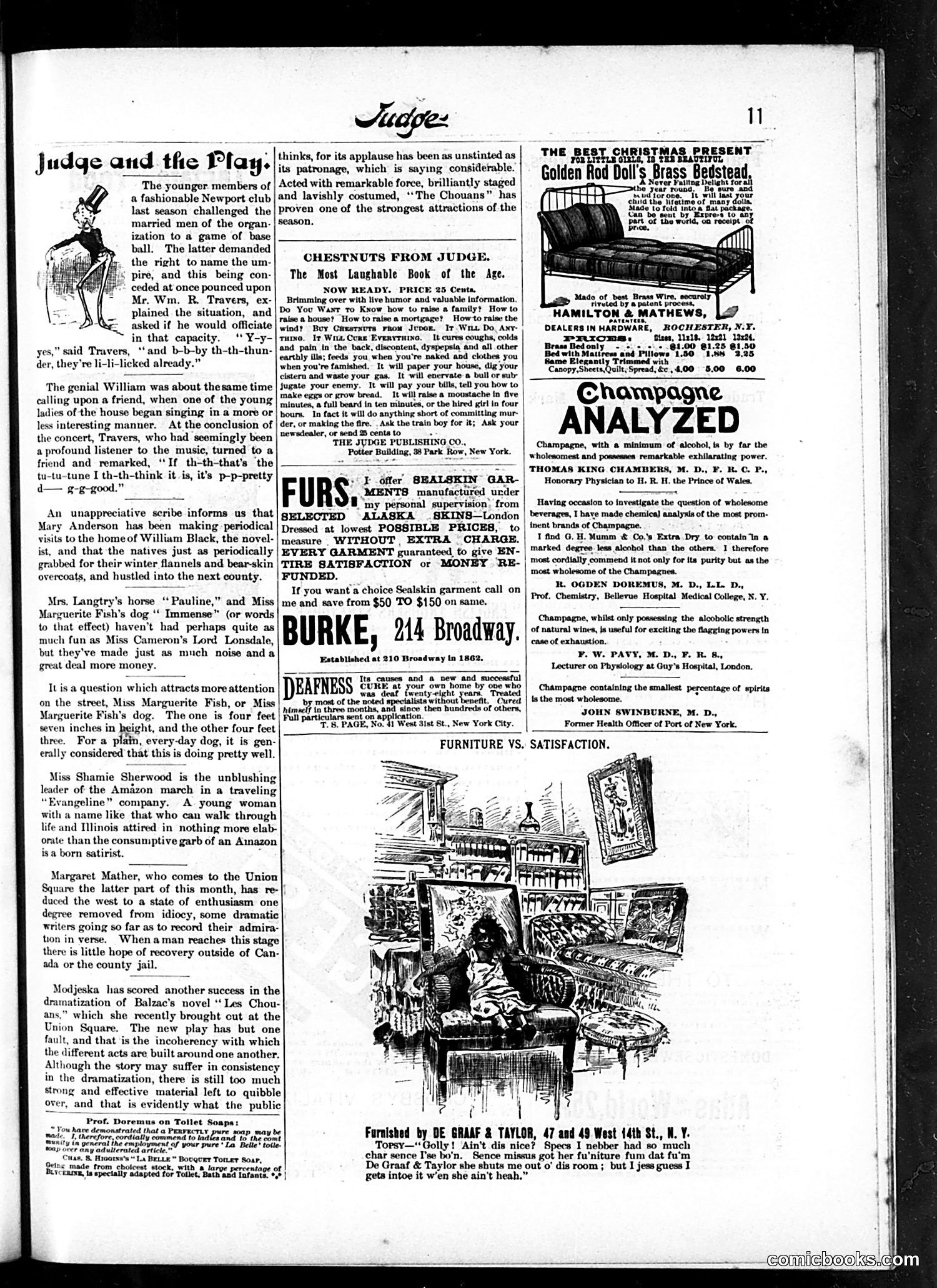
This page is primarily **social gossip and theater criticism** rather than political cartoons. The main feature, "Judge and the Play," satirizes Newport high society and theatrical personalities of the era. The humor targets: - **William R. Travers**: A wealthy Newport figure with a pronounced stutter, mocked for his confident pronouncements (his stammer makes his declarations absurdly confident) - **Mary Anderson, Lillie Langtry, Margaret Mather, Modjeska**: Famous actresses of the period, critiqued for their performances and social presence - **Newport society**: The piece ridicules the wealthy elite's pretensions and leisure activities The satire works through anecdotes exposing the gap between society figures' self-importance and their actual merit. For instance, Travers declares the married men will lose at baseball before the game starts—his stutter undercuts his authority. The page also contains **advertisements** (brass bedsteads, champagne, furniture) and a notice for "Chestnuts from Judge," the magazine's humor collection. This represents Judge's characteristic approach: mockery of the privileged classes and celebrity culture through gossipy, character-based humor rather than explicit political satire.
This is primarily an **advertising page** from Judge magazine, with one notable political reference. ## Political Content The text mentions "The Setting Sun" cartoon (not visible here) depicting "Napoleon Cleveland has seen his Moscow"—a reference to President **Grover Cleveland** and the recent November election. The comparison to Napoleon's failed Moscow campaign suggests Cleveland suffered a major political defeat, likely the 1894 midterm elections where Democrats lost congressional control due to the economic depression. ## Advertisements The page is dominated by patent medicine and consumer product ads typical of the 1890s: - **Allcock's Porous Plasters** (medical) - **Lactated Food** (infant formula) - **Dygestlyn** (digestive remedy) - **Kidneying** (kidney treatment) - Theater announcements and fur garments The ads reveal period concerns: digestive ailments, infant nutrition, and medical quackery were common advertising targets. The repeated emphasis on "genuine" vs. fraudulent products reflects widespread concern about patent medicine fraud in this era.
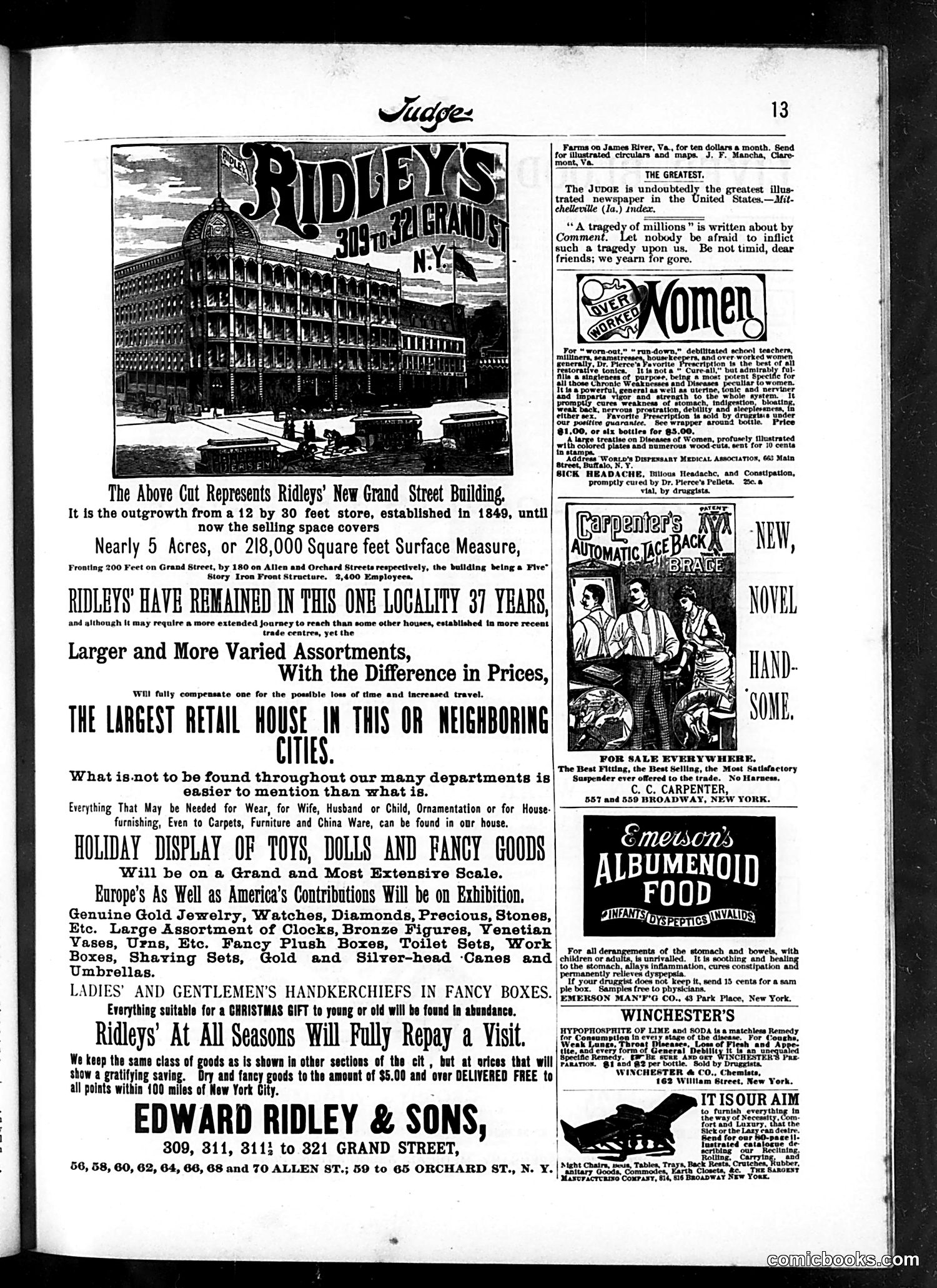
This page is **primarily advertising**, not satire or political commentary. It features a large advertisement for **Edward Ridley & Sons**, a major New York department store located on Grand Street in lower Manhattan. The main image shows the store's new five-story building, described as occupying nearly 5 acres with 2,400 employees. The advertisement emphasizes that Ridley's has remained in the same neighborhood for 37 years and offers comprehensive merchandise—clothing, furniture, toys, jewelry, and holiday goods—at competitive prices, with free delivery within 100 miles of New York City. The page also includes testimonials praising *Judge* magazine itself as "the greatest illustrated newspaper" and numerous patent medicine advertisements typical of the era (for headaches, women's ailments, digestive issues, etc.). There is no discernible political cartoon or satirical commentary visible on this page—it functions as a retail catalog and advertising vehicle.
This page is **entirely medical advertising**, not satire or political commentary. It's a full-page advertisement for "Golden Medical Discovery," a patent medicine sold by the World's Dispensary Medical Association in Buffalo, New York. The page features testimonial letters from patients claiming cures for liver disease, malaria, dyspepsia, consumption, and lung ailments. These were common in late 19th-century American magazines—unregulated patent medicines made exaggerated health claims with no scientific backing. The bold heading "THE BLOOD IS THE LIFE" appeals to then-popular medical theories about "humors" and blood purification. The price ($1.00 per bottle, or six for $5.00) and distributor address indicate this was a mass-marketed nostrum. By modern standards, this is fraudulent health advertising, but it was typical of Judge magazine's revenue model—publications relied heavily on patent medicine ads, regardless of editorial content.
This page is **primarily advertising** with no significant political cartoons or satirical content. It consists almost entirely of commercial advertisements typical of late 19th/early 20th-century publications. Notable ads include patent medicines (Hale's Honey for coughs, treatments for hernia and catarrh), hotel and business services, and household products. The small header testimonials praising *Judge* magazine itself—describing it as having "keenest ridicule" and sound positions on "national topics"—suggest *Judge* positioned itself as intelligent political satire, though no examples appear on this particular page. The ads reflect period concerns: tuberculosis/consumption fears, medical remedies of dubious efficacy, and hotels advertising "fireproof" construction (likely responding to major fires of the era). **No identifiable political figures or satirical commentary are visible.**
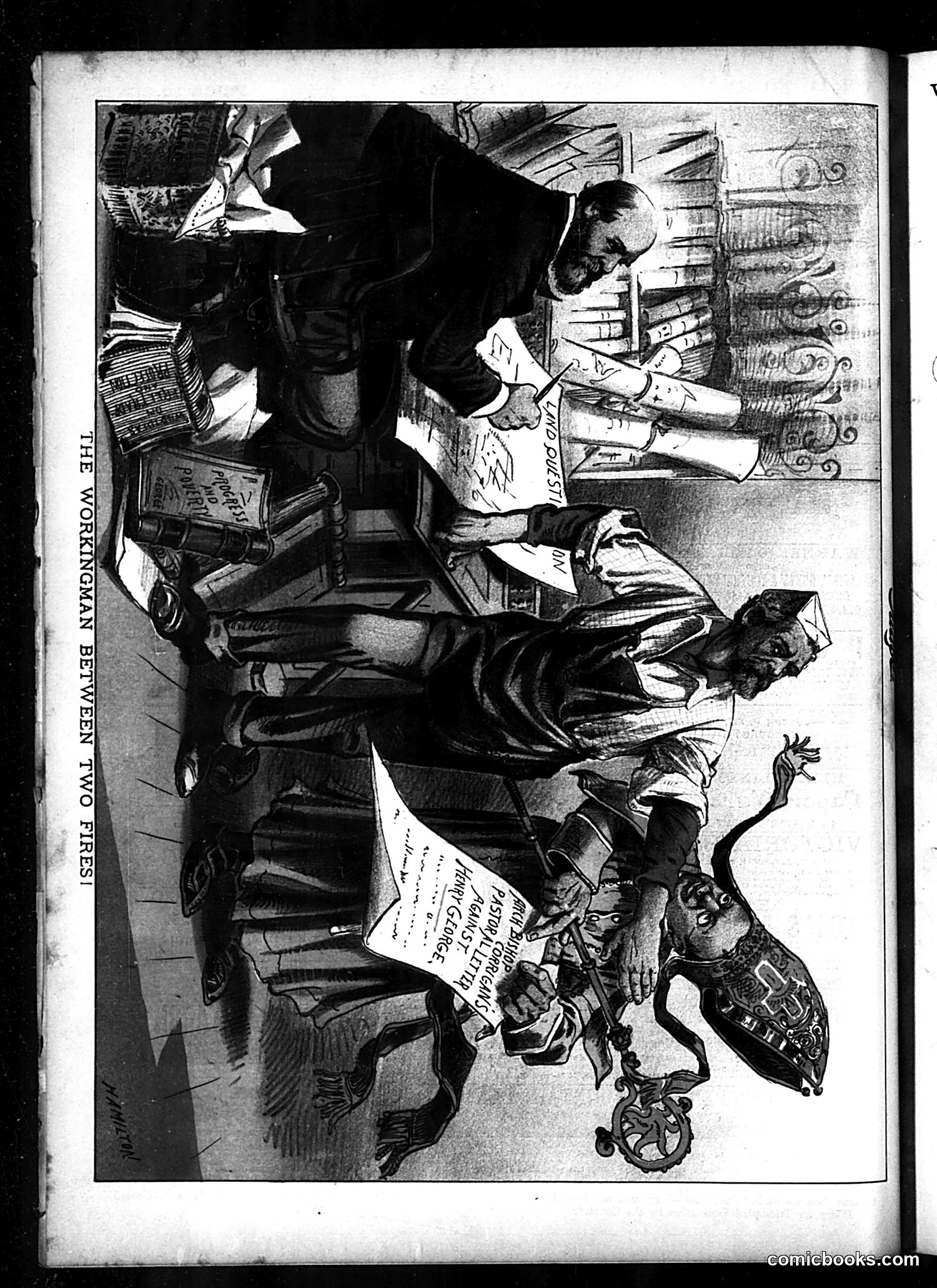
This page appears to show a political cartoon titled "FIRES!" The image is rotated and depicts what seems to be a chaotic scene with multiple figures in period dress (appearing to be late 19th or early 20th century based on clothing styles). The composition suggests satirical commentary, likely about political corruption or social upheaval, given Judge magazine's typical satirical focus. However, the image quality, rotation, and lack of clear identifying labels make it difficult to determine the specific figures, events, or political references being mocked. The word "FIRES" suggests the cartoon may reference literal fires, scandals, or metaphorical "fires" of controversy. Without clearer text or visible identifying marks, I cannot confidently explain which specific historical event or figures are being satirized.