
Judge, 1886-12-04 · page 7 of 16
Judge — December 4, 1886 — page 7: what you’re looking at
What you’re looking at
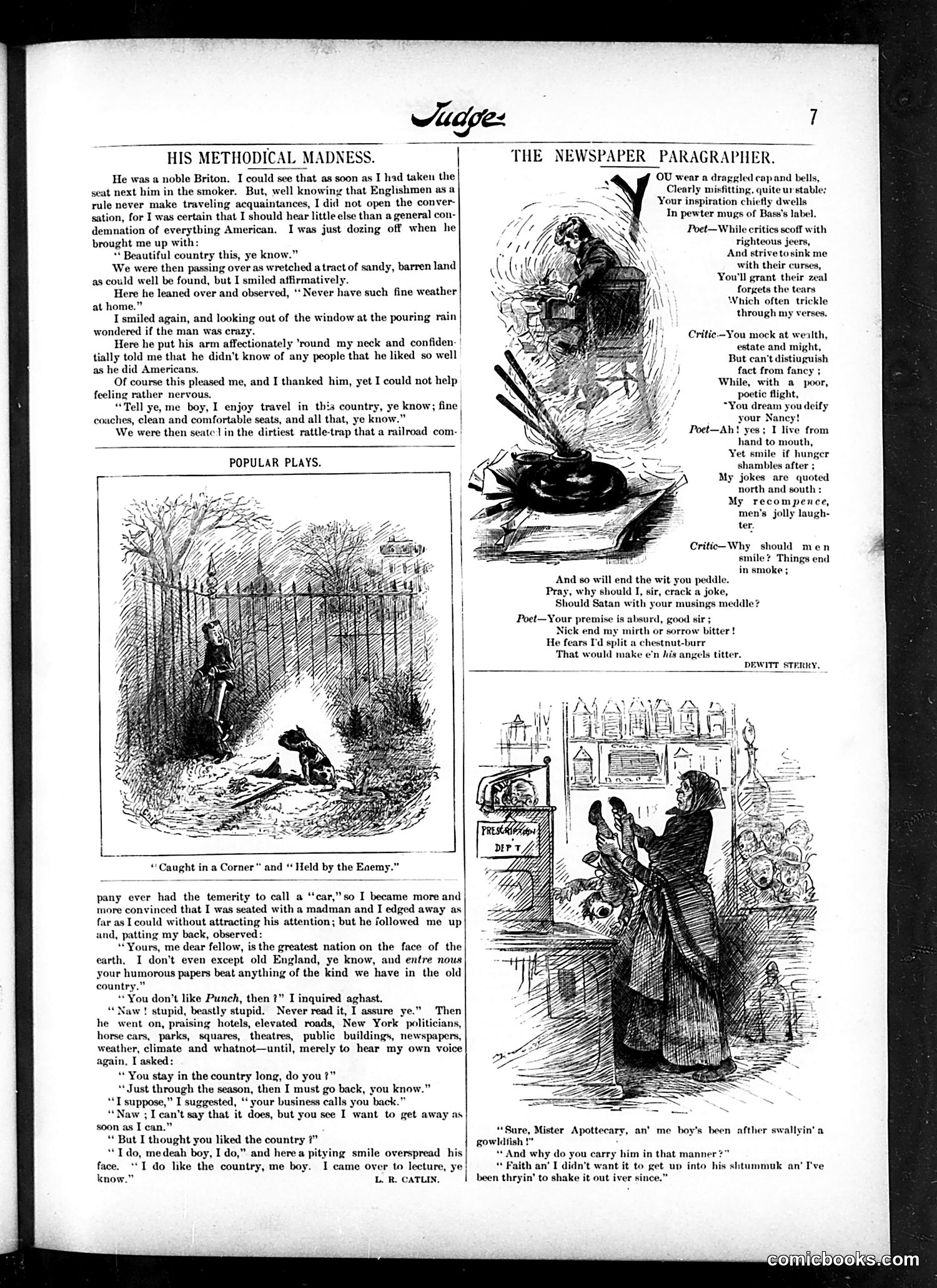
This page contains satirical commentary on Anglo-American relations through two main pieces: **"His Methodical Madness"** (L.R. Catlin): A narrative satire depicting an eccentric English traveler who praises America extravagantly while simultaneously experiencing obvious contradictions—praising barren land during rain, calling dirty train cars "comfortable," lauding American newspapers while dismissing British *Punch* magazine. The joke exposes the traveler's performative enthusiasm: he admits he actually wants to leave the country soon, revealing his praise as insincere flattery, likely motivated by his lecture tour. This mocks both British condescension toward America and the artificial politeness of transatlantic relations. **"The Newspaper Paragrapher"** (DeWitt Stern): A debate-poem between a Poet and Critic about artistic merit and financial success, ultimately defending humor and popular appeal against pretentious criticism. The accompanying illustrations are generic scene-setting rather than specific political caricature. The page satirizes Anglo-American cultural attitudes and the tension between critical legitimacy and popular entertainment.
📄 Transcribed text from this page (OCR, searchable)
Machine-transcribed from the original scan — historical spelling and the odd misread are preserved.
ape: HIS METHODICAI MADNESS. He was a noble Briton. I could see that as soon as I had taken the seat next him in the smoker. But, well knowing that Englishmen as a rule never make traveling acquaintances, I did not open the conver- sation, for I was certain that I should hear little else than a general con- demnation of everything American. I was just dozing off when he brought me up with: “ Beautiful country this, ye know.” We were then passing over as wretched atract of sandy, barren land as could well be found, but I smiled affirmatively. Here he leaned over and observed, ‘‘ Never have such fine weather at home.” | I smiled again, and looking out of the window at the pouring rain wondered if the man was crazy. Here he put his arm affectionately ‘round my neck and confiden- tially told me that he didn’t know of any people that he liked so well as he did Americans. Of course this pleased me, and I thanked him, yet I could not help feeling rather nervous. | “Tell ye, me boy, I enjoy travel in this country, ye know; fine, coaches, clean and comfortable seats, and all that, ye know.” We were then seate| in the dirtiest rattle-trap that a railroad com- POPULAR PLAYS. “Caught in a Corner” and “Held by the Enemy.” pany ever had the temerity to call a “‘car,”so I became more and more convinced that I was seated with a madman and I edged away as far as I could without attracting his attention; but he followed me up and, patting my back, observed: “Yours, me dear fellow, is the greatest nation on the face of the earth, I don’t even except old England, ye know, and entre nous your humorous papers beat anything of the kind we have in the old country.” “You don’t like Punch, then ?” I inquired aghast. “Naw ! stupid, beastly stupid. Never read it, I assure ye.” Then he went on, praising hotels, elevated roads, New York politicians, horse cars, parks, squares, theatres, public buildings, newspapers, weather, climate and whatnot—until, merely to hear my own voice again, I asked: “ You stay in the country long, do you?” ‘Just through the season, then I must go back, you know.” “I suppose,” I suggested, “ your business calls you back.” “Naw ; I can’t say that it does, but you see I want to get away as soon as I can.” “But I thought you liked the country 7” “Tdo, medeah boy, I do,” and here a pit; ¢ smile overspread his face. “I do like the country, me boy. I came over to lecture, ye} know.” L. R. CATLIN, THE NEWSPAPER PARAGRAPHER, OU wear a draggled capand bells, Clearly misfitting, quite urstable; Your inspiration chiefly dwells In pewter mugs of Bass’s label. Poet—While critics scoff with righteous jeers, And strive tosink me with their curses, You'll grant their zeal forgets the tears Which often trickle through my verses, Critic—You mock at wealth, estate and might, But can't distiuguish fact from fancy ; While, with a poor, poetic flight, ~You dream you deify Nanc’ es; I live from hand to mouth, Yet smile if hunger shambles after ; My jokes are quoted north and south : My recompence, men's jolly laugh- ter. Critic—Why should men smile? Things end in smoke ; And 60 will end the wit you peddle. Pray, why should I, sir, crack a joke, Should Satan with your musings meddle? Poet—Your premise is absurd, good sir ; Nick end my mirth or sorrow bitter! He fears I'd split a chestnut-burr That would make e'n his angels titter. DEWITT STERN. SAAN SSS SS “And why do you carry him in that manne “ Faith an’ I didn’t want it to get up into his shtummuk an’ I've been thryin’ to shake it out iver since.”