
Judge, 1886-12-04 · page 3 of 16
Judge — December 4, 1886 — page 3: what you’re looking at
What you’re looking at
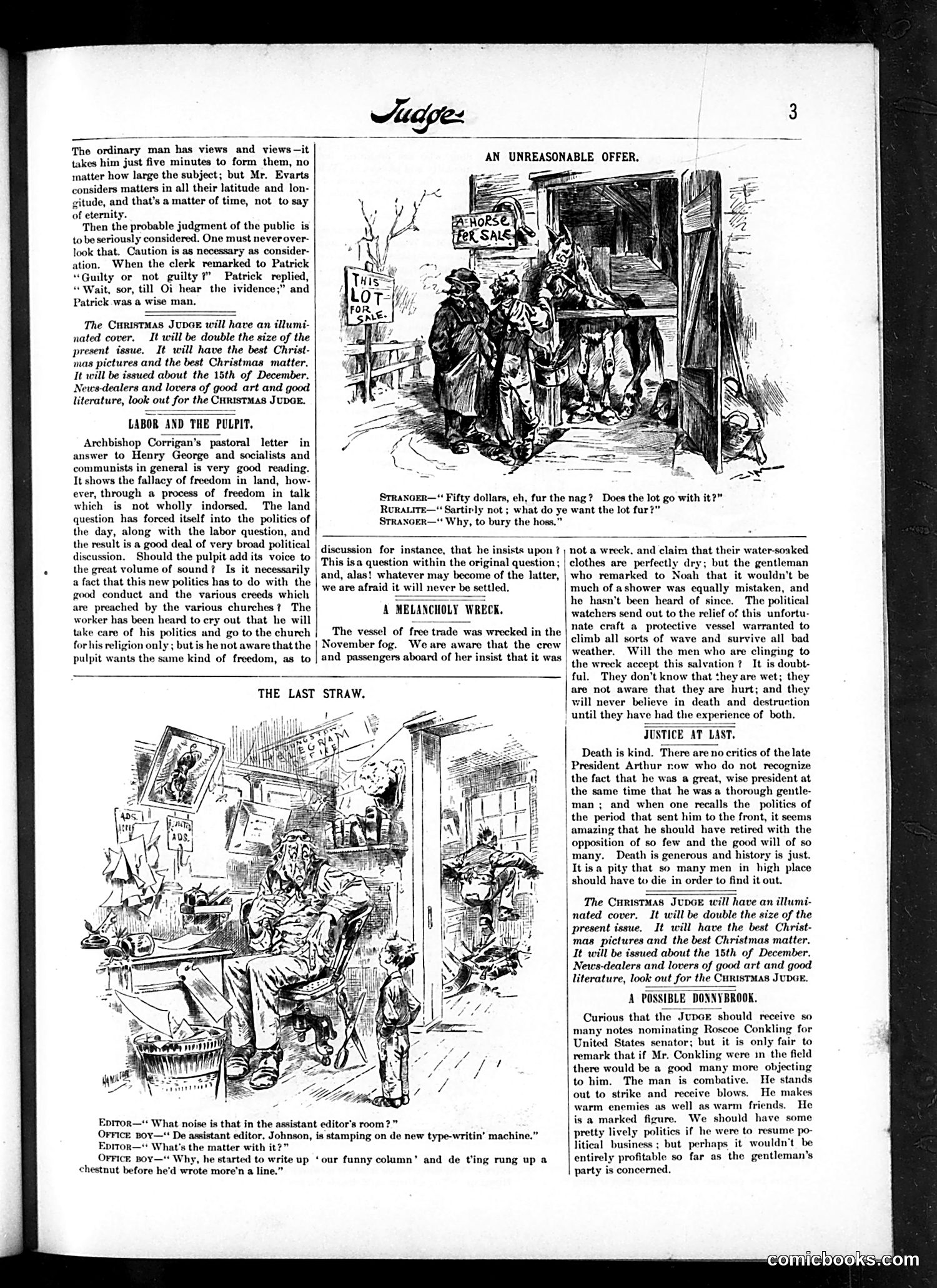
This page contains three distinct satirical pieces: **"An Unreasonable Offer"** (top cartoon): Shows a street vendor trying to sell a decrepit property lot to a potential buyer. The joke plays on the absurdity of selling worthless land—the stranger wants fifty dollars for "the nag" (horse), but balks when asked to include the lot, claiming he can't afford it. The buyer quips he needs the lot "to bury the horse," mocking the lot's complete uselessness. **"A Melancholy Wreck"** (center section): Uses the wreck of a "free trade" vessel during a November fog as metaphor for failed free trade policies. The passage sardonically notes that free traders deny the wreck occurred, while those offering "protective" alternatives (likely tariff supporters) offer salvation the drowning refuse to accept—not believing they're actually in danger. **"The Last Straw"** (bottom cartoon): Office humor showing an assistant editor stamping on a typewriter in frustration while attempting to write a "funny column," ironically creating noise before writing anything. The page satirizes political ideology, economic policy, and workplace absurdity typical of 1880s-90s American satire.
📄 Transcribed text from this page (OCR, searchable)
Machine-transcribed from the original scan — historical spelling and the odd misread are preserved.
The ordinary man has views and views—it takes him just five minutes to form them, no matter how large the subject; but Mr. Evarts considers matters in all their latitude and lon- gitude, and that’s a matter of time, not to say of eternity. ‘Then the probable judgment of the public is to be seriously considered. One must never over- look that. Caution is as necessary as consider- ation, When the clerk remarked to Patrick “Guilty or not guilty?” Patrick replied, ai “ar the ividence;” and Patrick was a wise man. The Curistmas JUDGE will have an illumi- nated cover, It will be double the size of the present issue, It will have the best Christ- mas pictures and the best Christmas matter. It will be issued about the 15th of December. News-dealers and lovers of good art and good literature, look out for the CurisTmas JUDGE. LABOR AND THE PULPIT. Archbishop Corrigan’s pastoral letter in answer to Henry George and socialists and communists in general is very good reading. It shows the fallacy of freedom in land, how- ever, through a process of freedom in talk which is not wholly indorsed. The land question has forced itself into the politics of the day, along with the labor question, and the result is a good deal of very broad political | discussion for instance, that he insists upon t | not a wreck, and claima that their water-soaked discussion. Should the pulpit add its voice to the great volume of sound? Is it necessarily | a fact that this new politics has to do with the good conduct and the various creeds which are preached by the various churches? The worker has been heard to cry out that he will take care of his politics and go to the church for his religion only ; but is he not aware that the pulpit wants the same kind of freedom, as to Strancen—“ Fifty dollars, eh, fur the nag? Does the lot go with it?” Reraite—“Sartirly not ; what do ye want the lot fur?” STRANGE! “Why, to bury the hoss.” This isa question within the original question; | clothes are perfectly dry; but the gentleman and, alas! whatever may become of the latter, we are afraid it will never be settled. A MELANCHOLY WRECK. The vessel of free trade was wrecked in the November fog. We are aware that the crew and passengers aboard of her insist that it was THE LAST ey STRAW. Eprror—* What noise is that in the assistant editor's room?” OFFice BoY— De assistant editor. Johnson, is stamping on de new type-writin’ machine.” Eprror—‘* What's the matter with it?” Orrick. por—“ Why, he started to write up ‘our funny column’ and de t'ing rung up a chestnut before he'd wrote more'n a lin who remarked to Noah that it wouldn't be much of ashower was equally mistaken, and he hasn’t been heard of since. The political watchers send out to the relief of this unfortu- nate craft a protective vessel warranted to climb all sorts of wave and survive all bad weather. Will the men who are clinging to | the wreck accept this salvation? It is doubt- ful. They don’t know that they are wet; they are not aware that they are hurt; and they will never believe in death and destruction until they have had the experience of both. JUSTICE AT LAST. Death is kind. There are no critics of the late President Arthur now who do not recognize the fact that he was a great, wise president at the same time that he was a thorough gentle- man ; and when one recalls the politics of the period that sent him to the front, it seems amazing that he should have retired with the opposition of so few and the good will of so many. Death is generous and history is just. Itisa pity that so many men in high place | should have to die in order to find it out. The CurisTMas JUDGE twill have an illumi- nated cover. It will be double the size of the present issue, It will have the best Christ- mas pictures and the best Christmas matter. It will be issued about the 15th of December. News-dealers and lovers of good art and good literature, look out for the CurisTmas JUDGE. A POSSIBLE DONNYBROOK. Curious that the JupGE should receive so many notes nominating Roscoe Conkling for United States senator; but it is only fair to remark that if Mr. Conkling were in the field there would be a good many more objecting to him. The man is combative. He stands out to strike and receive blows. He makes warm enemies as well as warm friends. He is a marked figure. We should have some pretty lively politics if he were to resume po- litical business ; but perhaps it wouldn't be entirely profitable so far as the gentleman's party is concerned.