
A complete issue · 17 pages · 1886
Judge — October 9, 1886
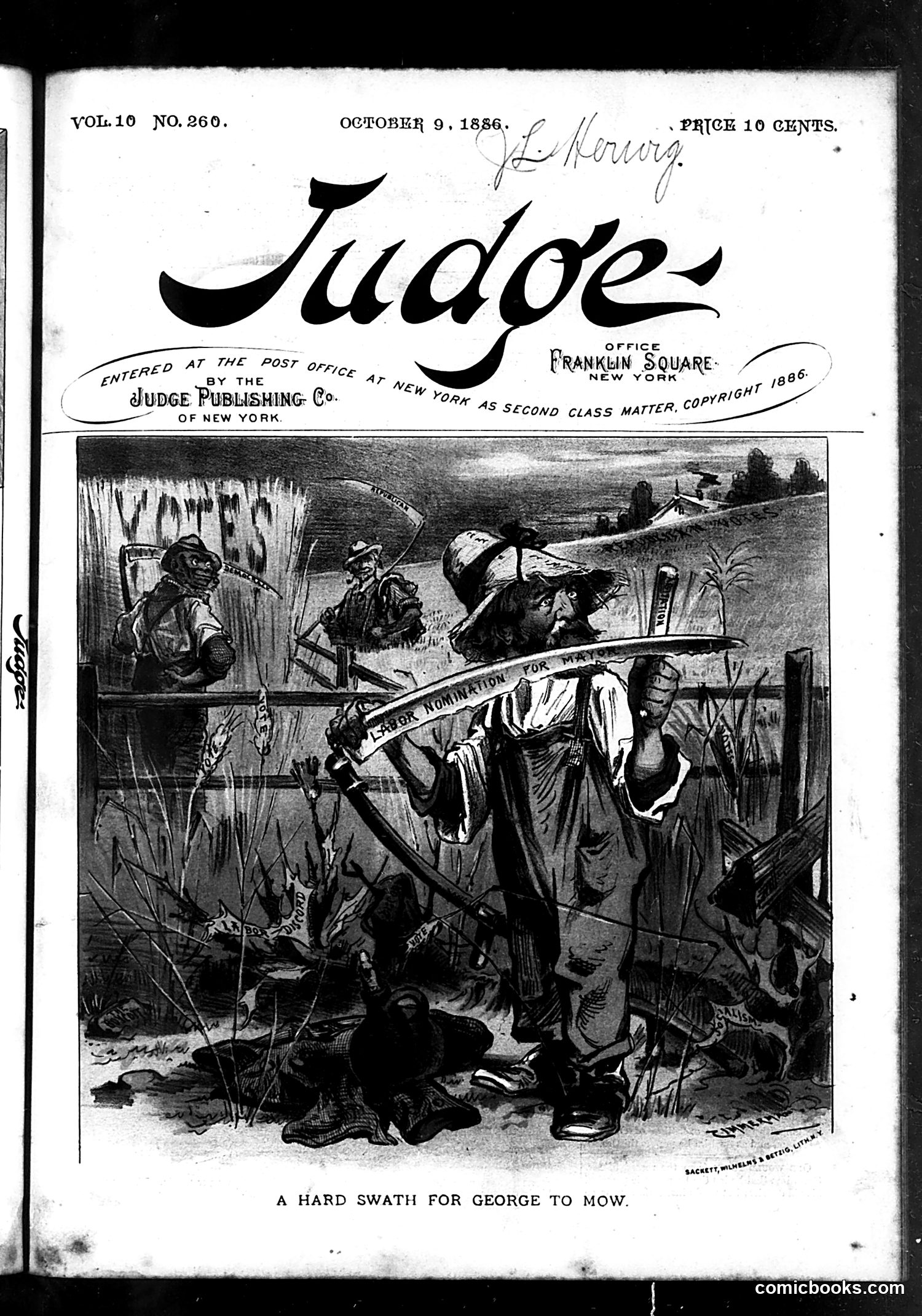
This October 1886 *Judge* cartoon satirizes what appears to be a political challenge for someone nicknamed "George." The illustration shows laborers struggling to clear overgrown vegetation—a metaphorical "hard swath to mow." The banner reads "LABOR NOMINATION FOR MAYOR," indicating this concerns a mayoral election where labor interests are involved. The difficult terrain represents obstacles facing the labor candidate or labor movement's political ambitions. Without clearer identification of the specific "George" referenced, the precise political context remains uncertain—this could concern New York City politics, where *Judge* was published. The cartoon suggests skepticism about labor's electoral viability or the difficulty of the political path ahead.
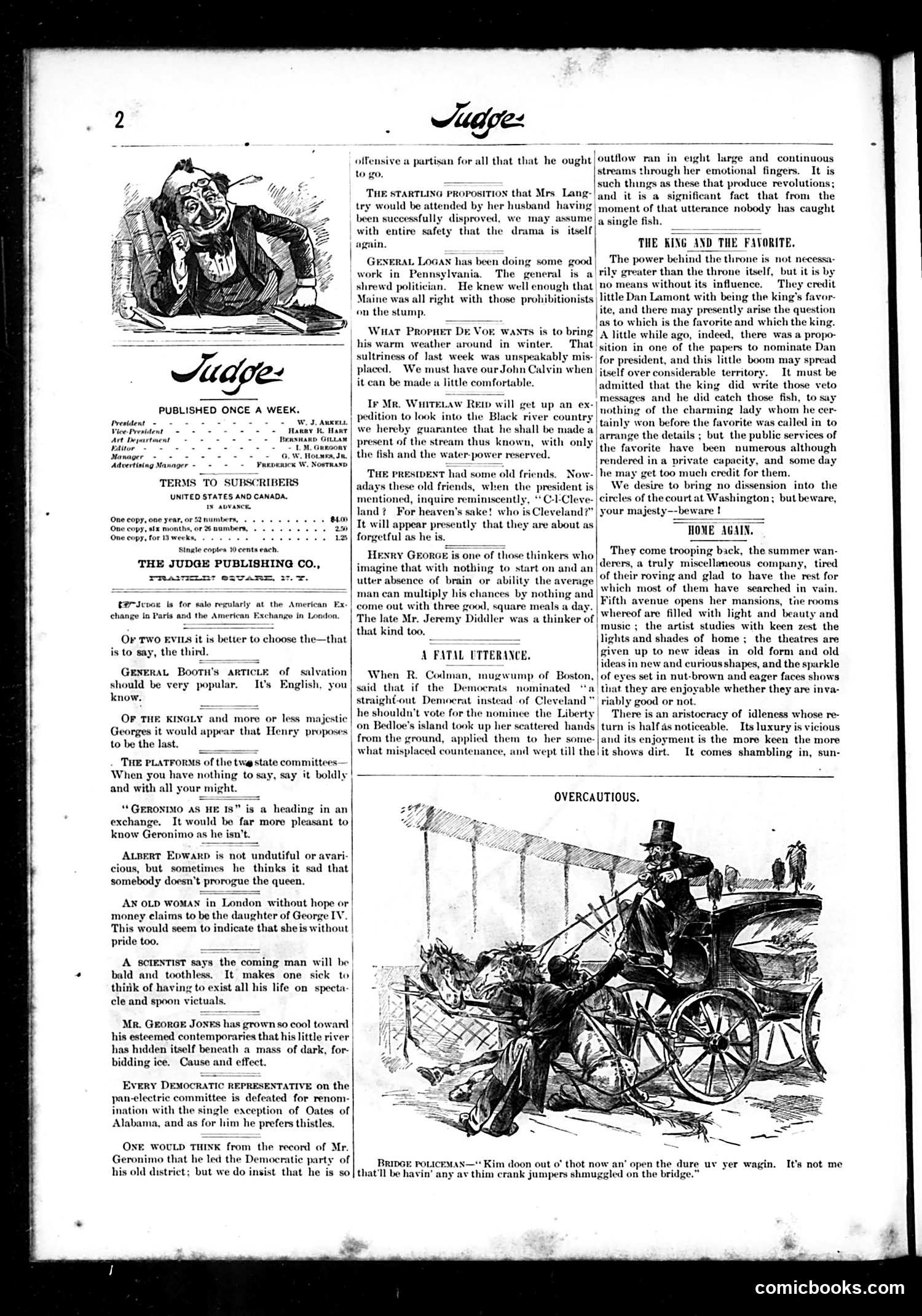
This page contains editorial commentary and two satirical cartoons from an undated issue of Judge magazine. **Top cartoon:** Depicts a figure in period dress, likely commenting on political or social hypocrisy, though the specific subject is unclear from the image alone. **"Overcautious" cartoon (bottom):** Shows a bridge policeman warning a carriage driver against allowing "crank jumpers" on the bridge. This appears to satirize either excessive caution by authorities or public anxiety about a contemporary threat—possibly referencing anarchist concerns or reckless behavior—though the specific historical reference is unclear without additional context. **Editorial content:** The text discusses various political figures and social commentary, including references to General Logan, Democratic nominations, and Cleveland, suggesting this addresses late 19th-century American politics, though exact dating and all specific references remain uncertain.
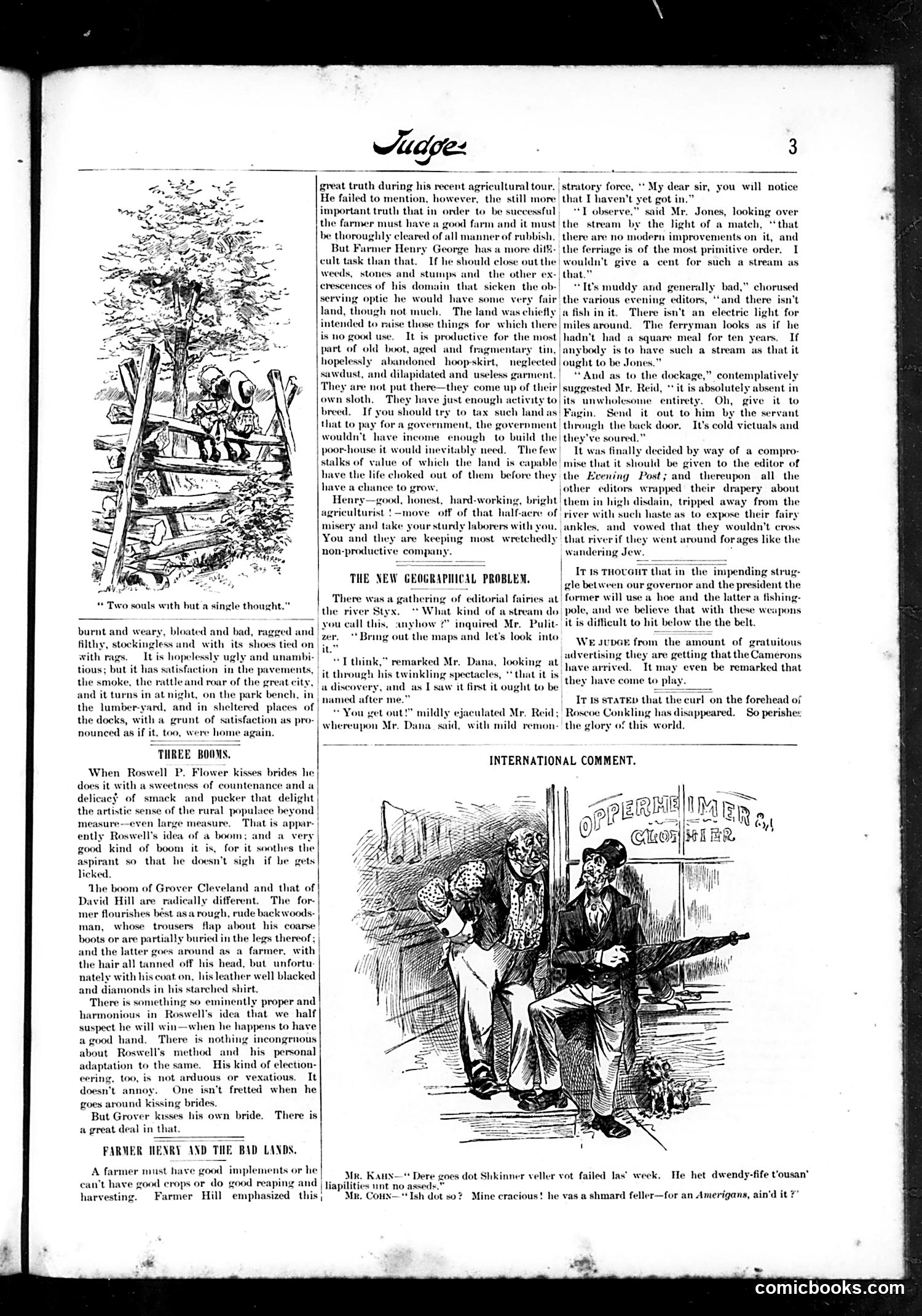
This page contains political satire about 1880s-90s American politicians, primarily targeting **Roswell P. Flower** (New York governor), **Grover Cleveland**, and **David Hill** in the "Three Booms" section. The cartoon mocks their different campaign styles: Flower's strategy of romantically kissing brides to win voters; Cleveland's rough, backwoods persona; and Hill's overly refined farmer appearance with diamonds. The satire suggests these theatrical campaign methods are absurd substitutes for actual policy. The second major section satirizes **Henry George**, the political economist who advocated taxing land to eliminate poverty. The joke: George claims farmers need better implements, but ignores that some land is so worthless (filled with garbage, abandoned clothing, sawdust) that taxing it would be pointless. This mocks George's single-tax theory as naive about land value reality. The lower cartoon appears to be separate commentary on environmental/economic conditions, though context remains unclear from this excerpt.
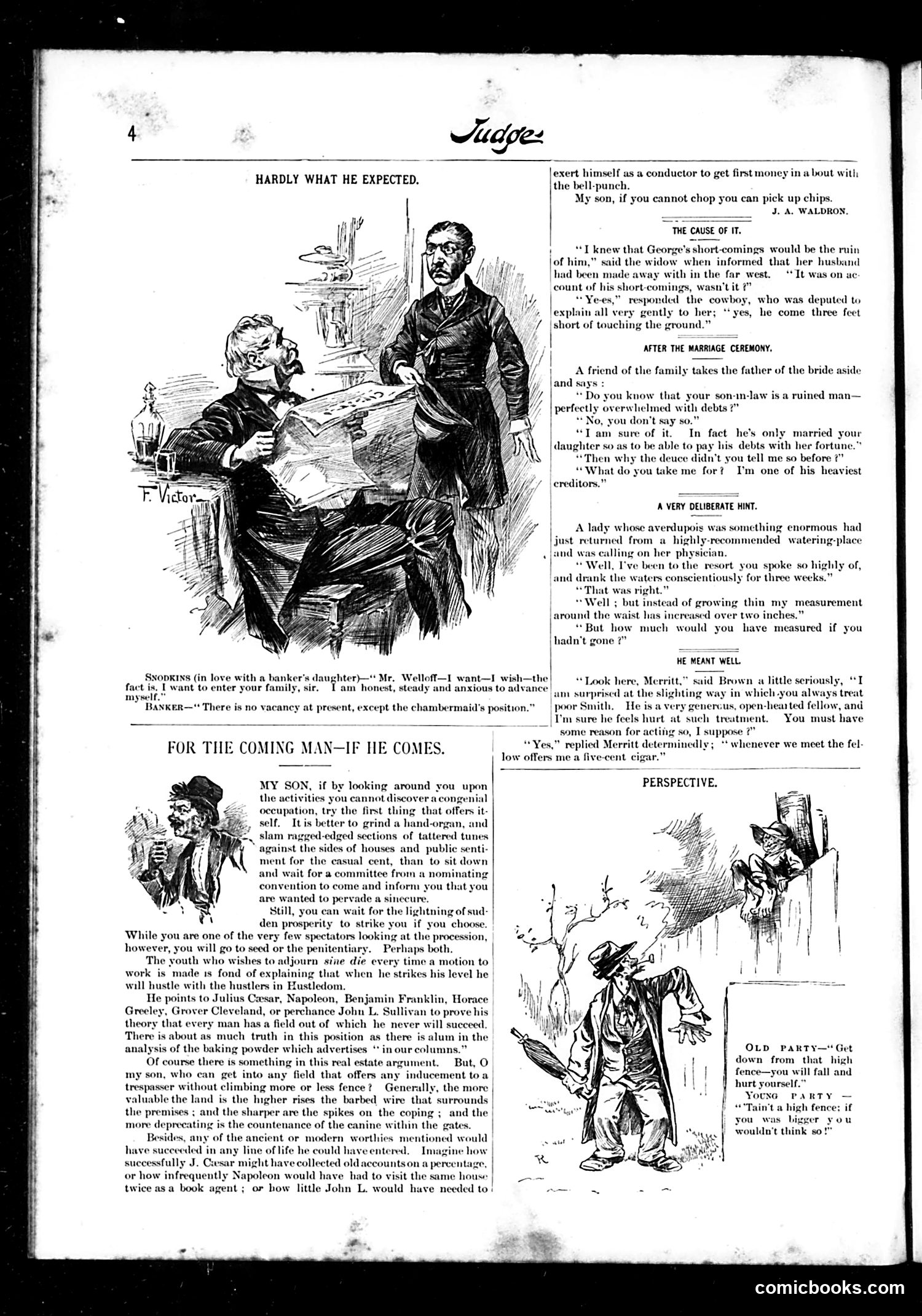
This page contains several humorous anecdotes and cartoons satirizing American social pretensions and economic realities of the Gilded Age. **Key Content:** The main piece, "For the Coming Man—If He Comes," mocks young men who expect easy success without work. It ridicules those who cite self-made figures (Julius Caesar, Napoleon, Benjamin Franklin, Horace Greeley, Grover Cleveland, John L. Sullivan) as proof that talent naturally finds its level, arguing this is false comfort. The satire's point: success requires grinding effort against obstacles, not waiting for opportunity to find you. Other brief anecdotes mock: a widow's dark humor about her hanged husband's "short-comings"; a creditor cynically marrying his debtor to his daughter; a woman's disappointment that spa waters failed to slim her. The cartoons illustrate these themes through exaggerated character types. The overall message targets complacency and delusion about social mobility among the working and middle classes.
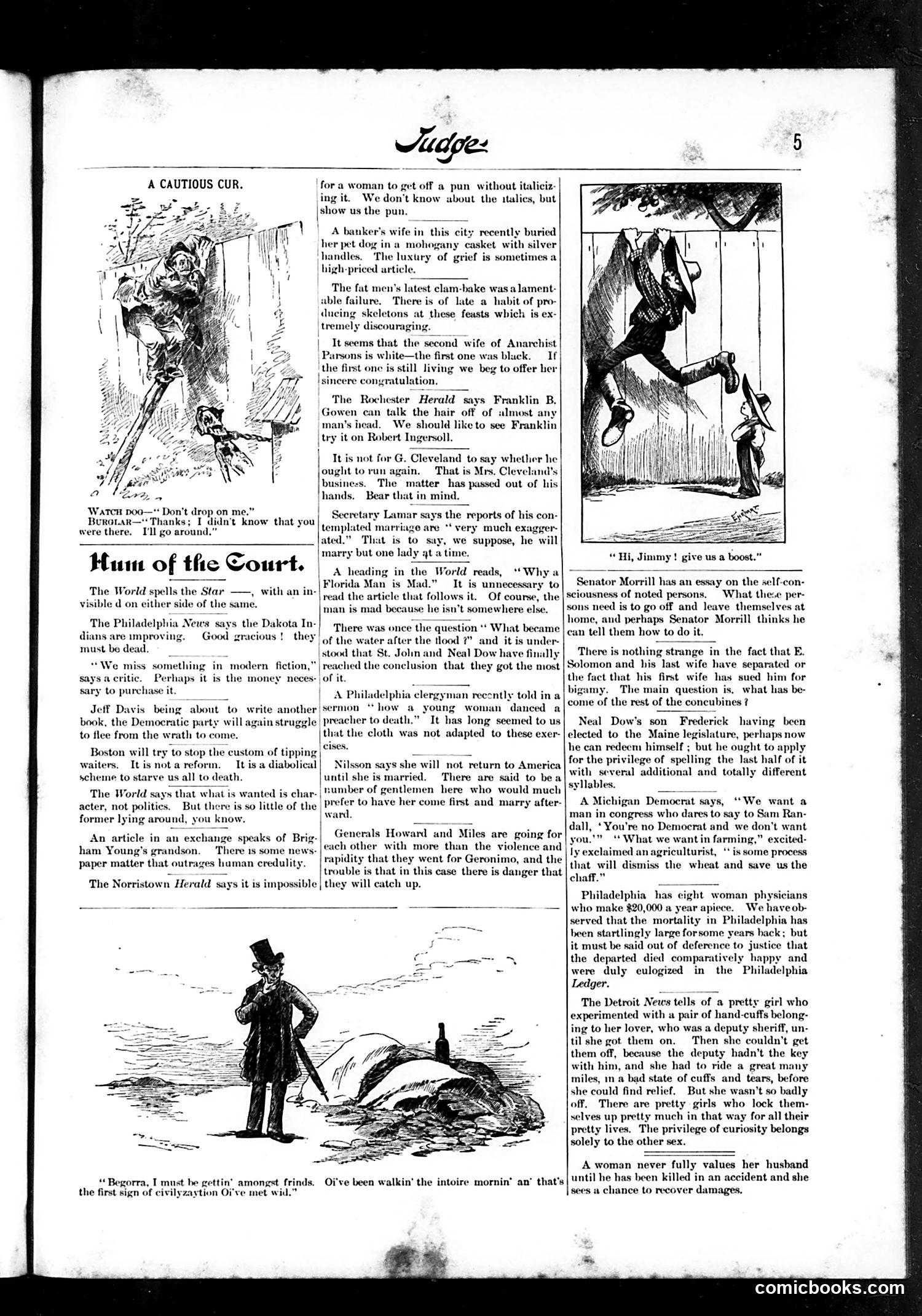
This page from **Judge** (a 19th-century satirical weekly) contains brief commentary items poking fun at contemporary figures and events, plus illustrated jokes. **Key references:** - **Anarchist Parsons**: Likely refers to Albert Parsons, a prominent anarchist executed in 1887; the joke mocks his marriages. - **G. Cleveland/Mrs. Cleveland**: President Grover Cleveland's personal life was fair game for satire. - **Secretary Lamar**: Refers to Secretary of Interior L.Q.C. Lamar, whose rumored marriage is mocked. - **St. John and Neal Dow**: Temperance advocates debating flood damage—satirizing their moral certainty. - **Nilsson**: A celebrated opera singer's marriage intentions are joked about. - **Generals Howard and Miles**: Likely Civil War figures; the reference to "Geronimo" suggests Apache conflicts. The cartoons feature stock comic types: a "cautious" dog and an Irish immigrant ("Begorra"). The humor is lightweight social commentary typical of 1880s Judge—sarcastic, often mean-spirited toward public figures, women, and immigrants.
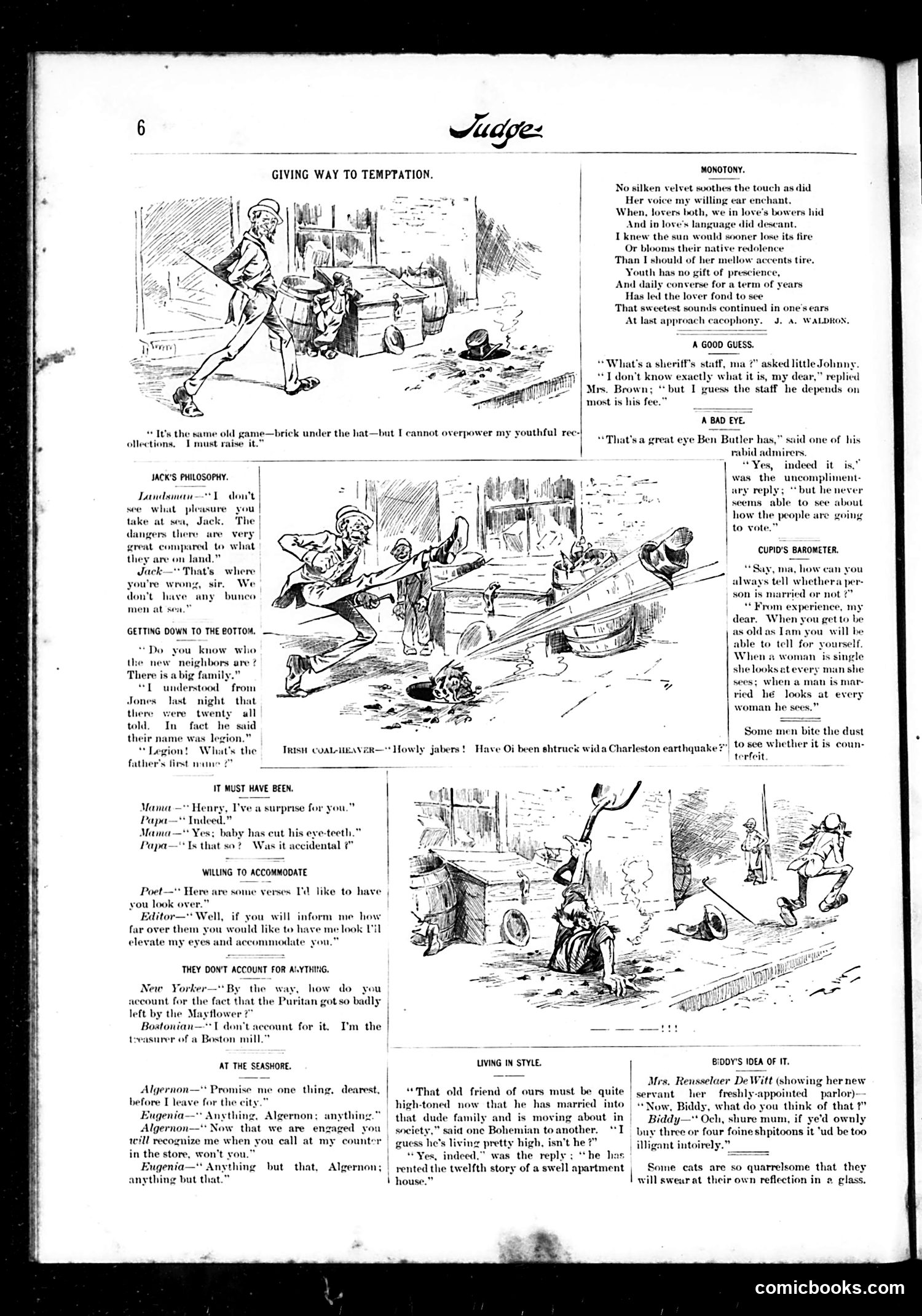
This page contains several brief satirical jokes and cartoons typical of late 19th-century humor magazines. **Key satire includes:** - **"Jack's Philosophy"**: A sailor's rationalization for dangerous sea work—claiming he has no family to lose, thus no "bunce men at sea" (dependents relying on wages). - **"Getting Down to the Bottom"**: A joke about new wealthy neighbors; the punchline suggests their surname is "Legit" or similar, implying they're nouveau riche (newly wealthy, possibly through questionable means). - **Political reference**: "Ben Butler" (likely General Benjamin Butler, a controversial Civil War figure and Reconstruction politician) is mocked for claiming to "see" how people will vote—suggesting dishonest political prediction or manipulation. - **Social satire**: "Living in Style" mocks pretension—a man marrying into money and renting an expensive apartment to appear refined. The servant Biddy's response suggests this display is absurdly excessive. - **"Monotony"**: A poem about romantic love fading into marital tedium. The humor targets class pretension, political corruption, and domestic realities—typical Judge magazine concerns.
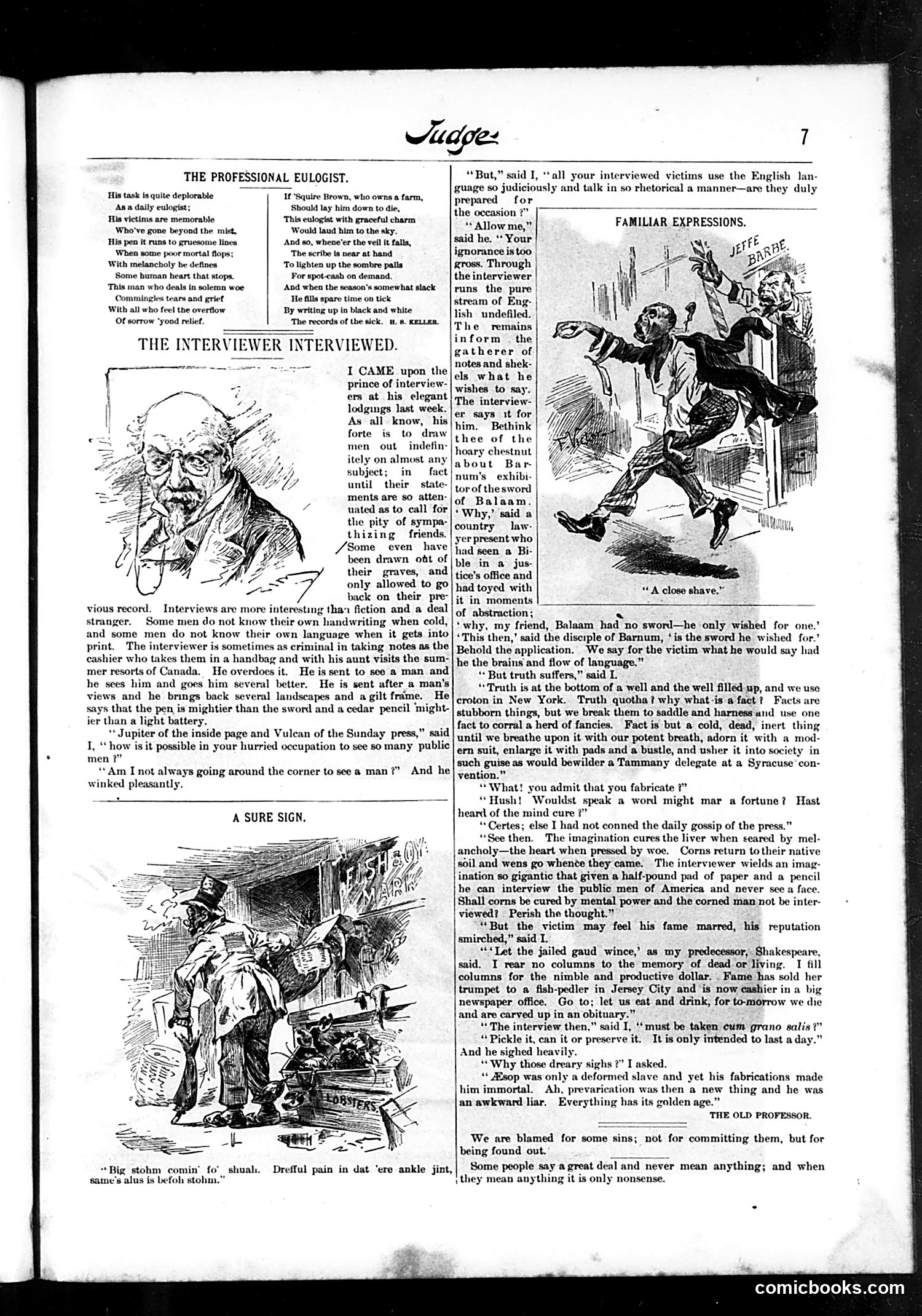
This page satirizes two professions through poetry and dialogue: **"The Professional Eulogist"** mocks paid obituary writers who compose flowery tributes for anyone, regardless of merit, simply for cash. The poem suggests these scribes manufacture sentimental praise even for ordinary farmers, treating death as commercial opportunity. **"The Interviewer Interviewed"** targets journalism's emerging interview format. A reporter boasts that interviewers don't merely record facts—they "say it for" their subjects, reshaping words through editorializing. When challenged about fabrication, he admits to embellishing facts with "pads and bustle" to make them socially presentable, comparing this to breaking wild facts into harness like animals. The cartoons mock both professions as morally compromised: one sells fake grief, the other sells manufactured truth. The satire reflects late-19th-century anxieties about journalistic ethics and the commercialization of language itself.
I can see this is a page from *Judge* magazine featuring an ornate decorative frame border with what appears to be classical or Renaissance-style architectural elements. However, the OCR text provided is blank, and the actual image content within the frame is too dark and low-contrast for me to reliably identify specific figures, caricatures, or make out satirical details with confidence. To properly explain the political or social satire to a modern reader, I would need either: clearer image resolution, the OCR'd text content, or additional context about the publication date. Without these, I cannot accurately identify the figures or explain the cartoon's specific meaning without risking inaccuracy.
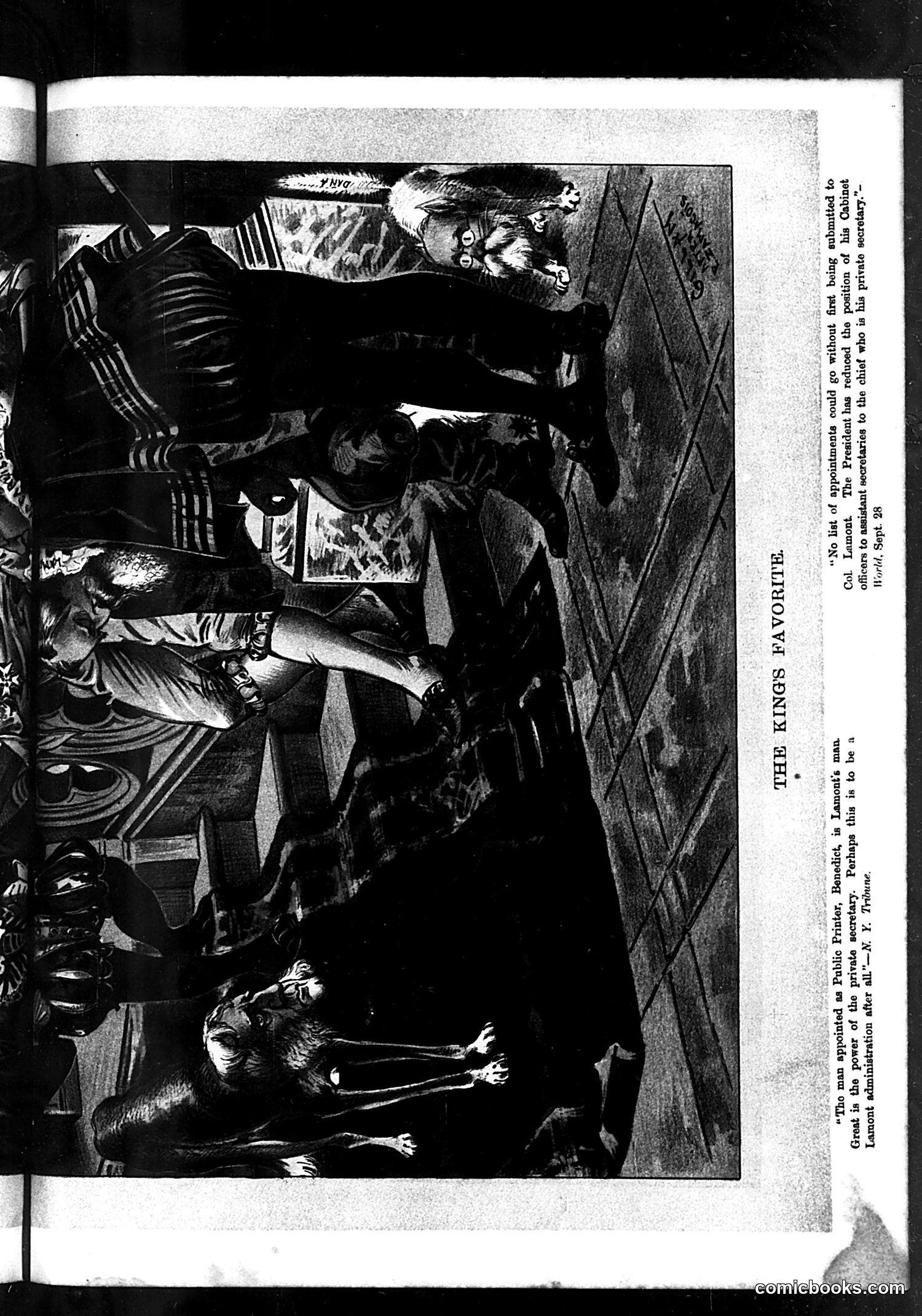
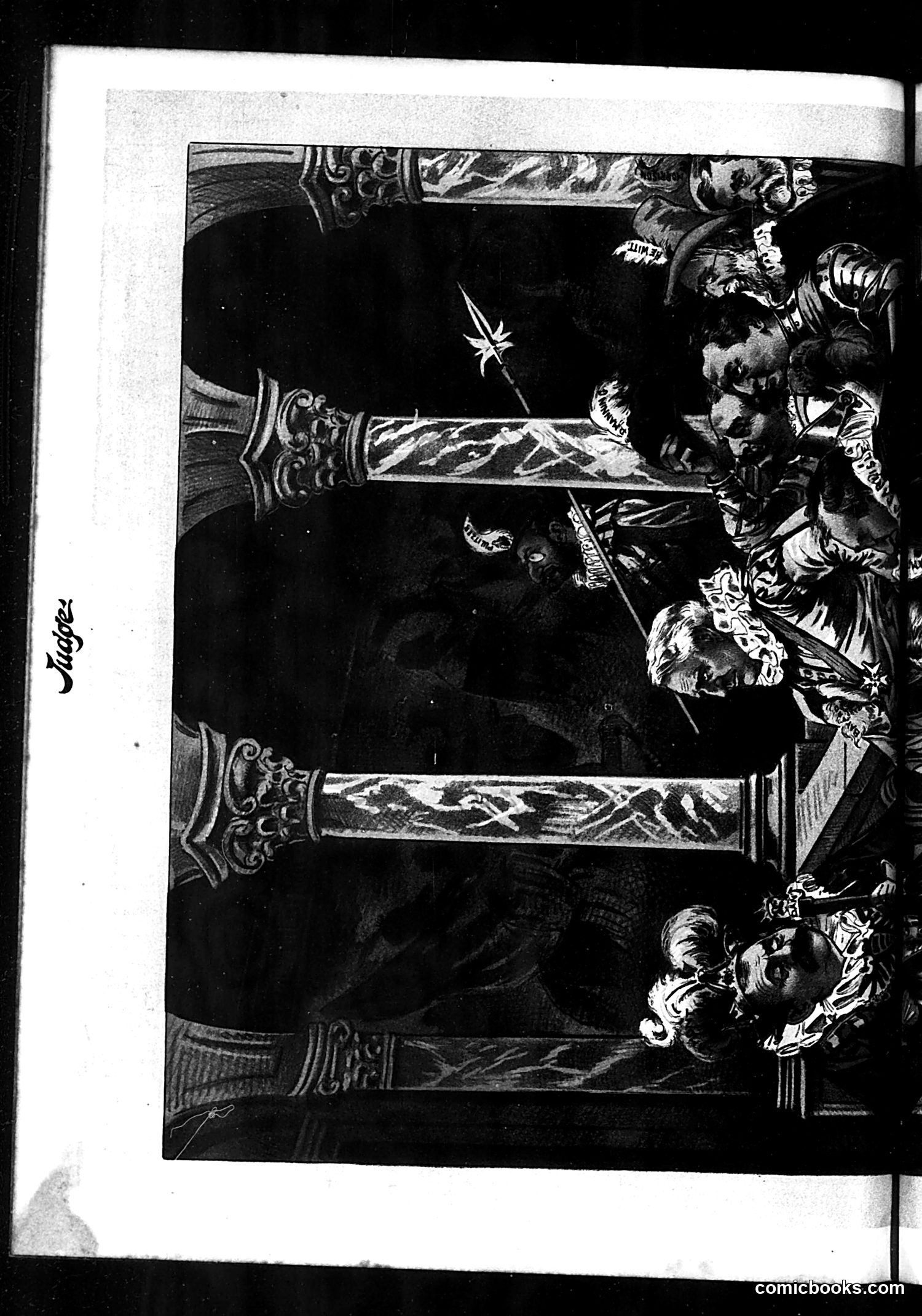
This appears to be a political cartoon from *Judge* magazine satirizing royal favoritism and court corruption. The image shows what appears to be a royal or aristocratic figure in elaborate dress receiving favors or gifts, while subordinate figures—including what looks like animals or caricatured individuals—surround them in supplication or servitude. The OCR text is largely corrupted and unreadable, making it difficult to identify the specific historical figures or events referenced. However, the cartoon's title "The King's Favorite" and the visual language of excessive privilege and sycophancy suggest commentary on nepotism, abuse of power, or the corrupting influence of court patronage—common themes in *Judge*'s satirical coverage of American politics and society during the Gilded Age or Progressive Era. Without clearer text, I cannot identify which specific king, favorite, or scandal is being depicted.
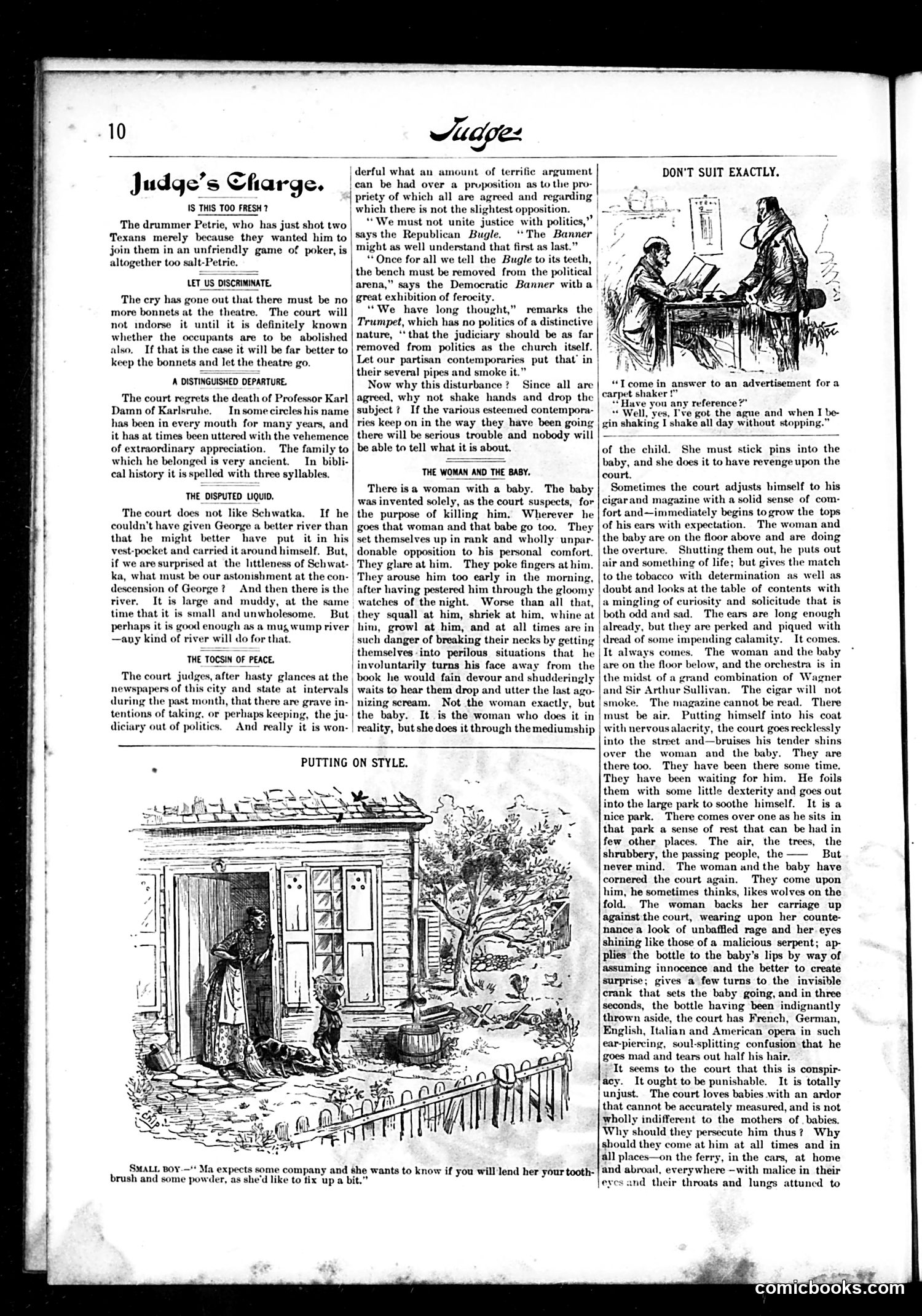
This page from the satirical magazine *Judge* contains several political and social commentaries typical of late 19th-century American humor. **"Judge's Charge"** mocks partisan newspaper hypocrisy. Republican and Democratic papers both denounce mixing politics with judiciary, yet both do exactly that. The *Trumpet* newspaper observes the irony: all agree the bench should be independent "as the church itself," yet continue their partisan attacks. The satire points out that newspapers engaged in performative outrage about issues they unanimously support. **"Don't Suit Exactly"** depicts a job interview where an applicant claims he "shakes all day" due to illness—a joke about unreliable workers. **Other sections** include brief satirical notes on theater bonnets, a pun on Professor Damn of Karlsruhe, and commentary on a woman with a baby who disturbs public spaces. The "Putting on Style" illustration shows domestic life, likely satirizing pretension or social climbing. The page exemplifies *Judge's* formula: political satire mixed with social commentary and domestic humor.
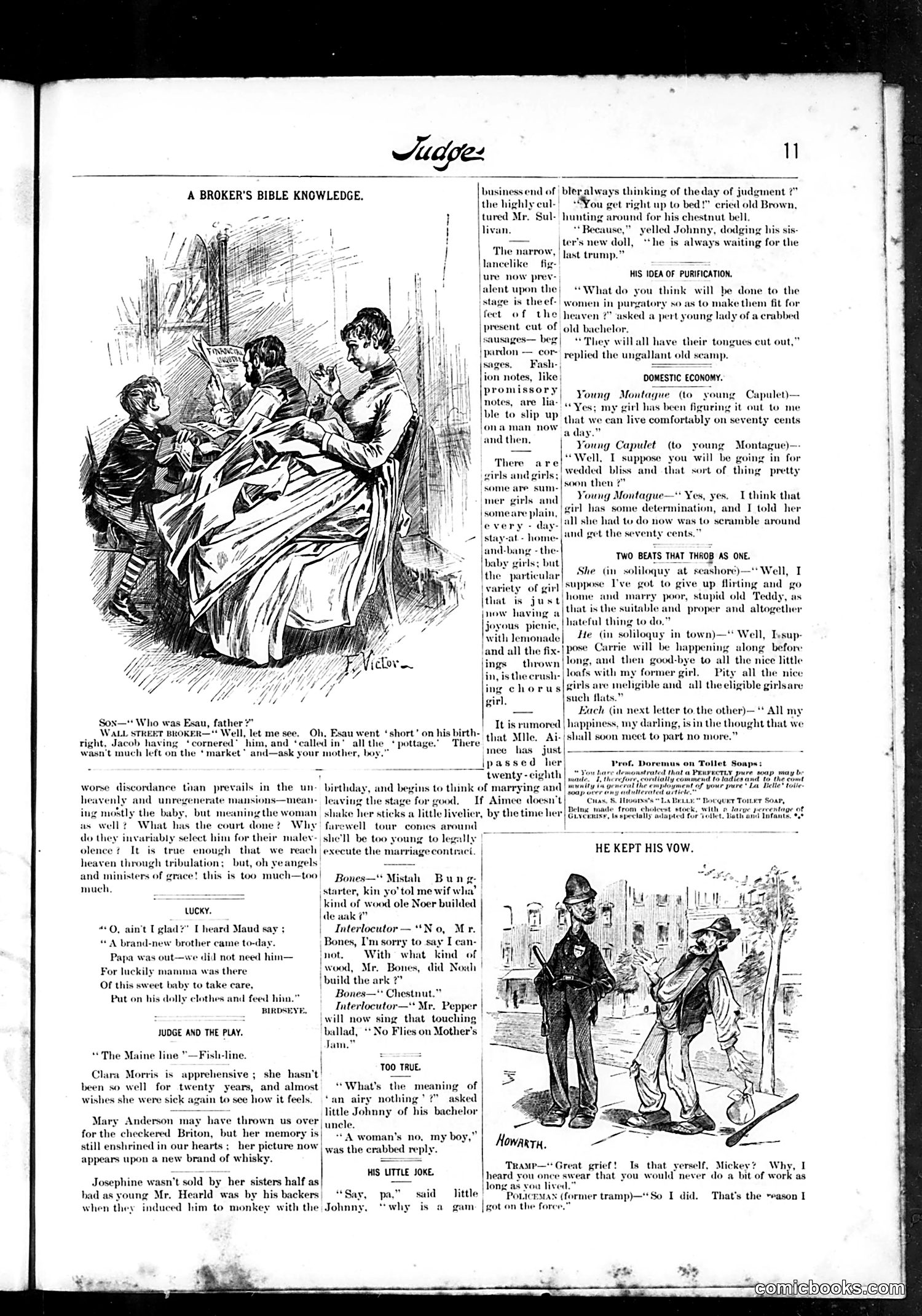
This page from *Judge* contains several satirical sketches mocking various social types and situations of the era. **"A Broker's Bible Knowledge"** depicts a street broker unable to answer a child's simple biblical question about Esau's father, despite pretending expertise. The satire ridicules financial speculators who lack genuine education while posturing as knowledgeable. **"Judge and the Play"** references actress Clara Morris and Mary Anderson (a famous stage performer whose image now advertises whisky), mocking celebrity endorsement and the theatrical world's volatility. **Domestic Economy sketches** humorously portray young couples planning marriages on minimal budgets, and contrasting male-female perspectives on romance—the woman resigned to "stupid old Teddy," the man reflecting similarly about "Carrie." The satire targets both naive young love and gender role expectations. **"Too True"** features a bachelor's misogynistic reply that women are "nothing"—punching at contemporary attitudes toward women. The sections also include minstrel-show dialogue (typical of period humor, now offensive) and commentary on theatrical actresses of the day. The overall tone mocks financial pretension, class anxiety, and romantic conventions.
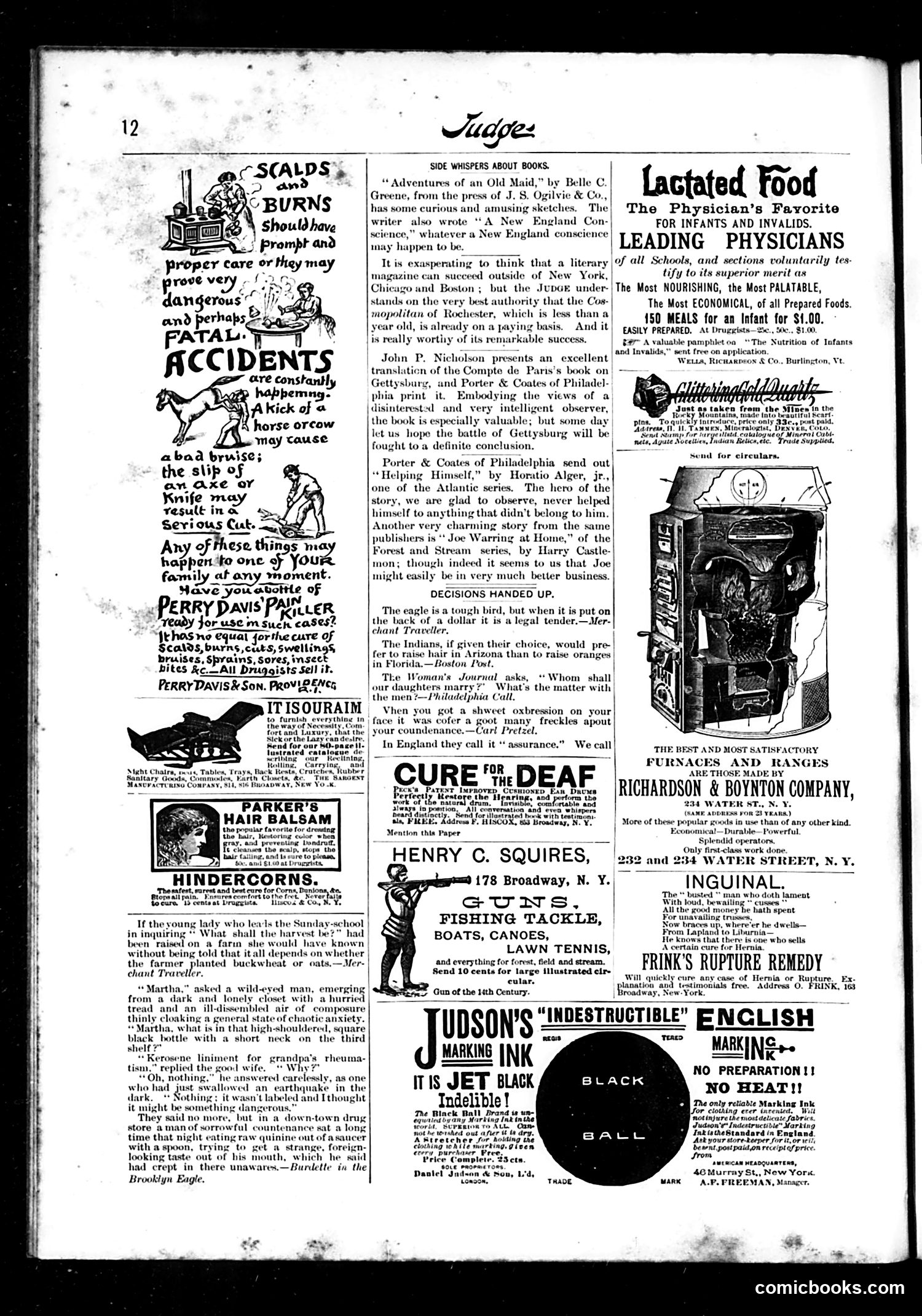
This page is primarily **advertisements and filler content** rather than political satire. The main elements include: **Book Reviews ("Side Whispers"):** Brief notices of popular novels, including Belle C. Greene's "Adventures of an Old Maid" and works by Horatio Alger Jr. The reviewer humorously notes that magazines outside New York (like Rochester's) can succeed—a gentle jab at East Coast literary establishment assumptions. **"Decisions Handed Up":** Humorous one-liners playing on current topics (an eagle on dollar bills as legal tender; debates about Native Americans in Arizona). **Dominant Content:** The page is overwhelmingly filled with period advertisements—patent medicines (Perry Davis's Painkiller, hair balsam, corn removers), food products (Lactated Food for infants), firearms, and household goods. The satire is minimal and mild. This appears to be a typical Judge issue from roughly the 1880s-1890s, where advertising revenue sustained the magazine alongside actual satirical content.
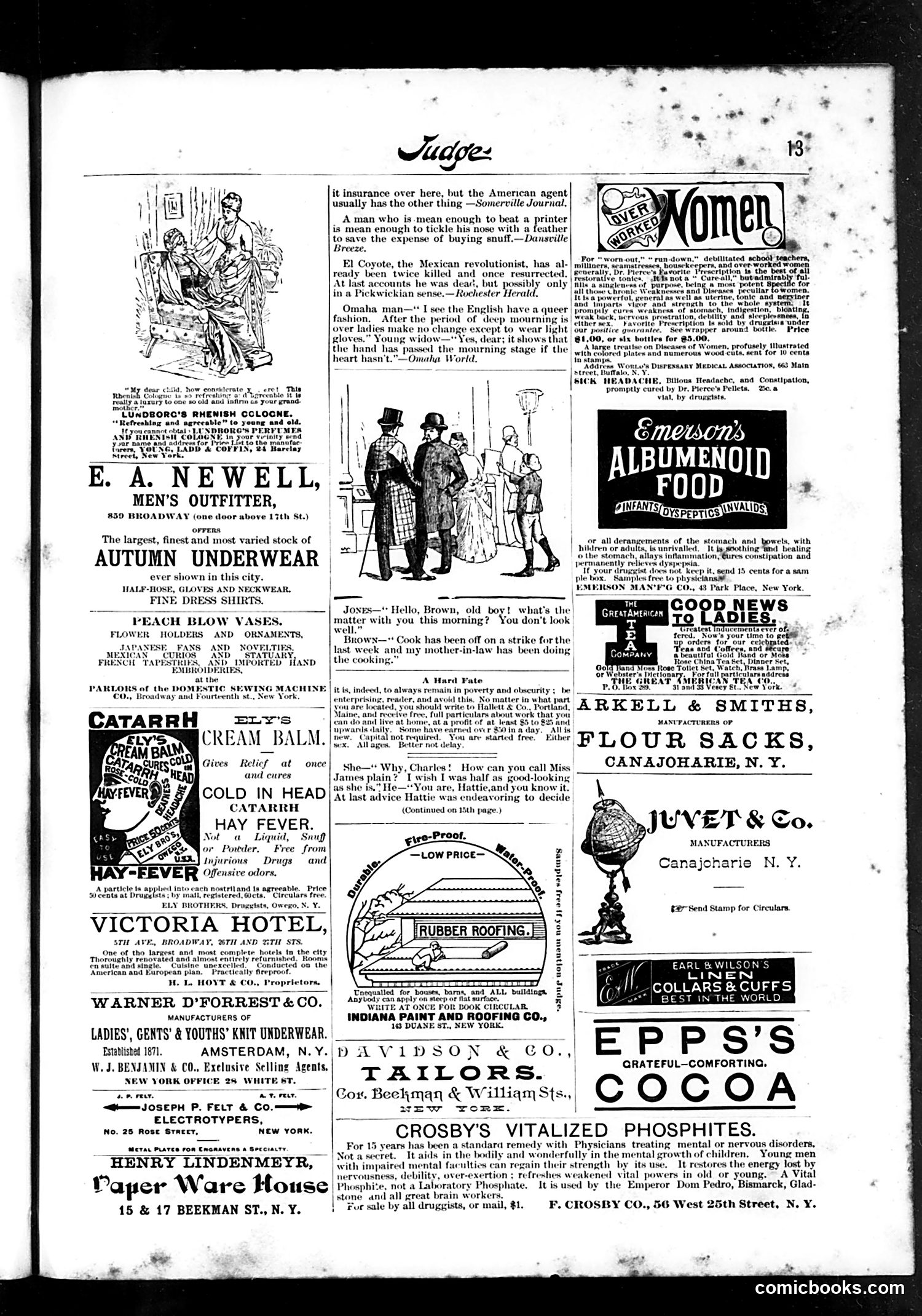
This page consists primarily of **advertisements and short humor snippets** rather than substantial political cartoons. The visible satirical content includes brief, disconnected jokes: - A quip about an English widow's mourning customs, suggesting she's moved past grief quickly - A domestic humor piece where "Brown" complains his cook struck and his mother-in-law's cooking is poor - Banter between "Charles" and "Hattie" about appearance and courtship These represent typical **Victorian-era domestic satire**—gentle jabs at marriage, class anxieties, and gender relations common to the period. The bulk of the page features **patent medicine advertisements** (Ely's Cream Balm, Crosby's Phosphites, Emerson's Albumenoid Food)—reflecting late 19th-century marketing of dubious remedies claiming to cure everything from hay fever to mental weakness. There are also ads for men's clothing, hotels, and printing services, indicating this is primarily a **commercial advertisement page** rather than editorial content. The satirical content serves mainly as filler between ads.
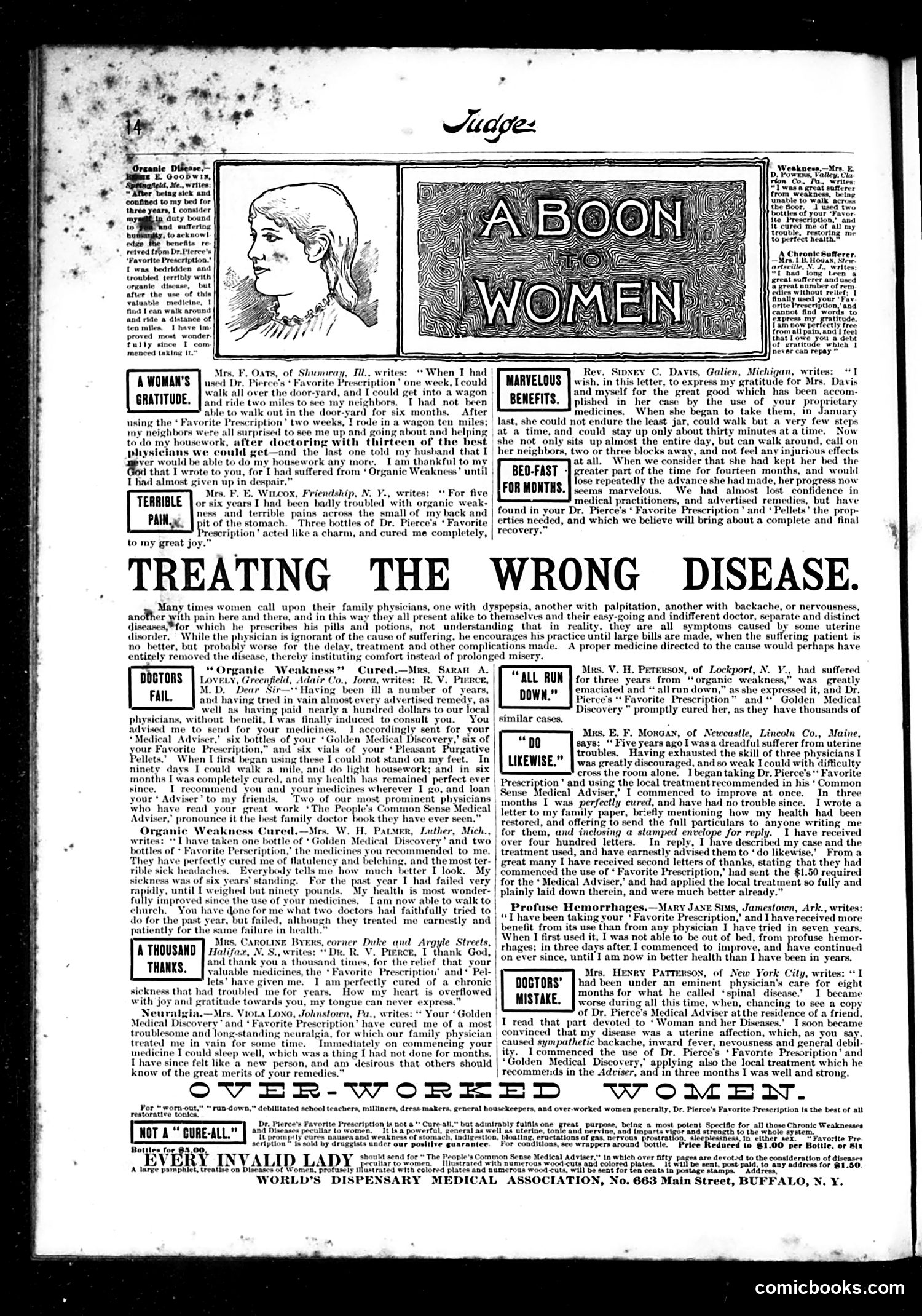
This page is primarily **medical advertising**, not political satire. It promotes Dr. Pierce's "Favorite Prescription"—a patent medicine marketed to women for "organic weakness" and related ailments. The central article, "TREATING THE WRONG DISEASE," argues that family physicians misdiagnose women's complaints (backache, nervousness, palpitations) as separate conditions rather than recognizing them as symptoms of uterine disease. Dr. Pierce's medicines, the text claims, address the *actual* cause. The page is filled with testimonials from satisfied (allegedly) female patients praising the prescription's effectiveness. The heading "A BOON TO WOMEN" frames the product as beneficial to its target audience. **Historical context**: This represents turn-of-the-century medical advertising that exploited women's genuine health concerns while promoting unproven remedies. Such patent medicines were largely unregulated until the 1906 Pure Food and Drug Act. This is **not satire**—it's sincere commercial promotion, though modern readers would recognize it as quackery.
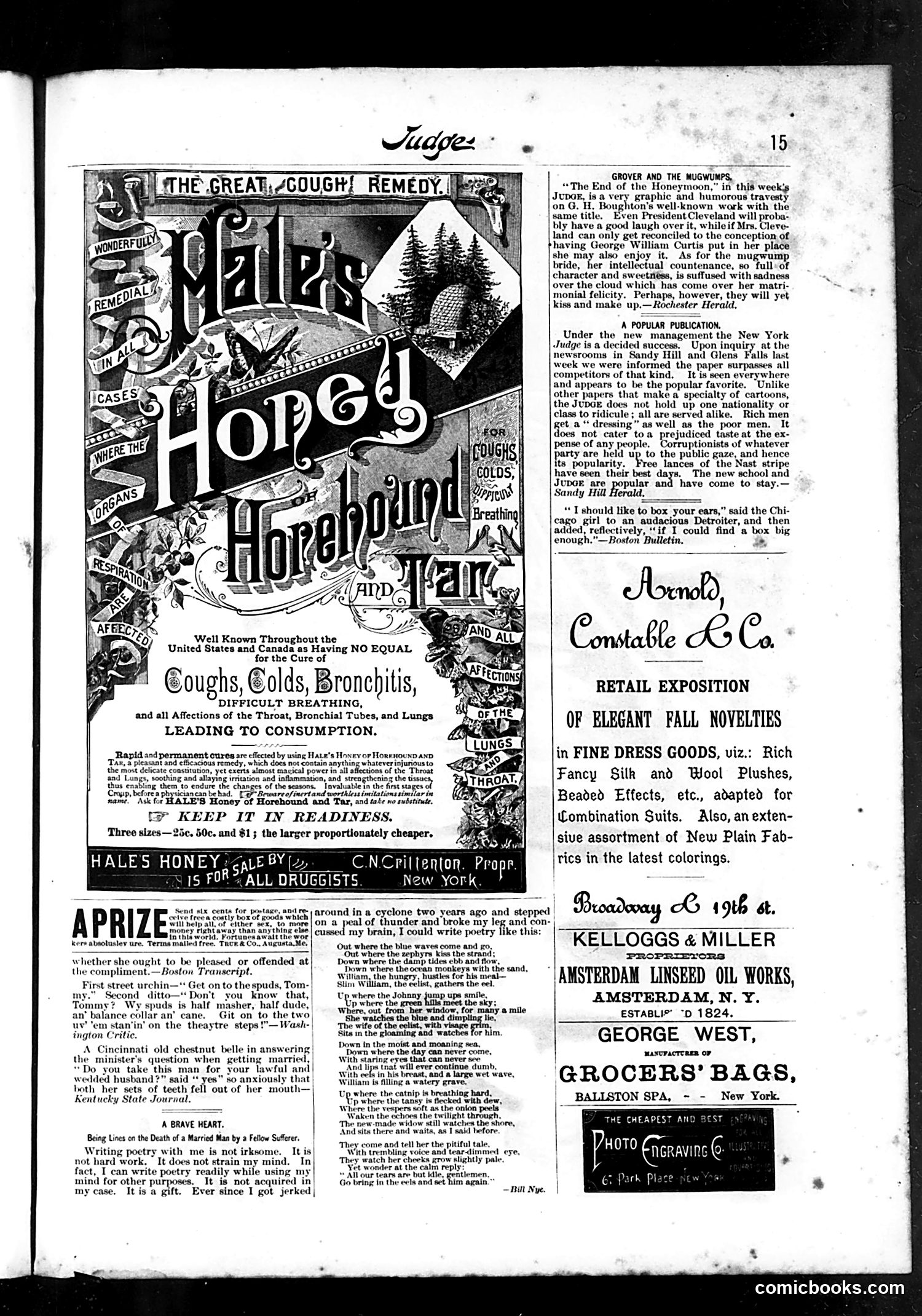
This page is primarily **advertising and filler content**, not political satire. The dominant element is a large advertisement for "Hale's Honey of Horehound and Tar," a patent medicine claiming to cure coughs, colds, bronchitis, and consumption (tuberculosis). Such dubious remedies were common in the era. The page includes several short humorous anecdotes about social situations—a minister's wedding question, theater urchins, a widow's teeth falling out—typical light comedy for the magazine. There is one political reference: a brief mention of "Grover and the Mugwumps," discussing a satirical piece about President Cleveland and the "mugwumps" (reform Republicans). The text suggests a comedic takeup of Cleveland's honeymoon period in office, though the full article isn't visible here. The remainder consists of small advertisements for dress goods, oil works, and photo engraving services—typical late-19th century magazine filler.
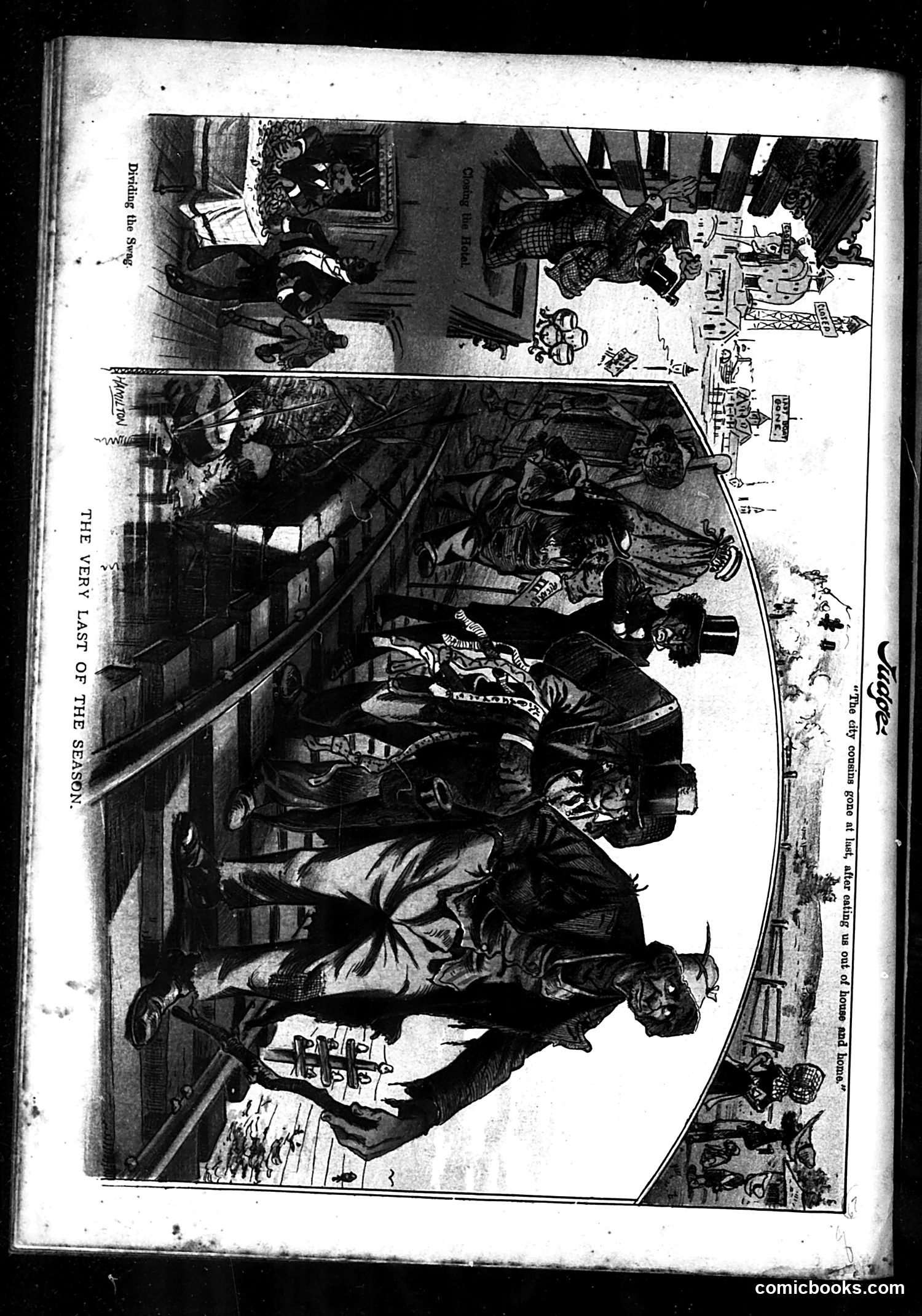
I can see this is a page from *Judge* magazine, but the image quality and orientation make it difficult to read with certainty. The page appears to contain multiple cartoon panels arranged vertically (the image is rotated 90 degrees). The OCR text is corrupted and unreadable, which prevents me from identifying the specific political or social references. From the visual elements alone, I can see this depicts what appears to be a scene with multiple figures in period dress in what looks like an interior setting, but I cannot reliably identify the specific individuals, caricatures, or satirical point without legible text or clearer imagery. To provide accurate historical context, I would need either a clearer image or functional OCR text identifying the cartoon's subject matter and date.

I cannot reliably interpret this page's content. The image appears to be almost entirely black or severely degraded, with only a white margin visible on the left side and the "comicbooks.com" watermark visible at the bottom. While there are faint traces suggesting there may be illustrations or text present, the image quality is too poor for me to identify any figures, read any OCR text, or determine what satirical point is being made. To provide accurate historical analysis, I would need a clearer scan or reproduction of this Judge magazine page.