
Judge, 1886-10-09 · page 7 of 17
Judge — October 9, 1886 — page 7: what you’re looking at
What you’re looking at
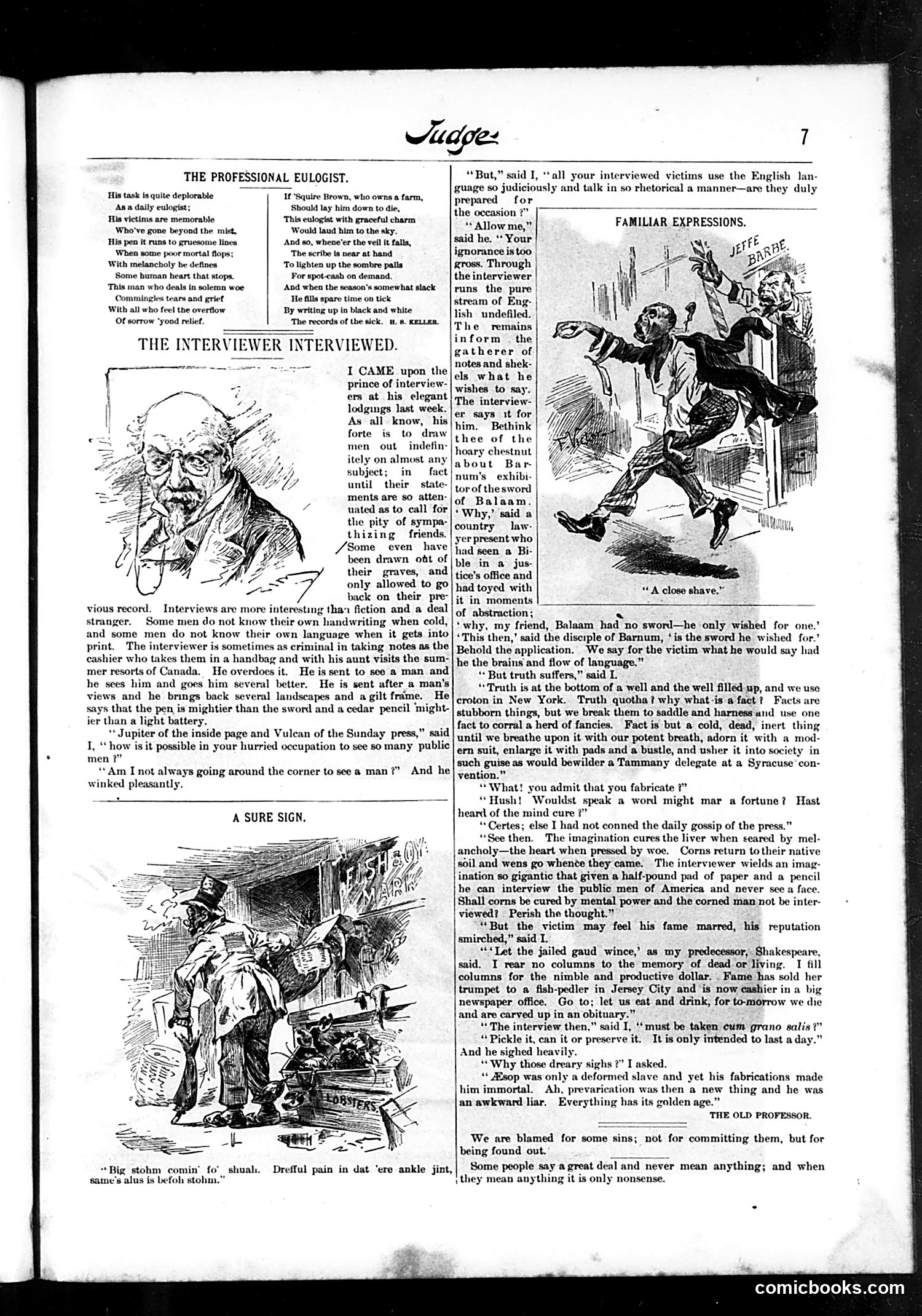
This page satirizes two professions through poetry and dialogue: **"The Professional Eulogist"** mocks paid obituary writers who compose flowery tributes for anyone, regardless of merit, simply for cash. The poem suggests these scribes manufacture sentimental praise even for ordinary farmers, treating death as commercial opportunity. **"The Interviewer Interviewed"** targets journalism's emerging interview format. A reporter boasts that interviewers don't merely record facts—they "say it for" their subjects, reshaping words through editorializing. When challenged about fabrication, he admits to embellishing facts with "pads and bustle" to make them socially presentable, comparing this to breaking wild facts into harness like animals. The cartoons mock both professions as morally compromised: one sells fake grief, the other sells manufactured truth. The satire reflects late-19th-century anxieties about journalistic ethics and the commercialization of language itself.
📄 Transcribed text from this page (OCR, searchable)
Machine-transcribed from the original scan — historical spelling and the odd misread are preserved.
7 THE PROFESSIONAL EULOGIST. His task is quite deplorable Asa daily eulogist; Hiis victims are memorable Who've gone beyond the mist, His pen it runs to gruesome lines ‘When some poor mortal flops; With melancholy he defines Some human heart that stops. This inan who deals in solemn woe Commingles tears and grief With all who feel the overflow If “Squire Brown, who owns a farm, Should lay him down to die, This eulogist with graceful charm ‘Would laud him to the sky. And so, whene’er the veil it falls, The scribe is near at hand To lighten up the sombre pals For spot-cash on demand, And when the season's somewhat slack He fills spare time on tick By writing up in black and white Of sorrow ‘yond relief. ‘The records of the sick. M. 8, KELLER. THE INTERVIEWER INTERVIEWED. a I CAME upon the prince of interview- ers at his elegant lodgings last week. As all know, his forte is to draw men out indefin- itely on almost any subject; in fact until their — state- ments are so atten: uated as to call for the pity of sympa- thizing friends. /Some even have been drawn ott of their graves, and only allowed to go back on their pre- vious record. Interviews are more interesting than fiction and a deal stranger. Some men do not know their own handwriting when cold, and some men do not know their own language when it gets into print. The interviewer is sometimes as criminal in taking notes as the cashier who takes them in a handbag and with his aunt visits the sum- mer resorts of Canada. He overdoes it. He is sent to see a man and he sees him and goes him several better. He is sent ufter a man’s views and he brings back several landscapes and a gilt frame. He says that the pen is mightier than the sword and a cedar pencil ‘might- ier than a light battery. ‘* Jupiter of the inside page and Vulcan of the Sunday press,” said I, ‘how is it possible in your hurried occupation to see so many public men 7” ‘‘Am I not always going around the corner to see a man ¢” winked pleasantly. And he A SURE SIGN. “Big stohm comin’ fo’ shuah. Drefful pain in dat ‘ere ankle jint, same’s alus is befoh stohm.” guage so judiciously and talk in so rhetori prepared for the occasion ¢” * Allow me,” said he. ‘* Your ignorance is too | gross. Through | the interviewer runs the pure | stream of Eng- lish undefiled. The remains inform | the gatherer of notes and shek- els what he wishes to say. The interview- er says it for him. - Bethink | thee of the} hoary chestnut about Bar num’s_ exhibi- | | tor of thesword of Balaam. ‘Why,’ said a country law- yer present who had seen a Bi- ble in a. jus- tice’s office and had toyed with it in moments of abstraction; a ‘why, my friend, Balaam had no sworl—he only wished for one.’ ‘This then,’ said the disciple of Barnum, ‘is the sword he wished for.’ Behold the application. We say for the victim what he would say had he the brains and flow of language.” “ But truth suffers,” said L “Truth is at the bottom of a well and the well filled up, and we uso croton in New York. Truth quotha? why what-is a fact? Facts are stubborn things, but we break them to saddle and harness und use one fact to corral a herd of fancies. Fact is but a cold, dead, inert thing until we breathe upon it with our potent breath, adorn it with a mod- ern suit, enlarge it with pads and a bustle, and usher it into society in such guise as would bewilder a Tammany delegate at a Syracuse con- vention.” “What! you admit that you fabricate ?” “Hush! Wouldst speak a word might mar a fortune? Hast heard of the mind cure ¢” “Certes; else I had not conned the daily gossip of the press.” “See then. The imagination cures the liver when seared by mel- ancholy—the heart when pressed by woe. Corns return to their native soil and wens go whente they came. The interviewer wields an imag- ination so gigantic that given a half-pound pad of paper and a pencil he can interview the public men of America and never see a face. Shall corns be cured by mental power and the corned man not be inter- viewed? Perish the thought.” “But the victim may feel his fame marred, his reputation smirched,” said I. “Let the jailed gaud wince,’ as my. predecessor, Shakespeare, said. I rear no columns to the memory of dead or living. I fill columns for the nimble and productive dollar. . Fame has sold her trumpet to a fish-pedler in Jersey City and is now cashier in a big newspaper office. Go to; let us eat and drink, for to-morrow we die and are carved up in an obituary.” “The interview then,” said I, ‘must be taken cum grano salis ?” “Pickle it, can it or preserve it. It is only intended to last a day.” And he sighed heavily. “Why those dreary sighs ?” I asked. ‘\ sop was only a deformed slave and yet his fabrications made him immortal. Ah, prevarication was then a new thing and he was an awkward liar, Everything has its golden age.” THE OLD PROFESSOR. a manner—are they duly FAMILIAR EXPRESSIONS. “A close shave.” We are blamed for some sins; not for committing them, but for being found out. pa ae Some people say a great deal and never mean anything; and when ; they mean anything it is only nonsense. comicbooks.com