
A complete issue · 16 pages · 1886
Judge — September 11, 1886
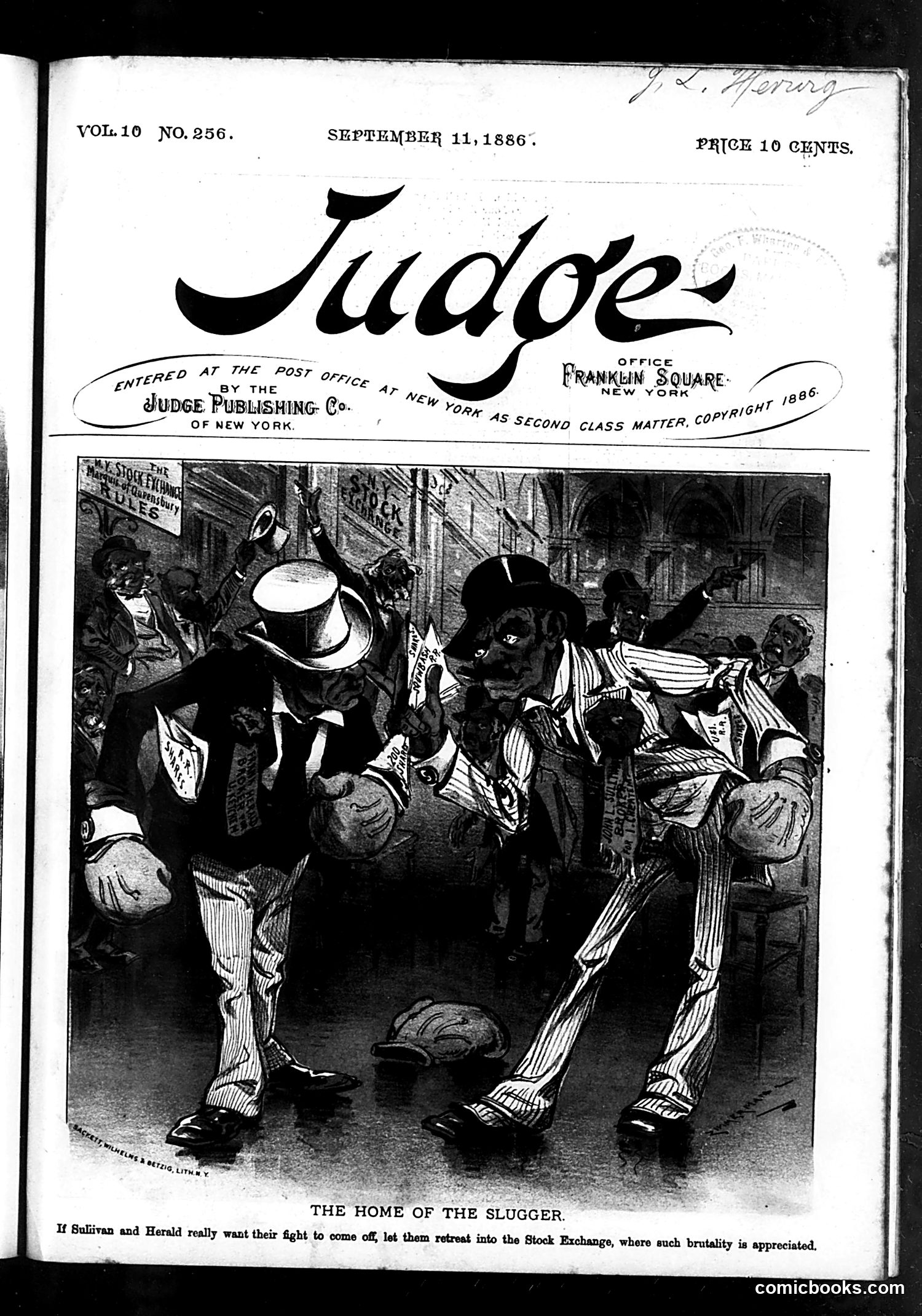
This cartoon satirizes baseball violence, specifically targeting players Sullivan and Herald. The illustration depicts caricatured figures with exaggerated Black features engaged in brutal fighting with bats and fists in a street setting—likely referencing actual violent incidents involving these players. The caption's sarcastic suggestion that such brutality belongs in the "Stock Exchange" rather than baseball mocks both the players' savagery and the ruthlessness of 1880s financial markets. The racist imagery reflects the magazine's editorial perspective and era's prejudices. The cartoon criticizes unprofessional conduct in baseball while using inflammatory racial caricature—a common but deeply offensive satirical convention of late 19th-century American humor.
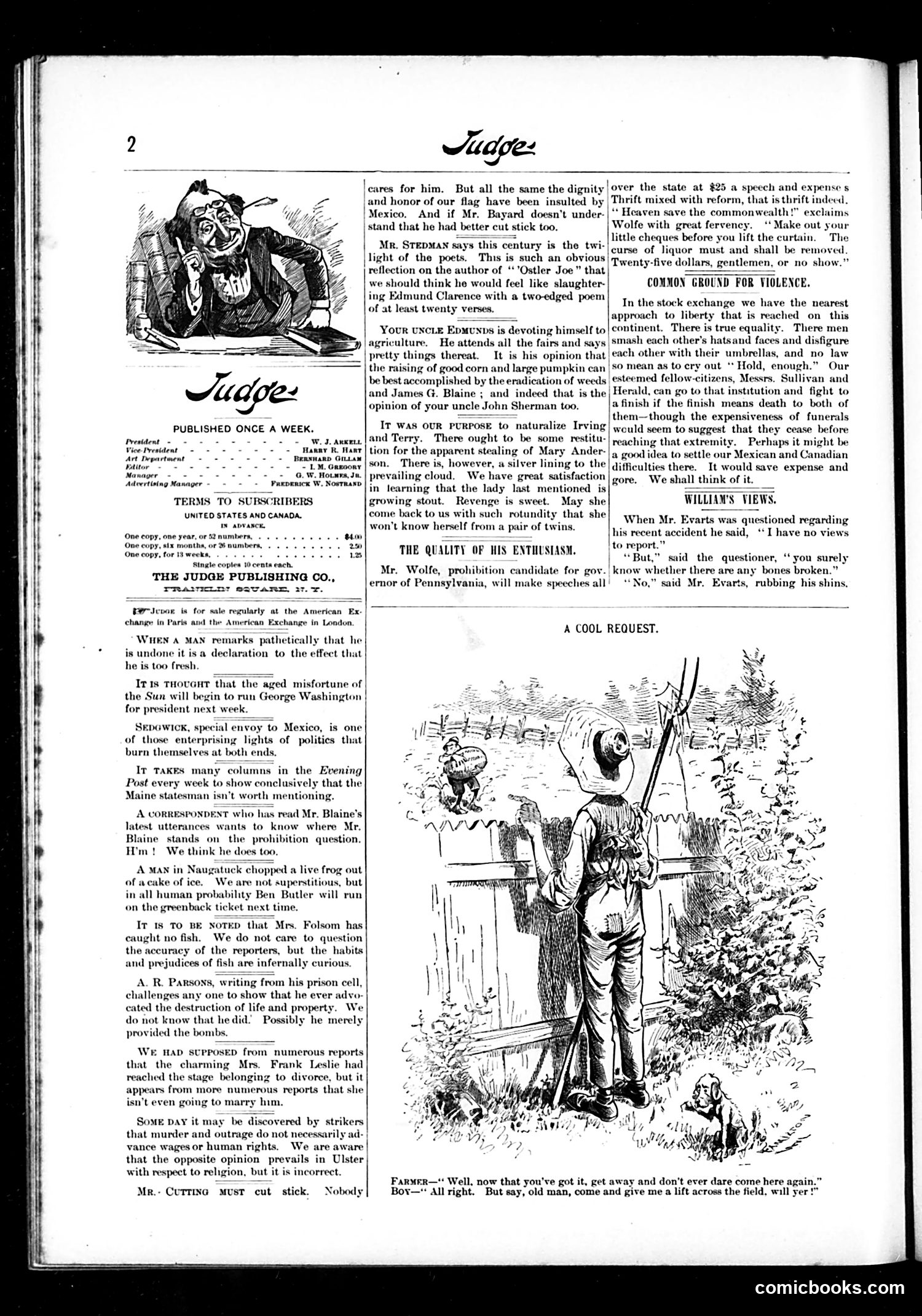
This page contains editorial commentary and two cartoons. The main text discusses various political and social issues of the era, including prohibition (referenced multiple times), Mexico relations, and political figures like Mr. Wolfe (prohibition candidate for Pennsylvania governor). **"A Cool Request"** cartoon depicts a farmer confronting a boy, demanding he leave and never return. The farmer appears angry while the boy protests. The specific incident referenced is unclear without additional context. The page's editorial tone criticizes excessive enthusiasm for certain causes and questions the accuracy of some reports. References to prohibition suggest this is from the early 20th century when that was a major political debate. Without clearer identification of specific individuals or dated events in the visible text, precise historical context remains uncertain.
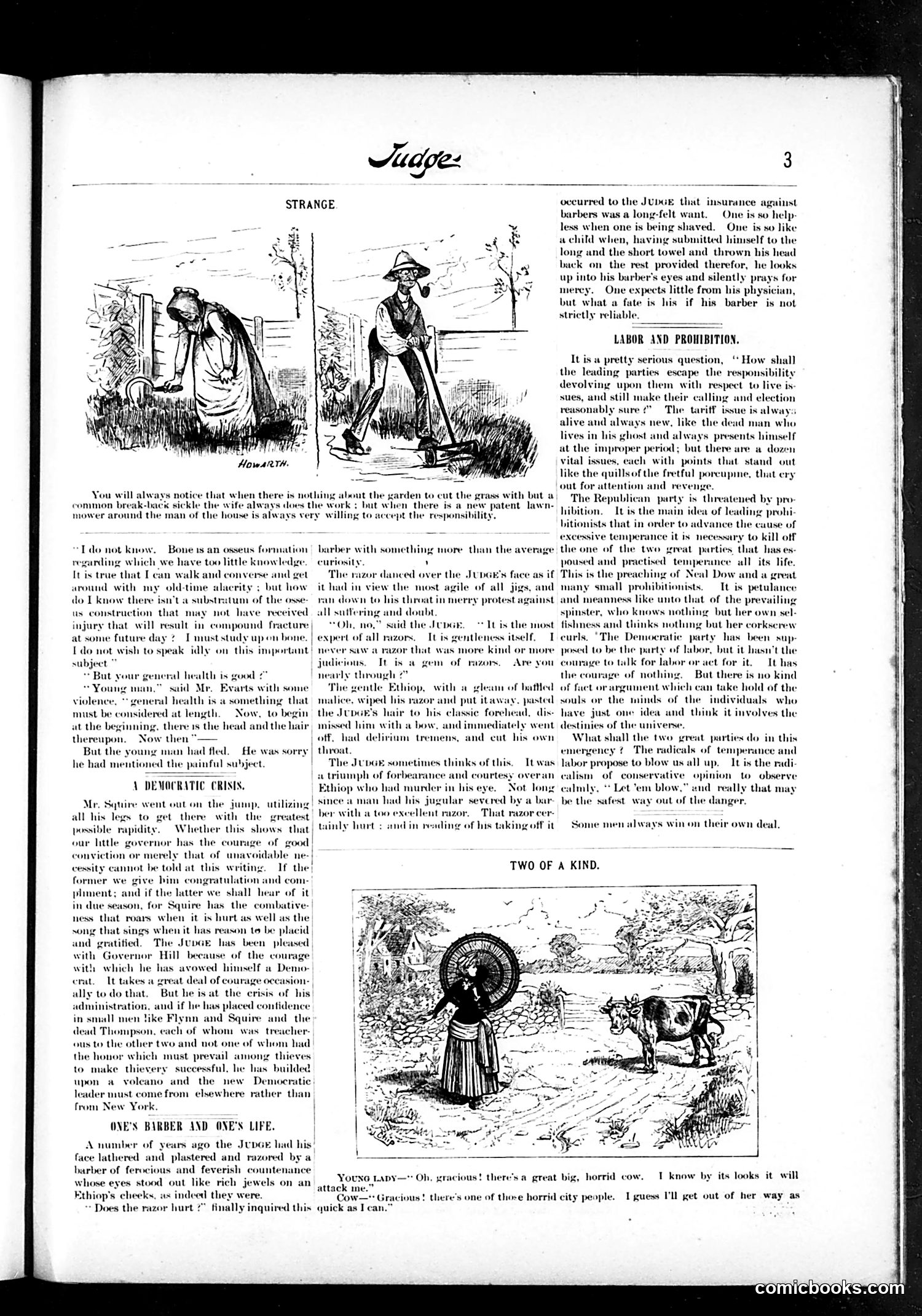
This page from Judge magazine (likely 1880s-90s based on style) contains several satirical pieces: **"Strange"** depicts a common garden scene where a wife operates a lawnmower while her husband rests—inverting typical gender labor roles for humorous effect. **"One's Barber and One's Life"** satirizes the vulnerability of being shaved, using an anecdote about a black barber. The Judge reflects on trusting one's barber with a razor near one's throat—a darkly comic meditation on helplessness and faith. **"A Democratic Crisis"** discusses New York Governor Hill's administration, criticizing his reliance on political operatives like Flynn and Squire as weak leadership. It advocates for stronger Democratic party direction from outside New York. **"Labor and Prohibition"** begins discussing tariff and labor issues facing political parties, though the text is partially obscured. **"Two of a Kind"** shows an illustration of a woman encountering a cow, with dialogue about avoiding the animal's path. The content reflects turn-of-century American political concerns and social commentary typical of Judge's satirical approach.
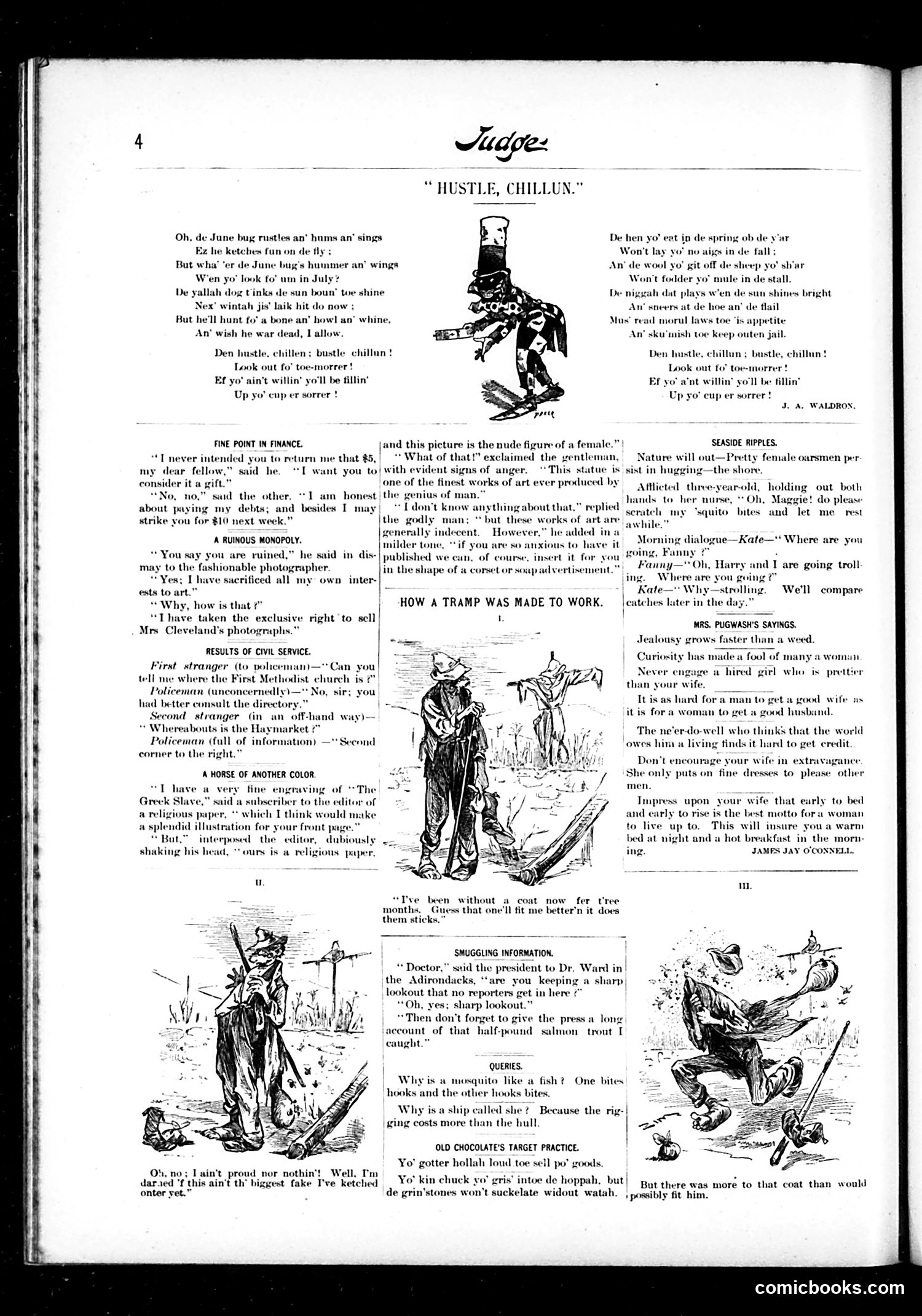
This Judge page contains multiple satirical pieces mocking various social topics of the era: **"Hustle, Chillun"** (top): A dialect poem featuring a caricatured Black figure offering life advice in exaggerated African American vernacular. It reflects the period's racist humor conventions, presenting stereotypical dialect humor common to late 19th-century American comedy magazines. **Other sections** mock contemporary issues: a photographer's absurd monopoly claim on Cleveland photographs; civil service incompetence (police unable to give directions); editorial absurdity (rejecting a nude engraving for a religious publication); and tramp labor exploitation. **"Mrs. Pugwash's Sayings"** offers satirical domestic observations about women and marriage, reflecting era-typical gender mockery. The overall tone targets perceived pretension, incompetence, and social hypocrisy through caricature and exaggeration—standard Judge magazine fare, though the racial stereotyping would be considered offensive today.
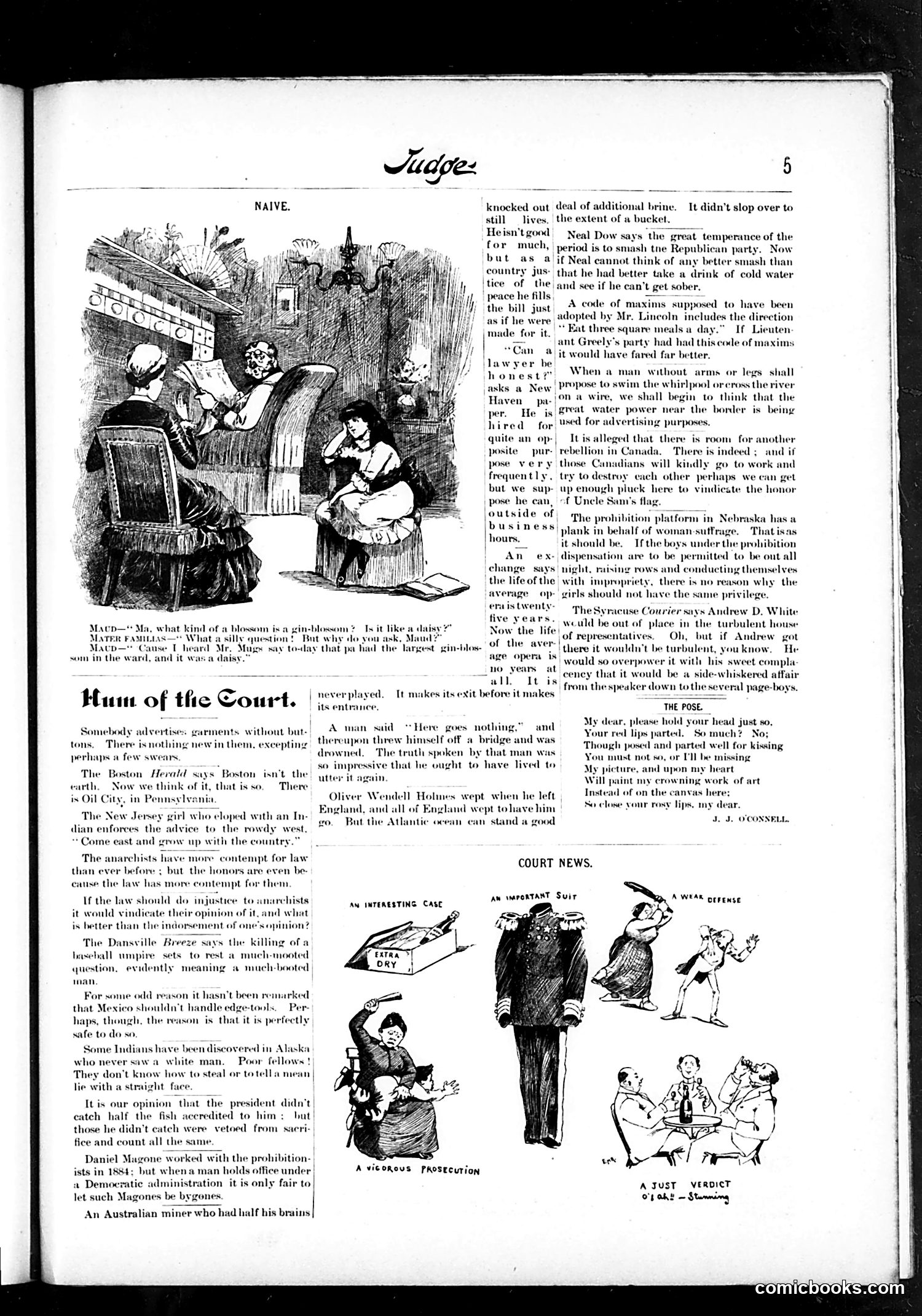
This page from Judge magazine contains political commentary and satirical items typical of the publication. The main content includes: **"Naïve"** — A sketch showing two women in conversation, illustrating social commentary about courtship or relationships. **"Hum of the Court"** — A column of brief satirical observations on current events, including jabs at: - Boston's self-importance - Mexican governance - Presidential fishing claims - Daniel Magone (a political figure switching administrations) - Various social absurdities presented as humorous observations **"Court News"** — Cartoon vignettes labeled "An Interesting Case," "A Vigorous Prosecution," "A Weak Defense," and "A Just Verdict Duly Rendered," depicting courtroom comedy through visual gags rather than specific legal cases. The overall tone is light ridicule of public figures, social pretension, and political hypocrisy—typical of Judge's satirical approach to 1880s-1890s American life and politics.
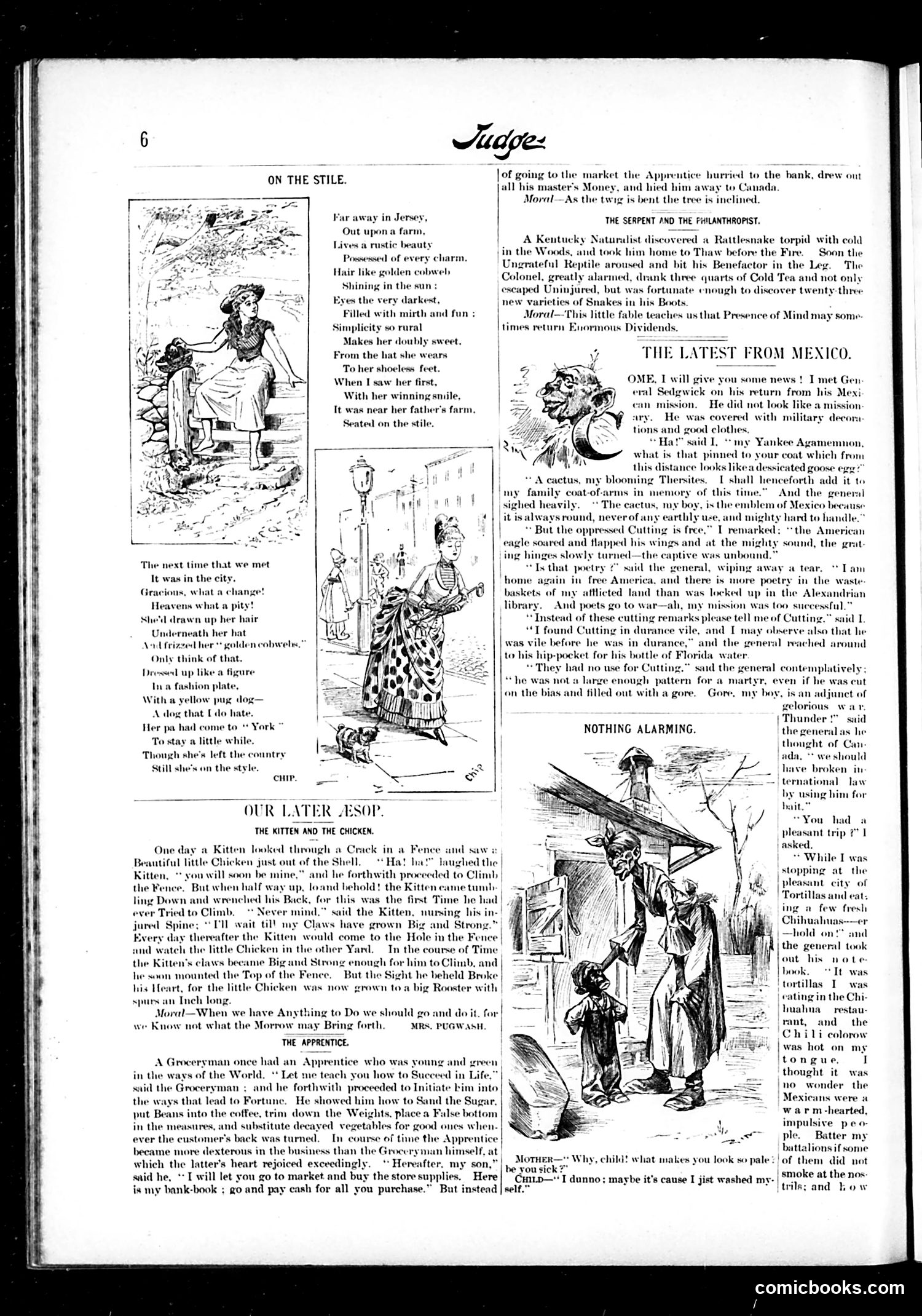
This page from the satirical magazine *Judge* contains several moral fables and social commentary typical of late 19th-century American humor: **"On the Stile"** depicts a familiar social satire: a rural girl loses her authentic charm when she moves to the city and adopts fashionable pretensions (including a decorative "yellow pug dog"), abandoning her natural simplicity. **"Our Later Aesop"** offers three Aesopian fables with morals: a kitten's premature ambition backfires; an apprentice taught dishonest business practices steals from his master; and a man who rescues a frozen rattlesnake is bitten—teaching that ingratitude and danger lurk even in charity. **"The Latest from Mexico"** appears to satirize American military involvement in Mexico through a general's account mixing flowery romantic language with criticism of Native American symbolism and the realities of warfare, likely commentary on contemporary American imperial ventures. The cartoons mock social pretension, business corruption, and American foreign policy through traditional moral fable structures—accessible to contemporary readers but requiring historical context about Gilded Age America and U.S.-Mexico relations.
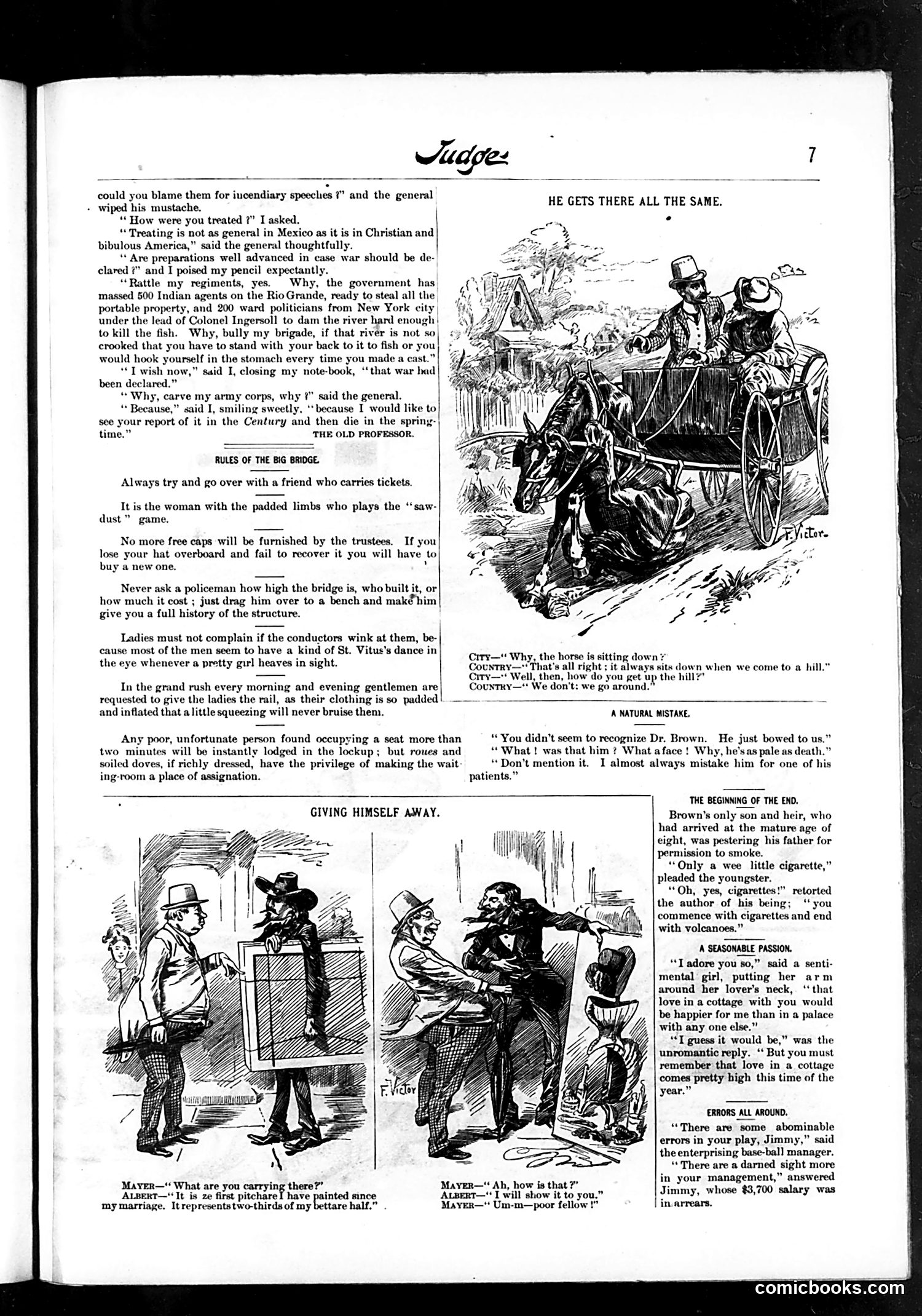
This page from *Judge* magazine contains multiple satirical pieces satirizing American society circa early 20th century: **"He Gets There All the Same"** (top): A dialogue between a reporter and a Mexican general discussing military preparedness. The satire mocks both Mexican corruption (officials stealing portable property) and American political interference (New York politicians damming rivers), suggesting incompetence pervades both nations' approaches to conflict. **"Rules of the Big Bridge"**: Humorous etiquette guidelines for Brooklyn Bridge users, satirizing crowded conditions, gender dynamics (padded women's clothing), and police behavior—poking fun at modern urban infrastructure chaos. **Lower cartoons** ("Giving Himself Away," "A Natural Mistake," etc.): Brief joke vignettes about mistaken identity, parental concerns about cigarettes leading to moral decay, and romantic sentimentality versus practicality. The page's overall tone mocks governmental incompetence, social pretension, and Victorian moral anxieties through gentle ridicule rather than sharp political critique.
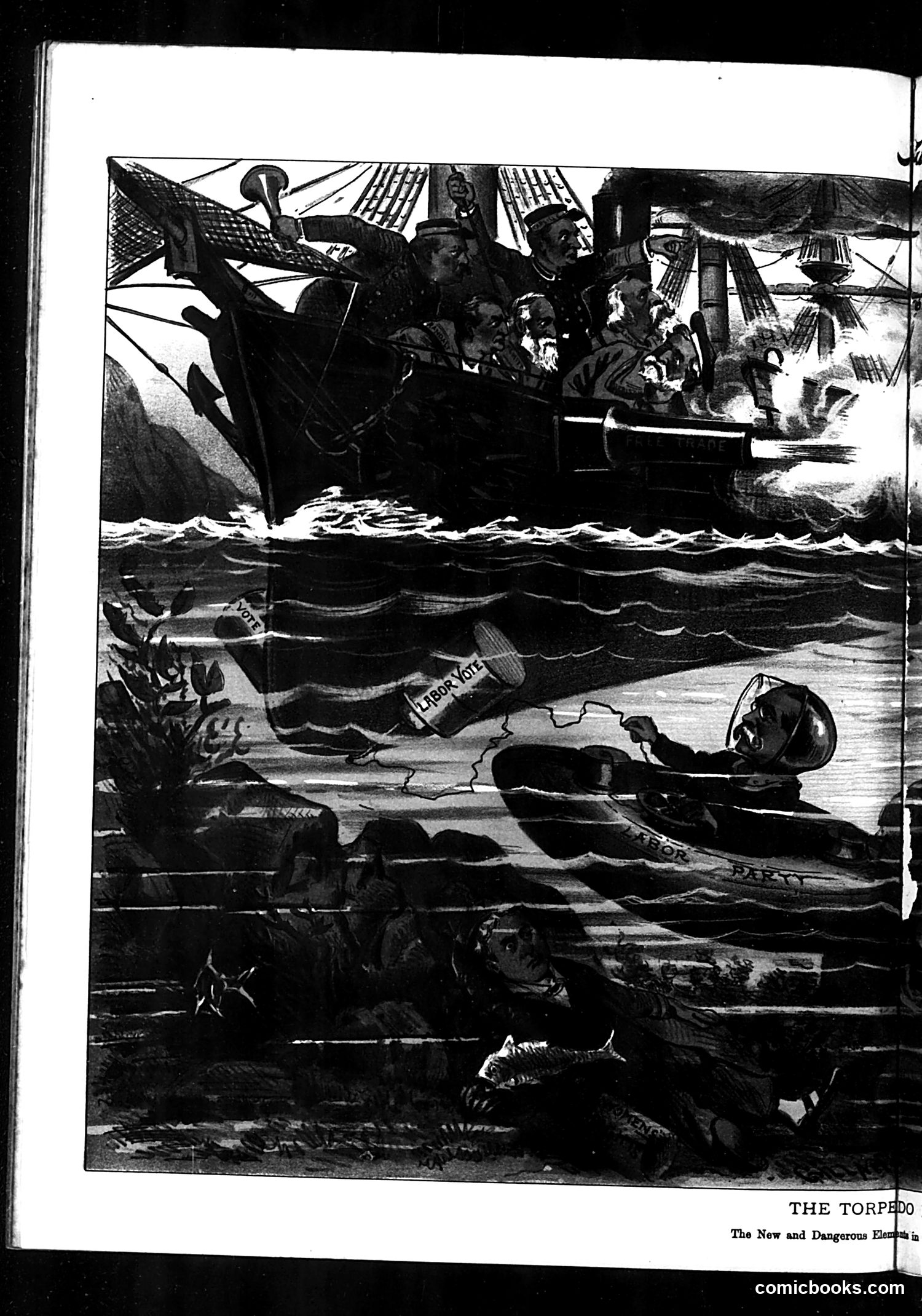
This illustration depicts a naval warfare scene titled "The Torpedo: The New and Dangerous Element in..." (text cut off). The engraving shows a warship with crew observing a torpedo in the water below—depicted as an underwater vessel or device with visible propulsion mechanisms. The satire likely comments on emerging torpedo technology as a revolutionary and destabilizing naval threat during the late 19th century. The torpedo represented a new military danger that made traditional naval tactics obsolete, as it could strike ships from beneath the surface, unseen. The crew's alarmed reaction suggests anxiety about this unpredictable weapon. The cartoon probably satirizes contemporary debates about naval defense and technological disruption—a common concern in Judge magazine during an era of rapid military innovation.
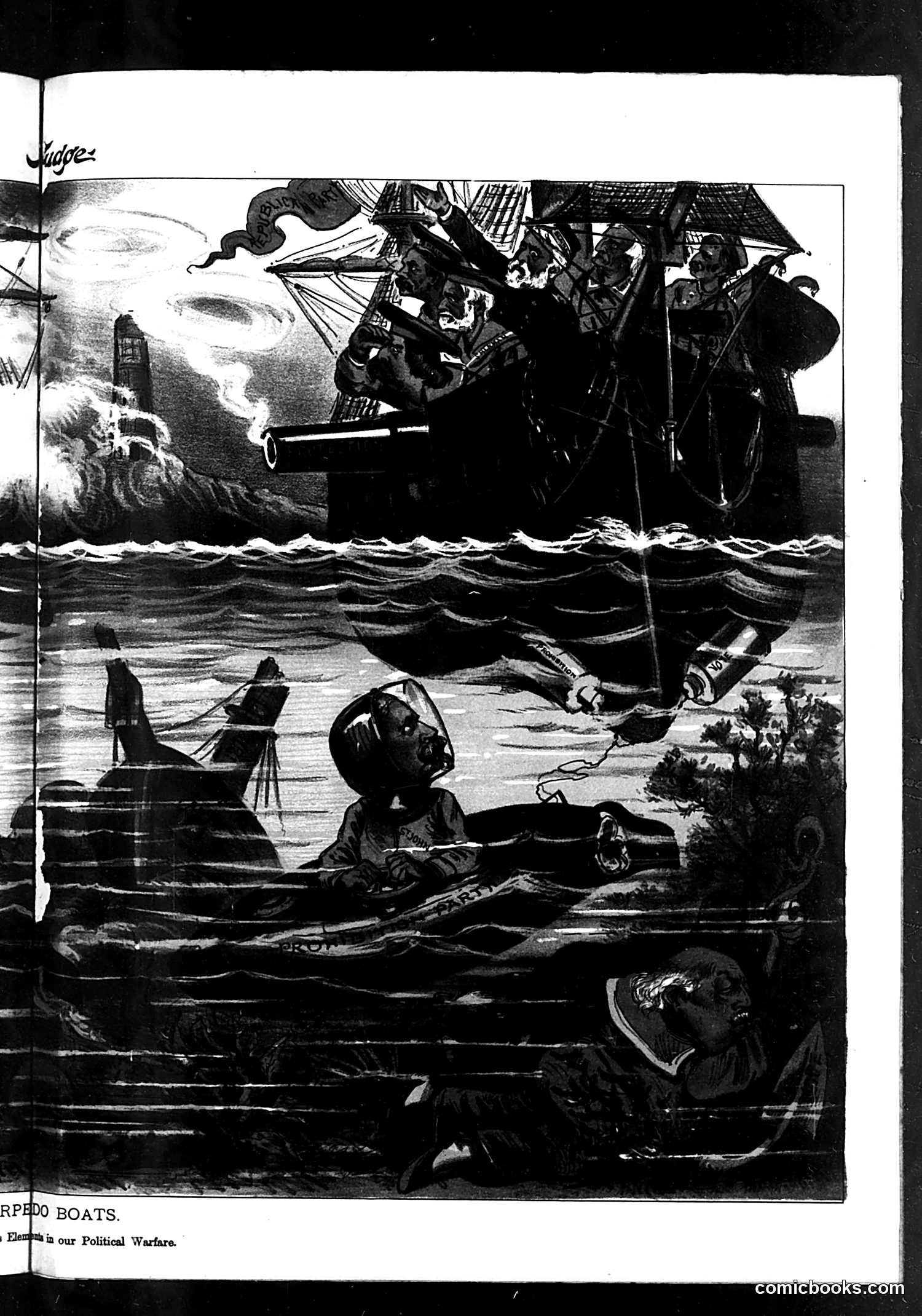
This Judge magazine cartoon depicts a naval battle scene with torpedo boats attacking a larger warship. The satirical caption "Elements in our Political Warfare" suggests the illustration uses military metaphor to comment on American politics. The image shows smaller vessels (torpedo boats) threatening a larger, more established naval vessel—likely representing political outsiders or insurgent factions challenging established political power. The dramatic, violent imagery of naval warfare serves as satirical commentary on the intensity and destructive nature of contemporary political conflicts. Without a visible date or clearer identifying details, the specific political conflict referenced remains unclear, though the metaphor of small, agile forces threatening traditional power structures was a common Judge theme during debates over political reform and party competition.
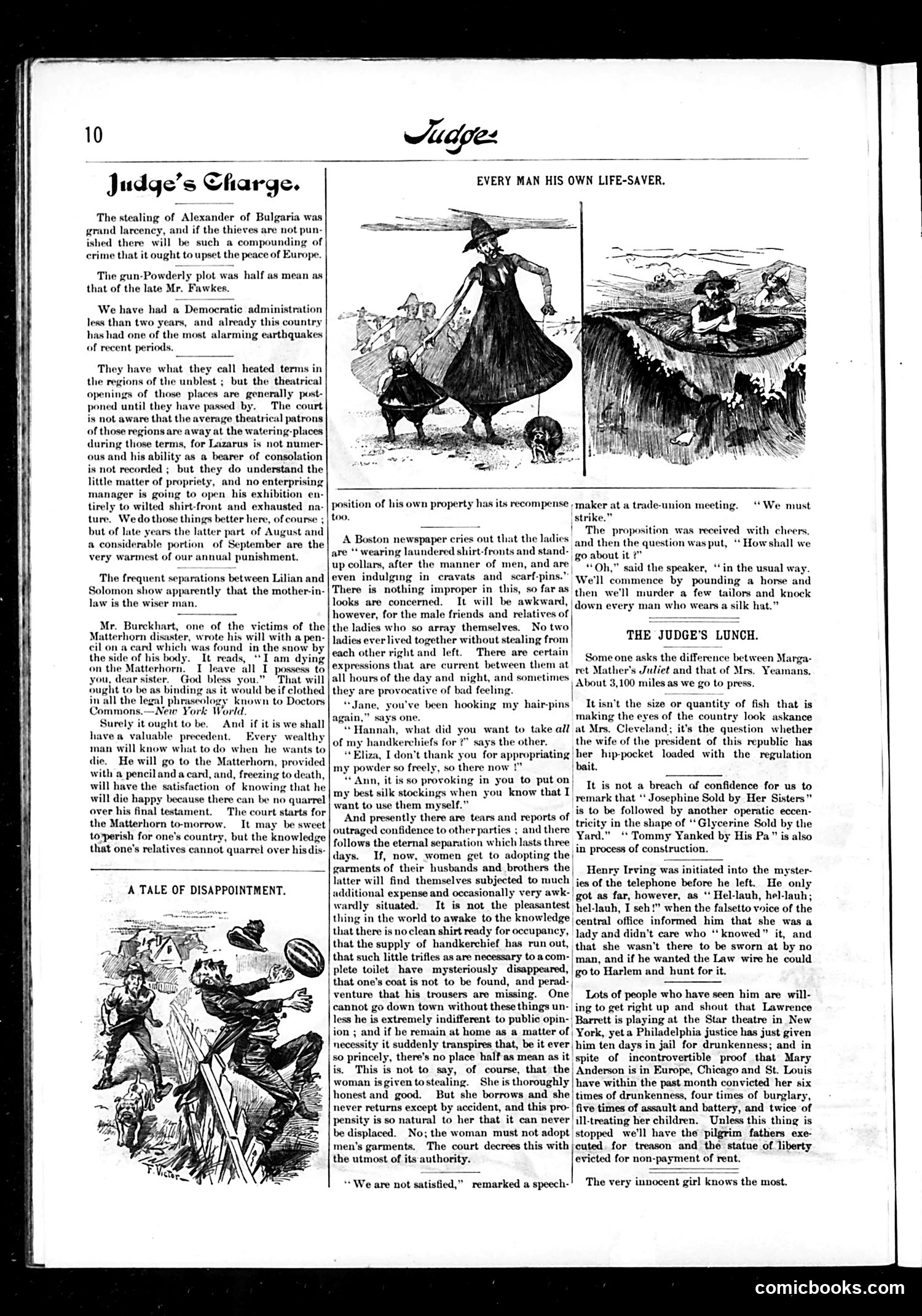
This page from the satirical magazine **Judge** contains several distinct commentaries on contemporary American issues: **"Judge's Charge"** (left column) criticizes the Democratic administration elected less than two years prior, sarcastically blaming them for recent misfortunes including an earthquake. The references to "gun-Powderly plot" and "late Mr. Fawkes" appear to invoke anarchist threats. It also mocks court decisions, including one regarding a dying man's handwritten will on the Matterhorn. **"Every Man His Own Life-Saver"** (top right illustration) depicts a figure with a large sail-like apparatus, appearing to satirize some contemporary invention or safety device, likely mocking over-engineered or impractical solutions. **The shirt-front commentary** criticizes women adopting masculine dress fashions (starched collars, cravats), humorously predicting domestic chaos as women would steal these garments from husbands and brothers, just as they already steal from each other. The overall tone is typical of Judge's blend of political criticism, social satire, and humorous domestic observations targeting the anxieties of the era's middle and upper classes.
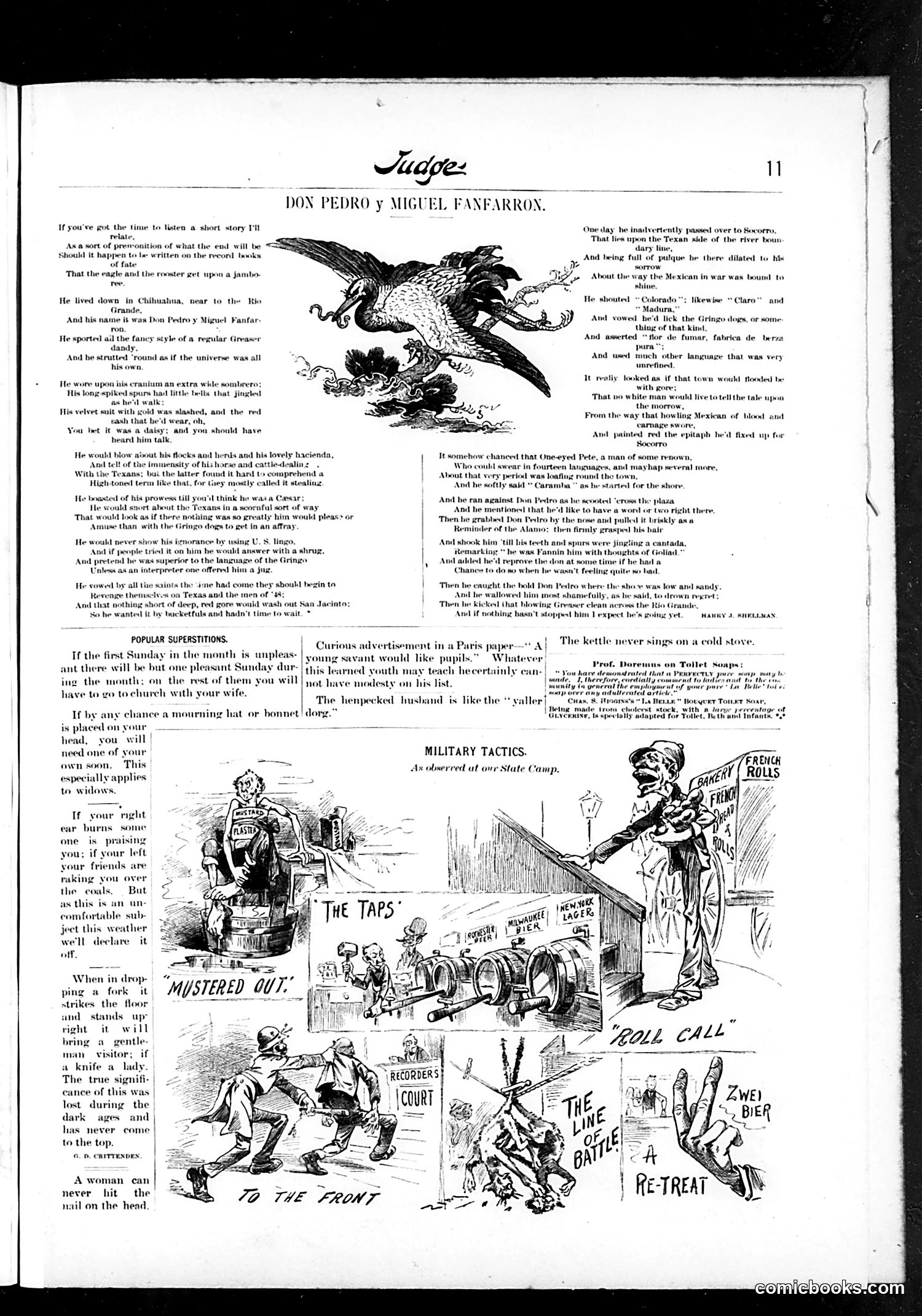
This page features "Don Pedro y Miguel Fanfarro," a story satirizing Mexican stereotypes popular in American publications of this era. The narrative describes a boastful Mexican rancher ("Don Pedro") living in Chihuahua who brags about his wealth and superiority over Texans, only to be humbled when confronted by "One-eyed Pete" and other Americans. The implicit message—typical of the period—presents Mexican characters as vain braggarts deservedly put in their place by Americans. The cartoon section titled "Military Tactics" shows crude military maneuvers labeled "The Taps," "Roll Call," "The Line of Battle," and "A Retreat"—likely satirizing incompetent military organization, possibly referencing a contemporary state militia or volunteer force. The page also includes period "Popular Superstitions" discussing folk beliefs about omens and luck. The overall content reflects early 20th-century American attitudes: ethnic stereotyping, military humor, and popular folklore presented for educated readers' amusement.
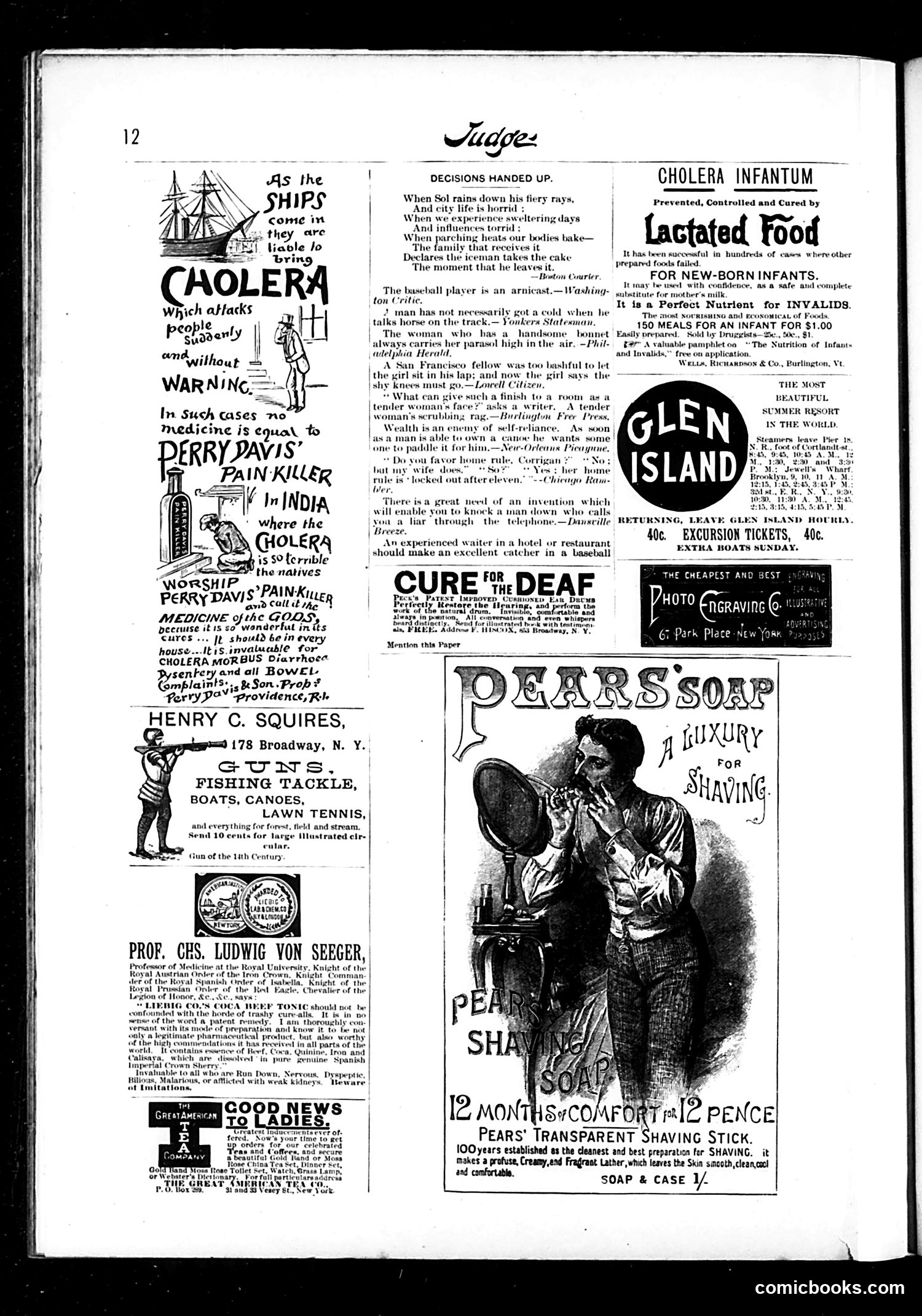
This page is primarily **advertisements** rather than political satire. The dominant content includes: **Main Advertisements:** - **Perry Davis' Pain Killer** (left): Marketed as a cure-all for cholera infantum and various ailments, with text claiming it's "worshipped" in India. This reflects 19th-century patent medicine marketing that made extravagant medical claims. - **Pears' Soap** (center-right): A luxury shaving soap advertisement featuring an illustration of two men, one shaving the other. - **Lactated Food** (top right): An infant formula product. - **Glen Island** excursion tickets and various other commercial products. **The smaller satirical content** includes brief witticisms about baseball players and hotel waiters, but these are minor—just conversational jokes rather than pointed political commentary. **Historical context**: This appears to be late 19th-century advertising typical of Judge magazine, reflecting the era's unregulated patent medicine industry and emerging consumer goods marketing.
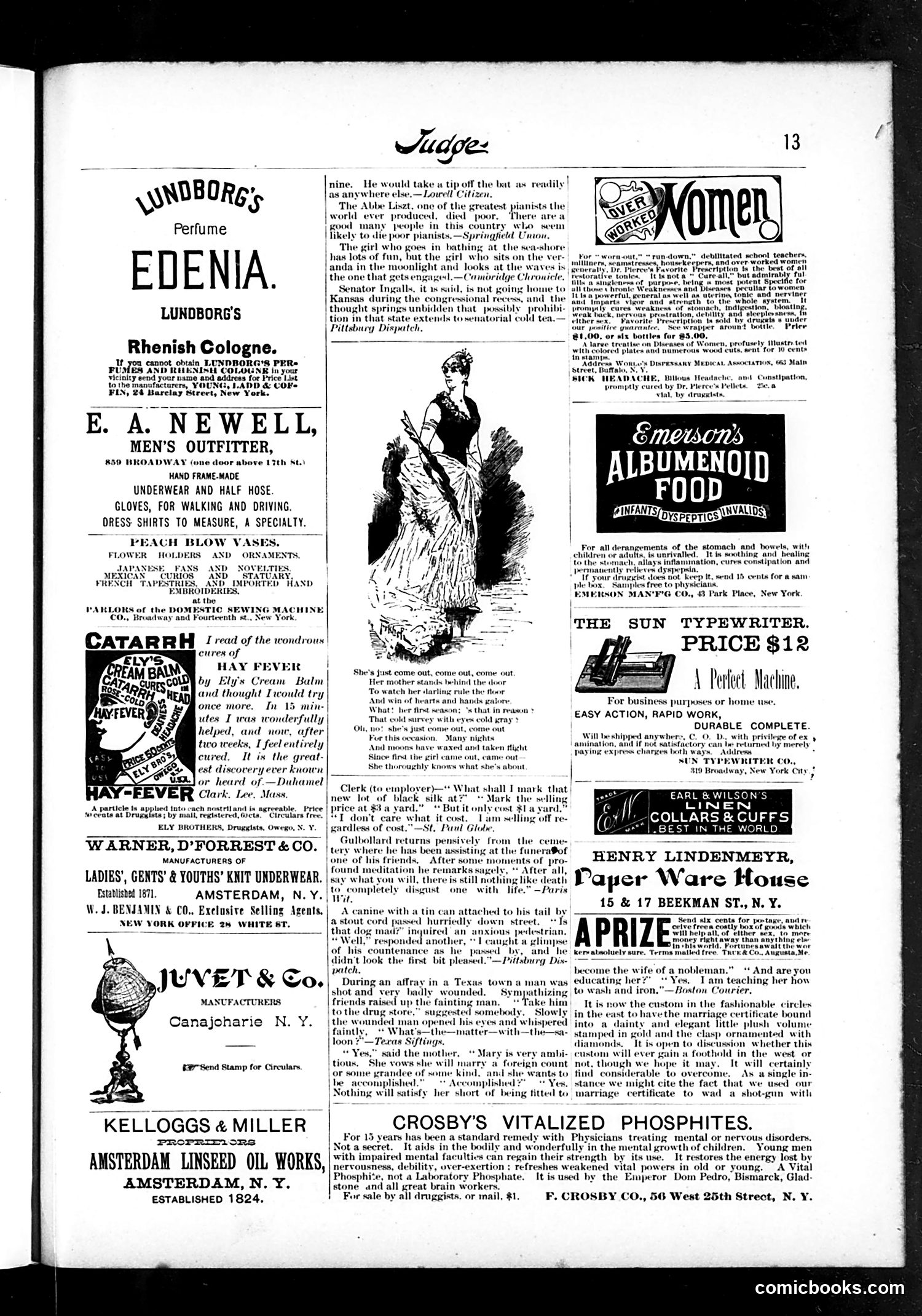
This page is primarily **advertisements** rather than political satire. It contains commercial ads for products like perfume, men's clothing, typewriters, and patent medicines typical of late 19th-century Judge magazine. However, the page includes a **central illustration** (a woman in Victorian dress) surrounded by short humorous **quoted observations** about social customs and gender relations—typical Judge content. These appear to joke about: - Gender differences in recreation and romance - The social spectacle of young women's "coming out" season - Marriage customs (notably, a quip about using a marriage certificate as a shotgun wadding—a crude joke about forced marriages) - The disconnect between public propriety and private behavior The satirical point seems directed at **Victorian social conventions** and their absurdities, particularly regarding courtship and women's restricted roles. The references mock the formality and ritualism of upper-class society rather than targeting specific political figures or events. The overall effect is lighthearted social commentary on gender and class customs of the Gilded Age.
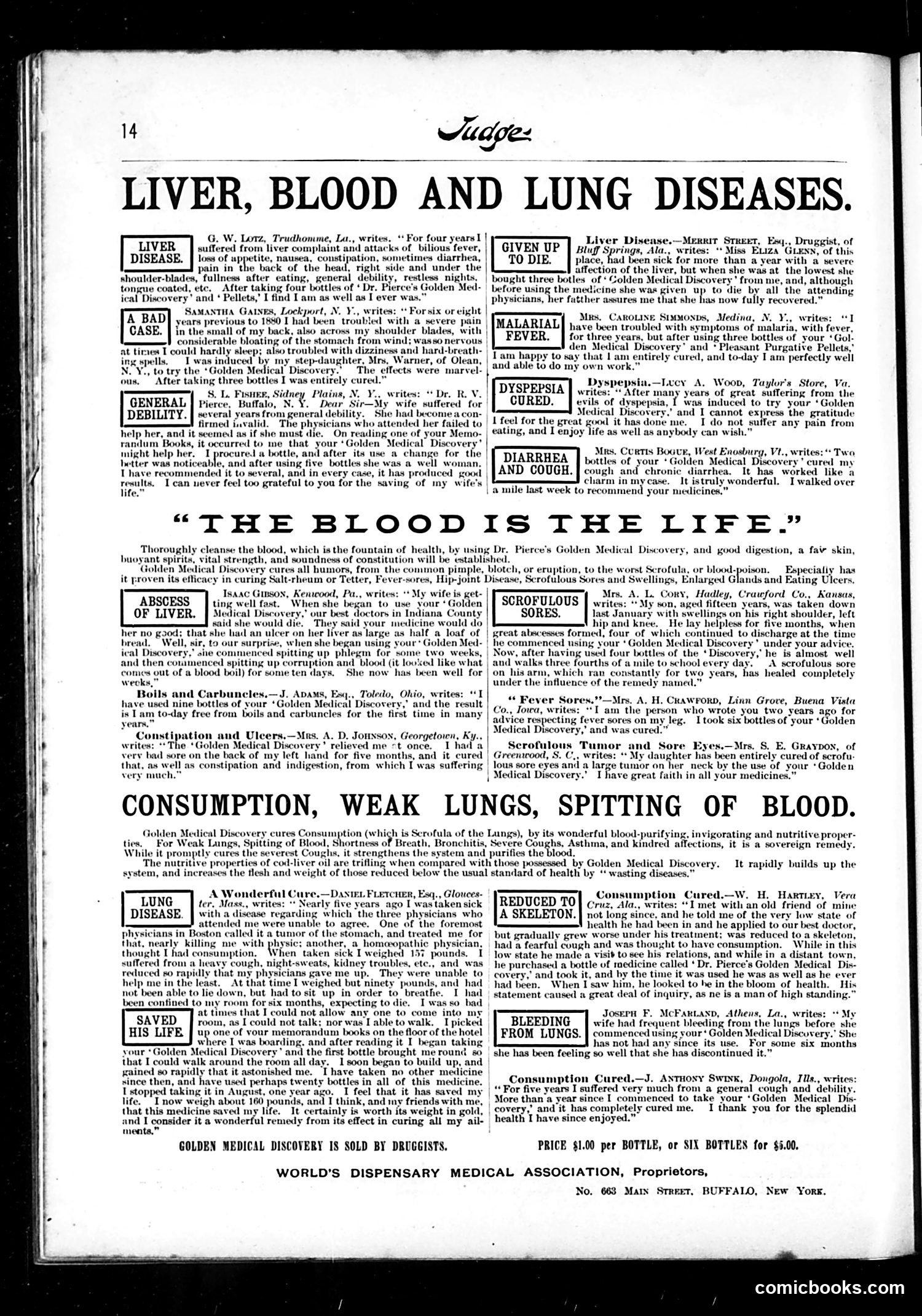
This page is **primarily advertising**, not editorial content or satire. It advertises Dr. Pierce's Golden Medical Discovery, a patent medicine claiming to cure liver disease, blood disorders, and lung ailments. The layout mimics a news or testimony format by printing dozens of alleged customer testimonials from real-sounding locations and names—a common and misleading marketing tactic of the late 19th century. Modern readers should recognize this as **snake oil advertising**. The testimonies are unverified claims (often fabricated or exaggerated); the product itself was likely ineffective for serious diseases like consumption, malaria, or liver failure. The repeated phrase "THE BLOOD IS THE LIFE" reflects period medical pseudoscience about purifying the blood. By republishing such ads, Judge magazine earned revenue while implicitly endorsing fraudulent medical claims—practices now illegal under FDA regulations. The content reveals how unregulated patent medicine marketing exploited sick people before modern consumer protections existed.
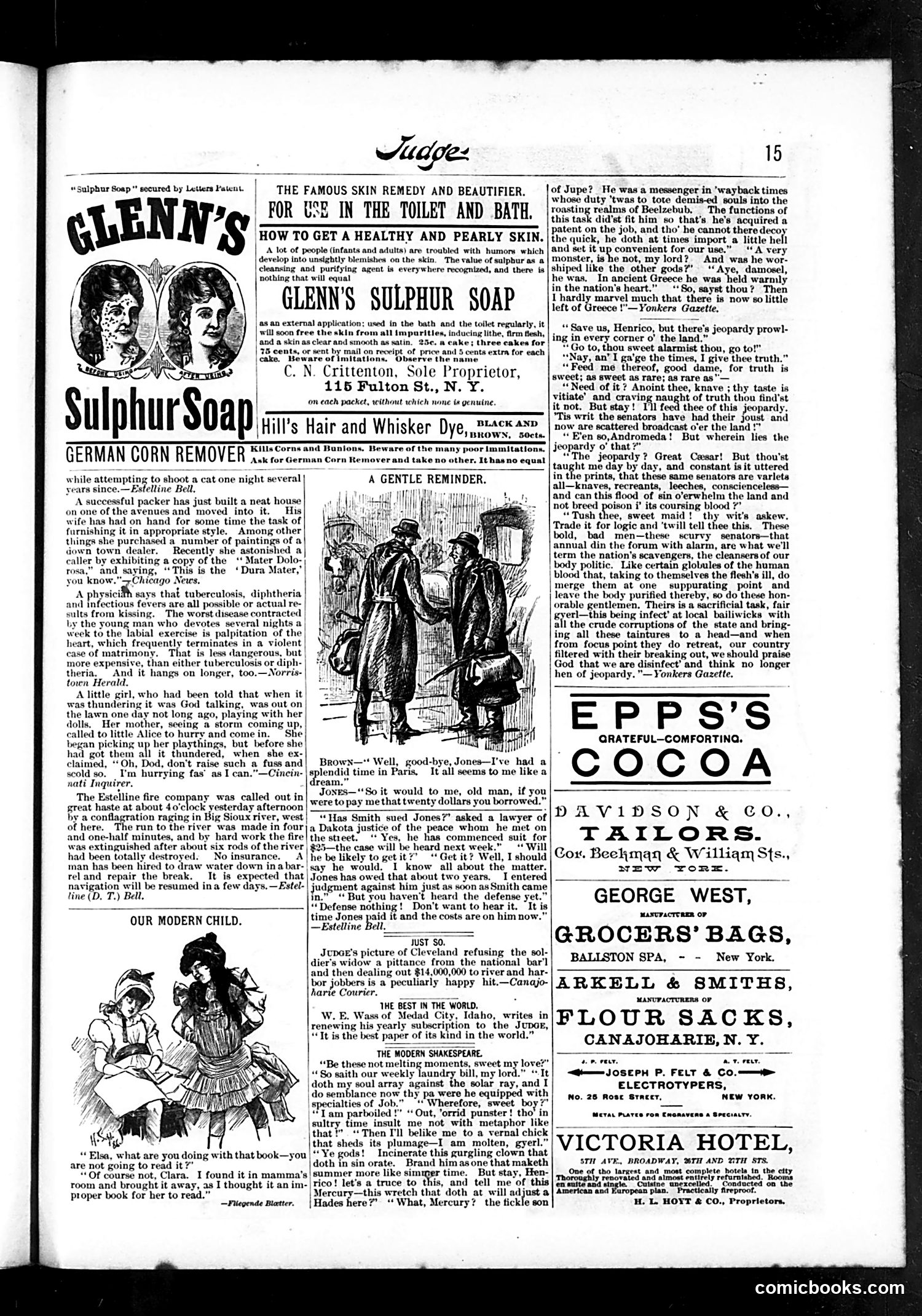
This page is primarily **advertising and humorous filler content**, not political satire. The dominant features are: **Advertisements:** Glenn's Sulphur Soap (patent medicine for skin conditions), Hill's Hair Dye, German Corn Remover, Epps's Cocoa, and various grocers and hotels dominate the layout. **Humorous anecdotes** fill the remaining space—brief comedic stories typical of late-19th-century magazines: - A woman mistakes "Mater Dolorosa" (religious artwork) for "Dura Mater" (brain membrane) - A child scolds God during thunder for being noisy - A fire company responds to a river fire - A lawyer's witty exchange about a loan **"Our Modern Child"** cartoon depicts a girl taking a "questionable" book from her mother's room—likely satirizing Victorian prudishness and how daughters police their parents' reading. The page reflects Judge's mix of patent medicine ads (common then) and light domestic humor targeting middle-class readers. No significant political commentary is present.
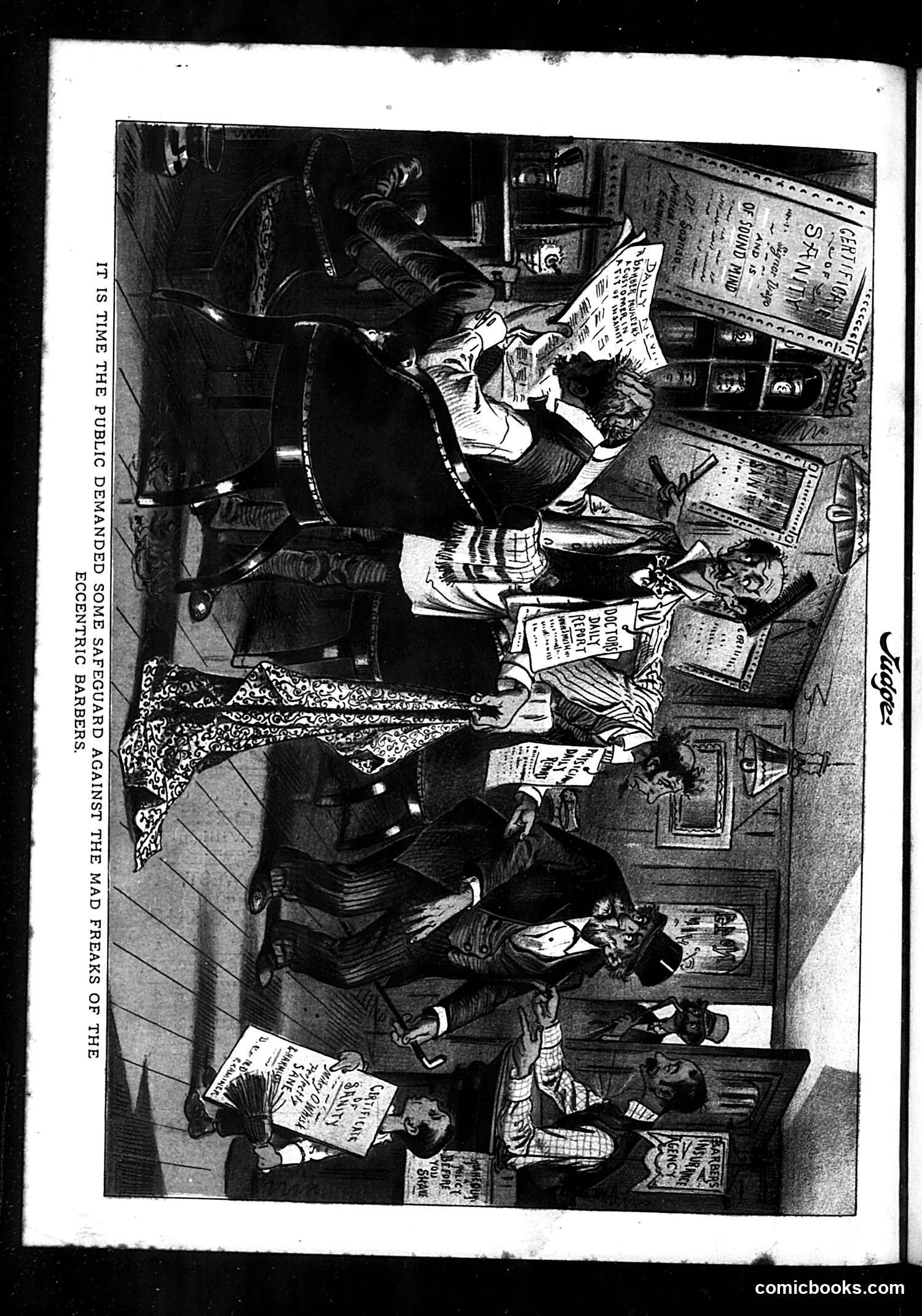
This appears to be a satirical cartoon from *Judge* magazine depicting what the caption describes as "eccentric barbers" engaged in some kind of public demonstration or protest. The image shows multiple figures holding signs and appearing to conduct some form of organized action, though the specific signs' text is difficult to read clearly in this reproduction. The cartoon likely satirizes a real historical event involving barbers—possibly labor organizing, a strike, or public campaign around working conditions or regulations. Without clearer text visibility or a specific date, I cannot identify the exact historical incident being mocked. The "eccentric" framing suggests the cartoonist intended to ridicule the participants' methods or demands as absurd or unreasonable, a common *Judge* approach to labor activism.