
A complete issue · 16 pages · 1886
Judge — August 21, 1886
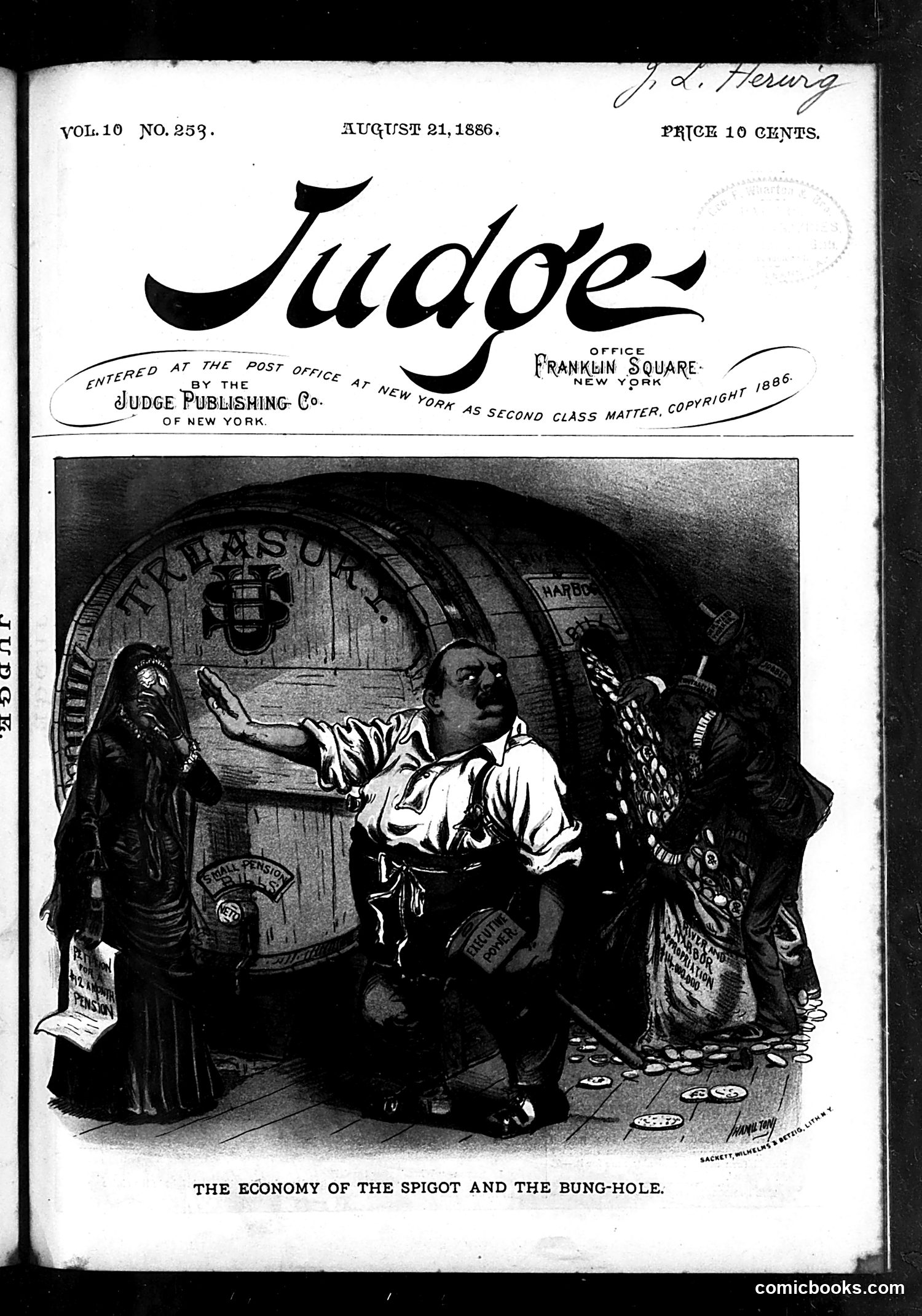
This political cartoon titled "The Economy of the Spigot and the Bung-Hole" depicts a man in shirtsleeves standing between two cloaked figures, apparently controlling the flow from a large barrel marked "APPROPRIATIONS." The figures on either side appear to represent competing political interests or factions seeking access to government funds. The satire likely critiques post-Civil War fiscal management and corruption—specifically how politicians controlled distribution of appropriated money. The "spigot and bung-hole" metaphor suggests selective, controlled access to public funds. Given the 1866 date, this probably comments on Reconstruction-era spending and debates over federal budget allocation, though the specific political figures are difficult to identify with certainty from the image alone.
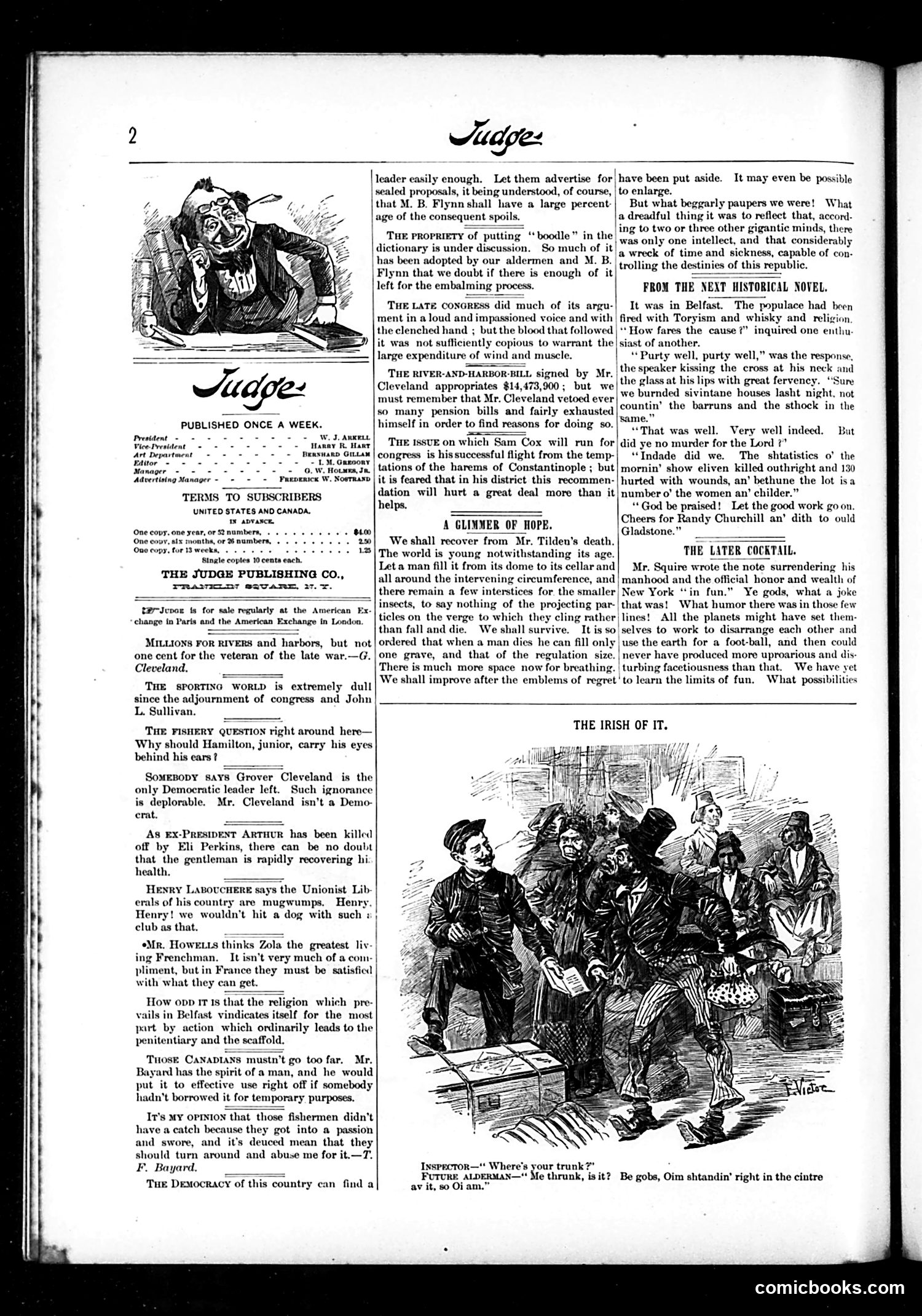
This page contains political commentary from the Gilded Age era. The left column includes editorials mocking Democratic leadership, particularly referencing Grover Cleveland as "the only Democratic leader left" and criticizing Arthur (likely President Chester Arthur) as having been killed by Eli Perkins. The main cartoon titled "THE IRISH OF IT" depicts an immigration/customs scene with an inspector questioning a figure about a trunk, with Irish dialect dialogue ("Be gobs, Oimstand'n right in the cintre"). This satirizes Irish immigrants arriving in America, playing on stereotypes about Irish accents and customs violations. The cartoon reflects period anxieties about immigration and ethnic groups, common satirical targets in late 19th-century American humor magazines.
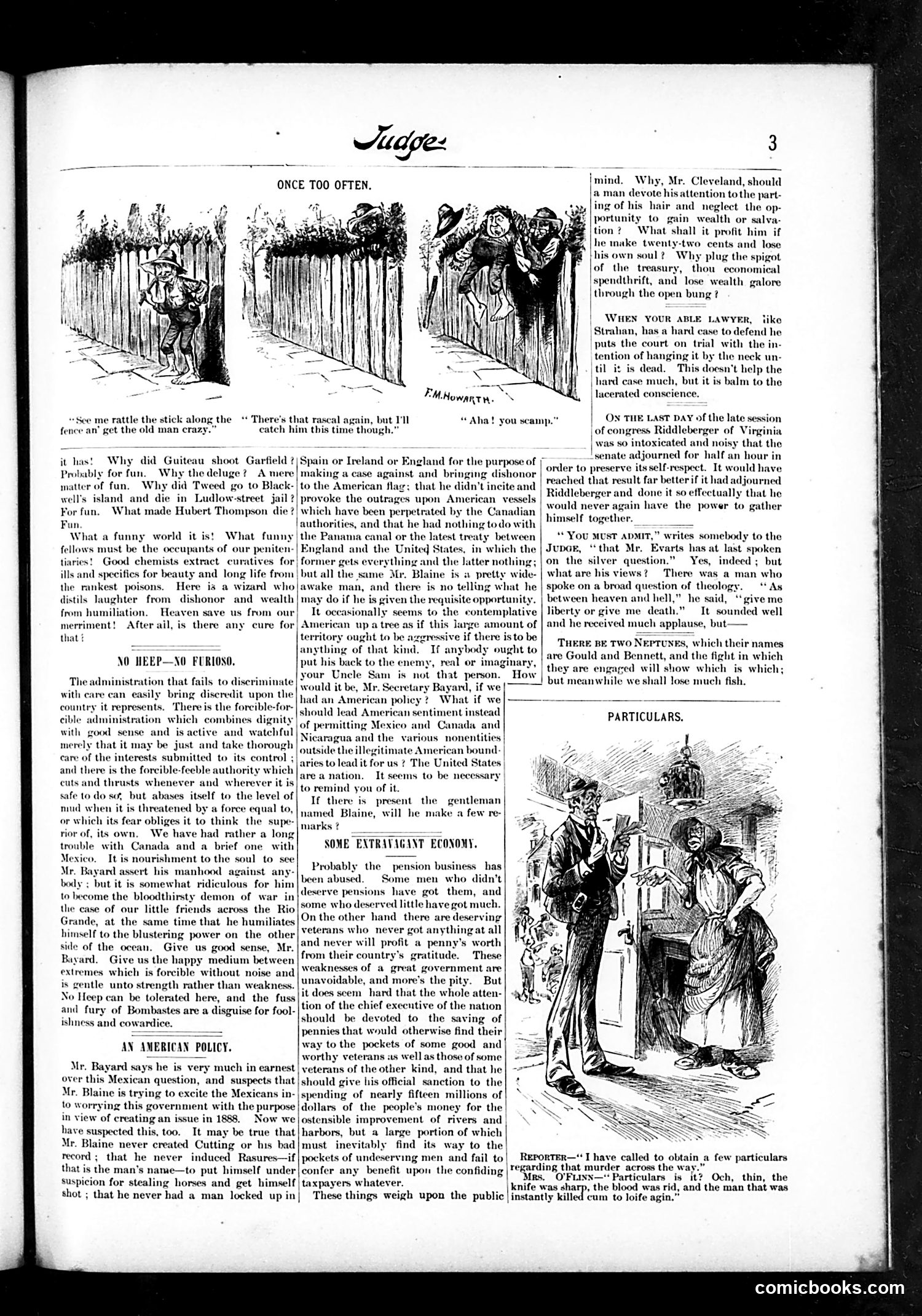
This three-panel cartoon by F.M. Howarth satirizes government ineffectiveness through a child repeatedly testing an adult's patience by rattling a stick along a fence—a visual metaphor for how minor provocations can escalate dangerously if ignored. The accompanying text critiques the Cleveland administration's inconsistent foreign policy under Secretary of State Thomas Bayard. The article attacks what it calls "forcible-feeble" authority: aggressive toward weak neighbors (Mexico, referencing the Cutting incident) while deferential to powerful nations (Canada, Britain). The piece also accuses Secretary Blaine of manufacturing diplomatic crises with Mexico to create a political issue for the 1888 election. The satire's core argument: a government must apply consistent, principled policy rather than alternating between bluster and appeasement based on perceived power dynamics. The fence-rattling metaphor suggests such inconsistency invites larger, uncontrollable consequences.
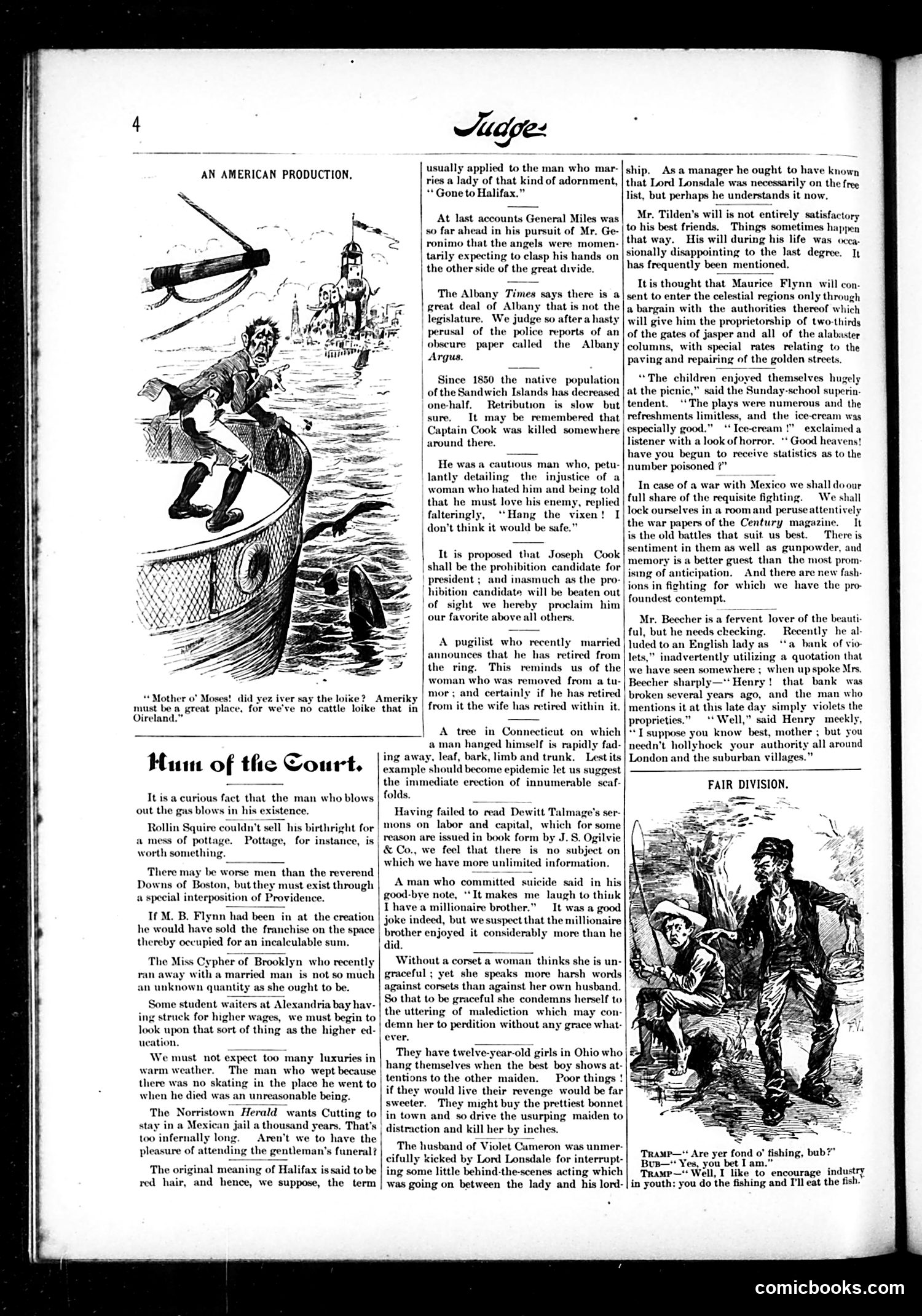
This page from Judge magazine contains several brief satirical items typical of the publication's format. The main cartoon (upper left) depicts an Irishman in stereotypical dress, apparently referencing Irish immigration and cultural representation in American theater—the caption suggests Ireland has "no cattle" to compare with American theatrical productions. The text items below mock various contemporary figures and issues: General Miles pursuing Geronimo (the Apache leader); Joseph Cook as a prohibition candidate; a boxer retiring from the ring after marriage; and various moral observations on contemporary behavior. The "Ham of the Court" section offers cynical social commentary on American society—mocking religious figures, financial speculators, and human folly generally. References to "Cutting" (likely diplomat David Terry Cutting) and Mexican imprisonment suggest current news items. The "Fair Division" cartoon (lower right) depicts a woman and child fishing, with dialogue about encouraging the child's interest in fishing as an industry. Overall, the page exemplifies Judge's satirical approach: brief jabs at politics, social pretension, and contemporary scandals mixed with crude period humor.
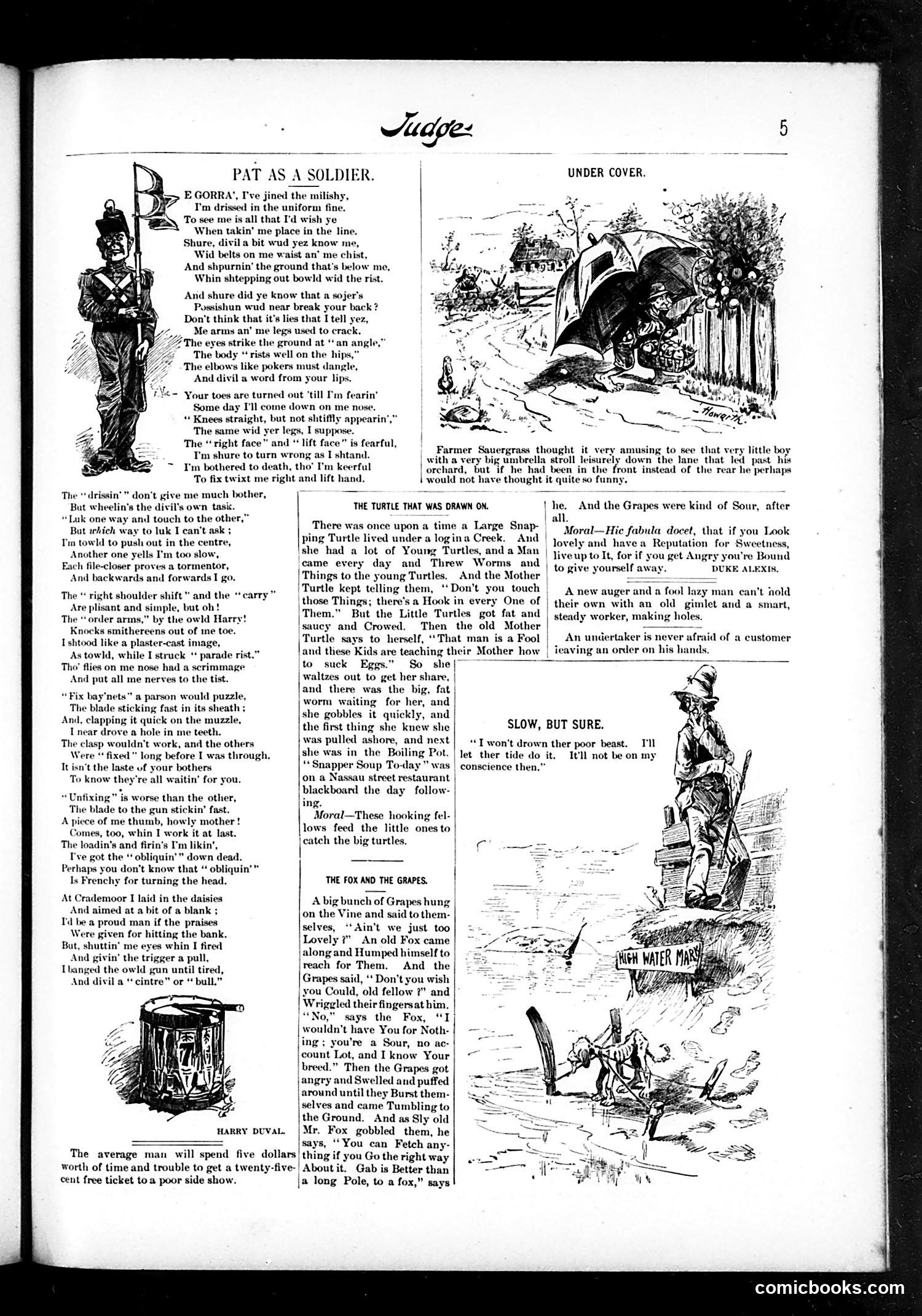
This page contains Irish-immigrant humor typical of late 19th-century American satire. **"Pat as a Soldier"** mocks an Irish recruit struggling with military drill—a common stereotype portraying Irish immigrants as comically incompetent at following precise orders. The dialect-heavy poem exaggerates Irish speech patterns while describing the physical awkwardness of military posture and marching formations. **"Under Cover"** shows a farmer's amusement at a boy with an oversized umbrella—simple visual humor with no apparent political content. **"The Turtle That Was Drew On"** presents a Aesop's fable-style morality tale where a mother turtle ignores warnings about hooks and meets her doom in a soup pot. The moral warns against teaching destructive lessons through example. **"The Fox and the Grapes"** is another fable retelling, likely Aesop's "Sour Grapes," teaching that those denied their desires often disparage them. The page represents Judge's typical blend of ethnic caricature, animal fables with moral lessons, and gentle social observation aimed at middle-class readers.
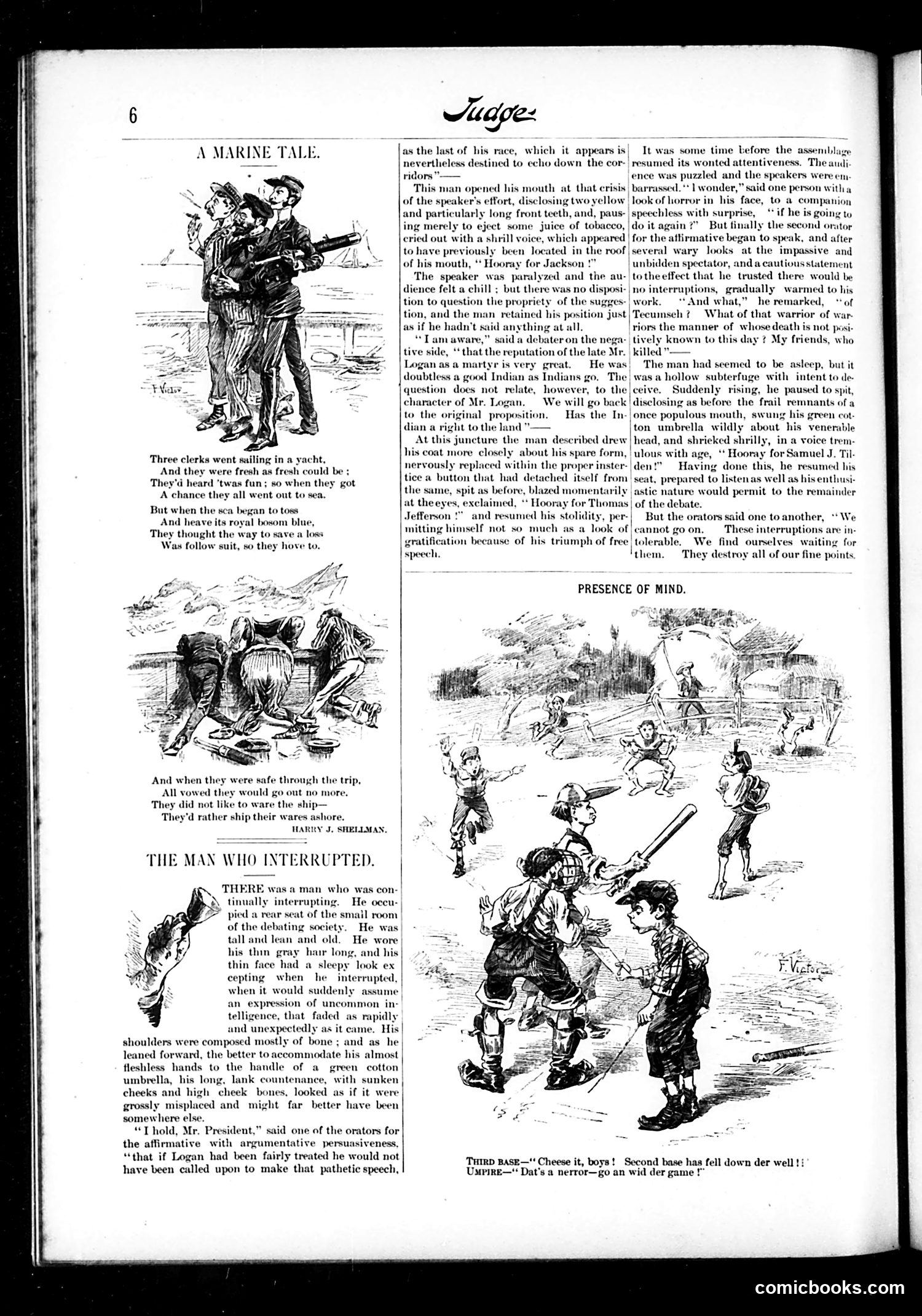
This page contains two distinct pieces of satire: **"A Marine Tale"** (left column and illustrations): A humorous poem about three clerks sailing a yacht who encounter a storm. The narrative is lighthearted maritime comedy with no apparent political content—simply entertaining verse about foolish sailors. **"The Man Who Interrupted"** (right column and illustration): This is the page's actual political satire. It depicts a recurring heckler at a debating society who repeatedly interrupts speeches about Native American rights and political figures (Jackson, Logan, Tecumseh, Samuel Tilden). The man—described as tall, lean, elderly, with a shabby appearance—keeps erupting with loud cheers ("Hooray for...!") while spitting tobacco, completely disrupting the proceedings. The satire targets **disruptive political discourse**: the interrupter represents how passionate but uncouth partisan supporters could derail serious debate through constant heckling, regardless of the topic's substance. It mocks both the heckler's boorishness and the speakers' inability to maintain decorum, suggesting political debate had become unmanageable theater. The page reflects 19th-century anxieties about democratic participation and civil discourse.
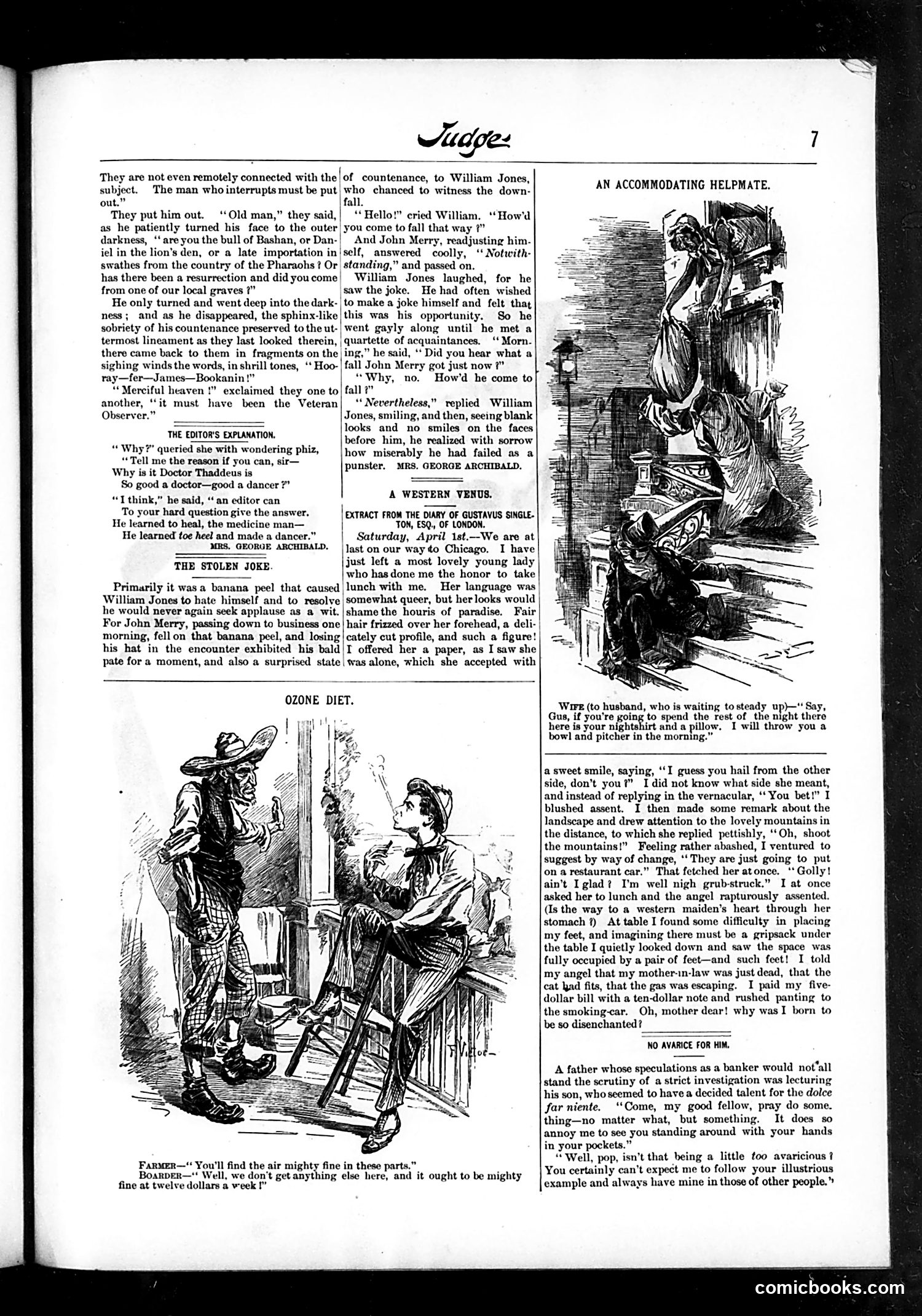
This page contains several humorous pieces typical of late 19th-century American satirical magazines: **"The Stolen Joke"** mocks a man named William Jones who attempts to be witty by retelling a pun about his acquaintance John Merry's fall, but fails to get laughs. The satire targets failed attempts at humor and social pretension. **"A Western Venus"** presents excerpts from a gentleman's diary about meeting an uncouth but attractive young woman heading to Chicago. She uses crude Western slang ("Golly!" "grub-struck") while he speaks in refined English. The humor derives from the collision between her rough frontier manners and his genteel expectations—a common theme mocking both Victorian propriety and crude American Western culture. **"An Accommodating Helpmate"** shows a wife sarcastically offering a drunk husband bedding while he recovers—domestic humor about alcohol and marital tolerance. The woodcut illustrations support each narrative with period-appropriate visual comedy. These pieces reflect Judge's focus on social manners, regional American differences, and domestic situations.
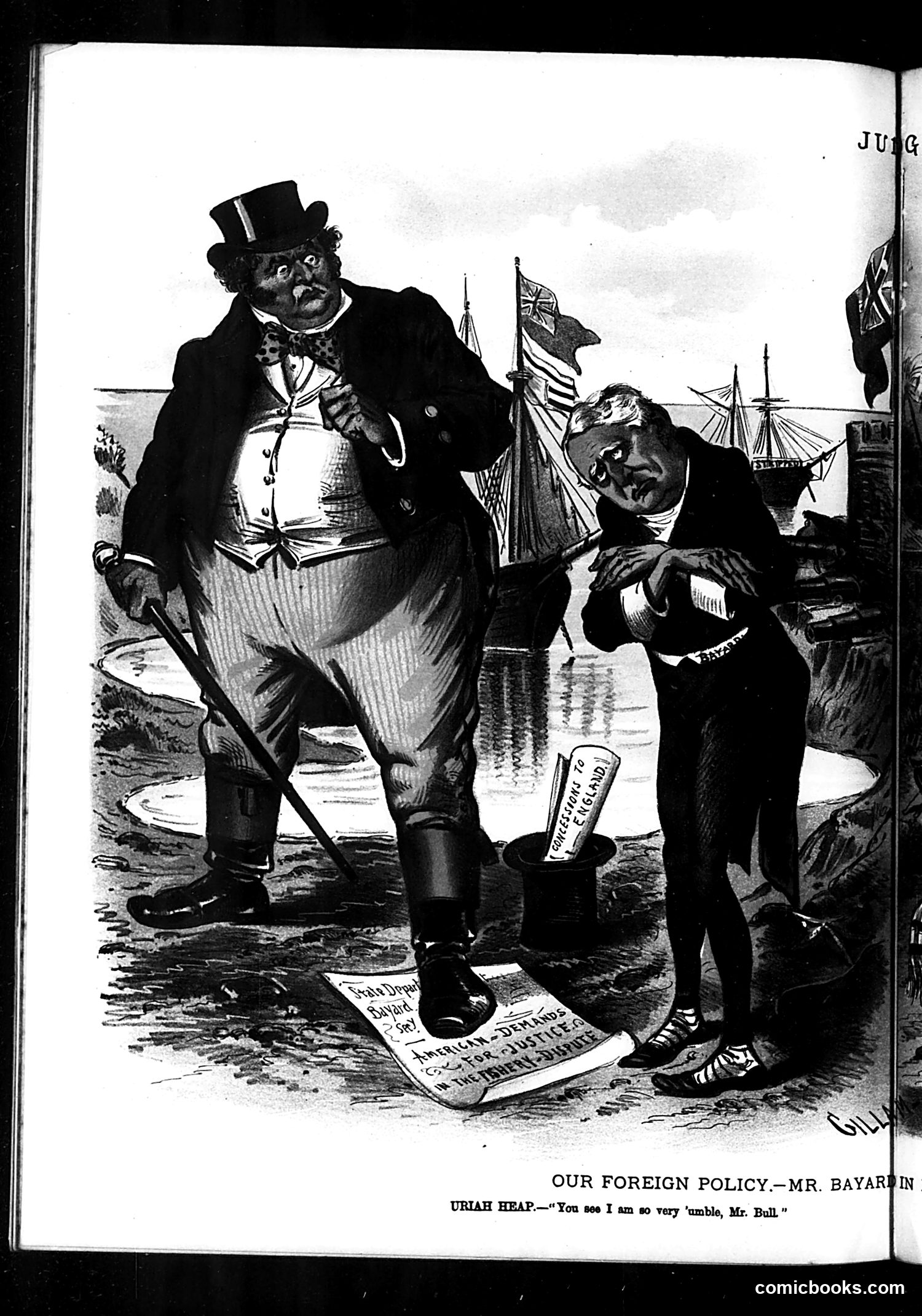
This political cartoon satirizes American foreign policy through a caricatured figure labeled "Mr. Bayar" (likely referencing a historical political figure), who adopts the persona of Uriah Heap—Charles Dickens's famously obsequious, hypocritical character known for false humility. The large figure, dressed in formal attire with a top hat, wields a shovel near what appears to be a grave or hole marked with text (partially legible). A smaller figure representing "Mr. Bull" (Britain, personified) stands nearby watching. Ships fly British flags in the background. The satire criticizes American foreign policy as deceptively humble or manipulative—presenting false modesty while actually pursuing aggressive aims. The grave imagery and tools suggest underhanded dealings or destructive intentions masked by superficial politeness, mocking the hypocrisy of American diplomatic claims versus actual conduct.
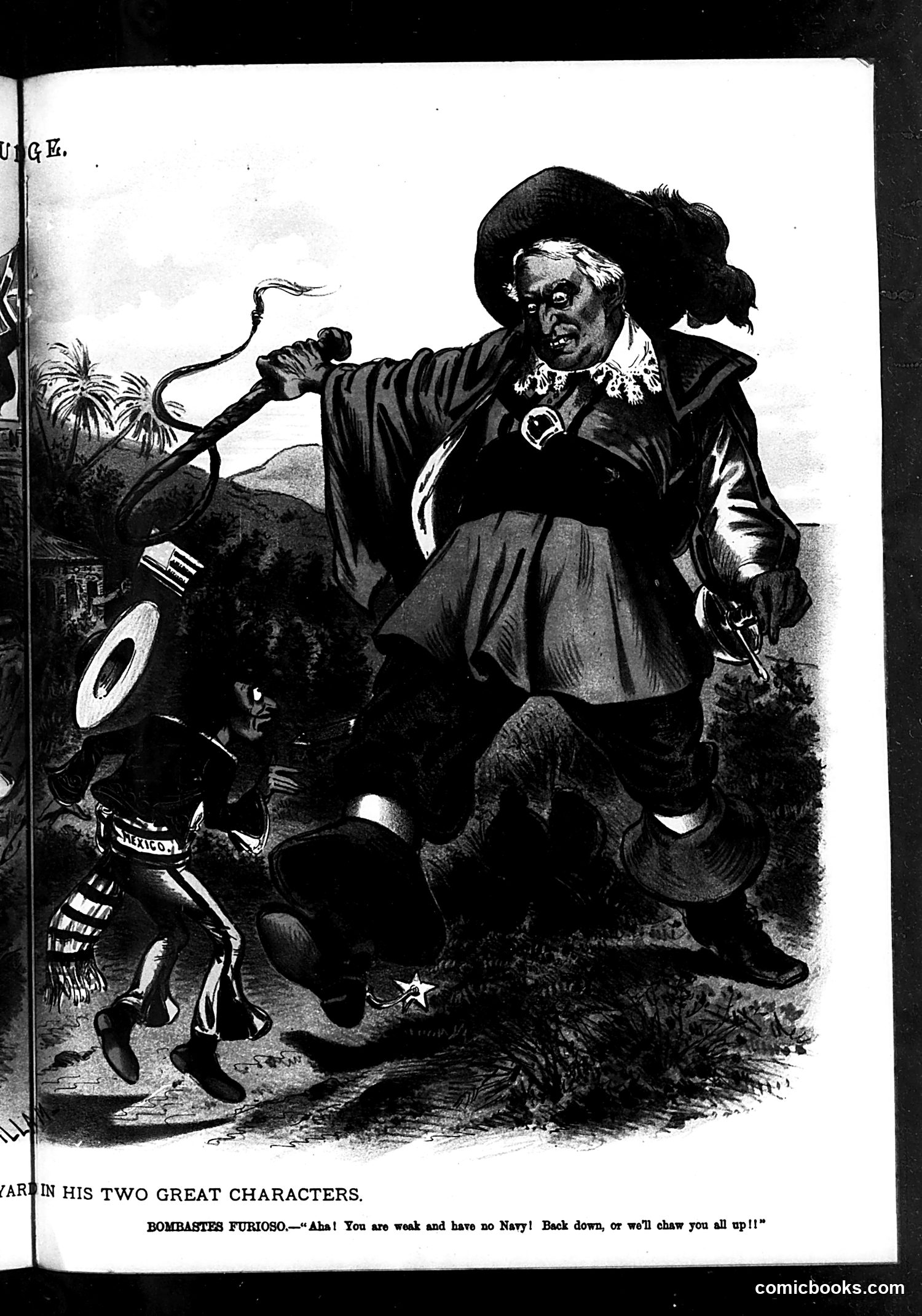
This satirical cartoon depicts a theatrical figure labeled "Bombastes Furioso" — a bombastic, aggressive character threatening someone with aggressive rhetoric about naval power. The caricature appears to exaggerate facial features in a grotesque style typical of 19th-century satirical illustration. The reference to "Bombastes Furioso" likely alludes to a theatrical character known for bluster and empty threats. The cartoon satirizes political or military posturing — someone making grandiose threats about naval superiority while adopting an aggressive, theatrical persona. The small figure being threatened appears diminished by comparison. Without knowing the specific publication date, the exact political context remains unclear, but the satire targets someone wielding inflammatory military rhetoric. The "two great characters" reference in the title suggests this depicts contrasting personalities or political positions Judge magazine was mocking during its era.
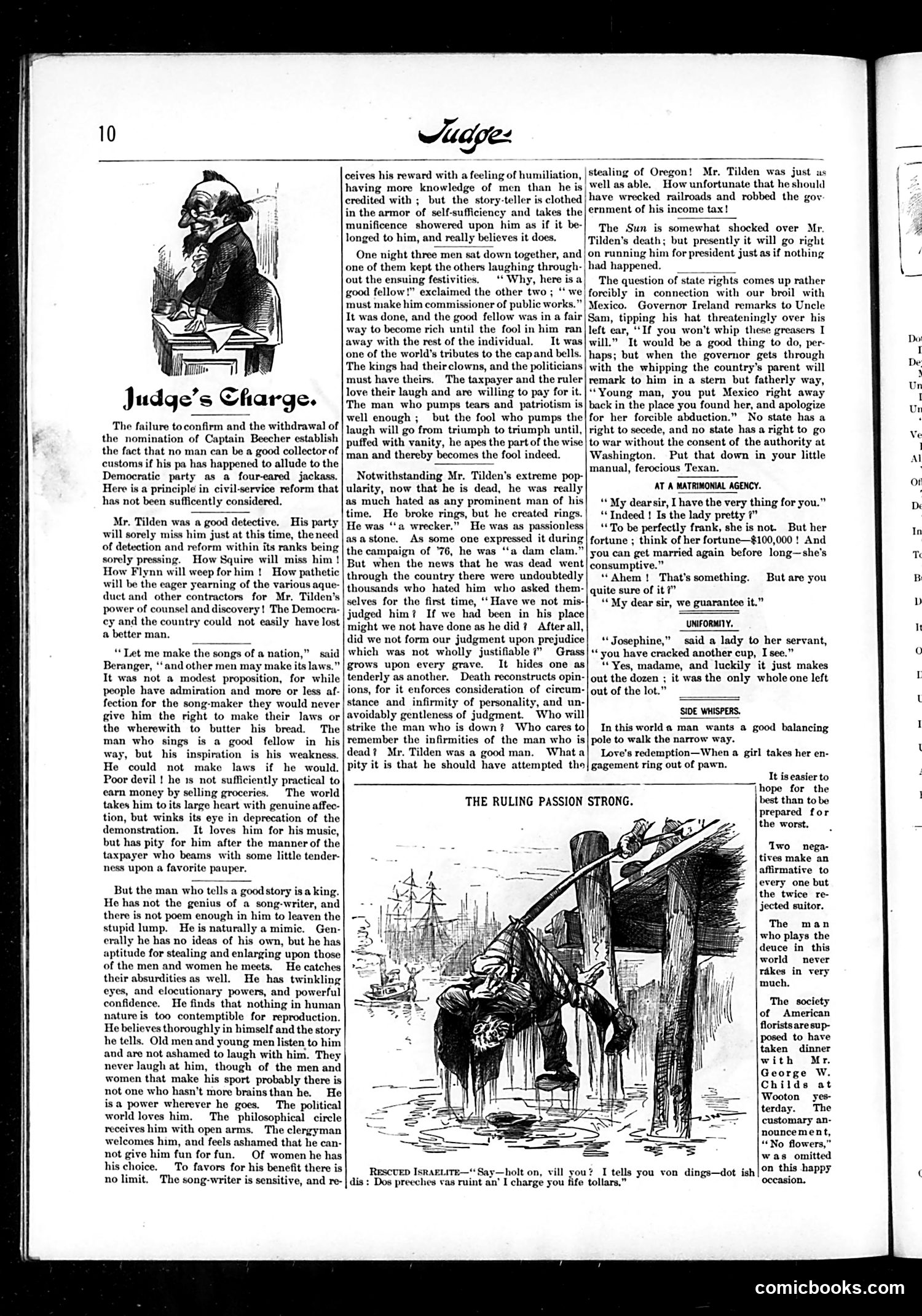
This page contains two distinct satirical pieces: **"Judge's Charge"** (main article): A commentary on civil service reform and the Beecher nomination controversy. The piece mocks both the Democratic Party's hypocrisy and the tendency of politicians to reward entertaining storytellers with government positions regardless of competence. It contrasts songwriters (presented as sensitive and humble) with storytellers (presented as confident charlatans who exploit their charm for power and wealth). The satire criticizes how political machines value entertainment and loyalty over actual ability—a person can become "commissioner of public works" merely by making politicians laugh. **"Rescued Israelite"** (illustration caption): A street scene showing someone apparently accosted by a beggar. The caption's pun about "dimes—dot ish" and "preaches vas ruint" suggests ethnic mockery of Yiddish-speaking immigrants, typical of the era's casual bigotry. The page critiques both political corruption and patronage systems of the Gilded Age.
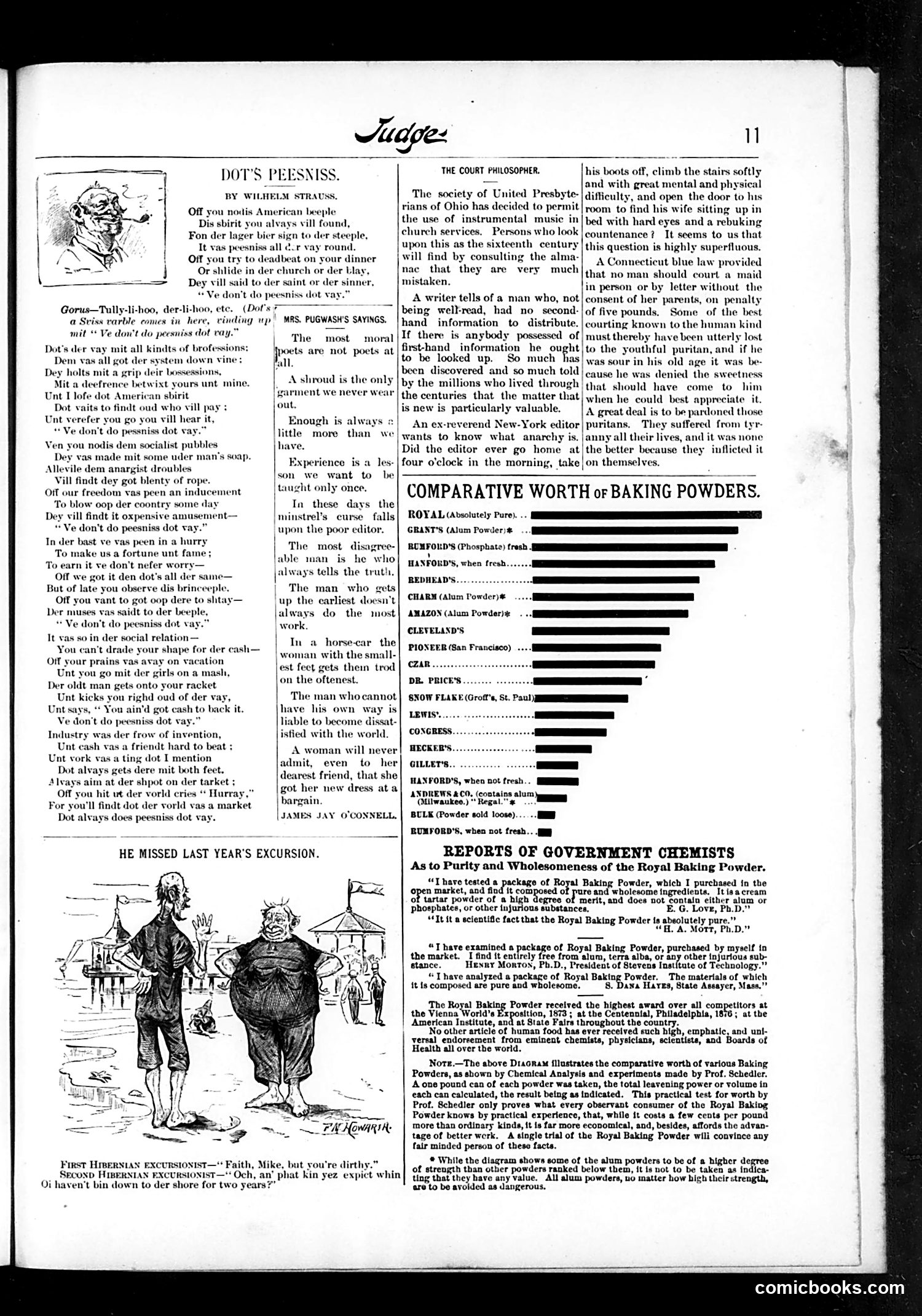
This page contains several distinct satirical elements: **"Dot's Der Vay" poem**: A dialect-heavy piece mocking German-American immigrants ("der," "vay" for "the," "way"), satirizing their assimilationist philosophy—that American business operates on the principle of "we don't do business that way," implying hypocrisy or inflexibility in social/commercial dealings. **"He Missed Last Year's Excursion" cartoon**: Two Irish immigrants (indicated by dialect: "Och," "phat kin yez expict") discuss missing a shore excursion. The humor likely plays on Irish-American stereotypes and working-class leisure activities of the era. **Supporting content**: Brief satirical observations ("Mrs. Pugwash's Sayings"), a baking powder comparison chart, and government chemistry reports praising Royal Baking Powder. The page reflects Judge's typical late-19th/early-20th-century approach: ethnic stereotyping (German and Irish accents rendered phonetically) mixed with social commentary and advertising disguised as editorial content.
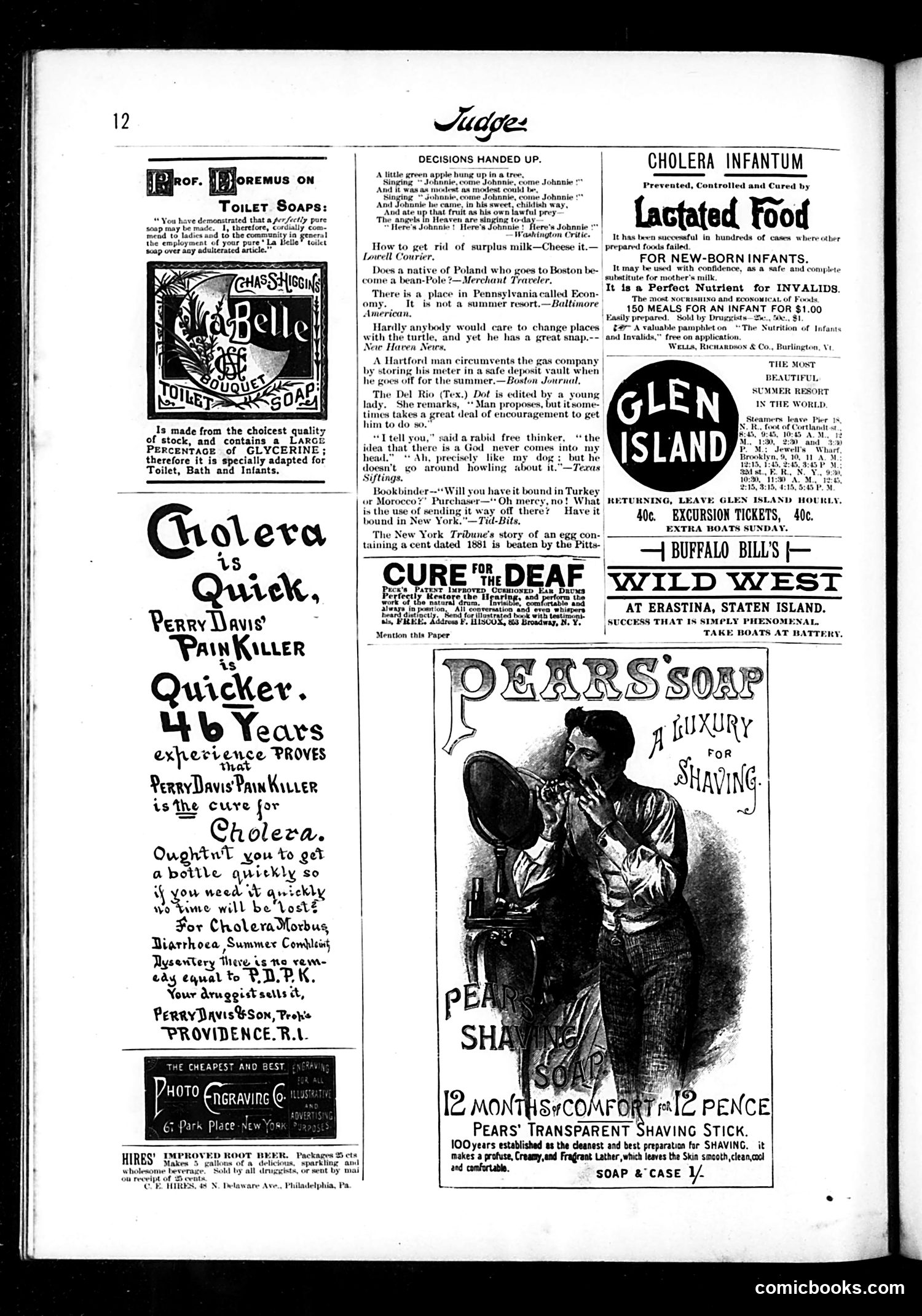
This page is primarily **advertising**, not political satire. It contains promotional materials for various patent medicines and consumer products typical of the late 19th century. The notable ads include: - **Perry Davis' Pain Killer** and similar remedies claiming to cure cholera, diarrhea, and dysentery—serious diseases of the era - **Lactated Food** for infants, marketed as a safe substitute for breast milk - **Pears' Soap** and other toiletries - **Buffalo Bill's Wild West** show at Staten Island (a touring spectacle that was genuinely popular in this period) The small section titled "Decisions Handed Up" contains brief humorous observations and puns rather than editorial cartoon commentary. **The satire is minimal here.** What's historically significant is the ads themselves—they reveal period anxieties about infant mortality, sanitation, and disease, alongside the era's marketing practices (making extravagant medical claims without FDA regulation). These ads would be illegal today, but they accurately reflect what 1880s-90s Americans actually bought and believed.
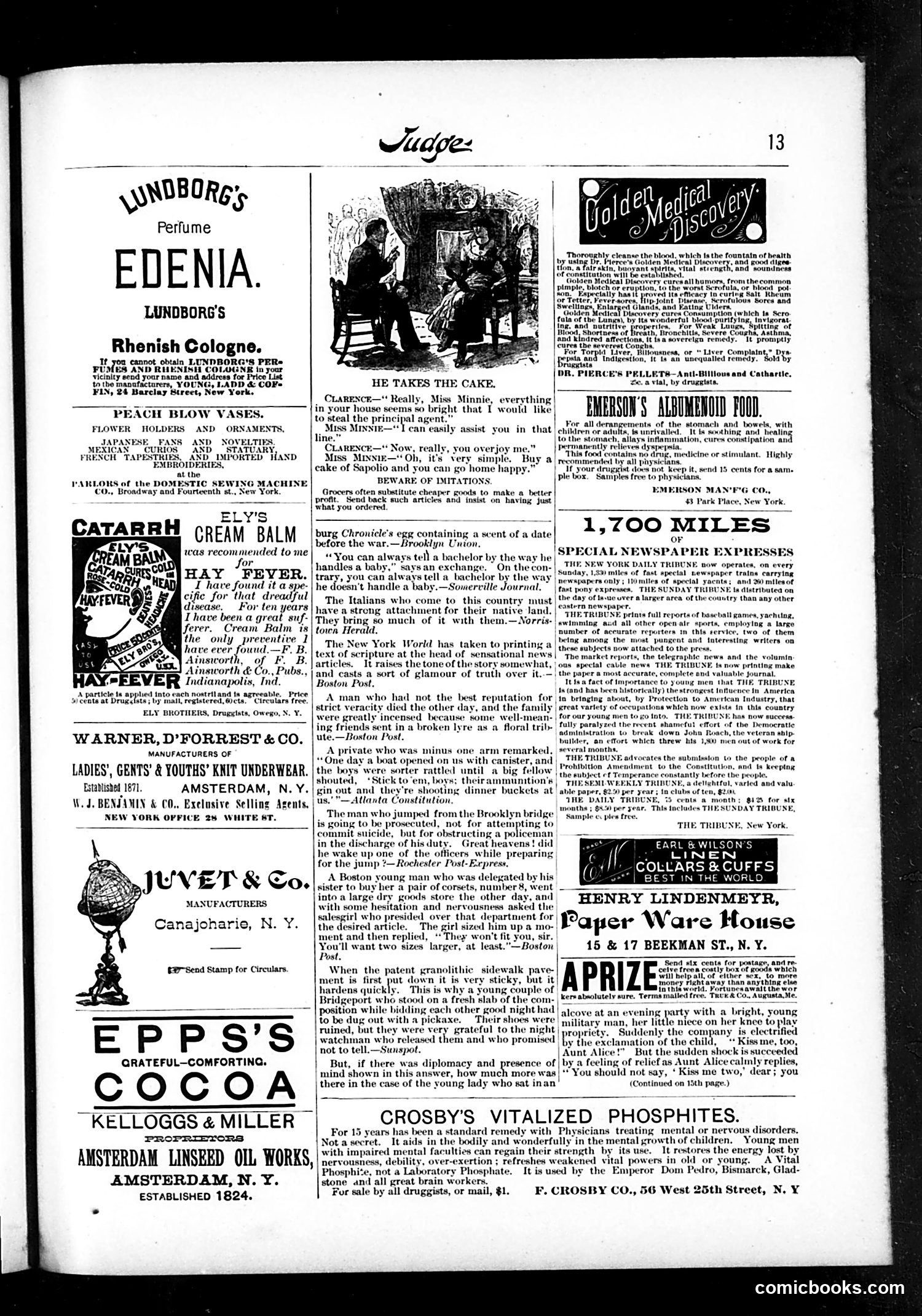
This is primarily an **advertising page** from Judge magazine, featuring numerous commercial advertisements for perfumes, medicines, home goods, and patent remedies typical of the late 19th century. The one **editorial cartoon** titled "HE TAKES THE CAKE" depicts a dialogue between Clarence and Miss Minnie. Clarence compliments her home's brightness and jokingly offers to "steal the principal agent" (her). Miss Minnie responds that the secret is simply buying **Sapolio** (a commercial cleaning cake). The joke satirizes **aggressive advertising**: the cartoon mocks how commercial products—in this case, a mundane cleaning agent—are promoted as magical solutions to domestic problems, and how such endorsements infiltrate everyday conversation. The page also includes testimonial advertisements for dubious patent medicines like Dr. Pierce's "Golden Medical Discovery" (claiming to cure everything from acne to consumption) and Crosby's "Vitalized Phosphites," which exemplify the **unregulated medical fraud** common in the era.
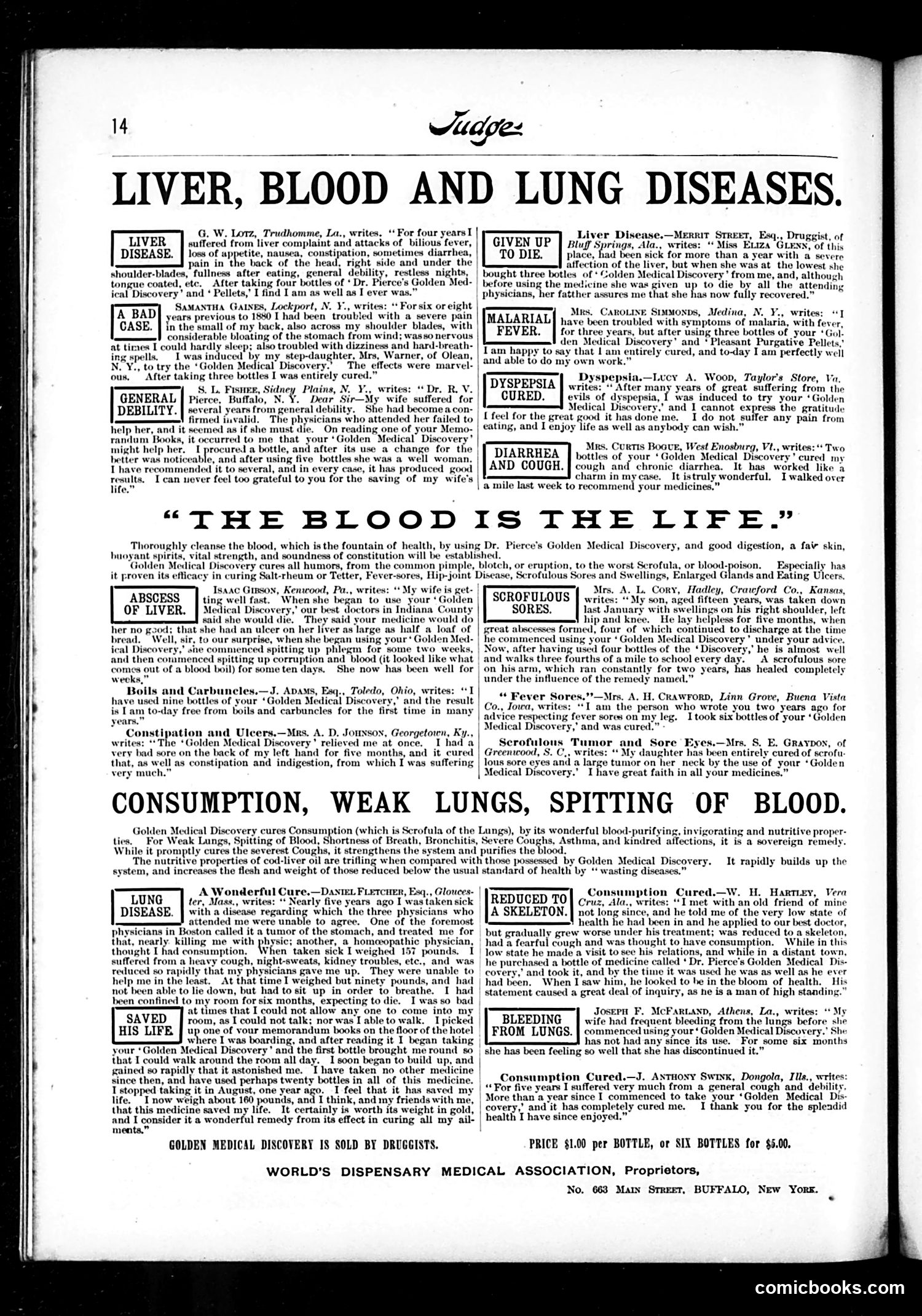
This page from Judge is **not a political cartoon or satire**—it's a full-page advertisement for "Dr. Pierce's Golden Medical Discovery," a patent medicine marketed for liver disease, blood disorders, lung problems, and consumption (tuberculosis). The page features testimonial letters from supposed users claiming miraculous cures. This was standard advertising practice in the late 19th/early 20th century, when patent medicines were heavily promoted in magazines and newspapers, often with fraudulent health claims. The irony for a modern reader: Judge was a satirical magazine, yet it accepted such advertisements. The "cures" described—including claims that the medicine saved dying patients doctors had abandoned—would be considered false advertising today. No actual medical oversight existed to verify these testimonials. The manufacturer was World's Dispensary Medical Association in Buffalo, New York. The price: $1.00 per bottle, or six bottles for $5.00.
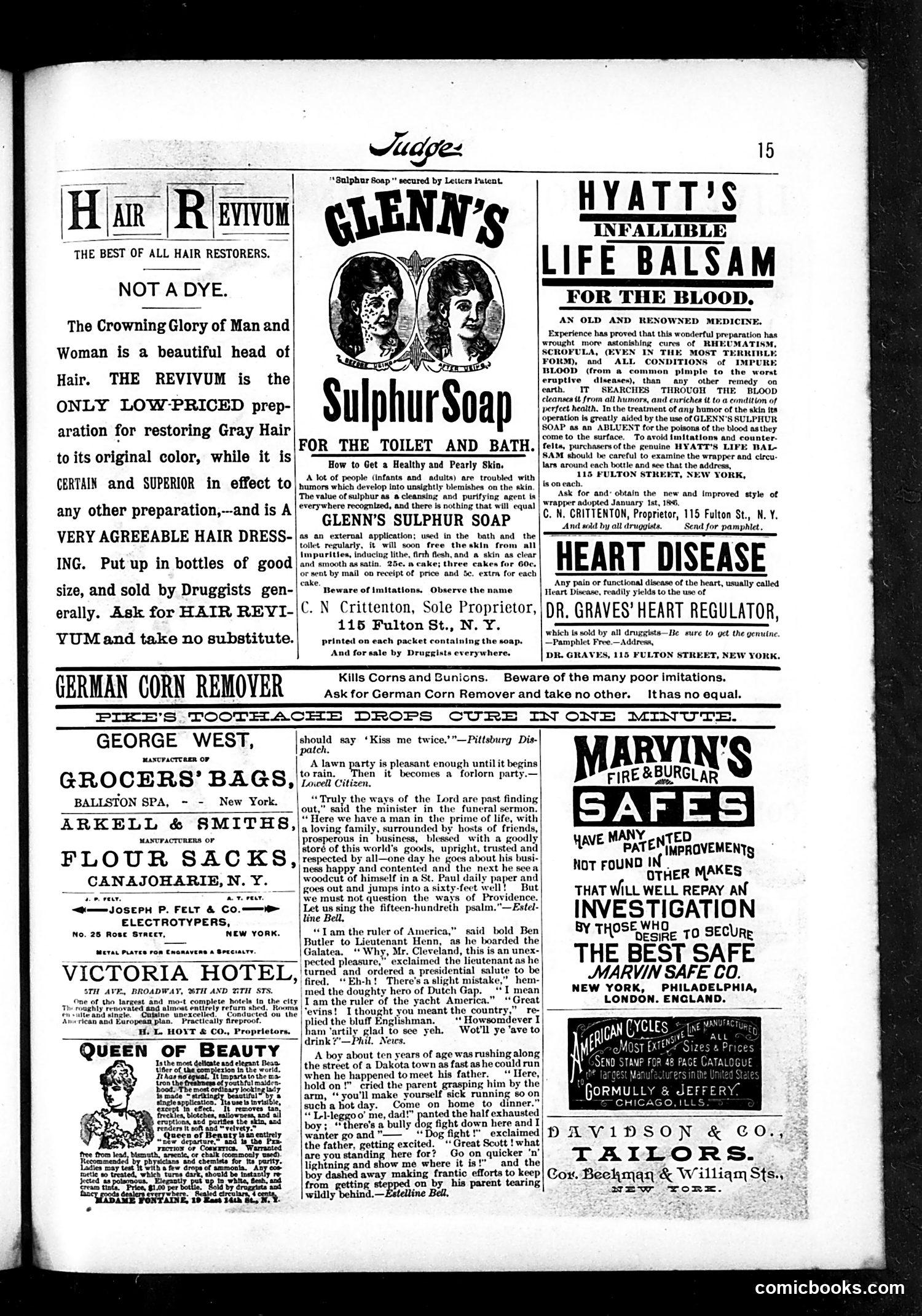
This page is predominantly **advertising** for patent medicines and commercial products typical of late 19th-century American magazines. The ads include hair restorers (Hair Revivum), blood tonics (Hyatt's Life Balsam), soap, and safes. The only satirical content appears to be brief **comic snippets** with attributed quotes: - A joke about kissing twice during rain - A comment on lawn parties becoming "forlorn" when it rains - A funeral sermon joke about divine Providence and an unexpectedly prosperous man's death These are mild social humor rather than political satire. The "Queen of Beauty" illustration on the left appears to be decorative advertising copy. The page reflects Judge's business model: satirical magazine content subsidized by extensive patent medicine advertisements—many making dubious health claims (blood purifiers, heart regulators) that would face FDA scrutiny today. This was standard for American periodicals of this era.
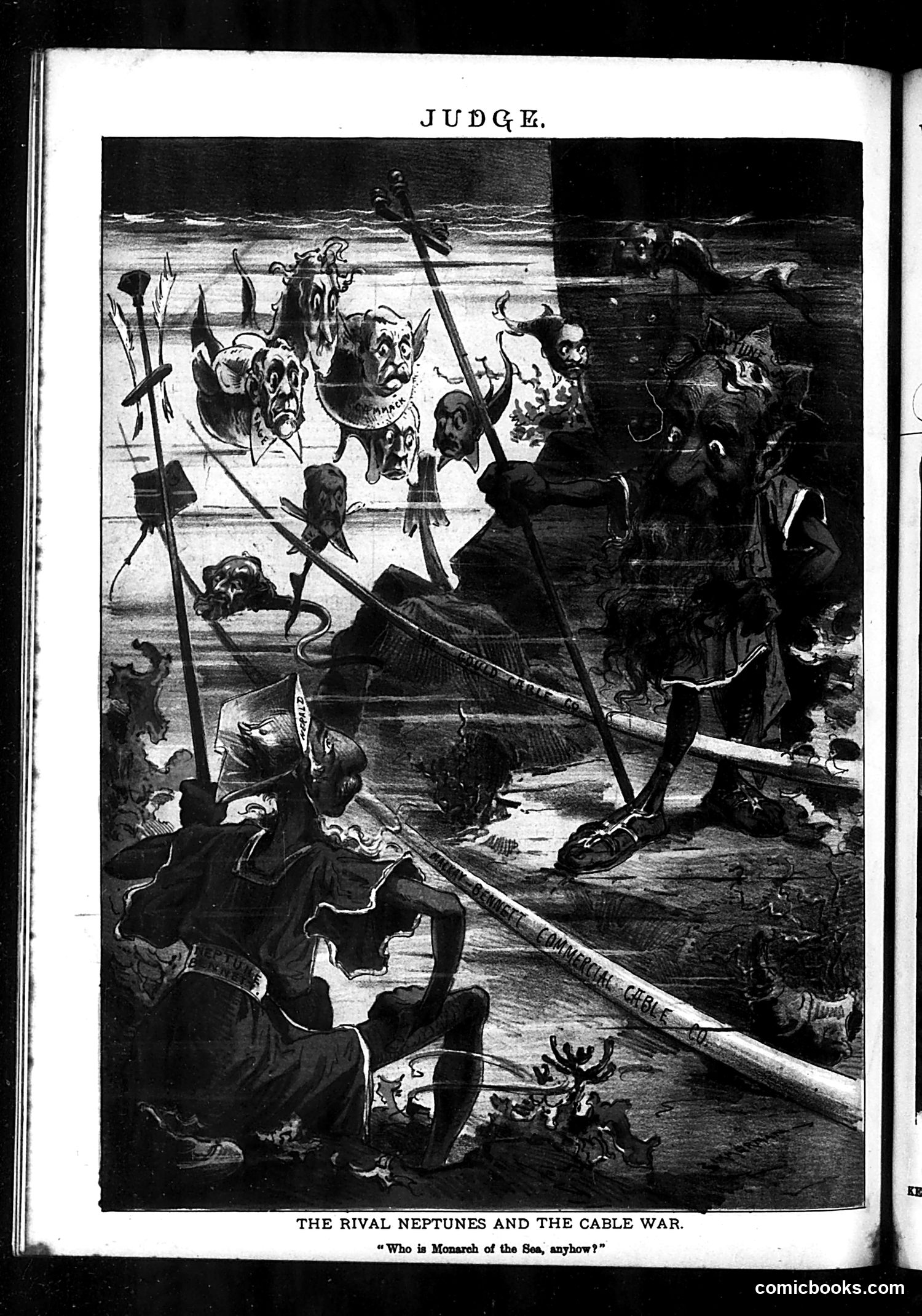
This satirical cartoon depicts a underwater battle between competing figures representing rival powers in the transatlantic telegraph cable competition. The image shows what appear to be Neptune-like figures (identifiable by tridents and crowns) engaged in conflict, with various demonic or aggressive creatures surrounding them. The "Cable War" refers to late 19th-century competition over submarine telegraph cables connecting Europe and America. The cartoon's central question—"Who is Monarch of the Sea, anyhow?"—satirizes the economic and imperial rivalry between nations (likely Britain and America) fighting for control over this vital telecommunications infrastructure. The grotesque creatures and violent imagery mock the intensity of this commercial competition, suggesting it resembled actual warfare despite being about technological/economic dominance.