
Judge, 1886-08-21 · page 10 of 16
Judge — August 21, 1886 — page 10: what you’re looking at
What you’re looking at
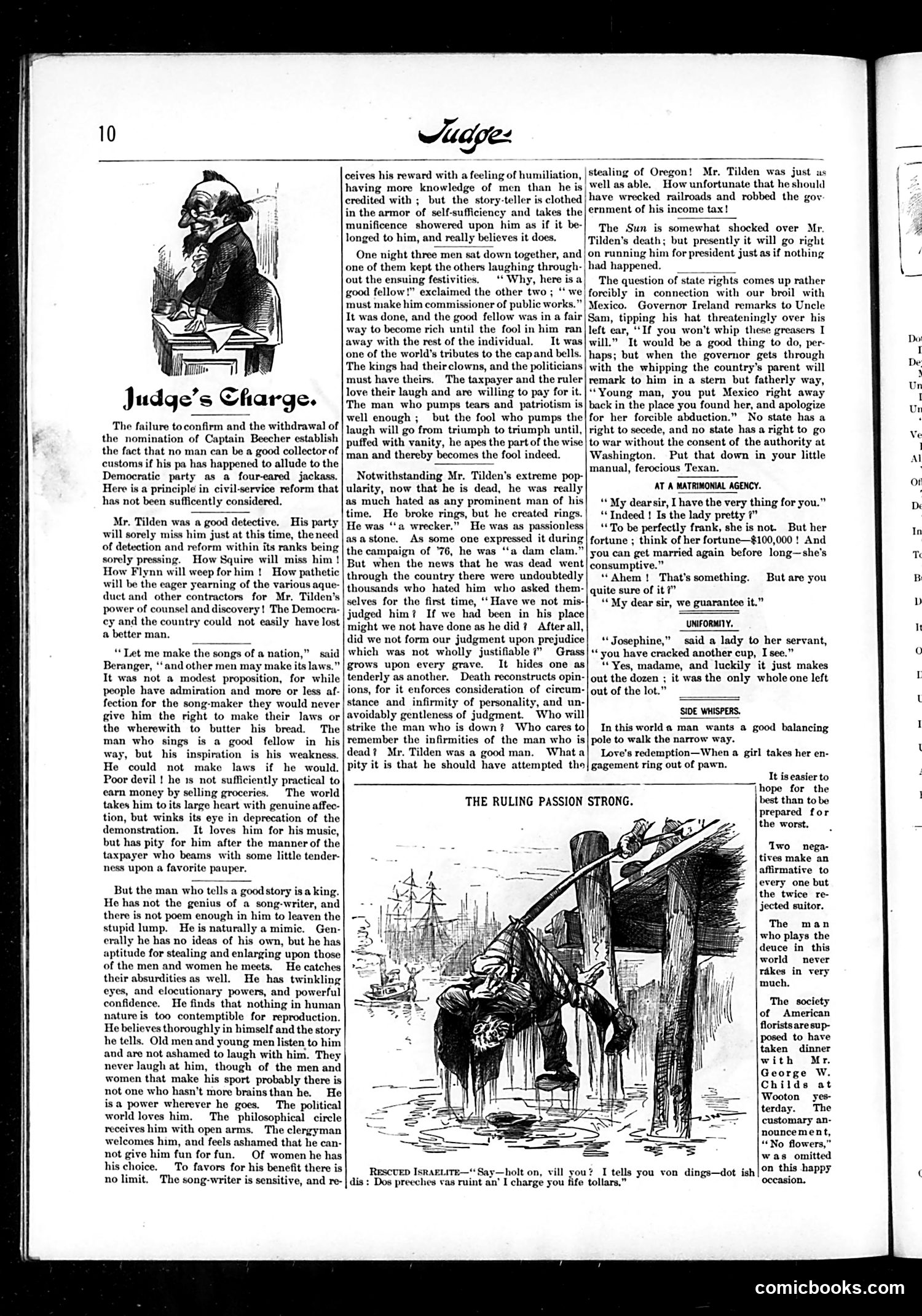
This page contains two distinct satirical pieces: **"Judge's Charge"** (main article): A commentary on civil service reform and the Beecher nomination controversy. The piece mocks both the Democratic Party's hypocrisy and the tendency of politicians to reward entertaining storytellers with government positions regardless of competence. It contrasts songwriters (presented as sensitive and humble) with storytellers (presented as confident charlatans who exploit their charm for power and wealth). The satire criticizes how political machines value entertainment and loyalty over actual ability—a person can become "commissioner of public works" merely by making politicians laugh. **"Rescued Israelite"** (illustration caption): A street scene showing someone apparently accosted by a beggar. The caption's pun about "dimes—dot ish" and "preaches vas ruint" suggests ethnic mockery of Yiddish-speaking immigrants, typical of the era's casual bigotry. The page critiques both political corruption and patronage systems of the Gilded Age.
📄 Transcribed text from this page (OCR, searchable)
Machine-transcribed from the original scan — historical spelling and the odd misread are preserved.
Judge’s Charge. The failure toconfirm and the withdrawal of the nomination of Captain Beecher establish the fact that no man can be a good collector of customs if his pa has happened to allude to the Democratic party as a four-eared jackass. Here is a principle in civil-service reform that has not been sufficently considered. Mr. Tilden was a good detective. His party will sorely miss him just at this time, the need of detection and reform within its ranks being sorely pressing. How Squire will miss him ! How Flynn will weep for him !| How pathetic will be the eager yearning of the various aque- duct and other contractors for Mr. Tilden’s power of counsel and discovery! The Democra- cy and the country could not easily have lost a better man. “Let me make the songs of a nation,” said Beranger, ‘and other men may make its laws.” It was not a modest proposition, for while people have admiration and more or less af- fection for the song-maker they would never give him the right to make their laws or the wherewith to butter his bread. The man who sings is a good fellow in his way, but his inspiration is his weakness. He could not make laws if he would. Poor devil ! he 18 not sufficiently practical to carn money by selling groceries. The world takes him to its large heart with genuine affec- tion, but winks its eye in deprecation of the demonstration. It loves him for his music, but has pity for him after the manner of the taxpayer who beams with some little tender- ness upon a favorite pauper. But the man who tells a good story isa king. He has not the genius of a song-writer, and there is not poem enough in him to leaven the stupid lump. He is naturally a mimic. Gen- erally he has no ideas of his own, but he has aptitude for stealing and enlarging upon those of the men and women he meets, He catches their absurdities as well. He has twinkling eyes, and elocutionary powers, and powerful confidence. He finds that nothing in human nature is too contemptible for reproduction. He believes thoroughly in himself and the story he tells. Old men and young men listen to him and are not ashamed to laugh with him. They never Jaugh at him, though of the men and women that make his sport probably there is not one who hasn't more brains than he. He isa power wherever he goes. The political world loves him. The philosophical circle receives him with open arms, The clergyman welcomes him, and feels ashamed that he can- not give him fun for fun. Of women he has his choice. To favors for his benefit there is no limit. The song-writer is sensitive, and re- ceives his reward with a feeling of humiliation, | stealing of Oregon! Mr. Tilden was just as having more knowledge of men than he is| Well as able. How unfortunate that he should credited with ; but the story-teller is clothed) in the armor of self-sufficiency and takes the munificence showered upon him as if it be- longed to him, and really believes it does, One night three men sat down together, and) one of them kept the others laughing through- out the ensuing festivities, ‘* Why, here is a good fellow!” exclaimed the other two ; ‘ we must make him commissioner of public works.” It was done, and the good fellow was in a fair) way to become rich until the fool in him ran away with the rest of the individual. It was one of the world’s tributes to the capand bells. The kings had their clowns, and the politicians must have theirs. The taxpayer and the ruler love their laugh and are willing to pay for it. The man who pumps tears and patriotism is well enough ; but the fool who pumps the laugh will go from triumph to triumph until, puffed with vanity, he apes the part of the wise man and thereby becomes the fool indeed. Notwithstanding Mr. Tilden’s extreme pop- ularity, now that he is dead, he was really as much hated as any prominent man of his time. He broke rings, but he created rings. He was ‘a wrecker.” He was as passionless asastone. As some one expressed it during the campaign of '76, he was “a dam clam.” But when the news that he was dead went through the country there were undoubtedly thousands who hated him who asked them- selves for the first time, ‘Have we not mis- judged him? If we had been in his place might we not have done as he did? After all, did we not form our judgment upon prejudice which was not wholly justifiable?” Grass grows upon every grave. It hides one as tenderly as another. Death reconstructs opin- ions, for it enforces consideration of circum- stance and infirmity of personality, and un- avoidably gentleness of judgment. Who will strike the man who is down? Who cares to remember the infirmities of the man who is dead? Mr. Tilden was a good man. Whata | Mexico. pity it is that he should have attempted tho have wrecked railroads and robbed the gov: ernment of his income tax! The Sun is somewhat shocked over Mr. Tilden’s death; but presently it will go right on running him for president just as if nothing had happened. The question of state rights comes up rather forcibly in connection with our broil with Governor Ireland remarks to Uncle Sam, tipping his hat threateningly over his left ear, “If you won't whip these greasers I will.” It would be a good thing to do, per- haps; but when the governor gets through with the whipping the country’s parent will remark to him in a stern but fatherly way, “Young man, you put Mexico right away back in the place you found her, and apologize for her forcible abduction.” No state has a right to secede, and no state has a right to go to war without the consent of the authority at Washington. Put that down in your little manual, ferocious Texan. ‘AT A MATRIMONIAL AGENCY. “My dearsir, [have the very thing for you.” “Indeed ! Is the lady pretty #” “To be perfectly frank, she is not. But her fortune ; think of her fortune—$100,000 ! And you can get married again before long—she's consumptive.” “Ahem ! That's something. quite sure of it 7” “My dear sir, we guarantee it.” But are you UNIFORMITY, “Josephine,” said a lady to her servant, “ you have cracked another cup, I see.” “Yes, madame, and luckily it just makes out the dozen ; it’ was the only whole one left out of the lot.” SIDE WHISPERS, In this world a man wants a good balancing pole to walk the narrow way. Love's redemption—When a girl takes her en- gagement ring out of pawn. It is easier to THE RULING PASSION STRONG. Rescvep IsraktiTe—“Say—holt on, vill you? I tells you von dings—dot ish dis: Dos preeches vas ruint an’ I charge you fife tollars.” jhope for the best than tobe prepared for the worst. ‘Iwo nega tives make an affirmative to every one but the twice re- jected suitor. The man who plays the deuce in this world never rakes in very much. The society of American florists are sup- posed to have taken dinner with Mr George W. Childs at Wooton yes- terday. The customary an- nouncement, “No flowers,” was omitted on this happy occasion. comicbooks.com