
A complete issue · 18 pages · 1886
Judge — July 17, 1886
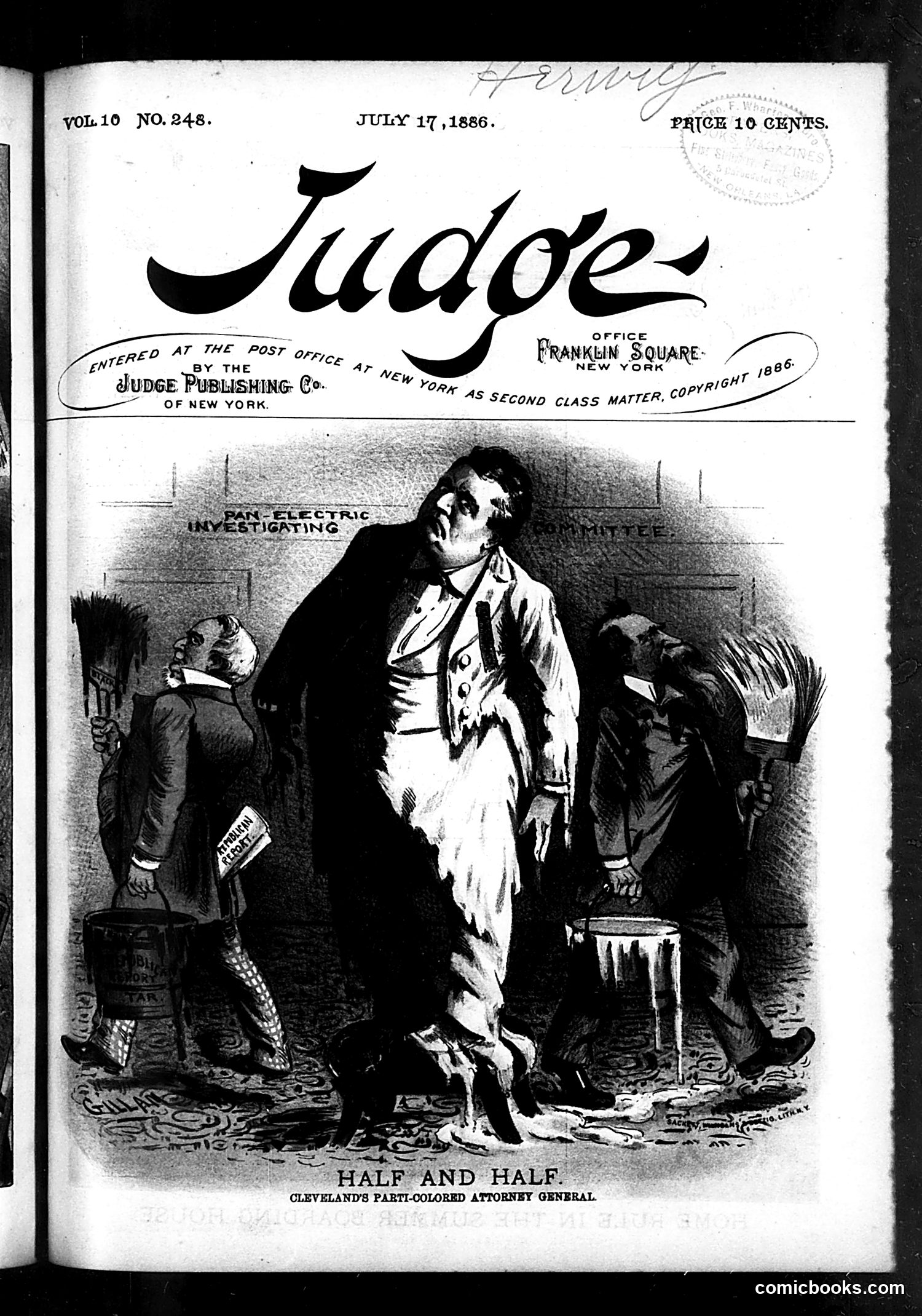
This 1886 *Judge* cartoon satirizes Attorney General Augustus Garland under President Cleveland's administration. The title's crude pun refers to Garland's alleged racial compromise or hypocrisy—likely commenting on his Southern background and positions on race during Reconstruction's aftermath. The central figure appears distressed or conflicted, flanked by smaller figures representing different political or racial constituencies pulling in opposite directions. The "Pan-Electric Investigating" text visible in the background suggests this relates to a specific scandal or investigation, possibly the Pan-Electric telephone company controversy. The cartoon mocks Garland as attempting to satisfy incompatible political factions—a common satirical trope for politicians perceived as unprincipled or evasive on divisive issues of the era.
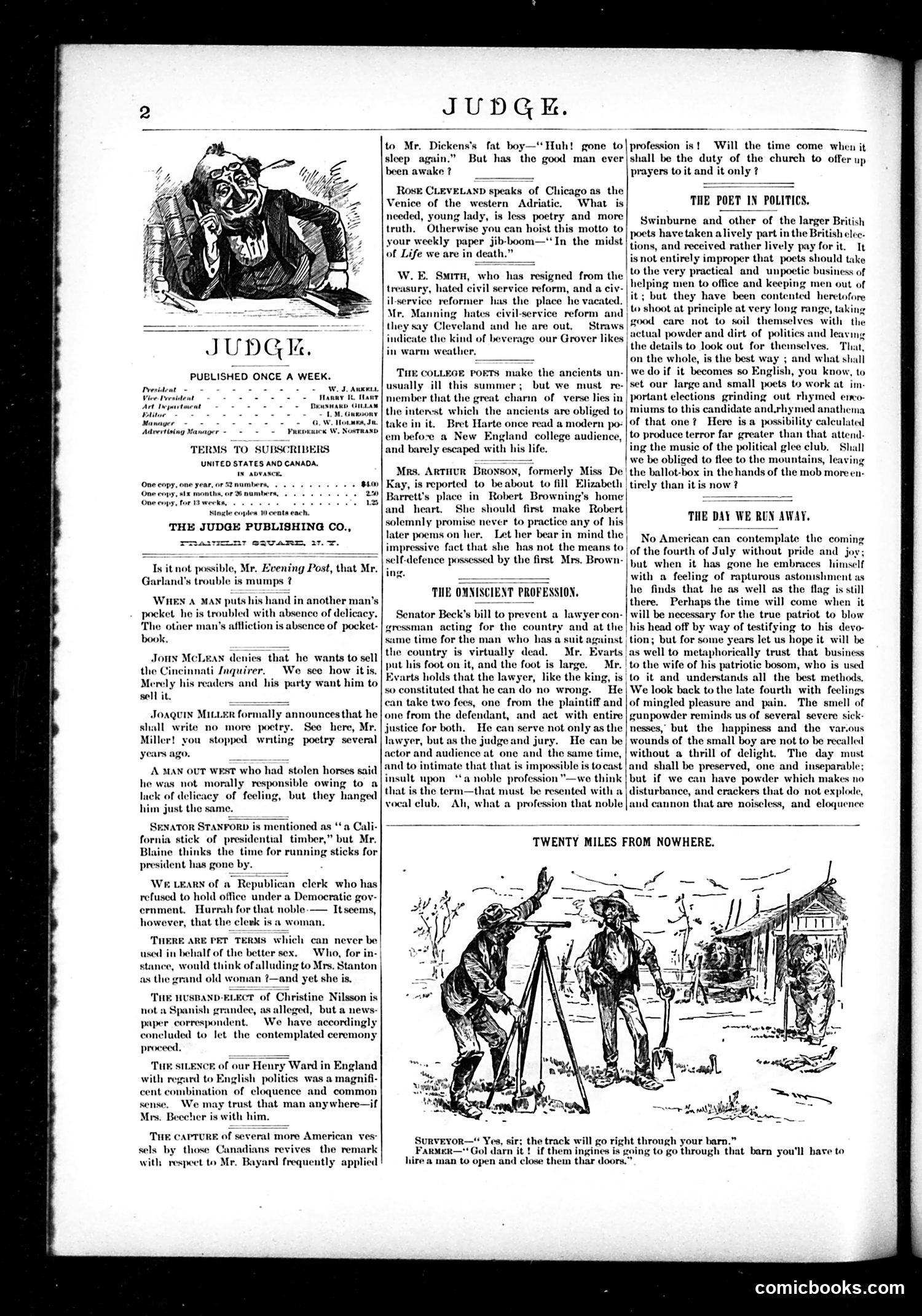
This page contains several brief satirical commentaries and one cartoon titled "TWENTY MILES FROM NOWHERE." The main cartoon depicts a surveyor showing a farmer a surveying instrument, with the farmer objecting that if the survey line goes through his barn, he'll need to hire someone to open and close the barn doors. This is rural humor about the inconvenience of property surveys to farmers. The text sections mock various targets: a "fat boy" reference (unclear), Cleveland's Venice comparison, college poets entering politics, and professional acting. There's also commentary on refusing to hold public office under a Democratic administration (suggesting partisan resistance). The overall tone is typical Judge satire—poking fun at political pretension, rural attitudes, and professional affectation through brief, comedic observations rather than sustained political argument.
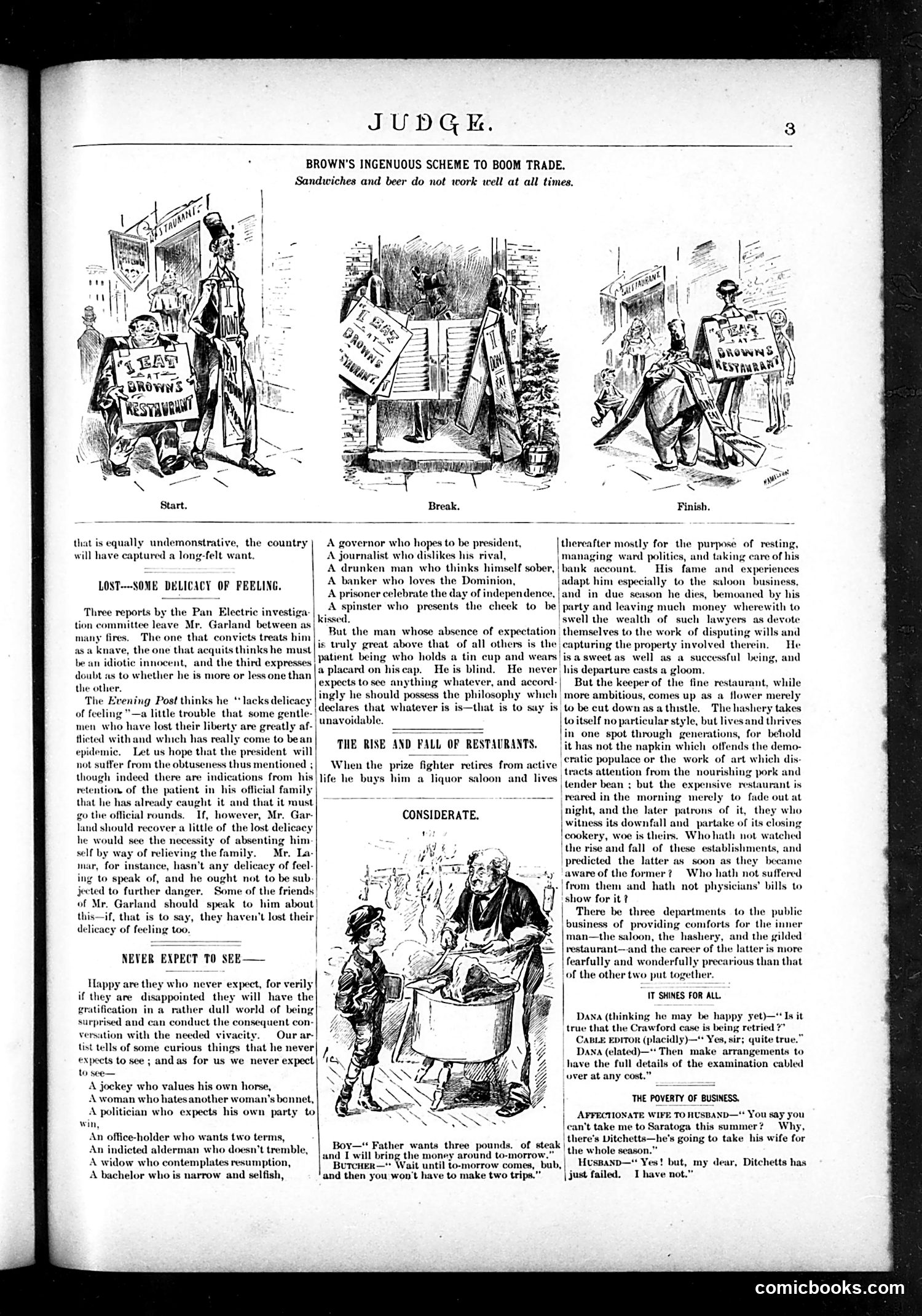
This three-panel cartoon satirizes a failed business strategy. The sequence shows a man (Brown) attempting to stimulate trade by operating a restaurant serving "sandwiches and beer." The title's subtitle notes these items "do not work well at all times." The cartoon contrasts two types of dining establishments: the modest, enduring "hashery" that thrives through generations without pretense, versus the expensive restaurant built on fancy presentations that inevitably fails and closes. The accompanying text uses this as social commentary—suggesting that honest, unpretentious business succeeds while ostentatious ventures collapse. The satire appears to critique both business overconfidence and class-based assumptions about commerce. The lower illustration ("Considerate") shows a separate domestic scene, unrelated to the main cartoon's point about restaurant economics. This reflects Judge magazine's typical editorial stance: mocking failed schemes and championing practical over grandiose approaches to American enterprise.
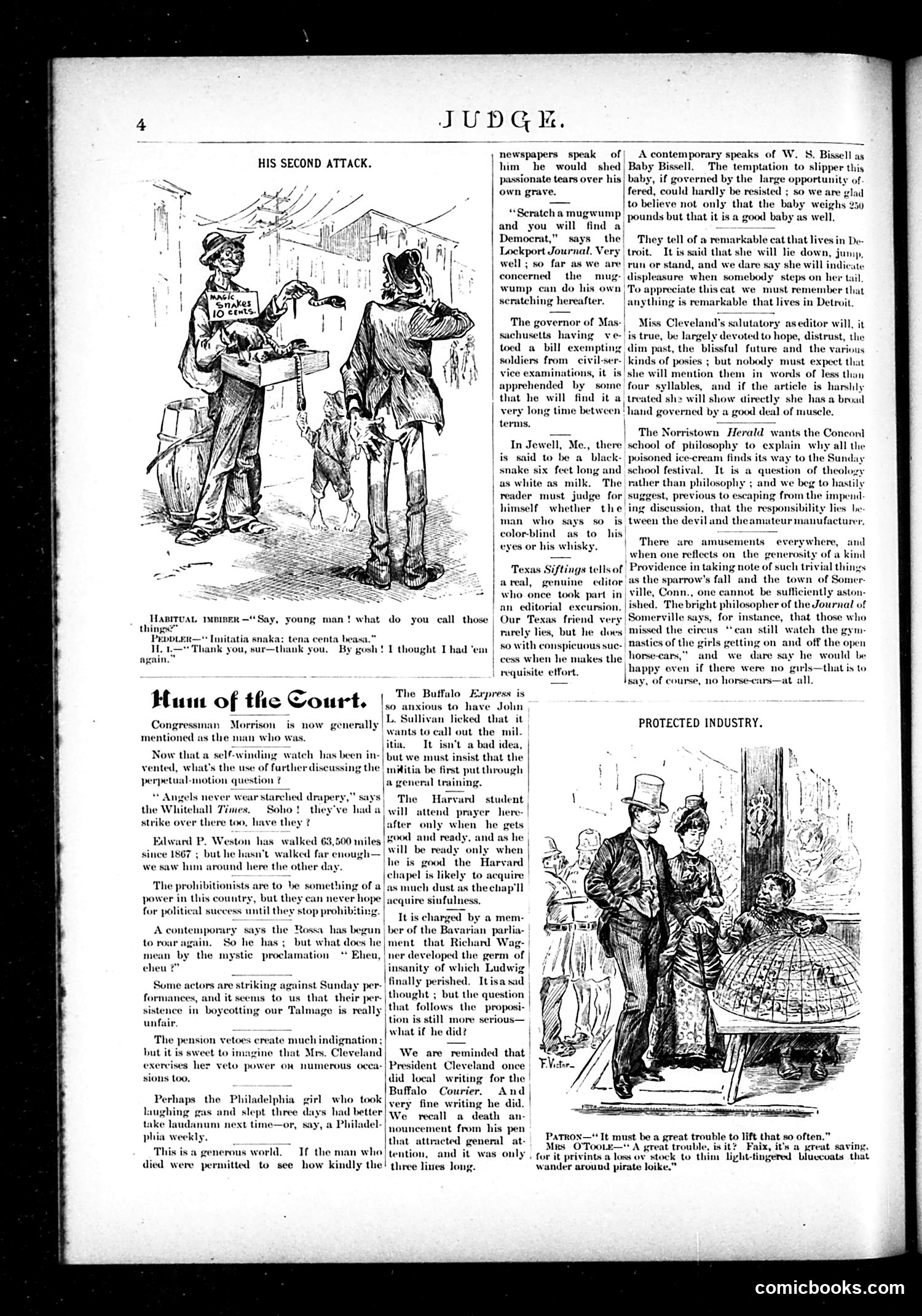
This page contains several brief satirical commentary pieces and two cartoons typical of Judge's style. **"His Second Attack"** (left cartoon): Shows a man and woman in confrontation. The text references a Massachusetts governor who vetoed a bill exempting soldiers from service examinations—the "attack" being his veto. The satire mocks both the governor's action and the soldiers' complaints. **"Hum of the Court"** (center column): A collection of short jabs at various figures and events. References include criticism of Congressman Morrison, Edward P. Weston (famous pedestrian), prohibitionists, and mentions of "Mrs. Cleveland" exercising political veto power—likely Frances Cleveland, wife of President Grover Cleveland, whose influence the writer finds troubling. **"Protected Industry"** (right cartoon): Depicts what appears to be industrial or manufacturing figures, though the specific satire is unclear from the visible text. The overall tone is typical 1880s-90s American political humor: irreverent, gossipy, and focused on mocking public figures' minor actions and personal lives.
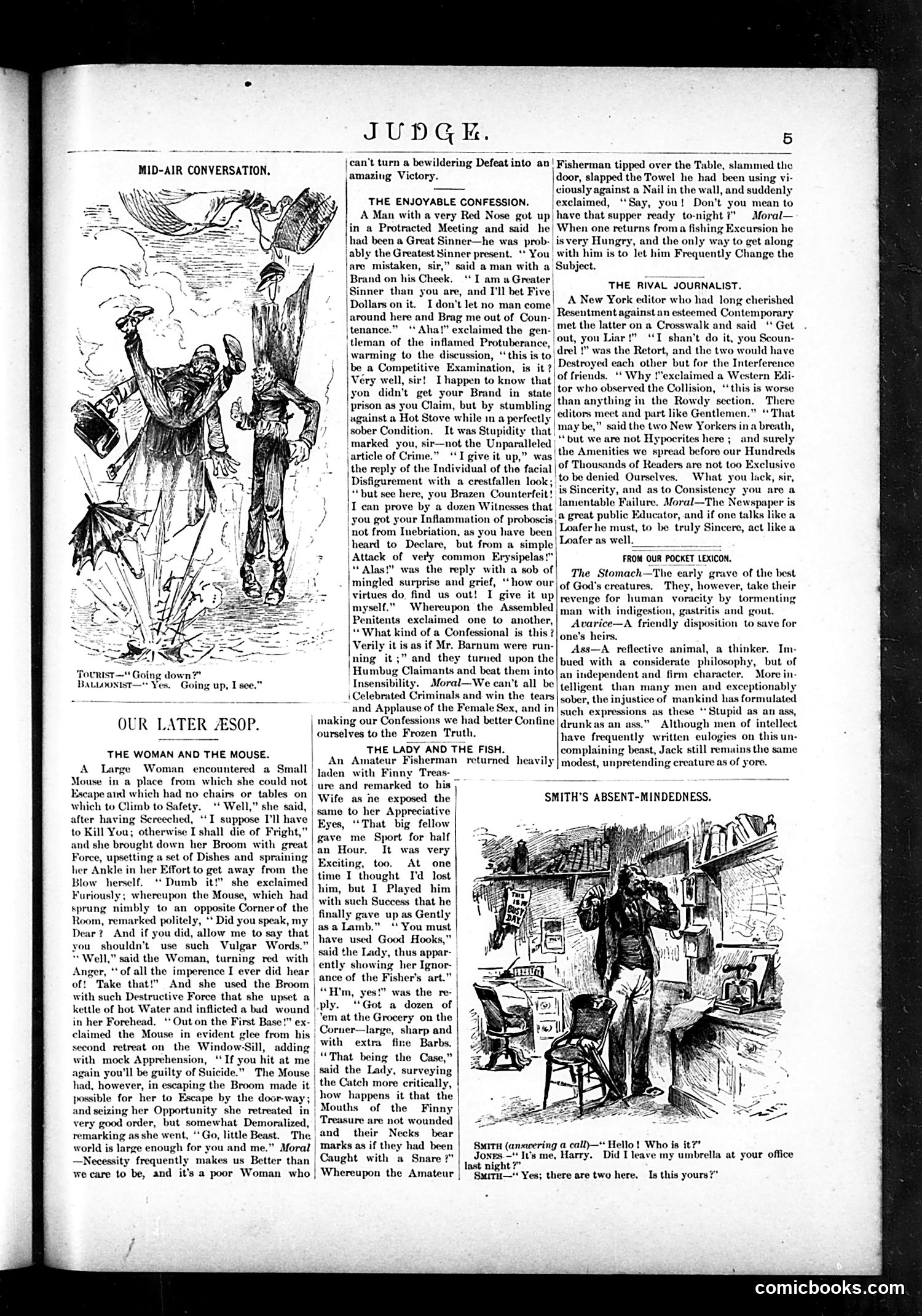
This page contains three separate satirical pieces typical of Judge magazine's moral fables format: **"Mid-Air Conversation"** (top cartoon): Two figures argue mid-air about whose "brand" (facial mark/scar) indicates greater sinfulness. One claims a prison scar; the other reveals it's actually from a hot stove accident and erysipelas (skin disease). The satire mocks competitive boasting about vice and the absurdity of false criminal pretense—people exaggerating their wickedness for social status. **"The Woman and the Mouse"** (Aesop-style fable): A woman repeatedly attacks a mouse with a broom, injuring herself instead while the mouse escapes unharmed. Moral: desperation sometimes forces better behavior than we'd choose willingly. **"The Lady and the Fish"** and **"Smith's Absent-Mindedness"** (bottom sections): Domestic humor vignettes about a fisherman's irritability and lost umbrellas. These pieces exemplify Judge's satirical approach: using exaggerated scenarios and absurd logic to mock human vanity, domestic pretension, and social hypocrisy through supposed moral lessons.
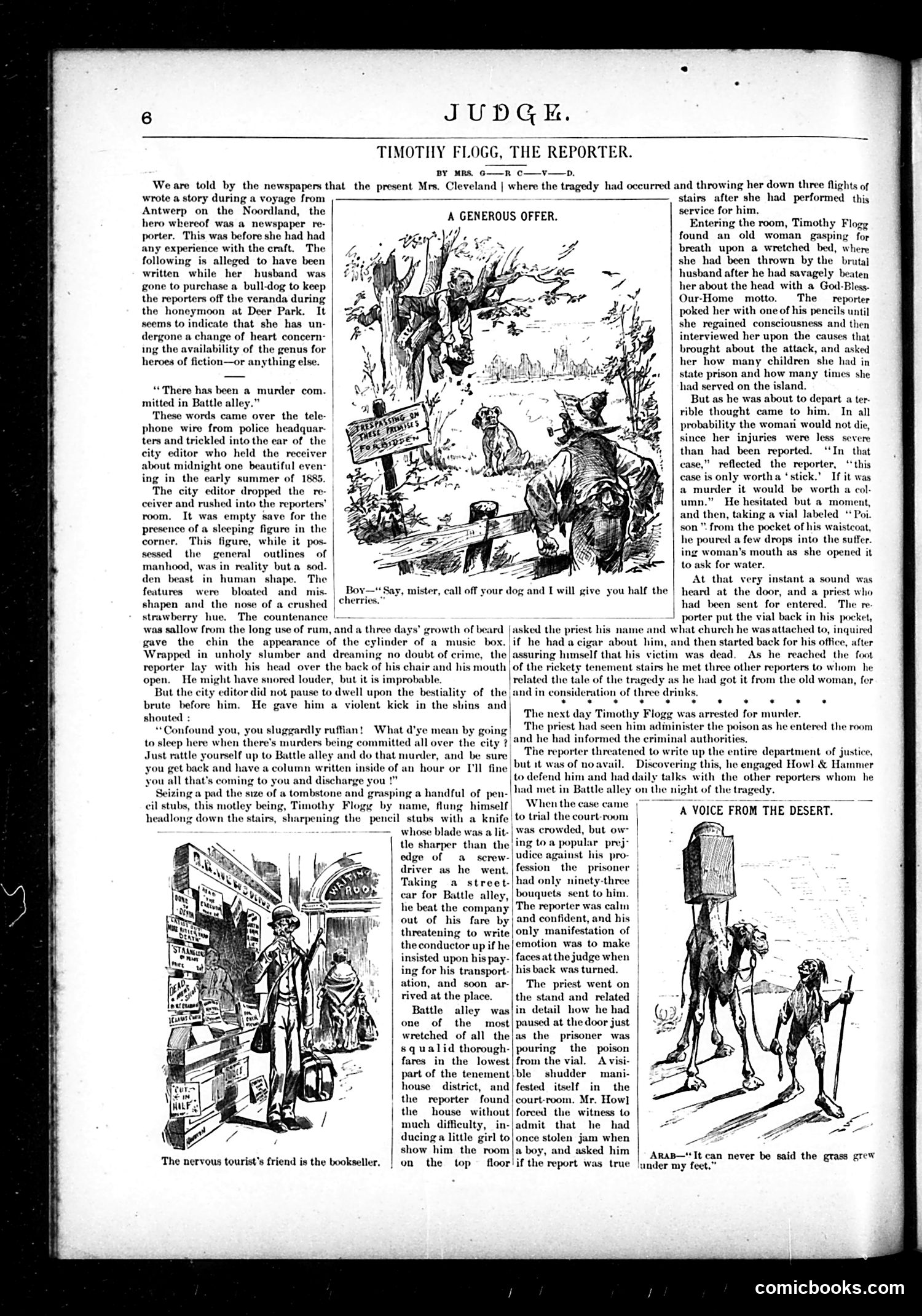
This story mocks newspaper reporters of the 1880s as ruthless, unethical opportunists. The protagonist, Timothy Flogg, represents the archetypal sensationalist journalist: slovenly, drunken, and morally bankrupt. The satire centers on Flogg's visit to a brutalized woman in a tenement. Rather than simply reporting her tragedy, he actively *worsens* it—poisoning her with strychnine from his pocket to create a more profitable "murder" story (worth a full column rather than a mere "stick" of print). He then invents details while interviewing a priest, fabricating quotes to sell papers. The piece satirizes how newspapers prioritize sensational content and profit over truth or human suffering. The reference to Mrs. Cleveland writing a reporter story likely provides contemporary context—poking fun at both her and the profession itself for glamorizing such unethical conduct.
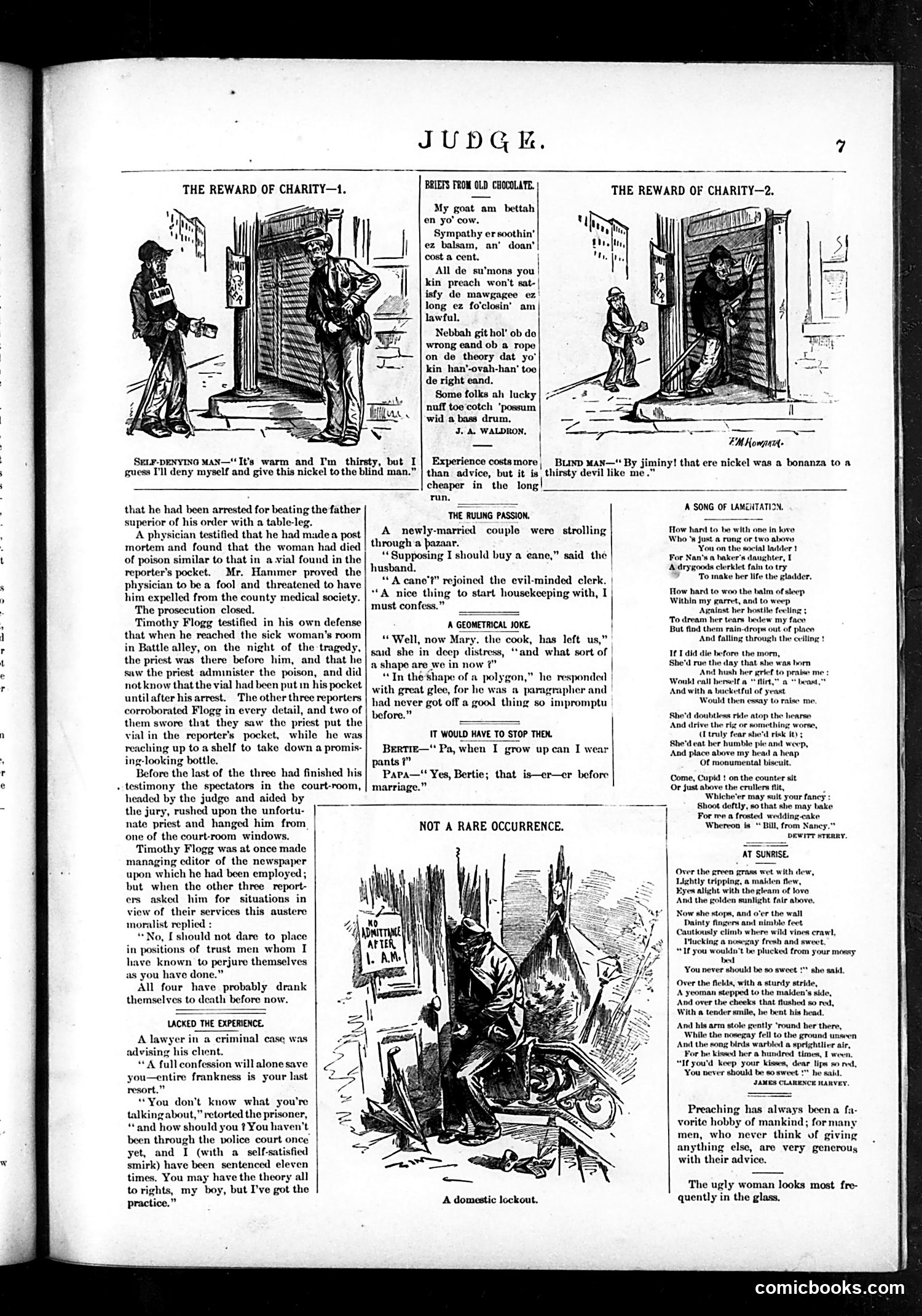
This page from *Judge* (a 19th-century American satirical magazine) presents several disconnected humorous items typical of the publication's format. **"The Reward of Charity" (two-panel cartoon):** Satirizes the irony of charity. A self-denying man gives his nickel to a blind beggar; the beggar immediately uses it to get drunk, becoming a "thirsty devil." The joke mocks both naive charitable impulses and the supposed moral failings of the poor. **"The Ruling Passion" and other brief jokes:** Quick punchlines about marriage, geometry wordplay, and children—standard Victorian humor with no specific political reference. **The longer text piece about Timothy Flogg:** A satirical narrative about a newspaper reporter who commits perjury to frame a priest for murder, then becomes managing editor. When asked for jobs by his co-conspirators, he self-righteously refuses, claiming moral principle. The satire targets hypocrisy and corruption in journalism and the legal system. **Overall tone:** This appears to be a miscellaneous humor page with no unified theme—typical of *Judge*'s format mixing illustrations, verses, and short satirical pieces targeting Victorian social pretensions and institutional corruption.
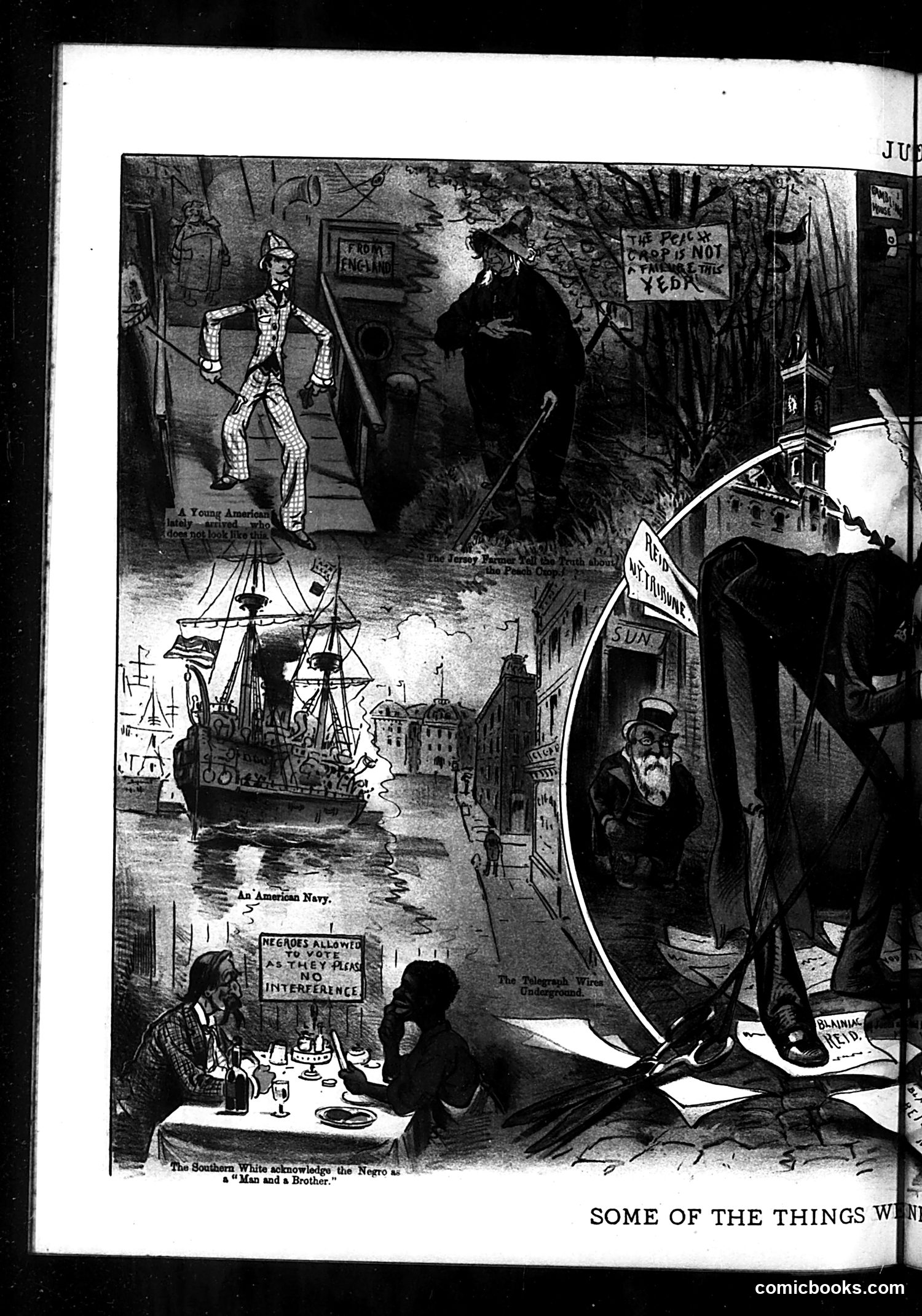
This appears to be a multi-panel satirical composition critiquing American race relations and political interference. The top panels show figures in period costume (likely representing colonial/founding era America) alongside modern scenes. One panel references "The Peace of Europe is NOT safe while" (text partially visible), suggesting concerns about international stability. Another panel shows "An American Navy" with a ship, and text about "Negroes allowed to vote" and "Foreign interference." The bottom caption reads: "The Southern White acknowledges the Negro as a 'Man and a Brother.'" The overall satire appears to mock the disconnect between American ideals of equality and actual treatment of Black Americans, particularly regarding voting rights and political participation during the Jim Crow era. The historical costume figures contrast sharply with these contemporary racial and political conflicts.
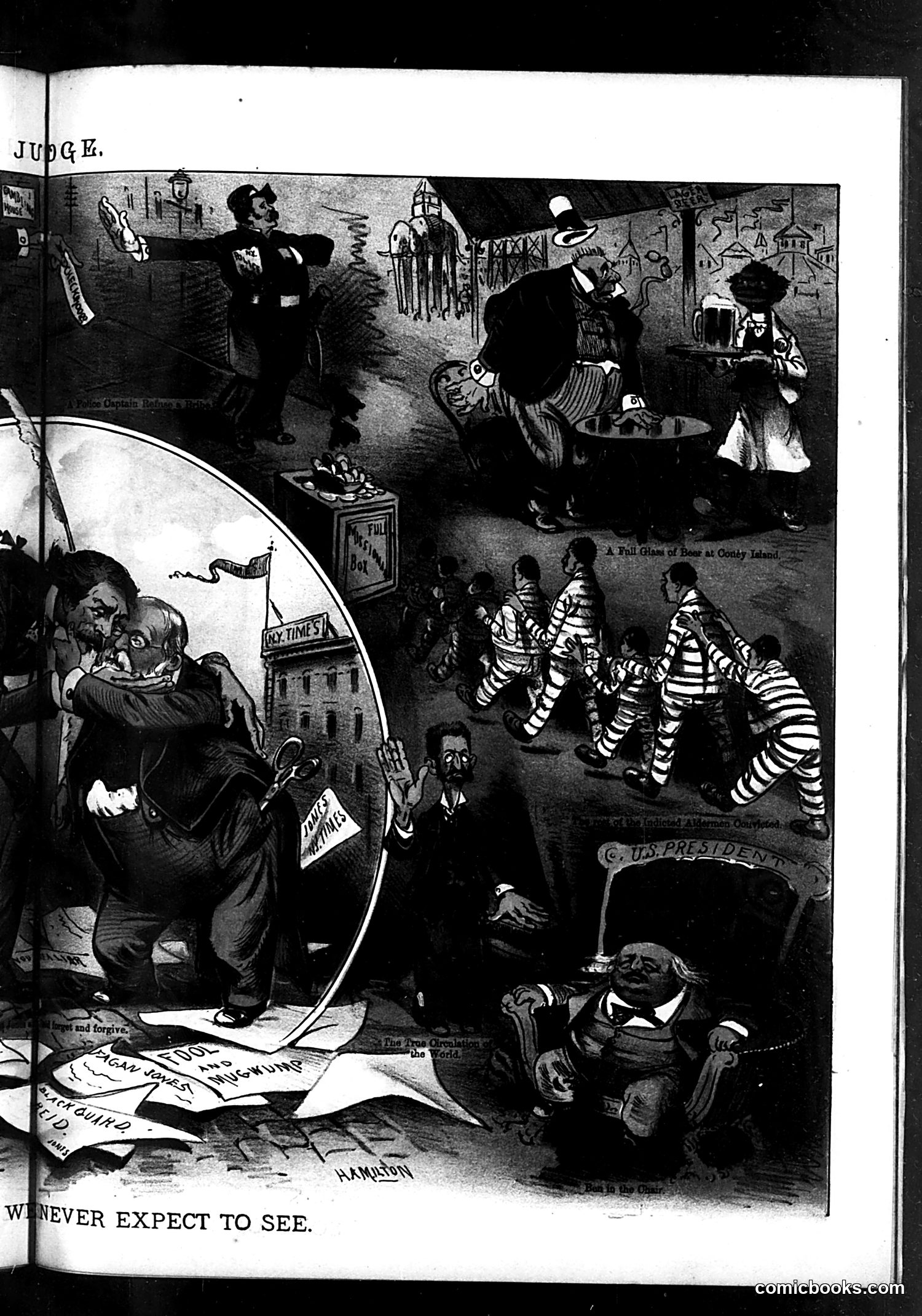
This satirical cartoon depicts an imagined courtroom or judicial scene where figures in striped prison uniforms (suggesting convicted criminals) appear before a judge. The composition contrasts wealthy or powerful men in formal dress with imprisoned figures, suggesting ironic commentary on selective justice—the cartoon's title implies that seeing wealthy or prominent people actually imprisoned is something readers should never realistically expect. The various vignettes in the upper portion appear to show different scenarios of corruption or misconduct. Without clearer identification of specific labeled figures, the general point seems to be critiquing the perception that America's legal system protects the powerful from consequences while ordinary citizens face imprisonment.
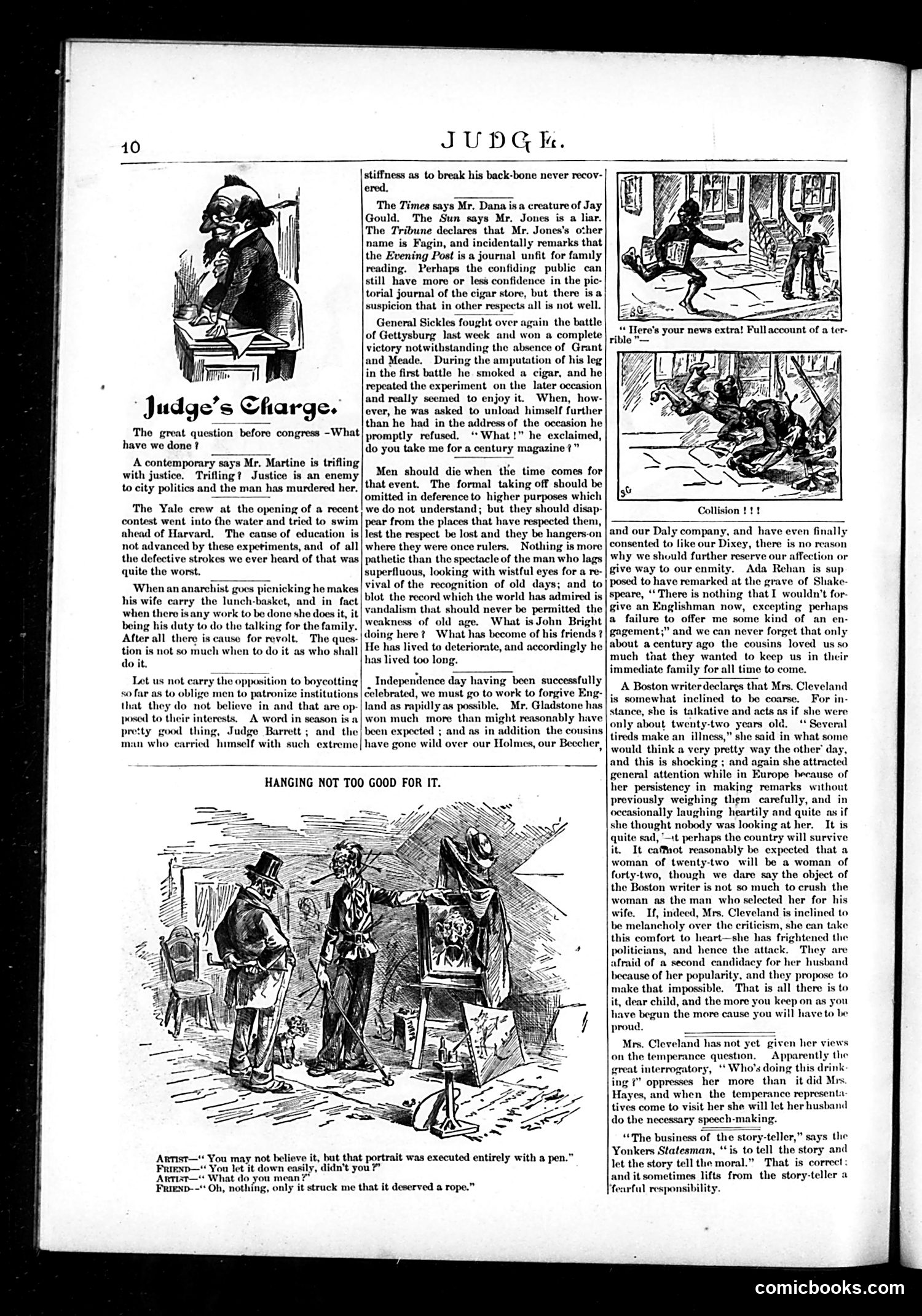
This page from **Judge** contains several disconnected satirical commentary pieces typical of the magazine's format: **"Judge's Charge"** mocks competing New York newspapers (Times, Sun, Tribune, Evening Post) for making contradictory accusations against public figures—a jab at partisan journalism's credibility. **"Hanging Not Too Good for It"** is a visual joke: an artist defends a portrait executed "entirely with a pen," but the friend suggests it deserves hanging by rope instead—wordplay on both artistic execution and the gallows, implying the artwork is so bad it deserves death. The text also includes satirical notes on General Sickles (mocking his repeated recounting of Gettysburg), John Bright's deteriorating reputation, post-Independence Day reconciliation with England, and various social observations. The cartoons feature Victorian-era engravings depicting street scenes. Without bylines visible, specific authorship is unclear. Overall, this represents **Judge's** characteristic blend of political commentary, press criticism, and visual humor aimed at educated American readers circa late 1800s.
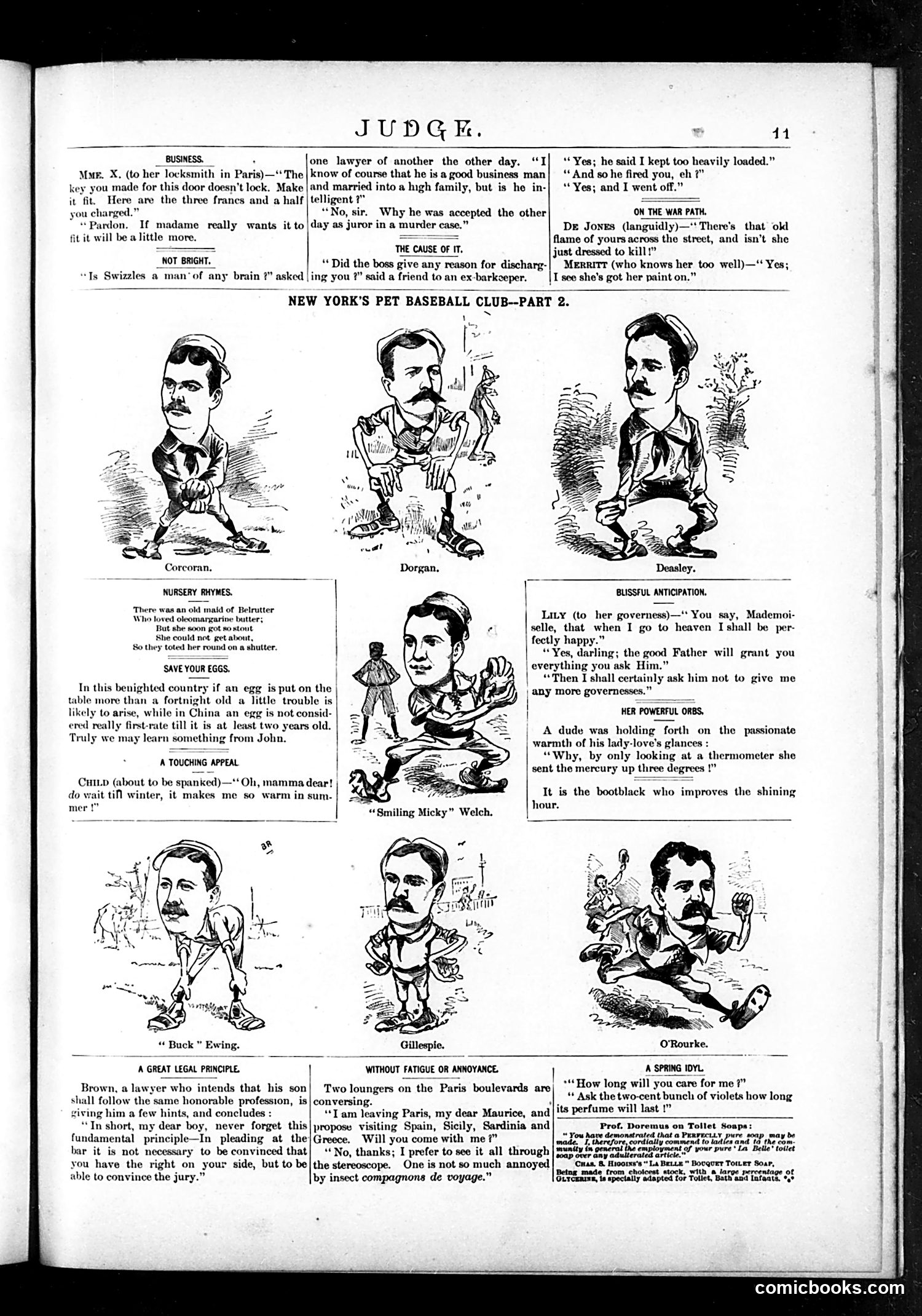
This page from *Judge* magazine contains several short humor pieces and caricatures of baseball players from New York's team (Part 2 of a series). **The Baseball Caricatures**: The top and bottom sections feature exaggerated drawings of players named Corcoran, Dorgan, Deasley, "Buck" Ewing, Gillespie, and O'Rourke—apparently well-known figures to contemporary readers, rendered in the grotesque style typical of sports satire. **The Humor Pieces**: The page includes various jokes and quips mocking: - A locksmith in Paris over a faulty lock - A bartender fired for being "too heavily loaded" (drunk) - A woman's appearance and makeup - A governess whom a child wants to escape in heaven - Lawyers and their principles - Courtship and romance **The Satire**: Most jokes target vanity, incompetence, and social pretension. The humor is gentle, domestic, and relies on puns and wordplay rather than political commentary. This reflects *Judge's* mixed content—entertainment and advertising alongside occasional political satire.
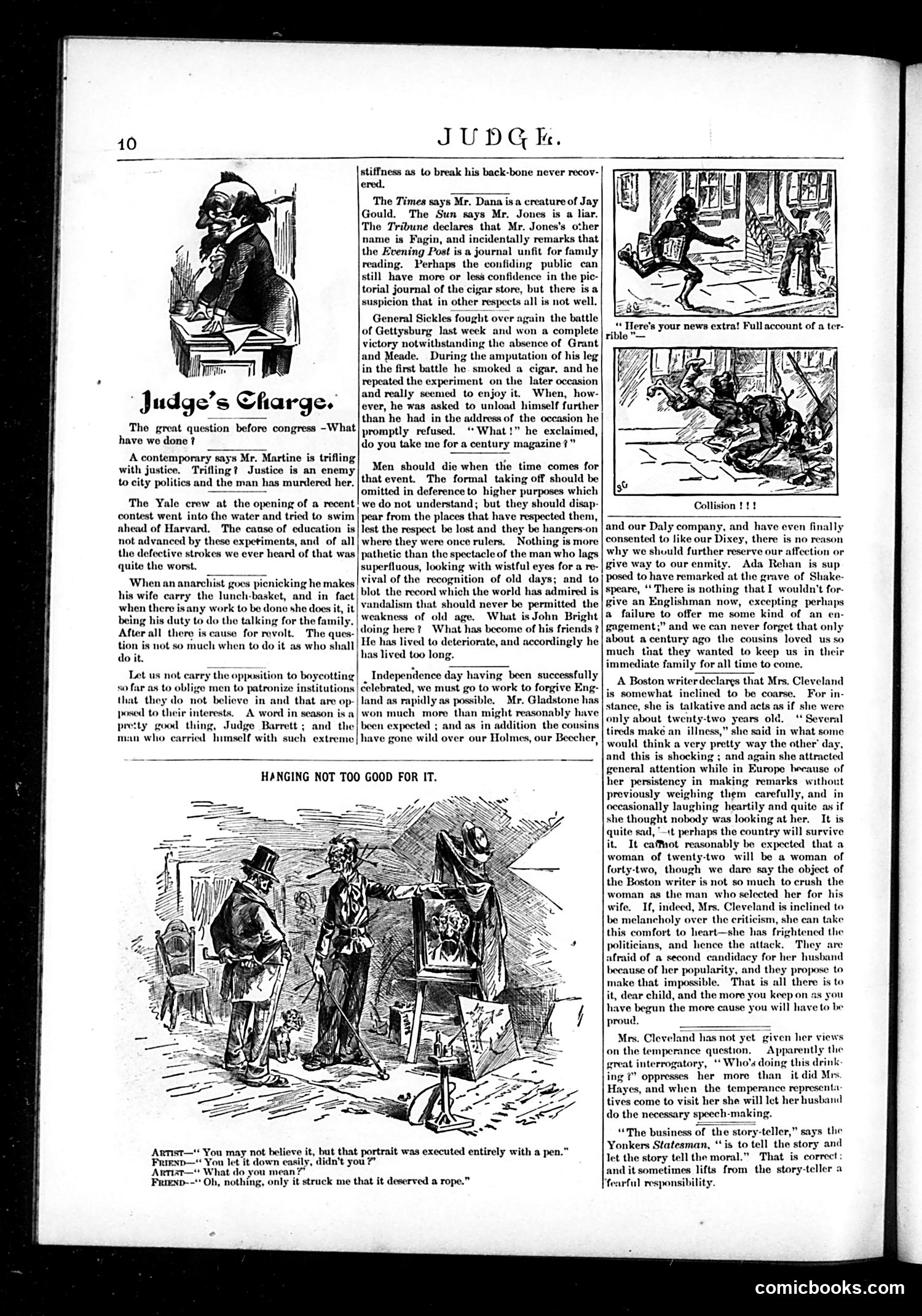
This page contains two main satirical pieces from the late 19th-century American humor magazine *Judge*: **"Judge's Charge"** (top left) presents a series of brief, disconnected political and social jabs. It mocks Congressional inaction, criticizes newspaper editors (Dana, Jones) for partisan attacks on each other, and comments on General Sickles's continued public presence despite age and infirmity—suggesting old politicians should gracefully exit rather than linger as "superfluous" figures. **"Hanging Not Too Good For It"** (bottom) is a cartoon dialogue between two men examining a crude portrait. One claims it was "executed entirely with a pen," prompting the other to joke that it "deserved a rope"—a dark pun on execution. The crude artistry is the target of satire. The page reflects *Judge*'s editorial voice: mocking political incompetence, newspaper rivalry, and aging public figures clinging to relevance. The humor assumes readers recognize contemporary figures and debates.
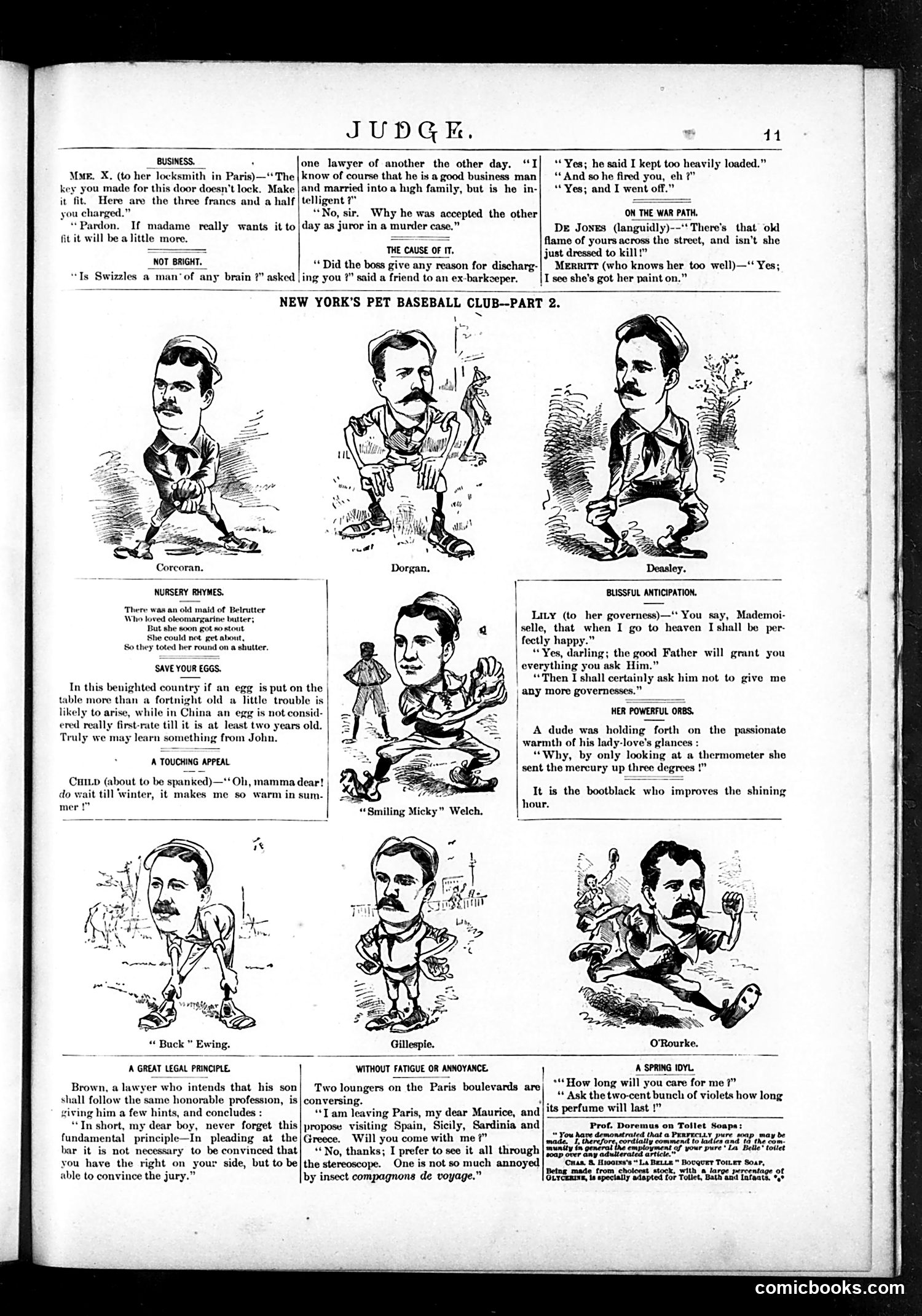
This page from Judge magazine contains several satirical humor pieces typical of the era: **"New York's Pet Baseball Club—Part 2"** features caricatured portraits of baseball players (Corcoran, Dorgan, Deasley, "Smiling Micky" Welch, "Buck" Ewing, Gillespie, and O'Rourke). The exaggerated physical features—prominent noses, mustaches, and body proportions—were standard caricature conventions of the period, poking fun at recognizable local celebrities. **The short jokes** mock everyday absurdities: a locksmith in Paris, a man fired from his job, a woman's appearance, and legal/social hypocrisy. "A Great Legal Principle" satirizes lawyer ethics by suggesting courts value persuasion over justice. "Without Fatigue or Annoyance" jokes about tourism via stereoscope rather than actual travel. The humor is lighthearted social commentary—no deep political agenda—aimed at middle-class readers familiar with local baseball personalities, legal practices, and contemporary gadgets like stereoscopes.
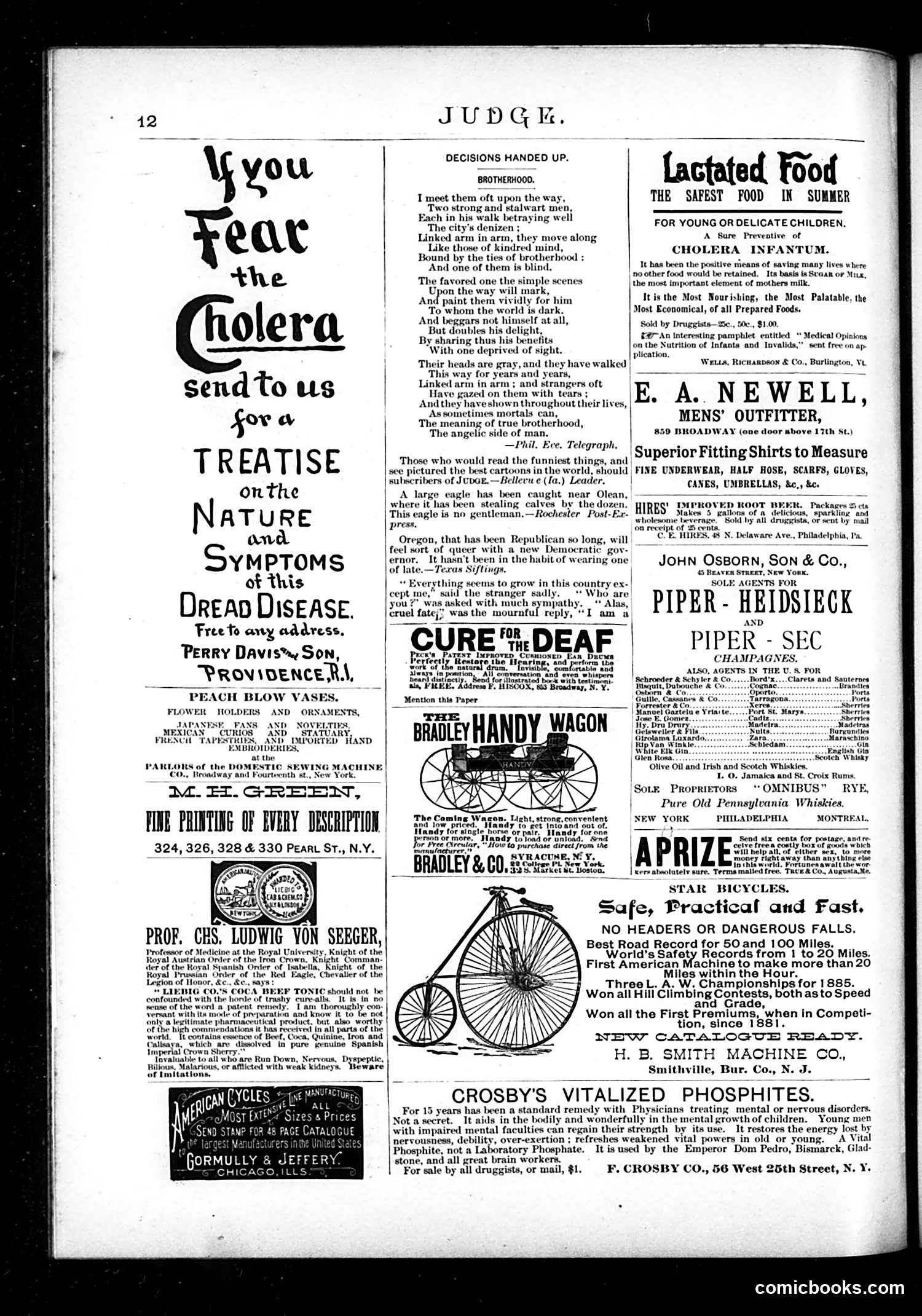
This page from *Judge* magazine is primarily an **advertising-heavy layout** rather than a political cartoon page. The only significant editorial content is a brief, sentimental poem titled "Brotherhood," celebrating friendship between two men (one blind), which appears centered on the page. This seems a moral/uplifting piece rather than satirical. The bulk of the page consists of advertisements: patent medicine ads (Perry Davis's cholera treatment, Lactated Food infant formula, Crosby's Vitalized Phosphites), bicycles and wagons, men's clothing, alcohol, printing services, and various consumer products typical of the 1880s-90s era. The advertisements themselves reveal period anxieties—cholera infantum (deadly diarrheal disease in children) and general debility—that these patent medicines promised to cure, often with questionable efficacy. There is no visible political satire or caricature on this particular page.
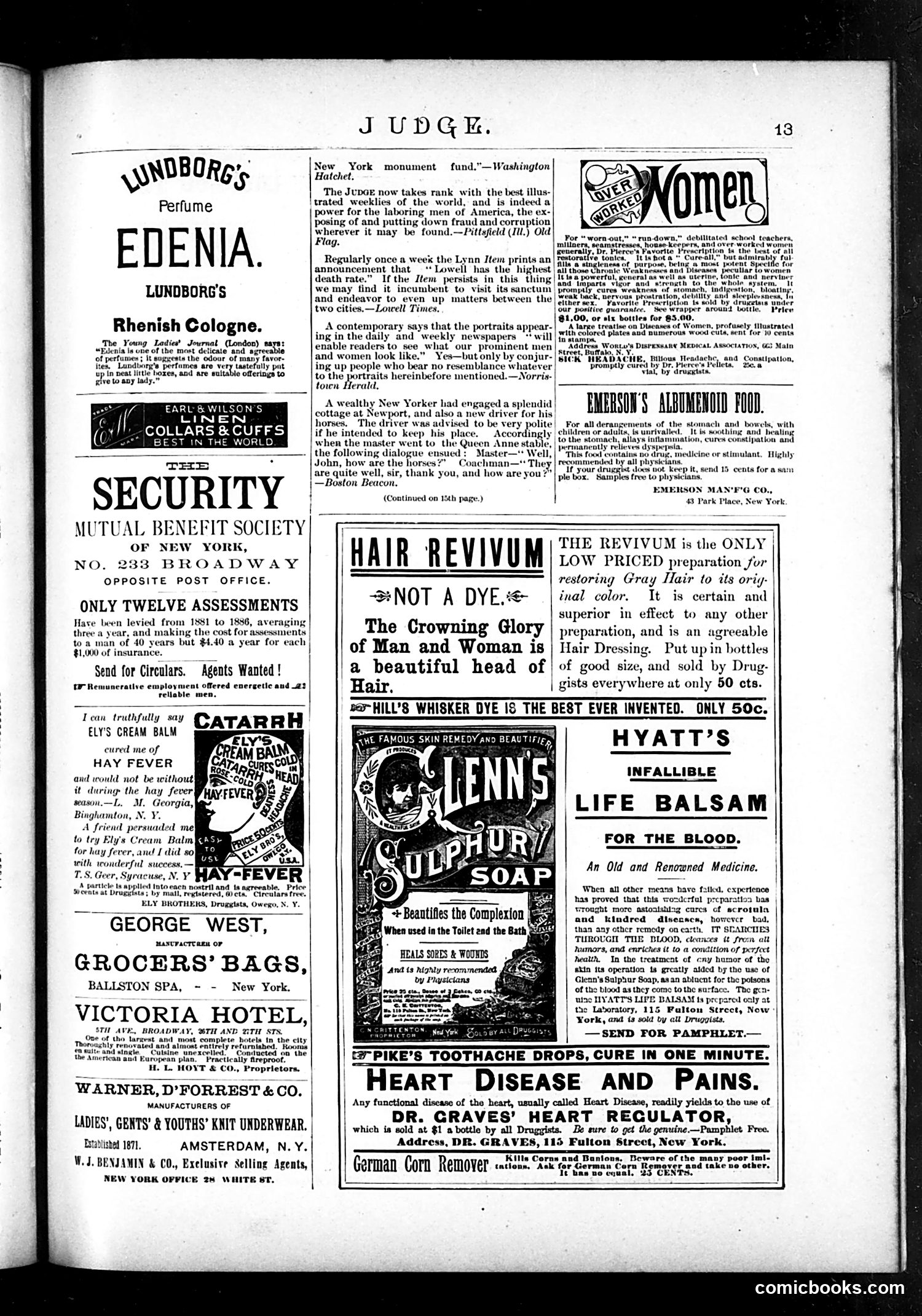
This page is primarily **advertising**, not political satire. It contains various patent medicine and consumer product ads typical of late 19th-century magazines. The small editorial snippets scattered among ads include: - A note praising Judge's investigative journalism against fraud - A joke about competing Massachusetts newspapers (Lynn Item vs. Lowell Times) arguing over which has a higher death rate - A satirical comment on newspaper portrait accuracy—newspapers print portraits of prominent people that bear "no resemblance whatever" to their subjects The humor here is light social commentary rather than political cartooning: it mocks newspapers' poor quality illustrations and journalistic competitiveness. The bulk of the page advertises patent medicines (Dr. Pierce's Favorite Prescription, Hair Revivum, Hyatt's Life Balsam), hair dyes, digestive tonics, and clothing—reflecting the era's unregulated medical marketplace where dubious remedies claimed miraculous cures.
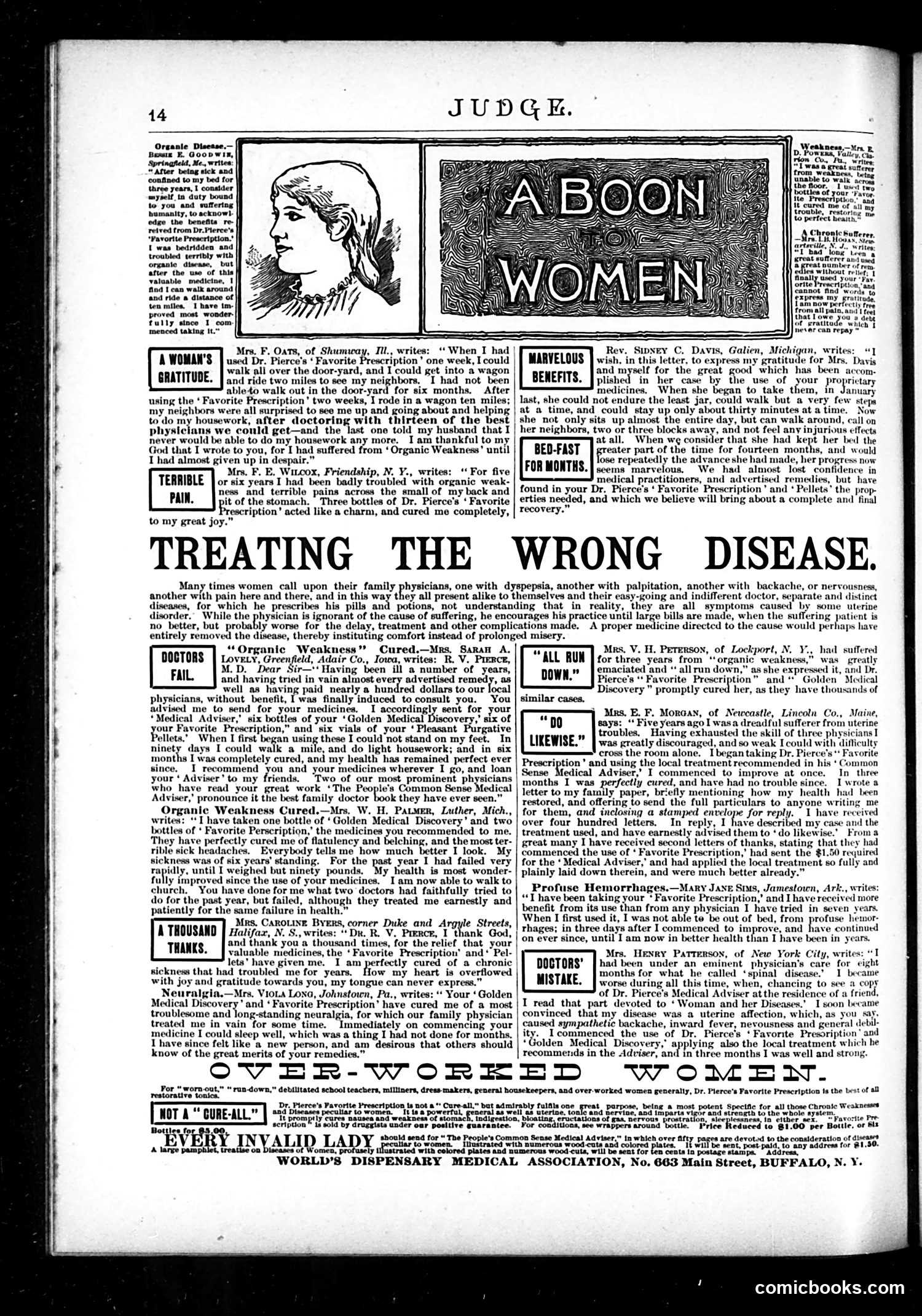
This is primarily a **patent medicine advertisement**, not political satire. The page promotes Dr. Pierce's "Favorite Prescription"—a commercially-sold remedy marketed to women suffering from "Organic Weakness," a vague 19th-century diagnosis applied to female ailments. The content consists of: - **Testimonial letters** from women claiming miraculous cures after using the product (walking distances previously impossible, household work restored) - **Doctors' failure narrative**: The ads contrast ineffective local physicians with this mail-order remedy's success - **Emotional appeal**: Women describe bed-ridden states lasting months, then recovery within weeks The satirical context appears to be Judge magazine's **ironic inclusion** of these dubious medical claims—the issue's actual content critiques how women were misdiagnosed and treated with ineffective remedies by real doctors, while patent medicines promised cures. The advertisement itself demonstrates the very problem the magazine appears to be mocking.
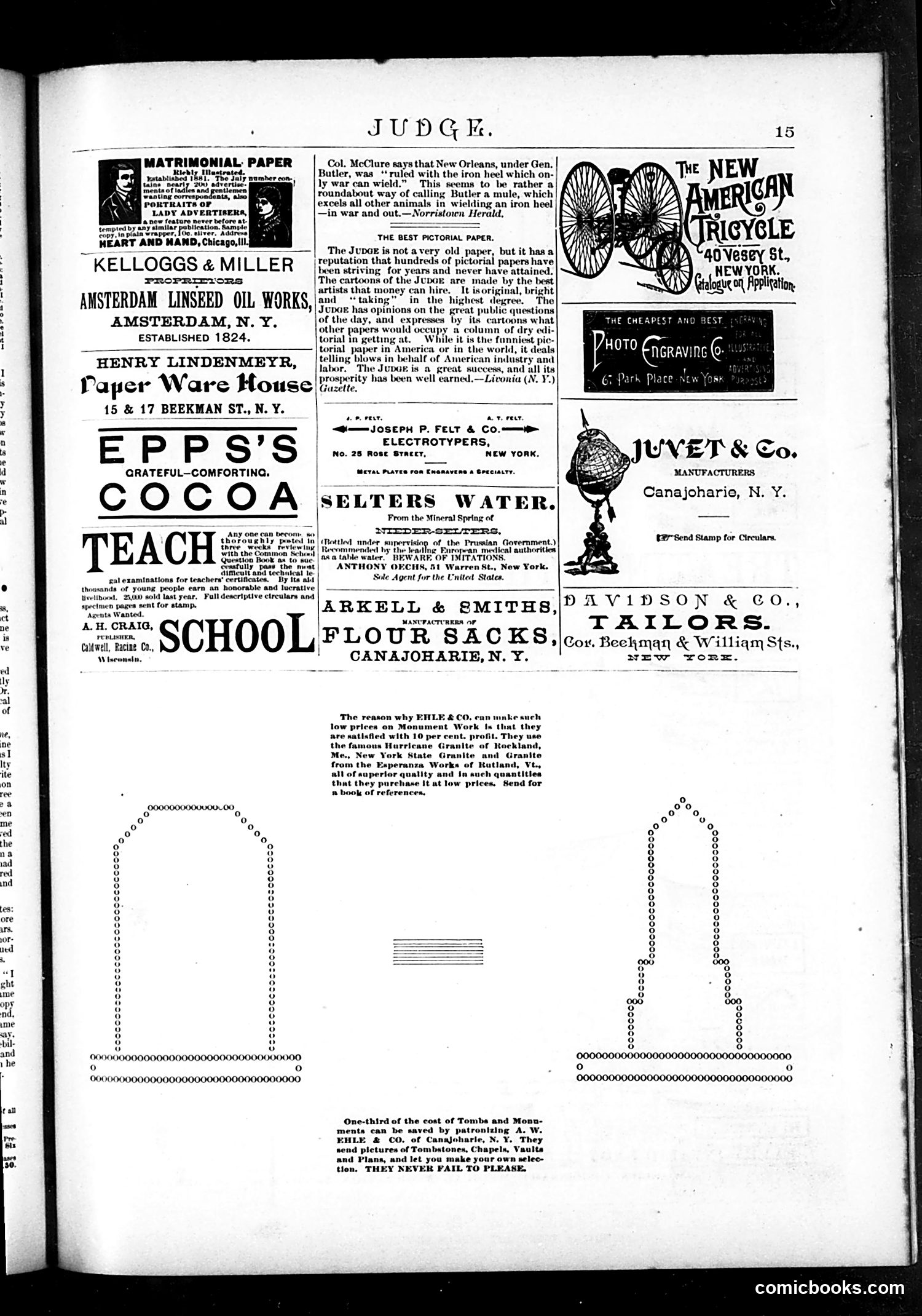
This page is primarily **advertising**, not editorial content or cartoons. It's from *Judge*, a satirical magazine, but this particular page showcases commercial advertisements for various 19th-century products and services. The one notable editorial content is a brief joke at the top mocking General Benjamin Butler's administration in New Orleans during Reconstruction. A Colonel McClure allegedly described Butler's rule as using an "iron heel," and the writer jokes that this is a roundabout way of calling Butler a "mule"—a crude insult questioning his intelligence and stubbornness. The rest consists of ads for linseed oil, cocoa, flour sacks, water, tailoring services, electrotyping, and monuments—typical period advertising. The page also includes self-promotional text praising *Judge*'s quality as a pictorial magazine with skilled cartoonists. No specific political figures are caricatured visually on this page.
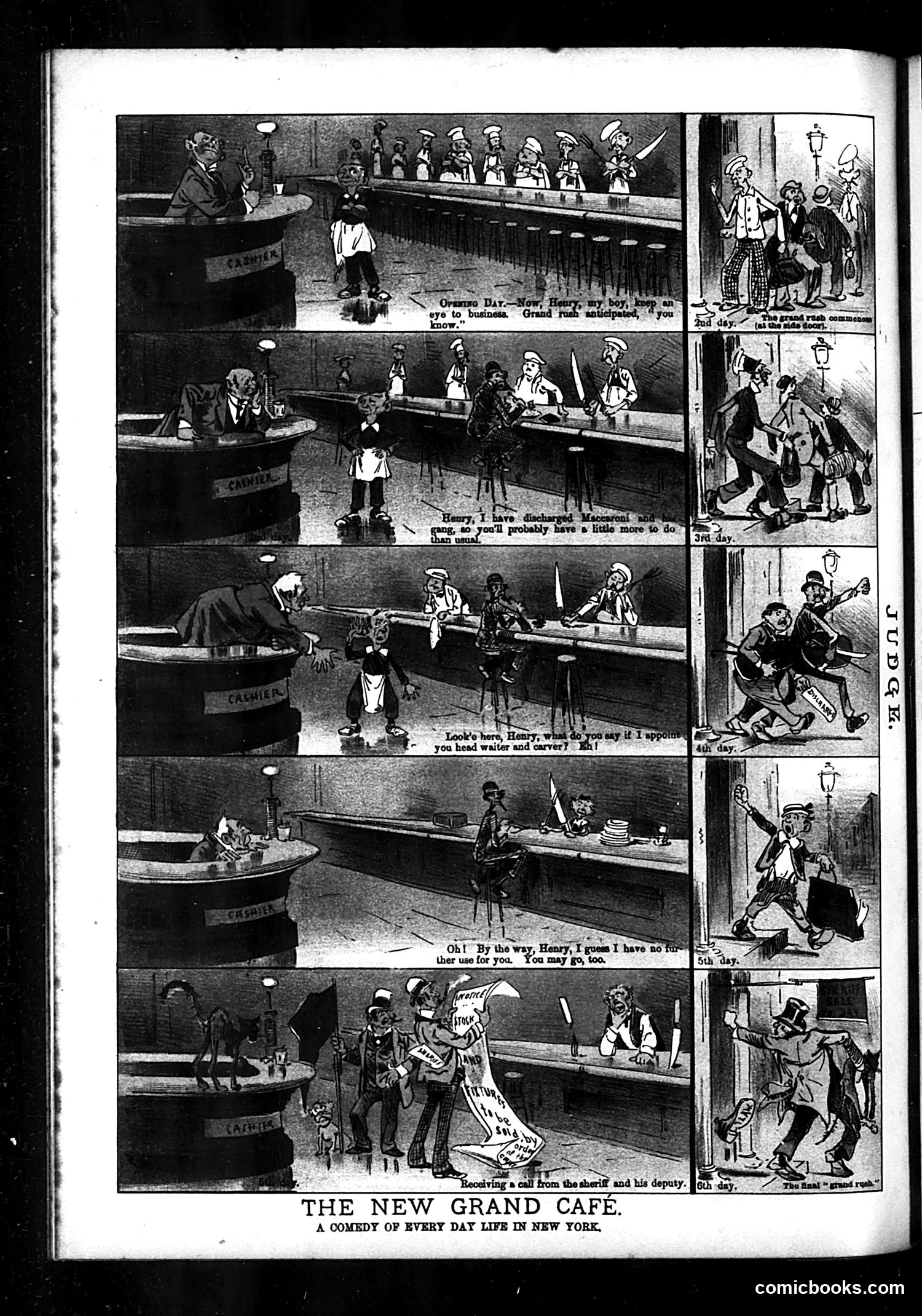
This multi-panel comic depicts everyday scenarios at a New York café, satirizing social hierarchies and workplace dynamics of the era. The strip shows a cashier or manager (likely named Henry) interacting with various patrons and staff members across different days. The humor revolves around class distinctions and the absurdities of service industry life—showing how authority figures dismiss or demote workers casually ("You may go, too"), the chaos of managing diverse clientele, and the contrast between refined pretense and actual disorder. The title emphasizes this is "everyday life," suggesting Judge's satirical commentary on New York's social stratification and the performative nature of public establishments. The strip appears to mock both management incompetence and the precarious employment situations workers faced.