
Judge, 1886-07-17 · page 12 of 18
Judge — July 17, 1886 — page 12: what you’re looking at
What you’re looking at
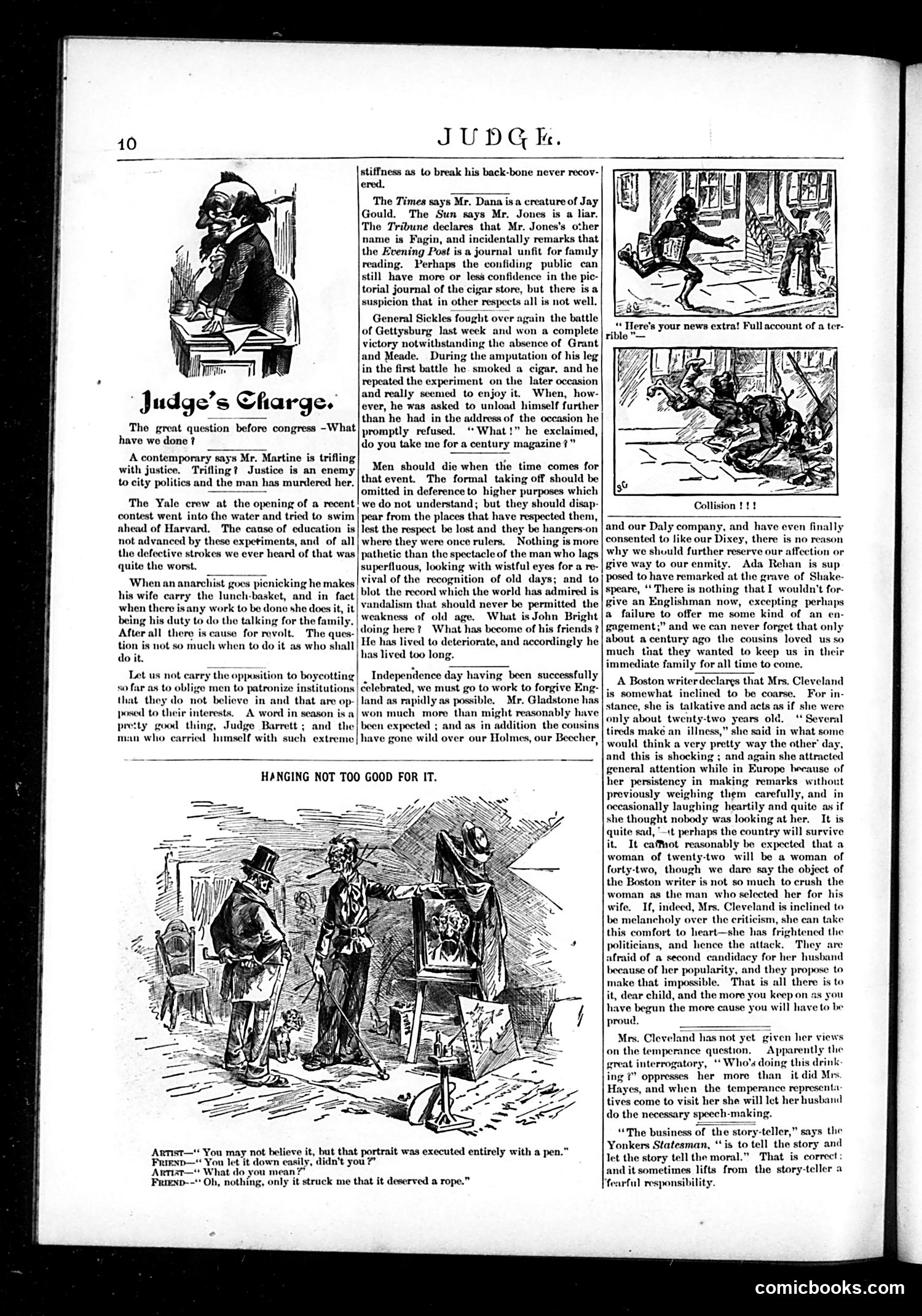
This page contains two main satirical pieces from the late 19th-century American humor magazine *Judge*: **"Judge's Charge"** (top left) presents a series of brief, disconnected political and social jabs. It mocks Congressional inaction, criticizes newspaper editors (Dana, Jones) for partisan attacks on each other, and comments on General Sickles's continued public presence despite age and infirmity—suggesting old politicians should gracefully exit rather than linger as "superfluous" figures. **"Hanging Not Too Good For It"** (bottom) is a cartoon dialogue between two men examining a crude portrait. One claims it was "executed entirely with a pen," prompting the other to joke that it "deserved a rope"—a dark pun on execution. The crude artistry is the target of satire. The page reflects *Judge*'s editorial voice: mocking political incompetence, newspaper rivalry, and aging public figures clinging to relevance. The humor assumes readers recognize contemporary figures and debates.
📄 Transcribed text from this page (OCR, searchable)
Machine-transcribed from the original scan — historical spelling and the odd misread are preserved.
JUDG. ‘ Judge’s Charge. The great question before congress -What have we done t A contemporary says Mr. Martine is trifling with justice, Trifling? Justice is an enemy to city politics and the man has murdered her. The Yale crew at the opening of a recent contest went into the water and tried to swim ahead of Harvard. The cause of education is not advanced by these expetiments, and of all the defective strokes we ever heard of that was quite the worst. When an anarchist goes picnicking he makes |} his wife carry the lunch-basket, and in fact} there isany work to be done she does it, it being his duty to do the talking for the famil After all there is cause for revolt. The ques-| tion is not so much when to do it as who shall do it. Let us not carry tl position to boycotting so far as to oblige men to patronize institutions | that they do not believe in and that are op-| posed to their interests. A word in season is a pretty good. thi Judge Barrett ; and the man who carried himself with such extreme stiffness as to break his back-bone never recov- ered. The Times says Mr. Dana isa creature of Jay Gould. The Sun says Mr. Jones is a liar. The Tribune declares that Mr. Jones's other name is Fagin, and incidentally remarks that the Evening Post is a journal unfit for family reading. Perhaps the confiding public can still have more or less confidence in the pic- torial journal of the cigar store, but there isa suspicion that in other respects all is not well. General Sickles fought over again the battle victory notwithstanding the al of Grant and Meade. During the amputation of his leg in the first battle he smoked a cigar, and he repeated the experiment on the later occasion and really seemed to enjoy it. When, how- ever, he was asked to unload himself further than he had in the address of the occasion he promptly refused. ‘What !” he exclaimed, do you take me for a century magazine?” Men should die when the time comes for that event. The formal taking off should be omitted in deference to higher purposes which we do not understand; but they should disap- pear from the places that have respected them, lest the respect be lost and they be hangers-on where they were once rulers. Nothing is more pathetic than the spectacle of the man who lags superfluous, looking with wistful eyes for a re- vival of the recognition of old days; and to blot the record which the world has admired is vandalism that should never be permitted the weakness of old age. What is John Bright doing here? What has become of his friends ? He has lived to deteriorate, and accordingly he has lived too long. Independence day having been successfully celebrated, we must go to work to forgive Eng- land as rapidly as possible. Mr. Gladstone has won much more than might reasonably have been expected ; and as in addition the cou have gone wild over our Holmes, our Beecher, HANGING NOT TOO GOOD FOR IT. | sy \\\\ but that Armst—“ You may not beli didn't yo Frirxp—* You let it down easil Armiat— What do you mea Friexp--" Oh, nothing, only portrait was executed entirely with a pen.” mu 7” struck me that it deserved a rope.” of Gettysburg last week and won a complete |.) Collision 11! and our Daly company, and have even finally consented to like our Dixey, ther why we should further reserve give way to our enmity. Ada Rehan is sup posed to have remarked at the grave of Shake- speare, ‘There is nothing that 1 wouldn't for- give an Englishman now, excepting perhaps a failure to offer me some kind of an en- gagement;” and we can never forget that only about acentury ago the cousins loved us so much that they wanted to keep us in their immediate family for all time to come. A Boston writer declares that Mrs. Cleveland is somewhat inclined to be coarse. For in- stance, she is talkative and acts as if she were only about twenty-two years old.“ Several tireds make an illness,” she said in what some would think a very pretty way the other’ day, and this is shocking ; and again she attracted general attention while in Europe because of her persistency in making remarks without previously weighing them carefully, and in occasionally laughing heartily and quite as if she thought nobody was looking at her. It is quite sad, st perhaps the country will survive it. It caffot reasonably be expected that a woman of twenty-two will be a woman of forty-two, though we dare say the object of the Boston writer is not so much to crush the woman as the man who selected her for his wife. If, indeed, Mrs, Cleveland is inclined to be melancholy over the criticism, she can take comfort to heart—she has frightened the politicians, and hence the attack. They afraid of a second candidacy for her hus because of her popularity, and they propose to make that impossible. That is all there is to it, dear child, and the more you keep on as you have begun the more cause you will have to be proud. Mrs. Cleveland has not yet. given her views on the temperance question. Apparently the great interrogatory, ‘ Who's doing this drink ing ¢” oppresses her more than. it did Mrs Hayes, and when the temperance representa tives come to visit her she will Ict her hus (dl do the necessary speech-making. “The business of the story-teller,” says the Yonkers Statesman, “is to tell the story and let the story tell the moral.” That is correct : and it sometimes lifts from the story-teller a fearful responsibility. comicbooks.com