
Judge, 1886-07-17 · page 2 of 18
Judge — July 17, 1886 — page 2: what you’re looking at
What you’re looking at
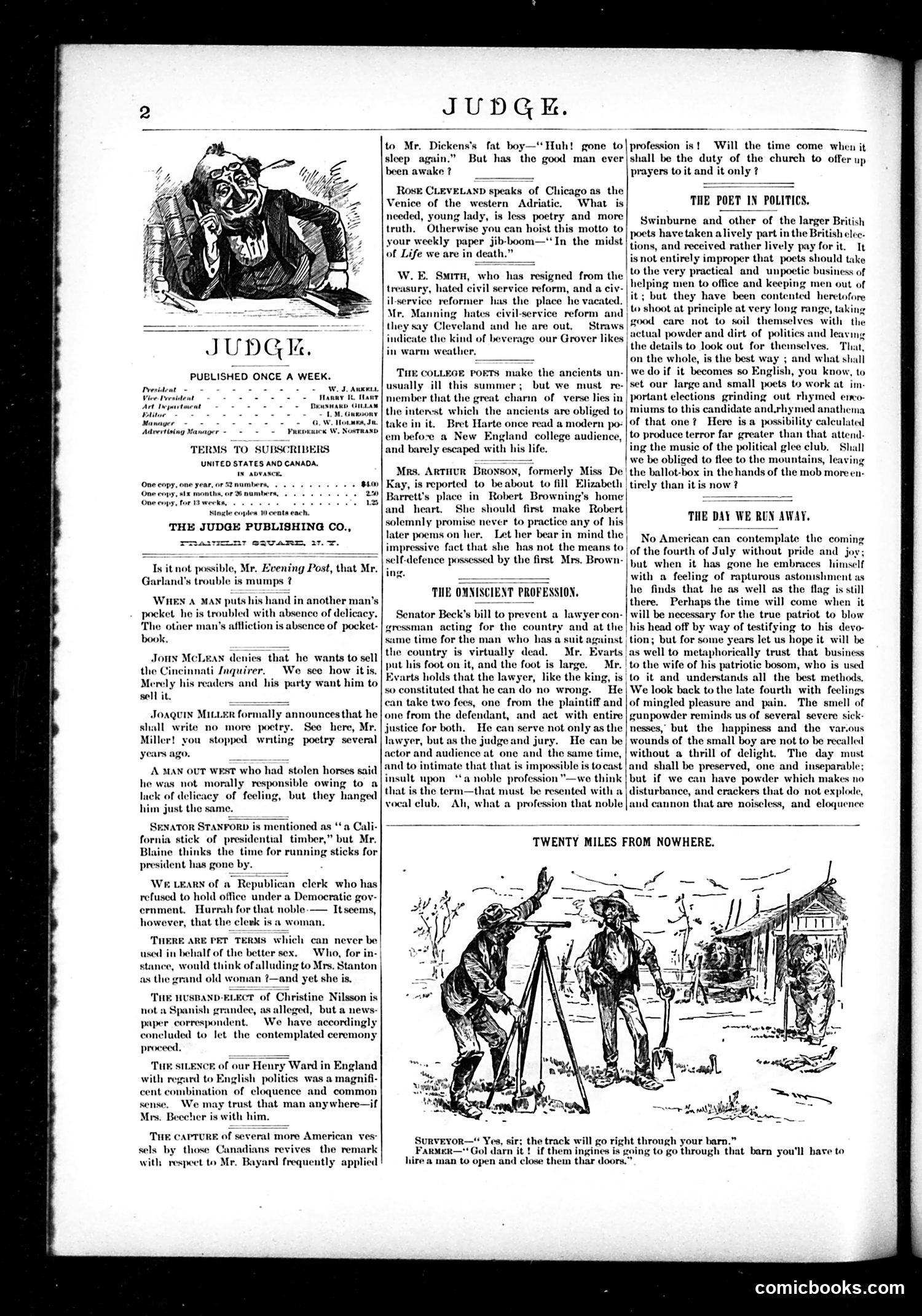
This page contains several brief satirical commentaries and one cartoon titled "TWENTY MILES FROM NOWHERE." The main cartoon depicts a surveyor showing a farmer a surveying instrument, with the farmer objecting that if the survey line goes through his barn, he'll need to hire someone to open and close the barn doors. This is rural humor about the inconvenience of property surveys to farmers. The text sections mock various targets: a "fat boy" reference (unclear), Cleveland's Venice comparison, college poets entering politics, and professional acting. There's also commentary on refusing to hold public office under a Democratic administration (suggesting partisan resistance). The overall tone is typical Judge satire—poking fun at political pretension, rural attitudes, and professional affectation through brief, comedic observations rather than sustained political argument.
📄 Transcribed text from this page (OCR, searchable)
Machine-transcribed from the original scan — historical spelling and the odd misread are preserved.
JUDG It. PUBLISHED ONCE A WEEK W. J. Awentt, Maney it Maer Bewsiano Gram LM, GW. Hotes, Jt. Prepenick W, Nosrmaxn TERMS TO SUBSCRIBERS: UNITED STATES AND CANADA. IY ADVANCE, THE JUDGE PUBLISHING CO., eavann, 27.5. rma2 Is itnot possible, Mr. Evening Post, that Mr. Garland’s trouble is mumps ? When A MAN puts his hand in another n pocket he is troubled with absence of delicacy. The otier man’s affliction is absence of pocket- book. Jos McLean denies that he wants to sell the Cincinnati Inquirer. We see how itis. Merely his readers and his party want him to sell it: Joaguiy MitLen formally announces that he shall write no more poetry. See here, Mr. Miller! you stopped wniting poetry several A MAN OUT West who had stolen horses said he not morally responsible owing to a lack of delicacy of feeling, but they hanged him just the same. SENATOR STANFORD is mentioned as “a Cali- fornia stick of presidential timber,” but Mr. ine thinks the time for running sticks for president has gone by. We Leary of a Republican clerk who has refused to hold office under a Democratic gov- ernment. Hurrah for that noble-— Itseems, however, that the clevk is a woman, Tu ARE PET TERMS which can never be used in behalf of the better sex. Who, for in-| stance, would think ofalluding to Mrs, Stanton as the grand old woman ?—and yet she is. Tue HUSsBAND-ELECT of Christine Nilsson is not a Spanish grandee, as alleged, but a news paper correspondent. We have accordingly concluded to let the contemplated ceremony proceed. ‘Tur sILeNcE of our Henry Ward in England with regard to English politics was a magnifi- cent combination of cloquence and common sense, We may trust that man anywhere—if Mrs. Beecher is with him. THe CAPTURE of ral more American ves- sels by those Canadians revives. the remark to Mr. Dickens's fat boy—‘‘Huh! gone to sleep again.” But has the good man ever been awake ? Rosr CLEVELAND speaks of Chicago as the Venice of the western Adriatic. What is needed, young lady, is less poetry and more truth. Otherwise you can hoist this motto to your weekly paper jib-boom—‘‘In the midst of Life we are in death.” W.E. Sith, who has resigned from the treasury, hated civil service reform, and a civ- il-service reformer has the place he vacated. Mr. Manning hates civil-service reform and they say Cleveland and he are out, Straw indicate the kind of beverage our Grover likes in warm weather. THE COLLEGE POETS make the ancients un- usually ill this summer; but we must. re- member that the great charin of verse lies in terest which the ancients are obliged to in it. Bret Harte once read a modern po- em before a New England college audience, and barely escaped with his li Mrs. Artuur Bronson, formerly Miss De Kay, is reported to be about to fill Elizabeth Barrett's place in Robert Browning's home and heart. She should first make Robert solemnly promise never to practice any of his ter poems on her, Let her bear in mind the npressive fact that she has not the means to If-defence possessed by the first Mrs. Brown- THE OMNI Senator Beck's bill to prevent a lawyer con- gressman acting for the country and at the} same time for the man who has a suit against the country is virtually dead. Mr. Evarts put his foot on it, and the foot is large. Mr. Evarts holds that the lawyer, like the king, is so constituted that he can do no wro1 can take two fees, one from the pla one from the defendant, and act with entire justice for both. He can serve not only as the lawyer, but as the judgeand jury. He can be actor and audience at one and the same time, and to intimate that that is impossible is tocast insult upon ‘a noble profession "—we think the term—that must be resented with a al club, Ah, what a profession that noble profession is! Will the time come when it shall be the duty of the church to offer up prayers to it and it only ? THE POET IN POLITICS. Swinburne and other of the larger British poets havetaken alively part in the British elec. tions, and received rather lively pay for it. It is not entirely improper that poets should take to the very practical and unpoctic business of |helping men to office and keeping men out of lit; but they have been contented heretofore to shoot at principle at very long range, taking good care not to soil them: with the ctual powder and dirt of pol d leaving the details to look out for themselves. That, on the whole, is the best way ; and what shall we do if it becomes so English, you know, to set our large and small poets to work at in portant elections grinding out rhymed erro- miums to this candidate and.rhymed anathema of that one? Here isa possibility calculated to produce terror far greater than that attend- ing the music of the political glee club. we be obliged to flee to the mountains, lea the ballot-box in the hands of the mob more en- |tirely than itis now ? THE DAY WE RUN AWAY. | No American can contemplate the coming of the fourth of July without pride and joy but when it has gone he embraces himself with a feeling of rapturous astonishment as he finds that he as well as the flag is still there. Perhaps the time will come when it will be necessary for the true patriot to blow is head off by way of testifying to his devo- tion; but for some years let us hope it will be as well to metaphorically trust that business to the wife of his patriotic bosom, who is used to it and understands all the best methods. We look back to the late fourth with feelings of mingled pleasure and pain. The smell of gunpowder reminds us of several severe sick nesses, but the happiness and the var.ous wounds of the small boy are not to be recalled without a thrill of delight. The day must and shall be preserved, one and inseparable; but if we can have powder which makes disturbance, and crackers that do not explode and cannon that are noiseless, and eloquence SURVEYOR Farmer— “« Yes, sir; the track will go rig] with respect to Mr. Bayard frequently applied hire a man to open and close them thar doors, Gol darn it! if them ingines is going to TWENTY MILES FROM NOWHERE. ht through your barn.” through that barn you'll have to comicbooks.com