
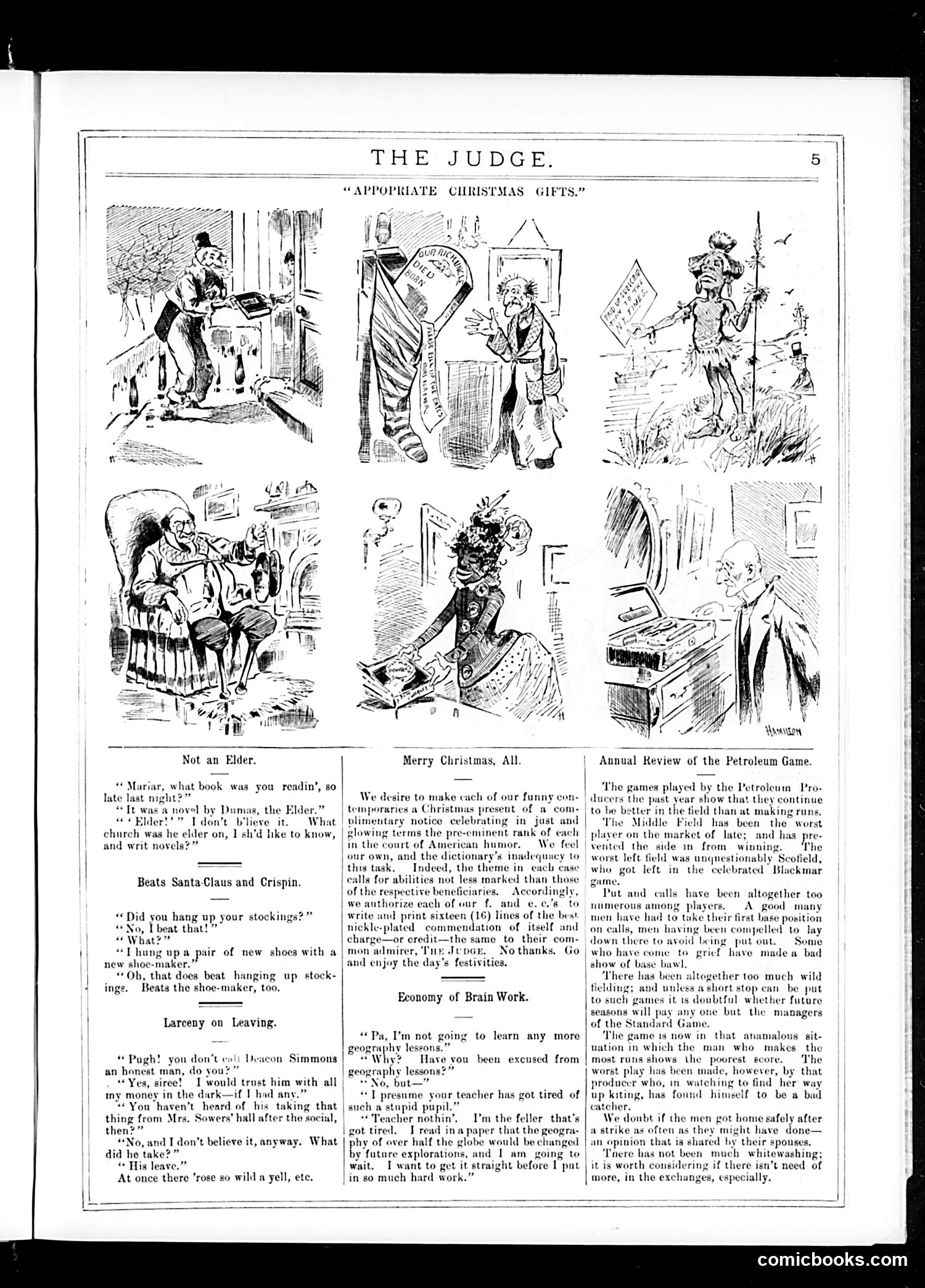
A complete issue · 16 pages · 1885
Judge — December 26, 1885
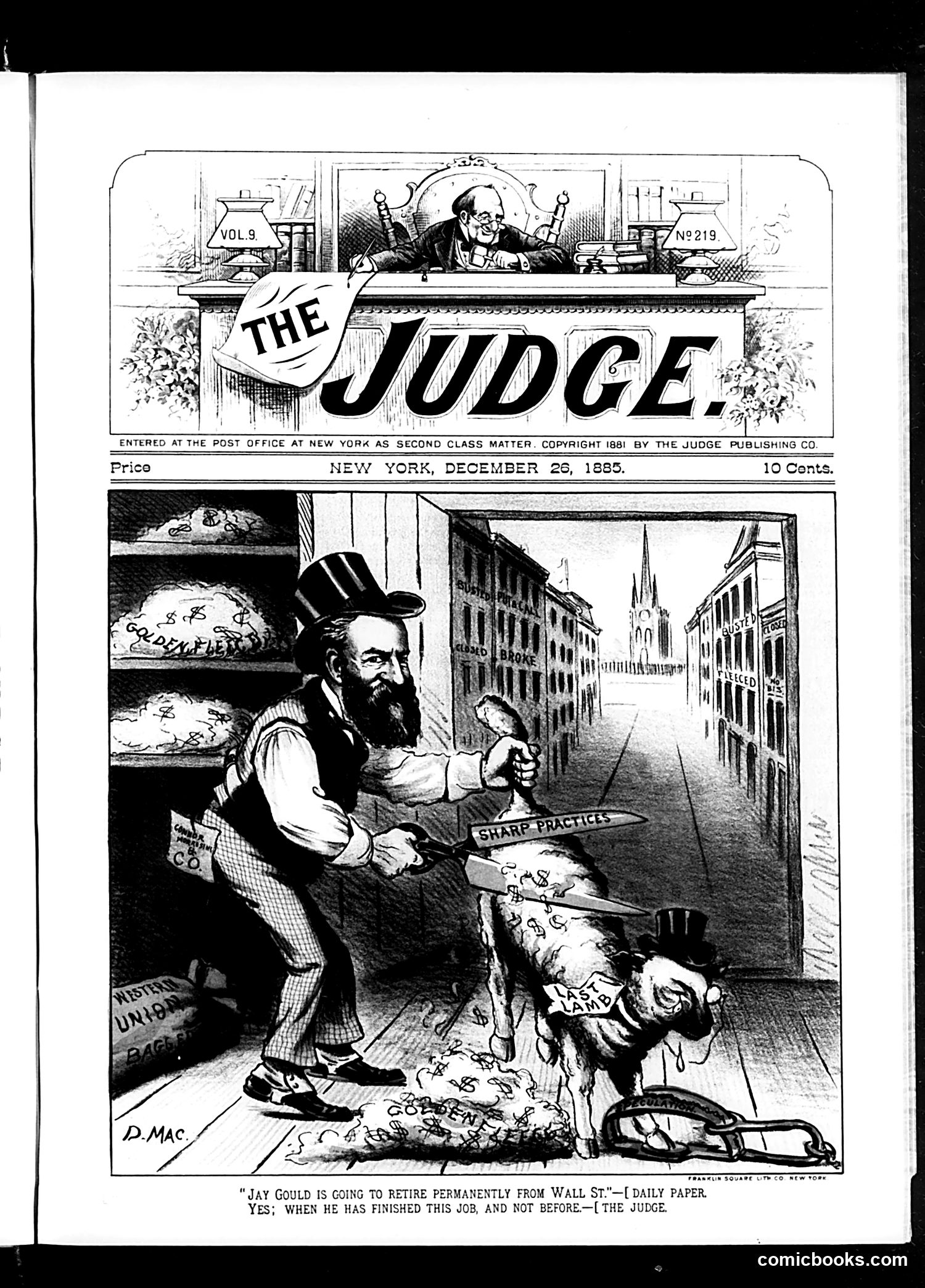
This cartoon satirizes **Jay Gould**, a wealthy railroad magnate and financier known for aggressive business tactics. The caption quotes a Daily Paper claim that Gould would "retire permanently from Wall St" once he finished "this job." The illustration depicts Gould as a bearded man wielding a broom labeled "Sharp Practices," sweeping up money and debris in an urban street. The satire suggests Gould won't actually retire—the implication being he's merely cleaning up evidence of his questionable business dealings before disappearing. The cartoon reflects public skepticism about Gould's ethics and practices. His aggressive railroad consolidations and financial maneuvers had made him controversial. The satirist doubts his retirement claims will materialize.
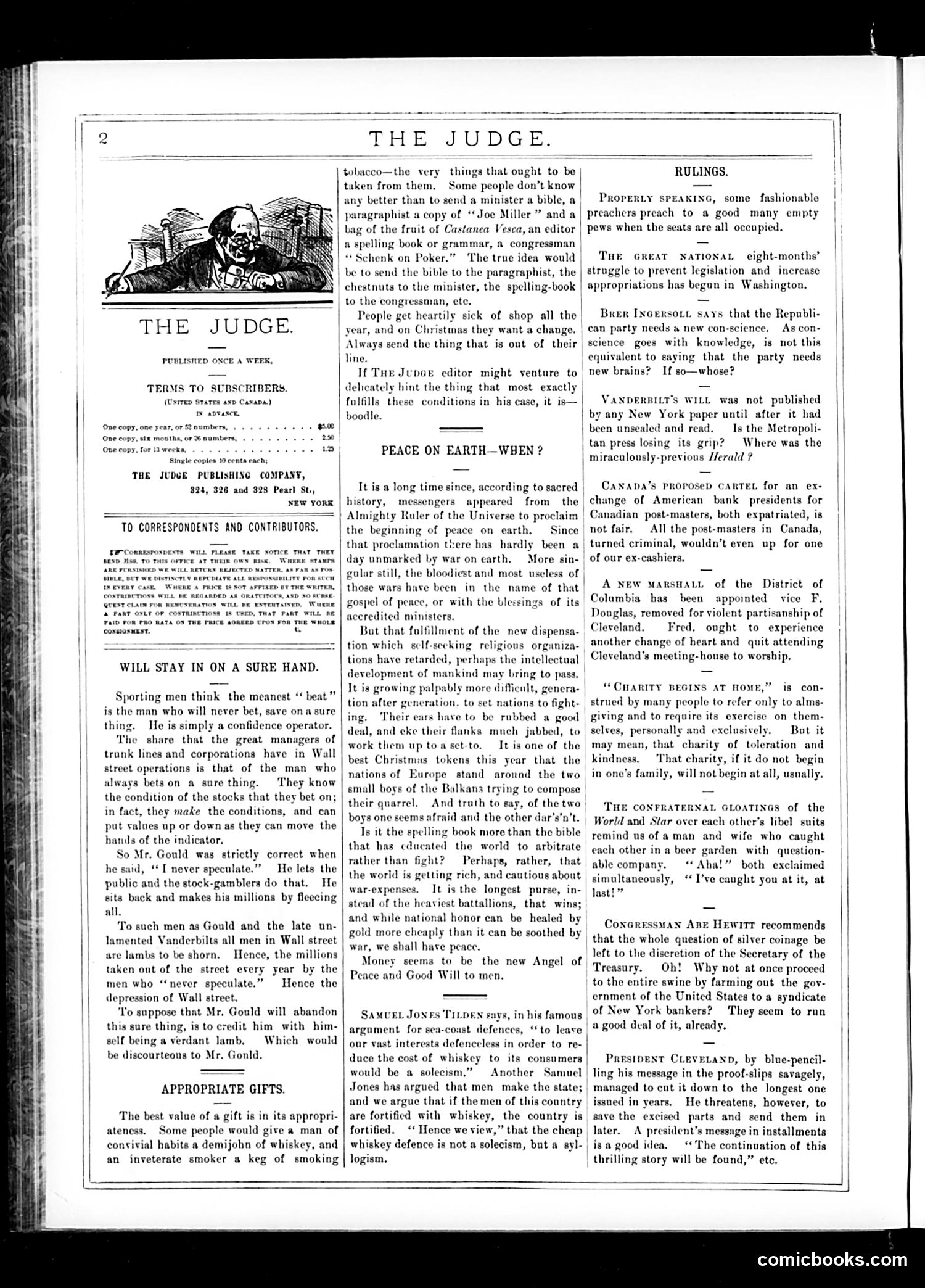
The masthead cartoon depicts a figure hunched over a desk, likely representing the editorial voice of *Judge* magazine itself—the satirist-commentator observing American politics and society. The visible articles address contemporary issues: "Peace on Earth—When?" questions whether lasting peace is achievable given ongoing conflict; "Will Stay in on a Sure Hand" discusses financial confidence and speculation; and "Appropriate Gifts" satirizes gift-giving customs. References to figures like Gould and Vanderbilt indicate concern with American industrialists and wealth concentration. The piece on Congressman Hewitt and silver coinage suggests monetary policy debates of the period. Without clearer visibility of specific illustrations or names, precise identification of particular caricatures is difficult, but the overall tone reflects *Judge's* satirical commentary on 1880s-90s American politics, economics, and social customs.
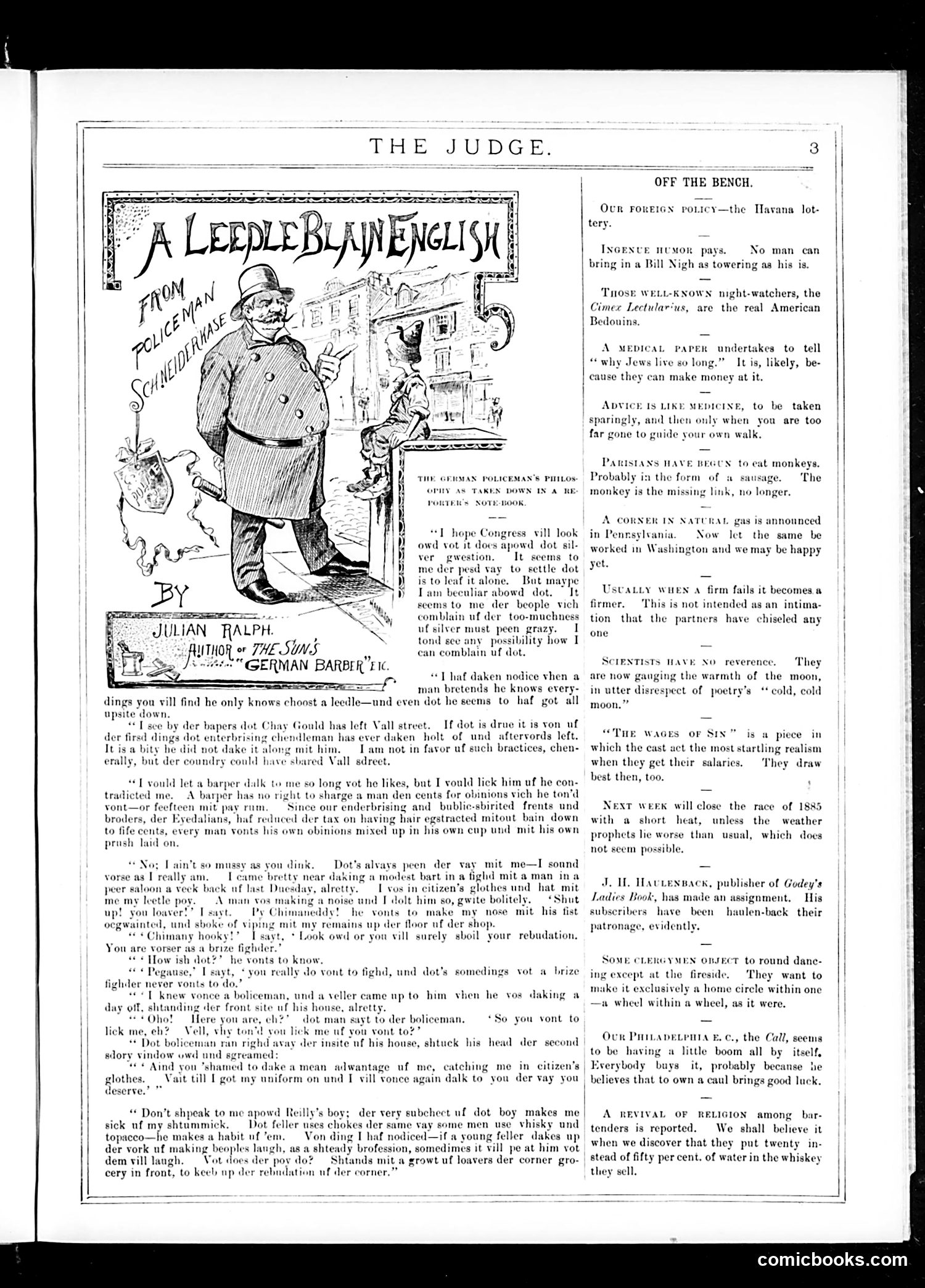
This cartoon satirizes a German-accented policeman discussing American politics and social issues. The humor relies on ethnic stereotyping—exaggerated German dialect and malapropisms ("dot," "vay," "beople") were standard comic devices of the era. The policeman's rambling monologue covers the silver currency debate (likely referencing 1880s monetary policy), wealthy figures like Jay Gould, and anecdotes about barber-shop arguments and street altercations. The title references James G. Blaine (a prominent politician), suggesting the whole piece mocks how immigrants understood—or misunderstood—American political controversies. The "Off the Bench" column contains brief satirical notes on foreign policy, Jews, science, and business failures. **For modern readers**: This reflects period-typical ethnic humor, where immigrant accents and broken English were treated as inherently comedic, often paired with supposedly foolish observations about American society.
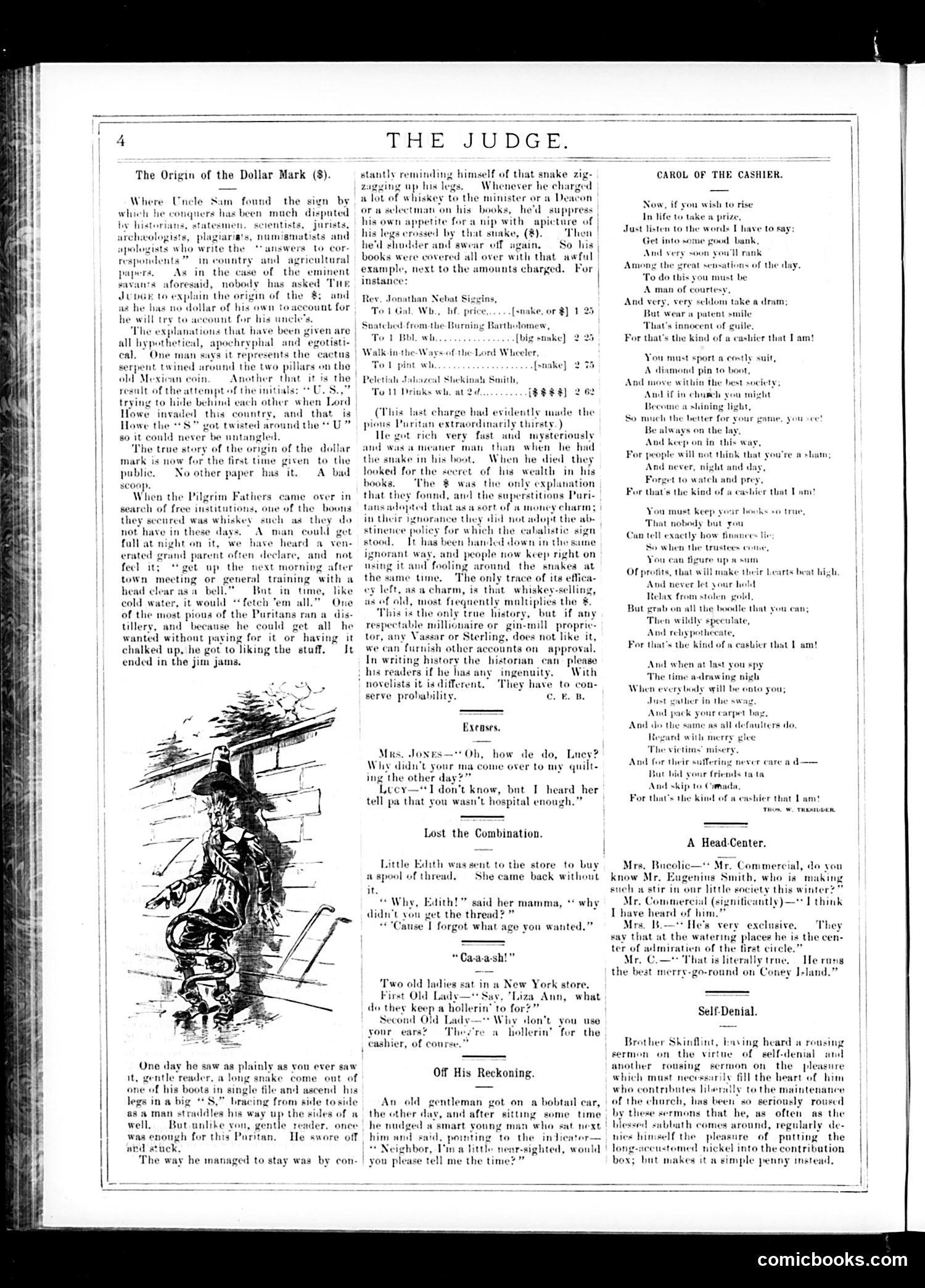
This page contains two main satirical pieces: **"The Origin of the Dollar Mark ($)"** is a humorous mock-historical account claiming the $ symbol originated from a Puritan drunk who saw a snake zigzagging up his legs. The drunk later became mysteriously wealthy, leading superstitious Puritans to believe the $ was a lucky charm for alcohol sales. The satire mocks both fanciful historical explanations and the ironic fact that whiskey-selling "most frequently multiplies the $"—poking fun at American commercialism and dubious origin myths. **The cartoon illustration** (lower left) depicts a disheveled man with a snake coiled around his legs—the visual joke of the story above. The remaining brief sketches ("Excuses," "Lost the Combination," "Off His Reckoning," etc.) are unrelated comic anecdotes typical of *Judge* magazine's miscellaneous humor sections, including jokes about forgetfulness and social awkwardness. The overall tone uses absurdist humor to satirize American greed and pseudo-historical reasoning.
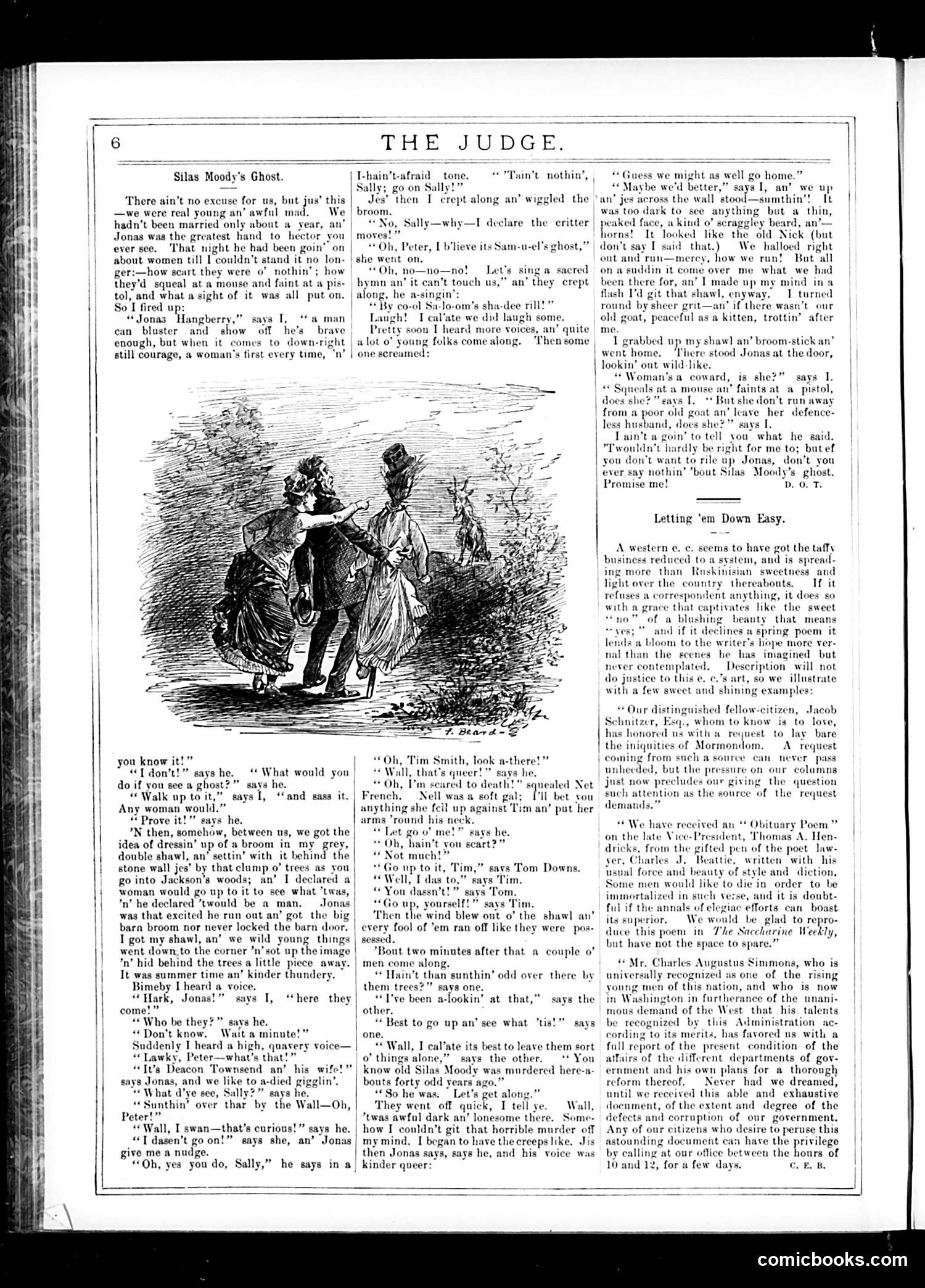
This page presents "Silas Moody's Ghost," a humorous tall tale from *Judge* magazine. The narrative describes a prank gone wrong: a husband and wife dress a broom in a shawl to test whether the wife's claim that women are braver than men holds true. They hide it by a wall. The prank succeeds at first—young people and then two men approach the "ghost" cautiously. However, the joke darkens when someone mentions that an actual murder victim, "old Silas Moody," died near this spot "forty odd years ago." The narrator begins feeling genuine dread about their prank, fearing the psychological weight of invoking a real tragedy. The satire targets masculine bravado and the gendered assumptions about fear. The illustration shows the "ghost" encounter. The surrounding text includes other brief humorous pieces typical of *Judge*'s satirical content, including commentary on literary and political matters of the era.
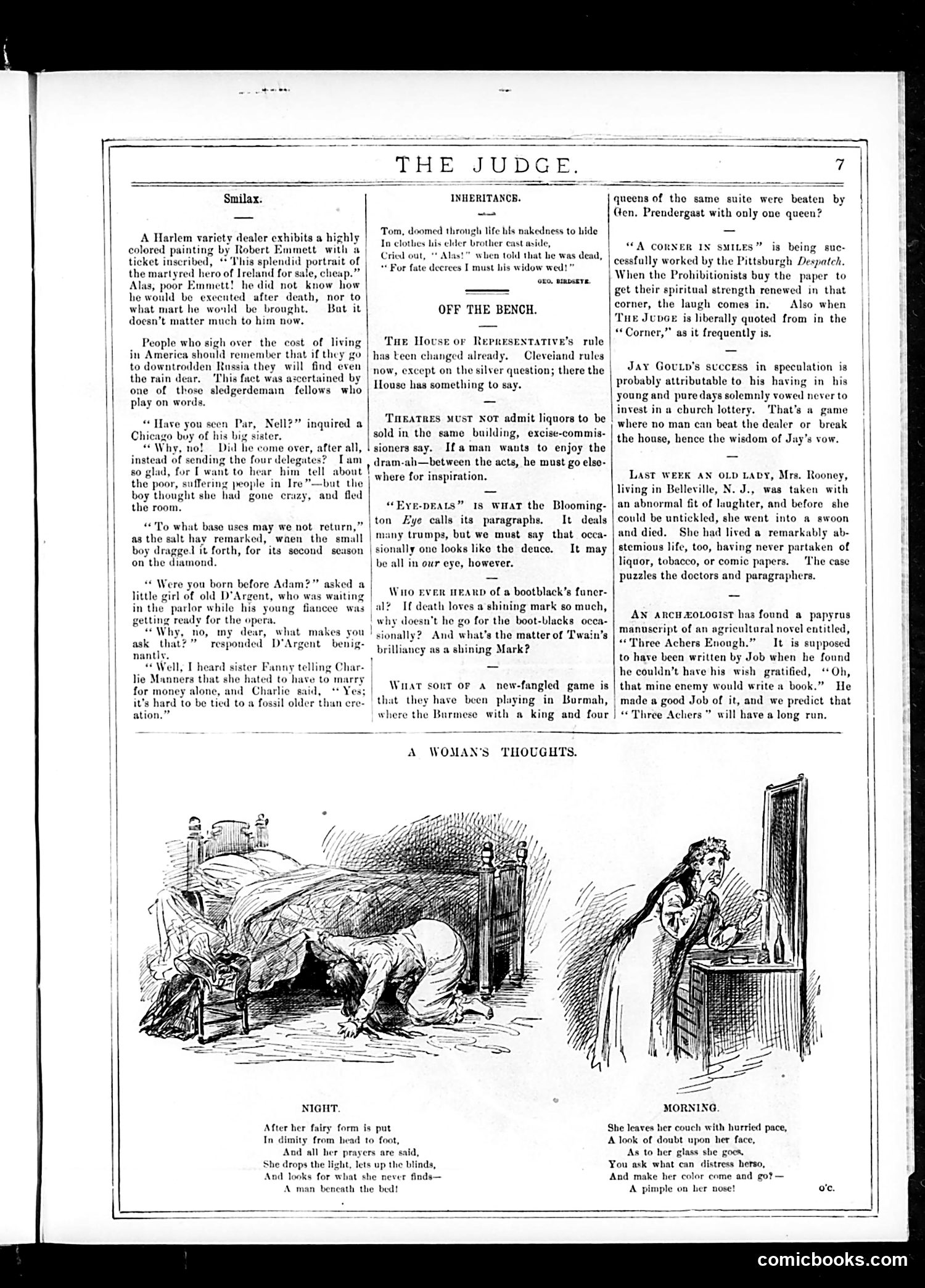
This page from *Judge* magazine contains brief satirical items and two illustrations titled "A Woman's Thoughts" (showing "Night" and "Morning"). **Key satirical items:** - **"Smilax"**: Mocks commercialization of Irish history—a dealer selling a portrait of Robert Emmett (executed Irish rebel) cheaply, treating his martyrdom as mere merchandise. - **"Inheritance"**: A man must marry his dead brother's widow, inheriting both the estate and an unwanted marriage—satirizing inheritance law's absurdity. - **Political references**: Mentions Cleveland and the "silver question" (currency debate of the 1880s-90s); references to Prohibition advocates and Jay Gould (famous speculator). - **"A Woman's Thoughts"** illustrations: Contrasts a woman's nighttime prayers with her morning vanity at the mirror—satirizing female hypocrisy regarding piety versus appearance. The overall tone is cynical about human nature, materialism, and social conventions typical of *Judge*'s satirical approach.
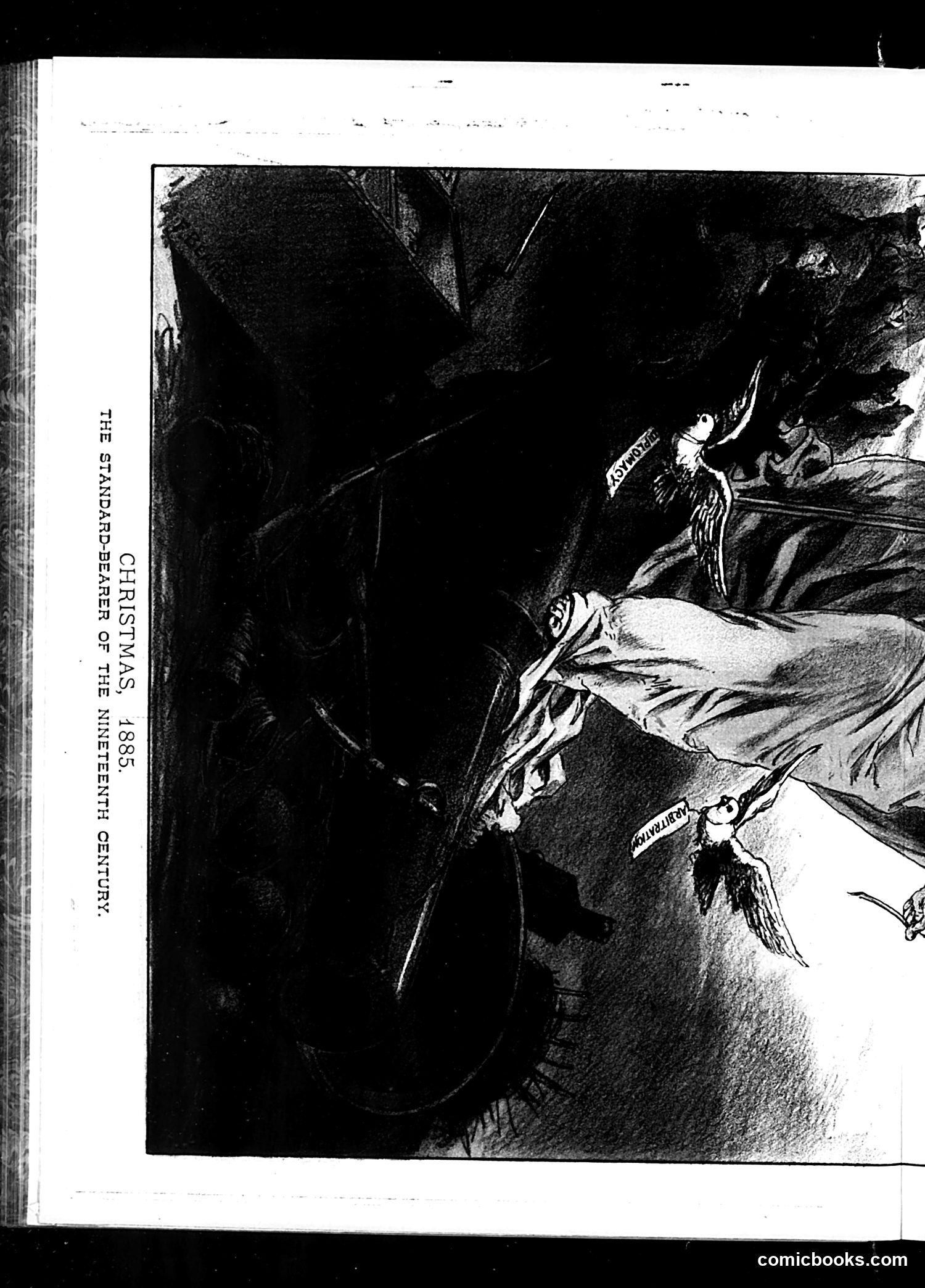
This engraving depicts Christmas as an allegorical female figure—a "standard-bearer"—carrying a banner or flag. She appears armored or formally dressed, positioned as a noble warrior or leader guiding civilization forward. The caption frames Christmas as the defining moral and cultural force of the 1800s. This reflects late Victorian sentiment that positioned Christmas (increasingly commercialized and sentimentalized during this era) as a civilizing influence and marker of Christian progress. The militaristic imagery—treating Christmas as a "standard-bearer" leading society—suggests the magazine viewed the holiday as central to American values and advancement, a thematic common in Gilded Age publications promoting both religious tradition and consumer culture.
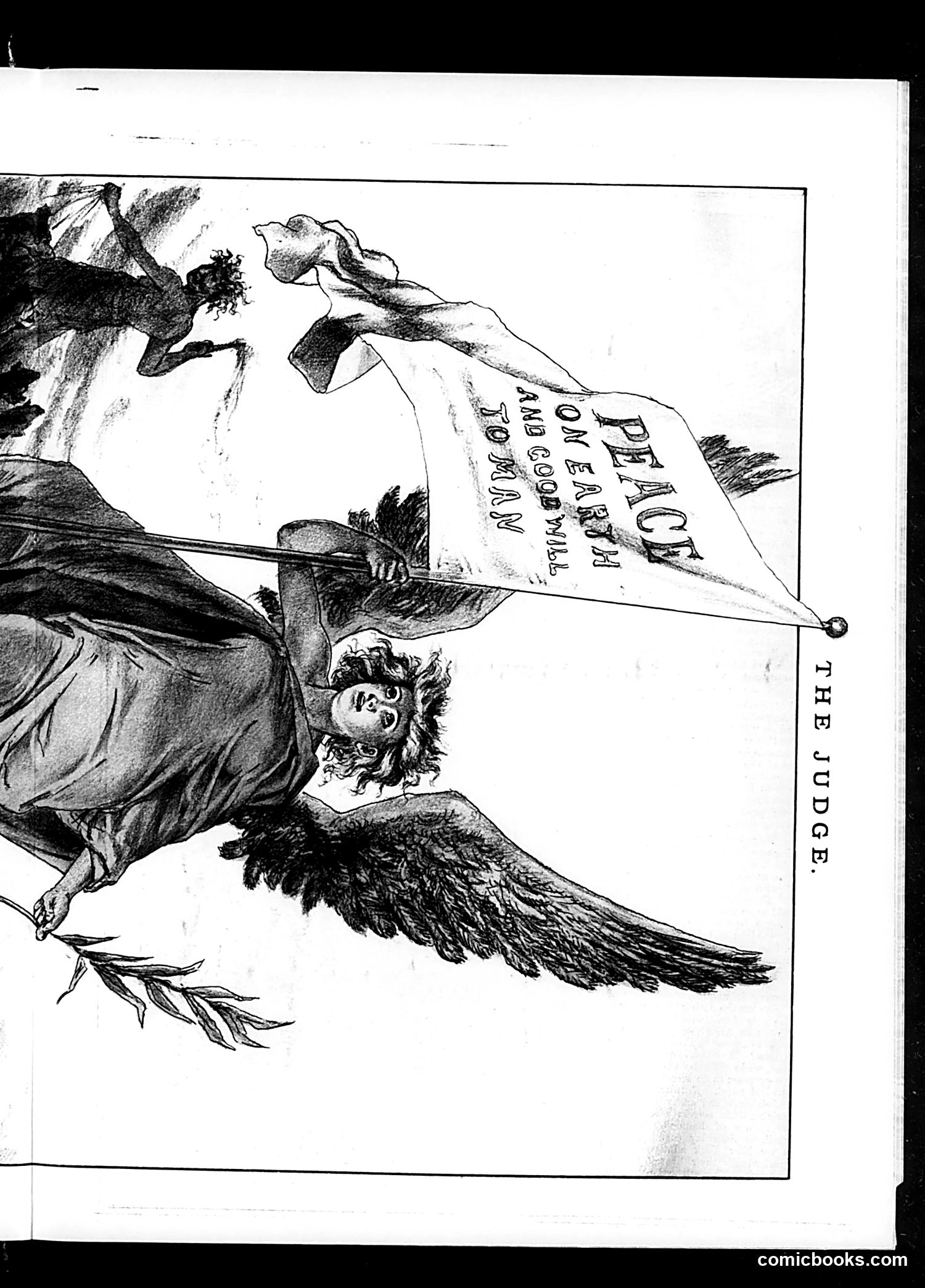
This political cartoon depicts **Justice as a winged female figure** (a classical allegorical representation) holding a scroll or document. The text on the scroll reads "PEACE AND GOOD WILL TO ALL" though partially obscured. A figure below—appearing to be a judge or authority figure—holds what looks like a gavel or staff, labeled "THE JUDGE." The satire appears to critique the gap between **idealistic proclamations of peace and justice versus actual judicial or political implementation**. The classical imagery of Justice suggests the cartoon questions whether lofty principles are genuinely upheld in practice. Without a visible date or additional context, the specific historical event or political target remains unclear, though the theme of institutional hypocrisy is evident.
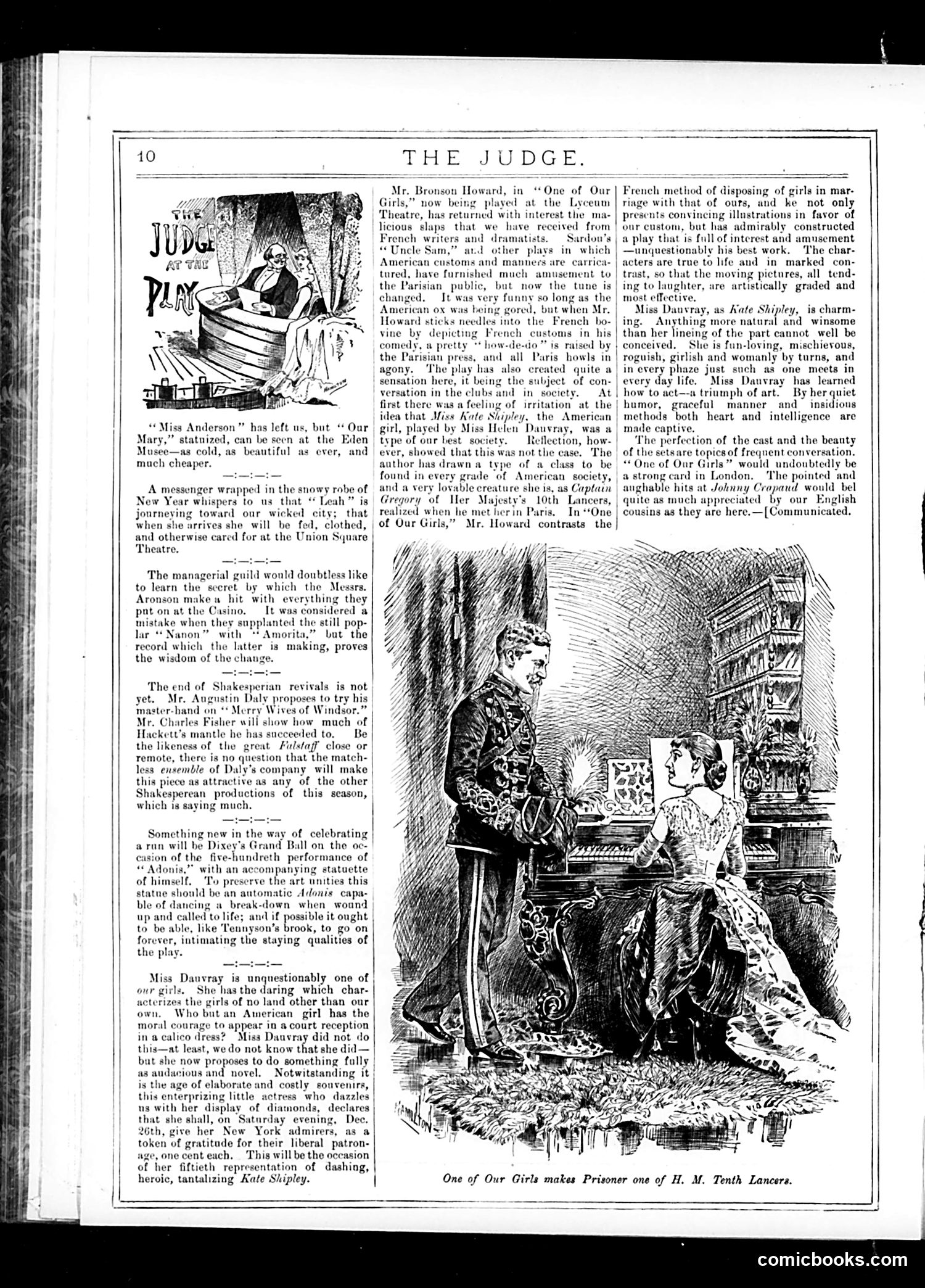
This page from *Judge* magazine reviews recent theatrical productions, particularly praising playwright Bronson Howard's "One of Our Girls" at the Lyceum Theatre. The play stars American actress Helen Dauvray as "Kate Shipley," an American girl navigating French society. The satire contrasts American and French customs regarding courtship and marriage. Howard's play apparently satirizes the French approach while celebrating American girls' independence and moral courage—notably, Dauvray's boldness in wearing a calico dress to a formal court reception, something the reviewer suggests only an American woman would dare do. The illustration shows Dauvray's character with what appears to be a military officer (likely Captain Gregory of the "10th Lancers" mentioned in text), suggesting the play's romantic plot. The page also briefly reviews other theatrical productions, including Shakespearean revivals and the ongoing success of "Adonis" at the Casino Theatre. The overall tone celebrates American cultural superiority and feminine boldness compared to European conventions.
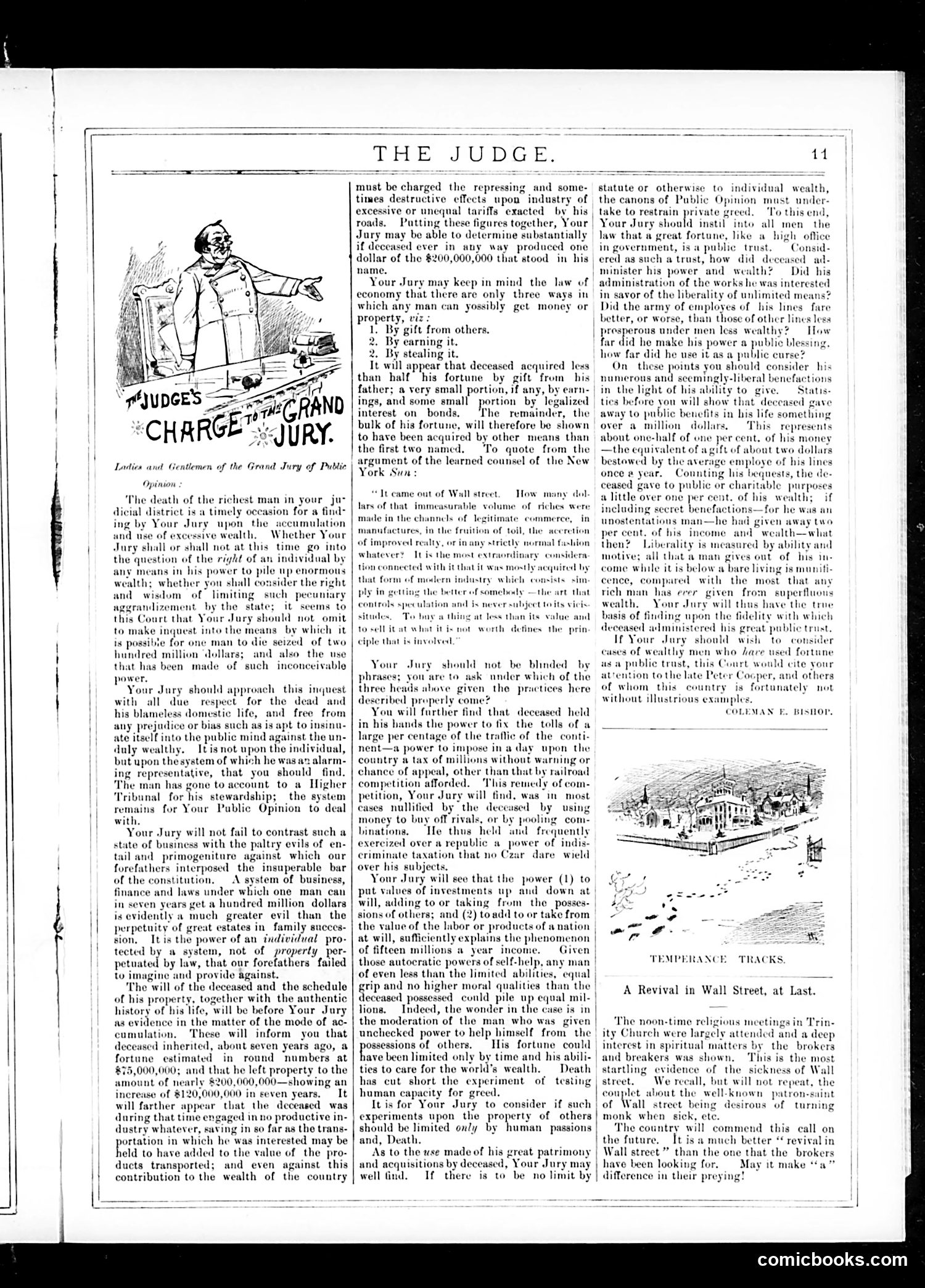
This page presents a judicial charge to a grand jury examining the death of an extraordinarily wealthy man who accumulated approximately $200 million over seven years—largely through inheritance and financial manipulation rather than productive labor. **The Satire's Target:** The cartoon critiques the Gilded Age system allowing massive wealth concentration. The judge's address sarcastically suggests the jury investigate whether the deceased *produced* even a single dollar of his fortune, implying he merely manipulated existing wealth through railroad interests and tariffs. **Key Points:** - The cartoon challenges the legitimacy of extreme wealth accumulation - It distinguishes between productive industry and speculative finance - It argues that great fortunes should be treated as "public trusts" with social obligations - The satire suggests that unregulated capitalism created worse problems than the hereditary aristocracy the Constitution opposed **Context:** This reflects Progressive Era criticism of robber barons and monopolists whose power derived from financial manipulation rather than genuine economic contribution. The piece advocates for public accountability of the wealthy.
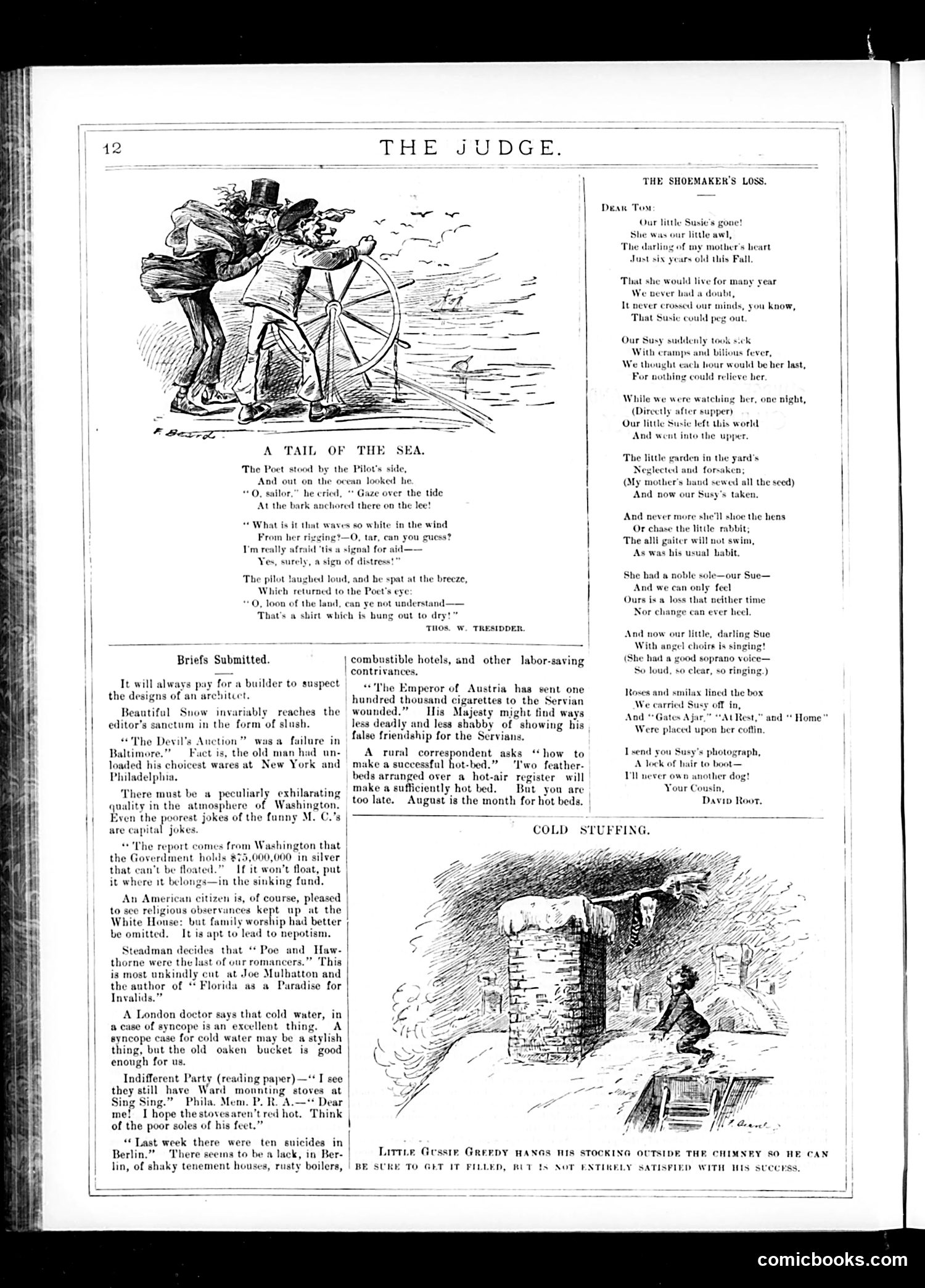
This page contains two main elements: **"A Tail of the Sea,"** a humorous poem about a poet and sailor discussing a fluttering shirt on a ship (a visual pun playing on "tail"), and **"The Shoemaker's Loss,"** a mock-sentimental elegy for a young girl named Susie. The satire in "The Shoemaker's Loss" is subtle but pointed: it mimics overly sentimental Victorian mourning literature while the punny occupation ("shoemaker") and repeated shoe-related wordplay ("sole," "gaiter," "peg out") undercut genuine grief. The excessive flowery language about a child's death becomes absurd through the shoemaking puns, mocking the era's tendency toward maudlin sentimentality. The "Briefs Submitted" section offers typical satirical quips about architects, newspapers, government waste, and social hypocrisy—standard Judge magazine fare poking fun at contemporary pretension and incompetence.
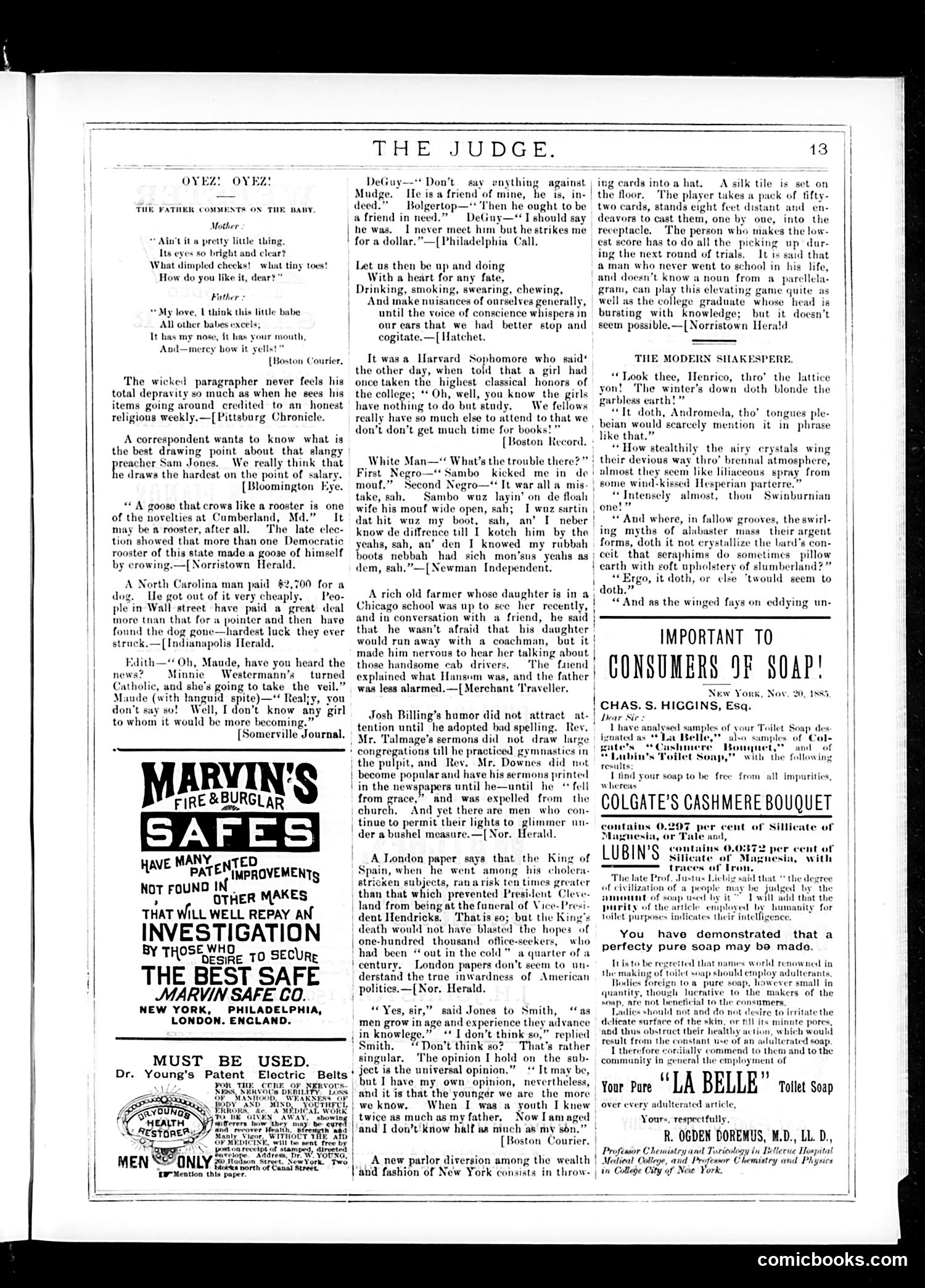
This page consists primarily of **humorous anecdotes and jokes** rather than political cartoons. The content reflects late 19th-century American humor: **Key Items:** 1. **"Father Comments on the Baby"** — A domestic joke contrasting the mother's sentimentality with the father's blunt observation that the infant "yells" excessively. 2. **Religious/Political Jabs** — Brief quips mock preachers (Sam Jones), Democratic politicians (a "rooster" making a "goose of itself"), and religious conversion (a woman becoming Catholic nun). 3. **Social Commentary** — Jokes about wealth (a $2,700 dog), Harvard elitism (female students have "nothing to do but study"), and racial stereotypes (dialogue between white man and Black men in dialect). 4. **Class Humor** — The farmer worried about his daughter's interest in "cab drivers" reflects anxieties about class mixing. The page is predominantly **advertisements** (Marvin Safes, Dr. Young's Electric Belts) interspersed with satirical content typical of Judge's genteel, conservative humor targeting contemporary social pretensions.
This page is **primarily advertising** with minimal editorial cartoon content. The main feature is a brief humorous anecdote titled "HE TOOK WHISKEY." ## The Anecdote The story mocks a snobbish British aristocrat ("Milord") traveling by stagecoach in the American West. Characterized as excessively exclusive and unwilling to socialize, he refuses a cowboy's offer to buy him a drink. The humor derives from the clash between upper-class British pretension and rough-and-tumble American frontier informality—a common satirical theme of the era. The page's header includes flowery, overwrought poetic dialogue (appearing to parody Victorian sentimentality), which contextualizes the magazine's general comedic approach to social pretension. ## Advertising Content The remainder consists of period advertisements for perfumes, pianos, safes, jewelry, candy, medical devices, and furniture—typical of Judge's revenue model. No identifiable political figures or specific contemporary events appear on this page.
This page is primarily **advertising** with one short humorous anecdote. The main illustrated content is commercial: patent medicines (Hale's Honey cough remedy), printing/lithography services, and various trade businesses typical of late 19th-century magazines. The satirical story—"Dust from the Bull Ring"—describes a British aristocrat ("Milord") encountering an American cowboy who coerces him into drinking whiskey by threatening violence, then forces his servants to socialize as equals with him. The humor mocks British class pretension: the nobleman is horrified at social leveling but ultimately capitulates. The cowboy's rough egalitarianism "wins," though the snobbish lord retreats into exclusiveness afterward—satirizing both British rigidity and American frontier bluntness. The shorter jokes mock editors' reading habits and women's beauty fading after marriage—typical period humor targeting intellectual vanity and gender stereotypes. Overall: **This is chiefly an advertising page** with light satirical commentary on British-American cultural clash.
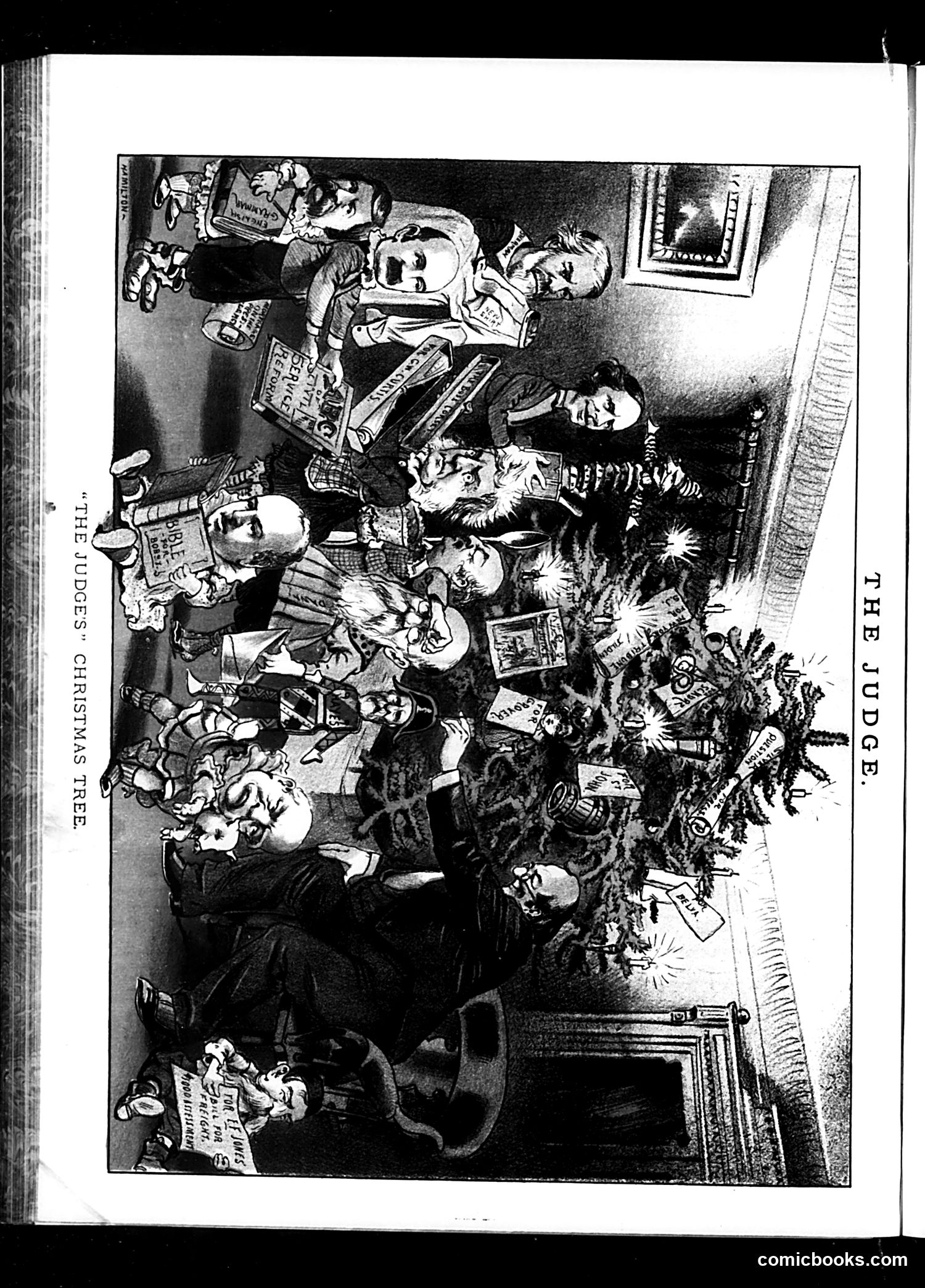
This is a satirical illustration showing a decorated Christmas tree labeled "The Judge's Christmas Tree" surrounded by numerous figures and caricatures. The scene appears to be a commentary on *Judge* magazine's editorial positions and satirical targets throughout the year. The tree is laden with what appears to be political figures, social types, and contemporary celebrities—the "ornaments" that *Judge* has mocked or featured in its satire. Without clearer labels on individual figures, the specific identities are difficult to determine, but the concept is clear: this is a visual inventory of *Judge's* favorite targets and subjects from the past year, presented as a humorous year-end retrospective. The cartoon uses the Christmas tree metaphor to celebrate *Judge's* satirical work and cultural commentary.