
Judge, 1885-12-26 · page 6 of 16
Judge — December 26, 1885 — page 6: what you’re looking at
What you’re looking at
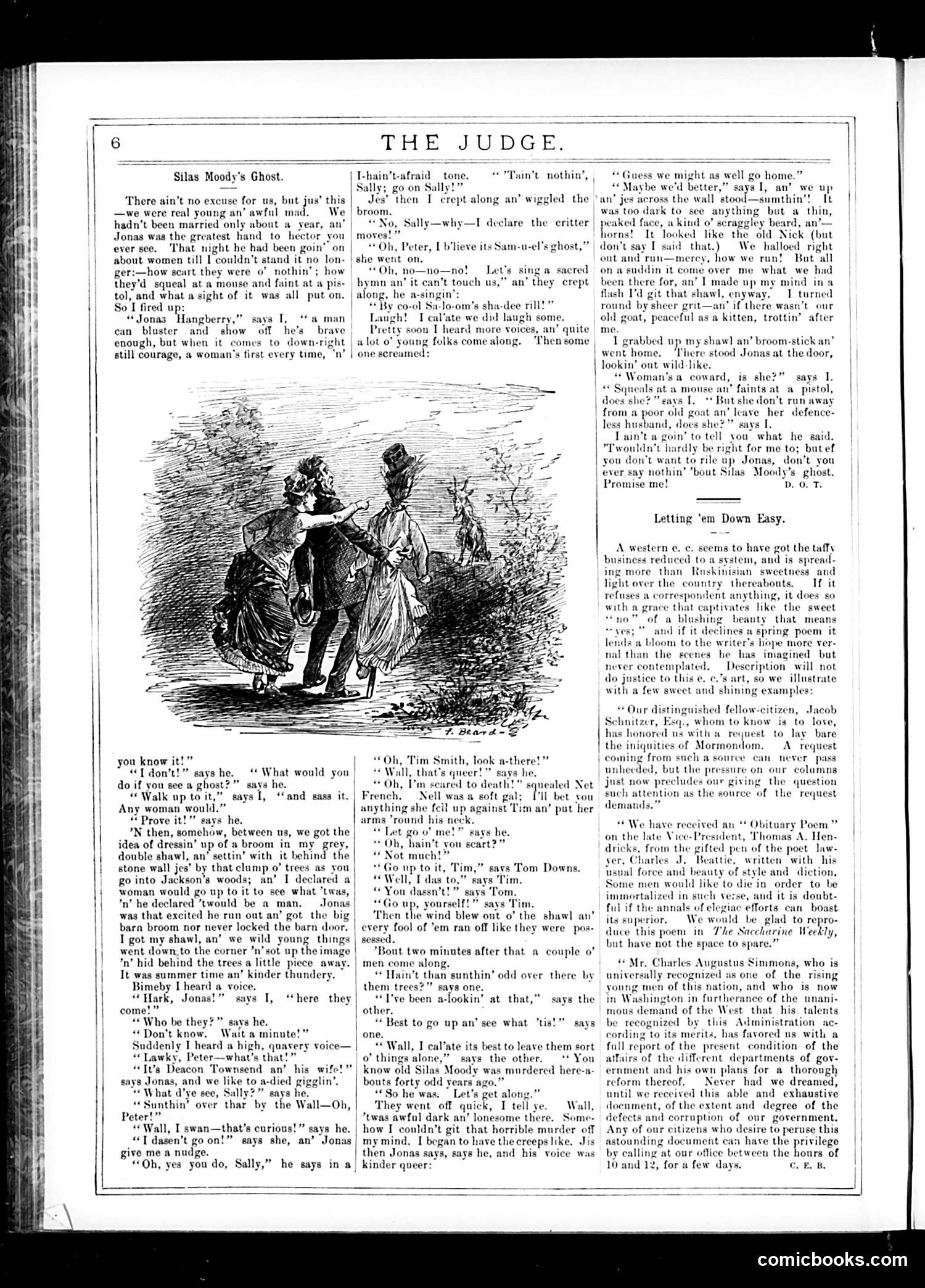
This page presents "Silas Moody's Ghost," a humorous tall tale from *Judge* magazine. The narrative describes a prank gone wrong: a husband and wife dress a broom in a shawl to test whether the wife's claim that women are braver than men holds true. They hide it by a wall. The prank succeeds at first—young people and then two men approach the "ghost" cautiously. However, the joke darkens when someone mentions that an actual murder victim, "old Silas Moody," died near this spot "forty odd years ago." The narrator begins feeling genuine dread about their prank, fearing the psychological weight of invoking a real tragedy. The satire targets masculine bravado and the gendered assumptions about fear. The illustration shows the "ghost" encounter. The surrounding text includes other brief humorous pieces typical of *Judge*'s satirical content, including commentary on literary and political matters of the era.
📄 Transcribed text from this page (OCR, searchable)
Machine-transcribed from the original scan — historical spelling and the odd misread are preserved.
THE JUDGE. | Silas Moody’ 's Ghost. There ain’t no excuse for us, but jus’ this |] —we were real young an’ awful nad. We hadn’t been married only about a year, an’ Jonas was the greatest hand to hector you ever see. ‘That night he had been goin” on about women till I couldn't stand it no lon- ger:—how scart they were 0’ nothin’; how they’d squeal at a mouse and faint at a pis- | tol, and what a sight of it was all put on. {| So I fired up: “Jonas Hangberry,” says I, can bluster and show off he’s — br: enough, but when it comes to down-rig’ still courage, a woman's tirst every time, ‘n? “T don't!” says he.“ What would you do if you see a ghost?” saya he. you know it!” | | | “Walk up to it,” says I, ‘and sass it. | | Any woman would.” j | Prove it!” says he. ’N then, somehow, between us, we got the idea of dressin’ up of a broom in my" grey, double shawl, an’ settin’ with it behind the stone wall jes’ by that clump 0” trees as you go into Jackson's woods; an’ I declared a woman would go up to it to see what ‘twas, | 'n’ he declared ’twould be a man, Jonas was that excited he run out an’ got the big bara broom nor never locked the barn door, I got my shawl, an’ we wild young things j Went down. to the corner ’n’ sot up the image ’n’ hid behind the trees a little piece aws It was summer time an’ kinder thundery Bimeby I heard a voice, | Hark, Jona come!” “Who be they?” says he. “Don’t know. Wait a minute!” Suddenly I heard a high, quavery voice— “Lawky, Peter—what’s that!” “It’s Deacon Townsend an’ his wife! says Jonas, and we like to a-died gigglin’, “What d’ye see, Sally?” says he. “‘Sunthin’ over thar by the Wall—Oh, Peter!” “Wall, I swan—that’s curious! “T dasen’t go on!” give me a nudge. “Oh, yes you do, Sally,” he says in a — 9 says he. says she, an’ a SS SS EES Serie S ta I, ‘there they | Jonas | |r T-hain’t- afraid. tone, + "Tuin’t nothin’, go on Sally! Guess we might as yell go home. Maybe we'd better,” ays I, an’ we up then I crept along an’ wiggled the ‘an’ jes across the wall stood—sumthin’! It broom. was too dark to see anythin but a thin, ae Sally—why—I declare the critter aked face, a kind o’ scraggley beard, an’— moves! ferns! It looked like the old Nic (but | + Oh, Peter, Lb'lieve its Sam-u-el’: don’t say I said that.) We halloed right | she went on. “Oh, no—no—no! Let's hymn an’ it can’t touch us,” an cred crept they lo-om’s sha-dee rill!” ate we did laugh some. Pretty soon [ heard more voices, an’ quite alot o° young folks comealong. ‘Then some Tim Smith, look a-there 1, that’s queer!” says hi Oh, I’m seared to death!” squealed Net | French. Nell was eoft gal; 1'll bet you anything she feil up against Tim an’ pat her | arms ‘round his neck, | “Let goo’ me!” says he. | “Oh, hain’t you scart?” “Not much!” Go up to it, “ Well, I das to,” says Tim. | You dassn’t!” says Tom. “Go up, yourself!” says Tim. ‘Then the wind blew out o’ the shawl an’ : fool of ’em ran off like they were pos- ed. "Bout two minutes after that a couple o’ men come along. “Hain’t than sunthin’ odd over there by them trees?” says on | “I've been a-lookin’ at tha | other. | ‘* Best to go up an’ see what “tis!” Tim,” says Tom Downs. says the says one. “Wall, o’ things alone,” say know old Silas Moody bouts forty odd years ago. ** So he was. Let’s get alot |. They went off quick, I tell Wall, “twas awful dark an’ lonesome there. Some- how I couldn’t git that horrible murder off my mind. I began to have thecreeps like. Jis | then Jonas says, says he, and his voice was kinder queer: I cal’ate its best to leave them sort a the other. — ** You murdered here-a } | from | out and run—mercy, how we run! Bat all on asuddin it come over me what we had been there for, an’ I made up my mind it flash I'd git that shawl, enyway. I turned round by sheer grit—an’ if there n't our old goat, p ulasa kitten, trottin’ after me. 1 grabbed up my shaw! an’ broom-stick an’ went home. ‘There stood Jonas at the door, lookin’ out wild-1i Woman pward, is she?” says I. ata mouse an’ faints at a pistol, I. ** But she don’t run awa: poor old goat an’ leave her defence- less husband, does she?” says I. Tain in’ to tell you’ what he said. ’Twouldn’t hardly be right for me to; butef you don't want to rile up Jonas, don’t you ever say nothin’ ’bout Silas Moody’s ghost. Promise me! D. 0. T. de Letting ‘em Down Easy. A western e. c. seems to have got the taffy incss reduced to tem, and is spread- more than inisian sweetness and light over the country thereabouts. — If it refuses a correspondent anything, it does so with a grace that captivates like the sweet ‘no” of a blushing beauty that means oy and if it declin le i bloom to the w nal than the scenes he has imagined but never contemplated. — Description will not do justice to this ¢ urt, so we illustrate with a few sweet and shining examples: a spring poem it 1's hope more ver- “Our dis ed fellow-citizen, Schnitzer, , Whom to know is to love, has honored us with a request to lay bare the iniquities of Mormondom. — A_ request coming from such a source can never pass unhe » pressure on our columns just now precludes our giving the question such attention as the source of the request demat ow, on th Jacob ived an ‘ Obituary Poem” ident, Thomas A, Hen- drick in the gifted pen of the poet law- yer, Charles J. Beattie, written with his usual force and beauty of style and. diction, Some men would like to die in order to be immortalized in such verse, and it is doubt- ful if the annals of clegiac efforts can boast its superior. We wonld be glad to repro- duce this poem in he Saccharine Weekly, but have not the space to spare.” “Mr. Charles Augustus Simmons, who is universally recognized as one of the rising men of this nation, and who is now shington in furtherance of the unani- mous demand of the West that his talents be 1 nized by this Administration ac- cording to its merits, has favored us with a full report of the present condition of the atfairs of the different departments of gov- ernment and his own plans for a thorough reform thereof. Never had we dreamed, until we received this able and exhaustive document, of the extent and degree of the defects and corruption of our government. Any of our citizens who desire to peruse this astounding document can have the privilege y calling at our office between the hours of and 12, for a few days. B. comicbooks.com