
Judge, 1885-12-26 · page 11 of 16
Judge — December 26, 1885 — page 11: what you’re looking at
What you’re looking at
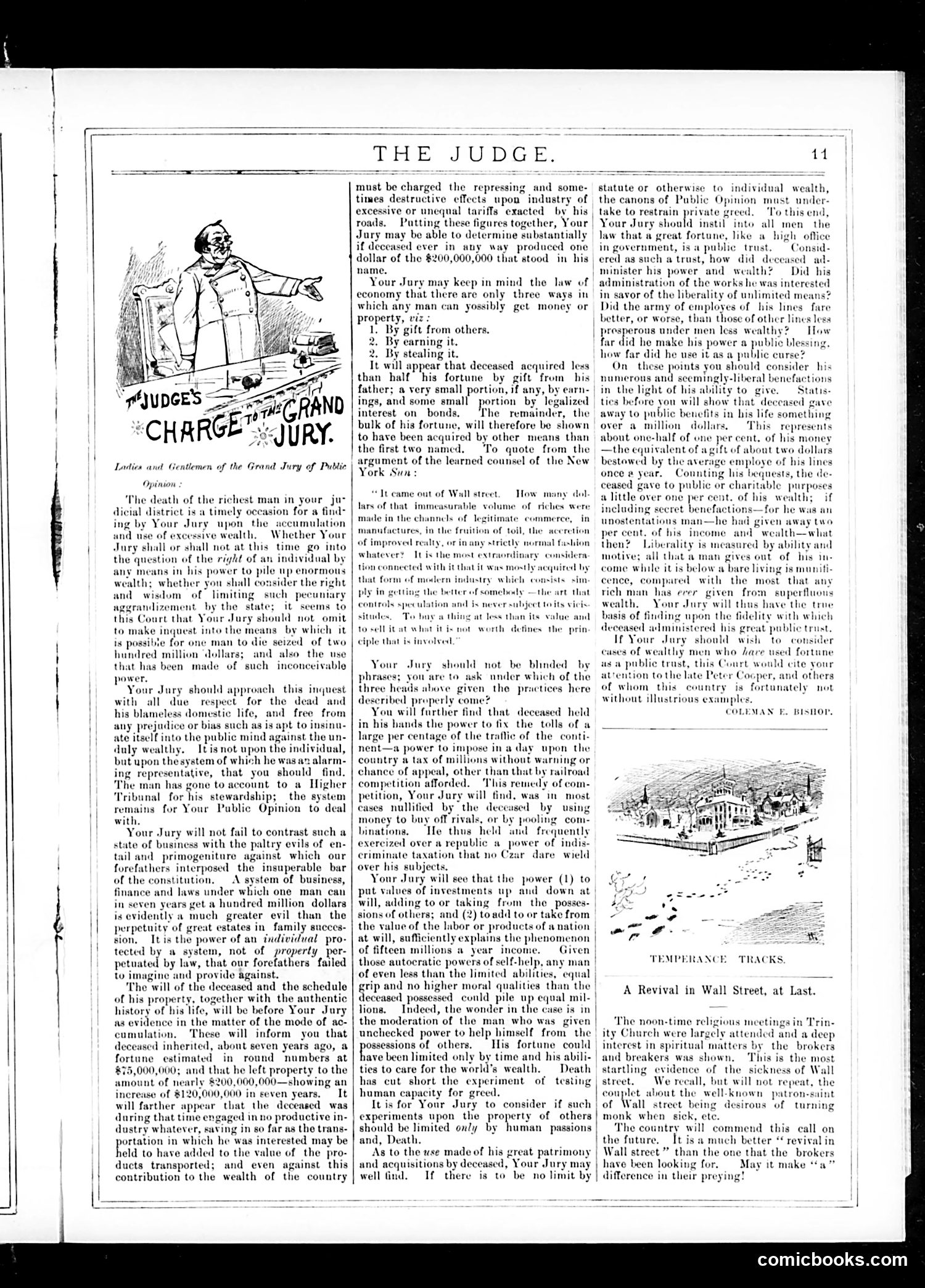
This page presents a judicial charge to a grand jury examining the death of an extraordinarily wealthy man who accumulated approximately $200 million over seven years—largely through inheritance and financial manipulation rather than productive labor. **The Satire's Target:** The cartoon critiques the Gilded Age system allowing massive wealth concentration. The judge's address sarcastically suggests the jury investigate whether the deceased *produced* even a single dollar of his fortune, implying he merely manipulated existing wealth through railroad interests and tariffs. **Key Points:** - The cartoon challenges the legitimacy of extreme wealth accumulation - It distinguishes between productive industry and speculative finance - It argues that great fortunes should be treated as "public trusts" with social obligations - The satire suggests that unregulated capitalism created worse problems than the hereditary aristocracy the Constitution opposed **Context:** This reflects Progressive Era criticism of robber barons and monopolists whose power derived from financial manipulation rather than genuine economic contribution. The piece advocates for public accountability of the wealthy.
📄 Transcribed text from this page (OCR, searchable)
Machine-transcribed from the original scan — historical spelling and the odd misread are preserved.
— Latics and Gentlemen of the Grand Jury of Public Opinion ‘The death of the richest man in your ju- dicial district is a timely occ ing by Your Jury upon the accumulation und use of excessive wealth. Whether Y Jury shall or shall not at this time go into e question of the right of an individual by cans in his power to pile up enormous whether you shall consider the right and wisdom of’ limiting such pecuniary aggrandizeme hy the state; it seems to this Court that Your Jury should not omit to make inquest into the means by which it is possibie for one man to die seized of two hundred million dollar nd o the use that has been made of such inconceivable powe Your Jury should approach this inquest with all due respect’ for the dead and his blameless domestic life, and free from any prejudice or bias such as is apt to insinu- ate itself into the public mind against the un- duly wealthy, It is not upon the individual, but upon thesystem of which he was an alarm- ing representative, that you should find. © man has gone to account to a Higher Tribunal for his stewardship; the system remains for Your Public Opinion to deal with, Your Jury will not fail to contrast such a state of business with the paltry evils of en- tail and primogeniture against which our forefathers interposed the insuperable of the constitution, A system of busin finance and laws under which one man can in seven years get a hundred million dollars is evidently a much greater evil than the perpetuity of great estates in. family suc sion, It is the power of an individual pro- tected by a system, not of property per- petuated by law, that our forefathers’ failed to imagine and provide against. ‘Tho will of the deceased and the schedule of his property, together with the authentic history of his life, ‘will be before Your Jury as evidence in the matter of the mode of ac- cumulation, These will inform you that deceased inherited, about seven years ago, a fortune estimated in round numbers at $75,000,000; and that he left property to the amount of nearly 10,000,000—showing an increase of $120,000,000 in seven years. It will farther appear that the deceased was during that time engaged in no productive in- dustry whatever, saving in so far as the trans- portation in which he was interested may be eld to have added to the value of the pro- ducts transported; and even against This contribution to the wealth of the country sion for a find | THE JUDGE. must be charged the repressing and some- times destructive effects upon industry of excessive or unequal tariffs exacted by his roads, Putting these figures together, Your Jury may be able to determine ‘substantia Hy if deceased ever in uny way produced one dollar of the $200,000,000 that stood in his name. Your Jury may keep in mind the law of economy that there are only three ways in 44 statute or otherwise to the canons of Public Opinion must under take to restrain private greed. ‘To this end, Your Jury should instil into all inen the w that a great fortune, like a high office in government, is a public trust. — Consid- individual wealth, ered ag such a trust, how did ed a minister his power and we Did his administration of the wor as interes in savor of the liberality of unlimited m: which sny man can yossibly get money or Did the army of employes of his lines fare property, better, or worse, th se of other lines lees 1. By gift from others. prosperous under men less wealthy? — How By earning it. far did he m » his power a public blessi 2. By stealing it. It will appear that deceased acquired less On than half his fortune by gift from his father; a very small portion, if any, by ear ings, and some small portion legaliz interest on bonds, The remainder, the bulk of his fortune, will therefore be shown to have been acquired by other means than the first two named. To quote from the argument of the learned counsel of the New York Sun: Is sy situdes, To to sell tat what i ciple that is con ulation and j never subject to its vic Ihing at Tess thai va its value and s the snot worth deti prin volved Your uses Jury should not be blinded by ph Ware k under which of the three heads above given the practices here deseribed properly come? You will further find that deceased held in his hands the power to fix the tolls of a large per centage of the traflic of the conti- nent—a power to impose in a day upon the country a tax of millions without warning or chance of appeal, other than that by railroad competition afforded. ‘This remedy of com- petition, Your Jury will find, was in’ most eases nullified by the deceased by using money to buy off rivals, or by pooling com- Linationa. “He thus held wud frequently exercized over a republic a power of indis- criminate taxation that no Czar dare wield over his subject Your Jury will see that the power (1) to put values of investments up and down at will, adding to or taking from the pos: sions of others; and (2) toadd to or take from the value of the libor or products of a nation at will, sufficiently explains the phenomenon of fifteen millions a year income. Given those autocratic powers of self-help, any man of even less than the limited abilities, equal grip and no higher moral qualities than the | deceased possessed could pile up equal mil- how far did he use it as a public eu these points you should consider his numerous and scemingly-liberal benefuctions in the light of his ability to give. Statis- ties before you will show that deceased gave away to public benefits in his life something over a million dolla This represents about one-half of one per cent, of his money —the equivalent of agift of bestowed by the average employe of his lines once # year. Counting his bequests, the de- ceased gave to public or charitable purposes about two dollars “It came out of Wall street. How many dol y little over one per cent. of his wealth; if lars of that immeasurable volume of riches we including secret benefactio for he was an made in the channels of legitimate commerce, in un ions man—he had given away two | manufactures, in the fruit ul retion per this income and wealth—what | of improved realty, or inany strictly normal fashion then? Liberality is measured by ability and whatever? Mist stextraordinary considera: motive; all that a man gives out of hi tion connected with it that it was mostly acquired by come while it is below a bare living is muniti that form of modern industry whieh consists sim: cence, compared with the most that any ply in getting the better efsomebody —the art that rich man has erer given fr superfluons wealth. Your Jury will thus have the true 8 of finding upon the fidelity with which deceased administered his great’ public tru If Your Jury shonld wish to consider cases of wealthy men who Lave used fortune 1s a public trust, this Court would cite your attention to the late Peter Cocper, and others of whom this country is fortunately not without illustrious examples. : COLEMAN Fe Bisnor. | TEMPERANCE TRACKS, A Revival in Wall Street, at Last. lions. Indeed, the wonder in the case is in | the moderation of the man who was given The noon-time religious meetings in Tr} unchecked power to help himself from the | ity Church were la ttended and a deep ossessions of others. His fortune could interest in spiritual matters by the brokers Fave beon limited only by time and his abili- | and breakers was shown, This is the most ties to care for the world’s wealth. Death evidence of the sickness of Wall has cut short the experiment of testing human capacity for greed. It is for Your Jury to consider experiments upon the property should be limited only by human passions | and, Death. As to the use made ¢ and acquisitions by dec well find. If there is if such his great patrimony a, Your Jury may | to be no limit by | of others | monk when © Wen all, but will not repeat, the about the well-known patron-saint street being desirous of turning sick, ete. The country will commend this call on | the future. It is a much better ‘ revival in Wall street ” than the one that the brokers have been looking for, it make | difference in their pi | cou of Watt comicbooks.com