
Judge, 1885-12-26 · page 7 of 16
Judge — December 26, 1885 — page 7: what you’re looking at
What you’re looking at
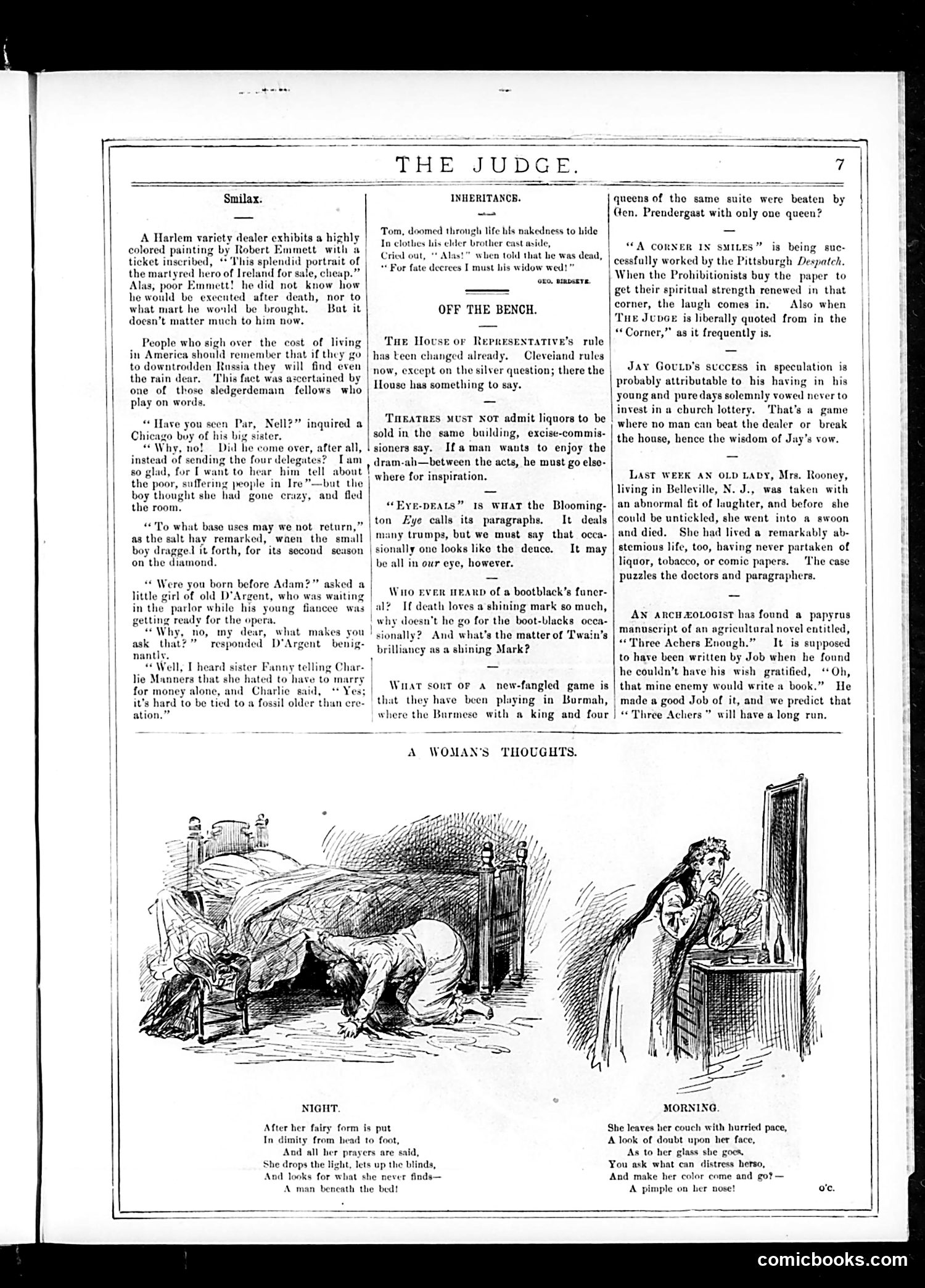
This page from *Judge* magazine contains brief satirical items and two illustrations titled "A Woman's Thoughts" (showing "Night" and "Morning"). **Key satirical items:** - **"Smilax"**: Mocks commercialization of Irish history—a dealer selling a portrait of Robert Emmett (executed Irish rebel) cheaply, treating his martyrdom as mere merchandise. - **"Inheritance"**: A man must marry his dead brother's widow, inheriting both the estate and an unwanted marriage—satirizing inheritance law's absurdity. - **Political references**: Mentions Cleveland and the "silver question" (currency debate of the 1880s-90s); references to Prohibition advocates and Jay Gould (famous speculator). - **"A Woman's Thoughts"** illustrations: Contrasts a woman's nighttime prayers with her morning vanity at the mirror—satirizing female hypocrisy regarding piety versus appearance. The overall tone is cynical about human nature, materialism, and social conventions typical of *Judge*'s satirical approach.
📄 Transcribed text from this page (OCR, searchable)
Machine-transcribed from the original scan — historical spelling and the odd misread are preserved.
Smilax. A Harlem variety dealer exhibits a highly colored painting by Robert Emmett witl ticket inscribed, “This splendid portrait of | 1 the martyred hero of Ireland for sale, cheap.” Alas, poor Emmett! he did not know how he would be executed after death, nor to what mart he would be brought. Bat it doesn’t matter much to him now, People who sigh over the cost of living in America should remember that if they go to downtrodden Russia they will find even the rain dear, This fact was ascertained by one of those sledgerdemain fellows who play on words. “ TLave you seen Par, y of his big sister. y, no! Did he come over, after all, instead of sending the four delegates? Tam so glad, for [ want to hear him tell about the poor, suffering people in Ire”—but the boy thought she had gone crazy, and fled the room. ell?” inquired a “To what base uses may we not return,” as the salt remarked, waen the small boy dragged it forth, for its second season on the diamond. “* Were you born before Adam?” asked a little girl of old D’Argent, who was waiting in the parlor while his young fiancee getting ready for the opera. “Why, no, my dear, as what- makes you responded’ D'Argent benig- ell, I heard sister F: lie Manners that she ha for money alone, and Charlie said, * Ye it’s hard to be tied to a fossil older than ation.” nny telling Char- <d to have to mar: INHERITANCE. Tom, doomed through life his nakedness to hide In clothes his elder brother cast aside, Cried out, ** Alas!” told that he was dead, ** For fate decrees I must his widow wed!” wher Oko, sinDseTE, OFF THE BENCH. Tue Hovse or Repr has teen changed already. ENTATIVE’S House has something to say. sold in the same building, excise-commis sioners say. where for inspiration. “EYE-DEALS jton Eye calls its paragraphs, It deal sionally one looks like the deuce. be all in our eye, however. Wuo ever mean of a bootblack’s funcr. al? [f death loves a shining mark so much doesn’t he go for the boot-blacks occa nally? And what’s the matter of Twain’ brilliancy as a shining Mark? Wuat sont or a new-fangled game is y have been playing in Burmah where the Burmese with a king and fou rule Cleveiand rules now, except on the silver question; there the | THEATRES MUST NoT admit liquors to be Ifaman wants to enjoy the , dram-ah—between the acts, he must go elso Is wHaT the Blooming- many trumps, but we must say that occa- It may queens of tho same suite were beaten Gen. Prendergast with only one queen? “(A CORNER IN SMILES” is being suc- | cessfully worked by the Pittsburgh Despatch. When the Prohibitionists buy the paper to get their spiritual strength renewed in that corner, the laugh comes in. Also when Tue Juve is liberally quoted from in the “Corner,” as it frequently is. Jay Govp’s success in speculation is probably attributable to his ing in his young and pure days solemnly vowed never to invest in a church lottery, That’s a game where no man can beat the dealer or break the house, hence the wisdom of Jay’s vow. LAst WEEK AN OLD LADY, Mrs. Rooney, living in Belleville, N. J., was taken with an abnormal fit of laughter, and before she could be untickled, she went into a swoon and died. She had lived a remarkably ab- stemious life, too, having never partaken of liquor, tobacco, or comic papers. ‘The case | puzzles the doctors and paragraphers. s | "| AN ancHXOLOGIST has found a papyrus manuscript of an agricultural novel entitled, “Three Achers Enough.” It is supposed to have been written by Job when he found he couldn't have his wish gratified, “Oh, that mine enemy would write a book.” He , | made a good Job of it, and we predict that r | “Three Achers ” will have a long run. NIGHT. After her In ‘y form is mity from head to foot, A WOMAN'S THOUGHTS. put And all her prayers are said, She drops the ight, lets up the blinds, And looks for what she never finds— A man beneath the bed! She leaves her couch with hurried pace, A look of doubt upon her face, As to her glass she gock. You ask what can distress herso, And make her color come and go? — A pimple on her nose! comicbooks.com