
A complete issue · 16 pages · 1885
Judge — September 26, 1885
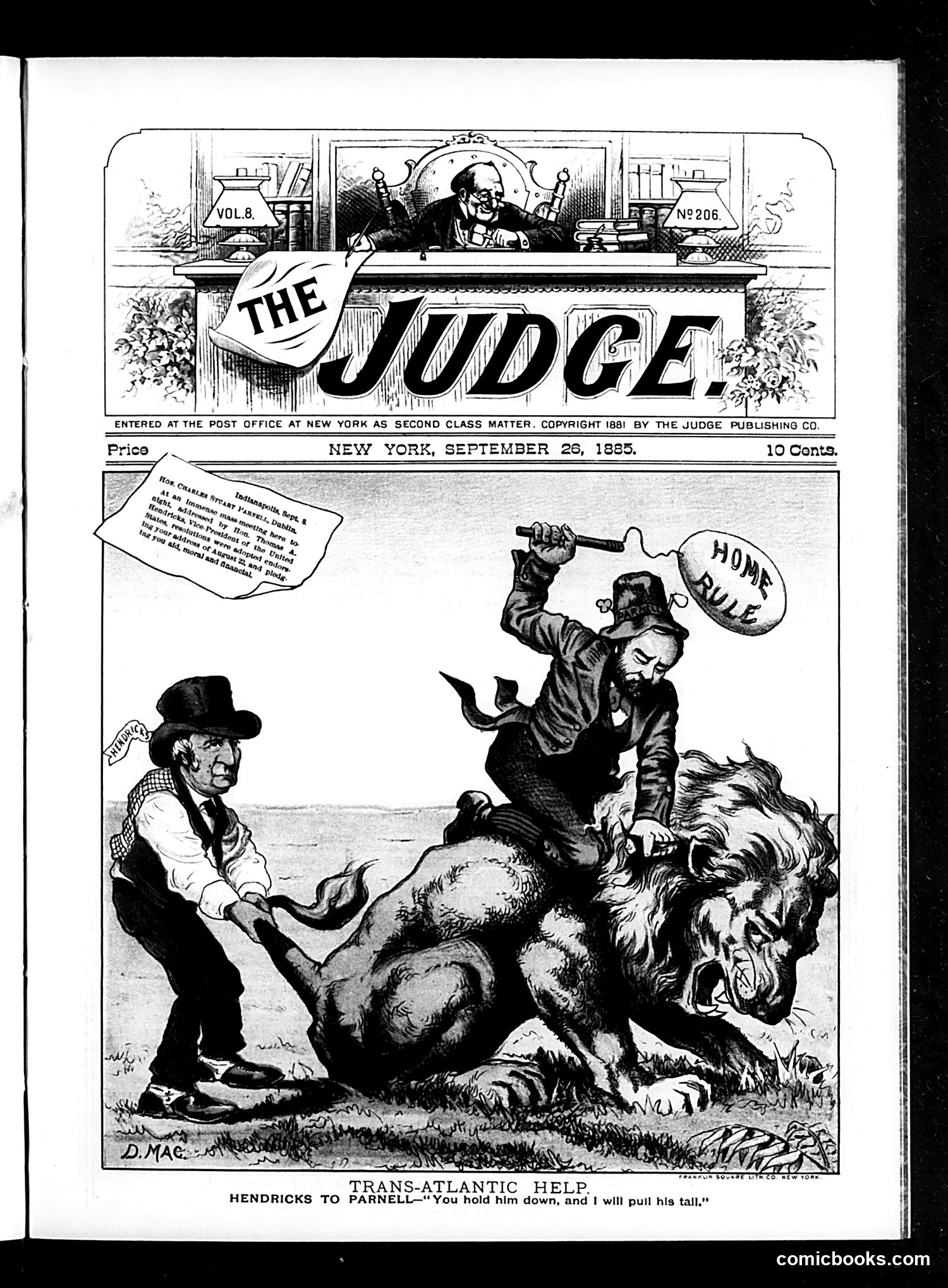
This **Judge** magazine cartoon from September 28, 1885 depicts a satirical scene titled "Trans-Atlantic Help," with the subtitle "Hendricks to Parnell—'You hold him down, and I will pull his tail.'" The cartoon shows two men attempting to control a large, aggressive bull labeled "HOME RULE." The figures appear to represent American and Irish political figures—likely Vice President Thomas Hendricks and Irish nationalist Charles Stewart Parnell—coordinating efforts to manage the contentious issue of Irish home rule. The satire criticizes the political alliance between American Democrats and Irish independence advocates, suggesting their collaboration over Irish sovereignty was awkward or problematic. The bull represents the untamed, dangerous nature of the home rule movement itself.
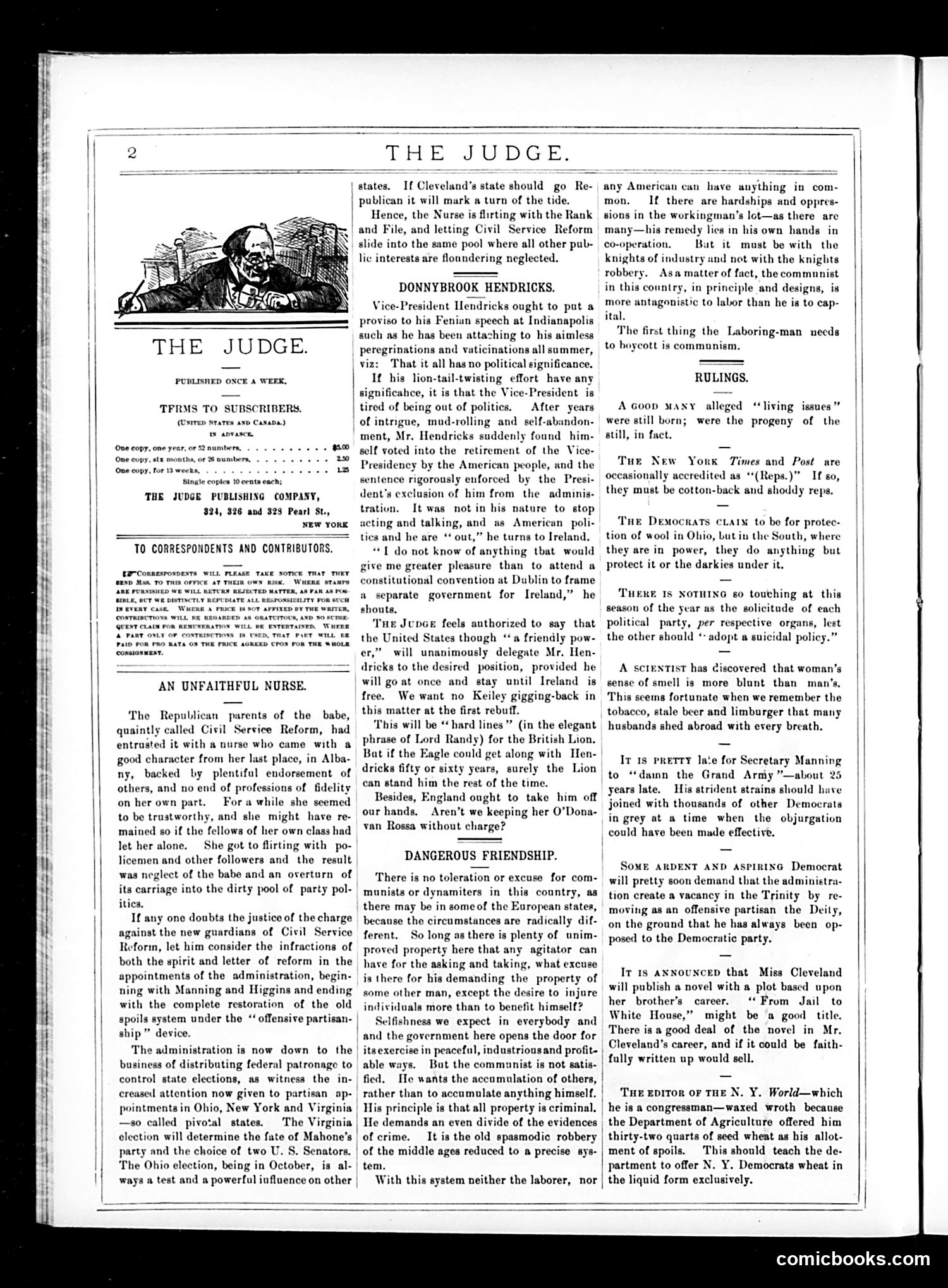
This page satirizes President Cleveland's administration for betraying Civil Service Reform—the Republican initiative to replace political patronage with merit-based government hiring. The main cartoon (top left, though faint) depicts Civil Service Reform as an abandoned baby in a carriage, tipped into a "dirty pool of party politics." The "unfaithful nurse" is Cleveland's administration, which promised to protect reform but instead restored the "spoils system"—rewarding political allies with federal jobs. The article criticizes specific appointments (Manning, Higgins) and the use of patronage in swing states (Ohio, Virginia, New York) to influence elections—exactly what reform was meant to prevent. A secondary item mocks Vice-President Hendricks for his Irish speeches, suggesting he's bored with political exile in the vice-presidency and should be permanently "delegated" to Ireland if he wants to stay active in politics. The satire implies he's become a nuisance.
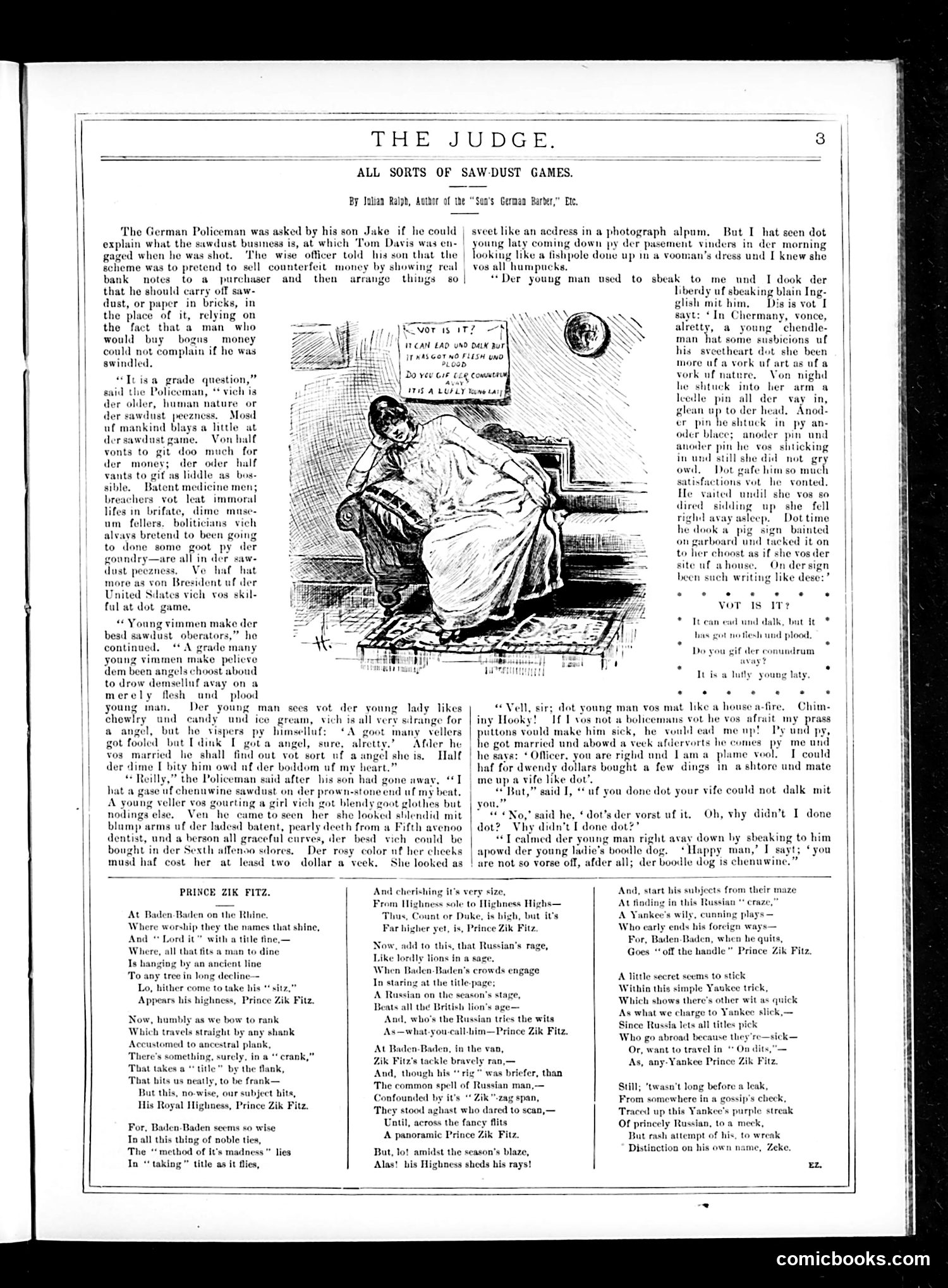
This satirical piece by Julian Ralph uses a German-accented policeman as a narrator explaining the "sawdust game"—a con scheme where fraudsters sell counterfeit money or worthless items to gullible victims by pretending legitimacy. The satire targets widespread deception in American society: fraudulent patent medicines, dime museums, and politicians. The policeman observes that everyone participates in some form of fraud—either overcharging or undercharging. The humorous anecdote about a young couple illustrates how young women deceive suitors with false appearances (comparing a woman to a "fishpole" wrapped in dress), while young men marry expecting angels and find themselves deceived. The German immigrant character—with his thick accent and outsider perspective—allows the author to critique American hypocrisy and corruption from a sardonic distance. The piece suggests deception permeates American commerce, romance, and politics equally.
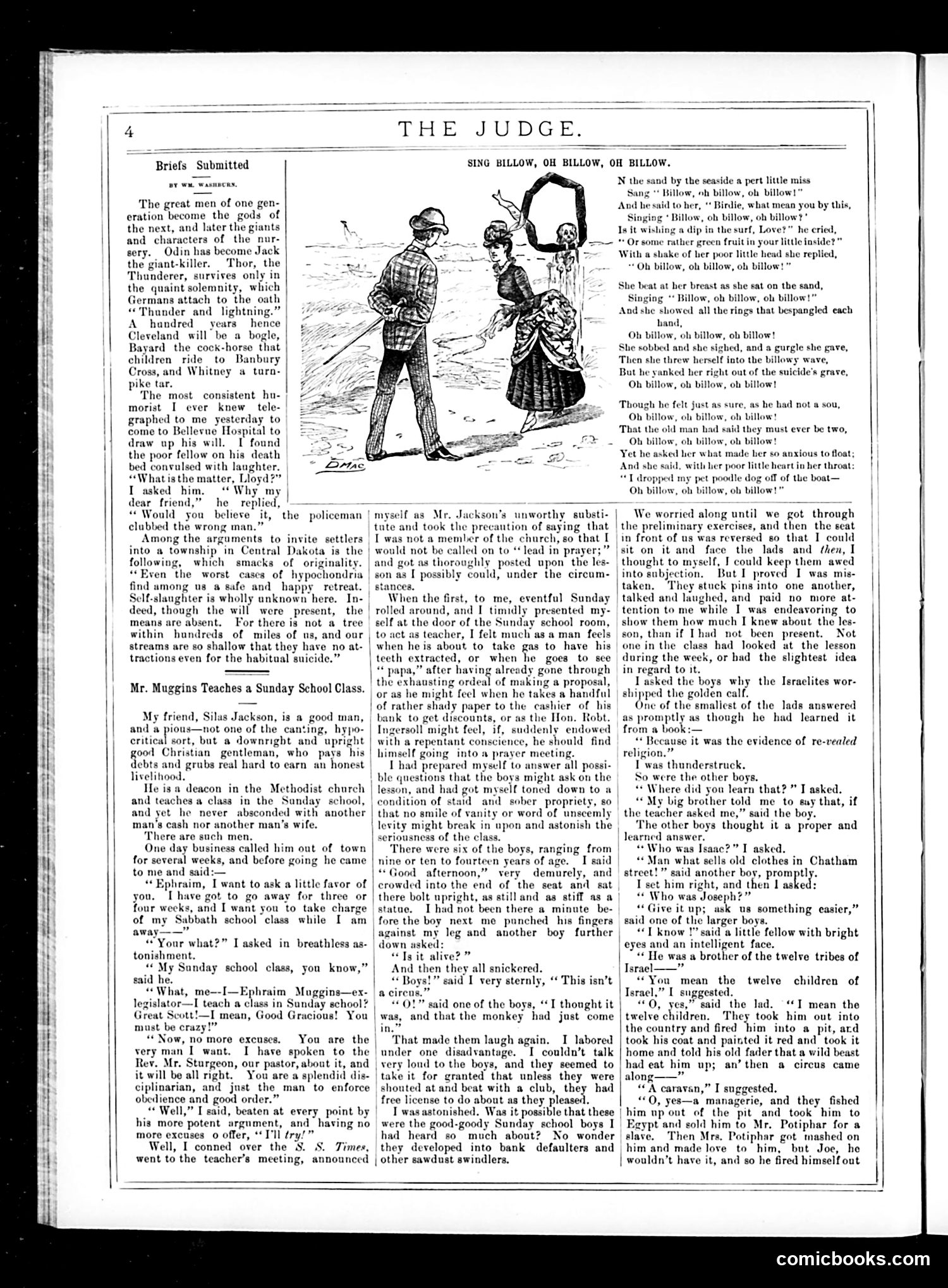
This page contains two satirical pieces from Judge magazine: **1. "Briefs Submitted" (top):** A brief commentary mocking American hero-worship. The writer suggests that figures like President Cleveland, Secretary of State Bayard, and politician Whitney will eventually become forgotten folklore—reduced to nursery rhymes and children's stories. The anecdote about the policeman clubbing "the wrong man" appears to be commentary on police incompetence or corruption, presented as darkly humorous. **2. "Mr. Muggins Teaches a Sunday School Class" (main text with illustration):** A longer satirical story about a reluctant man (Ephraim Muggins) pressured into teaching Sunday school despite lacking religious credentials. The humor derives from class anxiety and social pretension—Muggins is terrified of the responsibility and feels inadequate for the task. The illustration shows what appears to be a seaside scene with children and adults. The satire targets Victorian-era social pressures, religious hypocrisy, and the gap between public propriety and private discomfort in "respectable" society roles.
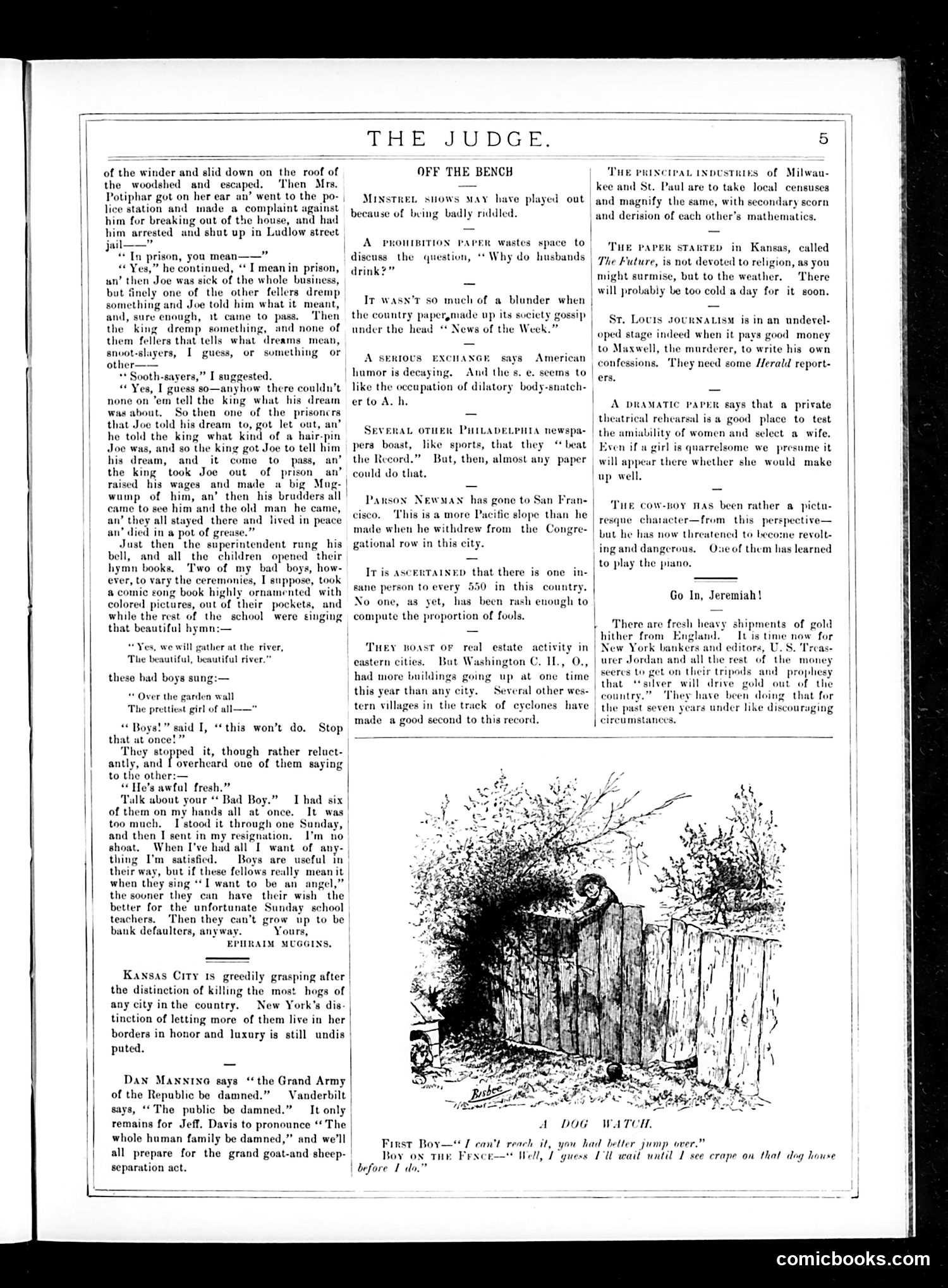
This page from *Judge* magazine contains miscellaneous satirical commentary and one illustration titled "A Dog Watch." **The Main Cartoon:** The illustration depicts a doghouse with a scraggly dog, captioned with dialogue between two boys. One says he won't reach the dog anymore since the last time he did, he creeps on the dog house before doing so. It's a simple visual gag about a mischievous dog and children's pranks—relatively timeless humor. **The "Off the Bench" Section:** These are brief satirical quips about contemporary issues: - Minstrel shows declining due to criticism - A joke about why husbands drink (prohibition debates) - Commentary on American humor "decaying" - Jabs at Philadelphia newspapers - A reference to "Parson Neways" going to San Francisco during some congregation controversy - A statistic about insanity rates The page also contains a long narrative piece about a schoolteacher (Ephraim Muggins) dealing with misbehaving Sunday school boys—social commentary on discipline and childhood behavior rather than political satire.
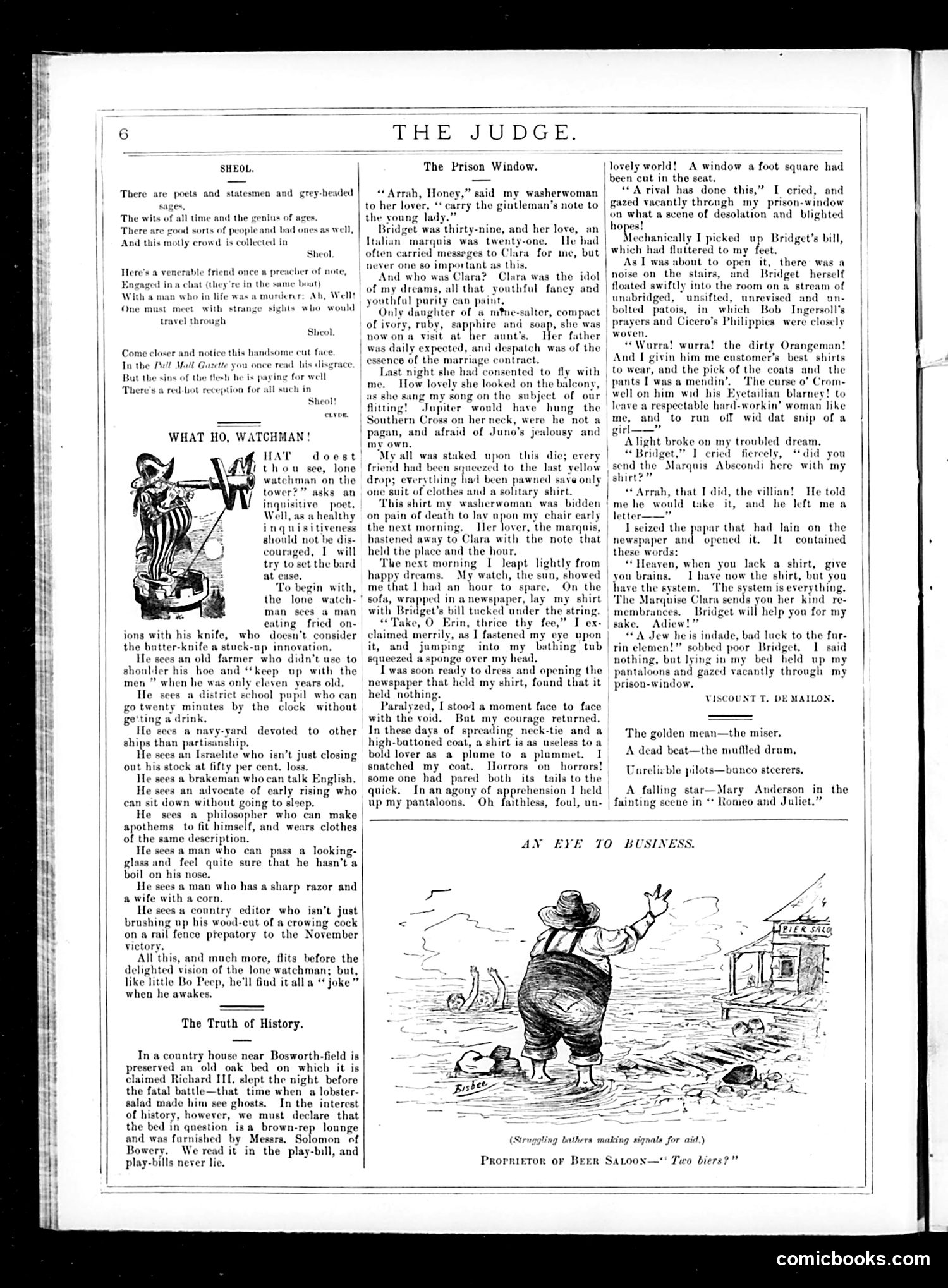
This page contains multiple satirical pieces typical of *Judge* magazine's humor: **"What Ho, Watchman!"** is a mock-serious poem listing absurdities—things the watchman supposedly sees that don't actually exist (a farmer who works without complaining, a country editor not promoting partisan politics, etc.). The joke satirizes common social hypocrisies and character flaws of the era. **"The Prison Window"** appears to be a serialized romantic comedy about a suitor attempting to elope with his beloved Clara. The narrator has pawned everything except one shirt, which his washerwoman was supposed to deliver—a setup for comedic misfortune. **"The Truth of History"** mocks historical inaccuracy, claiming a famous bed supposedly used by Richard III is actually just a modern sofa from a furniture store. It's a jab at gullible tourism and dubious historical claims. **"An Eye to Business"** shows a cartoon of a struggling bather signaling for assistance—likely commentary on commerce or desperation. The overall tone is light Victorian humor targeting social pretense, romantic folly, and false claims.
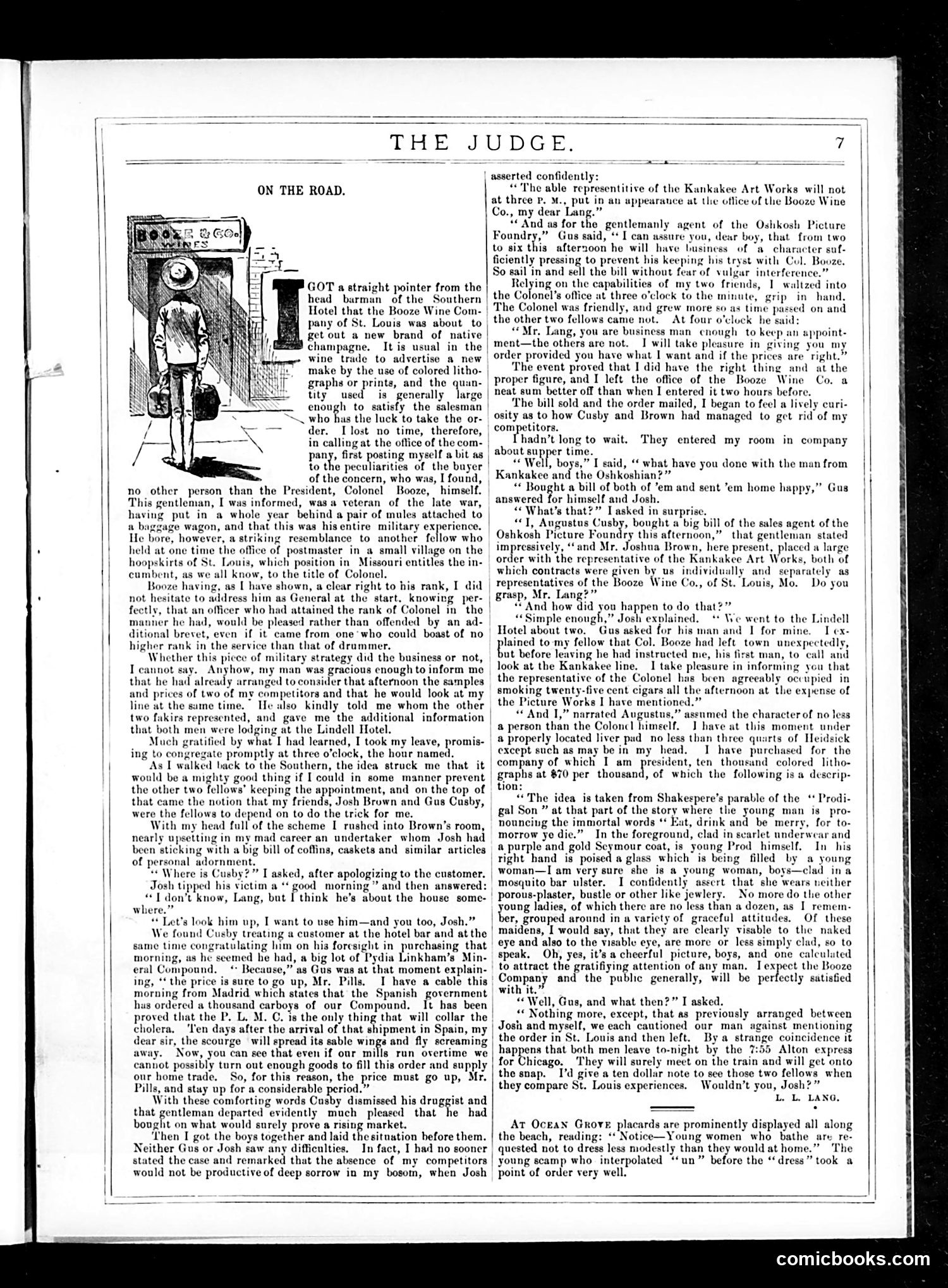
This page from Judge contains a satirical narrative story titled "On the Road," not a political cartoon. The piece mocks American business practices and salesmanship in the late 19th century. The protagonist is a traveling salesman attempting to secure a lithography order from "Colonel Booze" of the Booze Wine Company in St. Louis. The satire targets several elements: the absurd military titles granted to small-town postmasters (calling Booze "General" instead of "Colonel" to flatter him), the scheming tactics of competing salesmen, and the exaggerated patent-medicine advertisements (exemplified by the Lydia Pinkham's Compound parody). The humor derives from the narrator's cynical approach to business—using flattery and manipulation rather than genuine sales merit. The story suggests widespread corruption and dishonesty in Gilded Age commerce, presented with Judge magazine's characteristic irreverent tone toward American institutions and business culture.
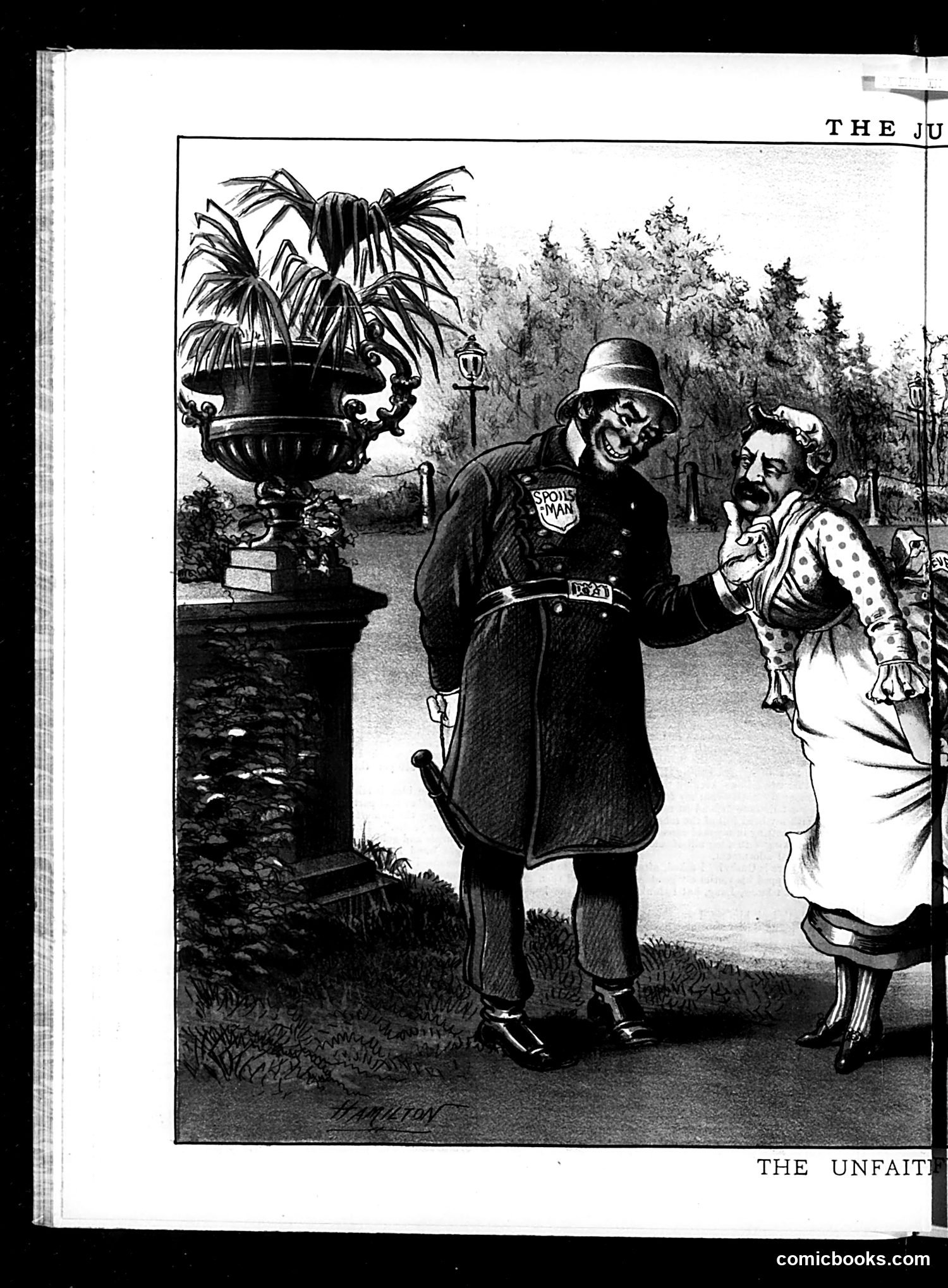
This appears to be a political cartoon from *Judge* magazine titled "The Unfait[hful]" (title cut off). The image shows a uniformed official or policeman with an exaggerated, grotesque face speaking with a woman in a polka-dotted dress in what appears to be a park setting with a decorative urn and trees. The cartoon likely satirizes corruption or infidelity—suggested by the title and the woman's apparent engagement with the uniformed figure. The caricatured features and the woman's body language suggest commentary on either political corruption, police misconduct, or marital infidelity involving an authority figure. Without the complete title and additional context, the specific target of satire remains unclear, though the visual presentation suggests mockery of abuse of power or moral failings by an official.
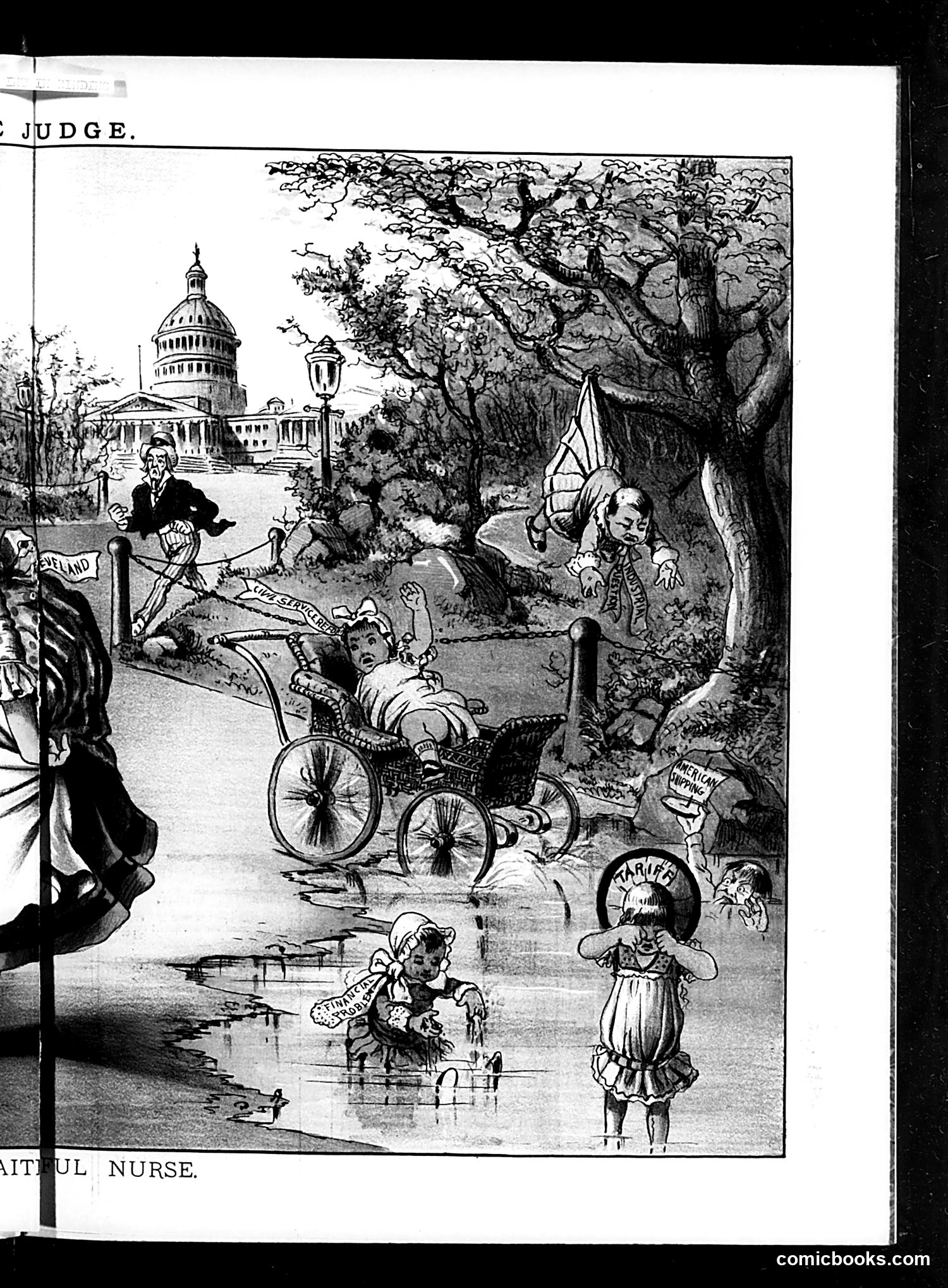
This satirical cartoon depicts the Capitol building in the background while various figures represent different political interests in the foreground. The title "A Faithful Nurse" appears to be ironic commentary on government care. The scene shows what appears to be a nurse (likely representing government) tending to or managing multiple figures labeled with tags suggesting tariffs and various economic interests. The figures in water and the pastoral setting suggest vulnerability or distress being "nursed" by political forces. Without clearer label visibility, the exact identities of individual figures remain uncertain, but the cartoon's core message appears to critique how government selectively cares for or manipulates different economic constituencies. The image likely comments on protectionist tariff policies and their unequal effects during the late 19th or early 20th century.
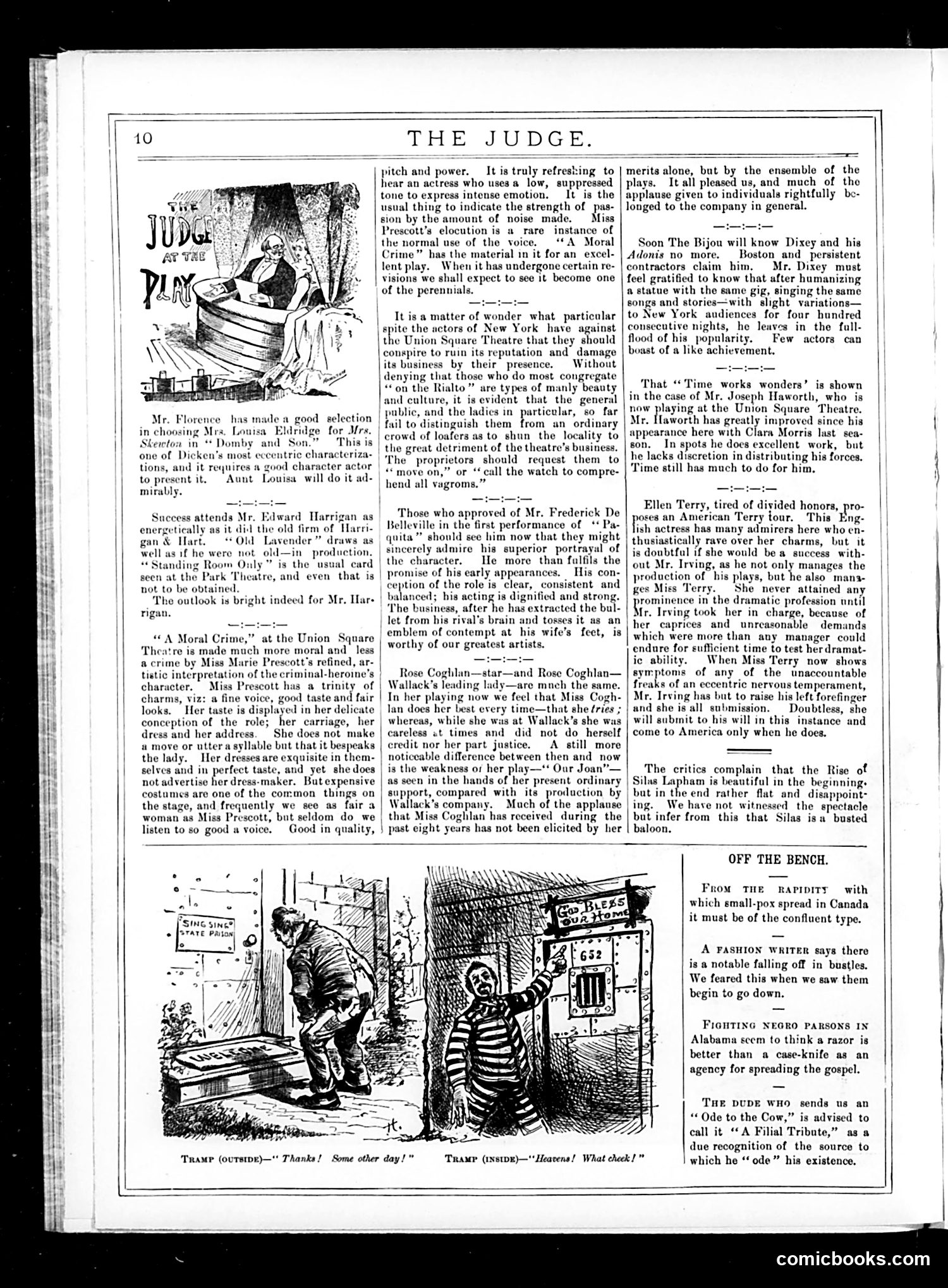
This page from Judge magazine contains theater reviews praising performances at New York venues like the Union Square Theatre and Park Theatre. The main satirical content appears in two cartoon panels at the bottom labeled "Tramp (Outside)" and "Tramp (Inside)," depicting vagrants—one outside in the cold asking "Thanks! Some other day?" and another inside warm shelter responding "Heavens! What shock?" This contrasts homelessness and hardship with unexpected comfort, likely commenting on class disparities or charitable attitudes of the era. The reviews discuss actors like Miss Marie Prescott and Rose Coghlan, praising their refined performances and proper vocal technique. There's notable criticism of actors congregating near the Union Square Theatre, whom reviewers describe as "loafers" damaging the venue's reputation—suggesting social anxiety about theater district character. The "Off the Bench" section contains brief satirical notes about Canadian small-pox, declining bustles in fashion, and fighting parsons in Alabama—typical Judge miscellaneous social commentary.
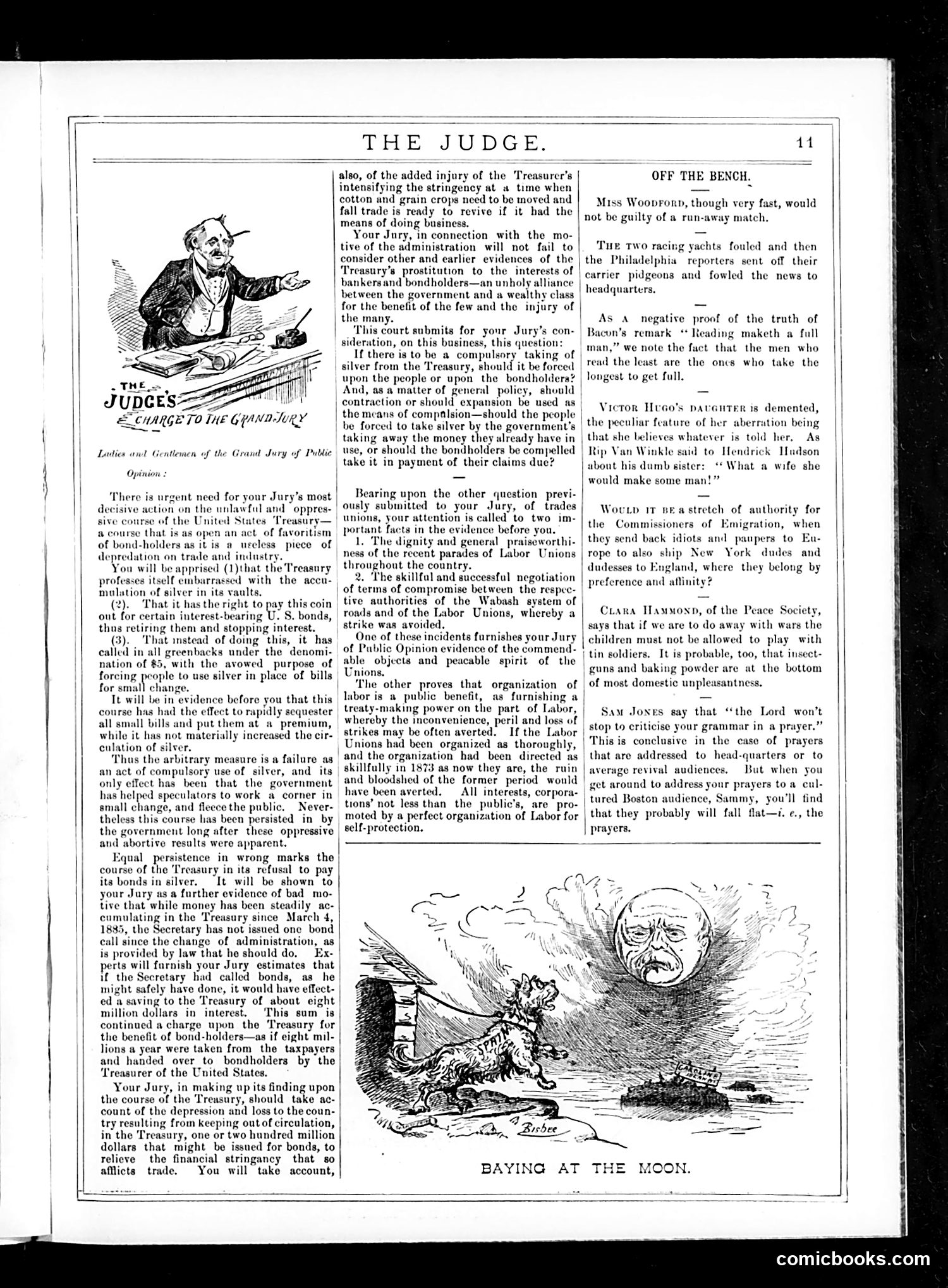
This page presents a judge's charge to a grand jury attacking Treasury Secretary policies under the Cleveland administration (post-March 4, 1885). The judge accuses the Treasury of: 1. **Artificial silver circulation**: Removing small-denomination greenback bills to force citizens to use silver, benefiting currency speculators while failing to increase actual silver circulation. 2. **Bond favoritism**: Refusing to call in bonds despite accumulated Treasury funds, costing taxpayers ~$8 million annually in interest while enriching bondholders. 3. **Economic harm**: Deliberately restricting money circulation during cotton/grain harvest season, worsening financial stringency. The cartoon criticizes what it sees as corrupt alliance between government and wealthy bondholders, arguing policy favors financial elites over working people and trade. The judge's rhetorical question—should compulsion fall on citizens or bondholders?—frames this as unjust class favoritism. The second cartoon, "Baying at the Moon," appears to mock critics as barking uselessly at authority.
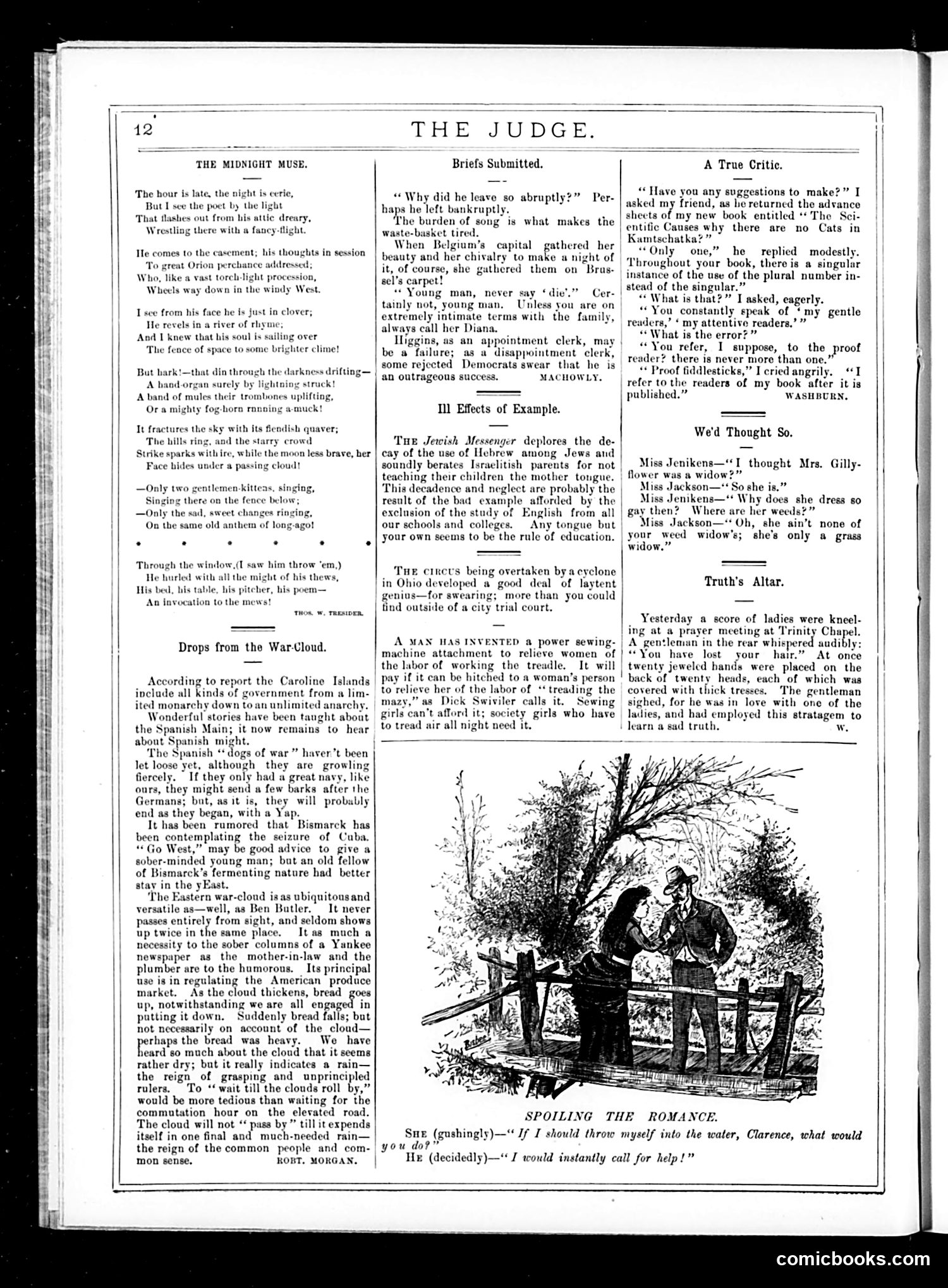
This page from Judge contains several satirical pieces mocking contemporary life and politics. **"The Midnight Muse"** (left column) is a humorous poem about a poet struggling to work late at night, only to be repeatedly interrupted by urban noise—described as "two gentlemen-kittens, singing" (street cats). The satire targets romanticized artistic struggle against mundane reality. **"Drops from the War-Cloud"** criticizes vague geopolitical anxiety. The author sarcastically notes how Eastern conflicts are perpetually invoked to affect American grain prices, yet never actually resolve. The piece mocks newspapers for constantly referencing war threats as a regulatory mechanism for commodity markets, suggesting it's become a tired trope used to manipulate public concern and commerce. **"Briefs Submitted"** and other short pieces offer quick satirical jabs at contemporary social conventions and politics, including references to appointment clerks and Democratic politics (likely Reconstruction-era). The overall tone reflects Judge's typical satirical approach: deflating pretension, mocking political uncertainty, and ridiculing how Americans instrumentalize foreign crises for economic purposes.
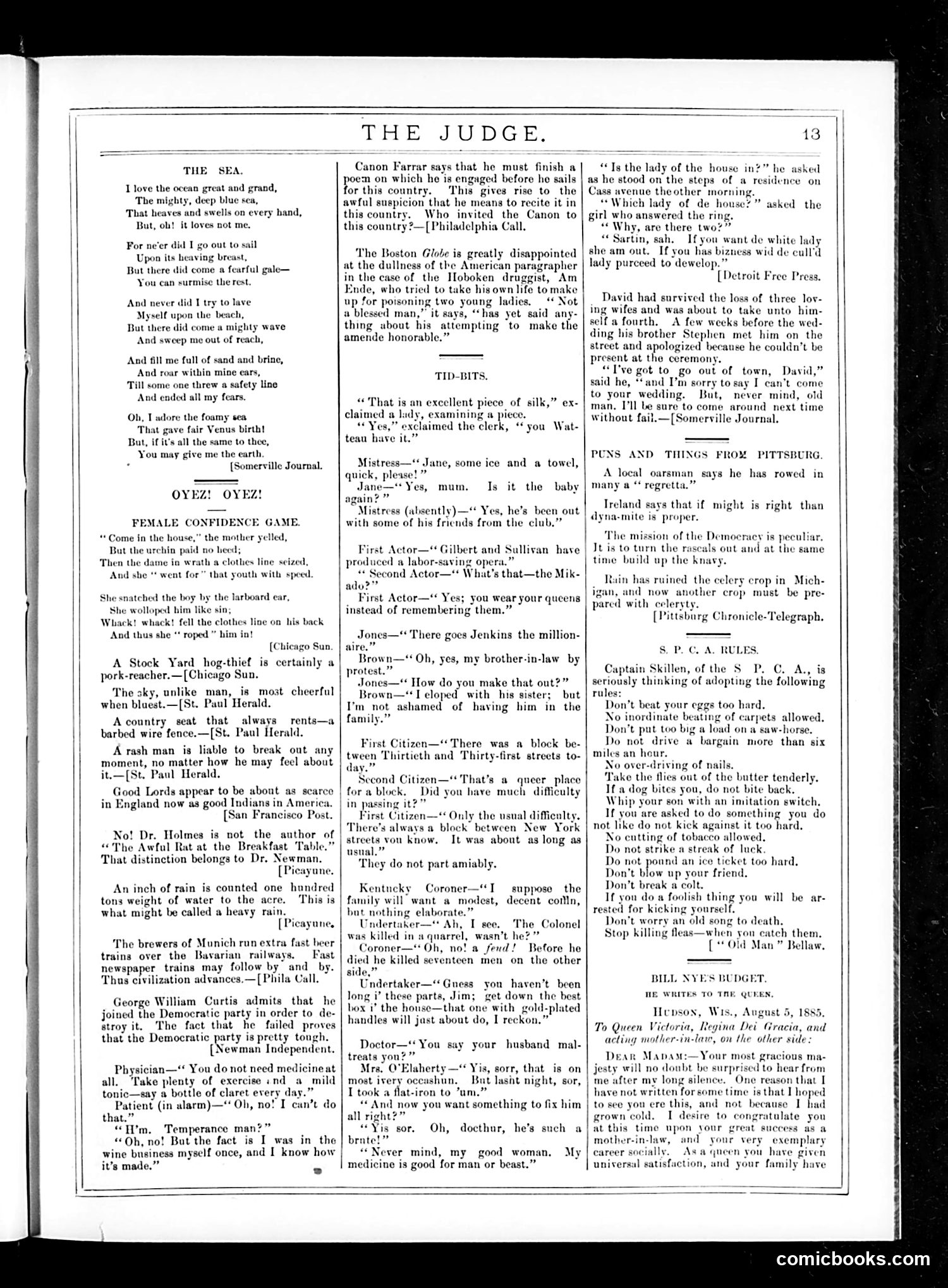
This page from *Judge* (a 19th-century American satirical weekly) contains miscellaneous short jokes, verse, and brief comic items rather than a single political cartoon. **Content includes:** - **"The Sea"** — A humorous poem about someone perpetually encountering disasters in the ocean (gales, waves, sand) - **"Female Confidence Game"** — A joke about a mother chasing a mischievous boy with a clothesline - **Short quips** — One-liners mocking various targets: Dr. Holmes, the Democratic Party, a prudish physician, Munich brewers, and George William Curtis (a real political figure who joined the Democratic party) - **"Tid-Bits"** — Brief anecdotes involving misheard words ("Watteau" instead of "water"), domestic servants, opera, and elopement **The satire's targets** are broad: human folly, pretension, temperance advocates, and public figures. The humor relies on wordplay, irony, and everyday domestic situations rather than specific political events. This format was typical of *Judge*'s miscellany pages.
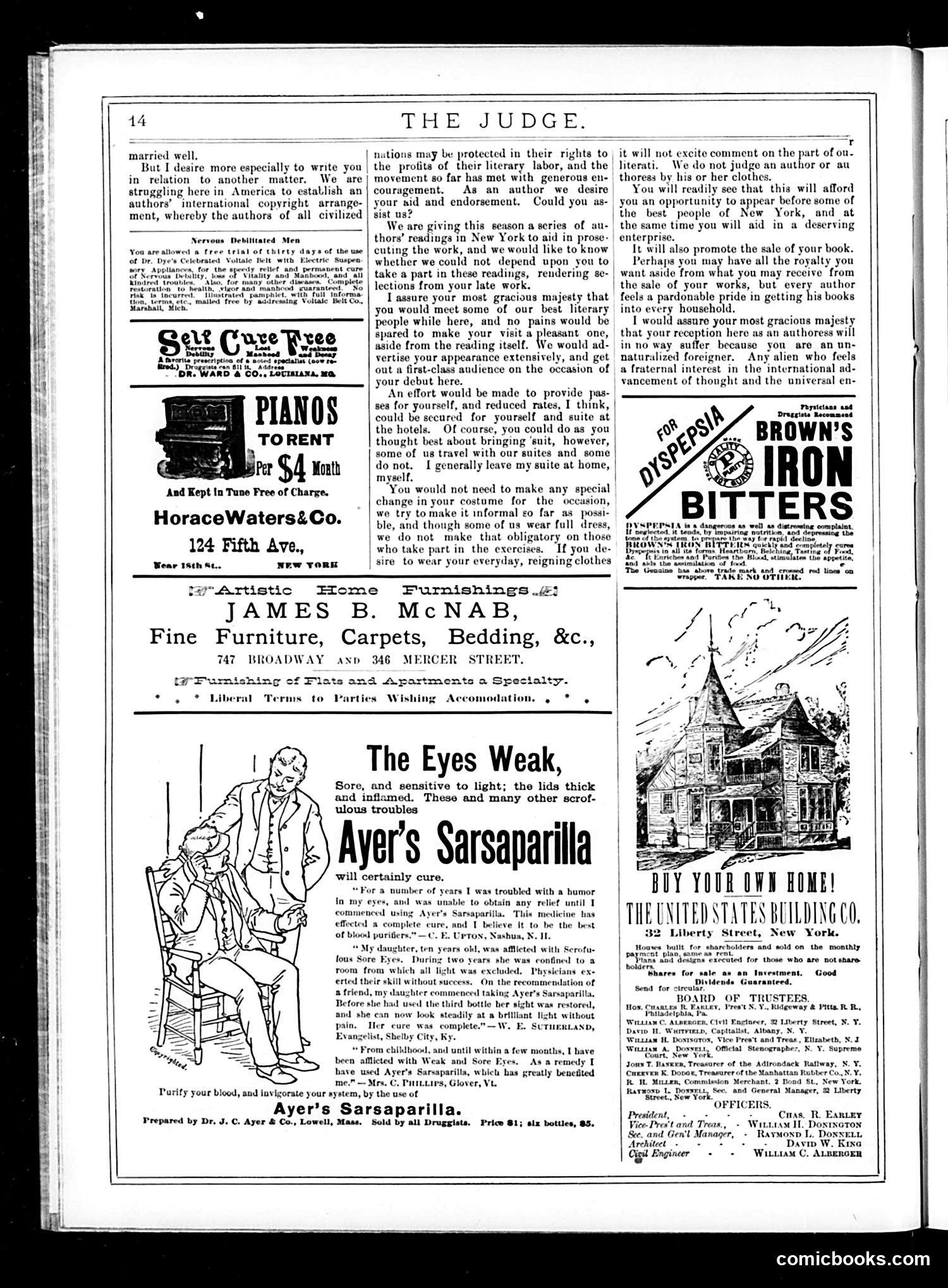
This page is primarily **advertisements and editorial content**, not political satire or comics. The main text discusses **international copyright protection for authors**—a serious 19th-century issue. An unnamed correspondent urges an author (likely a famous foreign writer being courted) to participate in readings in New York to support the copyright movement, promising respectful treatment and reduced hotel rates. The page is dominated by **period advertisements**: pianos for rent, furniture, a home-building company, and notably **Ayer's Sarsaparilla**—a patent medicine claiming to cure eye weakness and various ailments. The Ayer's ad includes testimonials from satisfied customers describing miraculous cures. By modern standards, these ads are striking for their **medical claims** that would be illegal today. The sarsaparilla patent medicine represents the largely **unregulated pharmaceutical industry** of the era, before FDA oversight. There is **no political cartoon visible** on this page—it's a typical magazine layout mixing earnest editorial matter with commercial advertising.
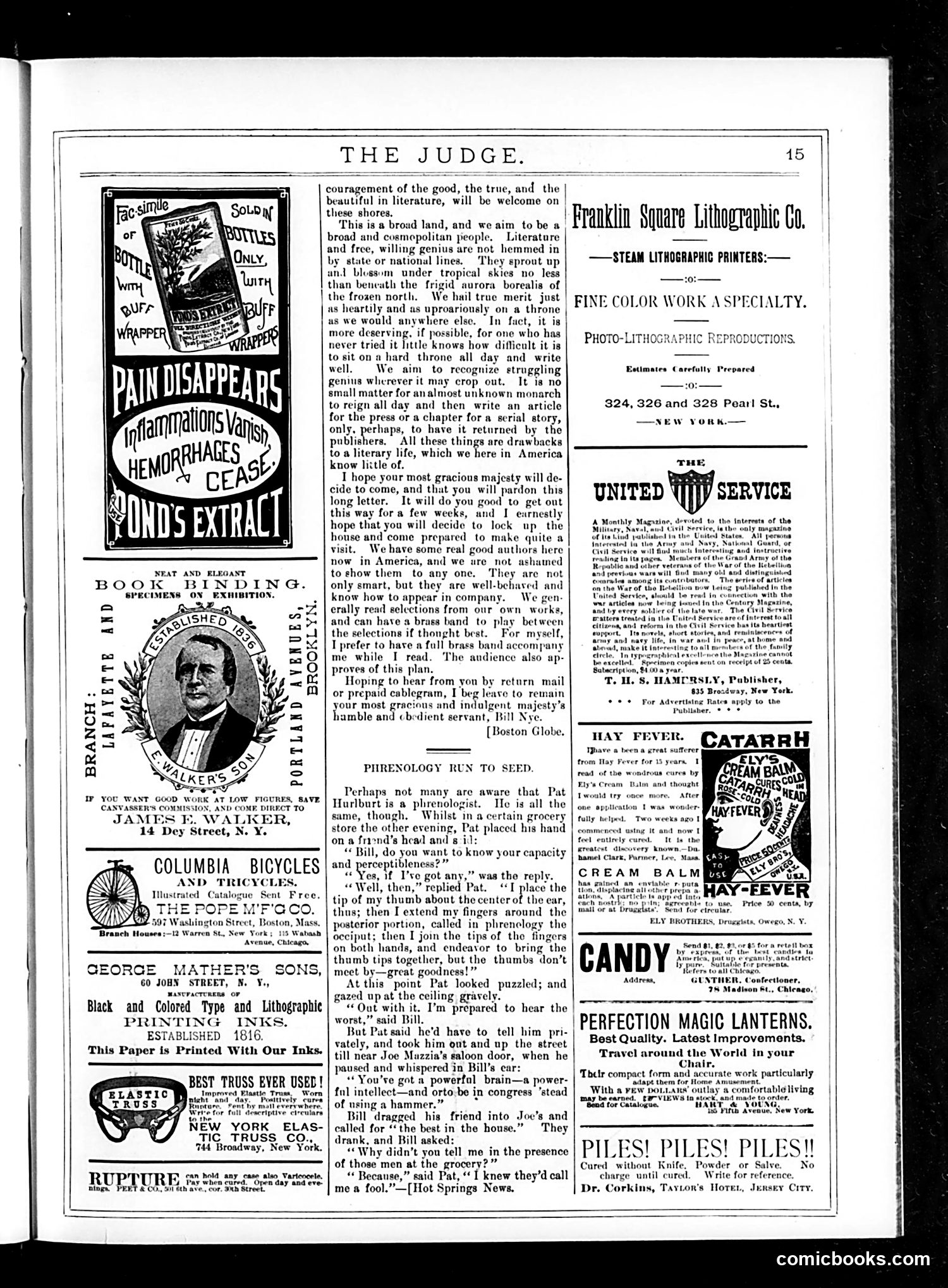
This humorous anecdote satirizes **phrenology**—a pseudoscience popular in the 19th century claiming skull measurements revealed character and mental capacity. The joke: Pat Hurlburt, a self-styled phrenologist, examines his friend Bill's head using the phrenology method (measuring distances between skull landmarks). When Pat's thumbs won't meet, he initially appears alarmed—suggesting Bill's skull measurements indicate some deficiency. However, Pat privately reveals the opposite: Bill has an exceptionally large, powerful brain suitable for Congress rather than manual labor (hammer-wielding). The satire mocks both phrenology's absurdity and flattery's versatility—the same skull measurements that initially seemed damning are reinterpreted as complimentary once drinks are involved. The friend rewards Pat's revised assessment by buying rounds, suggesting even transparent fraudulence succeeds when it's flattering.
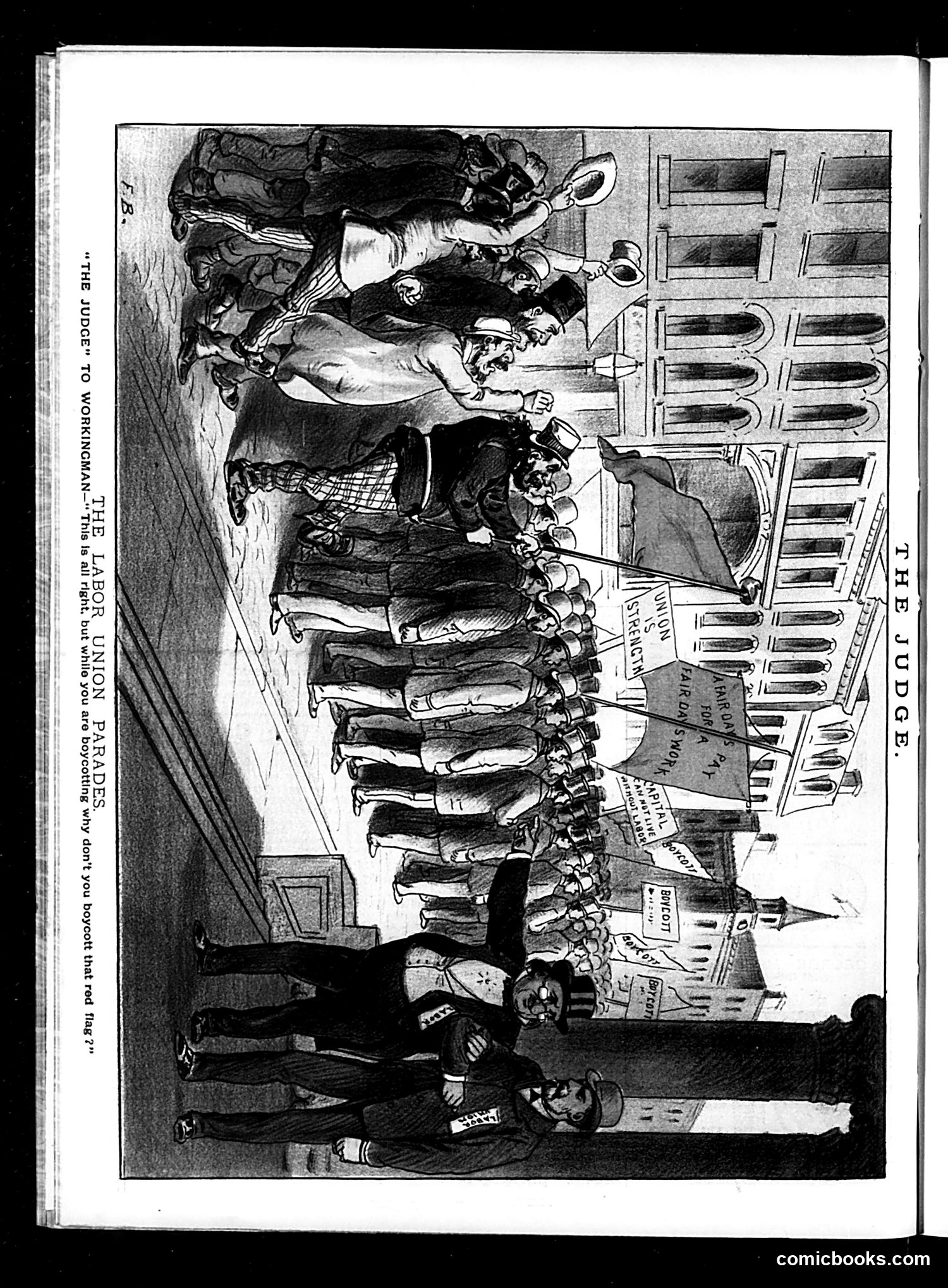
This satirical cartoon depicts a labor union parade featuring workers carrying various protest banners and signs. A prominent red flag is visible among the marchers. The Judge's caption mocks workers by suggesting they should "boycott that red flag"—implying association with radical or socialist ideology. The satire targets labor unions by equating them with dangerous radicalism. In the late 19th/early 20th century, *Judge* magazine was conservative and anti-labor; the red flag symbolized socialism and communism, which many American publications portrayed as foreign threats. The cartoon's sarcastic suggestion that workers should reject their own protest symbols while simultaneously protesting represents *Judge's* hostile view of organized labor activism and their attempt to delegitimize union movements by linking them to radical politics.