
Judge, 1885-09-26 · page 10 of 16
Judge — September 26, 1885 — page 10: what you’re looking at
What you’re looking at
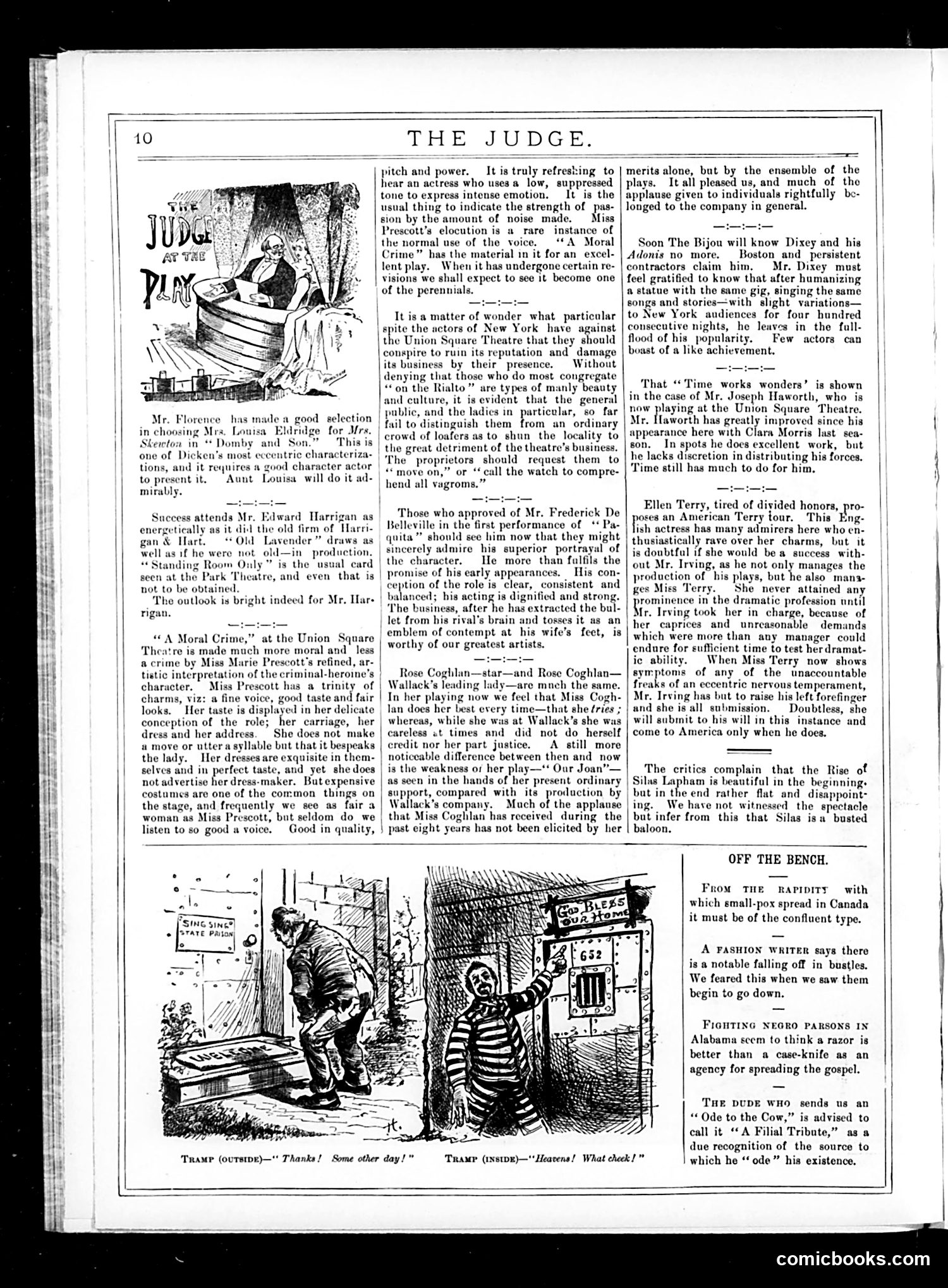
This page from Judge magazine contains theater reviews praising performances at New York venues like the Union Square Theatre and Park Theatre. The main satirical content appears in two cartoon panels at the bottom labeled "Tramp (Outside)" and "Tramp (Inside)," depicting vagrants—one outside in the cold asking "Thanks! Some other day?" and another inside warm shelter responding "Heavens! What shock?" This contrasts homelessness and hardship with unexpected comfort, likely commenting on class disparities or charitable attitudes of the era. The reviews discuss actors like Miss Marie Prescott and Rose Coghlan, praising their refined performances and proper vocal technique. There's notable criticism of actors congregating near the Union Square Theatre, whom reviewers describe as "loafers" damaging the venue's reputation—suggesting social anxiety about theater district character. The "Off the Bench" section contains brief satirical notes about Canadian small-pox, declining bustles in fashion, and fighting parsons in Alabama—typical Judge miscellaneous social commentary.
📄 Transcribed text from this page (OCR, searchable)
Machine-transcribed from the original scan — historical spelling and the odd misread are preserved.
THE JUDGE. ‘lorence in choosing Mra Skewton in * Domb: one of Dicken’s most eccentric characteriza- tions, and it requires 1 good character actor to present it. Aunt Louisa will do it ad- gan & Hart. ** Old well as if he were not old—in production. anding Room Only” is the usual card seen at the Park Theatre, and even that is not to be obtained. The outlook is bright indeed for Mr. Har rigan. “A Moral Crim at the Union Square Theatre is made much more moral and_ less acrime by Miss Marie Prescott’s refined, ar- tistic interpretation of the criminal-herome’s character. Miss Prescott has a trinity of charms, viz: a fine vo looks. Her taste is displayed in her delicate conception of the role; her carriage, her dress and her address. She does not make # move or utter a syllable but that it bespeaks the lady. Her dresses are exquisite in them- selves and in perfect taste, and yet she does not advertise her dress-maker. But expensive costumes are one of the common things on the stage, and frequently we see as fair a woman as Miss Prescott, but seldom do we | listen to so good a voice. Good in quality, e, good taste and fair | pitch and power. It is truly refrest:ing to hear an actress who uses a low, suppressed tone to express intense emotion. It is the usual thing to indicate the strength of pas- sion by the amount of noise made. Miss | Prescott’s elocution is a rare instance of the normal use of the voice. —‘*A Moral Crime” has the material in it for an_excel- lent play. When it has undergone certain re- visions we shall expect to see it become one of the perennials. | Itisa matter of wonder what particalar spite the actors of New York have against | the Union Square Theatre that they should |conspire to ruin its reputation and damage [its business by their presence. Without denying that those who do most congregate “on the Rialto” are types of manly beauty and culture, it is evident that the general public, and the ladies in particular, so far fail to distinguish them from an ordinary crowd of loafers as to shun the locality to the great detriment of the theatre's business. The proprietors should request them to ‘move on,” or ‘call the watch to compre- hend all vagroms.” Those who approved of Mr. Frederick De Belleville in the first performance of ‘* Pa- quita” should see him now that they might sincerely admire his superior portrayal of the character, He more than fulfils the promise of his early appearances. His con- ception of the role is clear, consistent and balanced; bis acting is dignified and strong. ‘The business, after he has extri the bul- let from his rival's brain and tosses it as an emblem of contempt at his wife’s feet, is | worthy of our greatest artists. Rose Cogiilan—star—and Rose Coghlan— Wallack’s leading lady—are mueh the same. In her playing now we feel that Miss Cogh- lan does her best every time—that she fries ; whereas, while she was at Wallack’s she was careless at times and did not do herself credit nor her part justice. A. still. more noticeable difference between then and now is the weakness of her play—‘* Our Joan”— as seen in the hands of her present ordinar: support, compared with its production by Wallack’s company. Much of the applause that Miss Coghlan has received during the ) past eight years has not been elicited by her merits alone, but by the ensemble of the plays. It all pleased us, and much of the applause given to individuals rightfully be- longed to the company in general. Soon The Bijou will know Dixey and his Adonis no more. Boston and_ persistent contractors claim him. Mr. Dixey must feel gratified to know that after humanizing a statue with the same gig, singing the same songs and stories—with slight variations— to New York audiences for four hundred consecutive nights, he leaves in the fall- flood of his popularity. Few actors can st of a like achievement. That ‘Time works wonders’ is shown in the case of Mr. Joseph Haworth, who is now playing at the Union Square ‘Theatre. Mr. Tiaworth has greatly improved since his appearance here with Clara Morris lust sea- son. In spots he does excellent work, but he lacks discretion in distributing his forces. Time still has much to do for him. Ellen Terry, tired of divided honors, pro- poses an American Terry tour. ‘This “Eng- ish actress has many admirers here who en- thusiastically rave over her charms, but it is doubtful if she would be a success with- out Mr. Irving, as he not only manages the production of his plays, but he also mana- ges Miss Terry. She never attained an prominence in the dramatic profession until Mr. Irving took her in charge, because of her caprices and unreasonable demands which were more than any manager could endure for sufficient time to test herdramat- ie ability. When Miss Terry now shows symptoms of any of the unaccountable freaks of an eccentric nervous temperament, Mr. Irving has but to raise his left forefinger nd she is all submission. Doubtless, she will submit to his will in this instance and come to America only when he does. The critics complain that the Rise of Silas Lapham is beautiful in the beginning. bat in the end rather flat and disappoint- ing. We have not witnessed the spectacle but infer from this that Silas isa busted baloon. “f ATE sal © Tramp (ourstpe)—"* Thanks ! Some other day!” ‘Tramp (1nstpe)—'‘Heavens! What check!" OFF THE BENCH. From THe Rapipity with which small-pox spread in Canada it must be of the confluent type. A PASHION WRITER says there is a notable falling off in bustles. We feared this when we saw them begin to go down. Fiontry: GRO PARSONS IN Alabama seem to think a razor is better than a case-knife as an agency for spreading the gospel. Tae puDE WHO sends us an “ Ode to the Cow,” is advised to call it “A Filial Tribute,” as a due recognition of the source to | which he “ode” his existence. comicbooks.com