
A complete issue · 16 pages · 1885
Judge — September 12, 1885
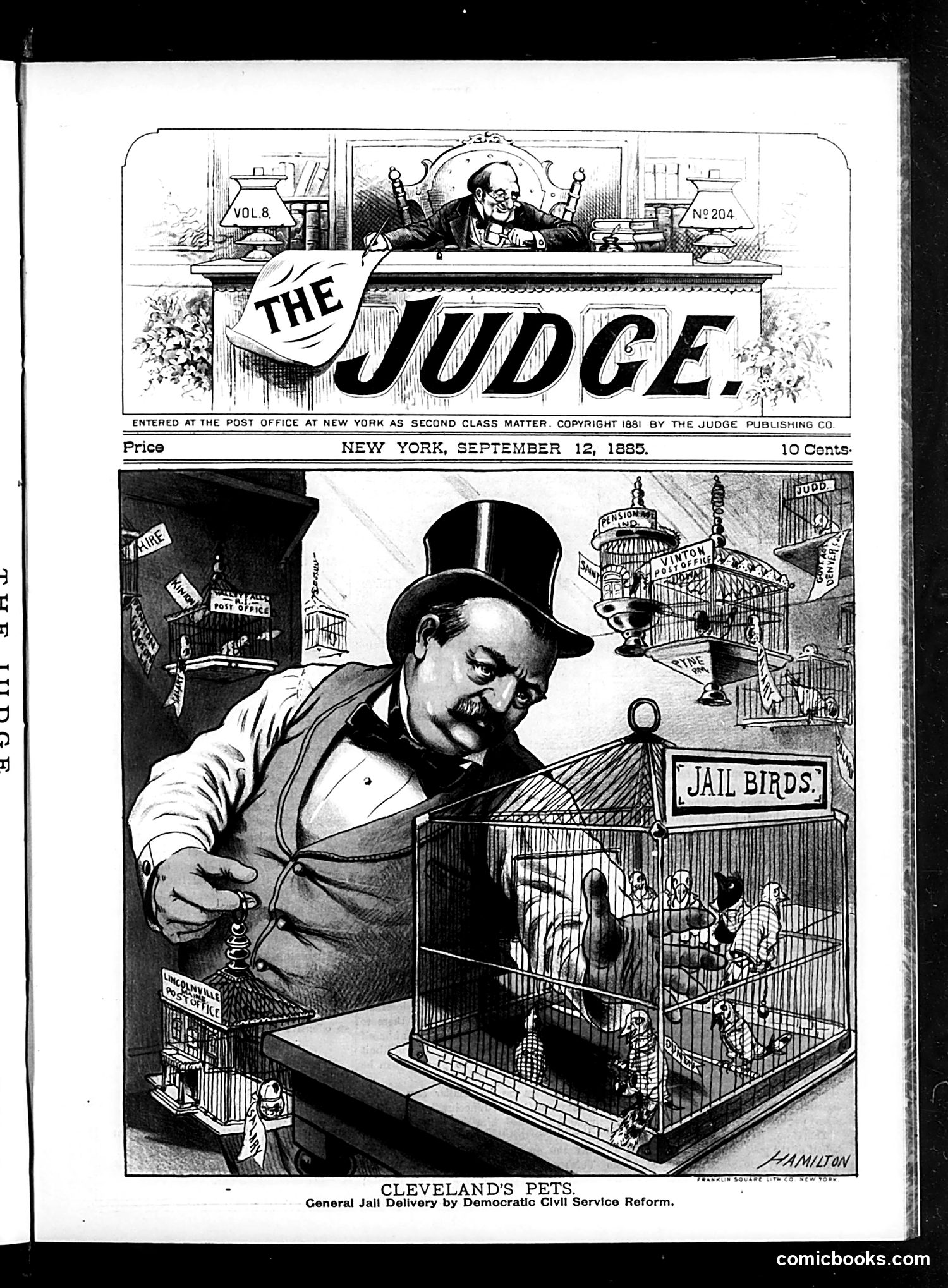
This 1885 cartoon satirizes President Grover Cleveland's civil service reform policies. The large figure in the top hat appears to be Cleveland himself, depicted as a jailer opening a cage labeled "Jail Birds" to release imprisoned figures—a visual metaphor suggesting his reforms are freeing political appointees or corrupt officials who should remain imprisoned. The satire criticizes Democratic civil service reform as inadequate or counterproductive. Rather than cleaning up government corruption, the cartoon suggests Cleveland's policies are actually releasing wrongdoers back into society. The "jail birds" represent those the cartoonist believes should be held accountable, implying the reforms are misguided or hypocritical.
This page contains two editorial essays attacking Democratic President Cleveland's administration, using heavy irony. **"Once More Into the Breach"** criticizes clergy who take summer breaks from moral reform work, sarcastically praising their "pluck." More pointedly, it attacks religious camp meetings like Ocean Grove and Asbury Park for becoming commercialized real-estate schemes rather than genuine spiritual gatherings—comparing corrupt religious operators to money-changers Jesus expelled from temples. **"Turning Rascals Out and In"** employs biting sarcasm about Cleveland's civil service reform. The author praises Cleveland for not merely firing corrupt officials (as previous presidents did) but actually *prosecuting and jailing* them. The examples cited—like C.P. Judd, a five-time horse-thief from Denver—suggest the satire questions whether Cleveland's "reform" is genuine integrity or merely replacing one set of rascals with another through prosecutions. The ironic tone implies skepticism about the administration's actual commitment to honest governance.
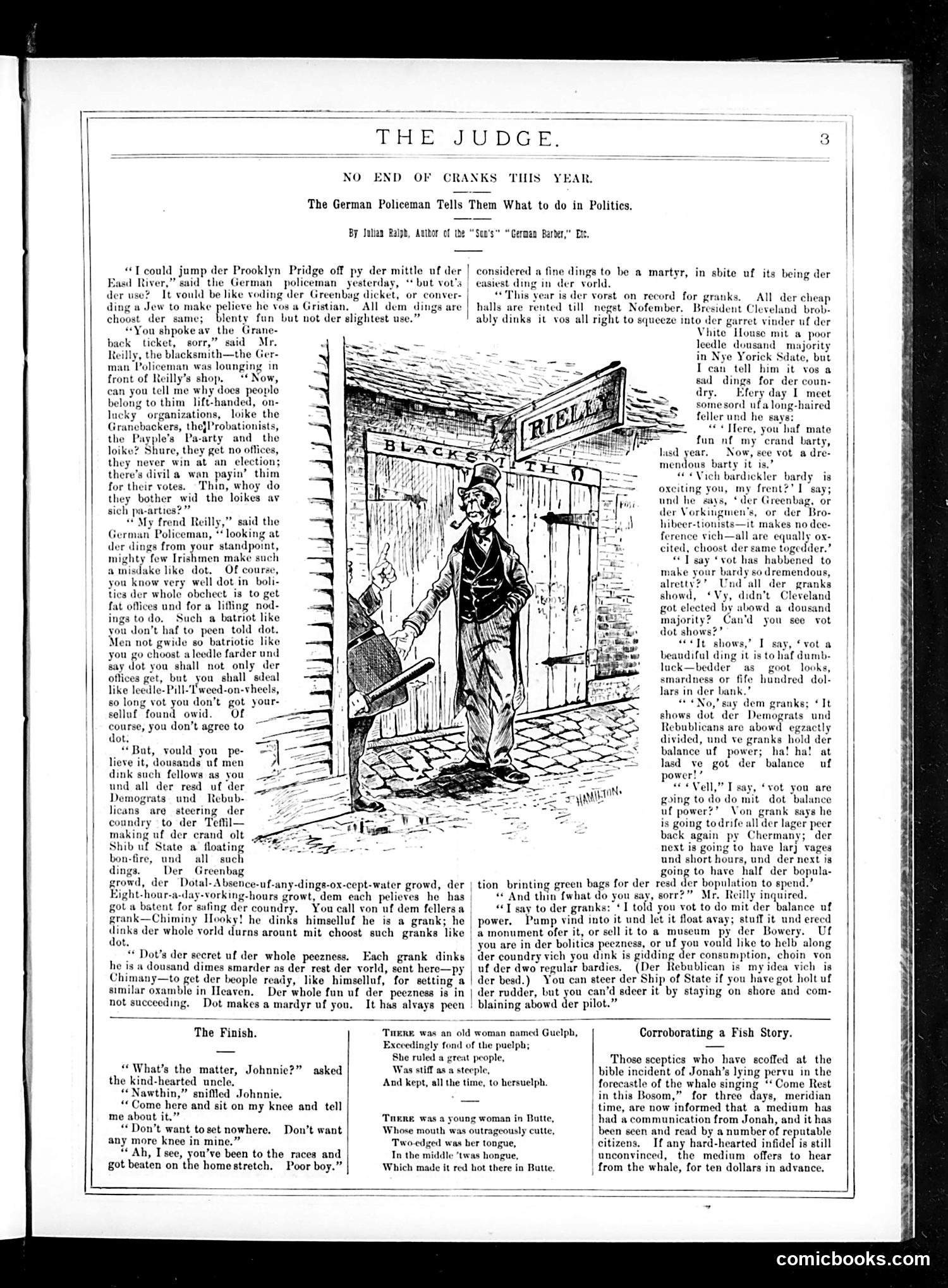
This satirical piece uses a German-accented policeman character to mock American political "cranks"—people advocating for third parties and reform movements in the 1880s-90s. The policeman ridicules supporters of fringe parties like the Greenbackers, Prohibitionists, and People's Party, arguing they waste energy on unelectable causes that gain no offices or patronage. He contrasts them with practical Irish Democrats and Republicans who at least benefit materially from party loyalty. The satire targets both the idealistic reformers AND the cynical machine politics of the era. The German character's broken English adds ethnic humor typical of the period. References to President Cleveland and voting mechanics suggest this dates to the 1880s. The cartoon mocks American political naïveté while simultaneously criticizing corruption—suggesting reformers are foolish, but also implying the major parties are cynically self-serving. The underlying message: American politics runs on patronage and personal gain, not principles.
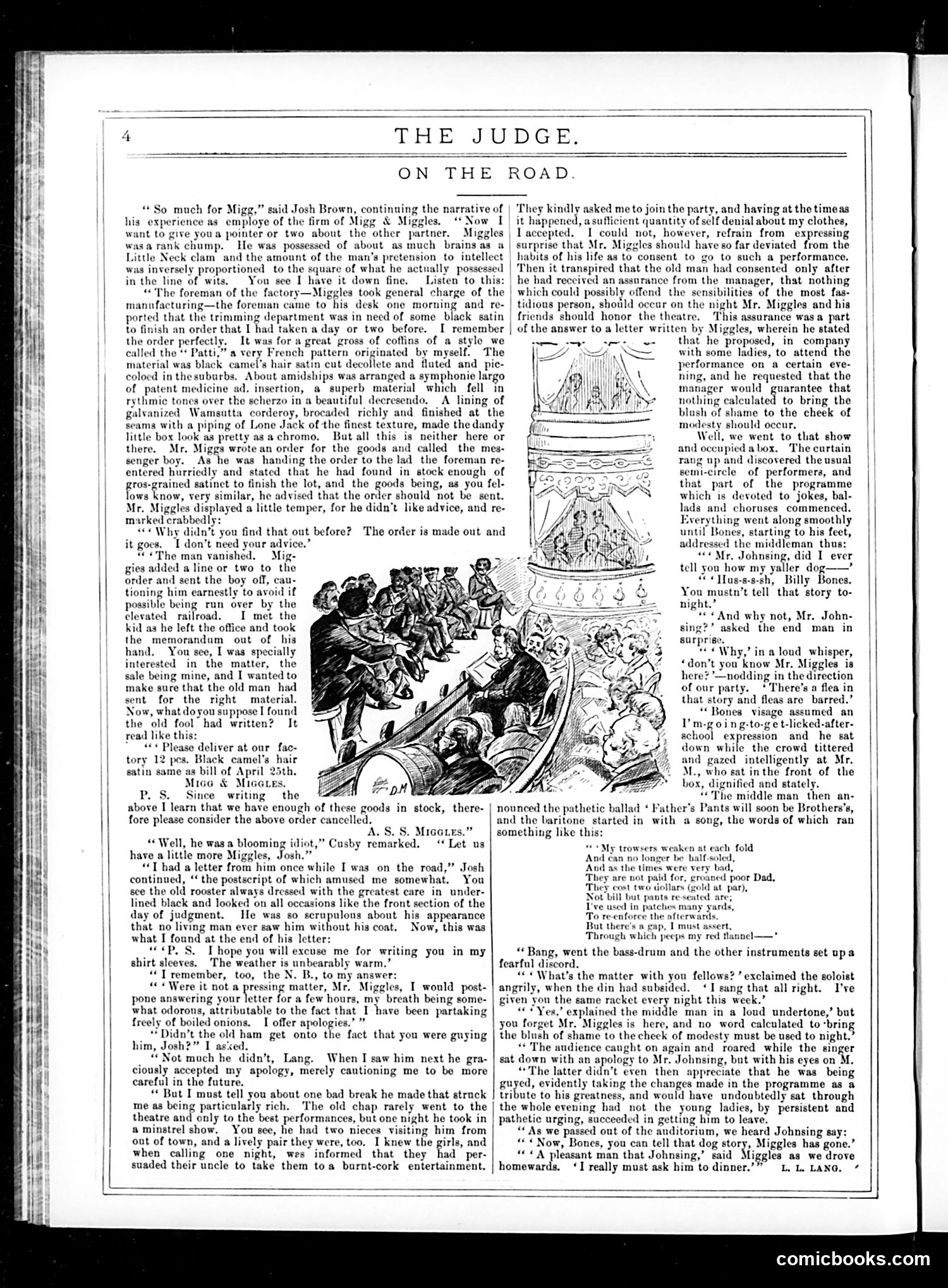
This page from Judge magazine (late 19th century) presents a humorous anecdote about Mr. Miggles, a factory owner portrayed as incompetent and absurdly pretentious. The narrative mocks his contradictions: he's described as having the intellect of a clam yet affects great knowledge. The satire centers on Miggles' bumbling management—he orders coffin linings, then cancels the order after the goods are already being prepared. He also obsesses over his formal appearance (never seen without a coat) yet complains about wearing shirt sleeves in a letter, revealing his pretense. The accompanying illustration shows a coach or carriage scene, suggesting this is part of a traveler's tale. The humor targets the vanity and incompetence of minor business figures—common subjects in Judge's satirical commentary on American commerce and social climbing. The piece exemplifies 19th-century humor mocking self-important, bumbling authority figures.
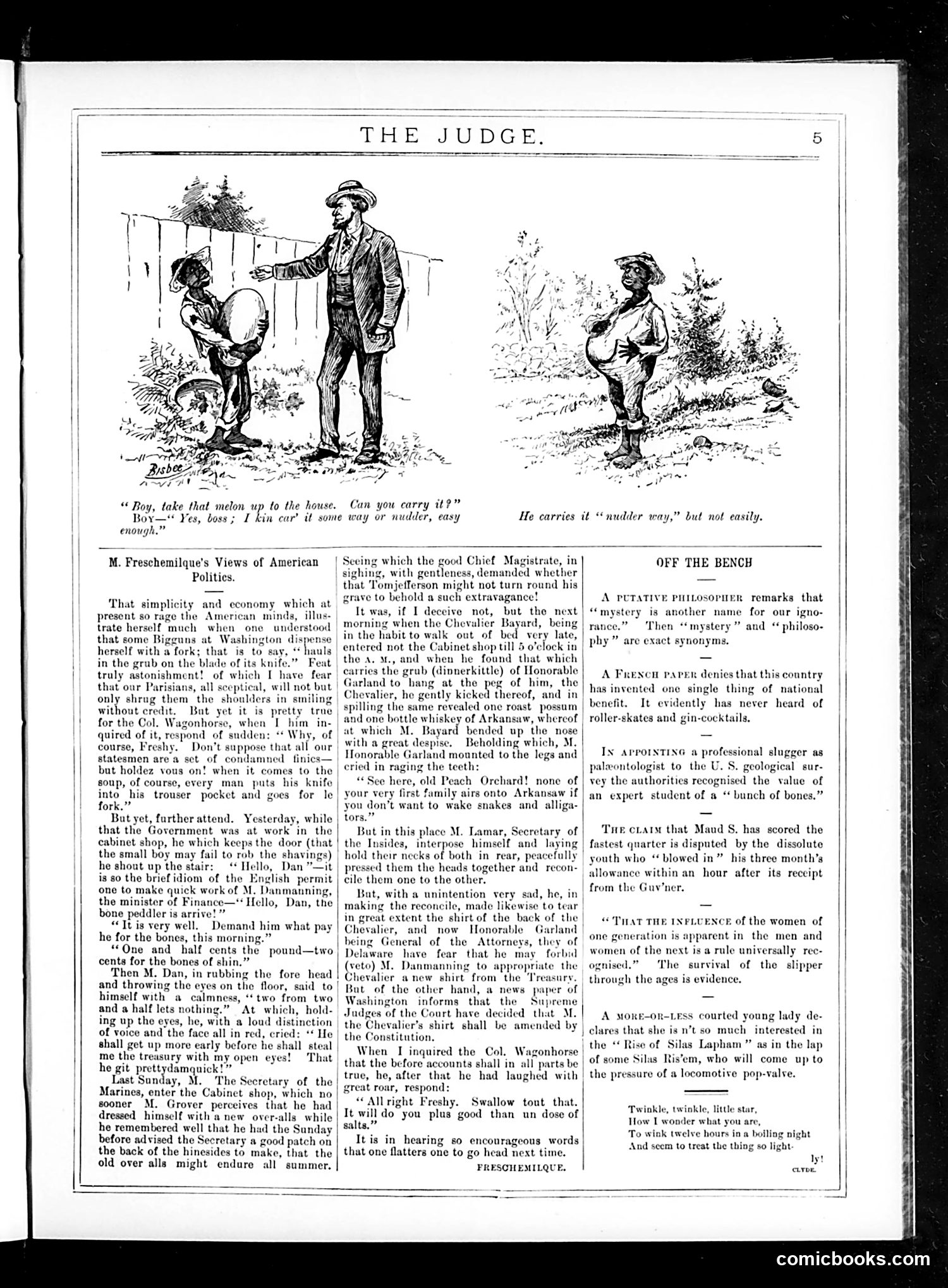
The two-panel cartoon satirizes racial attitudes of the era. In the left panel, a white man instructs a Black boy to carry a large watermelon "some way or nudder, easy enough." The right panel shows the boy struggling to carry it on his head—the "nudder way"—depicted as difficult and undignified. The humor relies on a racist stereotype: the association of Black people with watermelons. The joke's cruelty lies in showing the boy managing an awkward, humiliating task while the white authority figure remains indifferent. The accompanying text by "M. Freschemilque" satirizes American government figures (likely Cleveland-era cabinet members) through deliberately garbled pseudo-French, mocking their pretensions while recounting trivial anecdotes about their conduct. It's political satire aimed at Washington elites, though the cartoon above it reflects the publication's casual racism toward Black Americans.
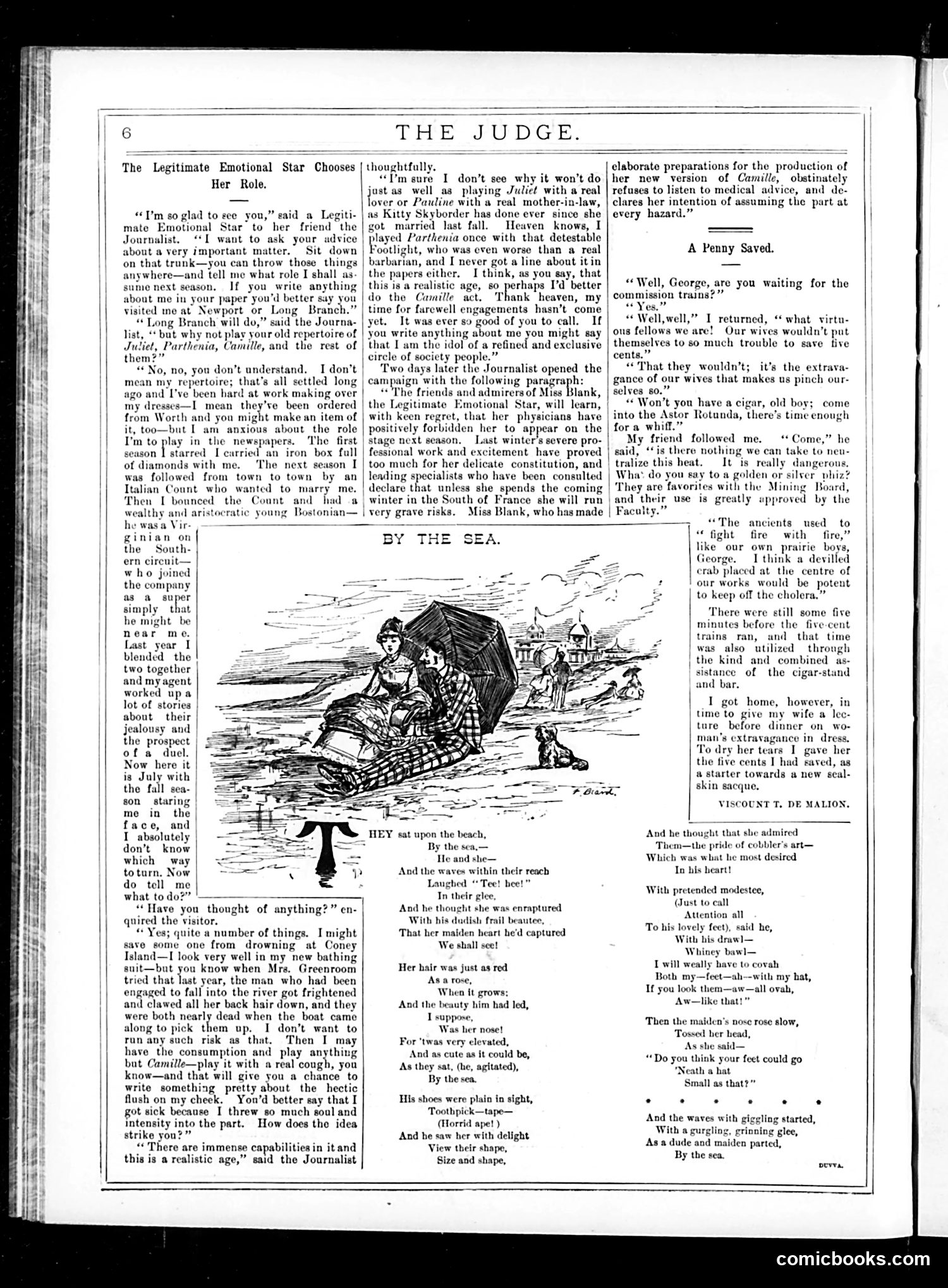
This page satirizes theatrical self-promotion and the blurred line between an actress's real life and her public image. The main cartoon features a "Legitimate Emotional Star" who consults a journalist about what dramatic personal storyline to cultivate for the upcoming season—not what role to play onstage, but what off-stage scandal or romance will generate newspaper coverage. She's essentially asking: should I be pursued by a wealthy suitor? Followed by an Italian count? The joke is that legitimate theater actresses were staging their personal lives as carefully as their performances, treating real-world drama as publicity stunts. The journalist responds by writing that she's ill and forbidden from performing—ironically creating the very melodrama she sought, but denying her the control she wanted. The secondary section, "A Penny Saved," appears to be unrelated satirical content about men boasting of frugality while spending on cigars and drinks.
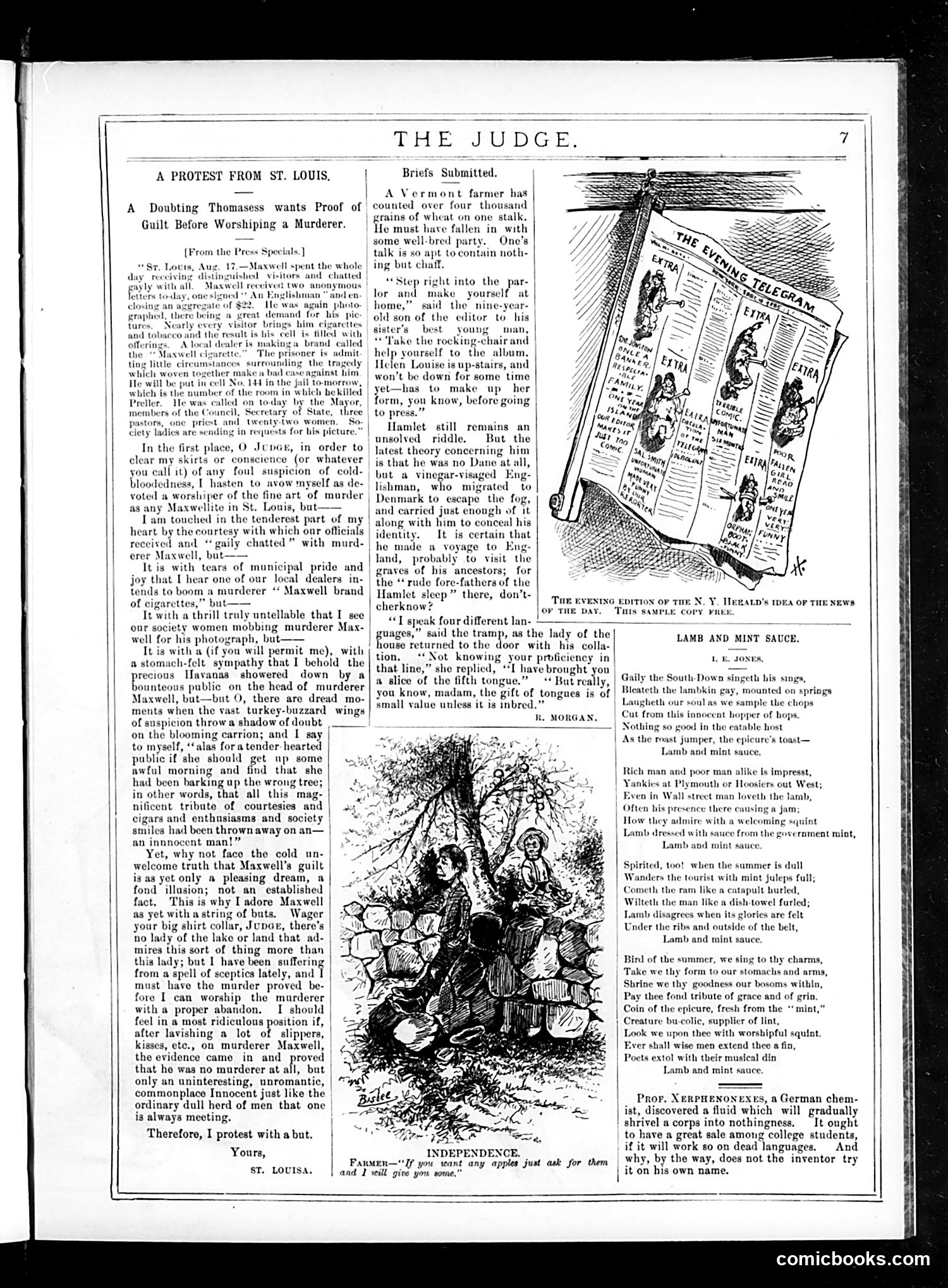
This page satirizes the public's bizarre hero-worship of Dr. Hawley Harvey Crippen (referred to as "Maxwell"), a murderer awaiting trial in St. Louis. The main letter protests the city's premature celebration: society ladies requesting his photograph, entrepreneurs marketing "Maxwell brand cigarettes," officials chatting cordially with him, and the public showering him with gifts—all *before* guilt is proven. The satirist's point: St. Louis has become absurdly infatuated with a potential murderer based on mere accusation, not evidence. The repeated refrain "but——" mocks this uncritical worship. The author warns the public could face embarrassment if Maxwell is exonerated, making their adulation of an "innocent man" ridiculous. The cartoon's central irony—celebrating a murderer whose guilt remains unestablished—critiques both mob mentality and the sensationalism surrounding crime in the era.
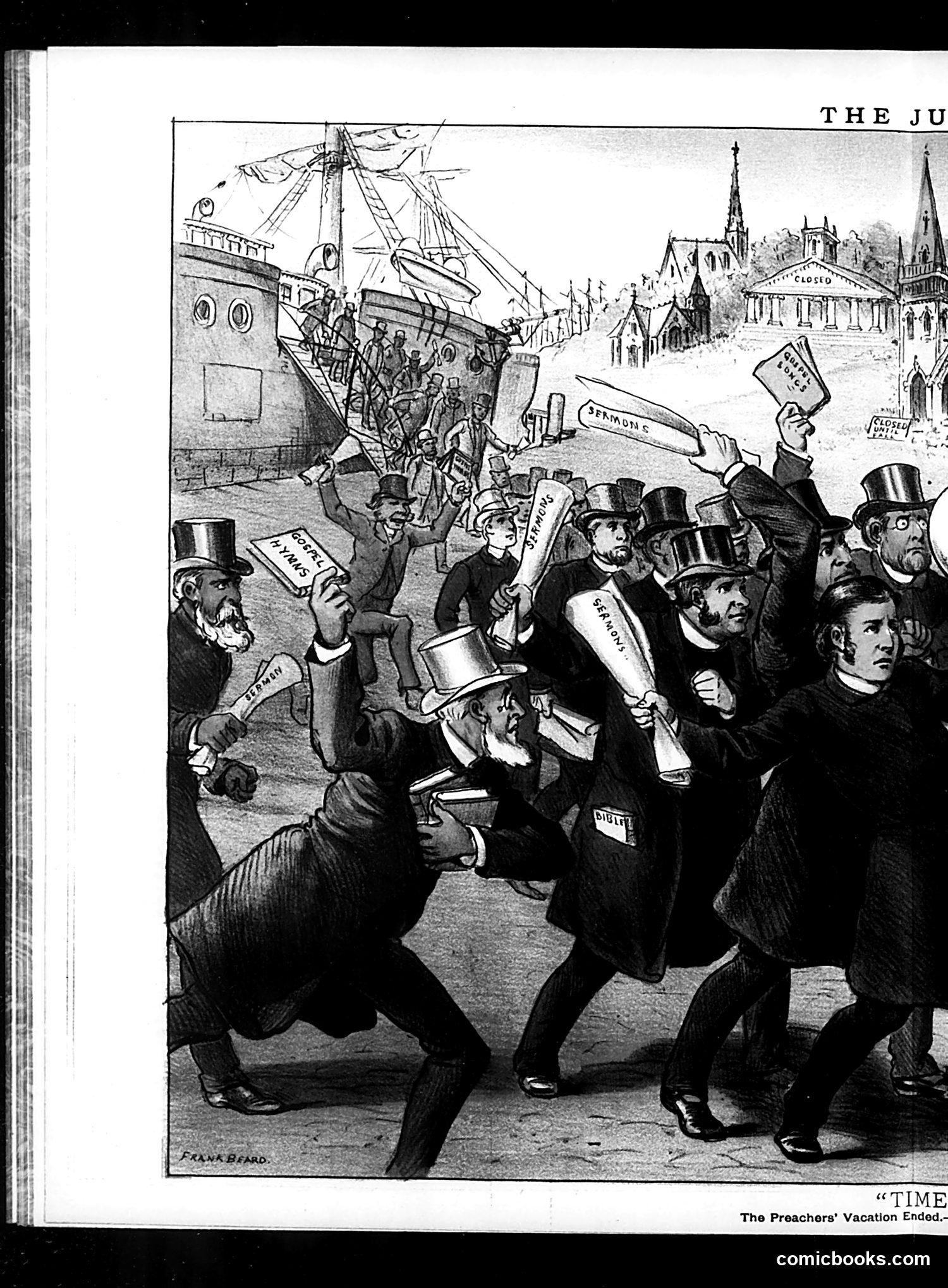
This political cartoon satirizes clergymen returning from vacation to resume their moral leadership. The scene depicts well-dressed men in top hats—identifiable as preachers or religious leaders by their formal attire—disembarking from a ship carrying scrolls labeled with moral imperatives (words like "SERMON" appear visible). The background shows a church with a "CLOSED" sign, suggesting the institution was shut during their absence. The satire targets the apparent hypocrisy: preachers enjoy leisure time away while their congregations and moral duties await. The returning figures clutch their moral proclamations somewhat awkwardly, suggesting they're resuming roles they've temporarily abandoned. The cartoon critiques religious leadership as selective in applying moral standards—preaching virtue while enjoying worldly pleasures themselves.
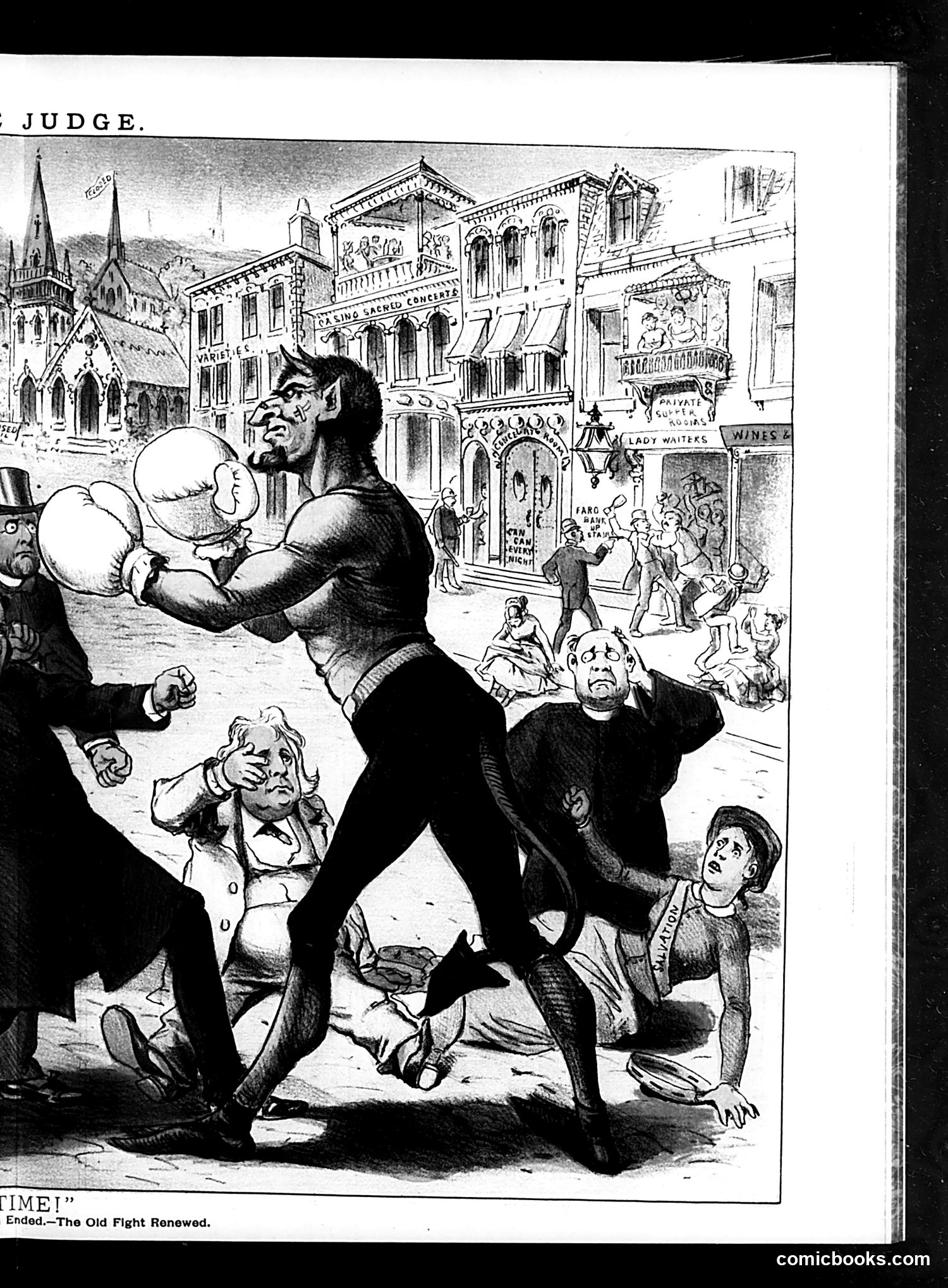
This cartoon depicts a street brawl in what appears to be a European city (note the Gothic church and continental architecture). A grotesquely caricatured demonic or villainous figure with exaggerated features dominates the center, juggling what appear to be weapons or explosive devices while engaging in combat with smaller, ordinary-looking men below. The title suggests a conflict that was supposedly finished has reignited. Without clearer historical dating or additional context on this Judge magazine issue, the specific political dispute remains unclear—it could reference labor unrest, international conflict, or domestic political violence of the Gilded Age/Progressive Era. The exaggerated facial features and composition style are typical of Judge's satirical approach to contemporary social upheaval.
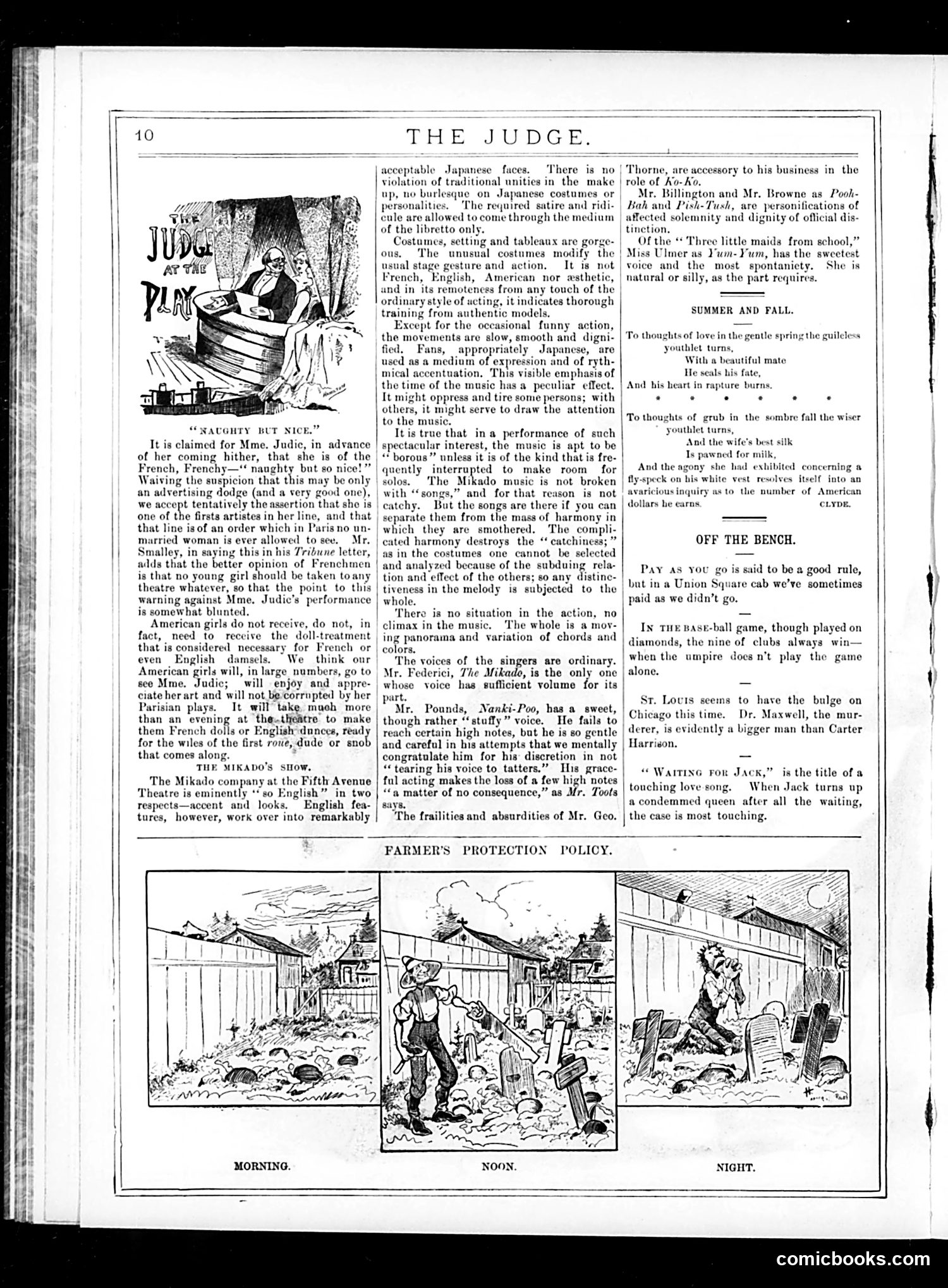
This page primarily reviews **Gilbert & Sullivan's "The Mikado"** and discusses the French actress **Mme. Judic's** upcoming American performances. **The Mikado Review**: The critic praises the production's Japanese authenticity in costumes and staging while noting the music lacks memorable "catchiness"—the elaborate harmonies obscure individual melodies. English actors performing Japanese roles is noted as ironically fitting for an "English" production. **Mme. Judic Discussion**: The page addresses American anxieties about a "naughty but nice" French actress performing in supposedly risqué Parisian plays. The writer argues American girls, unlike French or English girls needing "doll-treatment" protection, are sophisticated enough to attend without moral corruption—a defense of American female independence against European paternalism. **Bottom Cartoon**: "Farmer's Protection Policy" depicts a farmer protecting his fields from damage across morning, noon, and night—likely satirizing agricultural insurance or crop protection policy debates of the era. The page reflects late 19th-century American attitudes: confidence in American women's judgment, fascination with Japanese exoticism, and rural concerns.
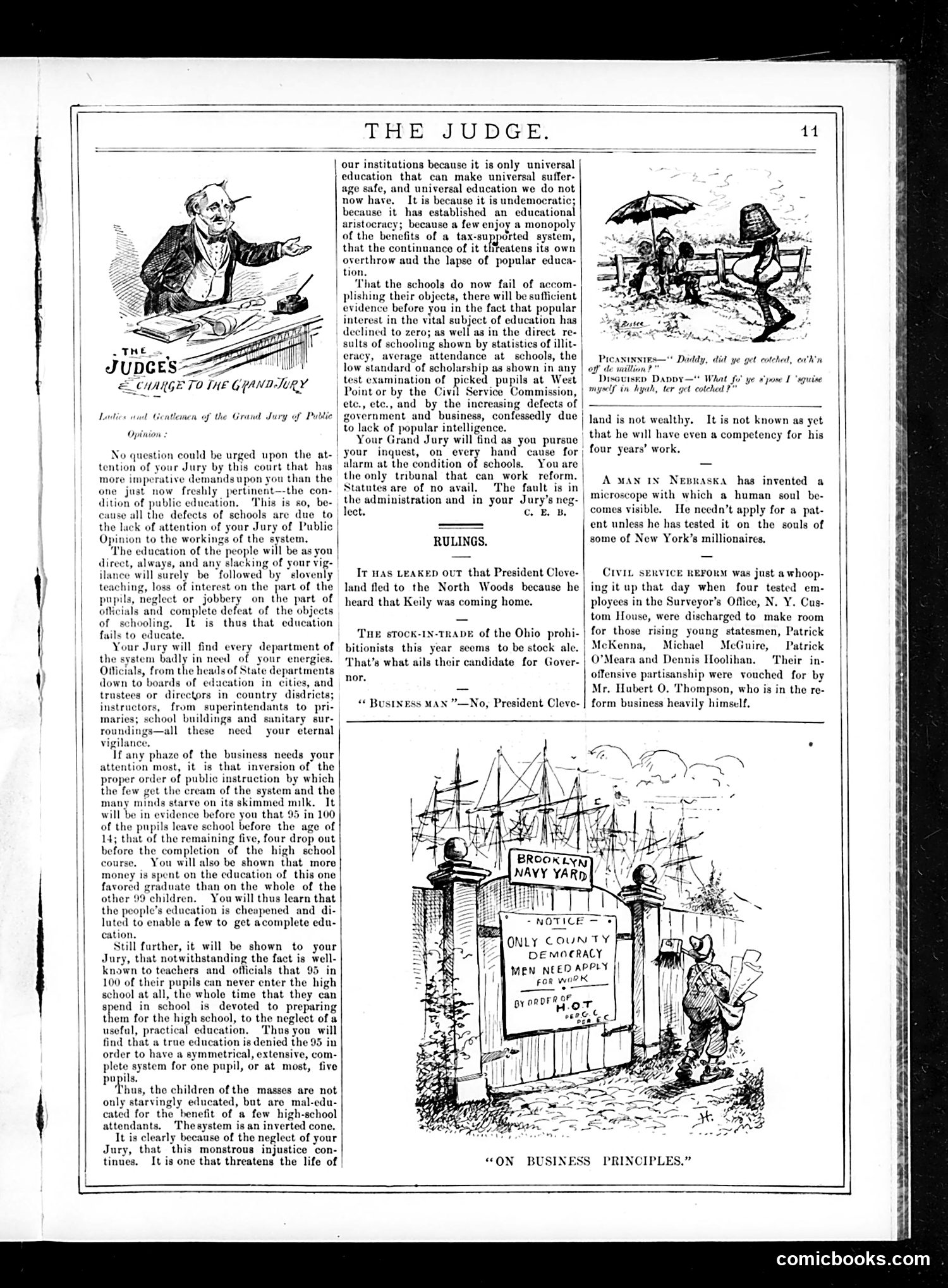
**The Main Editorial**: The left side presents a judge's address to a Grand Jury, criticizing the undemocratic nature of American public education. The core argument is that the education system inverts proper priorities—spending disproportionate resources on the few students (about 5%) who attend high school, while starving the majority (95%) who leave by age 14 with practical, vocational training. The judge frames this as threatening democracy itself, since universal suffrage requires universal education. **The Cartoons**: Two satirical illustrations mock related issues: a farmer asking which party will help him ("Pennianism"), and a Brooklyn Navy Yard sign reading "NOTICE—ONLY COUNTY DEMOCRACY MEN NEED APPLY," critiquing patronage hiring over merit—business conducted "on business principles" rather than competence. **Historical Context**: This appears critical of Gilded Age educational inequality and political corruption through patronage systems, both obstacles to democratic participation.
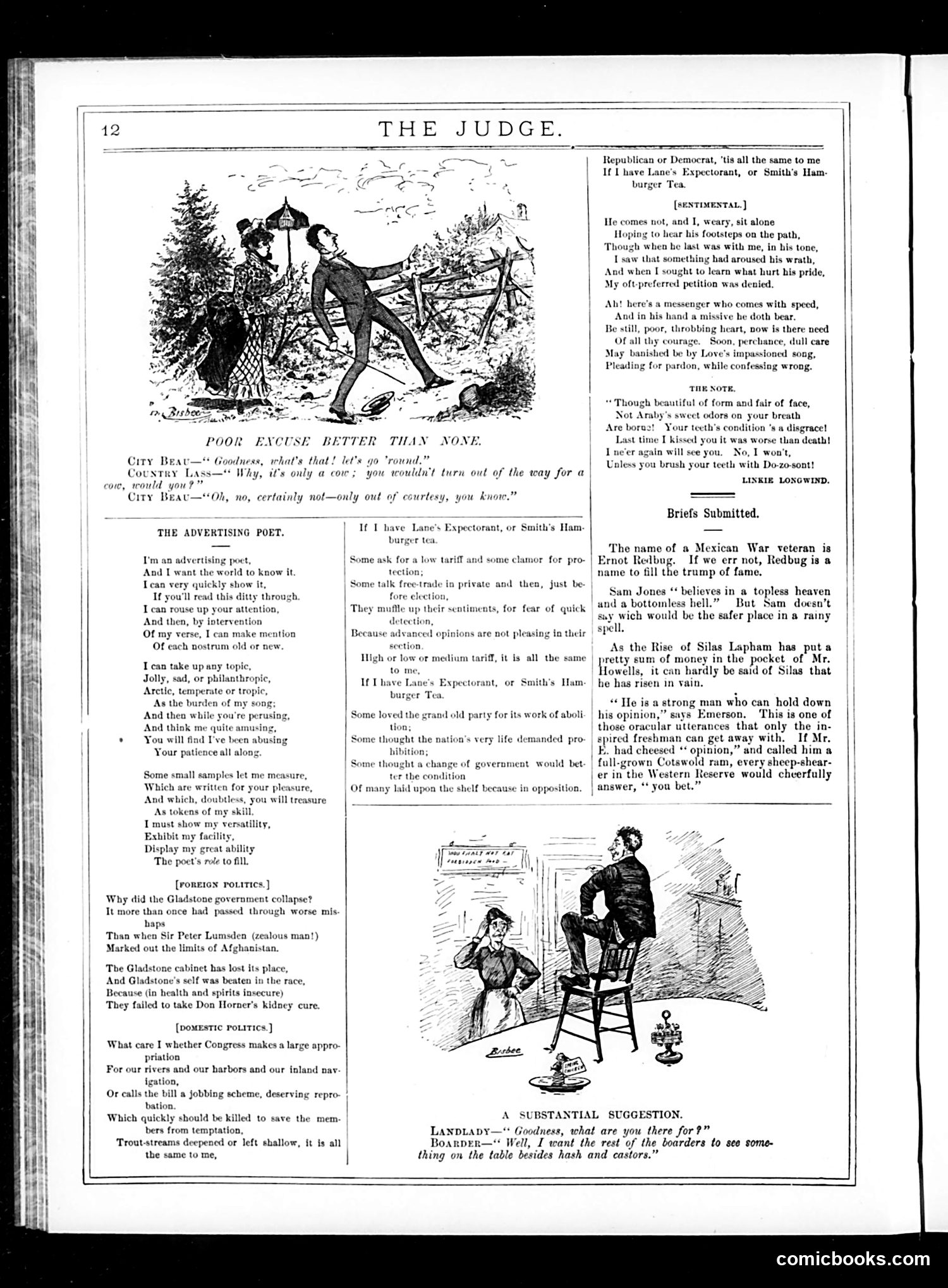
This page from *Judge* magazine contains multiple satirical pieces mocking American political and consumer culture of the late 19th century. **"Poor Excuse Better Than None"** depicts a city man pretending to escort a country woman past a cow out of "courtesy"—satirizing affected urban manners. **"The Advertising Poet"** ridicules how advertisers exploit any topic, any political position, to hawk products like "Lane's Expectorant" and "Smith's Hamburger Tea." The satire suggests advertisers don't care about actual issues—tariffs, government, elections—only selling their wares. **Political poems** mock the Gladstone government's collapse (attributed absurdly to failing to use "Don Horner's kidney cure") and Congress's appropriations debates, emphasizing political hypocrisy. **"A Substantial Suggestion"** shows a landlady asking a boarder for table items besides "hash and castor"—a joke about cheap boarding-house meals. Overall, the page satirizes advertising manipulation, political indifference, and consumer culture pretense.
This page contains political and social satire typical of late 19th-century American humor magazines. The content includes: **Seasonal Verses:** Mock-serious poems about summer ending, fat men rejoicing as heat subsides, servants returning from beaches, and women regretting scanty bathing attire that failed to attract marriage proposals—reflecting Victorian attitudes about female modesty and matrimonial prospects. **Political Jabs:** References to President Grant wearing inconspicuous uniforms, the President's party being "sick" (politically troubled), and satirizing baseball umpires as the only people who could sympathize with presidential problems. **Literary/Celebrity Mockery:** Oscar Wilde's newborn son being noted as "encouraging" proof a man exists in the family—sarcastic commentary on Wilde himself. **Workplace Humor:** A printing-house joke about a "sub dude" (substitute typesetter) who bungled work. **Religious Satire:** Reverend Sam Jones and a Pittsburgh preacher's absurd wealth criticisms. The humor relies on reader familiarity with contemporary figures and assumes audiences shared Victorian sensibilities about propriety, gender roles, and social hierarchy.
This is a humorous essay by Bill Nye (a popular 19th-century humorist) about Benjamin Franklin's early career as a printer. The piece satirizes Franklin's struggles working with his brother James at the *New England Courant*, a colonial newspaper. The joke centers on the *real* obstacles facing early American printers: they couldn't criticize the king without legal consequence. When an angry patron withdrew advertising after being insulted, the printer faced jail time—not from libel law, but from the practical reality that angry subjects could retaliate. Nye mocks modern journalists for their relative freedom, asking rhetorically whether they'd endure prison "for the cause of freedom" as Franklin did. The humor comes from Nye's exaggerated, irreverent tone and digressive style—discussing Franklin's invention of the "printer's towel" (a cleaning rag) as if it were a deadly weapon, and comparing colonial hardships to modern circus advertisements. It's period satire commenting on press freedom and the costs of editorial independence.
This page is primarily **advertising and biographical content**, not a political cartoon. The main feature is a lengthy biographical article about **Benjamin Franklin**, presented as a narrative of his life and accomplishments. The text satirizes Franklin in the style of "The Judge"—with humor embedded in exaggeration and irreverent tone. It describes Franklin establishing the *Pennsylvania Gazette*, his lightning experiments (humorously framed as collecting lightning "for a mess"), his work as postmaster-general, and his diplomatic missions to England and France. The satire portrays him as eccentric but effective: arriving at the royal court with wet umbrella, proudly illegitimate-son William, refusing French offers to return home to America. The surrounding space contains typical late-19th-century patent medicine and commercial advertisements (Pond's Extract, Columbia Bicycles, trusses, tooth powders), which was standard magazine filler of the era. **No identifiable political cartoon appears on this page.** The Franklin piece is biographical humor rather than current political satire.
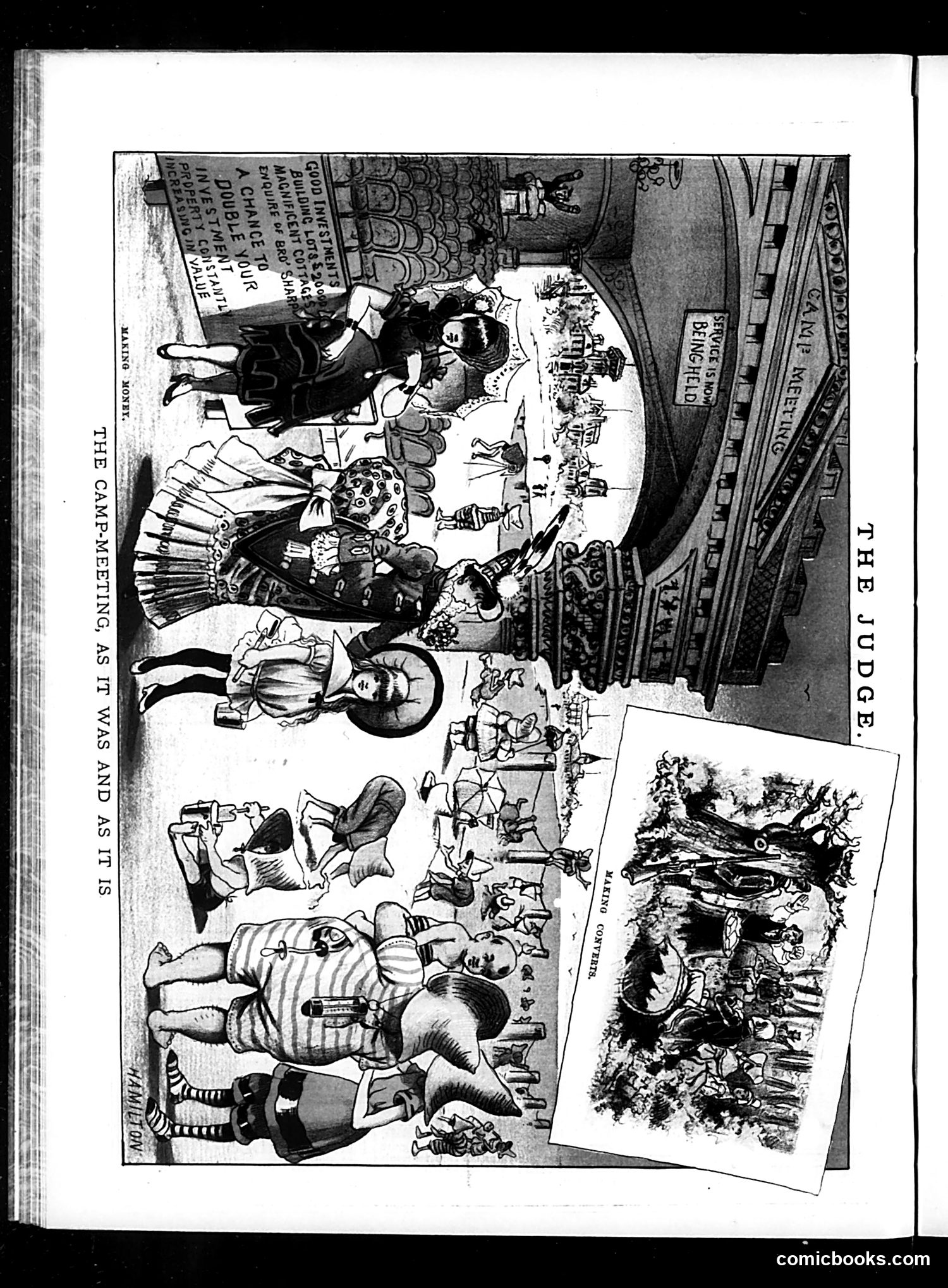
This page from *Judge* magazine contains satirical illustrations labeled "The Game-Meeting as it Was and as it Is" and "The Judge." The main cartoon appears to contrast past and present depictions of social gatherings or "game meetings." The top illustration shows an elegant, formal Victorian-era scene with well-dressed attendees in ornate surroundings. The bottom illustration depicts a more chaotic, crowded contemporary scene with figures in less formal dress. The satire likely mocks the decline of decorum and civility in social gatherings over time—comparing idealized past behavior to present-day disorder. The ornate architectural details and formal dress in the upper scene contrast sharply with the jumbled composition below, suggesting social deterioration or loss of propriety that would have resonated with *Judge's* educated, upper-class readership. The accompanying smaller illustration on the right remains unclear without additional context.