
A complete issue · 16 pages · 1885
Judge — September 5, 1885
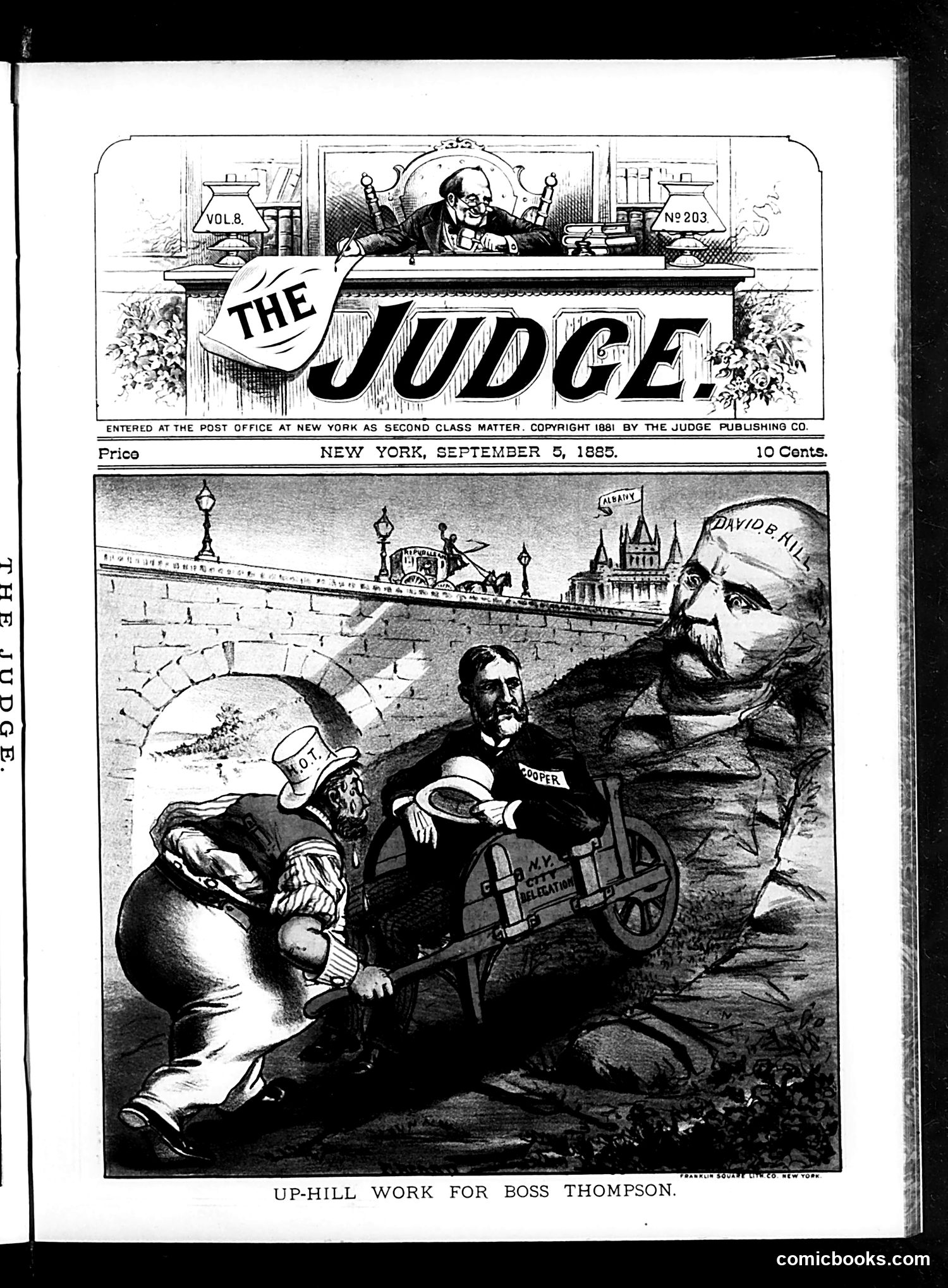
This *Judge* cartoon from September 5, 1885, depicts a political figure labeled "Boss Thompson" struggling to push a heavily laden cart uphill. The cart appears to carry burdensome responsibilities or scandals. A figure labeled "David Hill" (likely New York politician David B. Hill) stands to the right, observing the difficult task. The satire mocks Thompson's political struggles or unpopular policies. "Boss" indicates he held machine-politics power. The uphill struggle is literal metaphor for his mounting difficulties. The presence of Hill suggests political rivalry or commentary on New York state politics of that era. Without more biographical context on Thompson, the specific scandal or issue remains unclear, but the cartoon clearly ridicules his political predicament.
This page contains three distinct political/social commentaries: **"Domestic Economy"** satirizes the lack of labor-saving inventions for women. Judge proposes an absurd "combination bedstead" — essentially an expandable, mechanical crib system to automatically handle nighttime child care. The satire mocks both the inadequacy of household technology and societal indifference to women's exhaustion. The reference to Mormon accommodations adds biting humor about polygamy. **"Hic Opus Thompsonii"** discusses New York Democratic Party internal conflict between "Short-Tairs" (urban Democrats supporting Hill) and "Hay Seeds" (rural Democrats supporting Cooper). Hubert O. Thompson appears to control the party machinery and favors Cooper, creating tension heading toward nomination and election. **"Mourners for Revenue Only"** criticizes vendors exploiting Grant's Tomb visitors, comparing them to scavenging birds and body-snatchers. It condemns their opportunistic commercialism at a sacred site, though acknowledges their poverty-driven desperation.
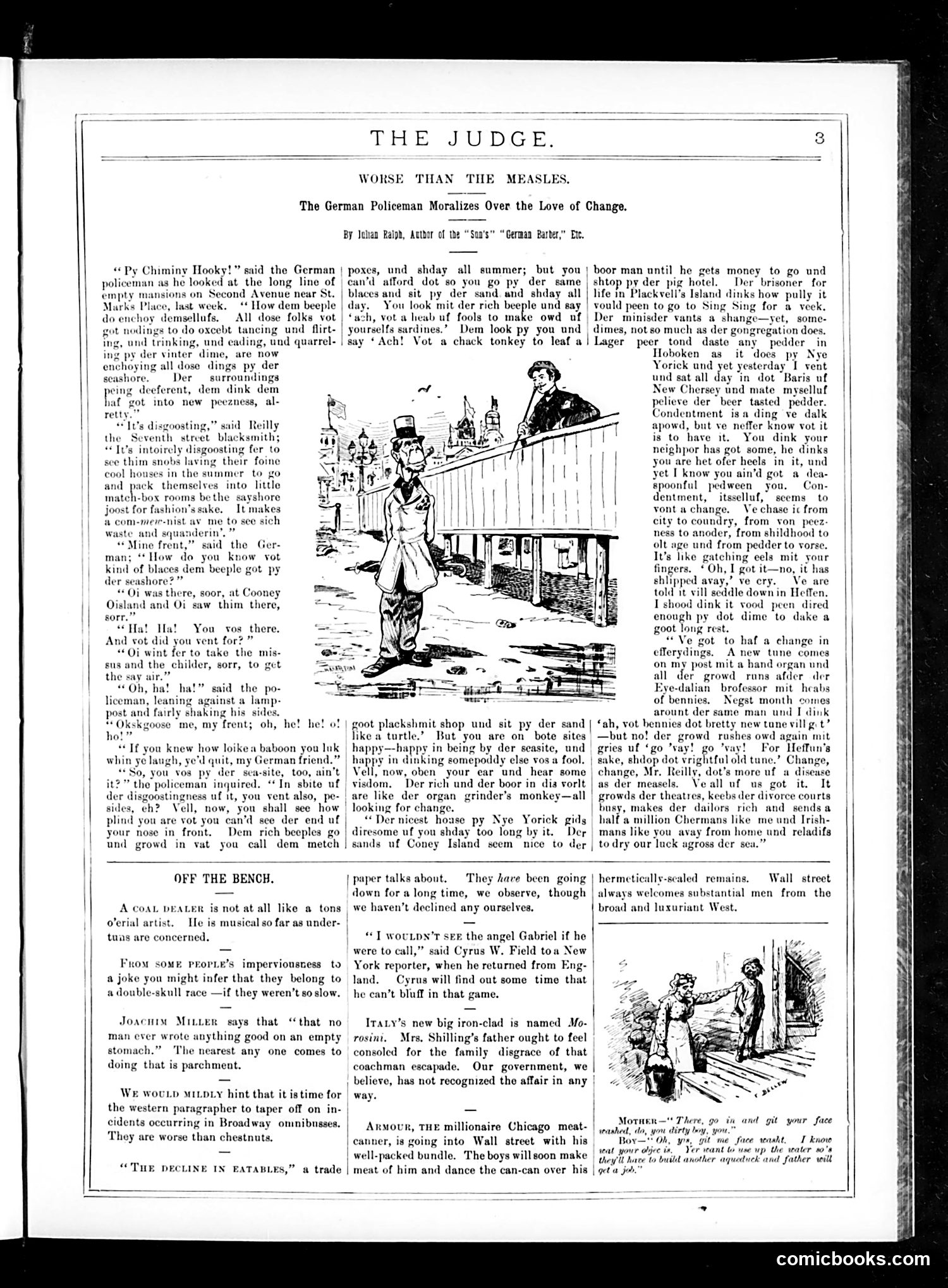
This piece satirizes American restlessness and constant desire for change through a German policeman's philosophical monologue. The policeman observes wealthy New Yorkers abandoning their homes for summer seaside vacations, then mocks a working-class man (who admits he also vacationed at Coney Island) for criticizing the rich. The joke: both rich and poor are hypocrites—they criticize each other's leisure-seeking while doing the same thing themselves. The policeman uses exaggerated German-accented English for comedic effect, a common Judge device of the era. His larger point: Americans are perpetually discontent, always chasing "change" (contentment being impossible). This restlessness afflicts everyone—rich, poor, clergy, prisoners—making it "worse than the measles," a contagious disease of the American character. The satire mocks both class hypocrisy and perceived American materialism and social climbing.
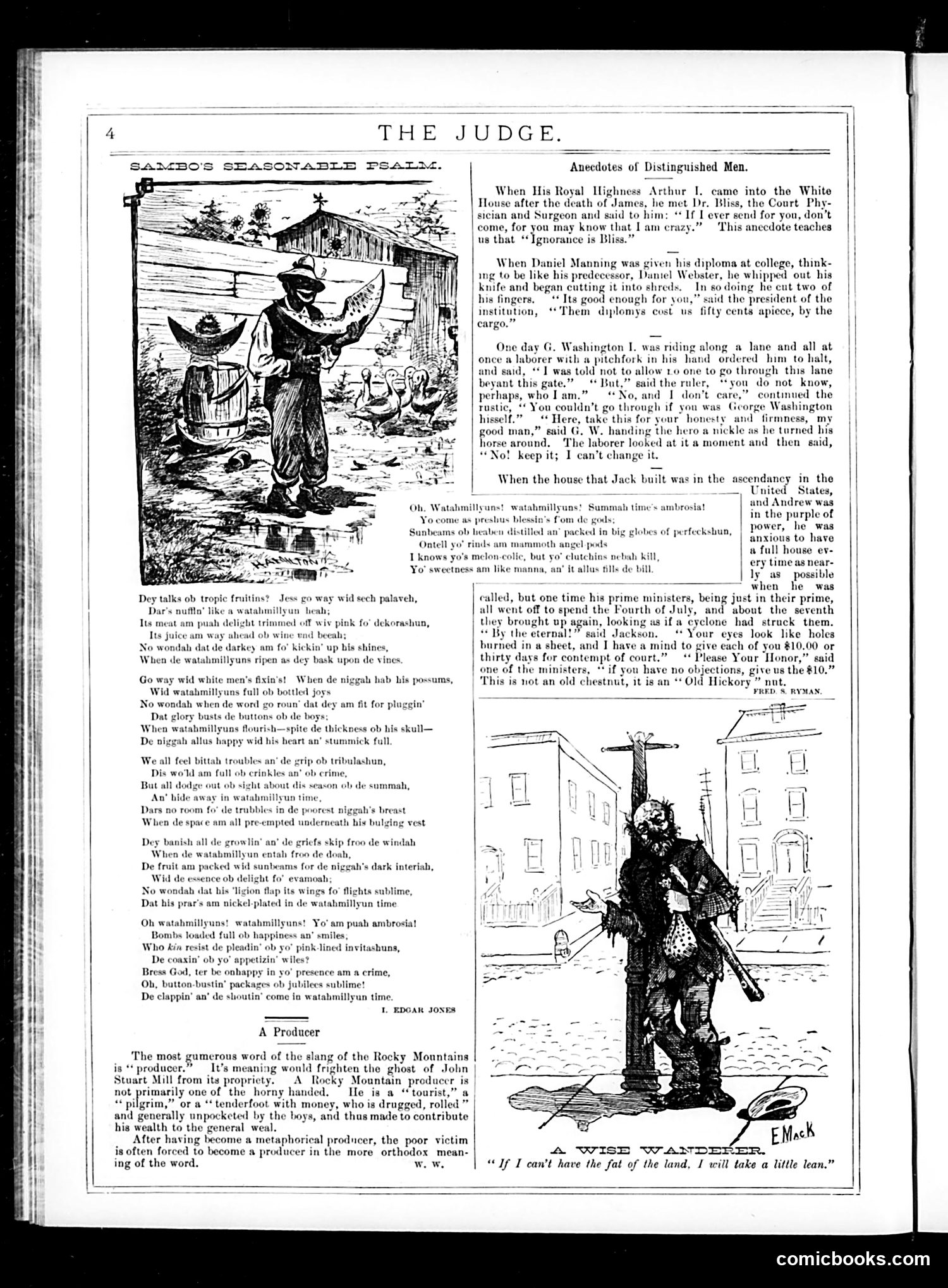
This page contains three distinct pieces of period American humor reflecting late 19th-century racial attitudes: **"Samba's Seasonable Psalm"** (left): A dialect poem in the voice of an enslaved or freed Black person praising watermelons. Uses heavy racial stereotypes and phonetic "black dialect" spelling ("watahmillyun," "fo'"). The satire targets both the subject and reflects contemporary minstrelsy conventions—treating Black speech and watermelon consumption as comedic subjects. The accompanying illustration shows a caricatured figure. **"Anecdotes of Distinguished Men"** (right): Humorous stories about presidents and officials, including Arthur, Manning, Washington, and Jackson. These are genteel anecdotes—not satirizing policy but presenting amusing character moments. **"A Producer"** (bottom): Explains Rocky Mountain slang where "producer" means a tourist who gets robbed by locals, then forced into actual labor. This is straightforward satire of frontier economic exploitation. The page reflects Judge magazine's mix of racial humor and general political/social satire typical of 1880s American publications.
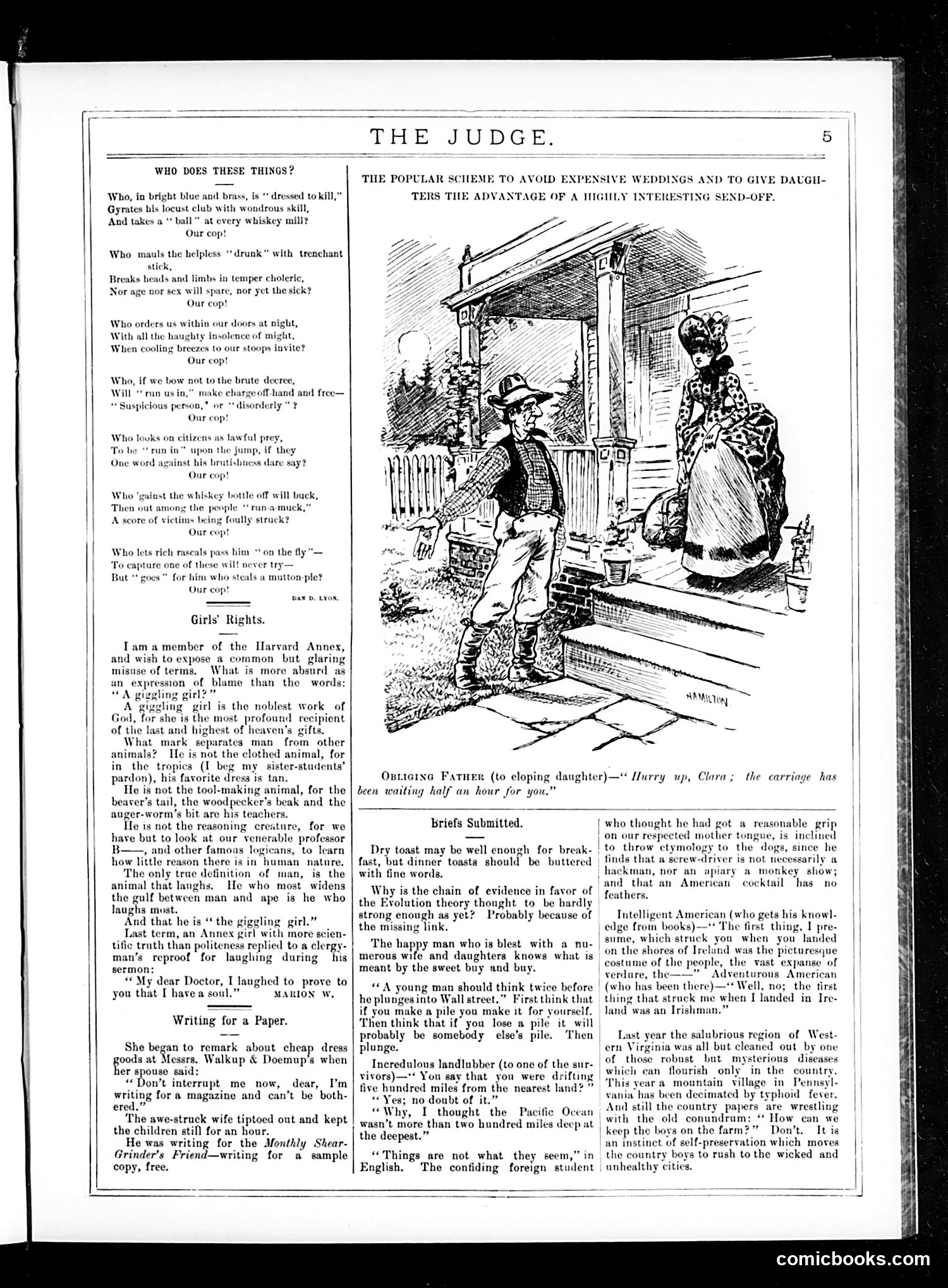
This page from *Judge* magazine contains satirical critiques of American society circa the late 1800s. The main cartoon depicts an elopement scene—a father chasing an eloping daughter and her suitor, urging them to hurry as "the carriage has been waiting half an hour." This mocks the "popular scheme to avoid expensive weddings" by having daughters elope, thus circumventing costly wedding ceremonies while still providing parents the "advantage of a highly interesting send-off." The accompanying poem "Who Does These Things?" savagely attacks police corruption and brutality. It catalogs abuses: police drunk on whiskey, attacking helpless intoxicated people without regard for age or sex, enforcing curfews with arrogance, and selectively harassing citizens as "suspicious persons" while ignoring actual crimes like theft. The poem criticizes officers who target the poor and vulnerable while protecting themselves and their vices. The other brief articles address women's education and satirize journalistic hackery—a writer interrupting his wife to focus on composing magazine content for free copies rather than payment.
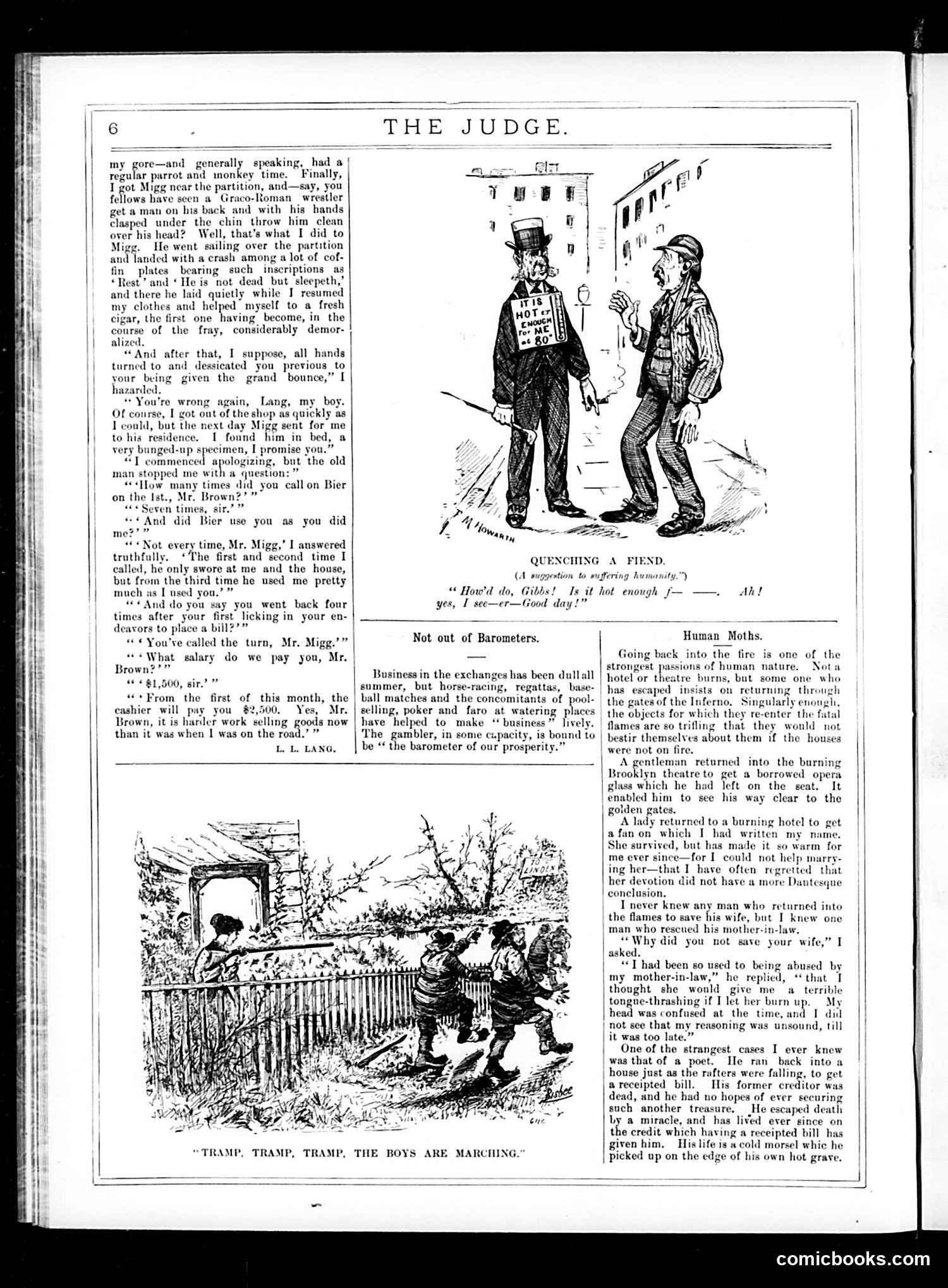
This page from the satirical magazine *Judge* contains two distinct pieces: **Main Story ("Quenching a Fiend"):** A narrative about a traveling salesman's encounter with a difficult customer named Migg. The accompanying cartoon shows a top-hatted man (marked "HOTEL" on his jacket) confronting another figure—likely depicting the salesman's humorous tale of physical confrontation over failed bill collection attempts. The story's humor derives from the protagonist's persistence despite repeated rejection and violence. **"Human Moths" Essay:** A social commentary on human irrationality, using fire as metaphor. It documents absurd instances of people returning into burning buildings for trivial possessions (opera glasses, fans) rather than family members. The final anecdote—a man rescuing his mother-in-law instead of his wife because he feared her criticism—satirizes misplaced priorities and domestic anxiety. **"Not out of Barometers" section** briefly notes that gambling activity serves as an economic indicator during slow business periods. The page's satirical tone critiques both commercial desperation and fundamental human foolishness.
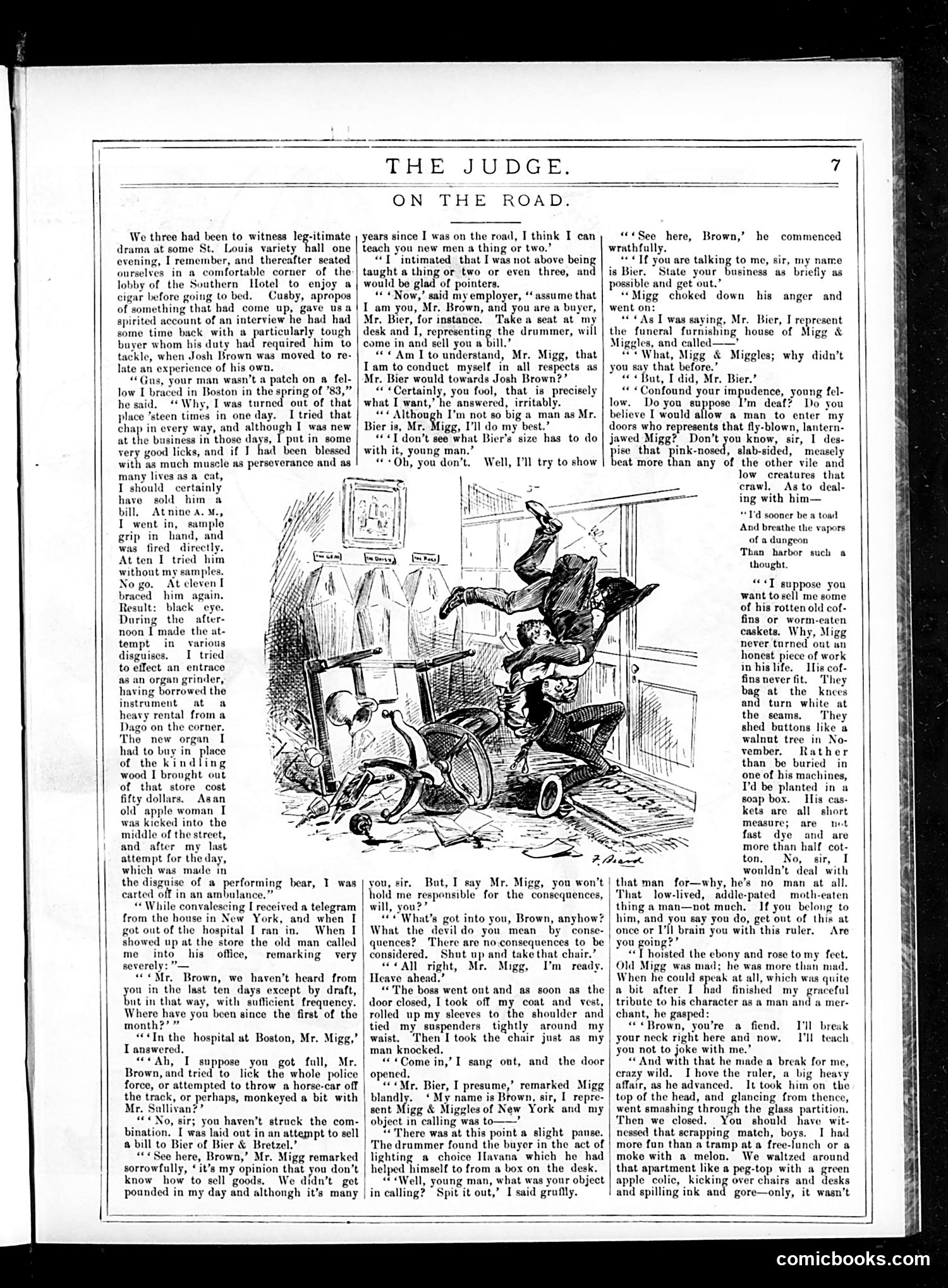
This page from *Judge* presents a humorous anecdote about traveling salesmen—a common topic in late-19th-century American comedy. The narrative centers on Josh Brown, a sales representative, recounting his disastrous attempt to sell to a tough customer named Bier in Boston. The humor derives from slapstick situations: Brown disguises himself as various characters (organ grinder, apple woman, performing bear) to approach Bier, only to be repeatedly ejected violently. The accompanying illustration depicts his comedic beating. The satire targets the brutal realities of door-to-door sales work and the desperation of salesmen facing hostile customers. Brown's willingness to endure repeated humiliation reflects the low status of traveling salesmen in the era. The boss, Mr. Migg, dismisses Brown's complaints and attempts to teach him "proper" selling technique—which predictably ends with Migg himself receiving the same violent treatment from Bier, suggesting the customer is simply unreasonable. The joke critiques both the exploitation of salesmen and the absurdity of aggressive sales tactics.
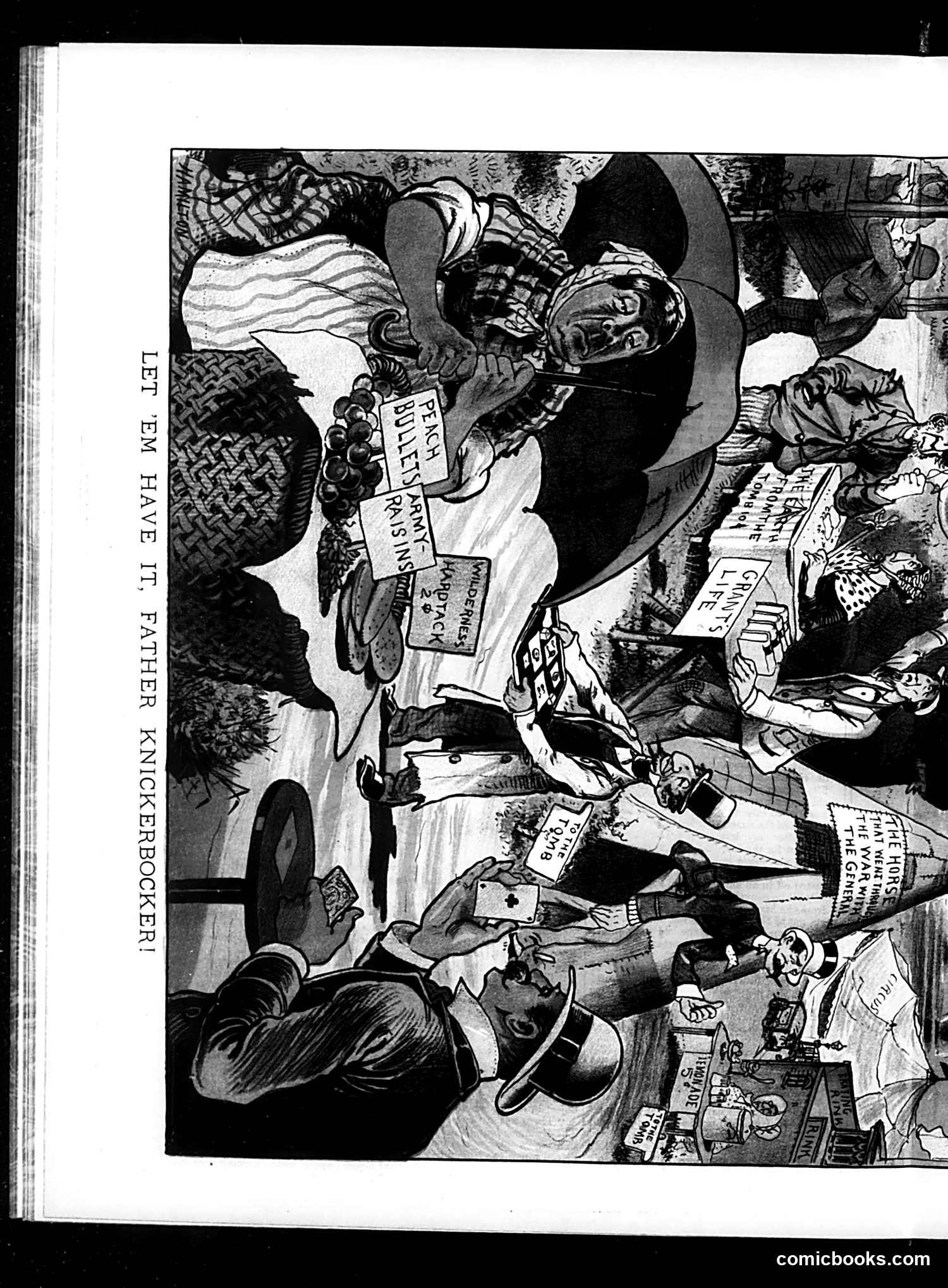
This appears to be a satirical cartoon titled "Let 'Em Have It, Father Knickerbocker," referencing New York City's Dutch colonial heritage (Father Knickerbocker being a personification of NYC). The image depicts what seems to be a street scene with multiple figures holding signs or labels—likely representing different social groups, professions, or political factions of the era. The crowded, chaotic composition suggests social conflict or competing demands. Without clearer visibility of all text on the signs and labels, I cannot definitively identify specific figures or the exact political reference. However, the cartoon likely satirizes either urban corruption, class conflict, or political patronage systems common to Gilded Age New York politics. The "Father Knickerbocker" framing suggests commentary on how the city leadership responds to or manages these competing interests.
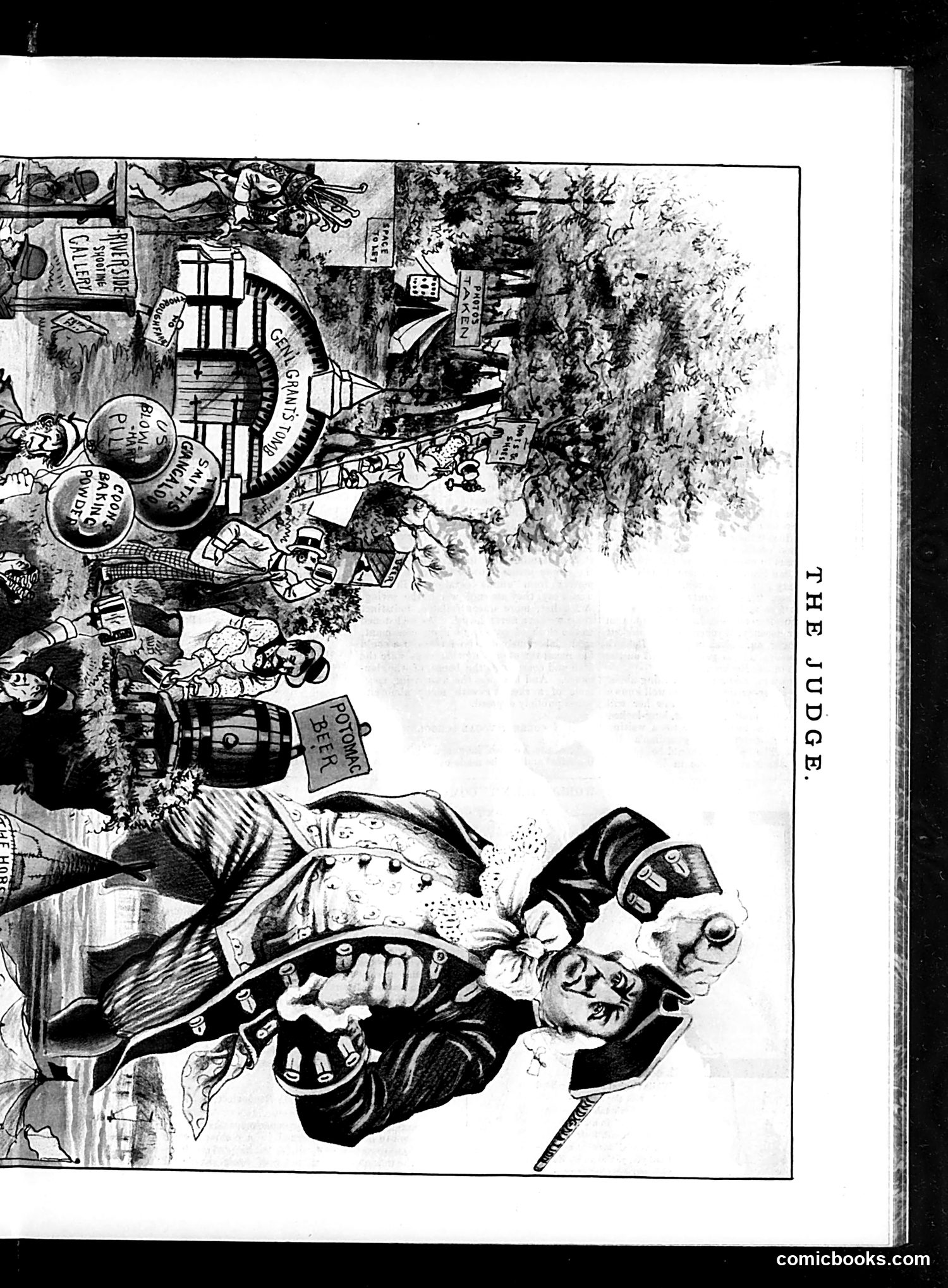
This appears to be a title page or section header from *Judge* magazine, featuring "The Judge" as a central figure. The page shows a caricatured man in formal attire (top hat, coat) depicted as a judge or authority figure. The surrounding scene contains various smaller figures and activities, suggesting a satirical commentary on contemporary society and its institutions. The text "SHOOTING" and "LIVERY" are partially visible, though their exact context is unclear from this OCR. The elaborate scene in the background appears to depict urban life or social commentary typical of *Judge's* satirical approach. Without clearer OCR or additional context about the specific date, the precise political or social references remain difficult to identify with certainty.
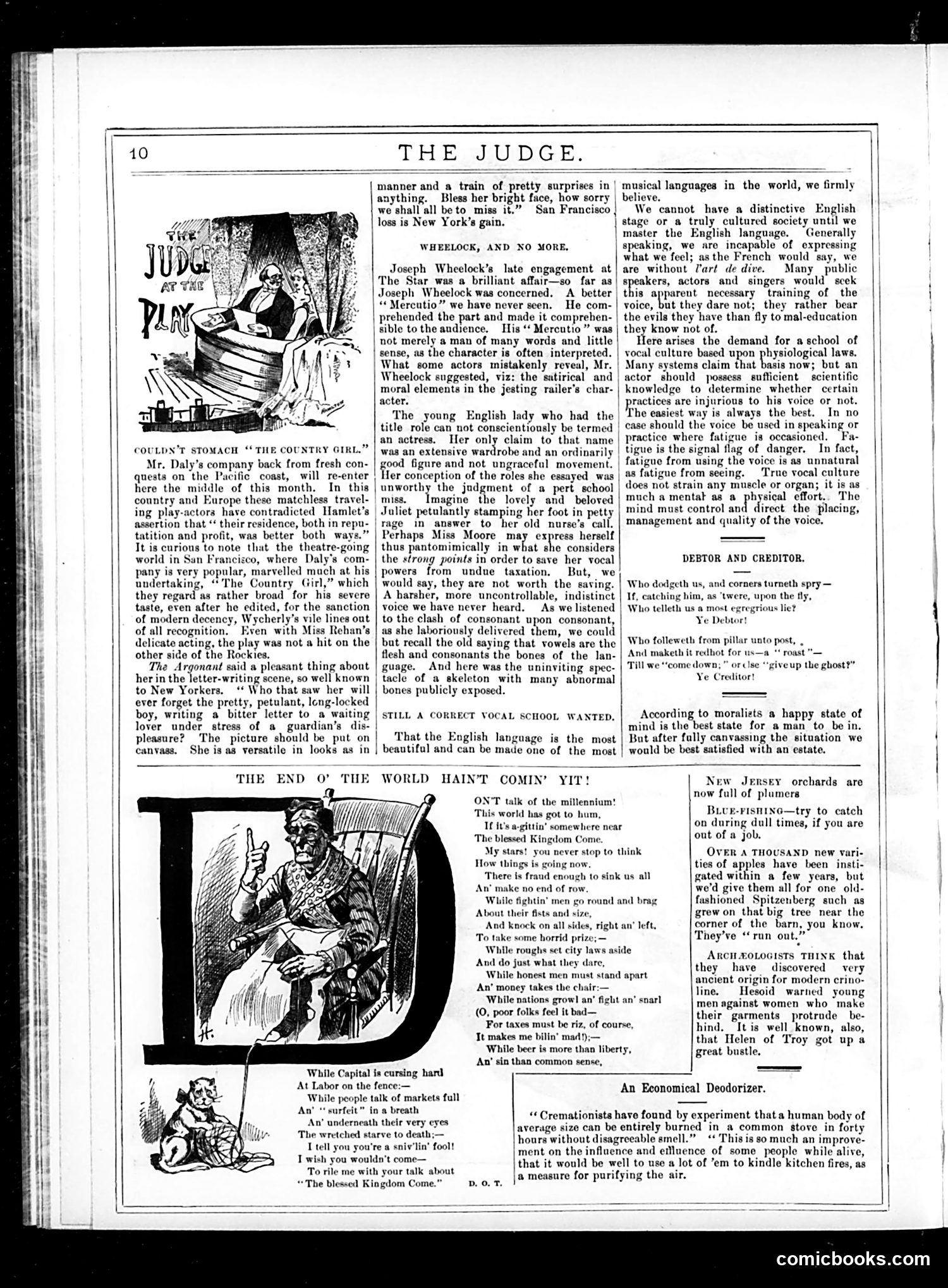
This page contains theater criticism disguised as satire, typical of Judge's cultural commentary. The main target is **Augustin Daly's theatrical company** returning from San Francisco with their production "The Country Girl." The satire ridicules the **young English actress playing Juliet** (likely identified as "Miss Moore" in the text) for her lack of talent—particularly her harsh, uncontrolled voice and wooden pantomime (stamping her foot petulantly). By contrast, actor **Joseph Wheelock's** performance as Mercutio is praised for actually *understanding* the role's satirical elements rather than merely reciting lines. The broader complaint: American theater lacks proper **vocal training schools** based on physiological principles. Actors, singers, and public speakers fear inadequate training but won't seek proper education. The satire argues England produces cultured theater because the language is properly mastered and delivered; American performers rely on wardrobe and movement instead of genuine skill. This reflects late-19th-century anxieties about American cultural sophistication versus European standards.
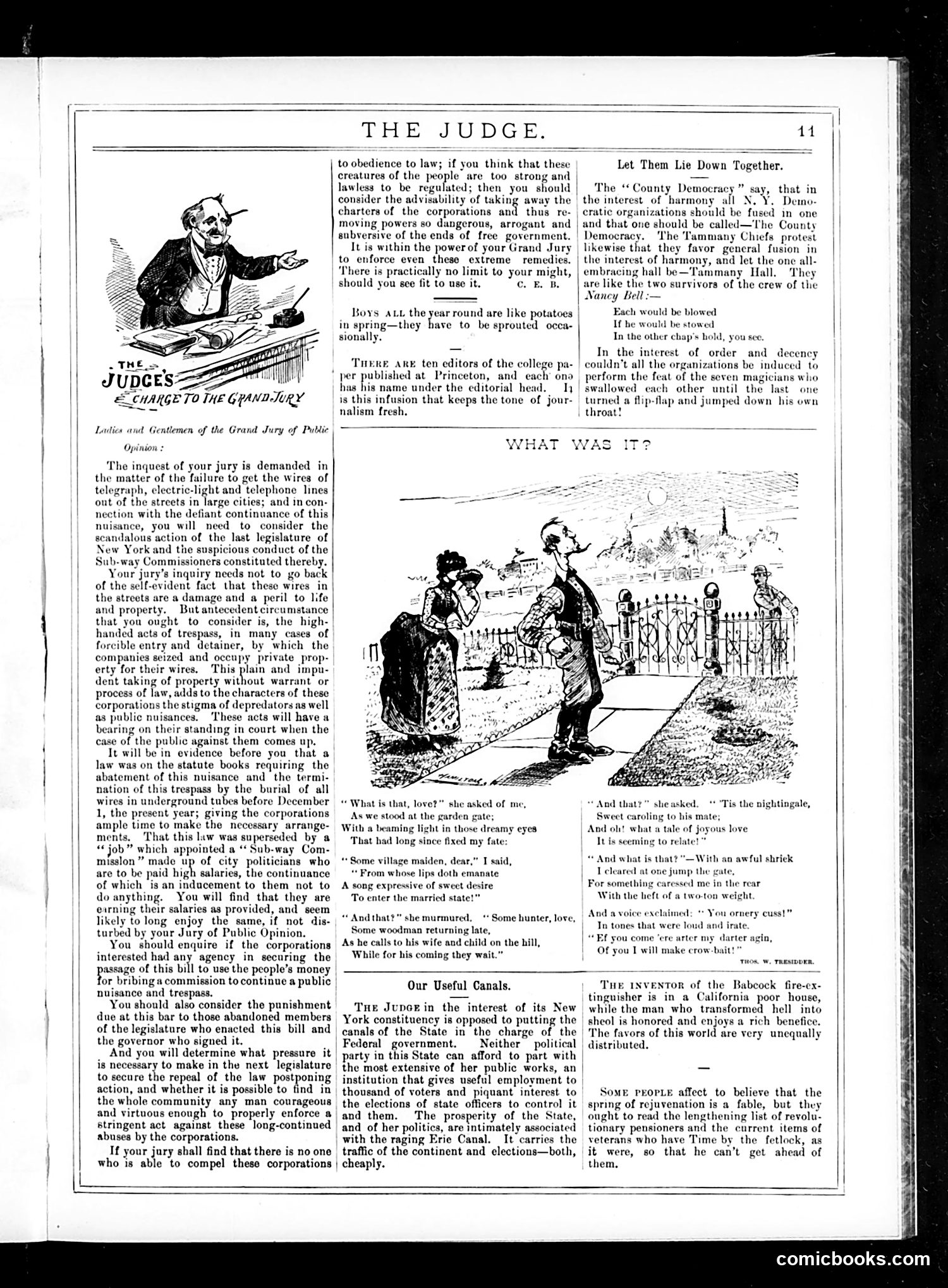
This page satirizes **corporate power and government corruption** in late 19th-century America. The main cartoon "The Judge's Charge to the Grand Jury" depicts a judge instructing jurors about corporate malfeasance—specifically telegraph, electric light, and telephone companies' illegal activities and their influence over legislators and the Sub-way Commission in New York. The satire argues corporations act with impunity, their wrongdoing protected by corrupted politicians and officials who are paid high salaries to ignore crimes. The judge suggests jurors must courageously enforce law against these powerful entities, as no one else will. The accompanying poem "What Was It?" appears to humorously depict a romantic encounter, offering lighter relief from the serious corporate-corruption theme dominating the page.
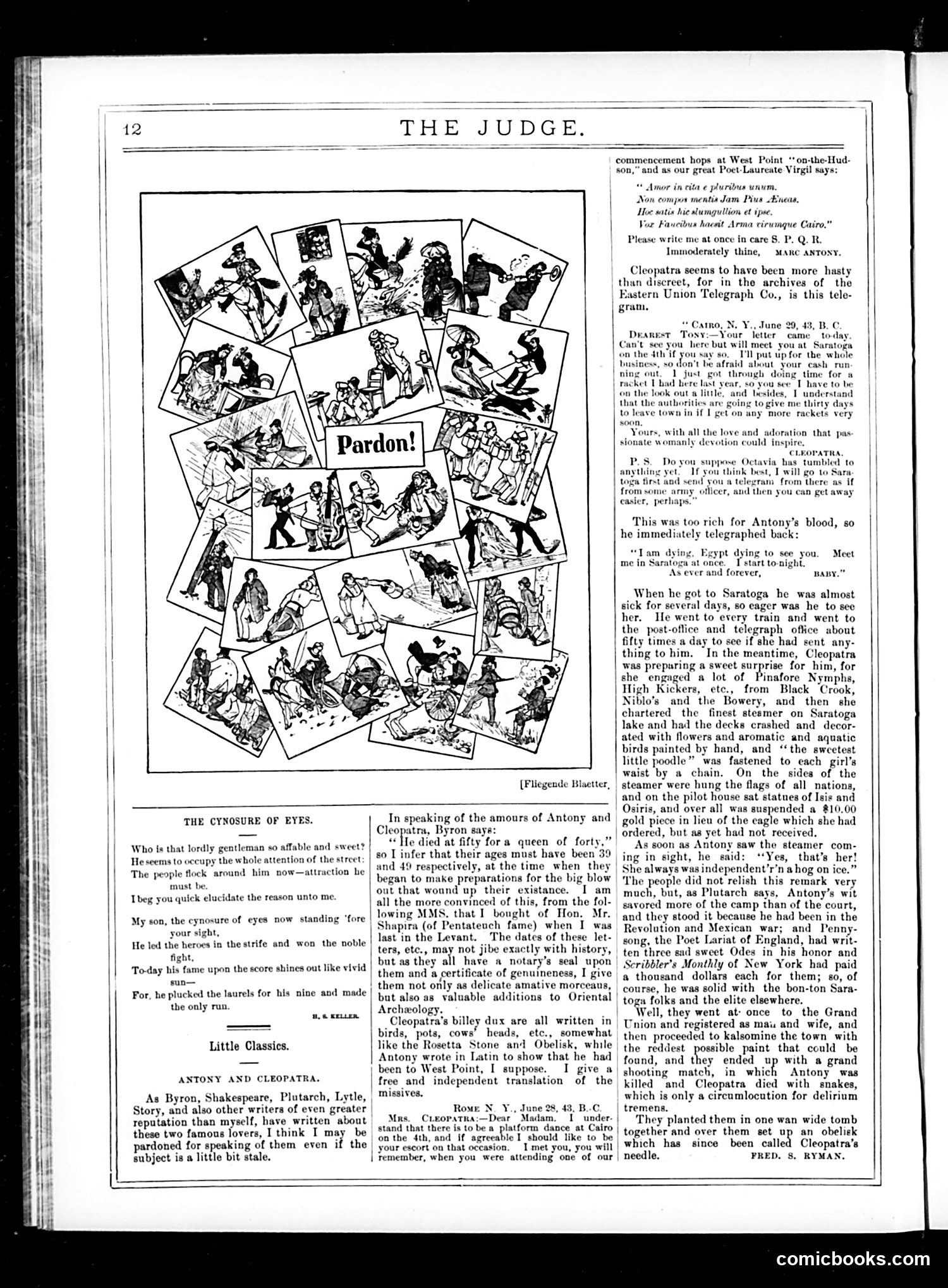
The main cartoon, "Pardon!," uses clustered vignettes to satirize everyday social transgressions and hypocrisy—showing various indiscretions (affairs, drunkenness, deception, theft) that people commit, then beg forgiveness for. The point appears to be that Victorian society is riddled with minor moral failures everyone overlooks. Below, "The Cynosure of Eyes" mocks sports mania, using baseball language ("nine," "only run") to celebrate a local hero whose fame is momentary and absurd. The "Little Classics" section parodies pretentious literary adaptations. The author humorously recasts *Antony and Cleopatra* as a modern romance involving Saratoga Springs (a fashionable resort), telegraph communications, and stage performers—reducing classical tragedy to contemporary flirtation and materialism. The fake scholarly apparatus and dubious "historical sources" mock both academic pretension and the era's obsession with commodifying high culture.
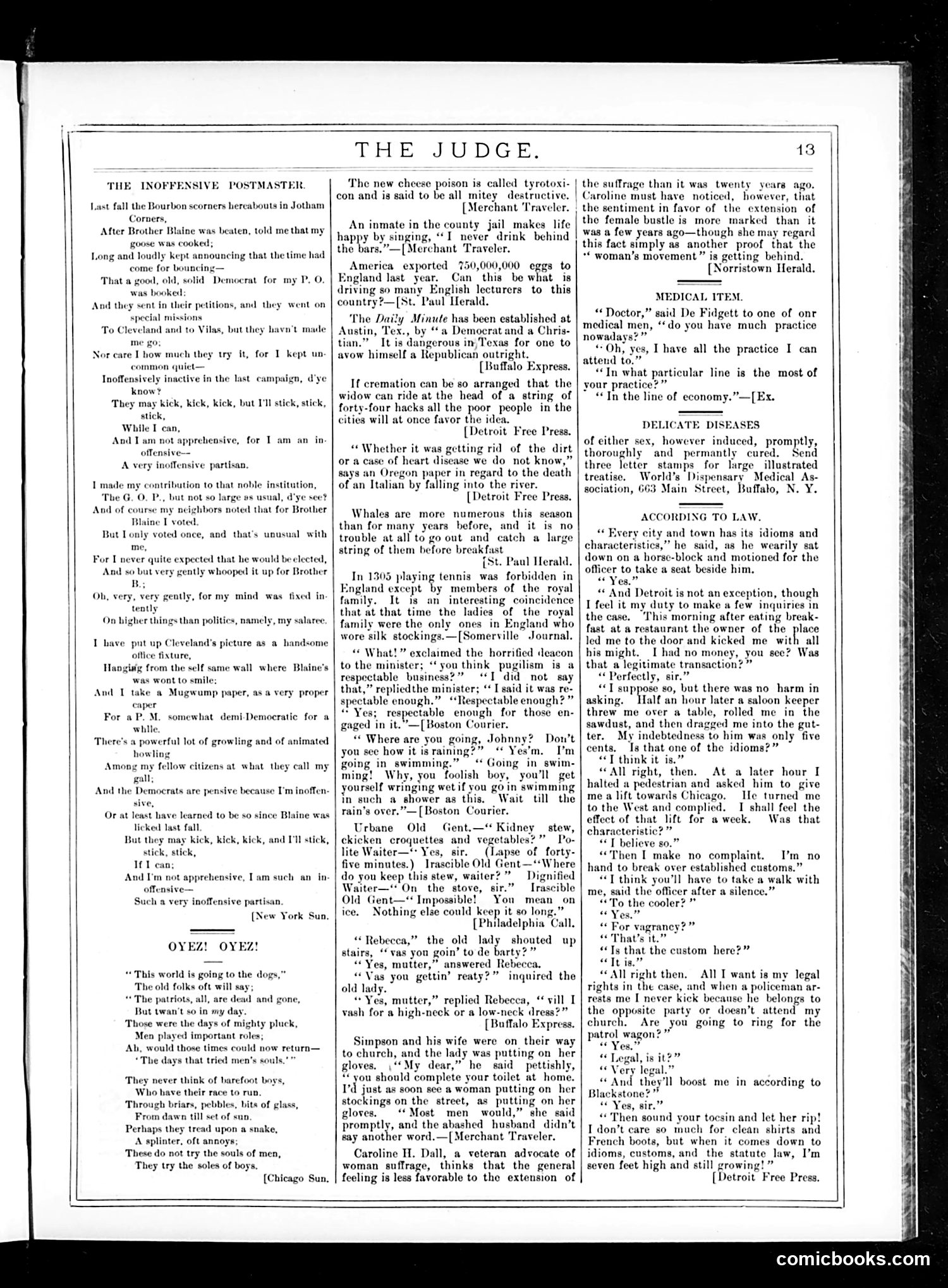
This page contains primarily **text-based satirical commentary** rather than illustrated cartoons. The main content is "The Inoffensive Postmaster," a poem mocking a self-described neutral political operative who serves as postmaster under both Republican and Democratic administrations. The satire targets **political opportunism and cowardice**. The speaker claims to be a loyal "inoffensive" Democrat while maintaining his Republican-appointed postal position—he voted for James G. Blaine (the defeated 1884 GOP candidate) only once and now displays Cleveland's portrait where Blaine's hung. Judge ridicules this transparent fence-sitting and moral flexibility, suggesting that such political trimming, while common, is contemptible. The surrounding "Judge" section collects brief satirical news items on topics like poisoned cheese, egg exports, and cremation—typical period humor mocking contemporary absurdities and pseudo-scientific concerns. The secondary poem "Oyez! Oyez!" nostalgically contrasts hardy "barefoot boys" of the past with modern times, using contemporary gentleness to criticize modern weakness.
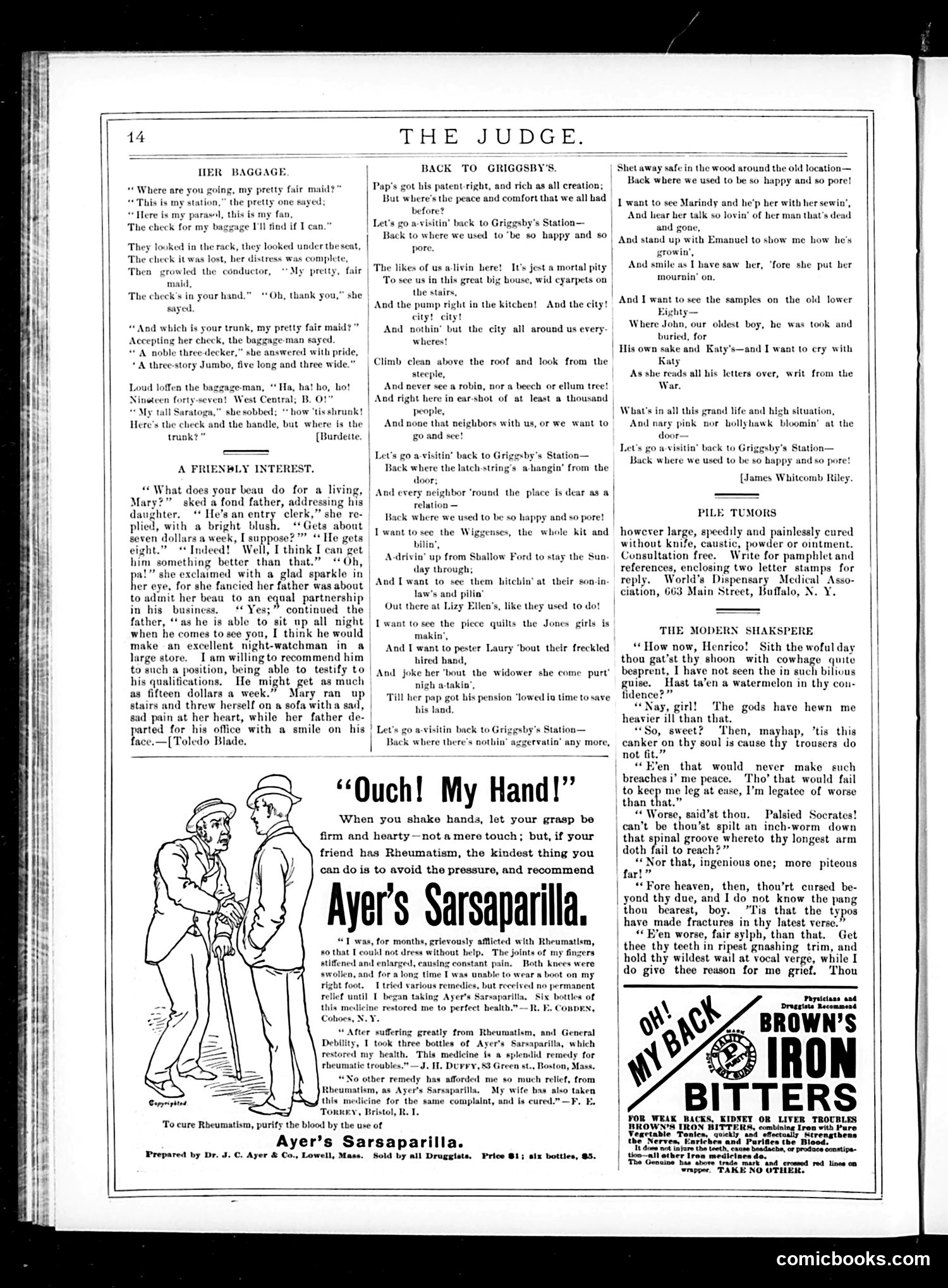
This page contains two distinct sections: a humorous dialogue about lost baggage and a nostalgic poem. **"Her Baggage" cartoon**: A woman reports her trunk missing to a conductor. The humor relies on her describing an absurdly large, multi-story "trunk" (a common travel container of the era), which the conductor cannot locate. The joke plays on the gap between her grandiose description and the practical impossibility of losing something so enormous—a form of exaggeration-based humor typical of Judge magazine. **"Back to Griggsby's Station" poem**: This appears to be by James Whitcomb Riley (credited at bottom). It expresses rural nostalgia—a poor family has gained wealth ("Pap's got his patent-right, and rich as all creation") but feels unhappy in their new grand house with indoor plumbing and city surroundings. They yearn for their simple country home, neighbors, and the grave of their son John. The satire critiques materialism and suggests that wealth cannot replace authentic community and emotional fulfillment—a common Progressive-era social commentary. The page also includes advertisements for patent medicines (Ayer's Sarsaparilla and Dr. Brown's Iron Bitters).
This page is primarily **advertisements and filler content** rather than political satire. The main textual pieces are: 1. **"Years Teach More Than Books"** — a medical advertisement for Dr. Pierce's "Golden Medical Discovery," disguised as editorial content praising the product's efficacy for liver and blood ailments. 2. **"A Cheerful and Cheering Visitor"** — a dialect piece (written in exaggerated rural/working-class speech) depicting a gossipy neighbor visiting a sick woman, recounting how excessive worry and neighborhood interference drove another woman, "Liddy Ann," to mental breakdown and asylum commitment. The second piece reflects period anxieties about **women's mental health**, the dangers of **social stress and gossip**, and suggests that isolation and positive thinking aid recovery—typical 19th-century medical thinking. The surrounding advertisements for bicycles, trusses, and printing services are standard commercial content. No specific political figures or events are referenced on this page.
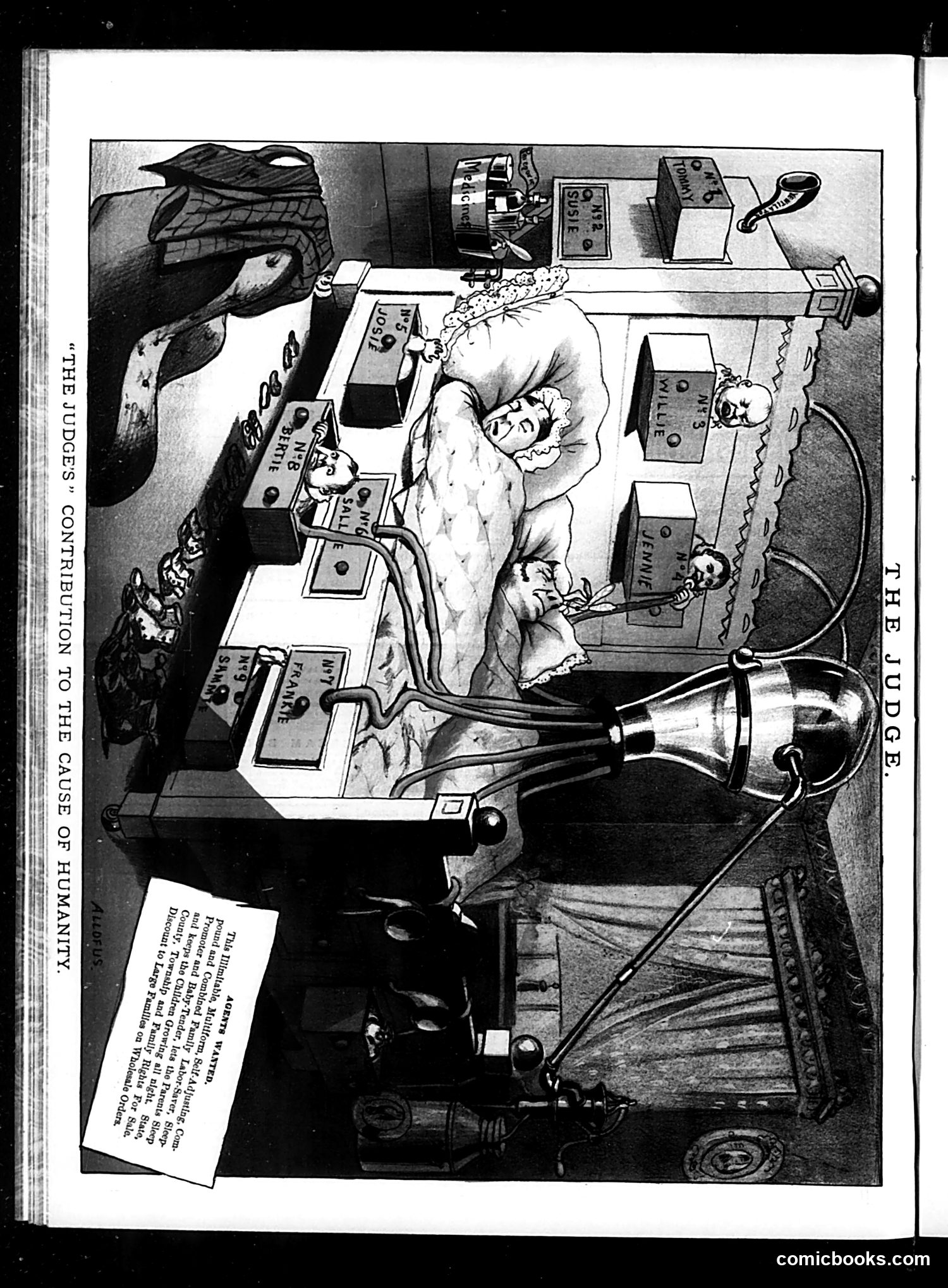
This satirical cartoon depicts a figure (appearing to represent judicial authority or "The Judge") presiding over what looks like an electrical execution device or torture apparatus surrounded by babies or cherubs. The image uses dark humor to critique the justice system's inhumane methods. The elaborate mechanical equipment with dials and controls suggests either capital punishment technology (likely referencing electric chair executions) or medical experimentation. The presence of innocent-looking infants positioned around this machinery creates grotesque irony—implying the legal system harms the vulnerable rather than protects them. The title sarcastically frames this as "contribution to the cause of humanity," mocking what the artist views as judicial cruelty or injustice. The cartoon likely critiques contemporary execution methods or harsh legal practices of Judge magazine's era.