
A complete issue · 16 pages · 1885
Judge — August 22, 1885
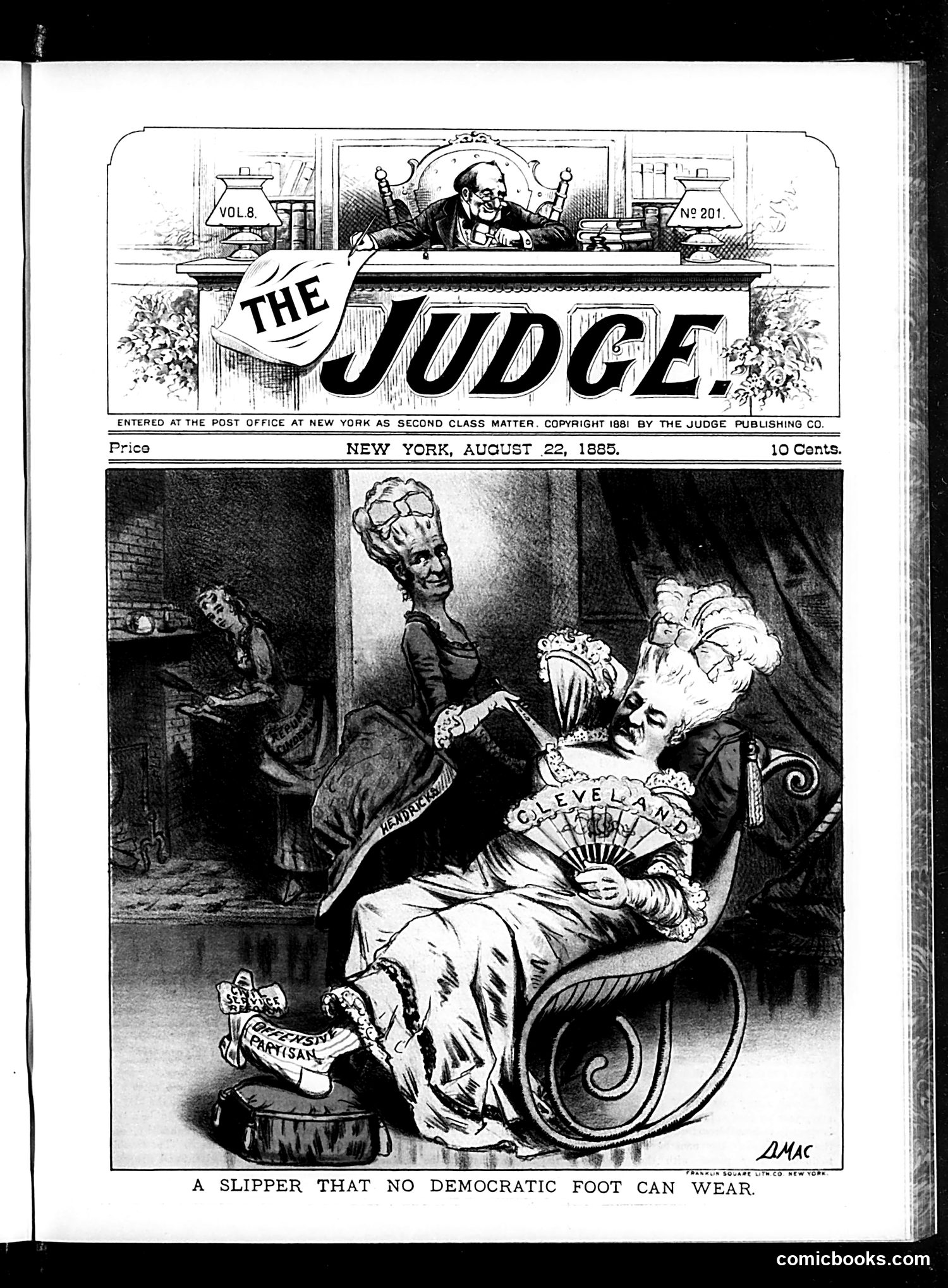
**Publication:** Judge magazine, August 22, 1885 **The Cartoon:** A woman labeled "Cleveland" reclines luxuriously while attendants serve her. She holds a fan marked "Cleveland" and rests her feet on what appears to be a partisan slipper. **Political Context:** This satirizes President Grover Cleveland (who took office in 1885) and Democratic Party politics. The "slipper that no Democratic foot can wear" likely critiques Cleveland's independent or controversial policies that alienated fellow Democrats—Cleveland was known for opposing patronage and party machine politics, positions that conflicted with traditional Democratic expectations. **The Satire:** The cartoon mocks Cleveland's refusal to conform to Democratic Party demands, suggesting his policies don't fit the party's actual interests or expectations, regardless of which Democrat holds power.
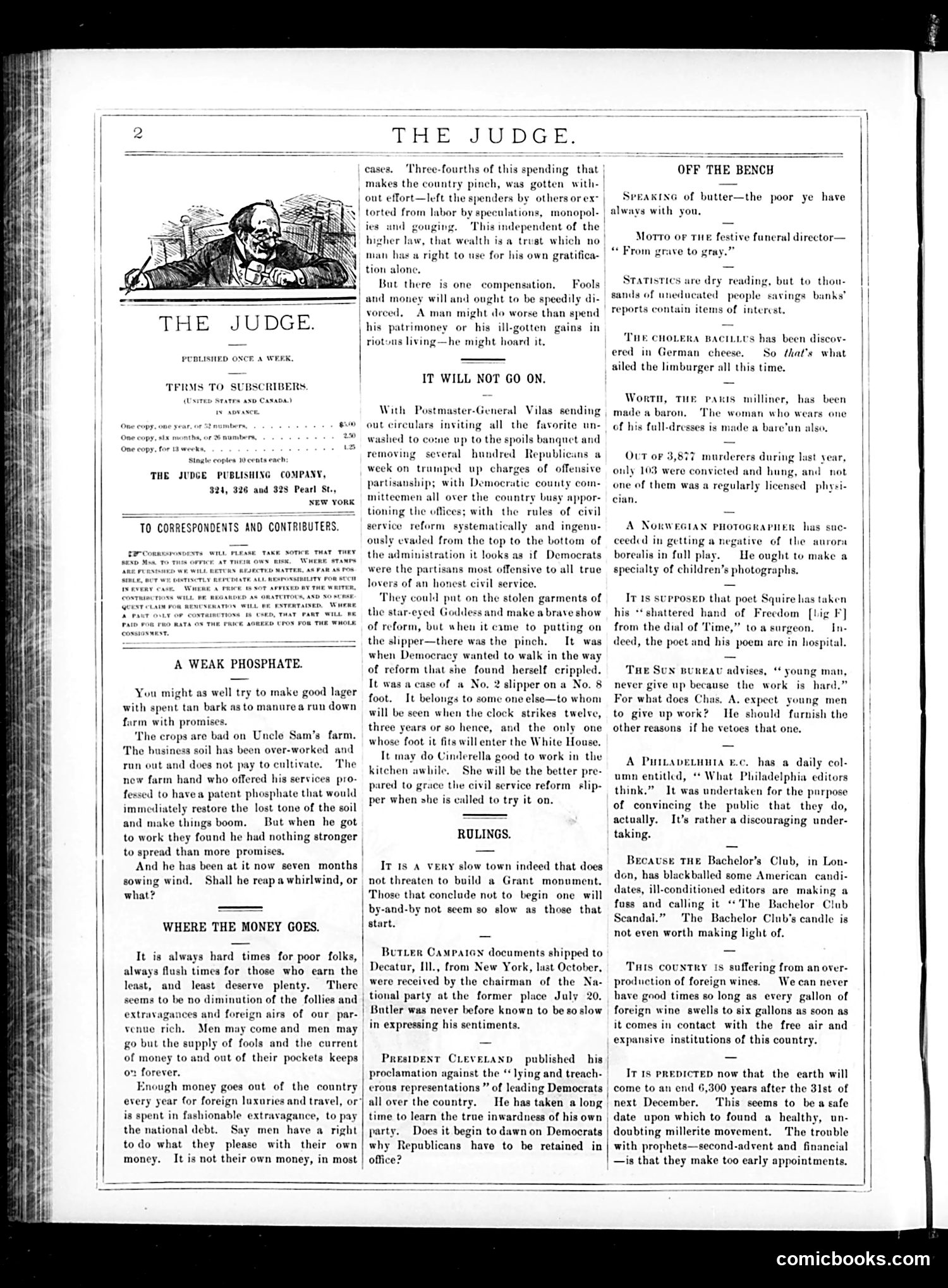
This page from Judge magazine (appears to be 1880s) contains editorial satire attacking Democratic corruption and hypocrisy. **Main targets:** The cartoon depicts Uncle Sam as a farmer with depleted soil—metaphorically representing the nation's economic problems. The "new farm hand" with false promises of a "patent phosphate" refers to the Democratic administration's failed economic policies. **Key political attacks:** 1. **Civil Service Reform hypocrisy**: Postmaster-General Vilas is mocked for replacing Republicans with Democrats under the guise of reform—exactly the partisan spoils system the Democrats claimed to oppose. 2. **The "Cinderella slipper"**: Democracy promised reform but couldn't actually deliver it; reform fits only the Republicans (who will eventually win the presidency). 3. **Wealth inequality**: A separate editorial criticizes the wealthy's wasteful foreign spending funded by ill-gotten gains from "speculations, monopolies and gouging." The satire's force relies on readers recognizing Democratic pretense toward civil service reform while practicing traditional partisan corruption.
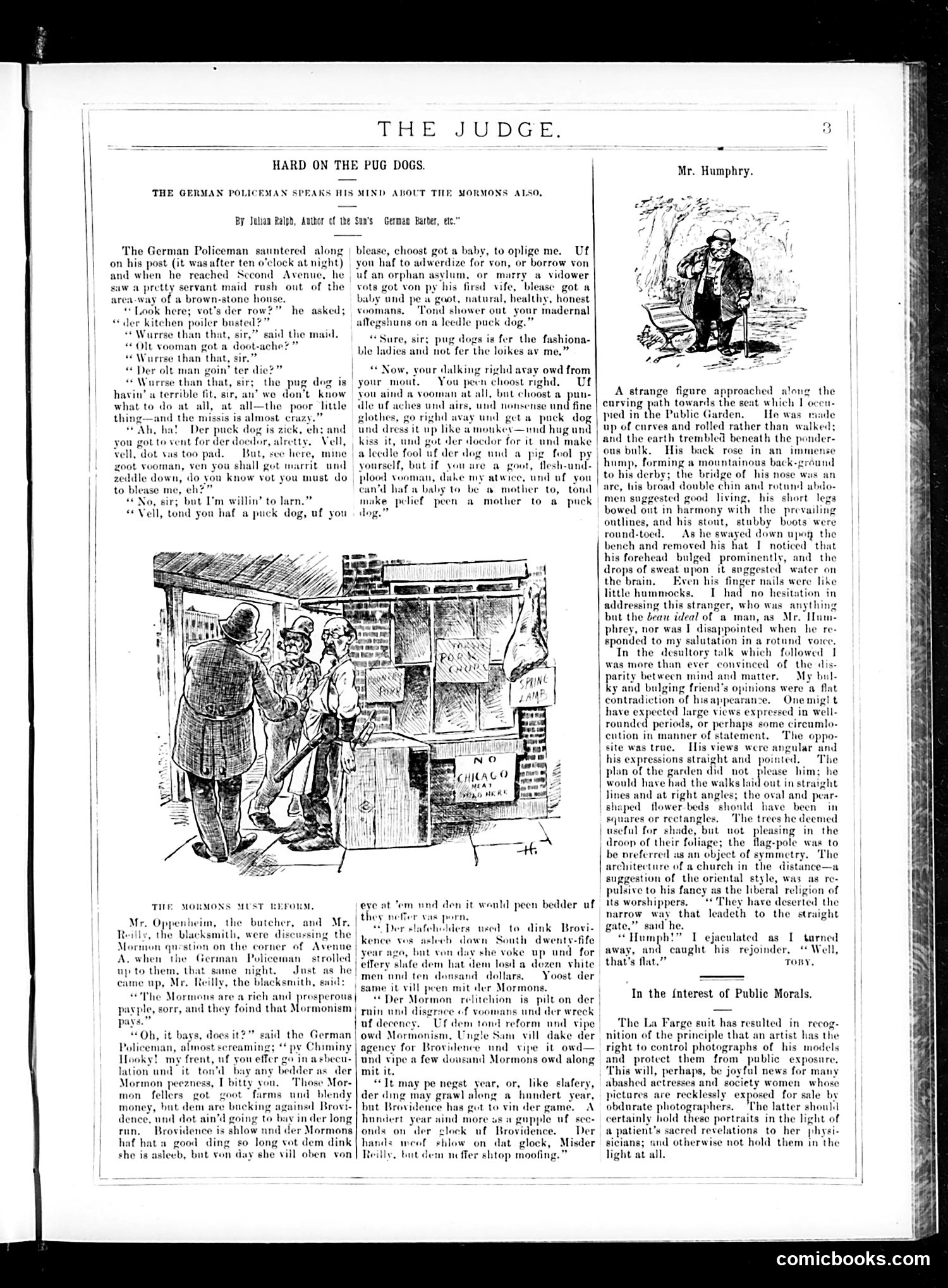
This 1880s-era satirical piece uses a German policeman character to mock two targets: pug dogs and Mormon polygamy. **The Pug Dog Satire:** The officer encounters a servant girl distressed over a sick pug dog. He sarcastically advises that if she wants a baby to nurture, she should get a pug instead—dress it like a monkey and fuss over it absurdly. This mocks upper-class women (particularly wealthy ones) who pampered small lap dogs as status symbols, treating them like children. **The Mormon Critique:** The policeman launches into a longer rant condemning Mormon polygamy as immoral and predatory toward women. He predicts divine justice will eventually eliminate Mormonism, comparing it to slavery—a historical wrong that Providence will eventually correct. This reflects 1880s anti-Mormon sentiment when polygamy was a national controversy. The heavy German accent dialect adds comedic effect while the contrasting topics (trivial pet obsession versus serious religious practice) create satirical juxtaposition typical of Judge's approach.
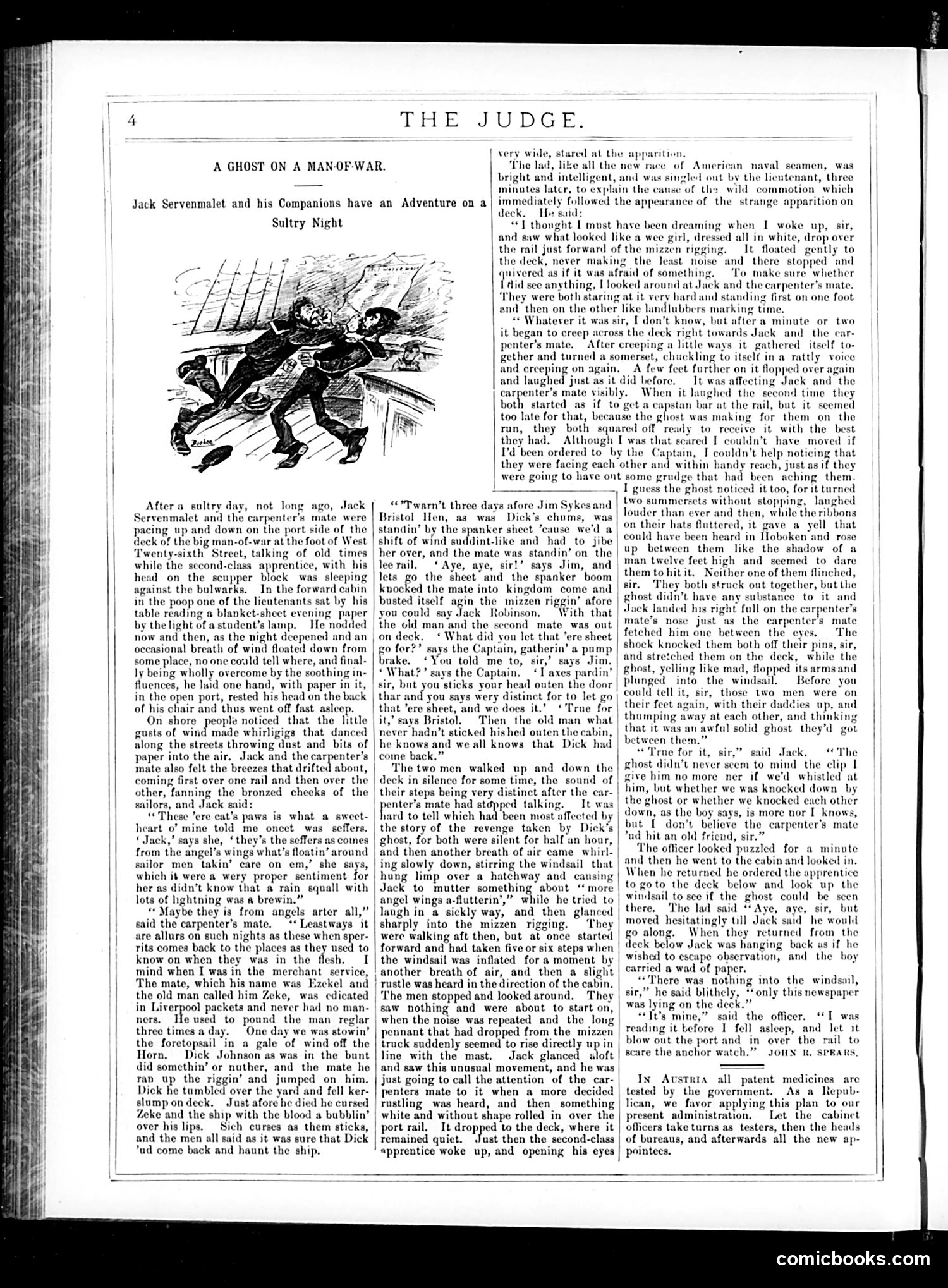
This is a seafaring ghost story rather than political satire. The narrative describes sailors on a naval vessel sharing tales of supernatural occurrences at sea. The main story involves Jack Servenmalet and the carpenter's mate recounting the death of Dick Johnson, a sailor allegedly cursed while dying after falling from the rigging during a storm. They claim his spirit haunts the ship, appearing as mysterious wind gusts ("cat's paws") that sailors' folklore attributes to angels watching over seamen. The second anecdote concerns Jim Sykes and an incident where a captain's head mysteriously appears at a cabin porthole, leading to a fatal accident with the mate—suggesting Dick's vengeful ghost is causing chaos aboard. This appears to be serialized fiction—atmospheric ghost entertainment rather than contemporary political commentary. The page includes an illustration of the sailors' encounter and continues the narrative across multiple columns.
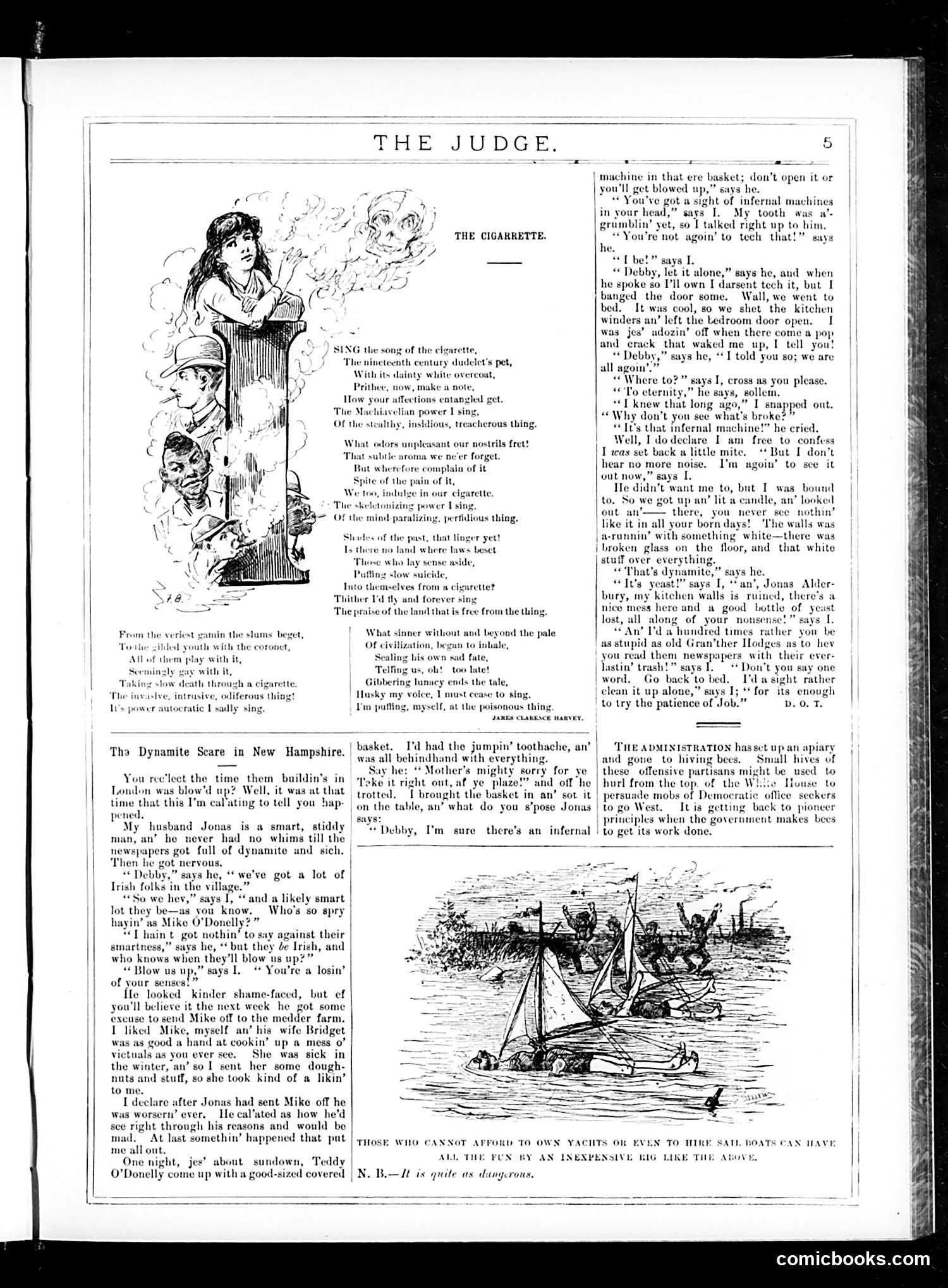
This page from *Judge* magazine satirizes cigarette smoking as a social menace. The main illustration and poem by James Clarence Harvey depict cigarettes as insidious threats to civilization—described as "stealthy," "treacherous," and "mind-paralyzing." The moralistic verse warns that smoking leads to physical and moral decay, reflecting late 19th-century health concerns and anti-smoking campaigns. The accompanying story, "The Dynamite Scare in New Hampshire," satirizes Irish immigrant anxieties. During this period, dynamite bombings in London created public panic about Irish-American anarchists. The rural husband Jonas irrationally fears his Irish neighbor Mike O'Donell, suspecting him of harboring explosives—a baseless prejudice. When neighbor Bridget delivers a harmless covered basket, Jonas panics, convinced it contains a bomb. The story's humor targets xenophobic paranoia and ignorant stereotyping of Irish immigrants as dangerous radicals, likely reflecting *Judge*'s editorial skepticism toward such fears.
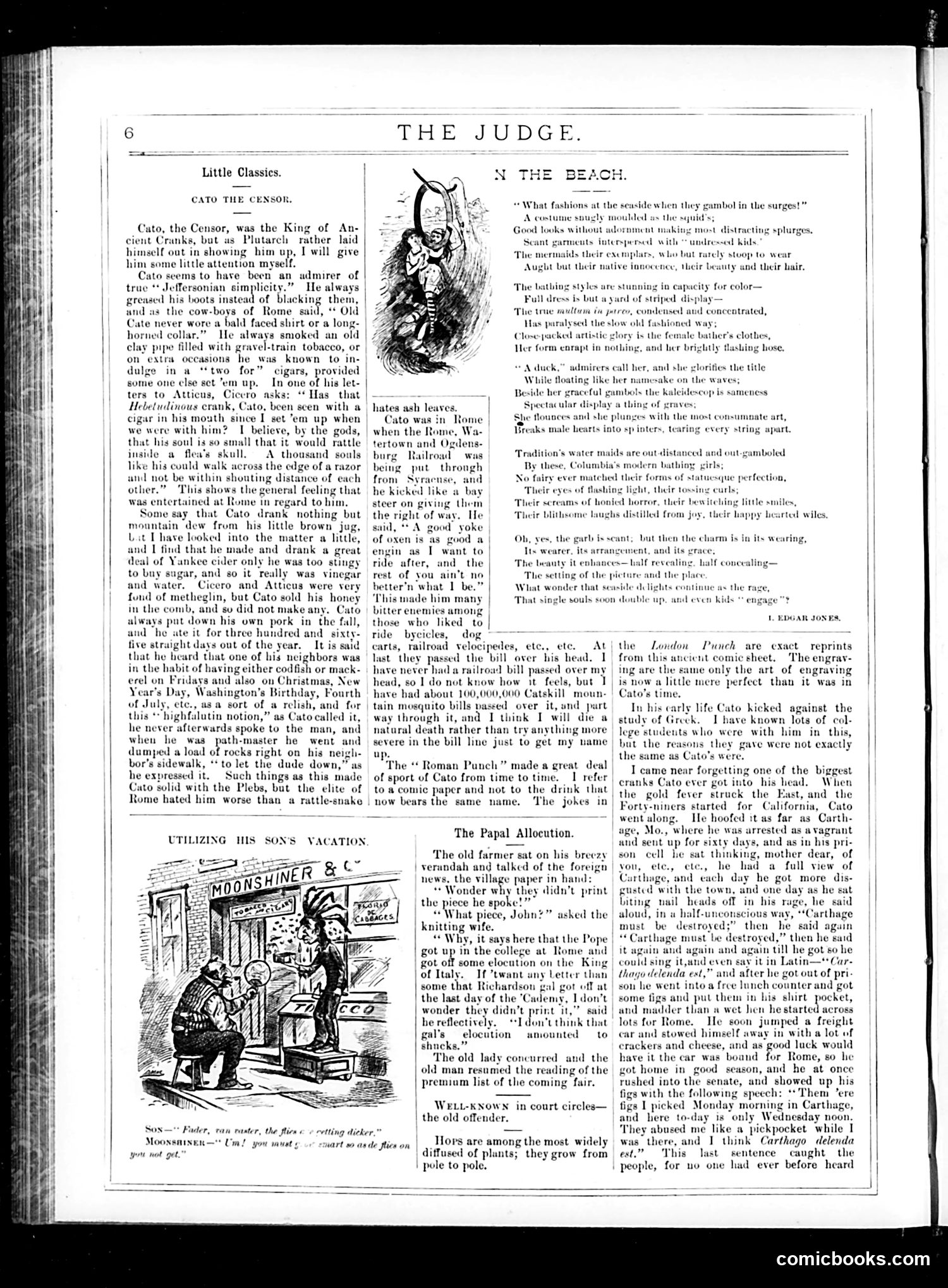
This article satirizes **ancient Roman censor Cato the Elder** as a stand-in for **American puritanical cranks and curmudgeons** of the author's era. The satire mocks Cato's obsessive simplicity—refusing to wear fine clothes, rejecting modern conveniences like railroads, and shunning neighbors with different lifestyles (notably one who ate fish on holidays). The piece appears to criticize rigid moralism disguised as virtue. By comparing Cato's "Jeffersonian simplicity" to 19th-century American self-righteousness, the author ridicules those who impose their austere values on others—dumping rocks on a neighbor's sidewalk for being a "dude," opposing railroad progress, and generally being "solid with the Plebs" while hated by educated society. The humor targets hypocritical asceticism: Cato's "mountain dew" is actually cheap vinegar; his principles mask stinginess. The satire suggests such zealous conformity to invented standards makes one unbearable to civilized people.
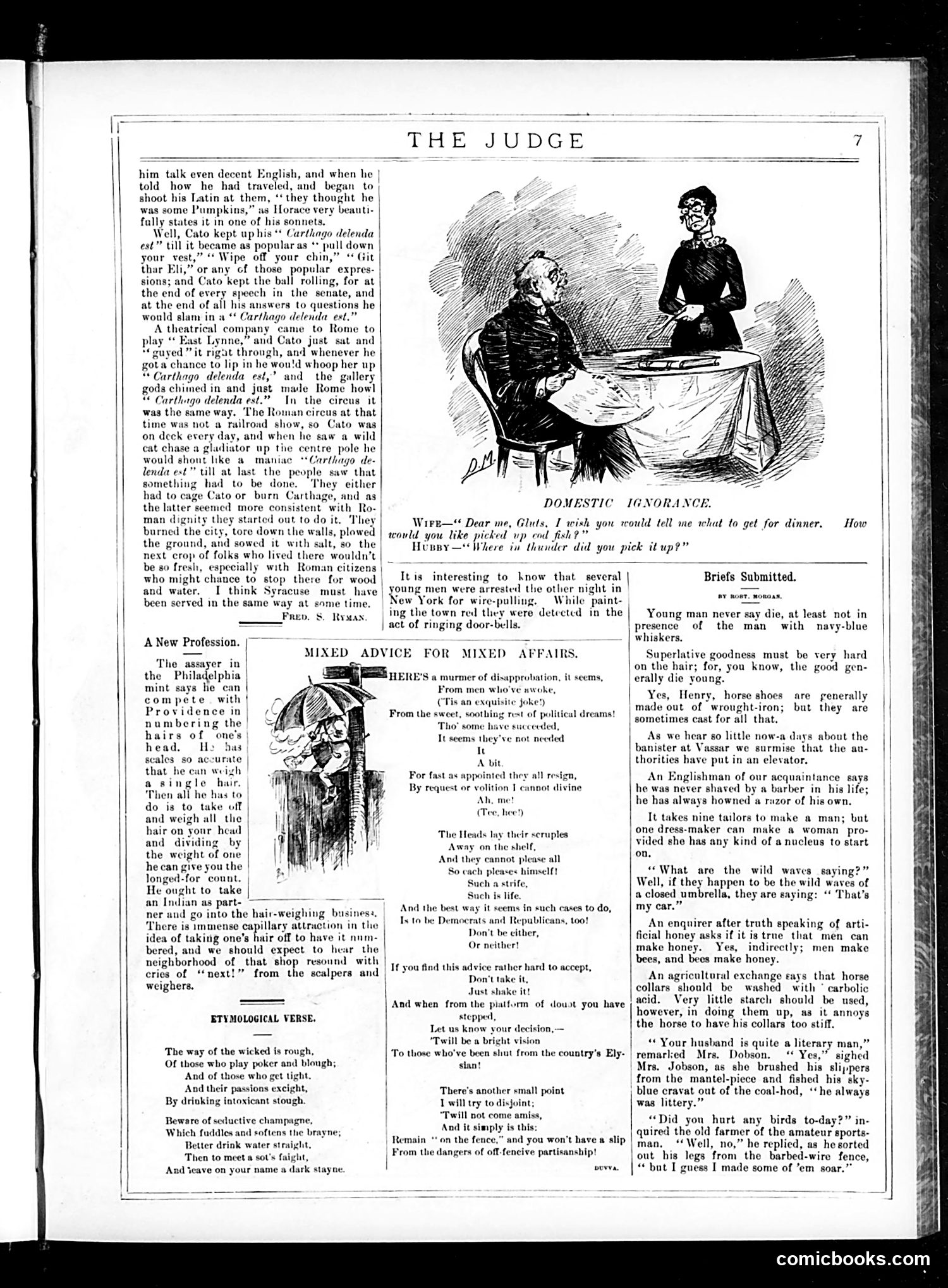
This page contains satirical commentary on American social life circa late 1800s. The main cartoon depicts a domestic scene titled "Domestic Ignorance," showing a husband asking his wife where she found a fish she's serving—apparently she's unsure of its origins, satirizing wives' disconnection from household provisioning. The text references the Roman statesman Cato, whose repeated cry "Carthago delenda est" (Carthage must be destroyed) became so ubiquitous that Romans eventually exiled him. This appears to function as a metaphor for tedious repetition in American public discourse. "Mixed Advice for Mixed Affairs" offers humorous guidance on contemporary etiquette and gender relations—notes on superfluous goodness, horseshoes, barbers, and dress-making. The satirical tone mocks both masculine and feminine affectations of the era. "A New Profession" jokes about a Philadelphia mint assayer who counts individual hairs on heads with scientific precision, poking fun at American faith in measurement and specialization. The page broadly satirizes Victorian-era American social pretension, domestic gender dynamics, and obsessive quantification.
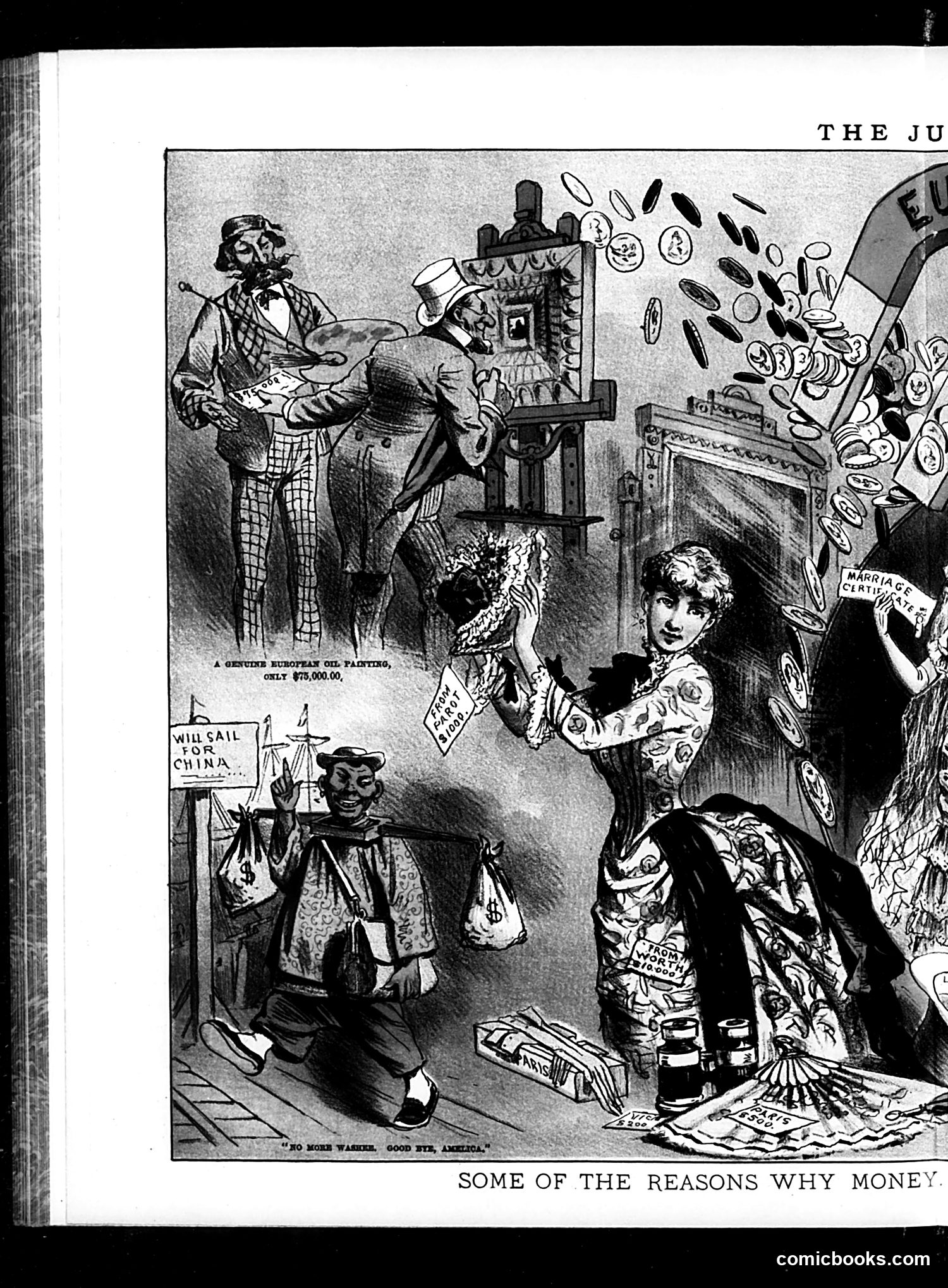
This appears to be a satirical cartoon titled "Some of the Reasons Why Money..." depicting various schemes to acquire wealth through questionable means. The cartoon shows multiple figures engaged in dubious financial activities: an art dealer selling a "genuine European oil painting" for $75,000; a man with a sign "Will Sail to China" (appears to be a con artist); and what looks like a woman with "Marriage Certificate" hawking her services—suggesting marriage fraud schemes. There are also figures displaying counterfeit or worthless goods. The satire criticizes widespread financial scams and get-rich-quick schemes prevalent in the era. The caricatured Asian figure likely reflects period stereotypes. The overall message warns readers about common fraud tactics targeting the gullible, using exaggeration and dark humor typical of Judge magazine's social commentary.
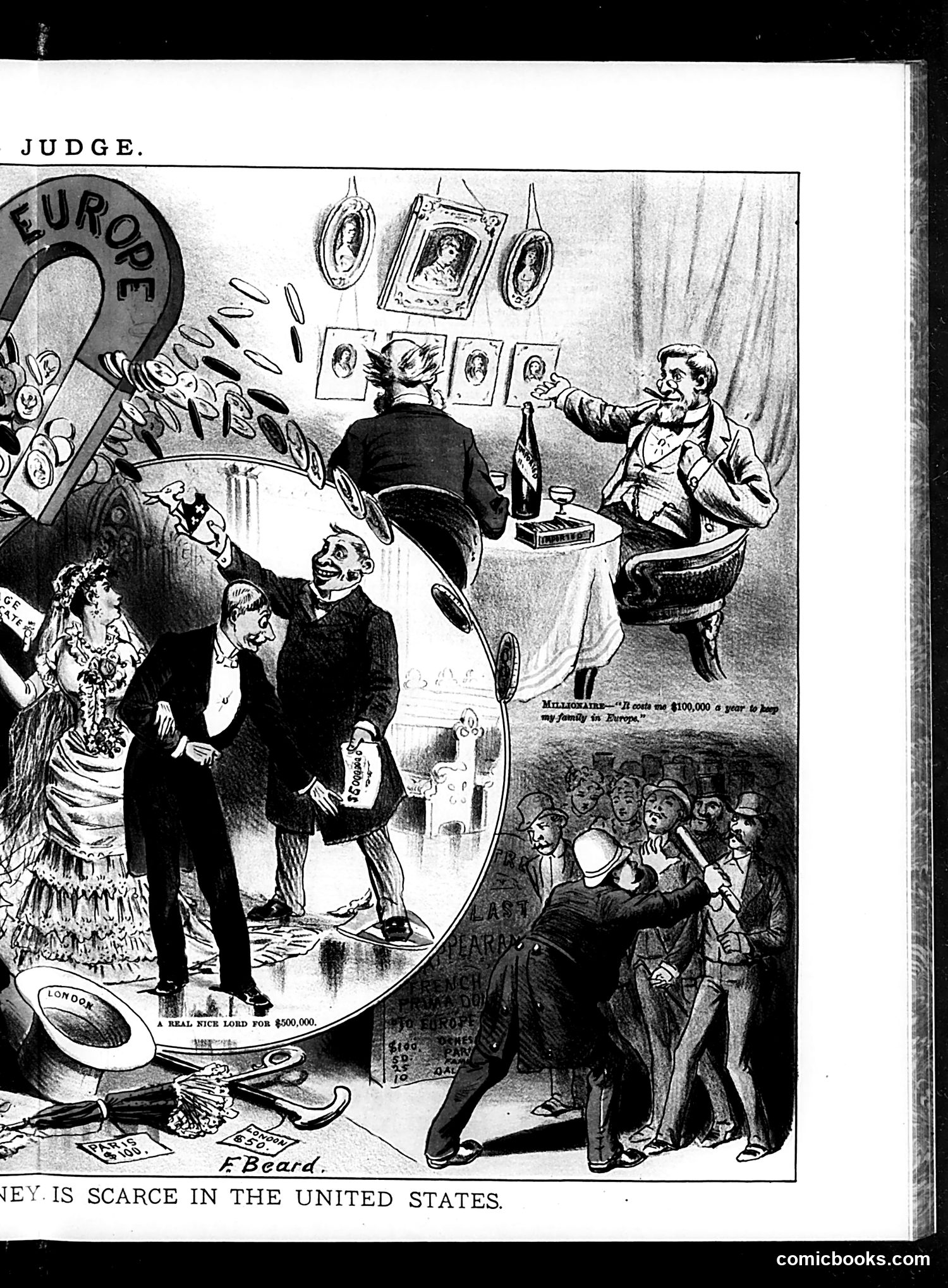
This F. Beard cartoon satirizes wealth inequality and financial disparities in America. The image contrasts two scenes: wealthy Europeans in an ornate interior displaying portraits and luxury goods (labeled "Europe"), while American working-class people gather outside in poverty below. The caption about a "millionaire" keeping "$100,000 a year to keep my family in Europe" suggests wealthy Americans were expatriating their fortunes while ordinary citizens struggled domestically. The "Europe" reference at left—paired with a question mark—emphasizes the irony: money supposedly "scarce in the United States" flowed freely to wealthy expatriates abroad. The cartoon critiques how American wealth concentrated among the elite while common citizens faced financial hardship—a recurring Progressive Era theme in Judge magazine.
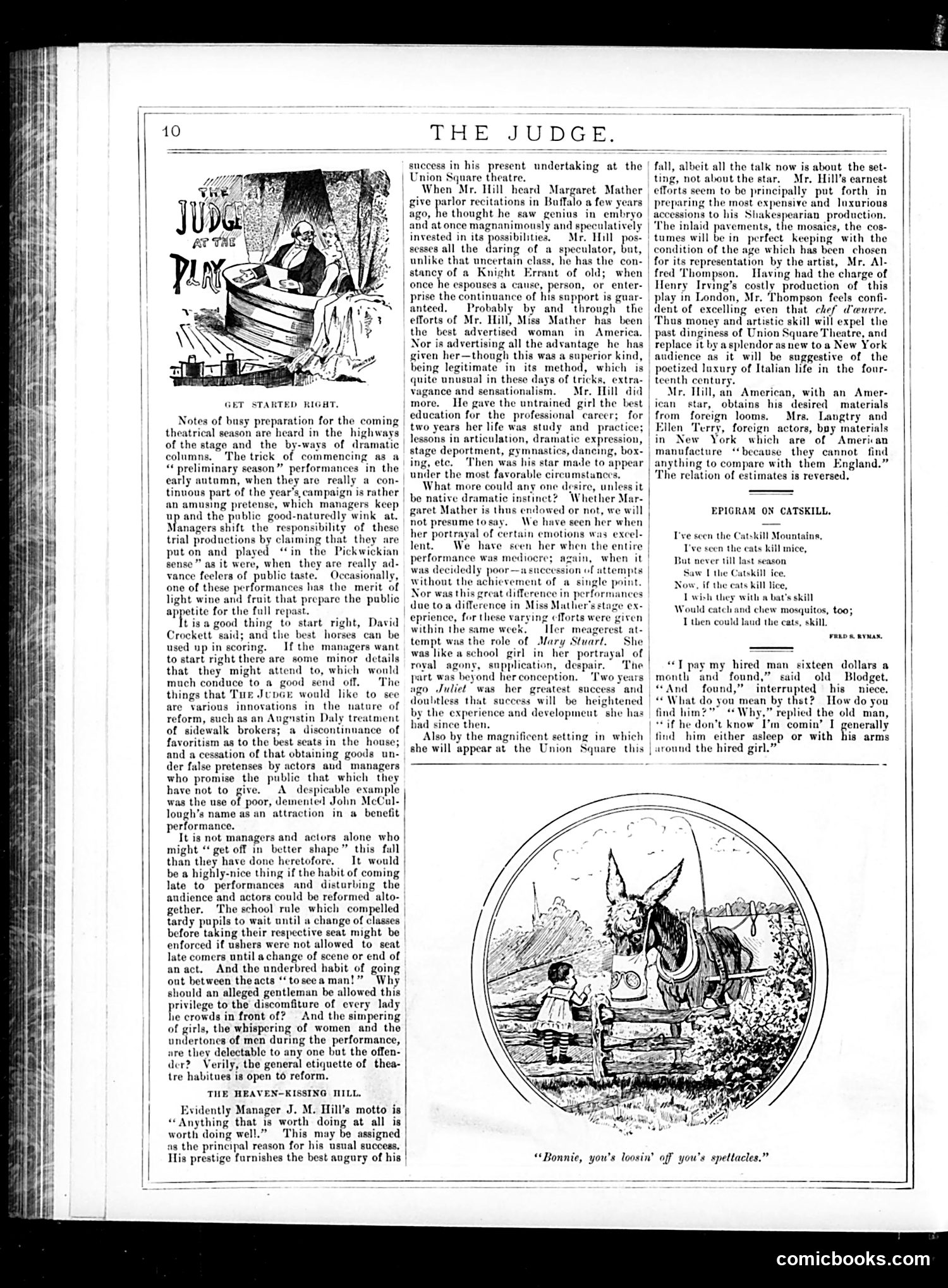
This page from *Judge* magazine contains two distinct pieces critiquing theatrical management and performance culture: **"Get Started Right"** discusses pre-season theatrical practices, criticizing managers for disguising trial runs as "preliminary seasons" and falsely advertising performances. The author objects to specific abuses: using dementia-afflicted actor John McCullough's name to attract audiences, and poor theater etiquette (late arrivals, audience talking, men leaving mid-act "to see a man"). **"The Heaven-Kissing Hill"** praises Manager J. M. Hill's legitimate approach to developing actress Margaret Mather's career. Unlike exploitative managers, Hill invested in her genuine education and professional development rather than sensationalist advertising, embodying the motto "Anything worth doing is worth doing well." The sidebar cartoon "Epigram on Catskill" and illustration appear decorative rather than satirical. The page essentially contrasts theatrical chicanery with principled management.
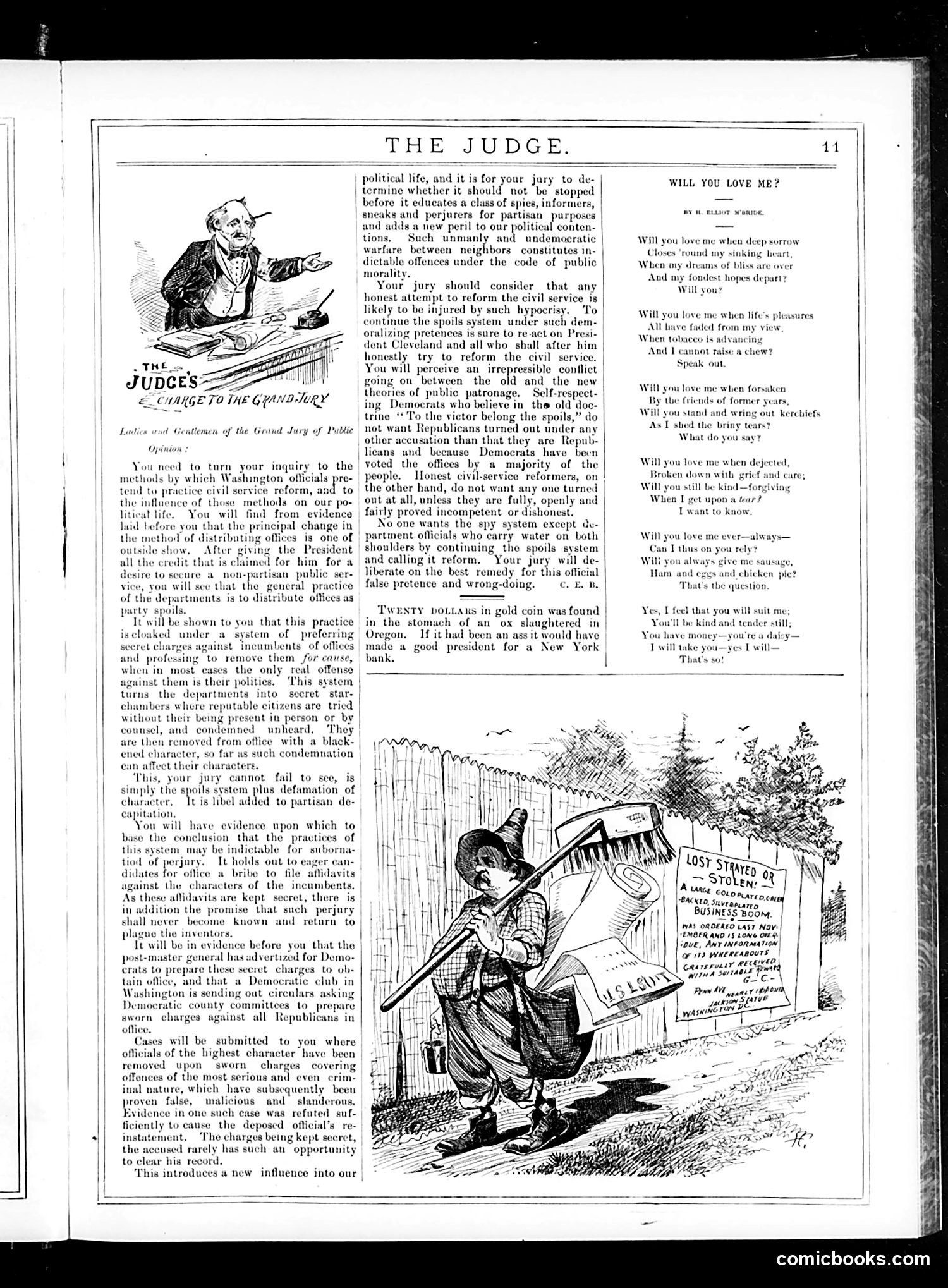
This page satirizes President Grover Cleveland's civil service reform efforts. The text presents a mock "charge to a grand jury" attacking Cleveland's administration for hypocritically claiming to reform the spoils system while actually perpetuating it under new disguises. **The Satire's Target:** Cleveland promised nonpartisan civil service reform but allegedly used secret accusations and perjured affidavits to remove Republican officeholders and replace them with Democrats—essentially maintaining the "spoils system" (rewarding political allies with government jobs) under the façade of merit-based reform. **Key Accusations:** - Officials were removed based on secret, unproven charges - Democratic clubs were solicited to file false affidavits against Republicans - The system created incentives for perjury and character assassination **The Cartoons:** The upper illustration shows a judge addressing the jury; the lower shows a figure drowning in bureaucratic corruption, labeled with documents about lost positions and stolen offices—visualizing the chaos of the spoils system. This reflects 1880s-1890s political conflict over civil service reform and partisan patronage practices.
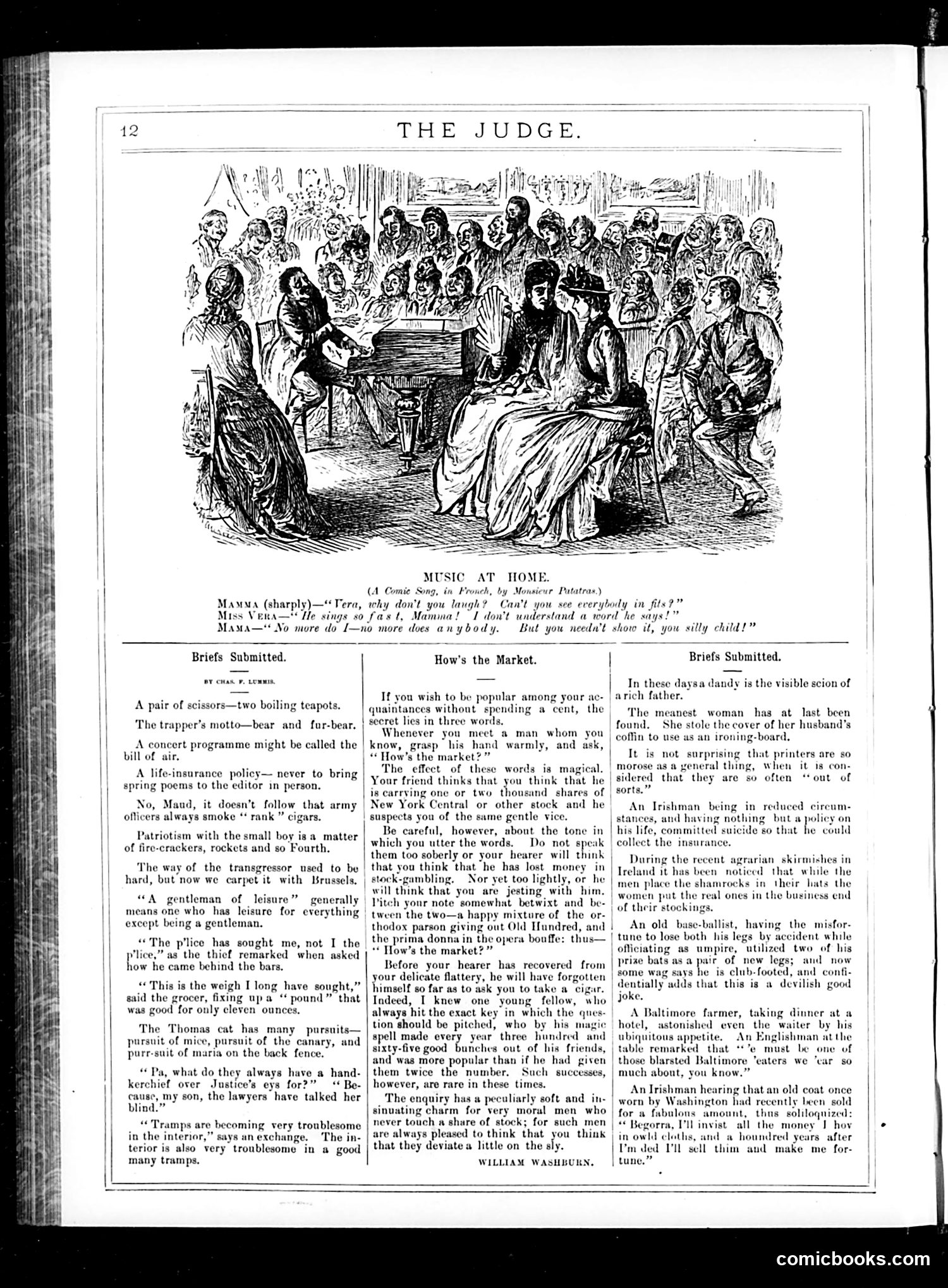
This is a satirical page from *Judge* magazine featuring a comic illustration and humor columns. **"Music at Home"** (top cartoon): A humorous domestic scene where a woman performs music poorly while family members endure it. The joke plays on the social expectation that ladies perform music for guests, even when talentless—the child's blunt complaint ("I don't understand a word he says!") contrasts with mother's instruction to hide her boredom. **"How's the Market"** (center): A satirical advice column by William Washburn explaining how to appear wealthy and well-connected without money. The trick: casually ask acquaintances "How's the market?"—implying they own stock—to flatter them into thinking you're their financial peer. It's social manipulation disguised as politeness, mocking both the desperate social climber and the vanity of the wealthy. **"Briefs Submitted"** (columns): Brief satirical quips on various topics—insurance policies, patriotism, lawyers, vagrant problems—typical *Judge* filler humor. The page satirizes Victorian social pretension, particularly around wealth signaling and amateur genteel entertainment.
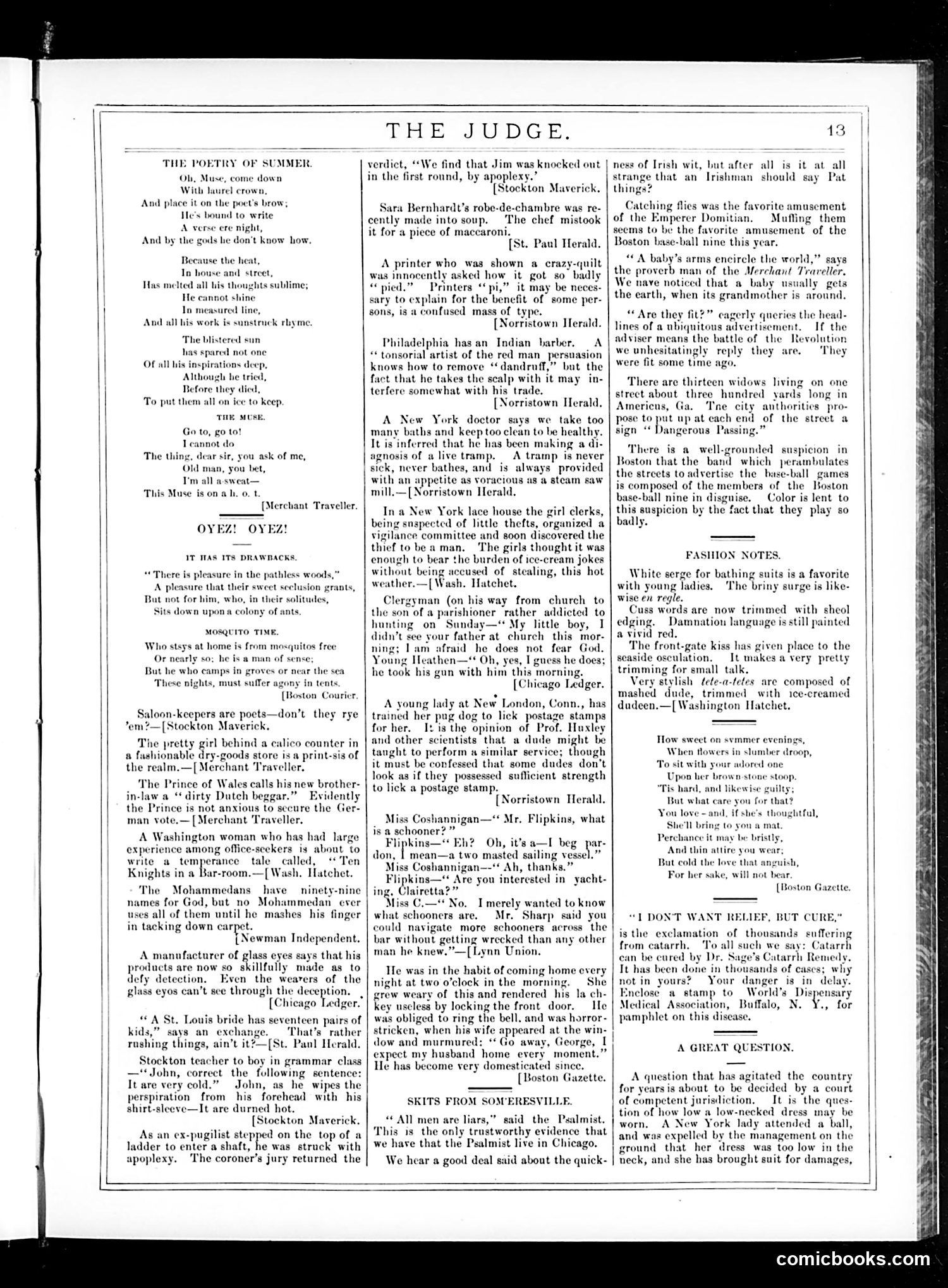
This page from Judge magazine is primarily a **humor and satirical commentary** collection rather than political cartoons. The content consists of brief jokes and witticisms sourced from various newspapers, targeting: **Social/Cultural Targets:** - Summer heat's effects on poets and workers - Urban inconveniences (mosquitoes, ants, uncomfortable conditions) - Gender stereotypes (the "pretty girl" behind the counter as romantic ideal) - Occupational humor (saloon-keepers as "poets," printers' typographical errors) - Medical/hygienic pretensions (doctors' claims about cleanliness) - Immigrant/ethnic stereotypes (Philadelphia's "Indian barber") **The Satire's Point:** Judge mocks Victorian-era pretensions, discomfort, and contradictions through short, punchy observations. The humor assumes middle-class readers familiar with contemporary urban life, workplace dynamics, and popular literature references (Byron's "pathless woods"). The page reflects late 19th-century American humor—sometimes gentle social observation, sometimes crude stereotyping by modern standards—presented as digestible, syndicated jokes for newspaper republication.
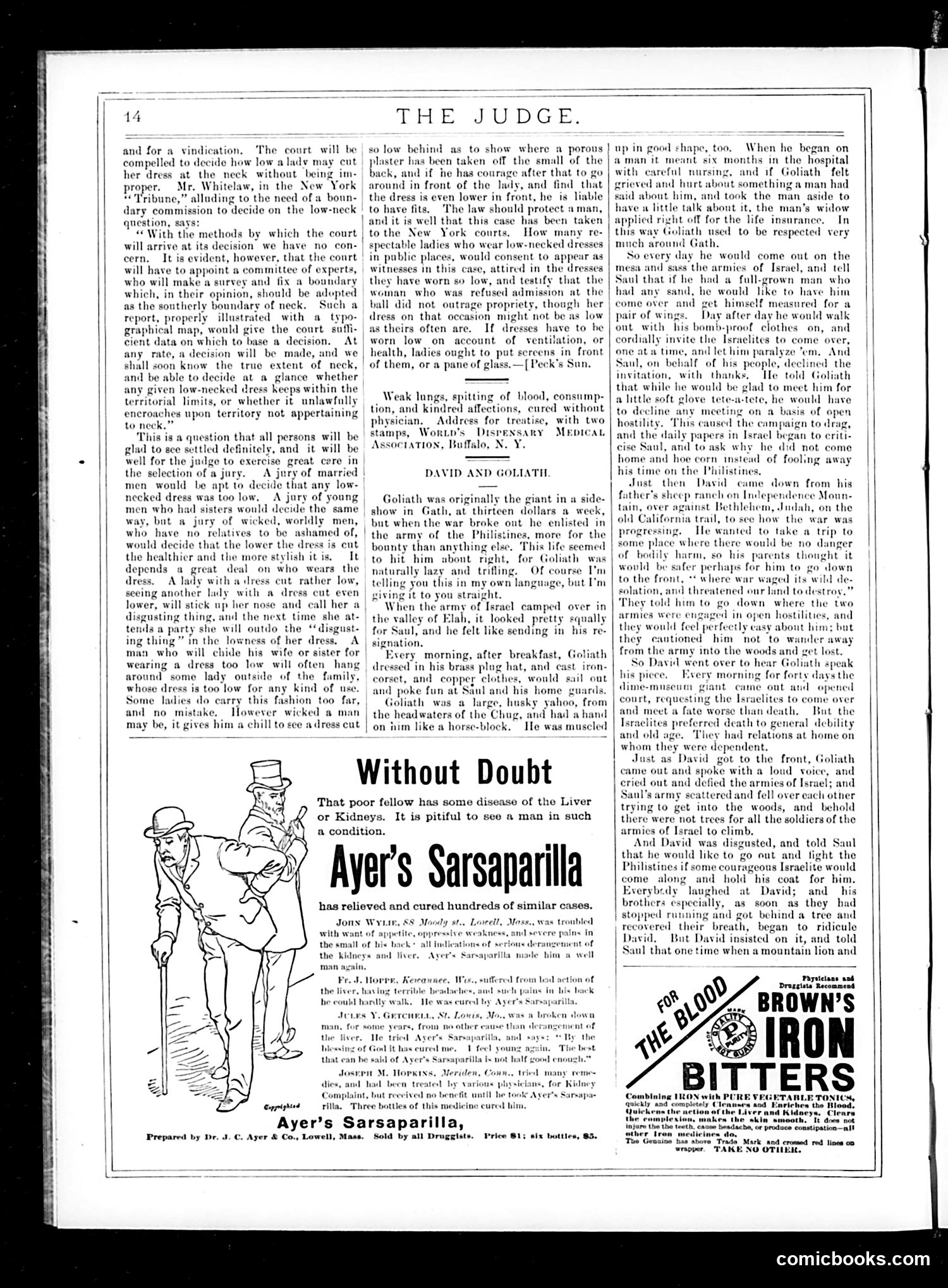
This page contains satirical commentary on a then-current legal controversy: whether courts should establish standards for how low women could cut their necklines on dresses. **The Main Article** mocks the absurdity of the situation by proposing that courts appoint a "committee of experts" to conduct surveys and create a "typographical map" establishing the southern boundary of acceptable neckline depth. The satire highlights the ridiculousness of legal intervention in fashion while also poking fun at the hypocrisy of men who publicly condemn low necklines but privately admire them. **The David and Goliath piece** appears to be a humorous retelling of the biblical story, presenting Goliath as a sideshow performer-turned-soldier motivated by bounty rather than principle—a jab at mercenary attitudes. **The advertisements** (Ayer's Sarsaparilla and Brown's Iron Bitters) are period patent medicines claiming to cure various ailments, typical of Judge's commercial content. The overall tone critiques both excessive prudishness and the folly of attempting legal regulation of social conduct.
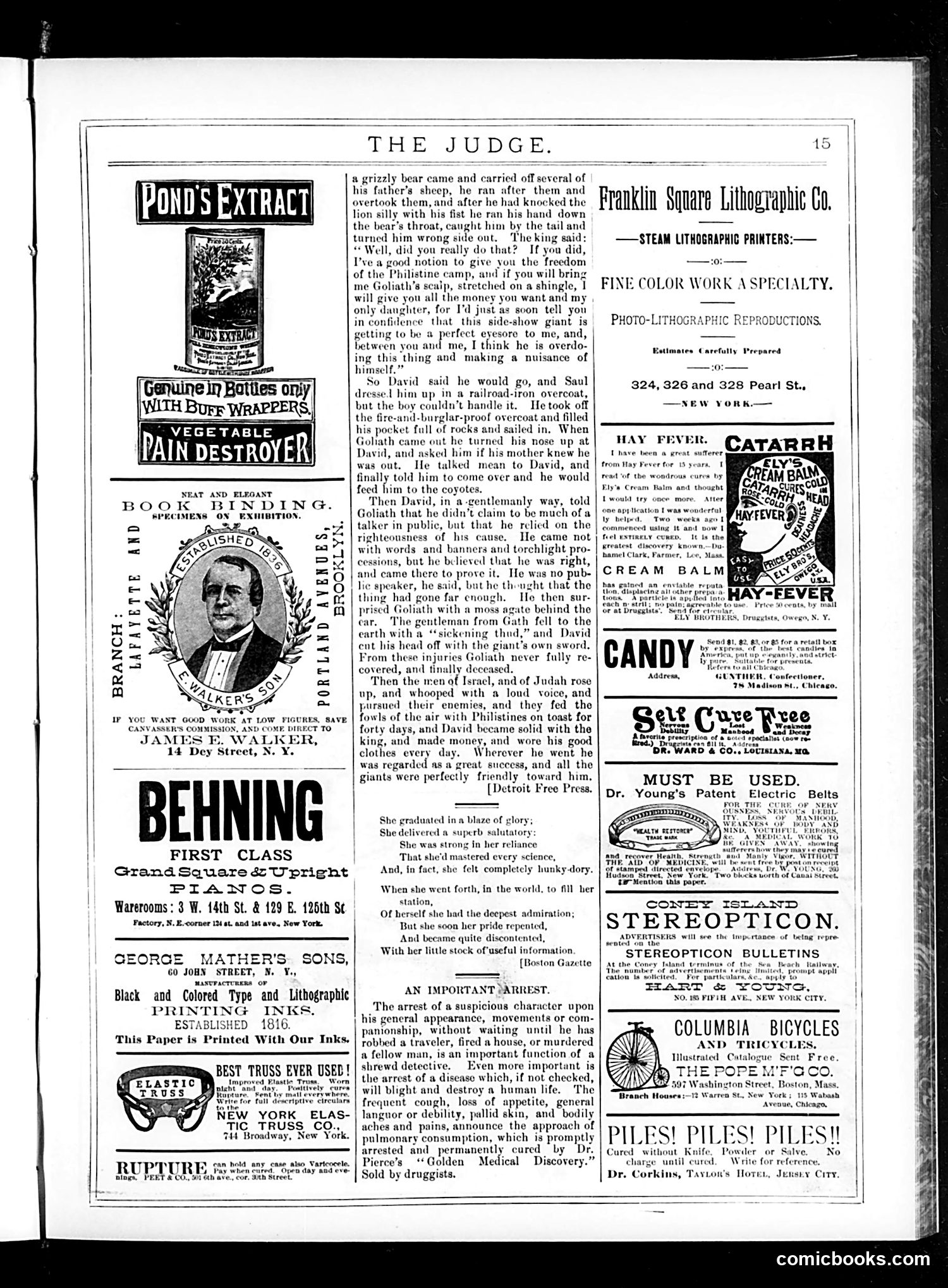
This is primarily a **page of advertisements** for various commercial products and services (pianos, printing inks, trusses, bicycles, medical remedies), interspersed with two brief **humorous stories in prose form**, not visual cartoons. The first story retells the biblical David and Goliath tale in crude, colloquial American language—David uses rocks from his pocket and delivers a "moss agate" (rock) blow "behind the ear" rather than a slingshot. The humor lies in deflating the heroic biblical narrative through vulgar, contemporary speech ("sickening thud," casual language). The second piece mocks an overconfident young woman graduate who believes herself completely educated but discovers her "little stock of useful information" inadequate for real life—social satire on educational pretension. A brief medical advertisement warns that tuberculosis (frequent cough, loss of appetite) requires early detection, typical period medical advertising mixing health concern with commercial pitch.
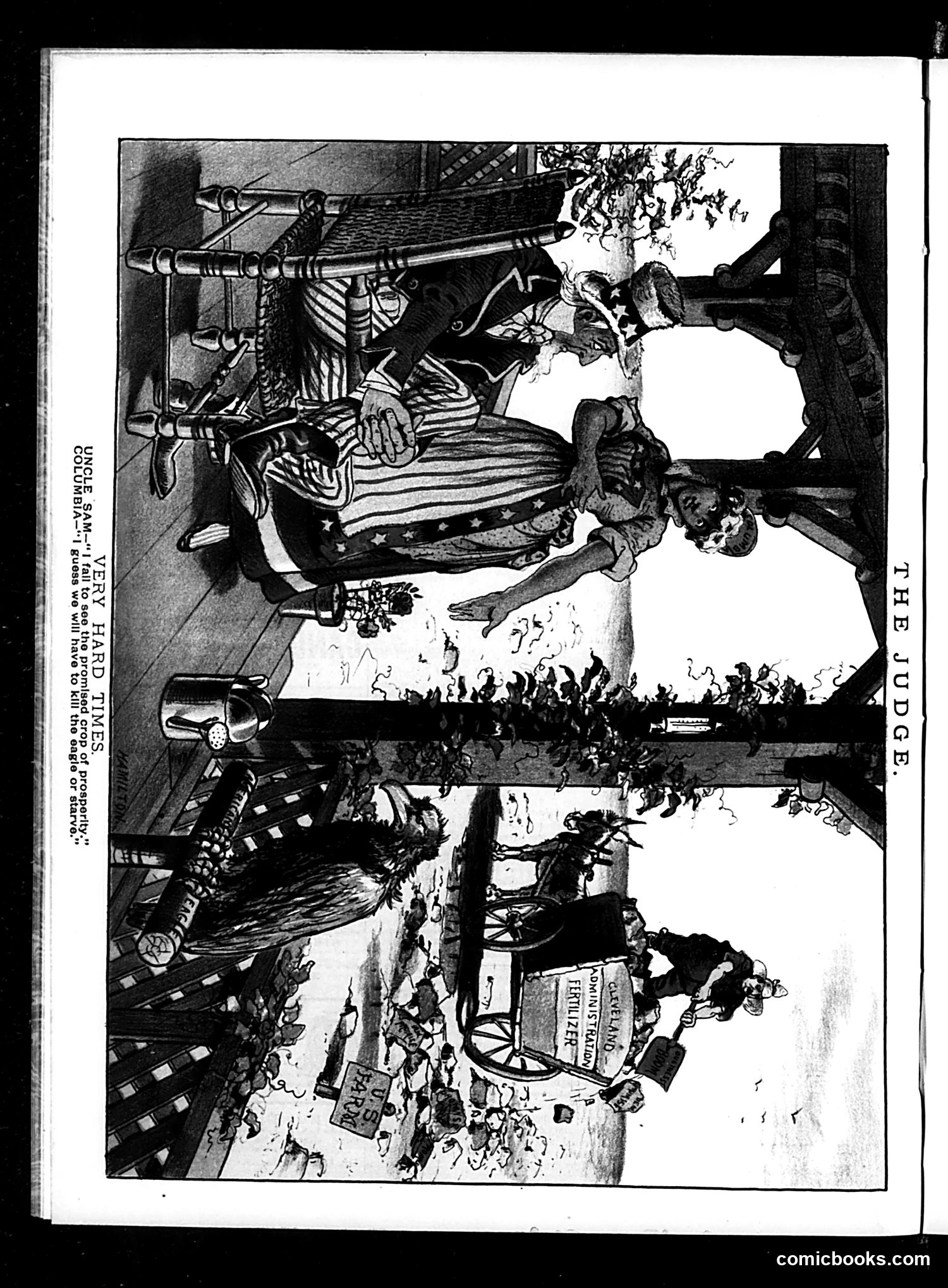
This satirical cartoon depicts an economic hardship scenario. The upper panel shows a figure (appears to be Uncle Sam or an American farmer) in distress, complaining about failing to see "the promised crop of prosperity." The lower panel presents a dark joke: faced with starvation during economic depression, the figure suggests killing "the eagle"—a reference to the American national symbol, representing the nation itself or its government policies. The satire criticizes broken promises of economic prosperity and suggests that conditions have become so dire that drastic, even self-destructive measures seem necessary. The comic implies government failure to deliver on optimistic economic forecasts, likely referencing a specific recession or depression era when Judge magazine was published, though the exact historical moment is unclear from this image alone.