
Judge, 1885-08-22 · page 10 of 16
Judge — August 22, 1885 — page 10: what you’re looking at
What you’re looking at
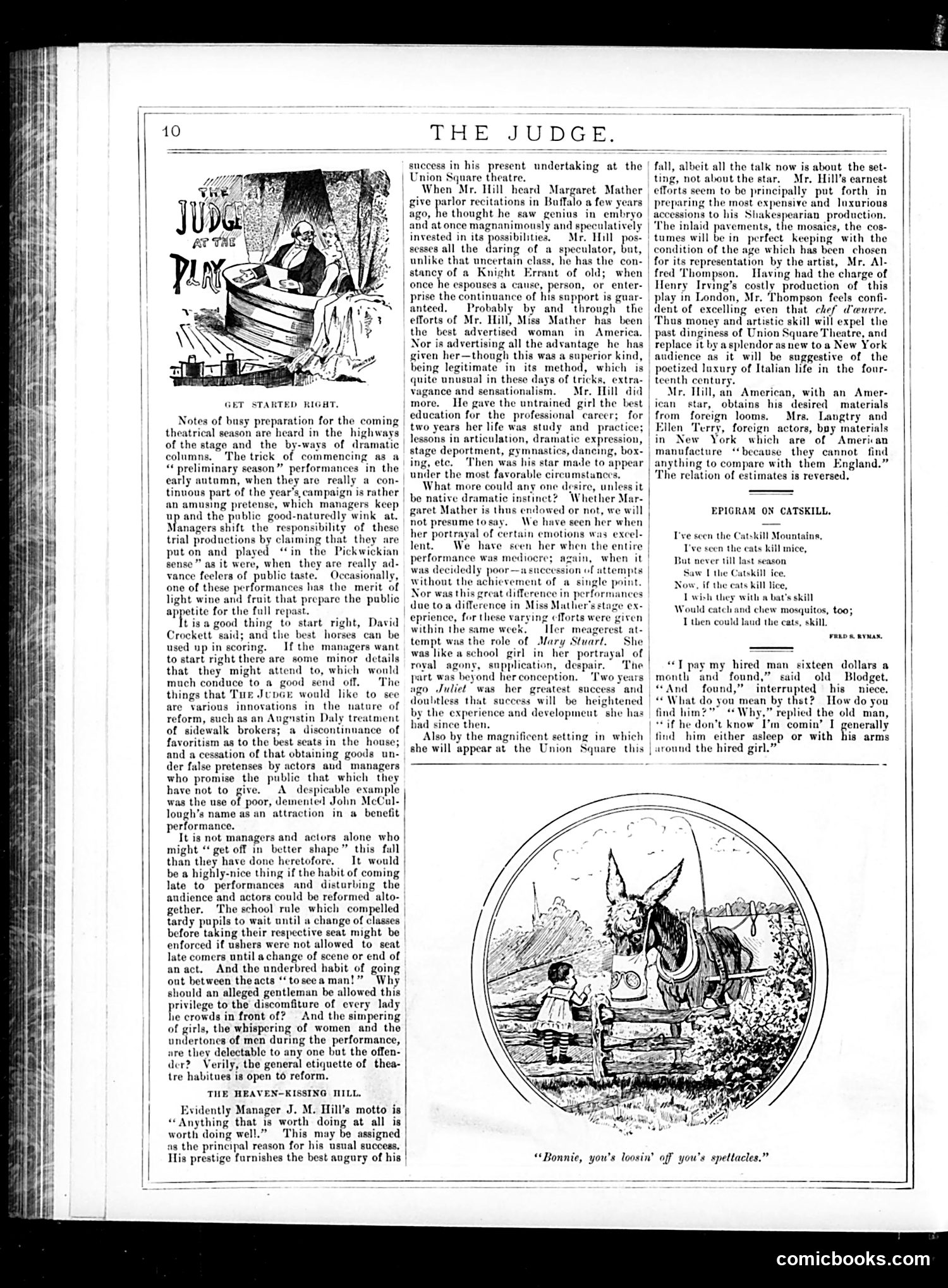
This page from *Judge* magazine contains two distinct pieces critiquing theatrical management and performance culture: **"Get Started Right"** discusses pre-season theatrical practices, criticizing managers for disguising trial runs as "preliminary seasons" and falsely advertising performances. The author objects to specific abuses: using dementia-afflicted actor John McCullough's name to attract audiences, and poor theater etiquette (late arrivals, audience talking, men leaving mid-act "to see a man"). **"The Heaven-Kissing Hill"** praises Manager J. M. Hill's legitimate approach to developing actress Margaret Mather's career. Unlike exploitative managers, Hill invested in her genuine education and professional development rather than sensationalist advertising, embodying the motto "Anything worth doing is worth doing well." The sidebar cartoon "Epigram on Catskill" and illustration appear decorative rather than satirical. The page essentially contrasts theatrical chicanery with principled management.
📄 Transcribed text from this page (OCR, searchable)
Machine-transcribed from the original scan — historical spelling and the odd misread are preserved.
GET STARTED RIGHT, Notes of busy preparation for the coming theatrical season are heard in the highways of the stage and the by-ways of dramatic columns. The trick of commencing as a “ preliminary season” performances in the early autamn, when they are really a con- tinuous part of the year npaign is rather an amusing pretense, which managers keep up and the public good-naturedly wink at Managers shift the responsibility of the: trial productions by claiming that the: puton and played ‘in the Pickw sense” as it were, when they are really ad- vance feelers of public taste. Occasionally, one of these performances has the merit of light wine and fruit that prepare the public appetite for the full rep: 2 tisa good thing to start right, David Crockett said; and the best horses can be used up in scoring. If the managers want to start right there are some minor details that they might attend to, which we much conduce to a good send off. ° things that Tuk JupGe would like to see are various innovations in the nature of reform, such as an Augustin Daly treatment of sidewalk brokers; a discontinuance of favoritism as to the best seats in the hoi and a cessation of that obtaining goods un- der false pretenses by actors and managers who promise the public that which they have not to give. A despicable examp! was the use of poor, demented John McC lough’s name as an attraction in a benefit | performance. It is not managers and actors alone who might get off in better shape” this full than they have done heretofore. It would be a highly-nice thing if the habit of coming late to performances and disturbing the audience and actors could be reformed alto- gether. The school rule which compelled tardy pupils to wait until a change of classes before taking their respective seat might be enforced if ushers were not allowed to seat late comers until a change of scene or end of an act. And the underbred habit of going out between the acts ‘‘toseea man!” Why should an alleged gentleman be allowed this nrivilege to the discomfiture of every lady Te crosds infront of? "And the simpering of girls, the whispering of women and the undertones of men during the performance, | ure they delectable to any one but the offen- der? Verily, the general etiquette of thea- tre habitues is open to reform. THE HEAVEN-KISSING HILL. Evidently Manager J. M. Hill’s motto is | “Anything that is worth doing at all is | worth doing well.” This may be assigned | as the principal reason for his usual success | His prestige furnishes the best augury of his | THE JUDGE. success in his present undertaking at the Union Square theatre, When Mr. Hill heard Margaret Mather give parlor recitations in Buffalo a few years ago, he thought he saw genius in embryo and at once magnanimously and speculatively invested in its possibilities. Mr. Hill pos- sesses all the daring of a speculator, but, unlike that uncertain class, he has the con- stancy of a Knight Errant of old; when once he espouses a cause, person, or enter- prise the continuance of his support is guar- anteed. Probably by and through the efforts of Mr. Hill, Miss Mather has been the best advertised woman in America. Nor is advertising all the advantage he has given her—though this was a superior kind, being legitimate in its method, which is quite unusual in these days of tricks, extra- vagance and sensationalis Mr. Hill did more. He gave the untrained girl the best education for the professional caree two years her life was study and practice; lessons in articulation, dramatic expression, stage deportment, gymnastics, dancing, box- ing, etc. Then was his star made to appear under the most favorable circumstances. What more could any one desire, unless it be native dramatic instinc! Whether Mar- garet Mather is thus endowed or not, we will not presume tosay. We have seen her when her portrayal of certain emotions was excel- lent. We have scen her when the entire performance was mediocre; again, when it was decidedly poor—a succession of attempts Without the achievement of a single point. Nor was this great difference in performan due toa difference in Miss Mather’s ex: eprience, for these varying efforts were given within the same wee Iler meagerest at- tempt was the role of Mary Stuart. She was like a school girl in her portrayal of royal agony, supplication, desy part was beyond her conception. y go Juliet her greatest success and 1 suce will be heightened y the experience and development she has had since then. Also by the magnificent setting in which she will appear at the Union Squa ‘Two years for | | ir, The e this | beit all the talk now is about the set- ting, not about the star. Mr. Hill’s earnest efforts seem to be principally put forth in preparing the most expensive and Inxurious accessions to his SI spearian productiot ‘The inlaid pavements, the mosaics, the cos- tumes will be in perfect keeping with the condition of the age which has been chosen for its representation by the artist, Mr. Al- fred Thompson. Having had the charge of Henry Irving’s costly production of this play in London, Mr. Thompson feels confi- dent of excelling even that chef deuvre. | Thus money and artistic skill will expel the past dinginess of Union Square Theatre, and replace it by a splendor as new toa New York audience as it will be suggestive of the poetized luxury of Italian life in the four- teenth century. Mr, Hill, an American, with an Amer- 1 star, obtains his desired materials m foreign looms. Mra. Langtry and ‘Men Terry, foreign actors, bay materials in New York which are of American manu ire ‘because they cannot find | anything to compare with them England.” ‘The relation of estimates is reversed. | - = | EPIGRAM ON CATSKILL. I've seen the Catskill Mountains, I've seen the cats kill mice, But never till last season Saw [the Catskill ice, Now, if the cats kill lice, I wish they with n bat’s skill Would catch and chew mosquitos, too; T then could laud the cats, skill. FRED RYMAN, “T pay my hired man sixteen dollars a nonth and found,” said old Blodget. “And found,” interrupted his niece. “What do you mean by thst? How do you find him?” “Why,” replied the old man, “if he don’t know I’m comin’ I generally find him either asleep or with his arms around the hired girl.” comicbooks.com