
A complete issue · 16 pages · 1885
Judge — August 8, 1885
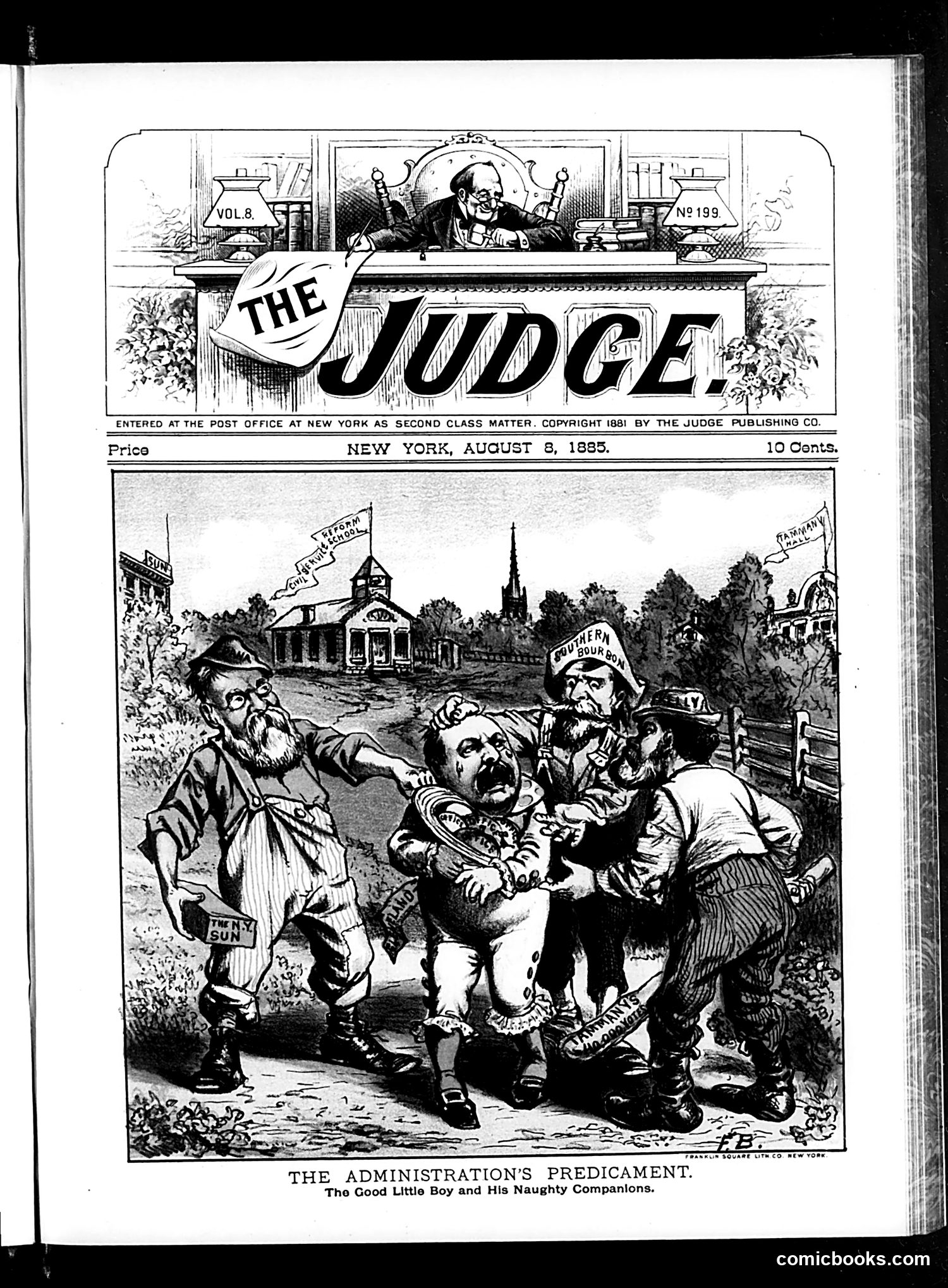
This political cartoon titled "The Administration's Predicament: The Good Little Boy and His Naughty Companions" depicts what appears to be a central figure (likely representing President Chester Arthur or his administration) being physically restrained or assaulted by surrounding men wearing labels including "Southern Bourbon" and "Railway" interests. The rural setting with a church suggests American heartland politics. The satire critiques the administration being manipulated or controlled by special interests and political factions—the "naughty companions"—despite attempts at virtuous governance. The central figure's distress illustrates the political pressures and compromises facing the executive branch during this Gilded Age period of American politics.
This page contains two main political allegories attacking the Democratic Party and reform efforts circa the Gilded Age. **"The Story of the Good Little Boy"** uses a transparent metaphor: "Gro-ver" (clearly Grover Cleveland) is the virtuous boy distributing apples to "Re-pub-li-cans" in reform school. The "bad boys" represent Democrats who resent his moral superiority and attack him for it. The satire mocks Cleveland's reformist posture. **"The Insect Delivery of the Parturient Mountain"** references the proverb about a mountain laboring to birth a mouse—meaning much effort yields little result. Judge ridicules Democratic reform promises, claiming their anti-corruption efforts after months of investigation ("raking departments") produced only trivial results ("a solitary roach"). The "Mugwamp midwives" suggests reform-minded Republicans complicit in Democratic failures. Both pieces mock Democratic/Cleveland-era reform as performative rather than substantive.
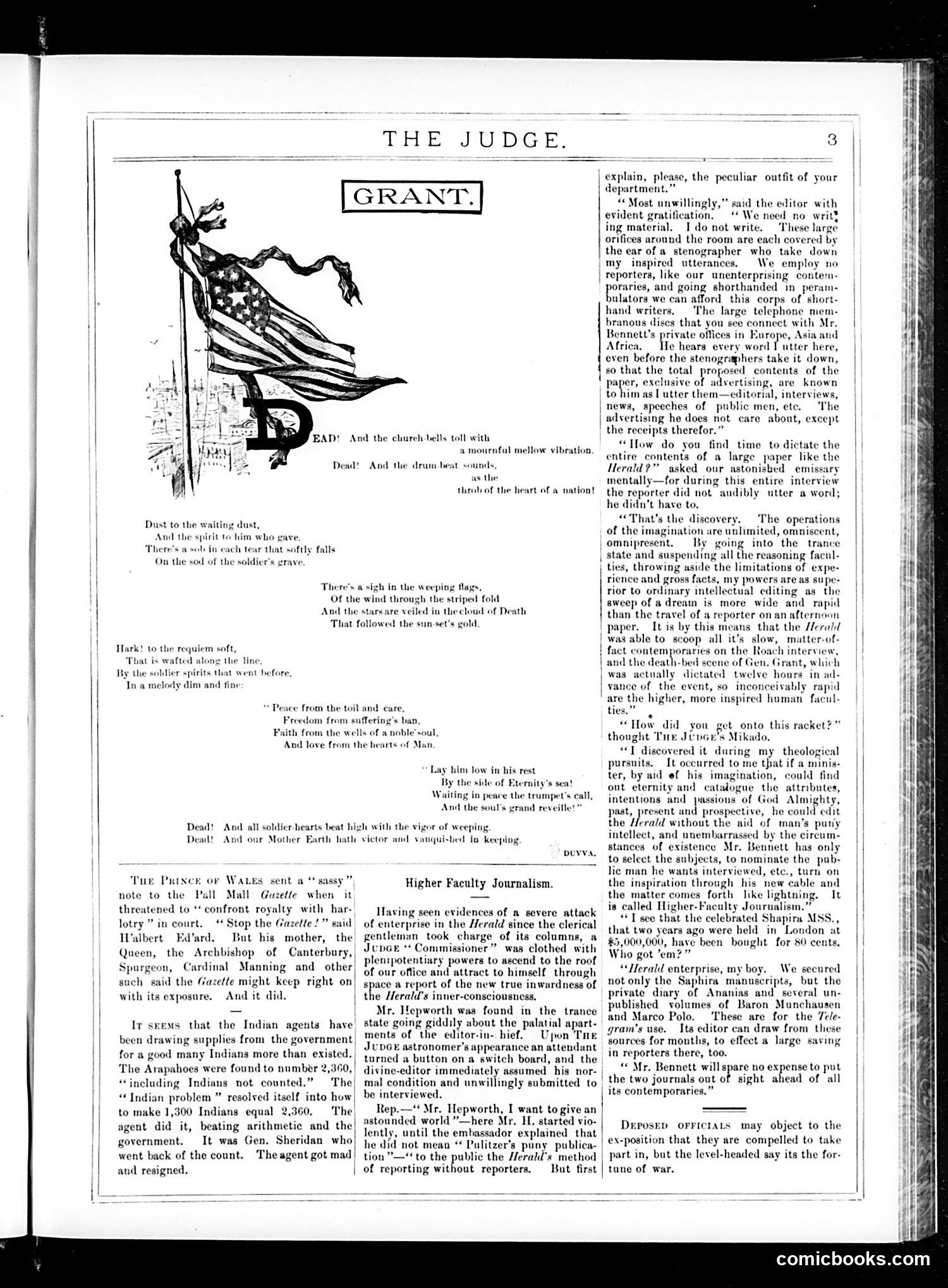
This page from Judge magazine contains a patriotic poem about fallen soldiers (likely from the Civil War era) and satirical commentary on newspaper operations. **The "Grant" cartoon** depicts a tattered American flag with a skeletal hand—likely representing death or the Grim Reaper—symbolizing the cost of war and national sacrifice. **"Higher Faculty Journalism"** mocks the *New York Herald* and its editor (likely James Gordon Bennett). The satire suggests the Herald claims to operate through absurdly modern methods: stenographers recording the editor's dictation, telephone connections to overseas offices, and reporting "without reporters." The joke critiques the Herald's sensationalism and claims of journalistic innovation as pretentious nonsense. **Other items** briefly mention the Prince of Wales confronting the *Pall Mall Gazette* over coverage, and an Indian agent scandal where officials falsified population counts to embezzle government supplies. The page reflects Judge's role as satirical commentary on contemporary politics, journalism, and government corruption.
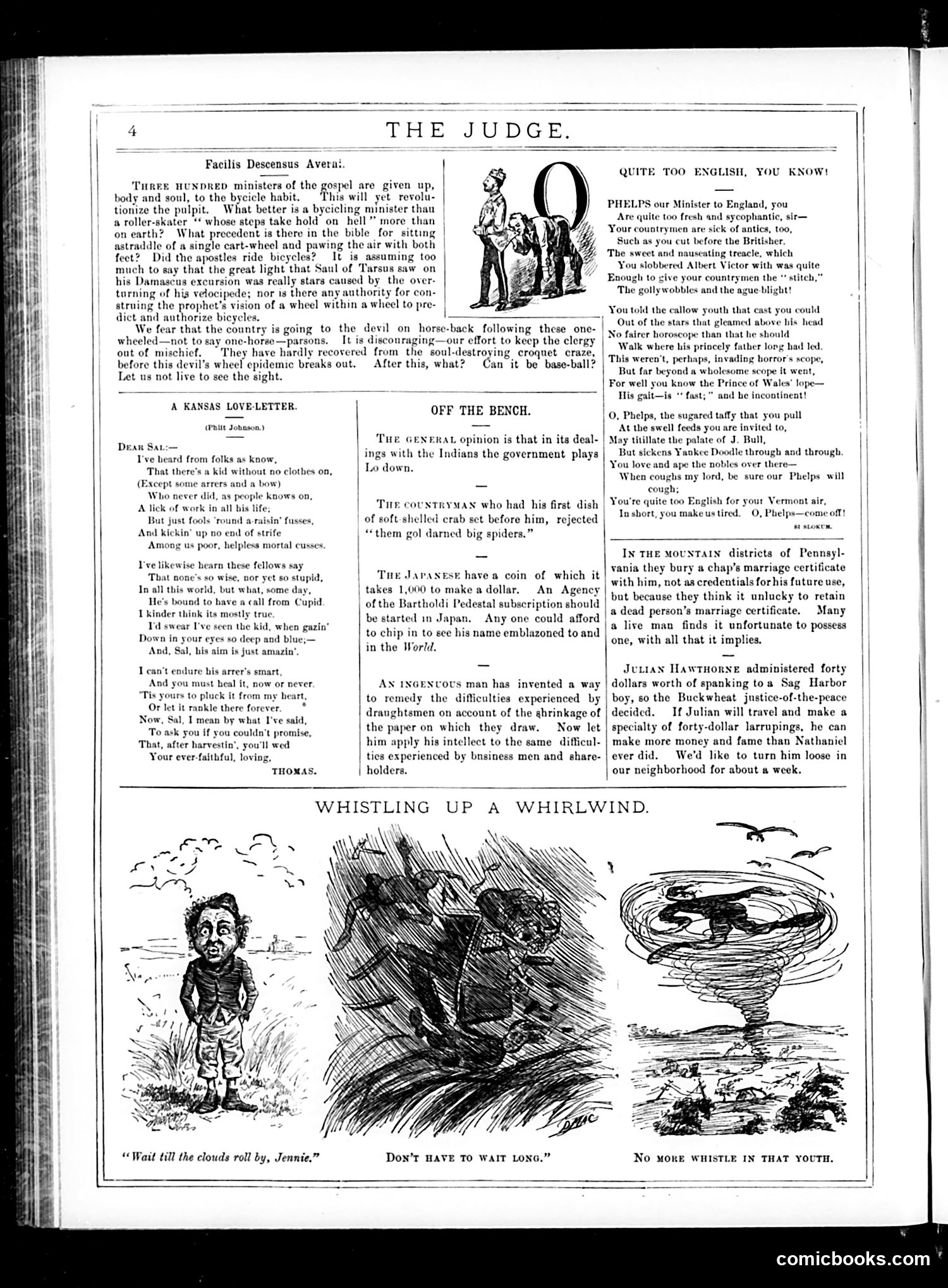
This page contains several satirical pieces mocking contemporary social trends and political figures: **Main Target: Minister Bicycling Craze** The lead article ridicules clergy adopting bicycles, sarcastically questioning biblical precedent for ministers "astraddle" wheeled vehicles. The satire suggests this fad undermines religious dignity. **"Quite Too English, You Know!"** This section attacks Phelps, the U.S. Minister to England, for excessive flattery toward British nobility, particularly Prince Albert Victor. The critique accuses him of obsequious behavior toward British aristocrats while embarrassing fellow Americans with his "fresh and sycophantic" conduct. **Minor Items** Brief satirical notes mock: Indians' government relations ("plays Lo down"), Japanese currency schemes, and a crabmeat anecdote. **"Whistling Up a Whirlwind" Cartoons** Three dark illustrations depict increasingly severe weather—seemingly commenting on consequences of foolish behavior. The page reflects Judge's pattern of attacking perceived American social pretension and inappropriate deference to European customs.
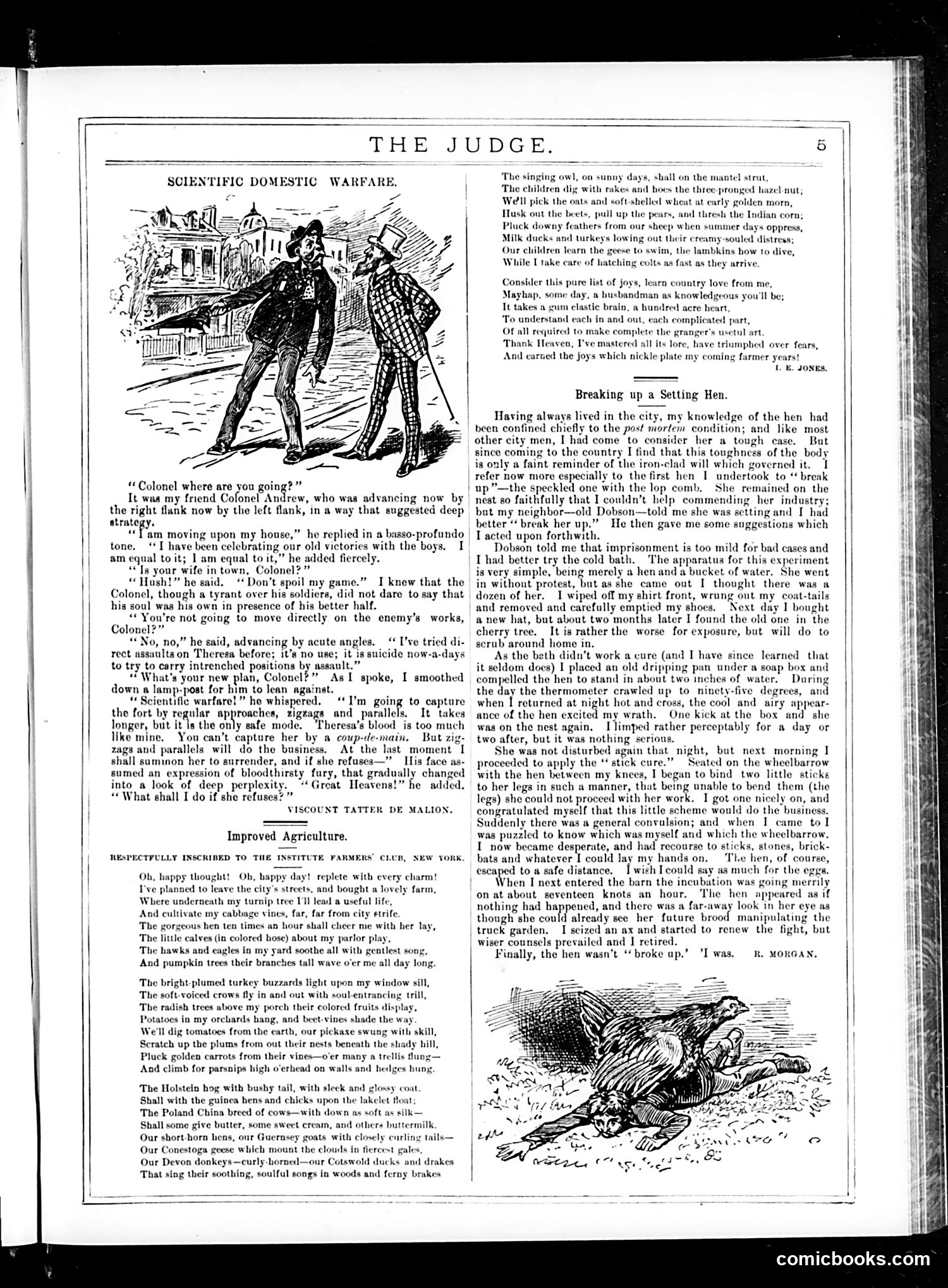
This page satirizes two distinct targets: **Upper section:** A mock-serious poem by I.E. Jones mocking urban transplants attempting farming. The absurdist humor lies in impossible agricultural claims—turkey buzzards nesting on windowsills, potatoes hanging like fruit, Holstein hogs floating on lakes. It ridicules city people's romantic delusions about rural life and their ignorance of actual farming. **Lower section:** A humorous anecdote about breaking a broody hen. Two Civil War officers (likely fictional characters named Colonel and Colonel Andrew) discuss military strategy while one describes battling a determined sitting hen. The satire uses military language ("scientific warfare," "strategy," advancing "flanks") to mock the exaggerated difficulty of farm life and equates stubborn farm animals with wartime obstacles. The hen becomes a formidable adversary requiring intervention. Both pieces mockingly suggest that country living and farming are far more complex, dangerous, and absurd than city dwellers imagine.
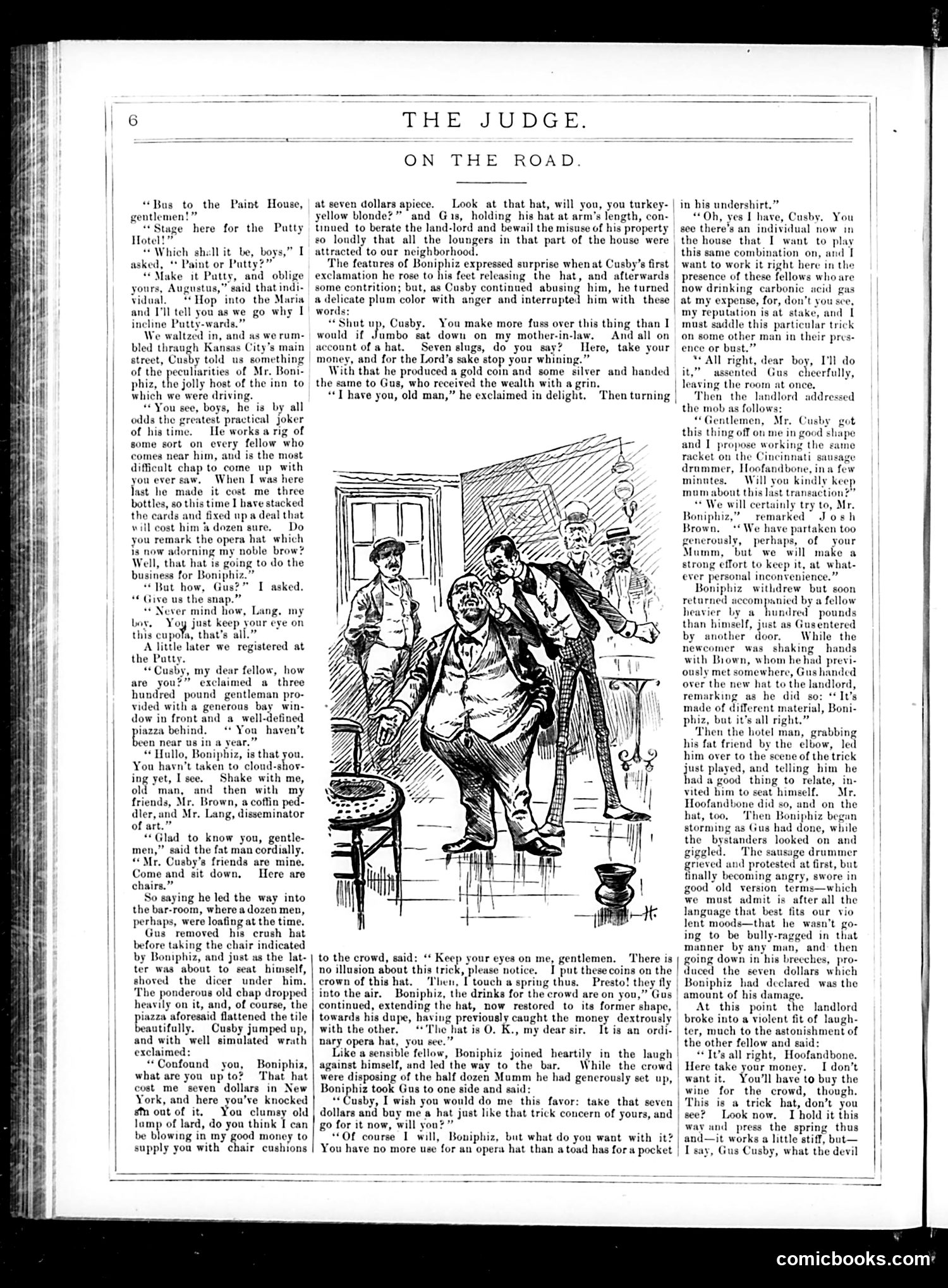
This page presents a humorous narrative about a practical-joke competition between two men: Cusby and Boniphiz, a portly innkeeper. The illustration shows Cusby's revenge scheme unfolding—he has placed a metal device (a "dicer") under Boniphiz's chair cushion. When the fat innkeeper sits, it flattens spectacularly, destroying Cusby's deliberately placed opera hat. Cusby then publicly berates Boniphiz over the "ruined" seven-dollar hat, shaming him before the bar-room crowd until Boniphiz angrily compensates him with coins. The joke's payoff: Cusby then performs a magic trick, claiming the coins leap from the hat—actually a sleight-of-hand con. The satire targets gullible marks and the era's fascination with "clever" deceptions. The story exemplifies Judge magazine's mix of narrative humor and social observation about turn-of-the-century American characters.
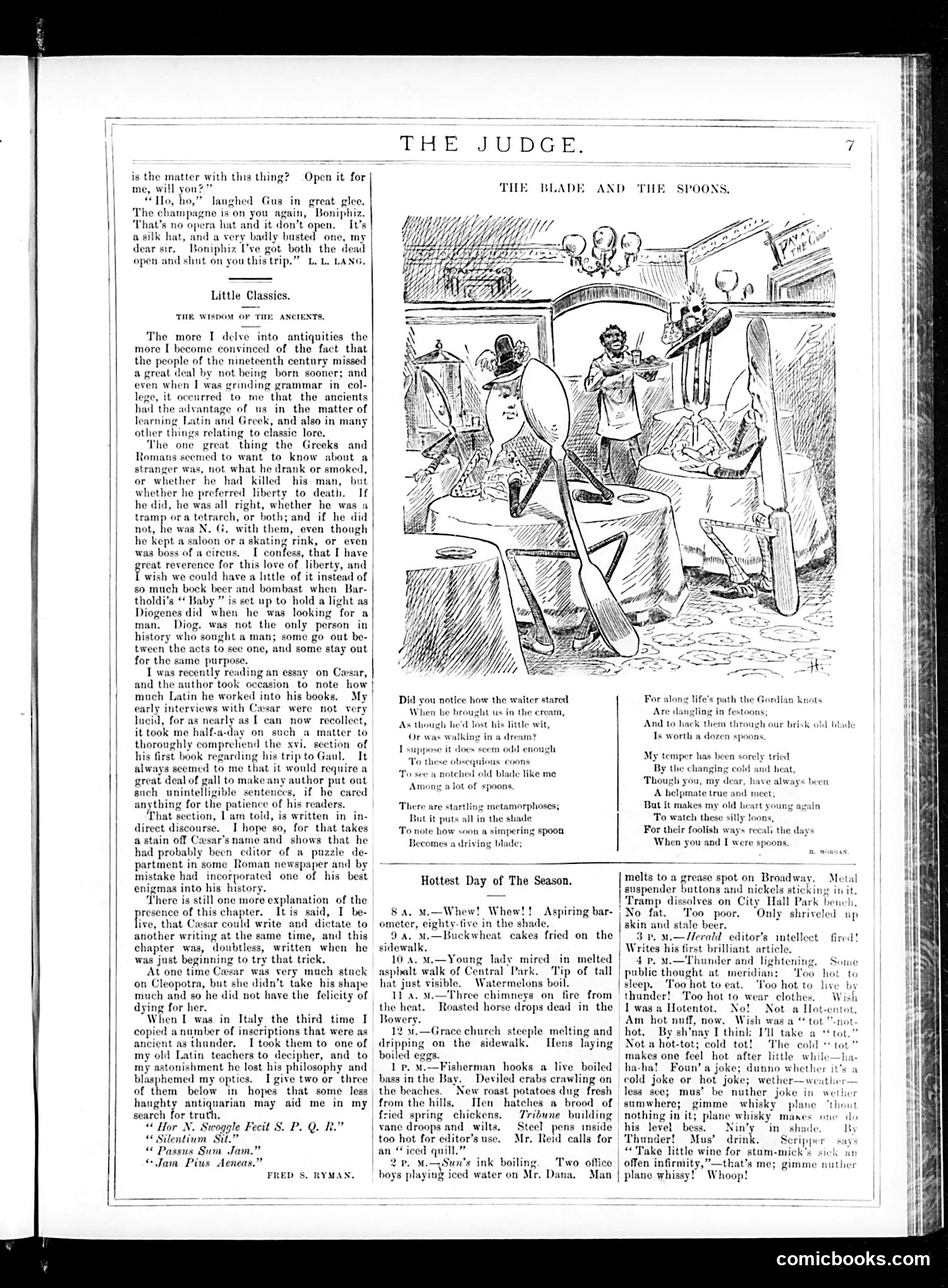
This page contains a satirical poem titled "The Blade and the Spoons," which appears to be a romantic allegory. The illustrated cartoon shows kitchen utensils—spoons and a blade (knife)—depicted as human figures in what seems a domestic or romantic scenario. The poem's conceit is that utensils once "were spoons" (equals, companions) but one has become "a driving blade"—likely suggesting a partner who has grown aggressive, domineering, or changed character. Lines like "My temper has been sorely tried / By the changing" suggest relationship strain caused by this transformation. The satire likely comments on marital discord or partnership conflict using the homely metaphor of kitchen implements. This was a common Victorian-era approach: using inanimate objects to discuss human relationships with a light, humorous touch while addressing serious emotional themes. The page also includes miscellaneous humor pieces on other topics unrelated to the main cartoon.
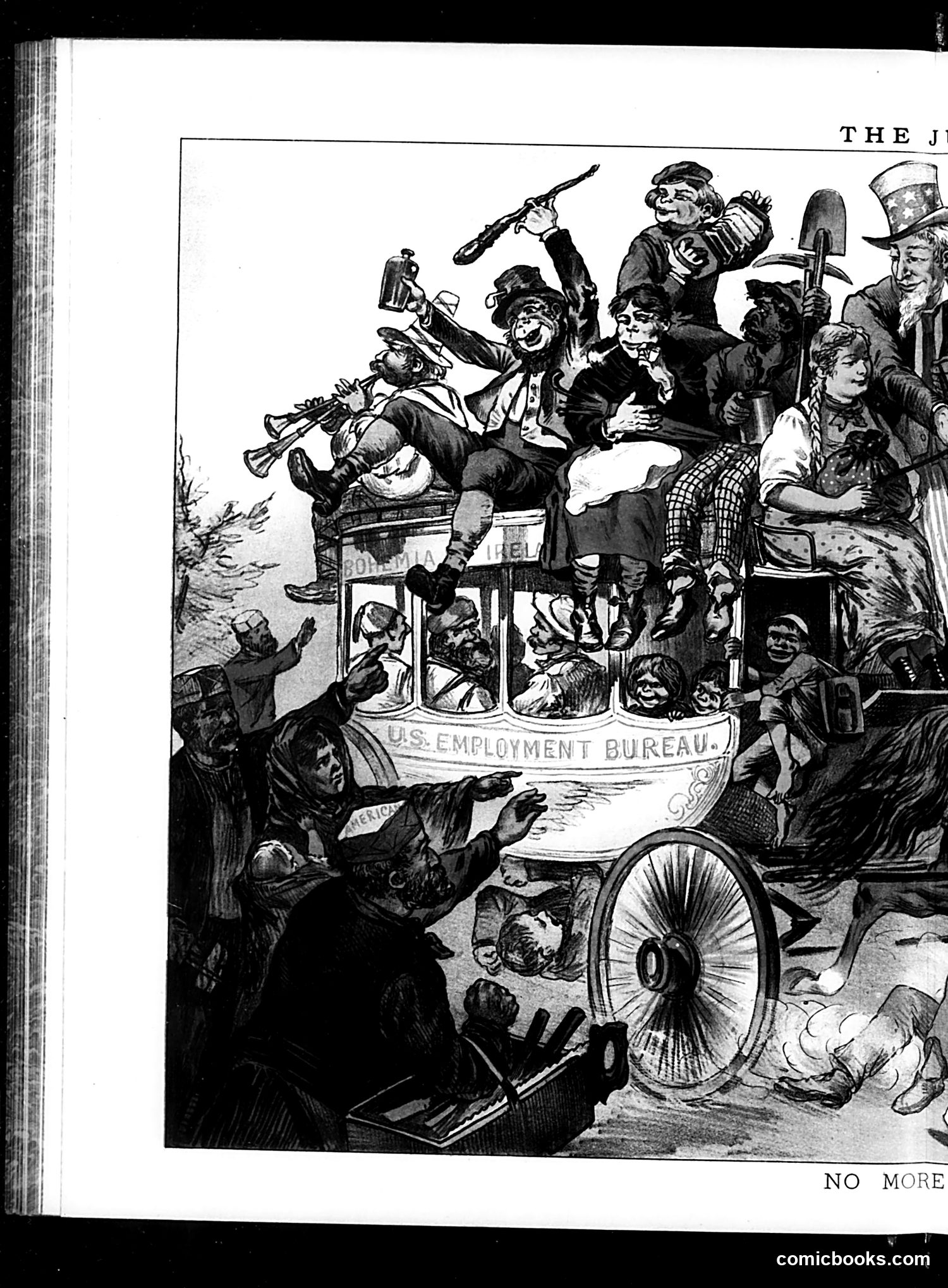
This Judge magazine cartoon depicts a crowded vehicle labeled "U.S. EMPLOYMENT BUREAU" overflowing with caricatured figures—many appearing to represent immigrants or working-class people. The figures are drawn in exaggerated, stereotypical style typical of early 20th-century satirical illustration. The cartoon critiques what appears to be bureaucratic mismanagement or overcrowding at employment services. The chaotic scene, with people hanging off the vehicle and gesturing wildly, suggests the system is overwhelmed or poorly organized. The text fragments visible ("THE J[UDGE]" and "NO MORE") indicate this is satirizing employment bureau operations. Without the complete text and publication date, the specific political target remains unclear, though it likely concerns immigration policy, labor management, or government efficiency during a period of significant social concern about employment.
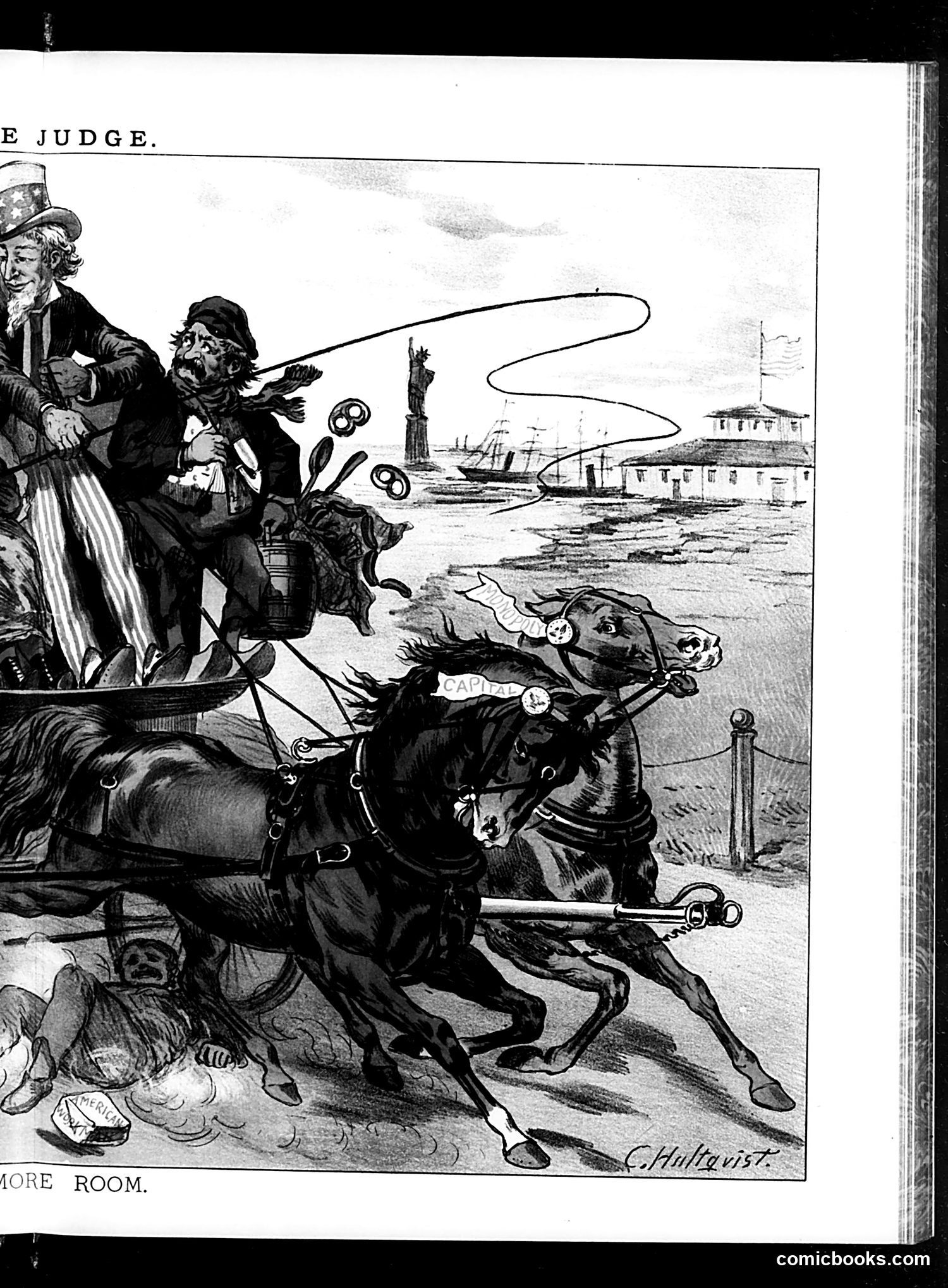
This satirical cartoon depicts Uncle Sam (left, in top hat) and what appears to be a political figure operating a whip toward a horse labeled "CAPITAL" near New York Harbor (recognizable by the Statue of Liberty). Money and financial symbols scatter as the horse bolts. The cartoon critiques government control or manipulation of capital/business interests. The whip suggests aggressive regulatory action or political pressure being exerted over American commerce and financial markets. The "more room" caption (partially visible) implies warnings about consequences or limited space for such tactics. The satire likely comments on late 19th-century debates over government intervention in the economy, trusts, or financial regulation—a frequent Judge magazine theme during the Gilded Age.
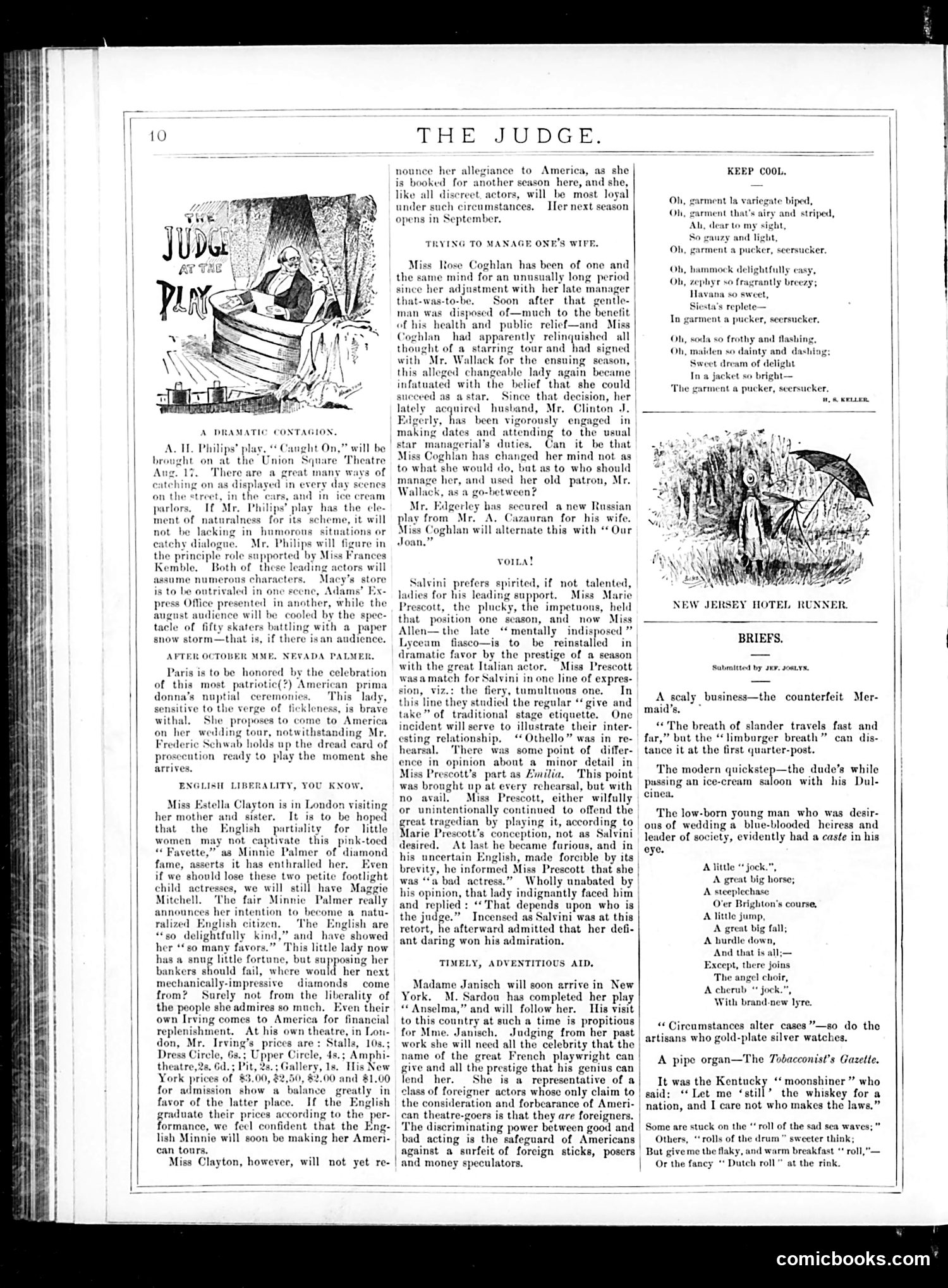
This page from Judge magazine (circa 1880s) contains theater gossip and brief satirical commentary rather than political cartoons. The main content includes: **"A Dramatic Contagion"**: Discusses Mr. Phillips' theatrical play featuring elaborate stage sets (Macy's store, Adams Express Office, ice skaters) and questions whether the production will attract an audience—satirizing theatrical excess. **"English Liberality"**: Mocks English stinginess by contrasting theater admission prices in London versus New York. The joke: English theater is so expensive that even celebrated actors like Henry Irving must come to America to make money. Young English-admiring actress Minnie Palmer should reconsider her plan to become British, as English "liberality" (generosity) is a myth. **"Trying to Manage One's Wife"**: Gossip about actress Rose Coghlan repeatedly changing career ambitions, with her husband chasing theatrical opportunities. The satire targets her indecisiveness and the challenge of managing a spouse in show business. The small illustrations appear decorative rather than carrying specific political meaning.
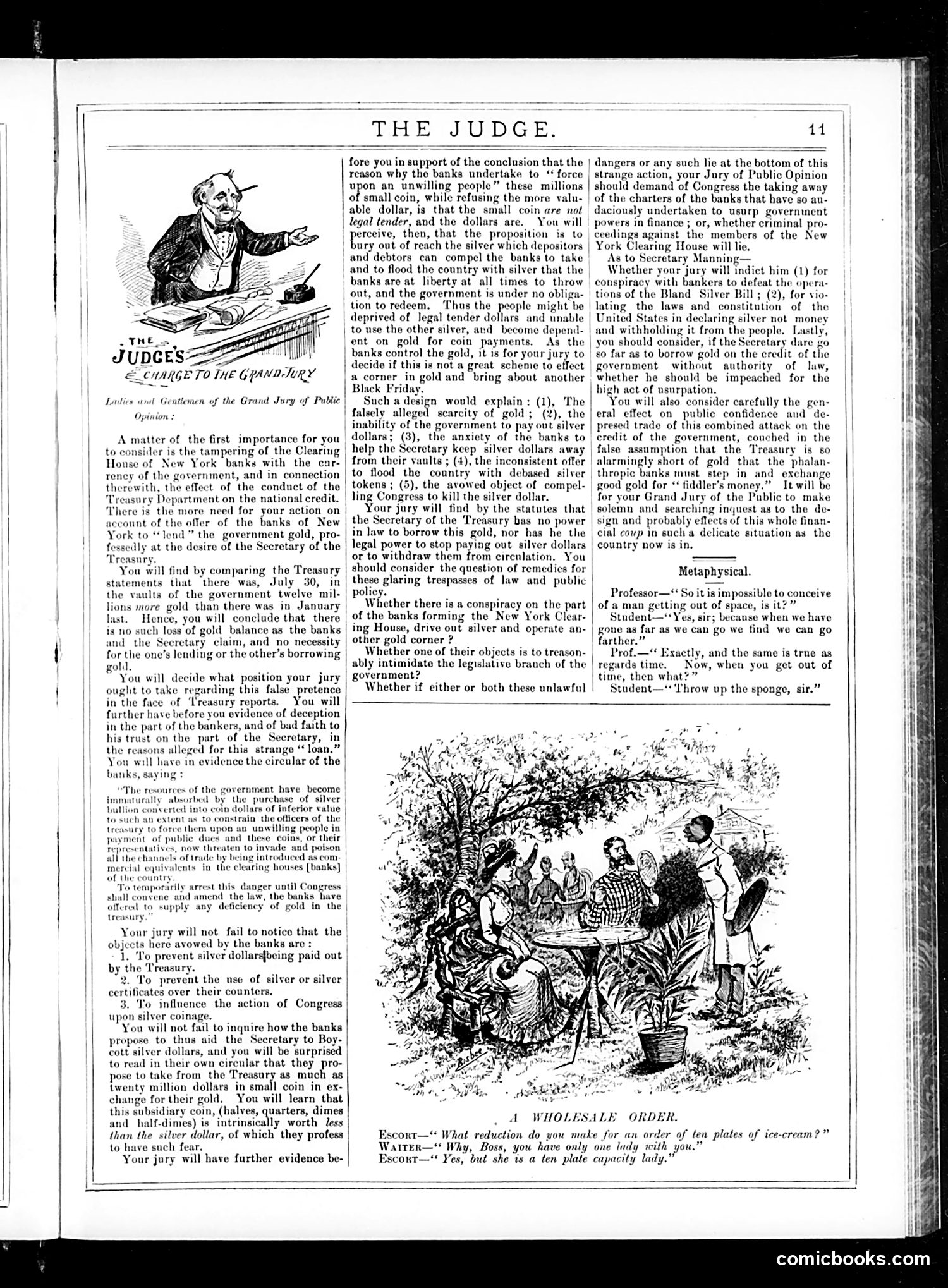
This editorial cartoon addresses a banking scandal during the Cleveland administration involving the New York Clearing House banks. The "charge" is a mock judicial address to public opinion as jurors, presenting accusations against the banks and Treasury Secretary. **The Issue:** Banks claimed gold reserves were depleted, requesting the government borrow gold from them—allegedly to prevent silver dollars from circulation. Judge argues this is fraudulent: Treasury records show *more* gold in July than January, exposing the false scarcity claim. **The Satire's Point:** The banks actually aim to (1) prevent silver-dollar circulation, (2) hoard gold to create artificial scarcity, and (3) force the government into dependent borrowing. By flooding markets with lower-value subsidiary coins instead of legal-tender silver dollars, banks manipulate currency while controlling gold supply—creating a financial "corner" benefiting themselves at public expense. **The Unnamed Figures:** The Secretary of Treasury (likely Daniel Manning or successor) and New York banking interests are implicit targets. The lower illustration appears unrelated social humor.
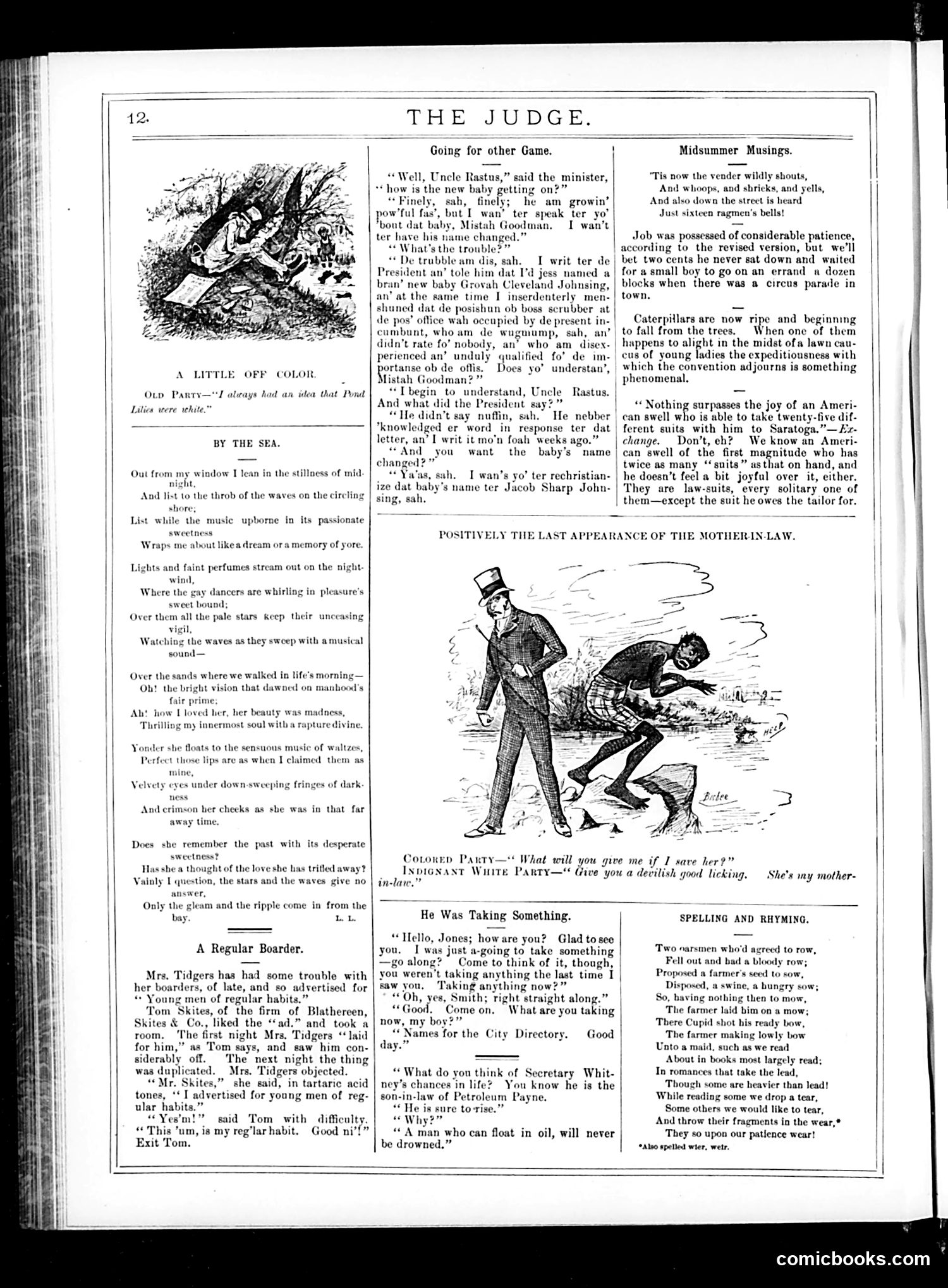
This page from *Judge* contains several satirical pieces targeting different audiences: **"Going for Other Game"** depicts a Black minister and parishioner discussing naming a baby "Grover Cleveland Johnsing" while mentioning a post office position. The satire targets political patronage and corruption—the implication being that naming a child after President Cleveland was a transparent attempt to curry favor for a government job. **"Positively the Last Appearance of the Mother-in-Law"** cartoon shows a man threatening violence against a woman, with captions about a "Colored Party" and "Indignant White Party." This reflects contemporary mother-in-law humor while also containing racial stereotyping typical of the era. The remaining content includes nostalgic poetry and various light social commentary pieces about summer activities and urban life. The page emphasizes *Judge*'s mix of political satire, social humor, and sentimental verse aimed at middle-class readers.
This page from *Judge*, a satirical magazine, contains primarily **humorous short jokes and quips** rather than political cartoons. The content reflects late 19th-century American humor. Key items of note: **"Second Adventism" dialogue**: A rural character (Sandy) is skeptical that Jesus would return after being mistreated ("'bused him, killed him") before—humorously questioning why he'd come back under those circumstances. **Editor's lament**: A comic poem about an editor struggling to generate copy, ultimately writing about "follies of men" and "whimsical follies of women." **Various one-liners** mock contemporary topics: the "girl of the period," Finnish language education, political corruption, and throat problems from excessive singing. **Fish reference**: A joke about James D. Fish (an incarcerated banker/defaulter) being "broiled" by humorists. **Buffalo prohibition society**: A brief note about a temperance journal nominating women (Lucy Webb Hayes, Elizabeth Cleveland) as presidential candidates—apparently satirizing female involvement in political reform movements. The page is primarily **filler humor and advertisements** rather than substantive political commentary.
This page from Judge magazine is primarily **advertisements and humorous anecdotes** rather than political cartoons. The content reflects late 19th-century American humor and commercial culture. The jokes center on period concerns: a tramp's witty response to being offered food; "Flipkins'" flawed logic about blood rushing to his head when standing upright; complaints about inferior whisky quality in different American cities; a Black defendant's creative (but ultimately unsuccessful) attempt to explain mitigating circumstances for horse theft; and a widow's scatter-brained small talk about mourning while ironically asking about fashion. The advertisements promote printing services, medical remedies (notably Dr. Sage's Catarrh Remedy with its "$500 reward"), and orthopedic devices—typical commercial pitches for the era. The racist stereotype in the horse-theft anecdote reflects the regrettable attitudes common in contemporary American humor publications.
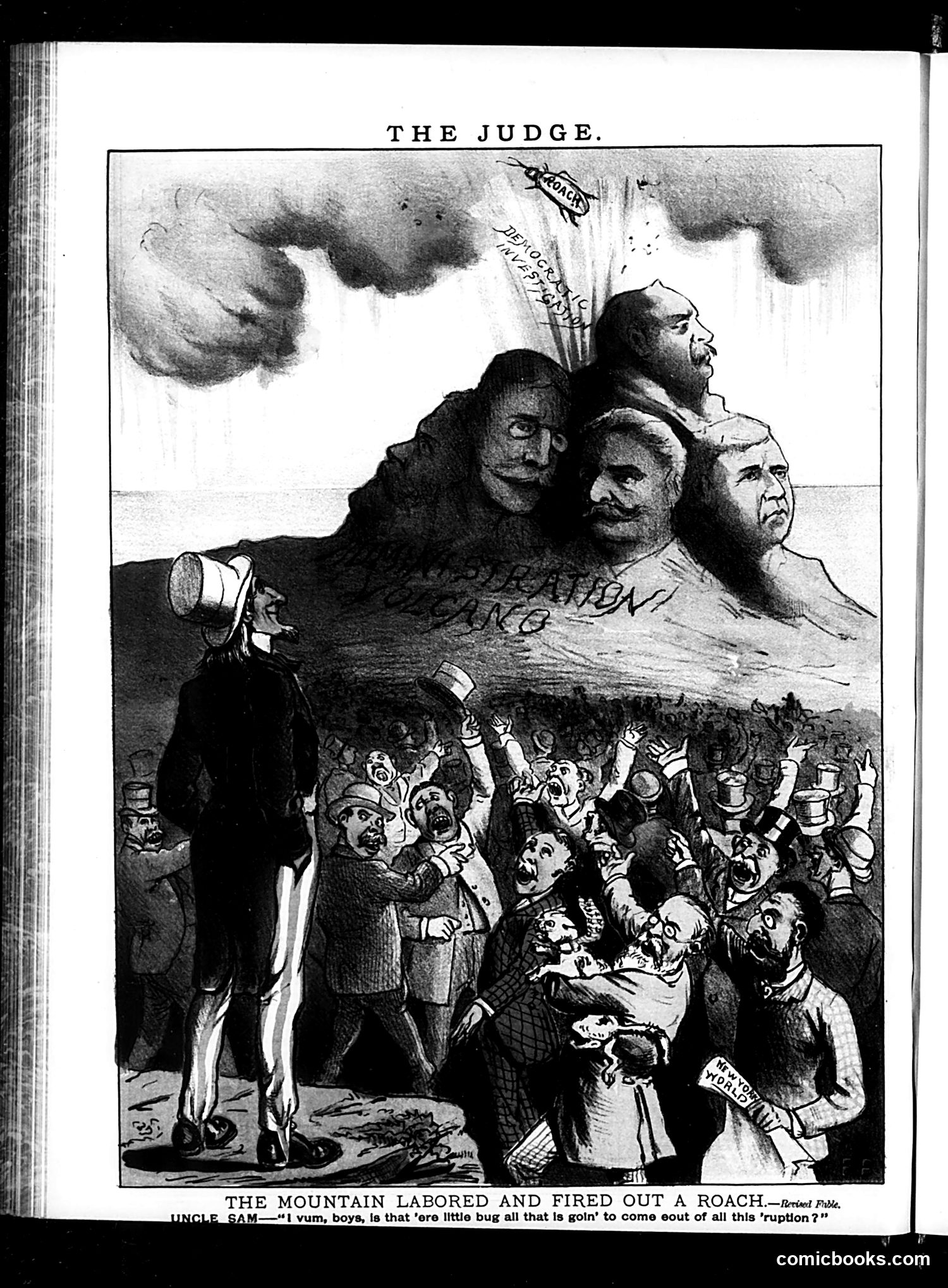
This satirical cartoon depicts four large male heads emerging from a mountain, while a crowd of soldiers or workers below watches. Uncle Sam (identifiable by his characteristic appearance) expresses disappointment that only a small "roach" resulted from the mountain's "eruption." The cartoon uses the classical allusion "the mountain labored and fired out a roach" (referencing Horace's *Ars Poetica*) to mock a political or military situation—likely a government initiative or conflict that produced minimal or disappointing results despite great buildup and effort. The large heads suggest important political or military figures whose grand plans yielded trivial outcomes. Without knowing the specific date, the exact historical reference remains unclear, but the satire critiques disproportion between effort and achievement.