
Judge, 1885-08-08 · page 3 of 16
Judge — August 8, 1885 — page 3: what you’re looking at
What you’re looking at
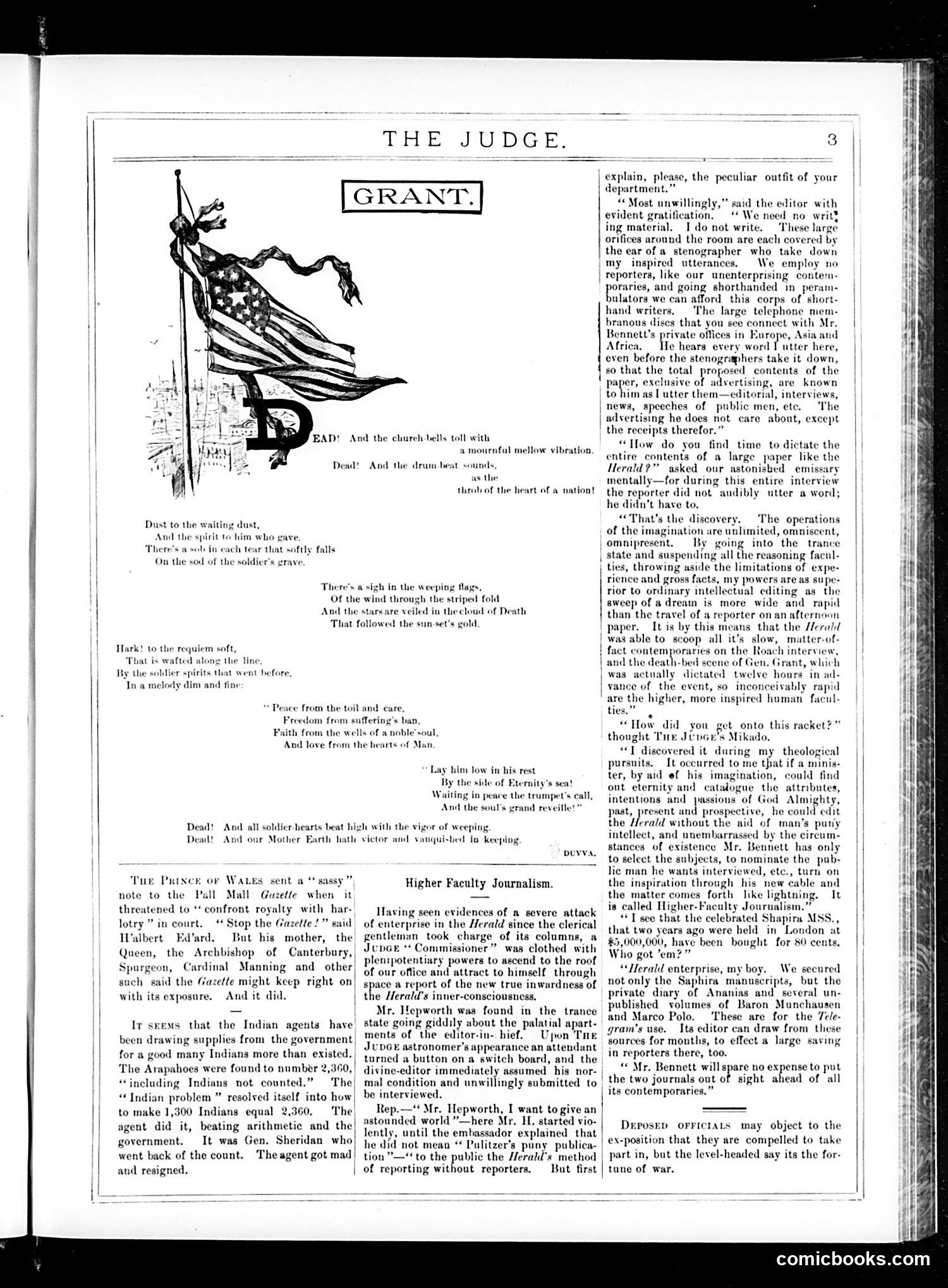
This page from Judge magazine contains a patriotic poem about fallen soldiers (likely from the Civil War era) and satirical commentary on newspaper operations. **The "Grant" cartoon** depicts a tattered American flag with a skeletal hand—likely representing death or the Grim Reaper—symbolizing the cost of war and national sacrifice. **"Higher Faculty Journalism"** mocks the *New York Herald* and its editor (likely James Gordon Bennett). The satire suggests the Herald claims to operate through absurdly modern methods: stenographers recording the editor's dictation, telephone connections to overseas offices, and reporting "without reporters." The joke critiques the Herald's sensationalism and claims of journalistic innovation as pretentious nonsense. **Other items** briefly mention the Prince of Wales confronting the *Pall Mall Gazette* over coverage, and an Indian agent scandal where officials falsified population counts to embezzle government supplies. The page reflects Judge's role as satirical commentary on contemporary politics, journalism, and government corruption.
📄 Transcribed text from this page (OCR, searchable)
Machine-transcribed from the original scan — historical spelling and the odd misread are preserved.
nn EAD! An Dead! Dust to the wa And the spirit to him who ‘There's a sob in each tear that softly falls On the ‘onl of the soldier's grave There's @ Of the And the stars are veiled That followed the sun-se Hark! to the requiem soft That is wafted along th Mier spirits that went before, clody dim and fine © from the toil Freedom from suf Dead! Dead! Tue Prince ov Waxe: note to the Pall Mall Gu threatened to ‘* confront ro: lotry ” in court, Stop the Gazelle!” said Ialbert Ed’ard. But his mother, the Queen, rehbishop of Canterbury, Spurgeon, Cardinal Manning and other! rid the Gazette might keep right on And it did. | nt a‘ sassy” tte when it alty with har- the such with its exposure, Ir seems that the Indian agents have been drawing supplies from the government for a good many Indians more than existed. ‘The Arapahoes were found to number 2,1 “including Indians not counted.” The “Indian problem ” resolved itself into how to make 1,300 Indians equal 2,360. The agent did it, beating arithmetic and the| government. It was Gen. Sheridan who| went back of the count. The agent got mad | and resigned. | aith from the wells of a nobl And love from the hi d the chureh-bells toll with a mournfal mellow And the drum-be: nds, Hof the heart of a nation! nin the weeping flags, wind throug triped fold the cloud of Death 's gold Ter Lay him low in his rest By t Waiting in peace the trumpet’s call, And the e side of Eternity’s sea! pul's grand reveille! ” And all soldier-hearts beat high with the vigor of weeping And our Mother Earth hath victor and vanquished ia keeping. Higher Faculty Journalism. Ifaving seen evidences of a severe attack of enterprise in the Herald since the clerical gentleman took charge of its columns, a JupGe * Commissioner” was clothed with plenipotentiary powers to ascend to the roof of our office and attract to himself through specs a report of the new true inwardness of the Herald’s inner-consciousness, Mr. Hepworth was found in the trance state going giddily about the palatial apart- ments of the editor-in- hief. Upon Tne JUDGE astronomer’s appearance an attendant turned a button on a switch board, and the divine-editor immediately assumed his nor- mal condition and unwillingly submitted to be interviewed. Rep.—‘ Mr. Hepworth, I want to give an astounded world ”—here Mr. H. started vio- lently, until the embassador explained that he did not mean “ Palitzer’s puny publica- tion "—*‘to the public the Herald's method of reporting without reporters, | news, speeches of public men, ete. But first | explain, please, the peculiar outfit of your department.” “ Most unwillin, said the editor with evident gratification. ‘ We need no writ? ing material. I do not write. These large orifices around the room are each covered by the ear of a stenographer who take down my inspired utterances. We employ no reporters, like our unenterprising contem- poraries ‘and going shorthanded in peram- bulators we can afford this corps of short- hand writers. The large telephone mem- branous discs that you see connect with Mr. Bennett's private offices in Europe, Asia an Africa, He hears every word I utter here, even before the stenographers take it down, so that the total proposed contents of the paper, exclusive of advertising, are known to him as I utter them—editorial, interviews, The advertising he does not care about, except the receipts therefor.” “Tow do you find time to dictate the entire contents of a large paper like the Herald?” asked our astonished emissary mentally—for during this entire interview the reporter did not audibly utter a word; he didn’t have to. “That's the di covery. ‘The operations of the imagination are unlimited, omniscent, omnipresent. By going into the trance state and suspending all the reasoning facul- ties, throwing uside the limitations of expe- rience and gross facts, my powers are as supe- rior to ordinary intellectual editing as the sweep of adreain is more wide and rapid than the travel of a reporter onan afternoon paper. It is by this means that the /erald matter-of- fact contemporaries on the Roach interview, and the death-bed scene of Gen. Grant, which 3 actually dictated twelve hours in ad- vance of the event, so inconceivably rapid are the higher, more inspired human facul- ties.” “How did you get onto this racket? thought Tne JupGe’s Mikado, “TI discovered it during my theologi pursuits, It occurred to me that if a minis ter, by aid ef his imagination, could find out eternity and gue the attributes, intentions and passions of God Almighty, past, present and prospective, he could edit the Herald without the aid of man’s puny intellect, and unembarrassed by the circum- stances of existence Mr, Bennett has only to select the subjects, to nominate the pub- lic man he wants interviewed, ete., turn on the inspiration through his new cable and the matter comes forth like lightning. It is called Higher-Faculty Journalism.” ‘*T see that the celebrated Shapira MSS., that two years ago were held in London at $5,000,000, have been bought for 80 cents, Who got em?” “Herald enterprise, my boy. We secured notonly the Saphira manuscripts, but the private diary of Ananias and several un- published volumes of Baron Munchausen and Marco Polo. These are for the Tele- gram’s use. Its editor can draw from these sources for months, to effect a large saving in reporters there, too. “ Mr. Bennett will spare no expense to put the two journals out of sight ahead of all its contemporaries.” DrPosED OFFICIALS may object to the ex-position that they are compelled to take part in, but the level-headed say its the for- tune of war. comicbooks.com