
Judge, 1885-08-08 · page 13 of 16
Judge — August 8, 1885 — page 13: what you’re looking at
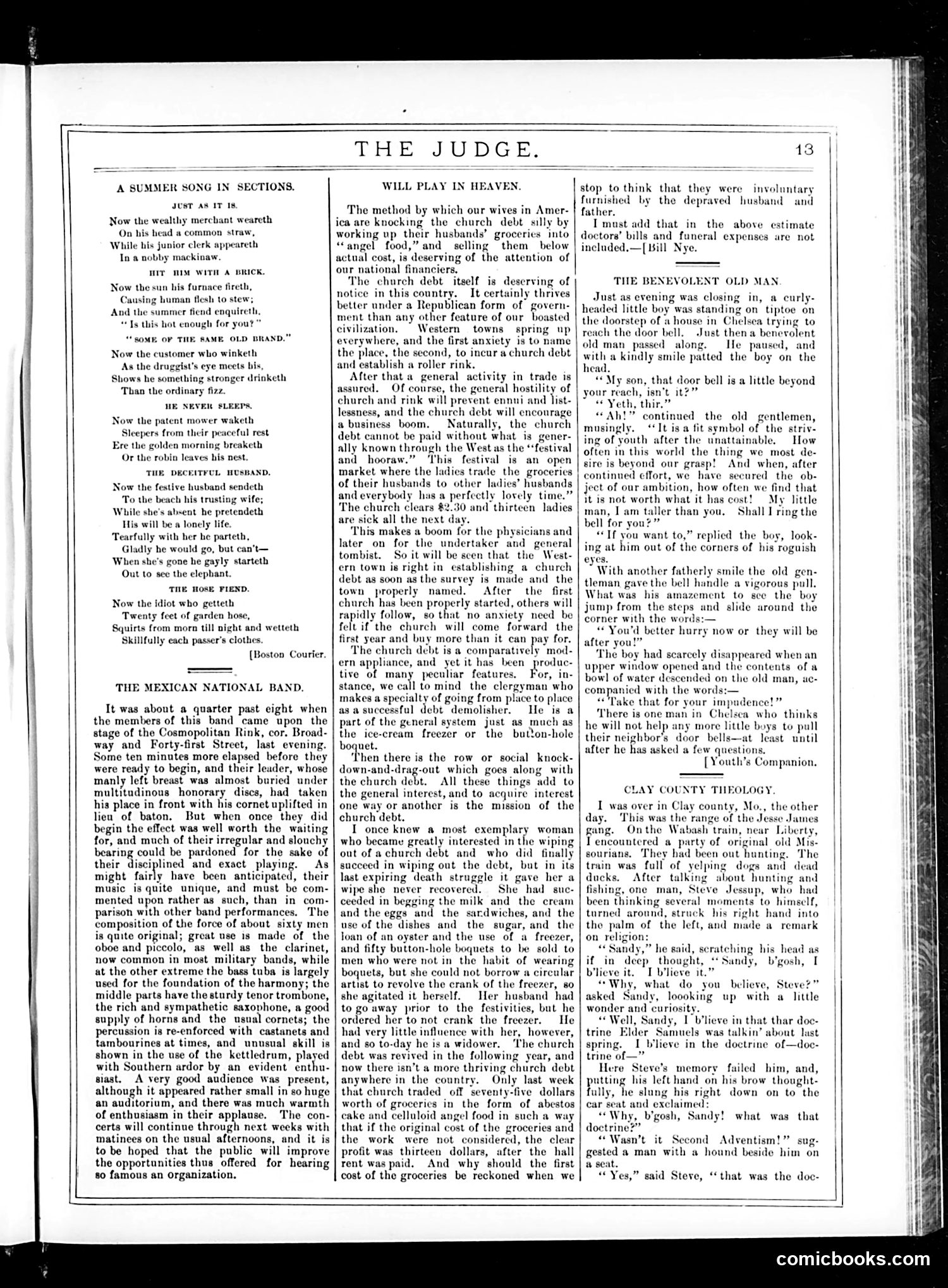
A restored page from Judge, 1885-08-08. Page through the whole issue in the reader above.
📄 Transcribed text from this page (OCR, searchable)
Machine-transcribed from the original scan — historical spelling and the odd misread are preserved.
THE JUDGE. A SUMMER SONG IN SECTIONS. JUST AS IT 18, Now the wealthy merchant weareth On his head a common straw While his junior clerk appeareth In a nobby mackinaw. HIT TM WITH A BRICK. Now the sun his furnace fire Causing human flesh to stew And the summer fiend enquireth, ++ Is this hot enough for yout AME OLD BRAND.” “some OF THE Now the customer who winketh As the druggist’s eye meets bis, Shows he something stronger drinketh ‘Than the ordinary fizz. UE NI Rut SL aketh Sleepers from their peaceful rest ¢ the golden morning breaketh Or the leaves his nest, THE DECEITFUL 1 Now the patent mower Ei SBAND. Now the festive husband sendeth To the beach his trusting wife; While she’s absent he pretendeth His will be a lonely life ‘Tearfully with her he parteth, Gladly he would go, but can't— When she’s gone he gayly starteth Out to see the elephant. THE HOSE FIEND. Now the idiot who getteth Twenty feet of garden hose, Squirts from morn till night and wetteth Skillfully each passer’s clothes, {Boston Courter. THE MEXICAN NATIONAL BAND. It was about a quarter past eight when the members of this band came upon the stage of the Cosmopolitan Rink, cor. Broad- way and Forty-first Street, last evening. Some ten minutes more elapsed before they wore ready to begin, and their leader, whose manly left breast was almost buried under multitudinous honorary discs, had taken his place in front with his cornet uplifted in lien of baton. But when once they did begin the effect was well worth the waiting for, and much of their irregular and slouchy bearing could be pardoned for the sake of their disciplined and exact playing. As might fairly have been anticipated, their music is quite unique, and must be com- mented upon rather as such, than in com- parison with other band performances, The composition of the force of about sixty men is quite original; great use 1s made of the oboe and piccolo, as well as the clarinet, now common in most military bands, while at the other extreme the bass tuba is largely used for the foundation of the harmony; the middle parts have the sturdy tenor trombone, the rich and sympathetic saxophone, a good supply of horns and the usual cornets; the percussion is re-enforced with castanets and tambourines at times, and unusual skill is shown in the use of the kettledrum, played with Southern ardor by an evident enthu- siast. A very good audience was present, although it appeared rather small in so huge an auditorium, and there was much warmth of enthusiasm in their SpPlanee: The con- certs will continue through next weeks with matinees on the usual afternoons, and it is to be hoped that the public will improve the opportunities thus offered for hearing 80 famous an organization. WILL PLAY IN HEAV. The method by which our wives in Amer- ica are knocking the church debt silly by working up their husbands’ groceries into “angel food,” and selling them below actual cost, is deserving of the attention of our national financiers, The church debt itself is deserving of notice in this country. It certainly thrives better under a Republican form of govern- ment than any other feature of our boasted civilization. Western towns spring up everywhere, and the first anxiety is to name the place, the second, to incur a church debt and establish a roller rink, After that a general activity in trade is assured. church and rink will prevent ennui and Jist- lessness, and the church debt will encourage a business boom. Naturally, the church debt cannot be paid without what is gener- ally known through the West as the ‘festival and hooraw.” ‘This festival is an open market where the ladies trade the groceries of their husbands to other ladies’ husbands and everybody has a perfectly lovely time.” The church clears $2.30 and thirteen ladies ‘k all the next day, ‘This makes a boom for the physicians and later on for the undertaker and general tombist. So it will be scen that the West- ern town is right in ablishing a church debt as soon as the survey is made and the town properly named. After the first church has been properly started, others will rapidly follow, go that ‘no anxiety need be felt if the church will come forward the first year and buy more than it can pay for. The church debt is a comparatively mod- ern appliance, and yet it has been produc- tive of many peculiar features, For, in- stance, we call to mind the clergyman who makes'a specialty of going from place to place asa successful debt demolisher. He is a part of the general system just as much as the ice-cream freezer or the button-hole boquet. ‘The there is the row or social knock- down-and-drag-out which goes along with the church debe All these things add to the general interest, and to acquire interest one way or another’ is the mission of the church debt. I once knew a most exemplary who became greatly interested in the wiping out of achurch debt and who did finally succeed in wiping out the debt, but in its last expiring death struggle it gave her a wipe she never recovered. She had suc- ceeded in begging the milk and the cream and the eggs and the sandwiches, and the use of the dishes and the sugar, and the Joan of an oyster and the use of a freezer, and fifty button-hole boquets to be sold to men who were not in the habit of wearing boquets, but she could not borrow a circular artist to revolve the crank of the freezer, 8o she agitated it herself. Her husband had to go uway prior to the festivities, but he ordered her to not crank the freezer. He had very little influence with her, however, and so to-day he is a widower. ‘The church debt was revived in the following year, and now there isn’t a more thriving church debt anywhere in the country. Only last week that church traded off ‘seventy dollars. worth of groceries in the form of abestos cake and celluloid angel food in such a way that if the original cost of the groceries and the work were not considered, the clear profit was thirteen dollars, after the hall rent was paid. And why should the first cost of the groceries be reckoned when we n Of course, the general hostility of | stop to think that they were involuntary furnished by the depraved husband and father. I must add that in the above estimate doctora’ bills and funeral expenses are not included.—[Lill Nye. THE BENEVOLENT OLD MAN Just as evening was closing in, a curly- headed little boy was standing on tiptoe on the doorstep of a house in Chelsea trying to reach the door bell. Just then a benevolent old man passed along. He paused, and with a kindly smile patted the boy on the head. “My son, that door bell is a little beyond your reach, isn’t it?”” “Yeth, thir.” “Ah!” continued the old gentlemen, musingly. ‘‘It isa fit symbol of the striv- ing of youth after the unattainable. How often in this world the thing we most de- sire is beyond our grasp! And when, after continued effort, we have secured the ob- ject of our ambition, how of! it is not worth what it has cost! My little man, I am taller than you. Shall I ring the bell for you “Tf you want to,” replied the boy, look- ing at him out of the corners of his roguish ey n_we find that With another fatherly smile the old gen- tleman gave the bell handle a vigorous pull. What was his amazement to sce the boy jump from the steps and slide around the corner with the word “You'd better hurry now or they will be after you!” The boy had scarcely disappeared when an upper window opened and the contents of a bowl of water descended on the old man, a companied with the word: “"Pake that for your impudence!” ‘There is one man in Chelsca whi he will not help any more little b: their neighbor's door bells—at after he has asked a few stions, [Youth's Companion. thinks to pull t until CLAY COUNTY THEOLOGY. I was over in C day. ‘This was the y county, Mo,, the other ange of the Jesse James gang. Onthe Wabash train, near Liberty, Tencountered a party of original old Mi sourians, They had been out hunting. train was full of yelping dogs and ¢ ducks. After talkin pout hunting and fishing, one man, Steve Jessup, who had been thinking several moments to himself, turned around, struck his right hand into the palm of the left, and made a remark on religion: andy,” he said, if in deep thought, bilieve it. I b'lieve it. “Why, what do you believe, Steve?” asked Sandy, loooking up with a little wonder and ‘curiosity “Well, Sandy, I b’lieve in that thar do trine Elder Samuels was talkin’ about 1 spring. I b'lieve in the doctrine of —doe- trine of—” I Steve's memory failed him, and, puts ig his lefthand on his brow thought- ully, he slung his right down on to the car seat and exclaimes “Why, b’gosh, Sandy! what was that doctrine?” “Wasn't it Second Adventism!” sug- gested a man with a hound beside him on a seat “Yes,” said Steve, “that was the doc- tching his head as “Sundy, b’gosh, T t comicbooks.com