
A complete issue · 19 pages · 1885
Judge — August 1, 1885
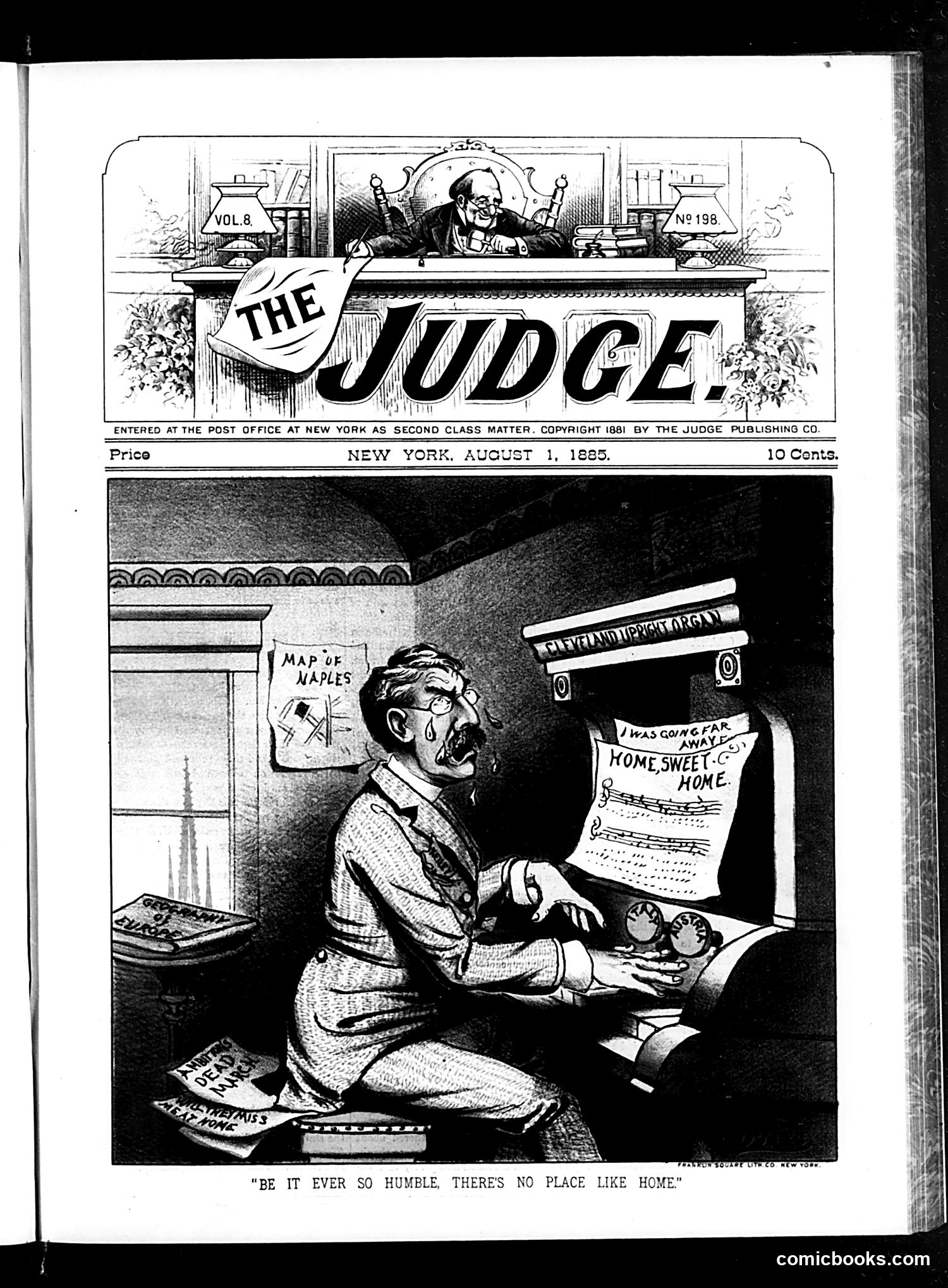
This August 1, 1885 *Judge* cartoon satirizes an Italian immigrant's homesickness. The figure, depicted with exaggerated ethnic features typical of period caricature, sits in a modest room surrounded by references to Naples—a map on the wall, sheet music for "Home, Sweet Home," and what appears to be personal mementos. The juxtaposition suggests irony: despite singing about home, he's visibly longing for Italy rather than America. The satire likely comments on immigration anxieties—either mocking immigrants' difficulty assimilating to American life, or critiquing their perceived reluctance to embrace their new country. The "humble" dwelling and nostalgic objects underscore themes of displacement common in Gilded Age satire about the immigrant experience.
This page from Judge magazine (likely 1870s-1880s based on content) contains political commentary rather than traditional cartoons. The main content addresses: **The Grant Section**: A tribute to General Ulysses S. Grant's character and legacy, emphasizing his integrity during turbulent post-Civil War years. It praises him as embodying American manhood. **"It's English, You Know"**: Satirizes British hypocrisy regarding child exploitation and trafficking. The piece notes that when authorities discovered systematic enslavement of poor girls by aristocratic men, they punished the *whistleblowers* rather than the perpetrators—calling this characteristically English corruption and indifference to class injustice. **"Back Yard Reforms"**: Criticizes Democrats for using naval yard corruption as political ammunition against Republicans, while both parties tolerated systemic abuse for decades. The satirical point: Britain's moral pretenses mask institutional depravity; American politicians exploit scandals for partisan gain rather than genuine reform.
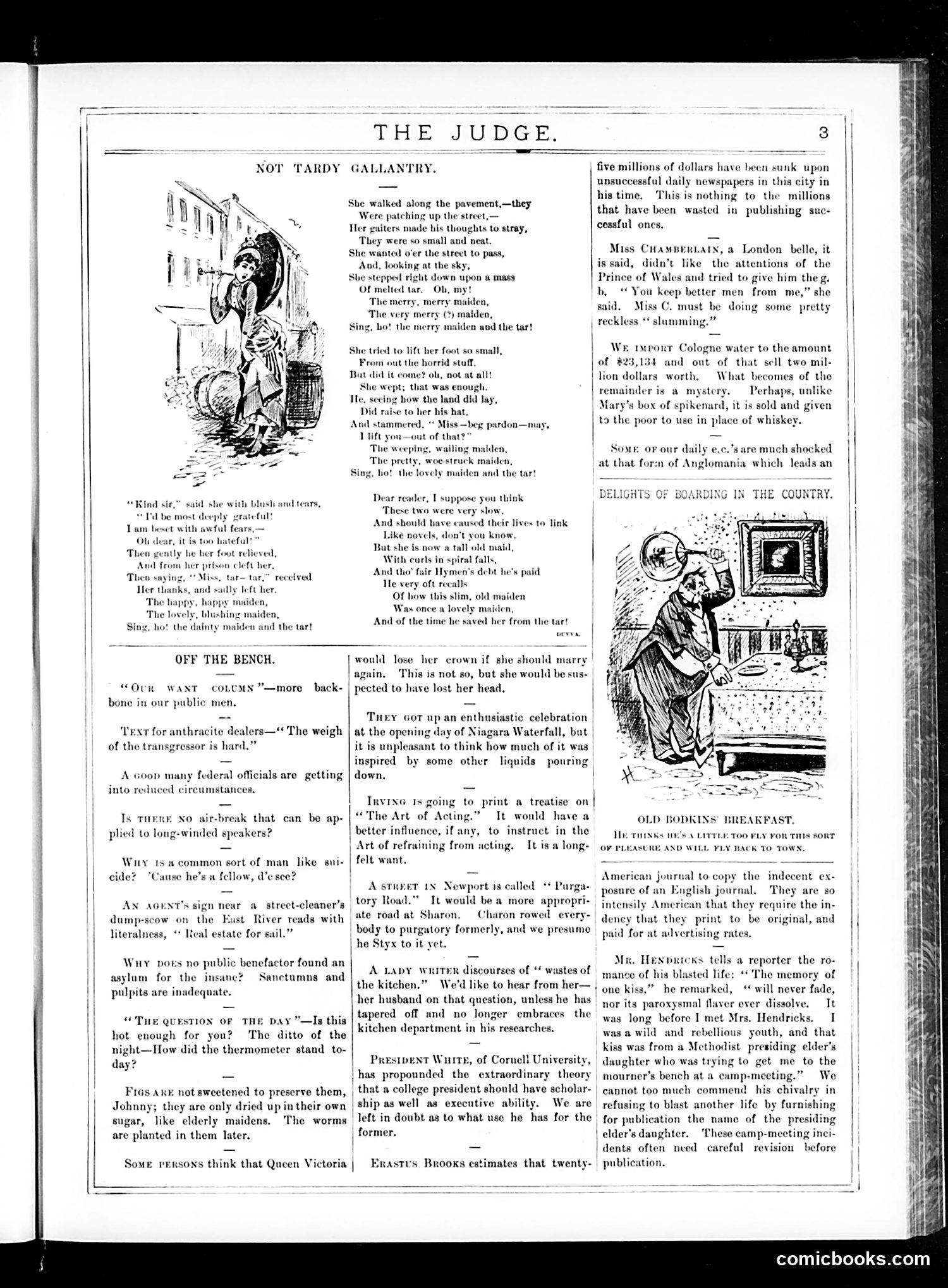
This page from Judge contains satirical short items ("Off the Bench") mocking contemporary issues, plus a humorous narrative poem "Not Tardy Gallantry." **The Main Cartoon/Poem:** "Not Tardy Gallantry" tells of a young woman stepping into melted street tar. A sailor helps free her foot—a small, gentlemanly gesture. The joke: despite this "romantic" meeting, they never marry. Decades later, she's an elderly spinster still remembering him fondly. The satire mocks sentimental Victorian romance fiction, where minor encounters supposedly spark lifelong connections. Reality, Judge suggests, is messier. **"Off the Bench" items** satirize contemporary American life: corrupt federal officials, long-winded politicians, wasteful spending on failed newspapers, pretentious writers, and college administrators. The references are period-specific and largely self-explanatory through their absurdist humor. The overall tone is cynical about politics, media, and romantic conventions—typical Judge magazine fare targeting educated urban readers with insider wit.
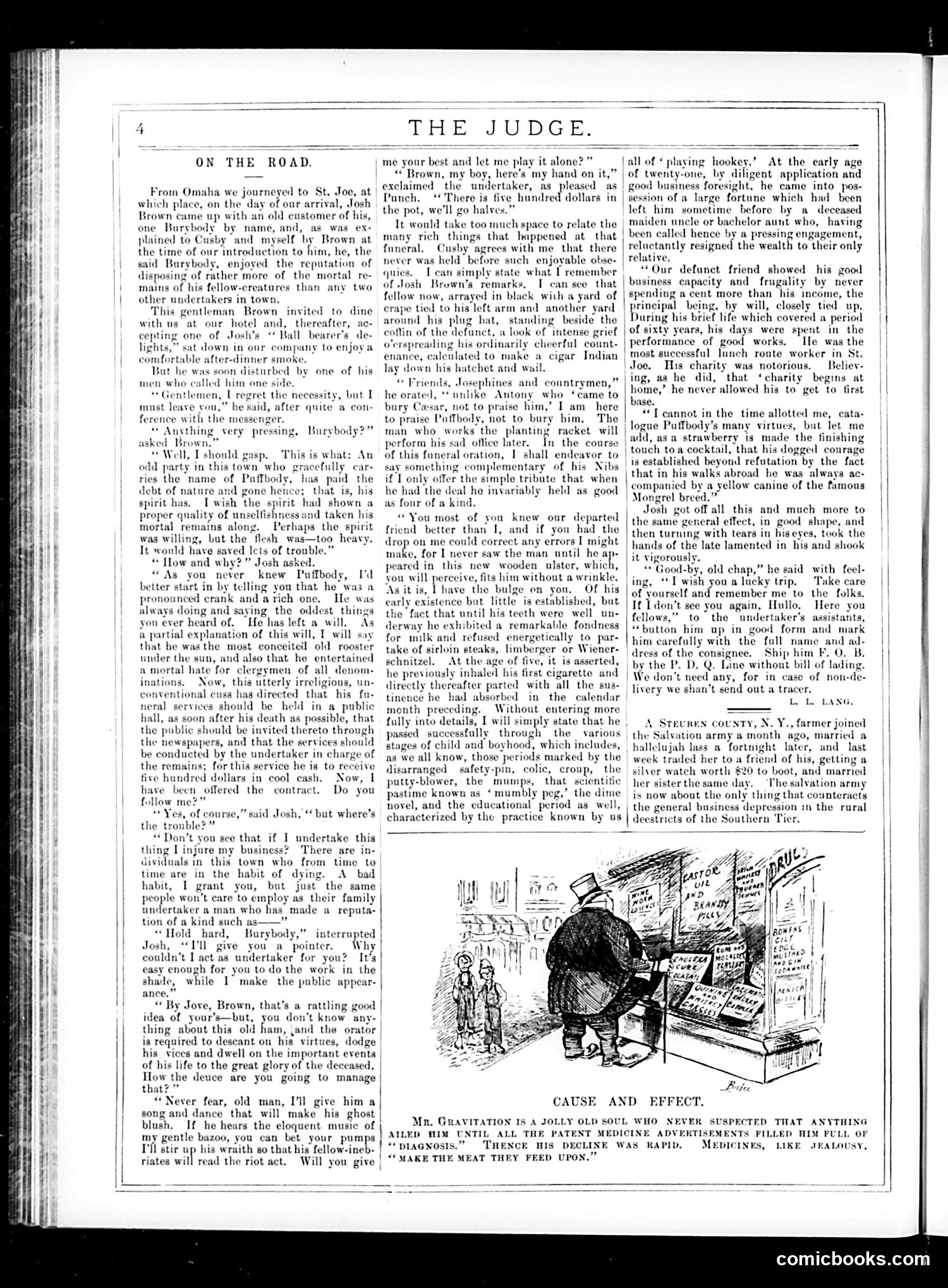
This cartoon satirizes **patent medicine advertising and its dubious claims**. The image shows a charlatan pitchman hawking fraudulent remedies to credulous customers. The caption mockingly describes "Mr. Gravitation" as a gullible soul convinced by patent medicine advertisements filled with pseudo-scientific jargon ("DRAGOONS," "MEDICINES, LIKE JEALOUSY"). The joke's mechanism is simple: the advertiser uses elaborate, meaningless language to sell ineffective or harmful products—the "cause" (fake advertising) produces the ridiculous "effect" (people buying worthless medicine). This reflects late-19th-century Judge magazine's regular criticism of patent medicine fraud, a genuine public health menace. These products often contained dangerous substances and made absurd medical claims. The satire targets both unscrupulous manufacturers and the gullible public who believed their elaborate marketing. The cartoon's humor comes from exposing how pseudo-intellectual language masks commercial exploitation.
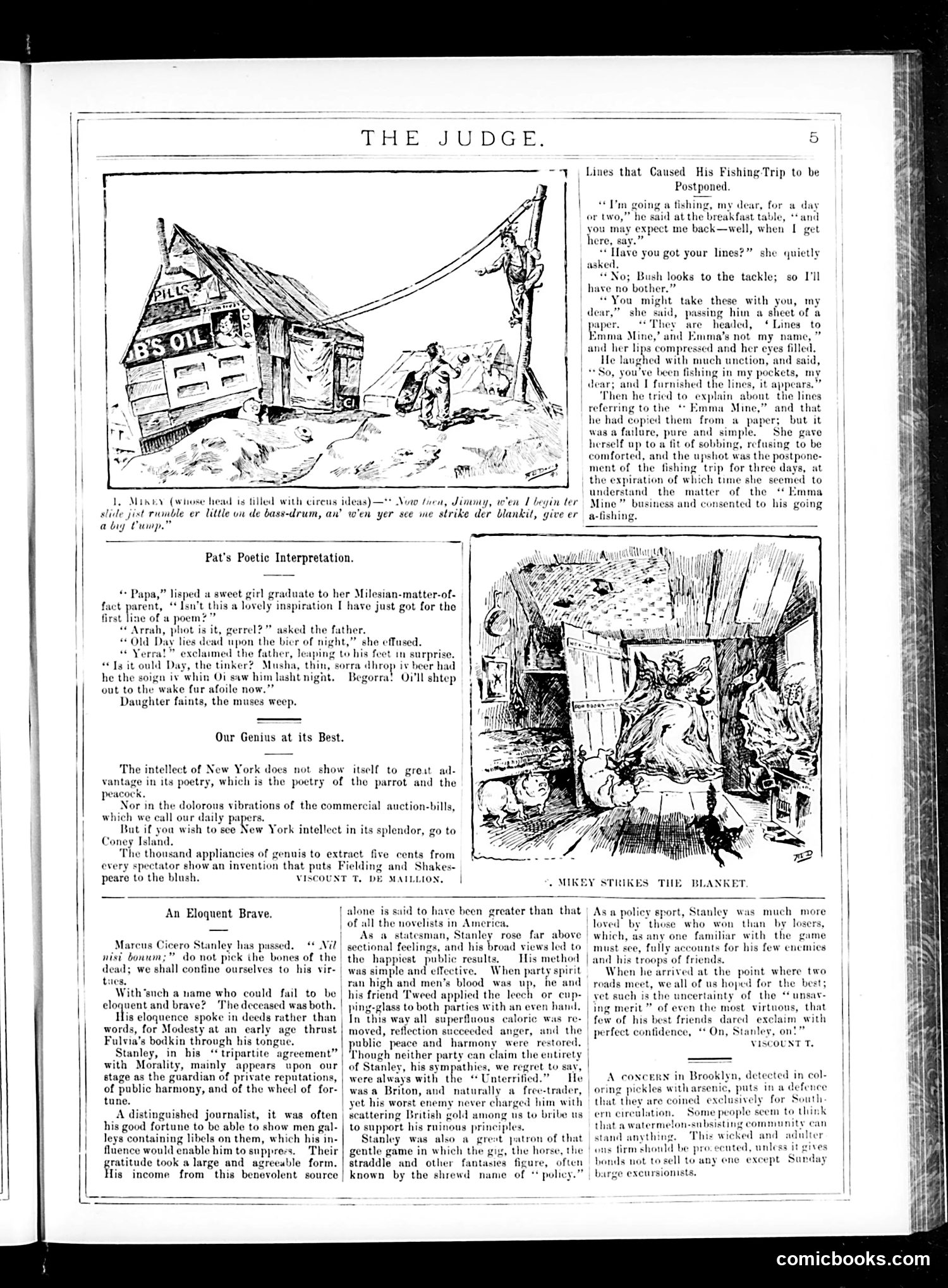
This Judge magazine page contains three distinct satirical pieces: **"Lines that Caused His Fishing Trip to be Postponed"** (top right): A domestic comedy where a husband planning a fishing trip finds his wife has discovered "lines to Emma Mine" in his pockets—suggesting infidelity. He claims they're fishing lines copied from a newspaper about an actual mine, but his wife doesn't believe him. The joke plays on the double meaning of "lines" (romantic deception vs. fishing equipment). **"Pat's Poetic Interpretation"** (middle left): An Irish immigrant father misunderstands his daughter's poetic line "Old Day lies dead upon the bier of night" as literal news about a drunk named "ould Day," planning to attend his wake. The satire mocks Irish immigrant dialect and lowbrow literalness. **"An Eloquent Brave"** (bottom): An obituary-style tribute to Marcus Cicero Stanley (a journalist), praising his ability to suppress libels and maintain public harmony during partisan conflict—likely satirizing actual contemporary political figures and their methods.
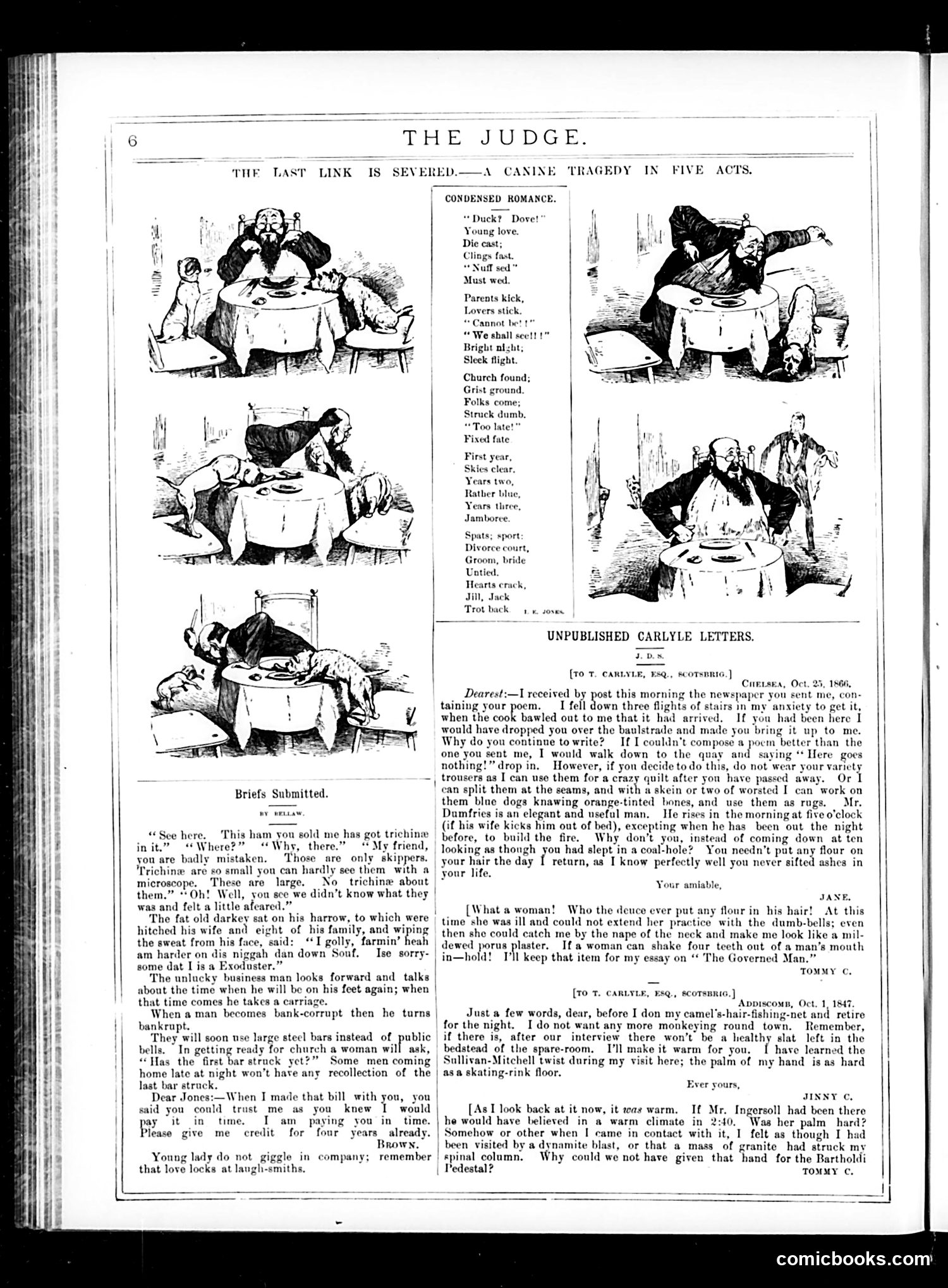
This page contains satirical humor typical of 19th-century Judge magazine. The main feature is a mock "canine tragedy" (left side)—five sequential illustrations showing dogs in romantic entanglement, marriage, and divorce, condensed into pithy rhyming couplets. It's a parody of sentimental Victorian romance narratives, absurdly applied to animals. The right side features fabricated "Unpublished Carlyle Letters"—fake correspondence purporting to be from philosopher Thomas Carlyle and his wife Jane. These mock both the couple's well-known contentious marriage and the Victorian literary fashion for publishing famous people's private letters. The jokes target domestic irritations: Carlyle complains about Jane's writing abilities and housekeeping; Jane retaliates with jabs about his slovenliness and physical weakness. Below are miscellaneous "Briefs Submitted"—short jokes on various topics including food safety (trichinosis), post-Reconstruction racial attitudes, and financial matters. The humor is period-specific and often relies on now-obscure references.
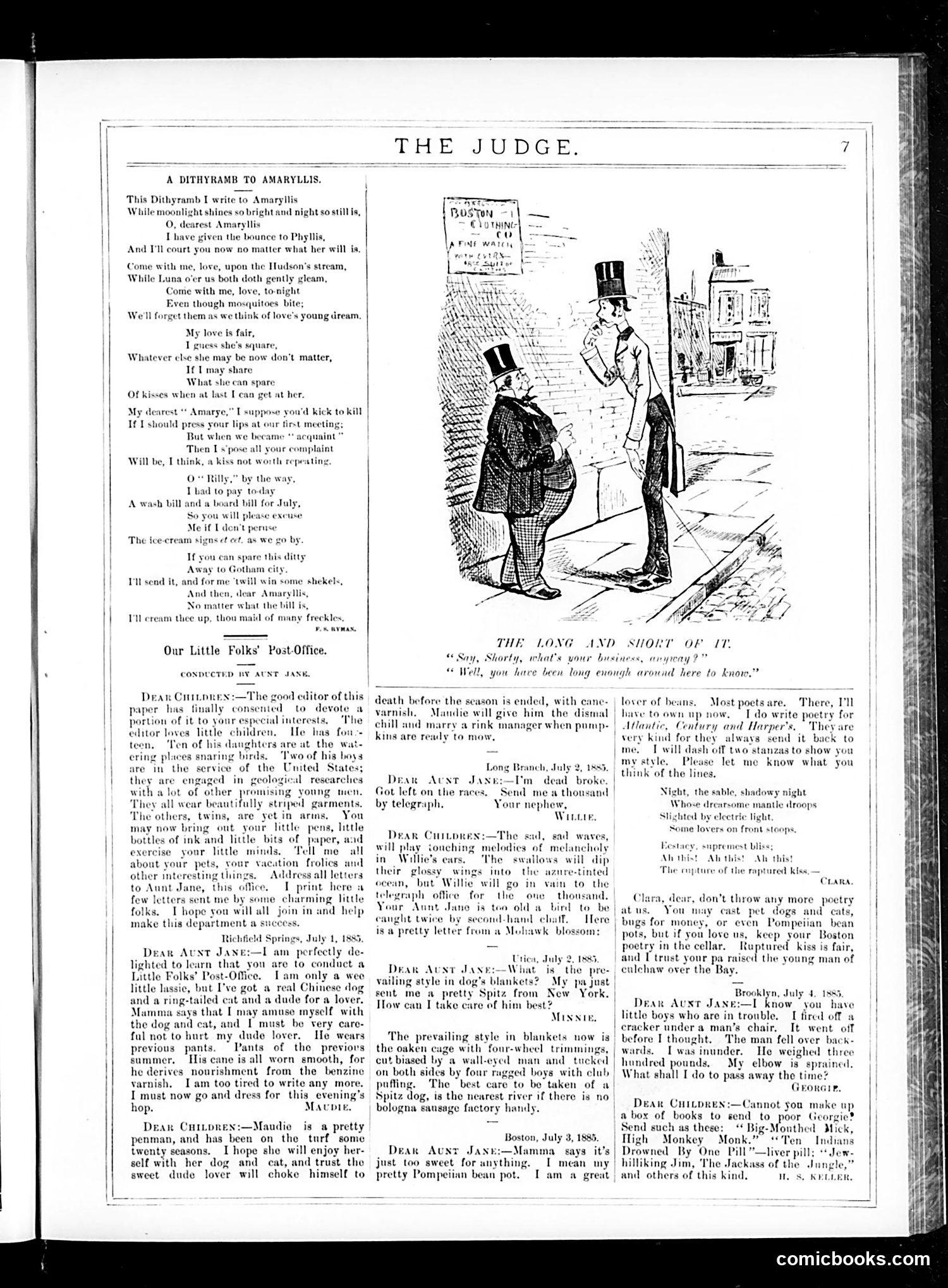
This cartoon depicts two men of contrasting heights—one very tall, one very short—meeting on a street. The caption reads: "Say, Shorty, what's your business, anyway?" / "Well, you have been long enough around here to know." The joke appears to be a simple pun playing on the men's physical differences: "Shorty" is being asked about his business while standing next to a much taller man, creating obvious visual irony. The humor relies on the physical contrast and the somewhat evasive response, suggesting the shorter man's "business" (literal occupation unclear) is somehow related to or defined by their height difference. This is typical light, visual humor from 1880s American satirical magazines—more observational comedy than pointed social commentary. The page's main content is "Our Little Folks' Post-Office," a advice column for children conducted by "Aunt Jane," with the cartoon serving as a sidebar illustration.
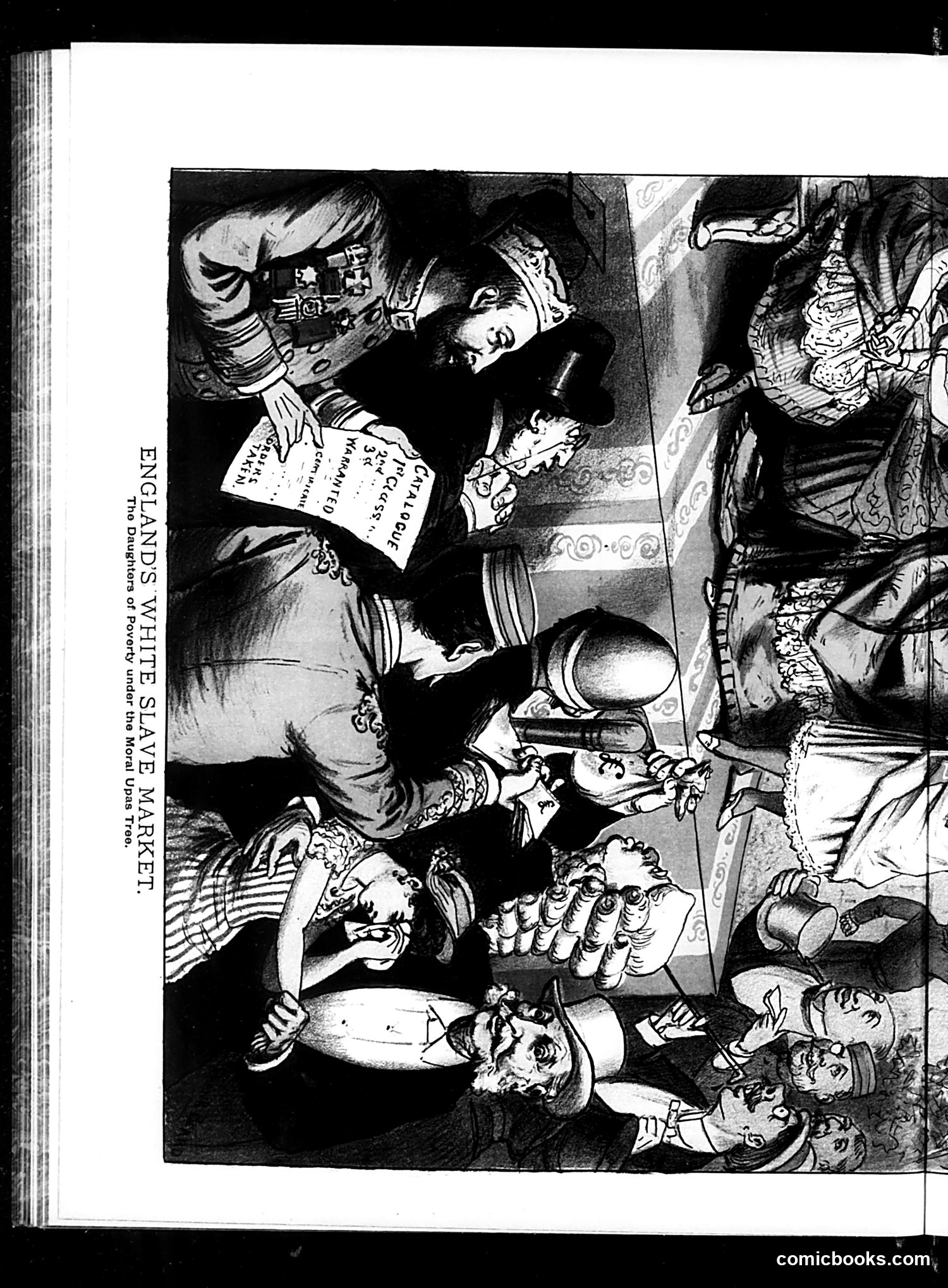
This satirical cartoon depicts a crowded market scene critiquing England's labor practices. The title visible on the left margin reads "ENGLAND'S WHITE SLAVE MARKET" with subtitle "The Development of Poverty under the Moral Uplift Era." The image shows well-dressed figures (likely representing wealthy merchants or politicians) overseeing crowds of working poor—men, women, and children in tattered clothing. One figure holds what appears to be a contract or document, suggesting exploitative labor agreements. The satire attacks British economic inequality and labor conditions during the era, drawing a parallel between this "white slave" exploitation and actual slavery. The contrast between the comfortable upper classes and desperate laborers illustrates Judge magazine's critique of industrial capitalism and poverty amid claimed moral progress. The specific "era" referenced remains unclear without additional context.
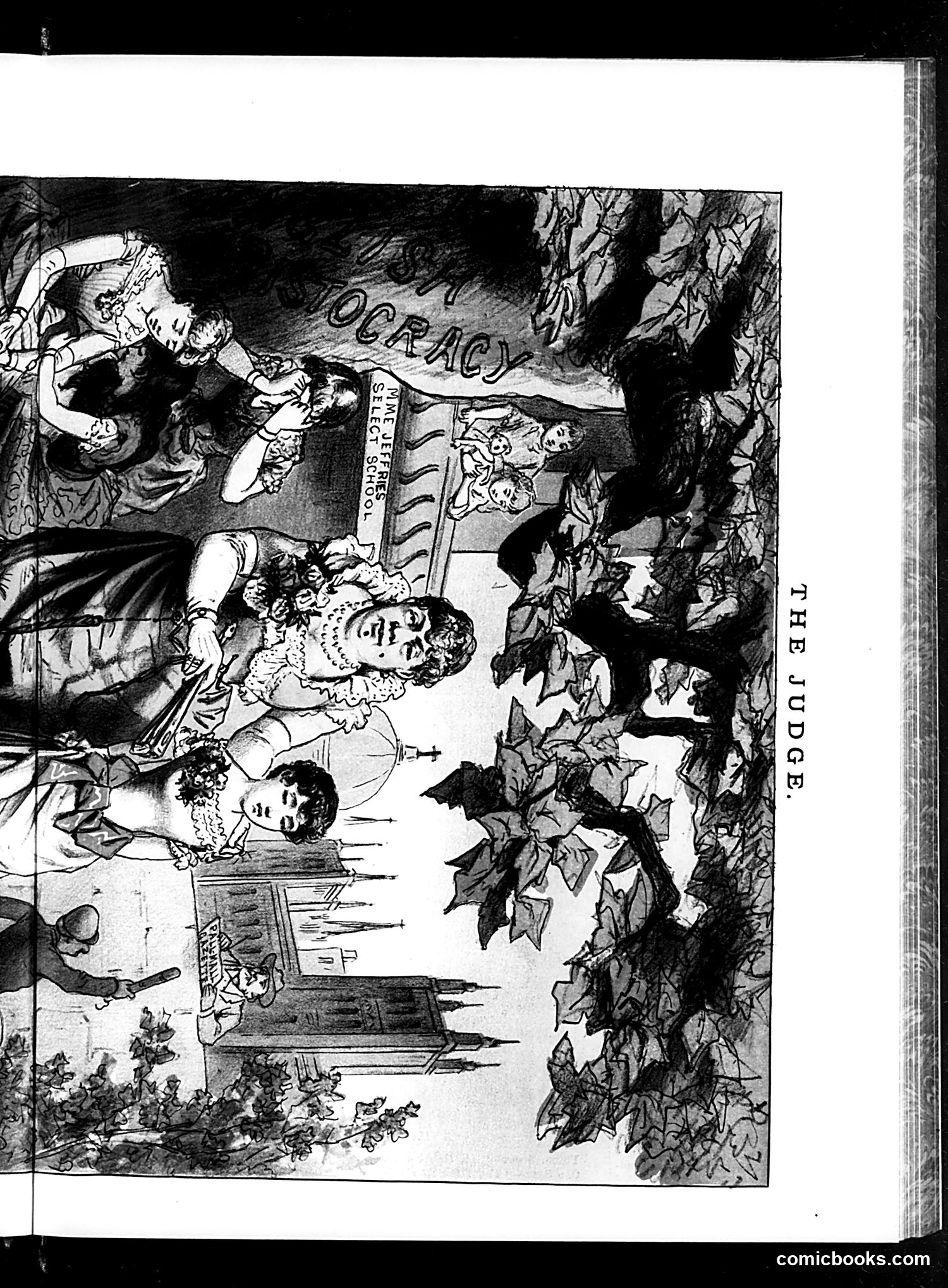
This page is titled "THE JUDGE" and appears to be a satirical illustration, though the OCR text is largely corrupted and unreadable. The image itself shows a garden or orchard scene with ivy-covered walls. There are several figures including what appears to be well-dressed adults and children in Victorian-era clothing. The composition suggests a domestic or social commentary scene, though without legible accompanying text, the specific political or social satire being critiqued remains unclear. The artistic style is consistent with late 19th/early 20th-century Judge magazine illustrations—detailed pen-and-ink work with strong contrast. The garden setting with cultivated plants suggests themes about growth, cultivation, or perhaps class and social hierarchy, but the exact meaning cannot be definitively established from the corrupted text alone.
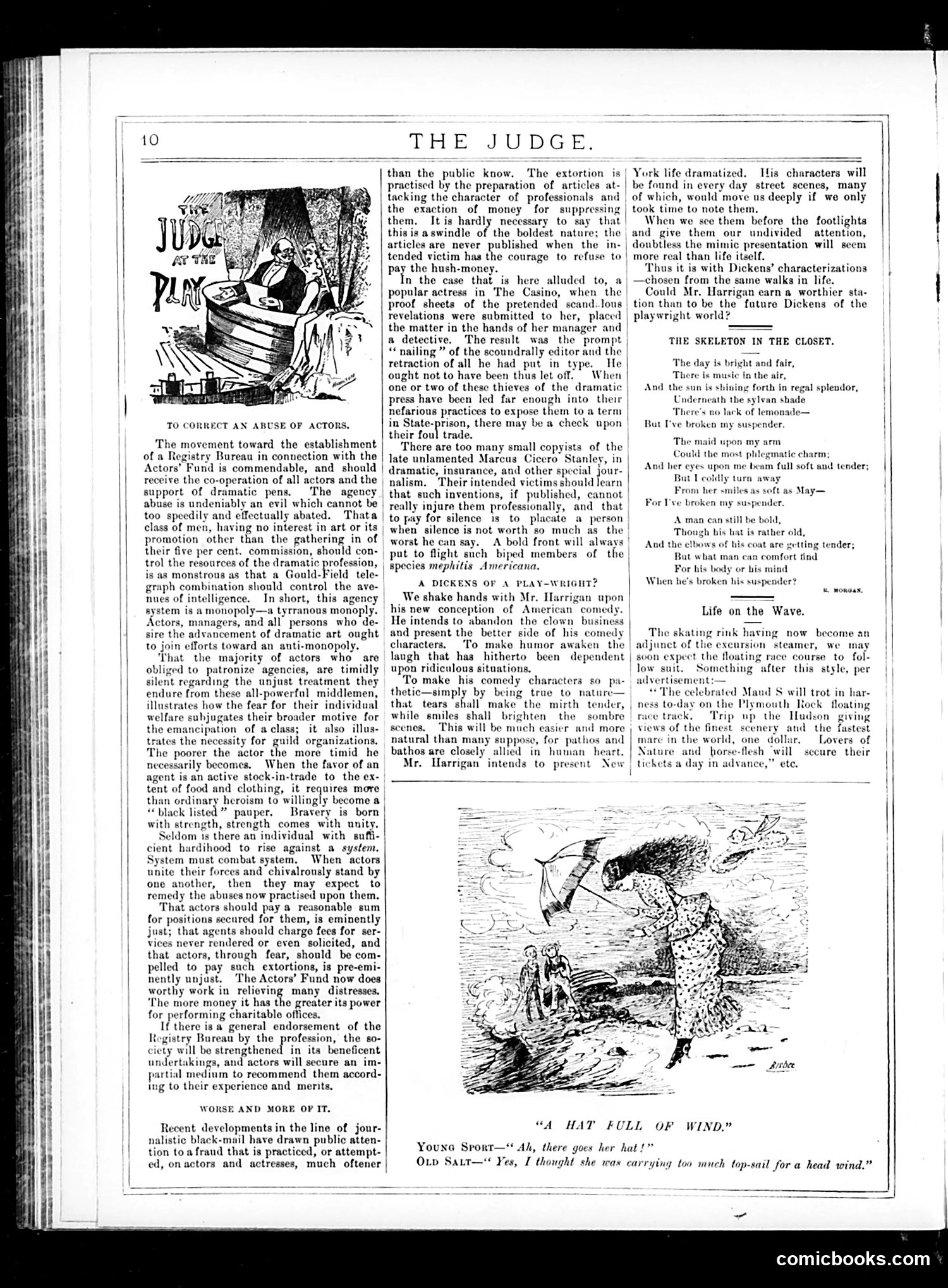
This page addresses **two interconnected abuses** in 1890s American theater: ## Main Articles: **"To Correct an Abuse of Actors"** attacks theatrical **talent agents** who operated as monopolies, exploiting actors through extortionate fees, blacklisting, and fear. The article advocates for an **Actors' Fund Registry Bureau** to break agent control and protect performers—especially poor actors too intimidated to resist. **"Worse and More of It"** exposes **journalistic blackmail**: editors would write scandalous articles about theater professionals, then demand payment for suppression. One unnamed "popular actress" at The Casino thwarted this by involving her manager and a detective, forcing a retraction. The article criticizes the lenient treatment given to these extortionists. ## The Satire: Both pieces critique systemic exploitation of powerless workers (actors) by entrenched middlemen (agents and corrupt journalists). The tone emphasizes that collective action and legal accountability are necessary to combat institutional corruption. The cartoon illustrations accompanying these pieces reinforce themes of theatrical performance and peril, though specific imagery details require clearer visibility.
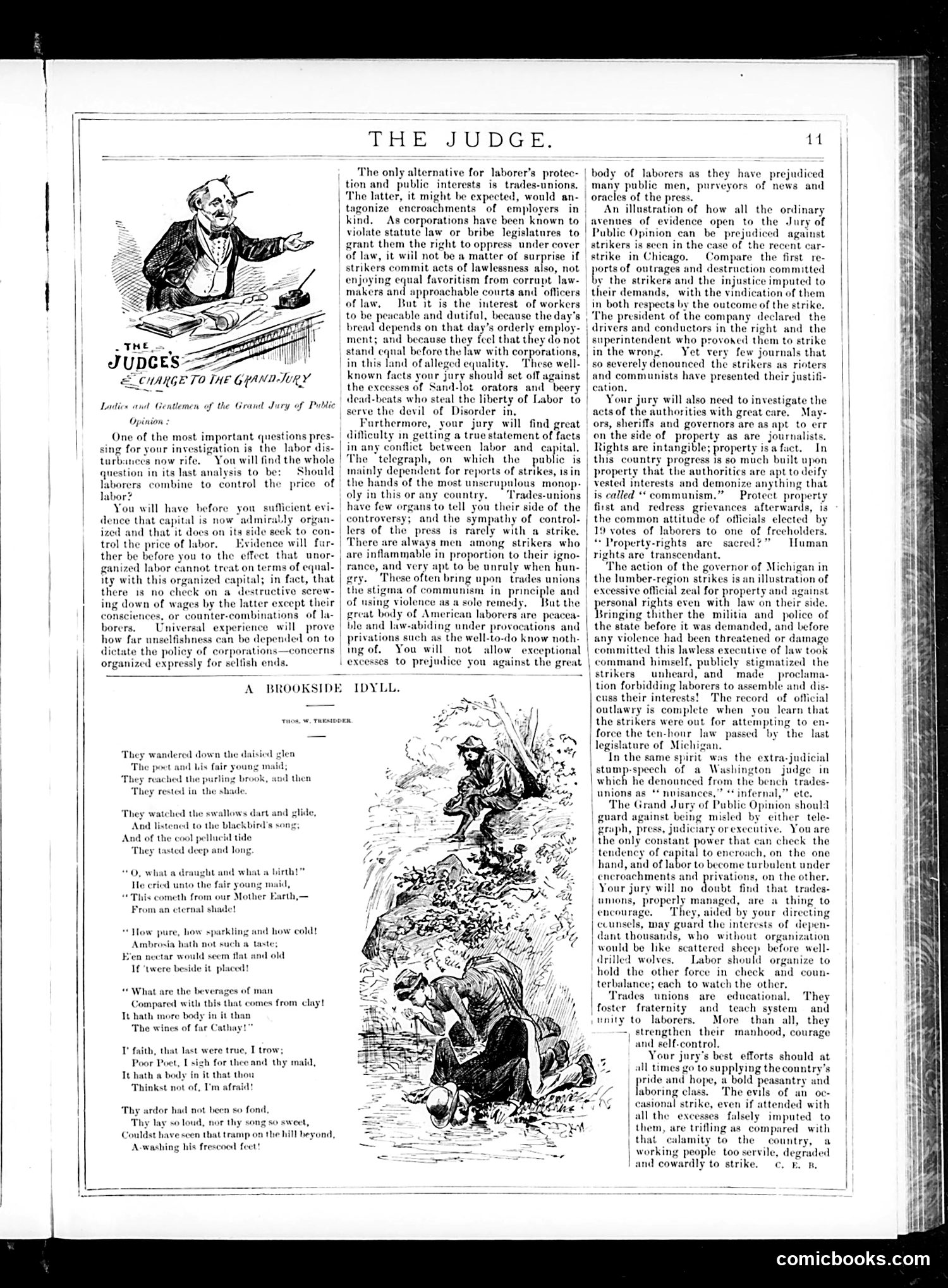
This page presents arguments defending labor unions and strikes to a hypothetical "Grand Jury of Public Opinion." **The Main Cartoon (top left):** Shows a judge or authority figure addressing laborers, advocating for their right to organize. The text frames the fundamental labor question: should workers combine to control wages, as capital already does? **The Argument:** The author contends that: - Organized capital already controls labor prices without restraint - Unorganized labor has no leverage; only unions provide equal footing - Strikes, though sometimes involving excess, are justified responses to exploitation - The press and telegraph monopolies suppress labor's side of strikes - Most laborers are peaceable despite extreme provocations **"A Brookside Idyll" (lower section):** A satirical poem mocking romantic idealization. A poet waxes poetic about pure spring water to his maid—until the punchline reveals a laborer washing his feet upstream, contaminating it. This ridicules those who ignore workers' actual conditions while celebrating nature. **Context:** This reflects Gilded Age labor disputes (likely 1870s-80s), when strikes faced hostile press coverage and judicial bias. The cartoon defends workers' right to organize against powerful industrial interests.
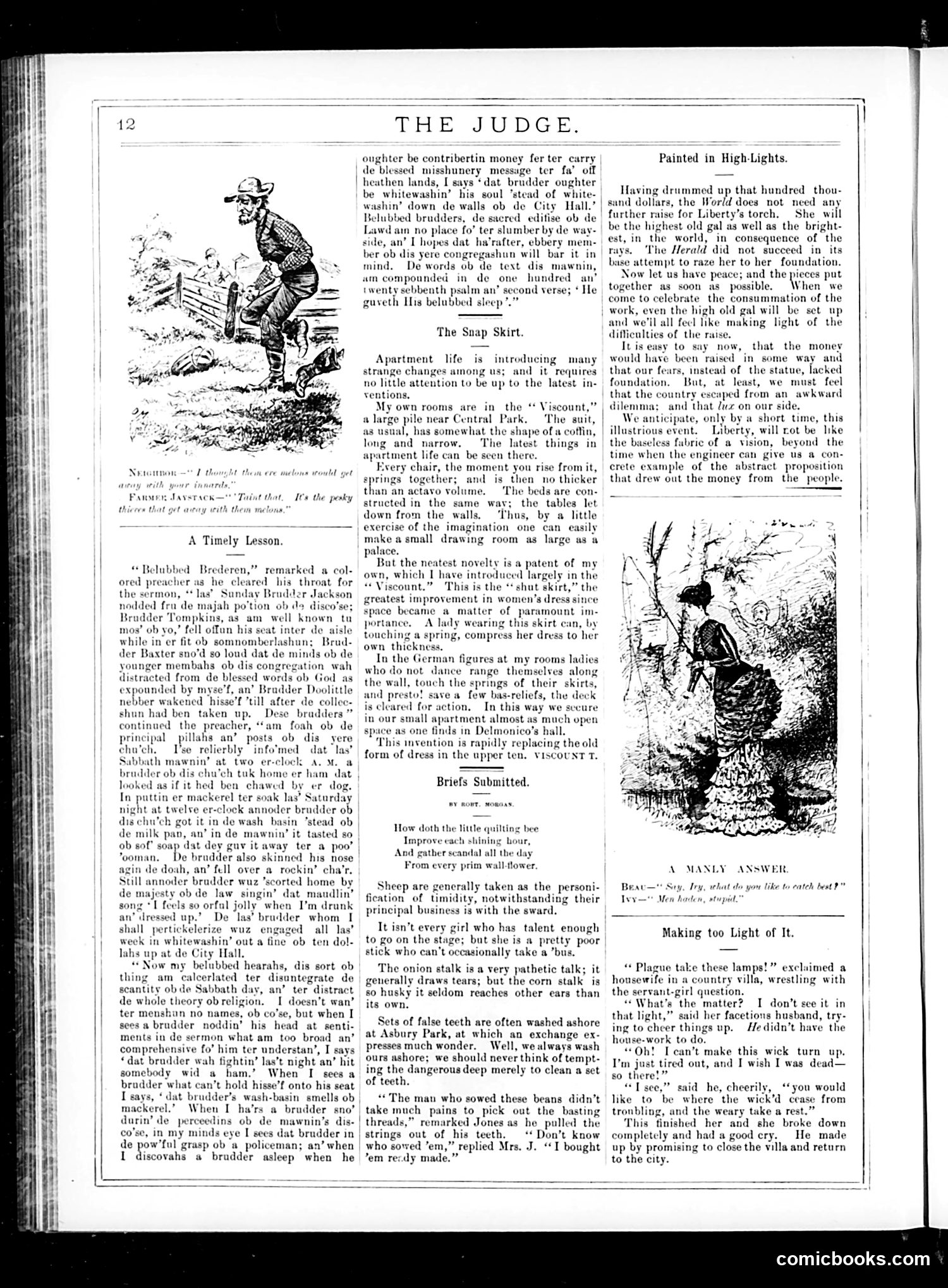
**"A Timely Lesson"** is a satirical sermon delivered by a Black preacher (rendered in exaggerated dialect) criticizing his congregation's weekend misbehavior. He catalogs various sins—sleeping during service, stealing a ham, getting drunk, fighting, and whitewashing city buildings—while hypocritically implying knowledge of perpetrators without "naming names." The joke satirizes both the pretense of moral authority and the gap between Sunday piety and weekday conduct. **"The Snap Skirt"** describes a new mechanical invention for women's fashion: a spring-loaded skirt that compresses when touched, saving space in cramped apartment living. It's satirizing the absurdity of increasingly elaborate "labor-saving" devices marketed to urban apartment dwellers, alongside gentle mockery of women's fashion constraints. Both pieces use humor to critique contemporary urban life, hypocrisy, and consumer culture in the late 19th/early 20th century.
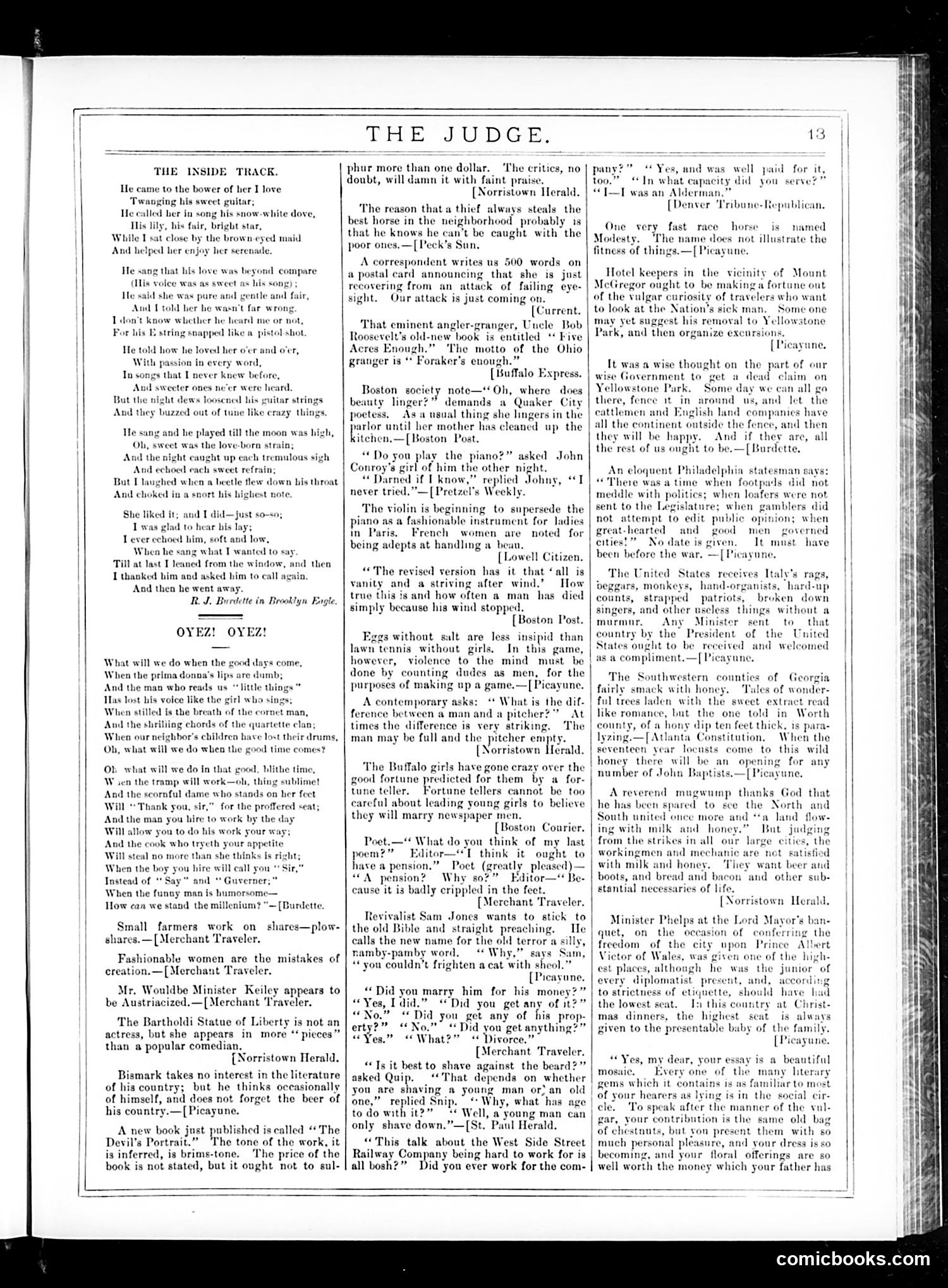
This page from **Judge** (a satirical American magazine) contains primarily **humorous prose and poetry** rather than political cartoons. The main content is "The Inside Track," a humorous poem by R.J. Burdette about a rival suitor who serenades a young woman with guitar music. The joke: despite his romantic singing, a beetle flies down his throat mid-performance, ruining the mood and giving the narrator (the competing suitor) the advantage. It's a lighthearted romantic comedy with no political content. The rest of the page consists of **brief satirical quips** mocking contemporary social types: fashionable women, small farmers, politicians (Minister Keiley), and Bismarck. These are generic social satire rather than commentary on specific events. **"Oyez! Oyez!"** is a longer poem questioning what society will do when performers and workers lose their ability to work—a gentle satire on dependence on entertainment and labor. Overall, this is a **humor and light satire page** with no significant political commentary or identifiable caricatures requiring historical context beyond understanding Victorian-era social conventions.
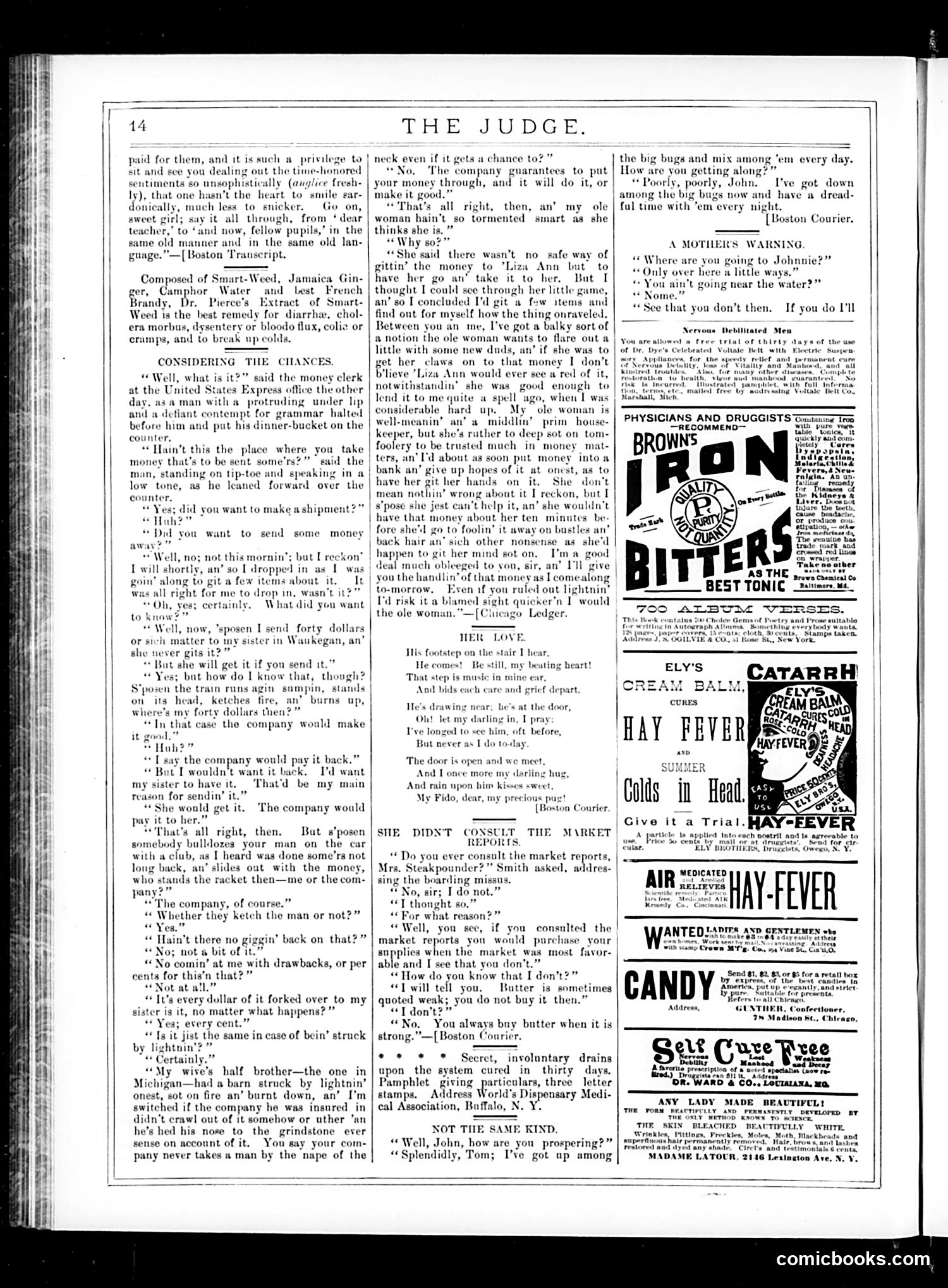
This page contains primarily **humor columns and advertisements** rather than political cartoons. The main content features **humorous anecdotes** about everyday American life, likely from the late 19th century. Notable pieces include: 1. **"Considering the Chances"** - A dialogue between an unsophisticated working man and a money clerk at a U.S. Express office, satirizing rural/working-class dialect and financial anxiety. 2. **"A Mother's Warning"** - A monologue about a man's distrust of his wife's financial judgment, reflecting period anxieties about women's spending habits. 3. **Rural/dialect humor** - Multiple pieces exploit exaggerated rural speech patterns and stereotypes for comedic effect. The right side contains period **patent medicine advertisements** (Browne's Iron Bitters, Ely's Cream Balm, Hay-Fever remedies), typical of Judge's revenue model. The satire targets **working-class anxieties** about money management, marital dynamics, and financial institutions—common themes in Gilded Age humor magazines. The heavy reliance on dialect comedy reflects Victorian attitudes toward rural/immigrant populations.
This is primarily an **advertising page** from Judge magazine, not editorial content with substantive satire. The page contains five brief humorous anecdotes in the text columns: 1. **"The Judge"** – A mother's increasingly absurd warnings to her child during vacation, satirizing parental anxiety. 2. **"So Far and No Farther"** – A shoe-shiner's witty comeback to a gruff customer who won't be polished beyond his shoes. 3. **"The Dog All Right"** – A broken-English German shoemaker satisfied that his new dog bites people, even when warned it might be a lie. 4. **"Lying to a Burglar"** – A man credits his dog with stopping a burglar by falsely claiming "it's ten days too early" (for the electric light bill payment scam). 5. **"Professional Etiquette"** – Doctors justifying advertising patent medicines, particularly Dr. Pierce's "Golden Medical Discovery." These are light, observational humor pieces typical of the era's satirical magazines. The bulk of the page is advertisements for pianos, book binding, trusses, and medical remedies—standard period commercial placement.
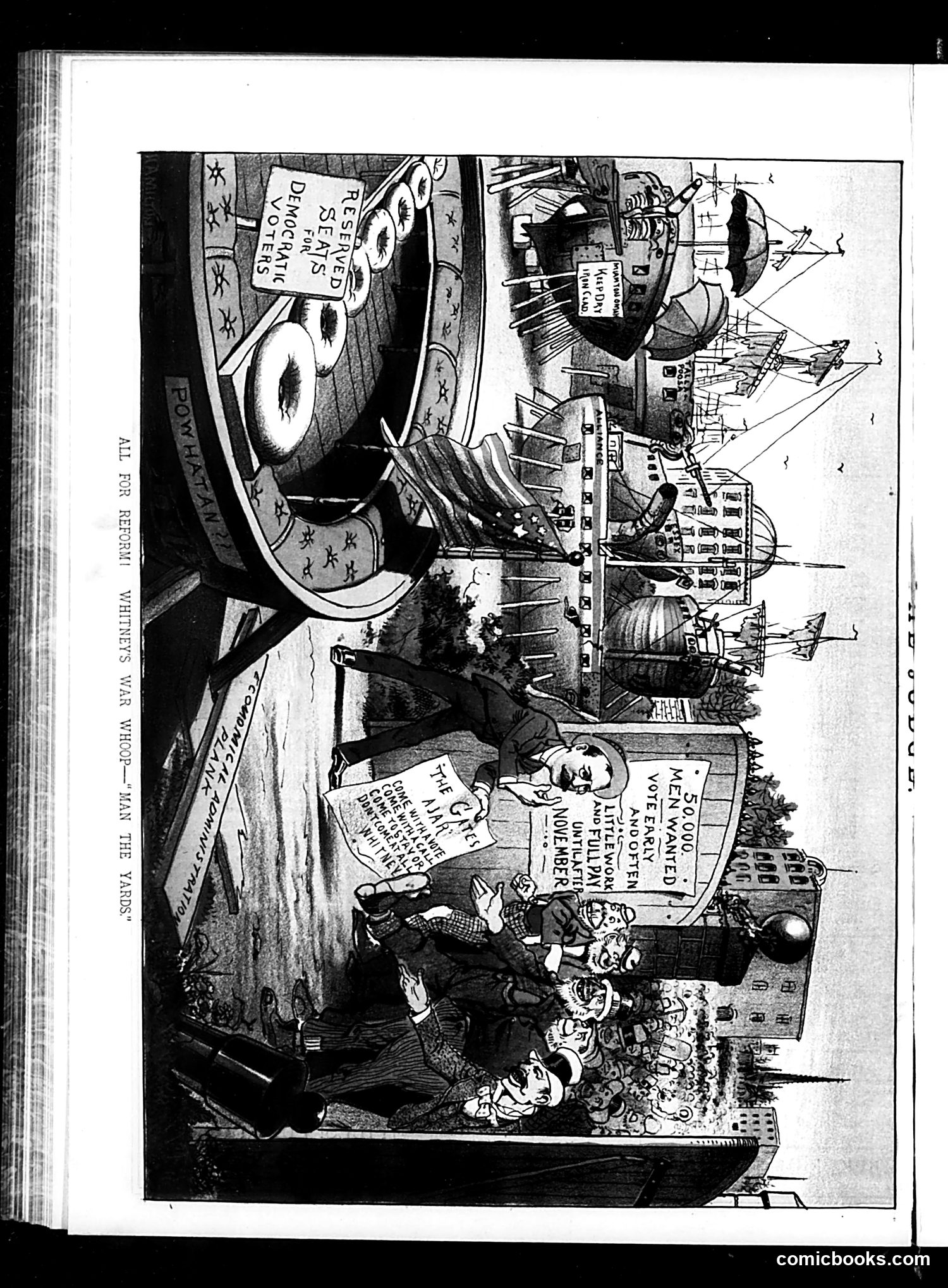
This Judge magazine page depicts a satirical scene about wartime recruitment. The central figure appears to be a military or government recruiter standing beside a large sign reading "50,000 MEN WANTED" with "VOTE EARLY" prominently displayed. The cartoon criticizes the conflation of voting rights with military conscription or enlistment during what appears to be a wartime period. The satire suggests that authorities are using patriotic language about voting to pressure or manipulate citizens into military service. The juxtaposition of "vote early" with recruitment messaging implies dark humor about coercion masquerading as democratic choice. The crowd of figures at the bottom likely represents the public being urged toward enlistment. This reflects anxieties about wartime government overreach and the blurring of civilian and military obligations during conscription periods in American history.

I can see this is a page from *Judge* magazine, but the image quality is too poor for me to make out specific cartoon content, illustrations, or readable text beyond the watermark and some barely visible markings on the left margin. The page appears to be mostly blank or extremely faded. Without being able to clearly identify any figures, captions, or visual elements, I cannot accurately explain what political or social satire this page contains. To provide you with accurate historical analysis following your rules, I would need a clearer, higher-resolution image where the actual cartoon artwork and text are legible. If you have a clearer version of this page, I'd be happy to analyze it properly.
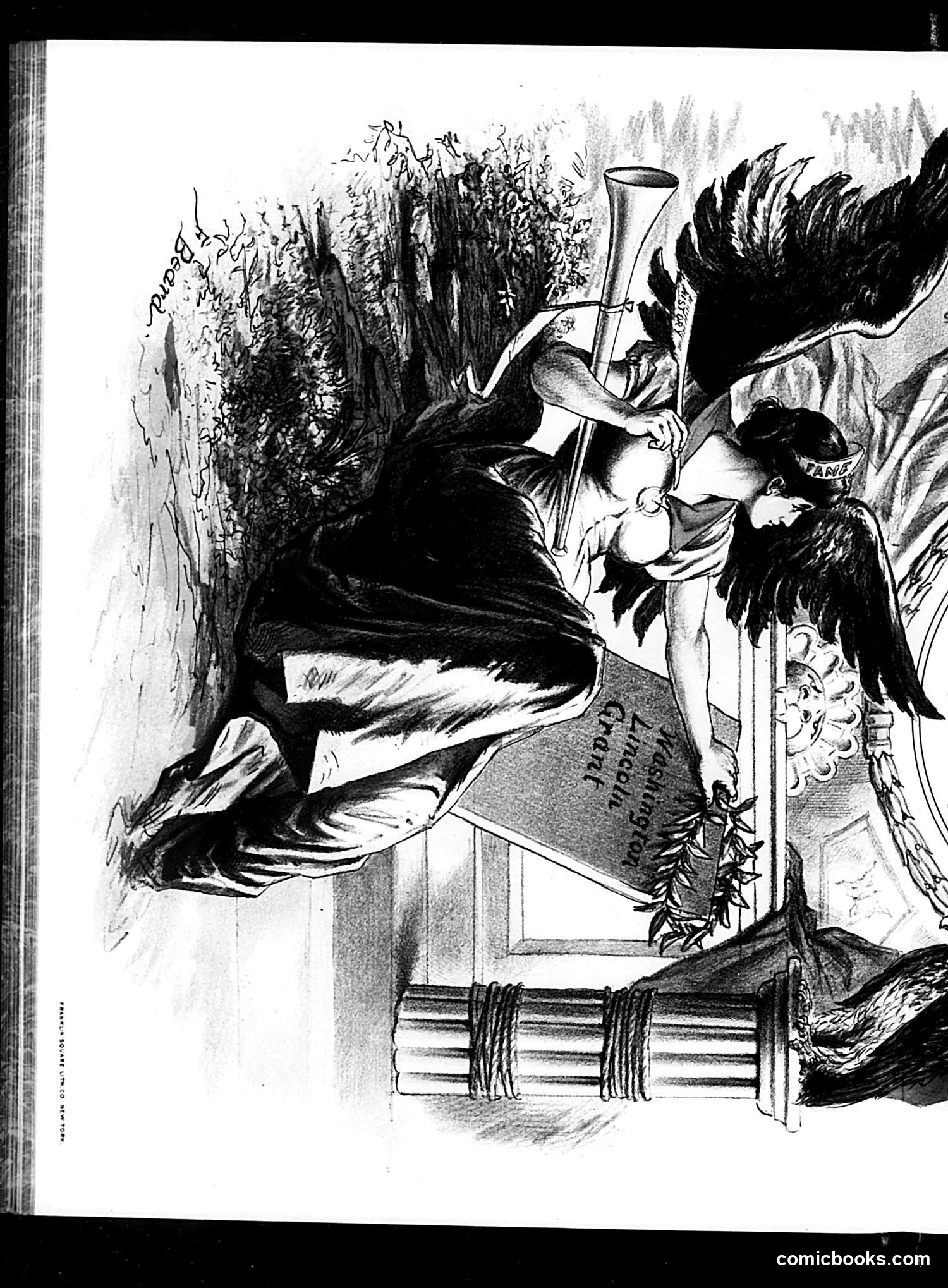
This appears to be a satirical cartoon from *Judge* magazine, though the OCR text is too corrupted to read the caption clearly. The image shows a figure in dark clothing reclining or resting against what appears to be a pedestal or monument, holding a long pipe or staff. The scene is set among vegetation and natural elements, rendered in detailed black-and-white ink. Without legible text identifying the specific figures or referencing particular events, I cannot definitively explain the political or social satire intended. The composition suggests commentary on leisure, authority, or perhaps criticism of a public figure or institution, but the exact meaning remains unclear without readable accompanying text or source information about the publication date.
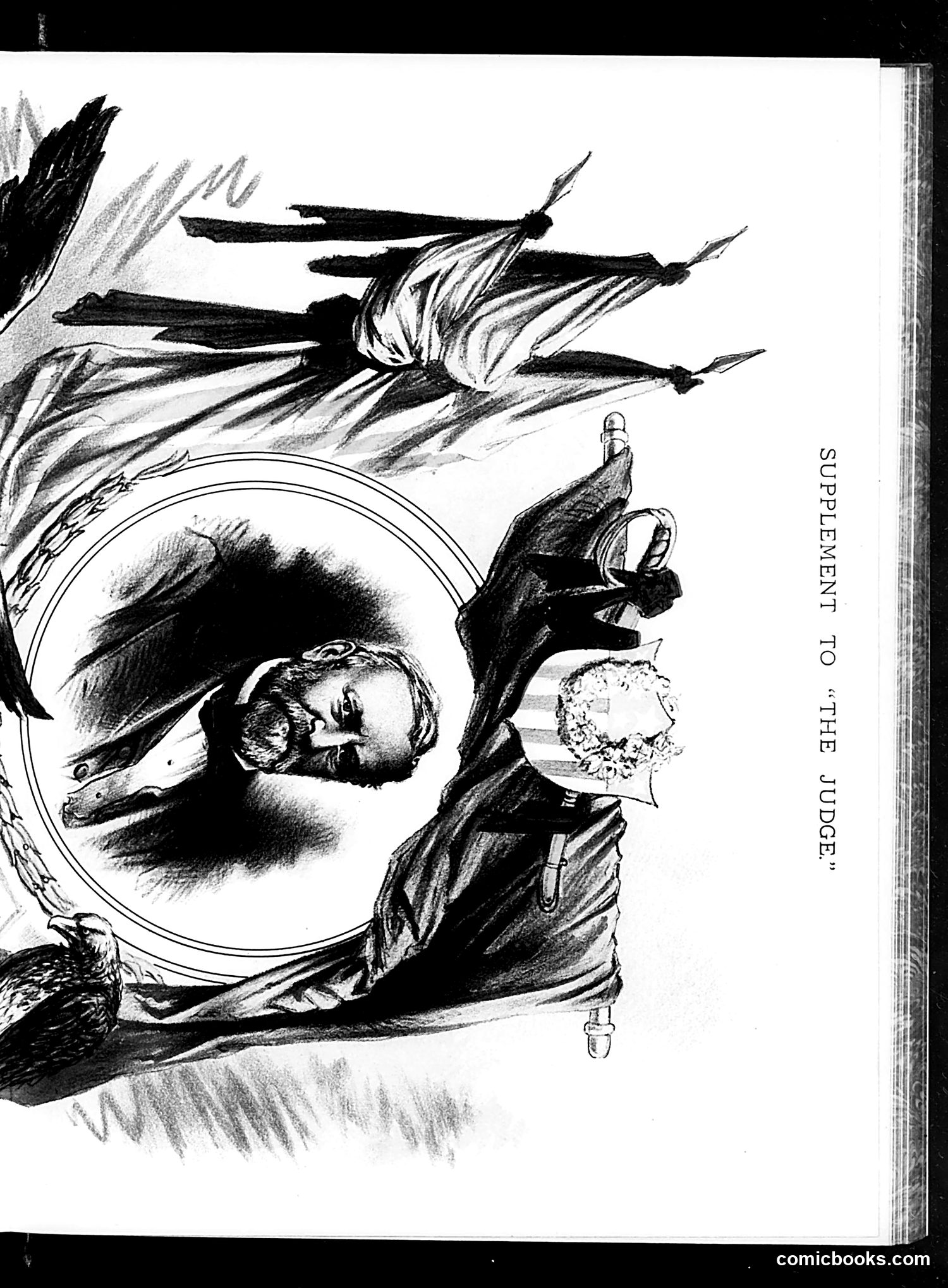
This appears to be a supplement cover from *Judge* magazine featuring a satirical illustration titled "Supplement to 'The Judge.'" The cartoon depicts a figure in judicial robes (labeled as "The Judge") holding what appears to be a wreath or circular object, while celestial or allegorical figures float above—possibly representing justice, fate, or divine judgment. The dramatic, swirling composition with flowing drapery suggests themes of legal authority and moral consequence. However, without clearer identification of specific contemporary figures or dated context visible on the page, I cannot definitively identify which judge or legal case this references, or pinpoint the exact satirical target. The artistic style and subject matter indicate commentary on the American judicial system, but the specific political or social critique requires additional contextual information.