
Judge, 1885-08-01 · page 11 of 19
Judge — August 1, 1885 — page 11: what you’re looking at
What you’re looking at
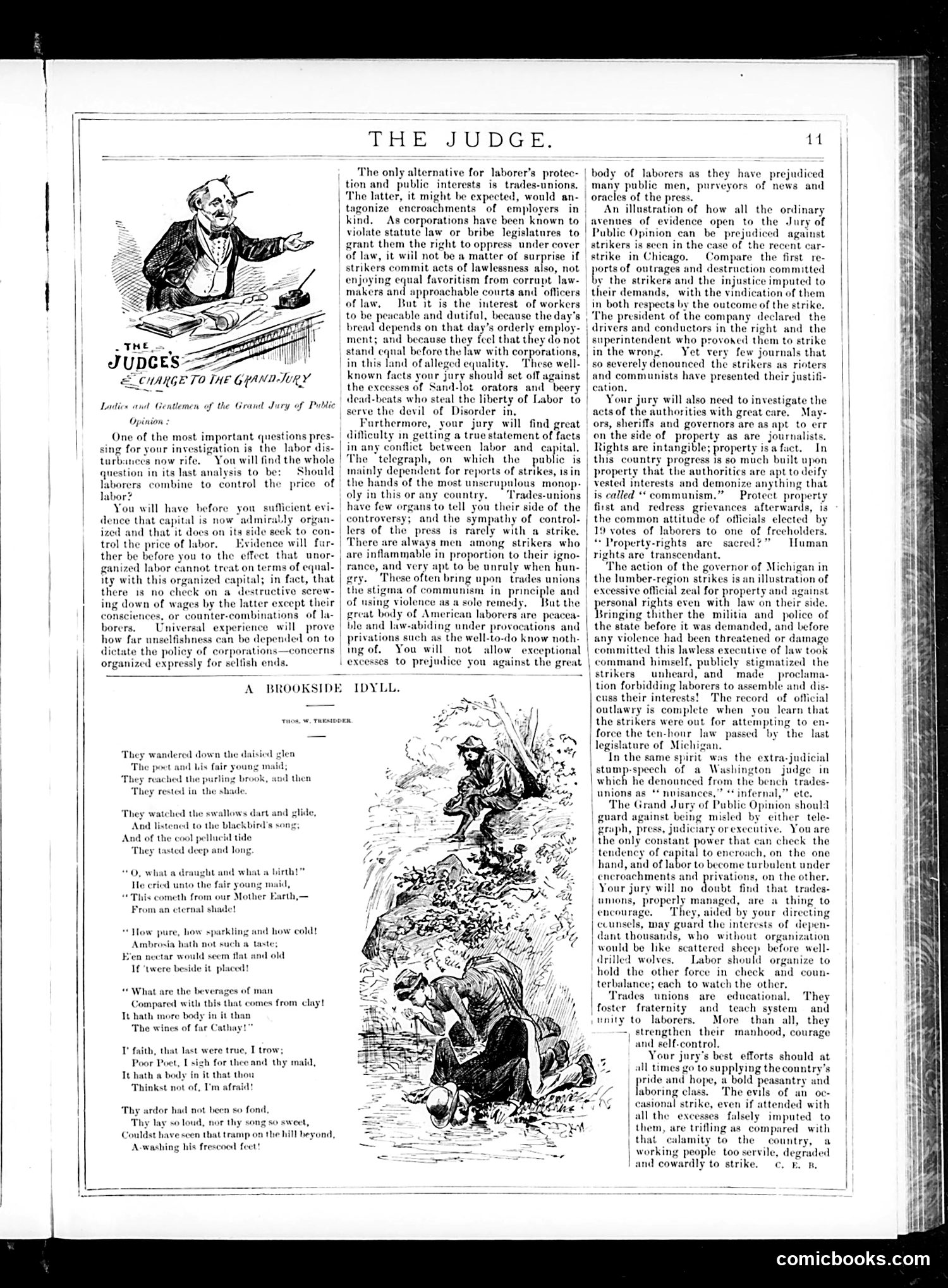
This page presents arguments defending labor unions and strikes to a hypothetical "Grand Jury of Public Opinion." **The Main Cartoon (top left):** Shows a judge or authority figure addressing laborers, advocating for their right to organize. The text frames the fundamental labor question: should workers combine to control wages, as capital already does? **The Argument:** The author contends that: - Organized capital already controls labor prices without restraint - Unorganized labor has no leverage; only unions provide equal footing - Strikes, though sometimes involving excess, are justified responses to exploitation - The press and telegraph monopolies suppress labor's side of strikes - Most laborers are peaceable despite extreme provocations **"A Brookside Idyll" (lower section):** A satirical poem mocking romantic idealization. A poet waxes poetic about pure spring water to his maid—until the punchline reveals a laborer washing his feet upstream, contaminating it. This ridicules those who ignore workers' actual conditions while celebrating nature. **Context:** This reflects Gilded Age labor disputes (likely 1870s-80s), when strikes faced hostile press coverage and judicial bias. The cartoon defends workers' right to organize against powerful industrial interests.
📄 Transcribed text from this page (OCR, searchable)
Machine-transcribed from the original scan — historical spelling and the odd misread are preserved.
Ladies and Gentlemen of the Grant Jury of Public Opinion : One of the most important questions pres- sing for your investigation is the labor dis- | turbanecs now rife. You will find the whole | question in its last analysis to be: Should laborers combine to control the price of labor? you sufli Imirably You will have before dence that capital is now ized and that it docs on its side seek to trol the price of labor. Evidence will f1 ther be before you to the effect that. unor- gani labor cannot treat on terms of equal- ity with this organized capital; in fact, that there is no check on a destructive screw- ing down of wages by the latter except their consciences, or counter-combinations of la- | Universal how far unselfishr dictate the police; organized expressly borers. experience will prove can be depended on to of corporations—concerns for seltish en A BROOKSIDE poet and bis They reached the purling brook, q cd in the shade. ir you vod then atched the swallows dart and glide, listened to the Dlackbird’'s s« And of the cool pellucid tide ‘They tasted deep and long. “0, what a dra He cried unto th “This cometh from From an eternal sh ht and what a birth!” fair young mai uur Moth + How pure, how sparkling Ambrosia hath n Een nectar would seem fh If ‘twere be placed! “What are the be Compared with this that comes from chy! Tt hath more body in it than The wines of far Cathay! I’ faith, that last were true, I trow; Poor Poet, sigh for theeand thy maid, It hath a body in it that thou Thinkst not of, I'm afraid! ‘Thy ardor had not been so fond, Thy lay so loud, nor thy song so sweet, Couldst have seen that tr the hill heyond, A-washing his frescoot feet! | tagonize encroachments of employ THE JUDGE, The only alternative for laborer’s protec- tion and public interests is trades-unions. The latter, it might be expected, would an- rs in kind. As corporations have been known to violate statute law or bribe legi grant them the right to oppress under cover of law, it wiil not be a matter of surprise if strikers commit acts of lawlessness also, not enjoying equal favoritism from corrupt law- makers and approachable courts and officers of law, But it is the interest of workers to be ble and dutiful, the day's bread depends on that da employ- ment; and because they feel that they ‘lp not stand eq with corporations, in this land of alleged equality. These well- known facts your jury should sct off against the excesses of Sand-lot orators and beery dead-beats who steal the liberty of Labor to serve the devil of Disorder in, Furthermore, your jury will find great dificulty in getting a true statement of in any conflict between labor and capital. The ‘telegraph, on which the pablic is mainly dependent for reports of strikes, 1s in the hands of the most unscrupulous monop- in this or any country ‘Trades-unions e few organs to tell you their side of the controversy; and the sympathy of control- lers of the press is rarely with a strike. ere are always men among strikers who are inflammable in proportion to their igno- rance, and ve pt to be unruly when hun- “These often bring upon. trades unions of communism in principle and ing violence as a sole remedy. Hut the body of American laborers are peacea- nd law-abiding under provocations and privations such as ‘the well-to- do know noth- ing of. You will not allow exceptional excesses to prejudice u against the great | IDYLL. slatures to | 14 body of labore; they have prejudiced many public men, purveyors of news and oracles of the press. An illustration of how all the ordinary avenues of evidence open to the Jury of Public Opinion can be prejudiced against strikers is seen in the case of the recent car- strike in Chicago. Compare the first re- ports of outrages and destruction committed by the strikers and the injustice imputed to their demands, with the vindi them in both respects by the outcome of the strike. ‘The president of the company declared the drivers and conductors in the right and the superintendent who provoxed them to strike in the wrong. Yet very few journals that so severely denounced the strike rioters and communists have presented their justifi- cation, Your jury will also need to investigate the acts of the authorities with great care. May- ors, sheriffs and governors are as apt to err on the side of property as are journalists. Rights are intangible; property isa fact. In this country progress 1s so much built upon property that the authorities are apt to deify vested interests and demonize a ything that is called “communism.” Protect. propert first and redress grievances afterwards, i the common attitude of officials elected by 19 votes of laborers to one of freeholde: ‘Property-rights are. sacred?” — Human rights are transcendant. The action of the governor of Michigan in the lumber-region strikes is an illustration of excessive official zeal for property and against personal rights even with law on their side. ringing thither the militia and police of the state before it was demanded, and before any violence had been threatened or damage committed this lawless executive of law took command himself, publicly stigmati: the | strikers unheard, and ‘made proclama- | tion forbidding laborers to assemble and dis- | cuss their interests!’ The record of official outlawry is complete when you n that the strikers were out for attempting to en- | force the ten-hour law passed by the last | legislature of Michigan. In the same spirit was the extra-judicial |stump-speech of a Washington judge in | which he denounced from the be neh tra unions * nuisanc “infernal,” ete. | The Grand Jury of Public Opinion should guard against being misled by either tele- hy press, judiciary orexecutive. You are | Theloniy constant power t ck the tendency of cay to encroach, on the one hand, ai J of labor to become turbulent under encroachments and privations, on the other. Your jury will no doubt find that. trades- [umons, properly managed, are a thing to encourage. They, aided by your directing | ccunsels, may guard the interests of depen- dant thousands, who without organization | would be like scattered sheep before well- drilled wolves, Labor should organize to hold the other force in check and coun- nee; each to watch the other. ‘Trades unions are educational. ter fraternity and teach system and ity to laborers. More than all, they -, strengthen their manhood, courage and se elf-control. Your jury's best efforts should at » to supplying the cou 's pride and hope, a bold peasantry and laboring class. The evils of an oc- sional strike, even if attended with I the ex y imputed to ut They | them, are trifling as compared with that calamity to the country | working people too servile, | and cowardly to strike. c, comicbooks.com