
Judge, 1885-08-01 · page 2 of 19
Judge — August 1, 1885 — page 2: what you’re looking at
What you’re looking at
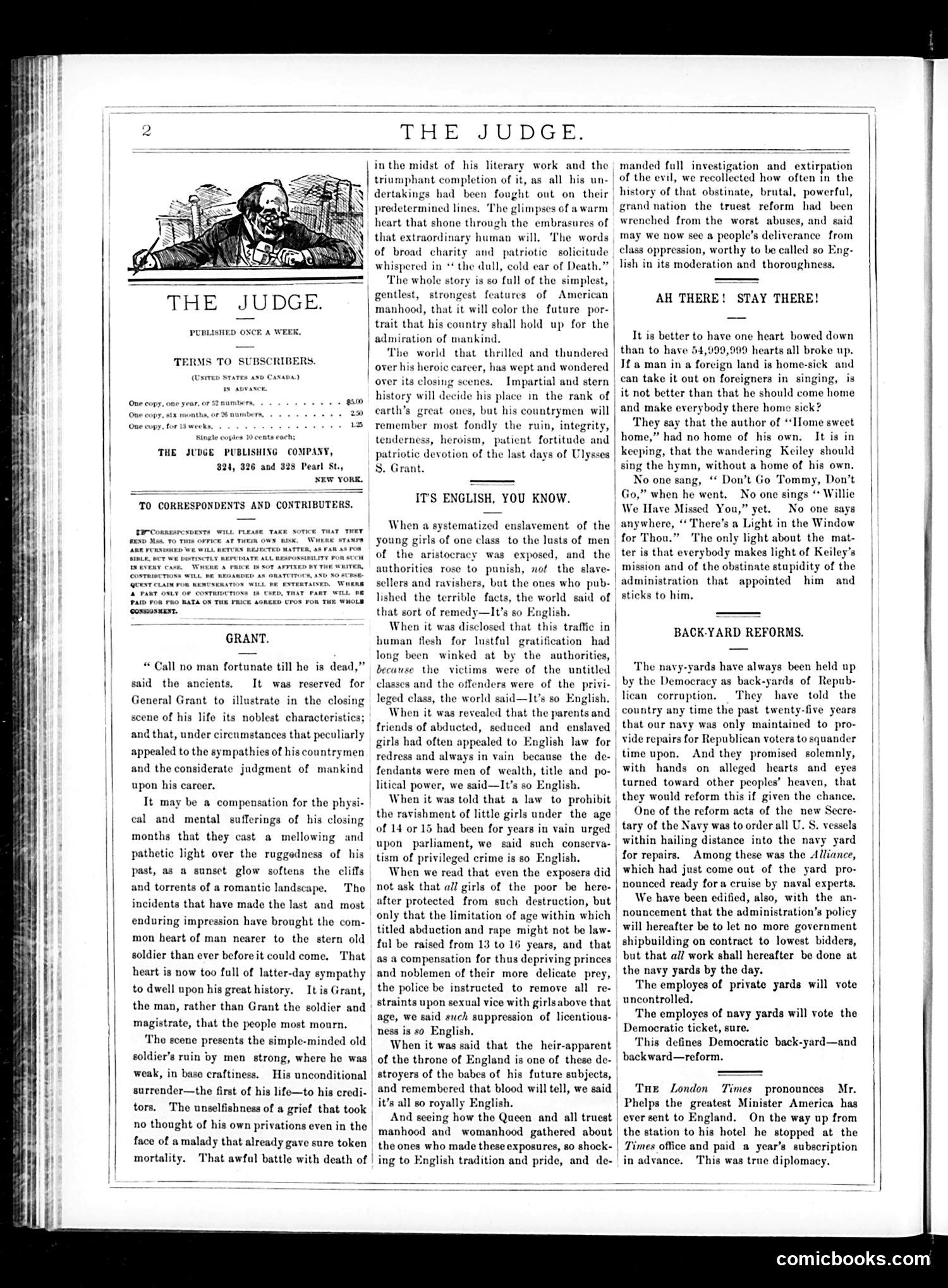
This page from Judge magazine (likely 1870s-1880s based on content) contains political commentary rather than traditional cartoons. The main content addresses: **The Grant Section**: A tribute to General Ulysses S. Grant's character and legacy, emphasizing his integrity during turbulent post-Civil War years. It praises him as embodying American manhood. **"It's English, You Know"**: Satirizes British hypocrisy regarding child exploitation and trafficking. The piece notes that when authorities discovered systematic enslavement of poor girls by aristocratic men, they punished the *whistleblowers* rather than the perpetrators—calling this characteristically English corruption and indifference to class injustice. **"Back Yard Reforms"**: Criticizes Democrats for using naval yard corruption as political ammunition against Republicans, while both parties tolerated systemic abuse for decades. The satirical point: Britain's moral pretenses mask institutional depravity; American politicians exploit scandals for partisan gain rather than genuine reform.
📄 Transcribed text from this page (OCR, searchable)
Machine-transcribed from the original scan — historical spelling and the odd misread are preserved.
THE JUDGE. inthe midst of his literary work and the | manded full investigation and extirpation triumphant completion of it, as all his un- | of the evil, we recollected how often in the | dertakings had been fought out on their | history of that obstinate, brutal, powerful, predetermined lines. ‘The glimpses of awarm grand nation the truest reform had been heart that shone through the embrasures of Wrenched from the worst abuses, and said that extraordinary human will, ‘The words , May we now see a people’s deliverance from of broad charity and patriotic solicitude class oppression, worthy to be called so whispered in ** the dull, cold ear of Death.” , lish in its moderation and thoroughness. | The whole story is so full of the simplest, | = gentlest, strongest features of American AH THERE! STAY THERE! manhood, that it will color the future por- t 4 1 4 , . : — | trait that his country shall hold up for the H FUBLEANED ONCE & WEEE, | adinteation‘ot mankiia: It is better to have one heart bowed down | ] 4 | a — : ne world that thrilled and thundered | than to have 54,999,999 hearts all broke up. TERMS TO SUBSCRIBERS. over his heroic career, has wept and wondered | Jf @ man in a foreign land is home-sick and (Usrren Braves asp Caxapa) over its closing scenes, Impartial and stern | can take it out on foreigners in singing, is | ecaciain history will decide his plice in the rank of | it not better than that he should come home | matin @BEEOMI,« core bes ® carth’s great ones, but his countrymen will | 8nd make everybody there home sick? | remember most fondly the ruin, integrity, | They say that the author of ‘Home sweet Hi ats each: tenderness, heroism, patient fortitude and | home,” had no home of his own. It is in } | THE JUDGE PUBLISHING COMPANY, patriotic devotion of the last days of Uly | keeping, that the wandering Keiley should i | $24, 326 and 328 Pearl St, S. Grant. sing the hymn, without a home of his own. NEW YORK. — No one sang, ‘‘ Don’t Go Tommy, Don’t | | SS as ———— Go,” when he went. No one sings “ Willie TO CORRESPONDENTS AND CONTRIBUTERS, IT'S ENGLISH, YOU KNOW. e We Ia When a systematized enslavement of the anywhere, ¢ e Missed You,” yet. No one says | There’s a Light in the Window EP-ConnexrespesTs WiLL ruEase young girls of one class to the lusts of men | for Thou.” ‘The only light about the mat- H of the aristocracy was exposed, and the | ter is that everybody makes light of Keiley’s | j authorities rose to punish, not the slav mission and of the obstinate stupidity of the | i sellers and ravishers, but the ones who pub- | administration that appointed him and { eee ee rune tate wontke Ghee roa'tus wuors lished the terrible facts, the world said of sticks to him. i | ommesaen. th i sort of remed ite * English - 5 ' = —_—— —_—_— Vhen it was disclosed that this traffic in 7 id GRANT. human flesh for lustful gratification had BSCE YARD REFORES: long been winked at by the authorities, because the victims were of the untitled | The navy-y || said the ancients. It was reserved for classes and the offenders were of the privi- | by the Democracy as back-yards of Repub- General Grant to illustrate in the closing leged class, the world said—It’s so English. | lican corruption, ‘They have told the When it was revealed that the parents and | Country any time the past twenty-five years friends of abducted, seduced and enslaved that our navy was only maintained to pro- girls had often appealed to English law for | Vide repairs for Republican voters to squander | redress and always in vain because the de-| time upon. And they promised solemnly, and the considerate judgment of mankind fendants were men of wealth, title and po-| With hands on alleged hearts and eyes || upon his career. litical power, we said—It’s so English. turned toward other peoples’ heaven, that | | It ma When it was told that a law to prohibit ey mould reform this if aren the shanets . - ri «closing the tavishment of little girls under the age| One of the reform acts of the new Secre- | cal and mental sufferings of his closing jo 14 015 had been for years in vain urged | tary of the Navy was to order all U. S. ve a upon parliament, we said such conserva- | Within hailing distance into the navy yard | pathetic light over the ruggedness of his tism of privileged crime is s0 English. for repairs, Among these was the Alliance, | | past, as a sunset glow softens the cliffs When we read that even the exposers did | Which had just come out of the yard pro- | and torrents of a romantic landscape. Tho not ask that all girls of the poor be here- | nounced ready fora cruise by naval experta. || incidents that have made the last and most ter protected from such destruction, but | We have been edified, also, with the an- only that the limitation of age within which | Nouncement that the administration’s policy | | titled abduction and rape might not be law- | Will hereafter be to let no more government ful be raised from 13 to 16 years, and that | shipbuilding on contract to lowest bidders, || soldier than ever before it could come. That as a compensation for thus depriving princes | but that all work shall hereafter be done at heart is now too full of latter-day sympathy | and noblemen of their more delicate prey, | the navy yards by the day. | to dwell upon his great history. Itis Grant, the police be instructed to remove all re- hs oeEor of privale:yarda;will vote | : ae straints upon sexual vice with girlsabove that | Uncontrolled. the man, rather than Grant the soldier and sce aan men ieppoaioa at Ticentions. | ‘The employes of navy yards will rote the ness is so English. Democratic ticket, sure. | When it was said that the heir-apparent | This defines Democratic back-yard—and soldier’s ruin by men strong, where he was of the throne of England is one of these de- | backward—reform. weak, in base craftiness. His unconditional | stroyers of the babes of his future subjects, = surrender—the first of his life—to his credi- | #24 remembered that blood will tell, we said | THe London Times pronounces Mr. it’s all so royally English. Phelps the greatest Minister America has And seeing how the Queen and all truest | ever aent to England. On the way up from manhood and womanhood gathered about | the station to his hotel he stopped at the the ones who made these exposures, so shock- | 7imes office and paid a year’s subscription Hn mortality. That awfal battle with death of | ing to English tradition and pride, and de-| in advance. ‘This was true diplomacy. “ Call no man fortunate till he is dea ards have always been held up | | scene of his life its noblest characteristics; and that, under circumstances that peculiarly appealed to the sympathies of his countrymen y be a compensation for the physi- months that they cast a mellowing and enduring impression have brought the com- mon heart of man nearer to the stern old magistrate, that the people most mourn. ‘The scene presents the simple-minded old tors, The unselfishness of a grief that took || no thonght of his own privations even in the face of a malady that already gave sure token comicbooks.com