
A complete issue · 16 pages · 1885
Judge — May 30, 1885
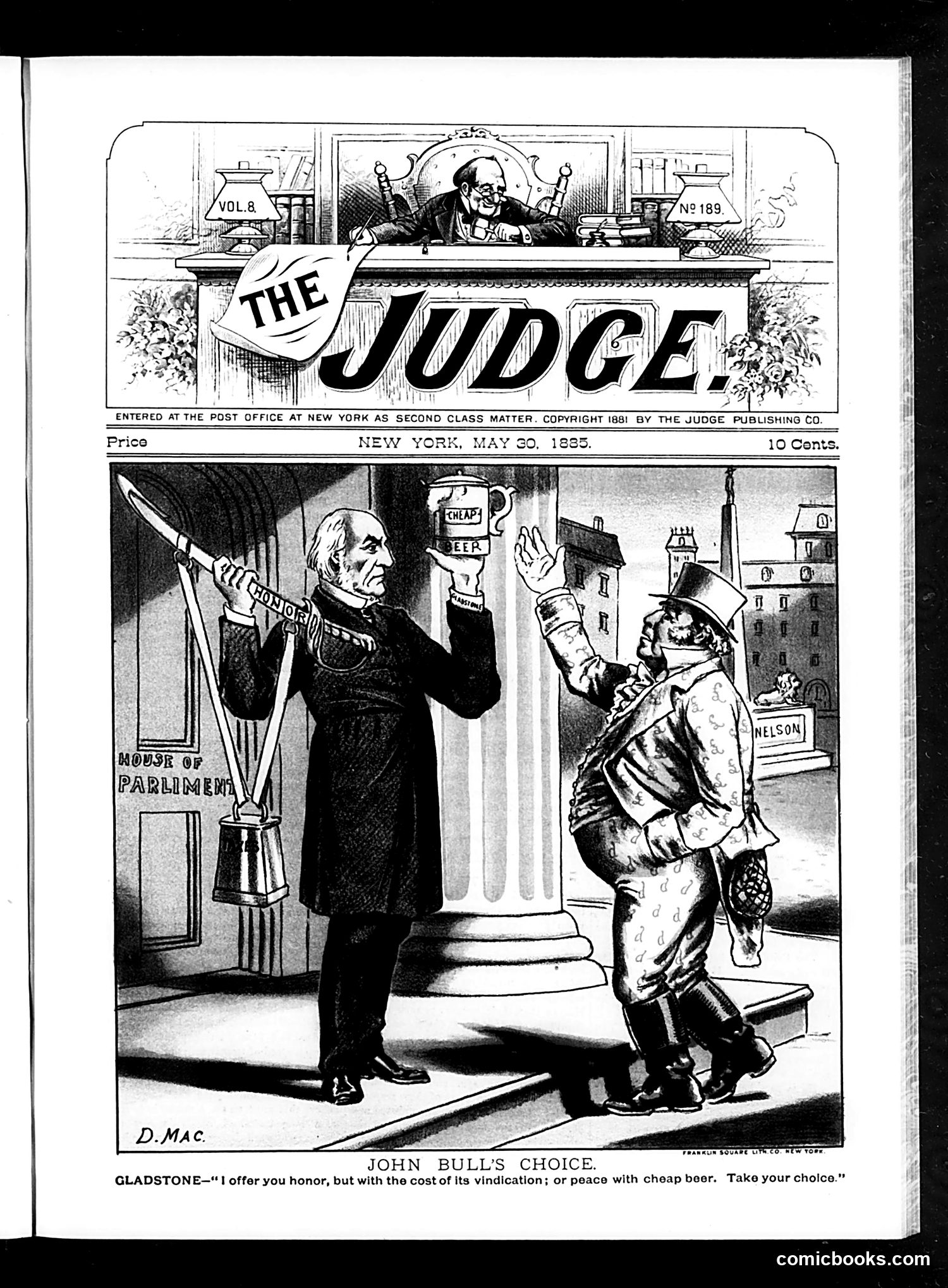
This cartoon satirizes British Prime Minister William Gladstone's political dilemma. The figure on the left, labeled "Gladstone," stands at the "House of Parliament" holding a sword, offering British honor (symbolized by military vindication) as one option. The figure on the right, labeled "Nelson" (referencing British naval hero Admiral Nelson), tempts him with "cheap beer"—representing a more economical, popular choice with voters. The satire mocks Gladstone's wavering between pursuing an expensive military/imperial policy versus adopting populist economic measures favored by the electorate. "John Bull" (England itself) must choose between national honor through costly conflict or appeasing the public with cheaper goods. The cartoon critiques Gladstone's political inconsistency during this period of imperial tensions.
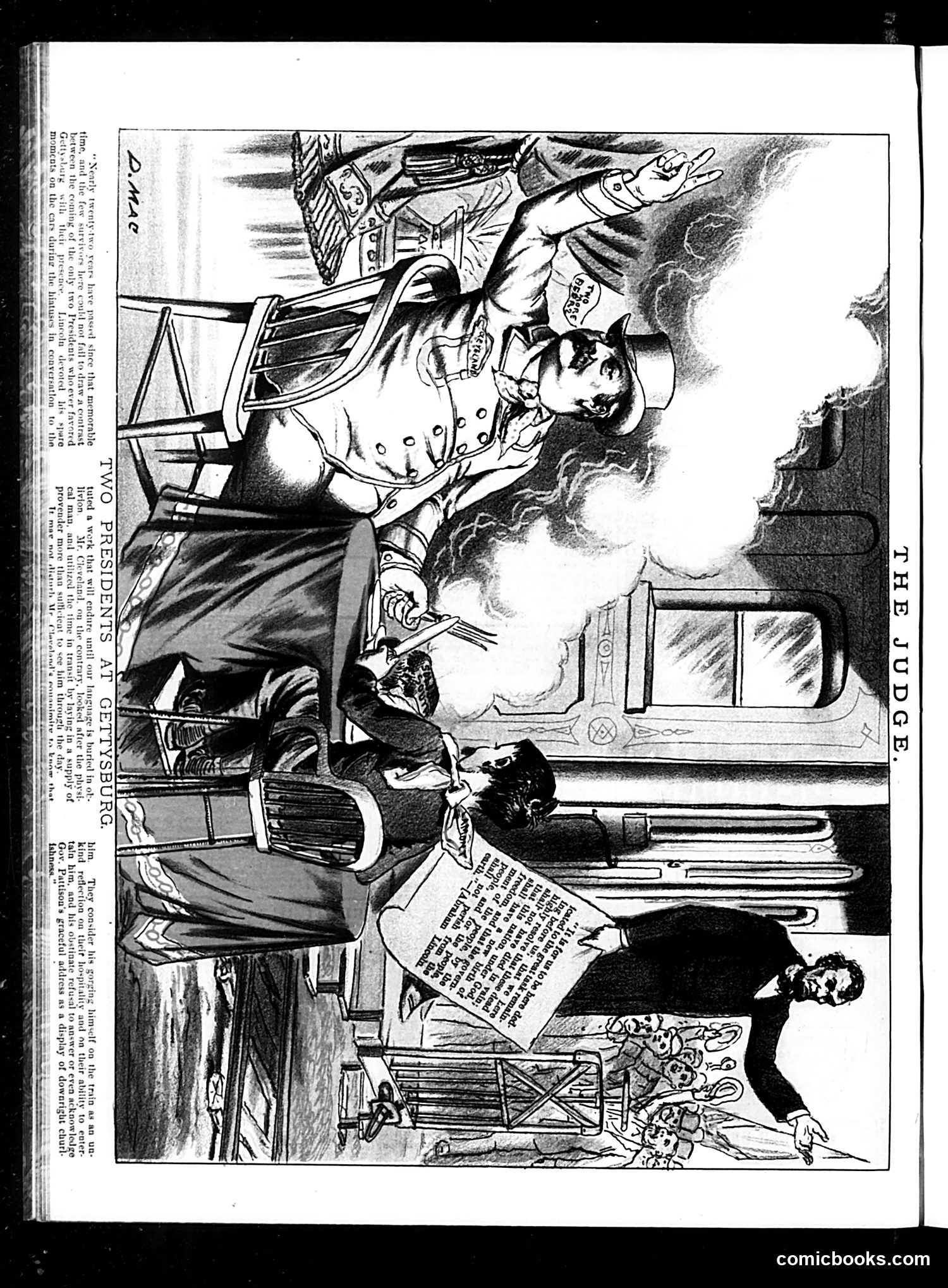
This page contains two distinct satirical pieces criticizing American and British politics: **"Peace with Beer"** mocks British inconsistency. The article satirizes how English citizens who loudly demanded aggressive military action against the Mahdi and Russia suddenly opposed war once a beer tax was implemented to fund it. Judge ridicules them as hypocritical patriots willing to fight only when it costs them nothing—reducing the English character to "part hero and part beer." **"Two Pictures"** compares Lincoln and Cleveland unfavorably. The piece contrasts Lincoln (1861)—who embodied emancipation and national unity—with Cleveland (1885), portrayed as a weak successor representing regression. Judge particularly attacks Cleveland's visit to Gettysburg as tone-deaf, emphasizing the contrast between Lincoln's sublime Gettysburg Address and Cleveland's implied mediocrity. The satire suggests Cleveland represents defeated Union causes being rehabilitated. Both pieces employ Judge's characteristic approach: using specific incidents to expose broader character flaws and political hypocrisy in leadership.
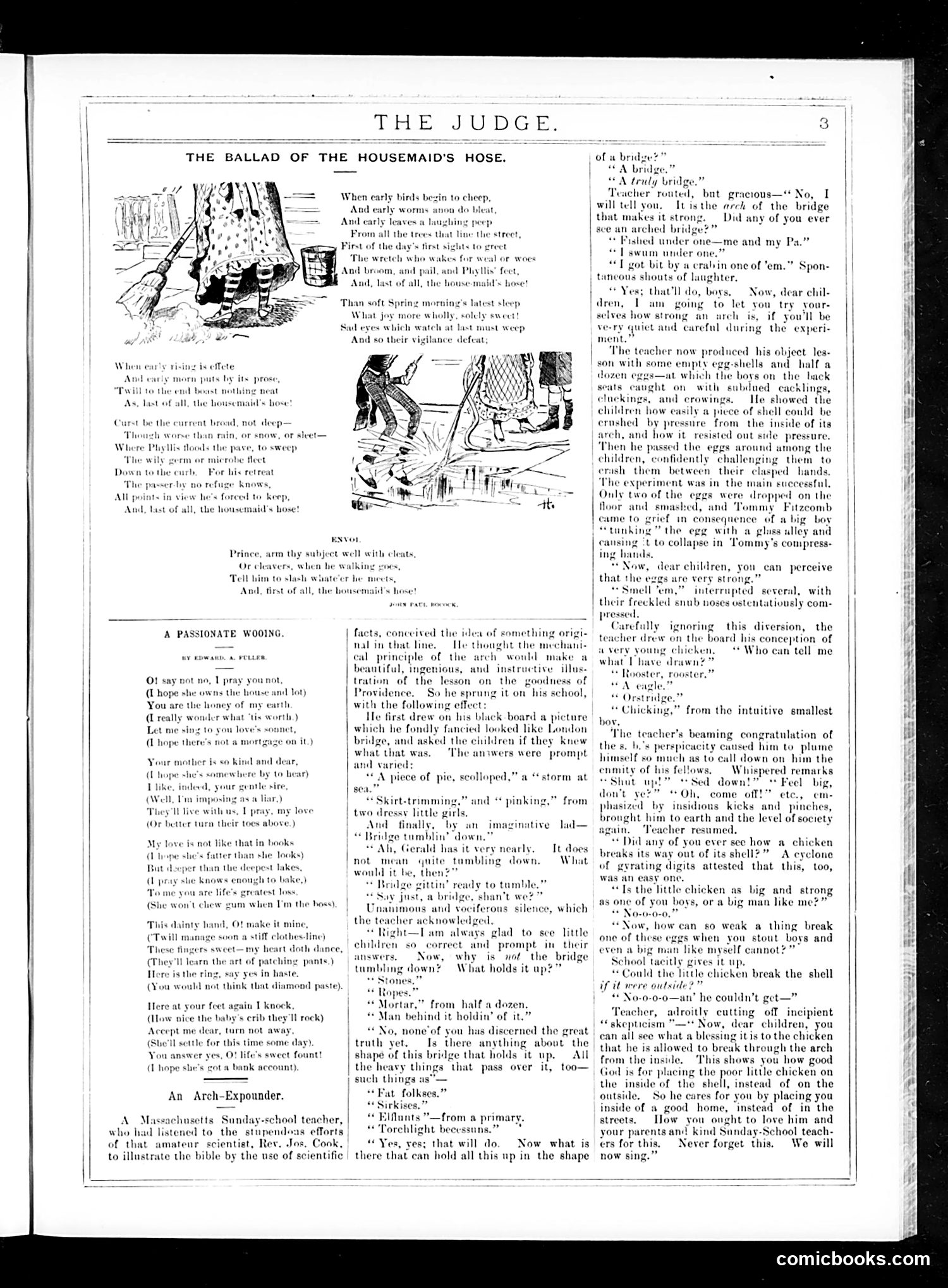
This page contains three separate humorous pieces from *Judge* magazine (likely early 1900s): 1. **"The Ballad of the Housemaid's Hose"**: A comic poem mocking the servant class by repeatedly emphasizing that a housemaid's hose (stockings/hosiery) is the most important thing in her life—satirizing both the precarious employment of domestic workers and Victorian class attitudes. 2. **"A Passionate Wooing"**: A parody love poem where a suitor proposes marriage while cynically calculating the bride's family wealth and property in parenthetical asides, mocking mercenary marriages and the hypocrisy of romantic declarations. 3. **"An Arch-Expander"**: A schoolroom anecdote where a minister attempts to teach architecture through a bridge drawing, but children give absurd answers ("Fat folkses," "Torchlight because-us"). The satire targets both amateur science education and children's literal-minded responses, poking fun at ill-prepared religious instruction. All three pieces use humor to critique social hierarchies, greed, and educational pretension.
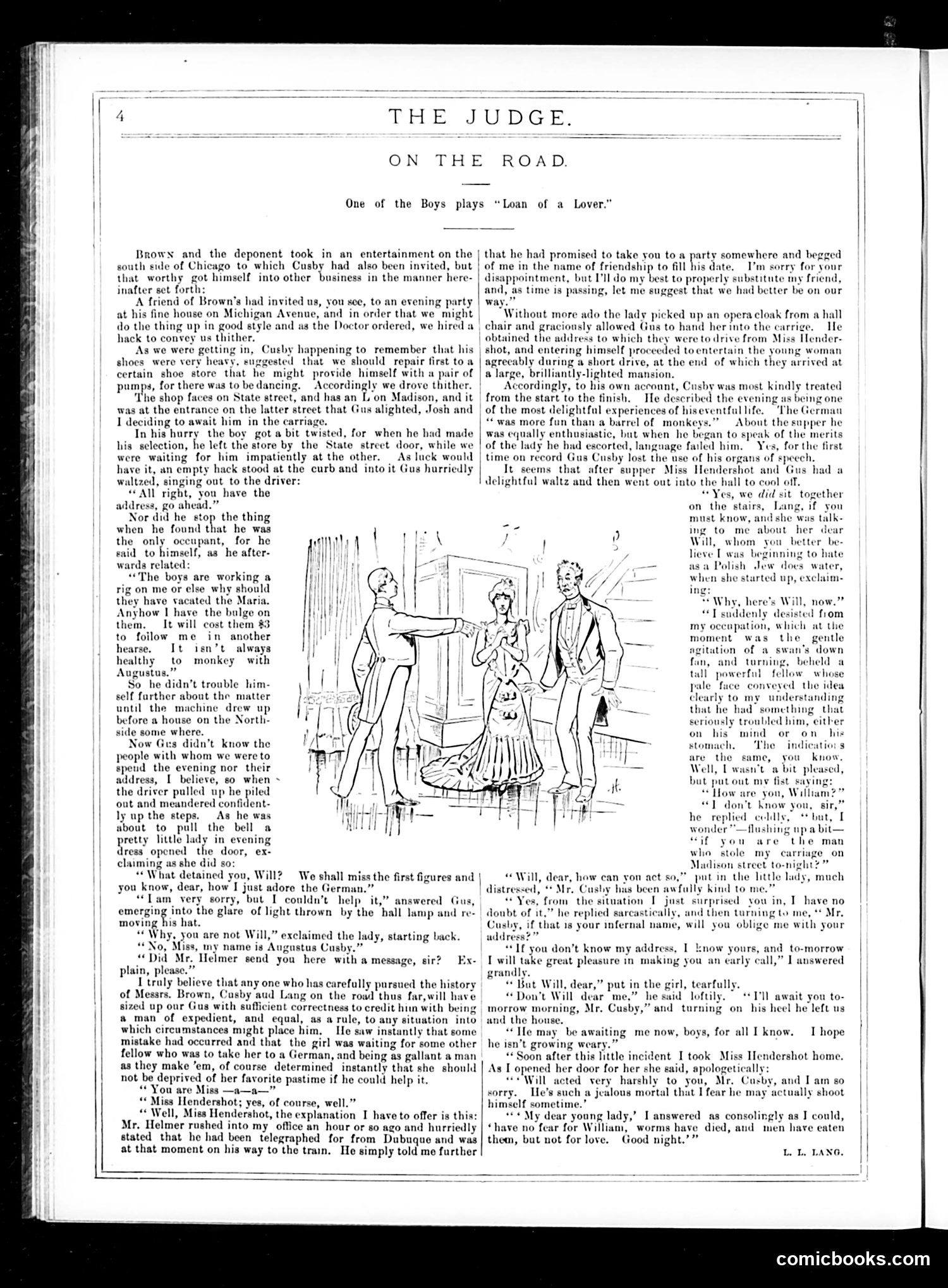
This humorous story describes Augustus Cusby, one of three traveling companions, accidentally entering the wrong house. Exiting a shoe store on the wrong street, Cusby boards a random carriage and arrives at a stranger's residence. A young woman, Miss Hendershot, mistakes him for "Will"—a guest named Mr. Helmer who was supposed to escort her to a German (a popular dance). Rather than disappoint her, the quick-thinking Cusby improvises, claiming Helmer was called away to Dubuque on urgent business and sent him as a substitute escort. The satire targets the era's social conventions: Cusby's resourcefulness and gallantry in covering an embarrassing mistake, plus his willingness to attend a formal dance despite the deception. The cartoon illustrates the awkward moment of discovery, capturing the social comedy of mistaken identity common in period humor and theatrical farces.
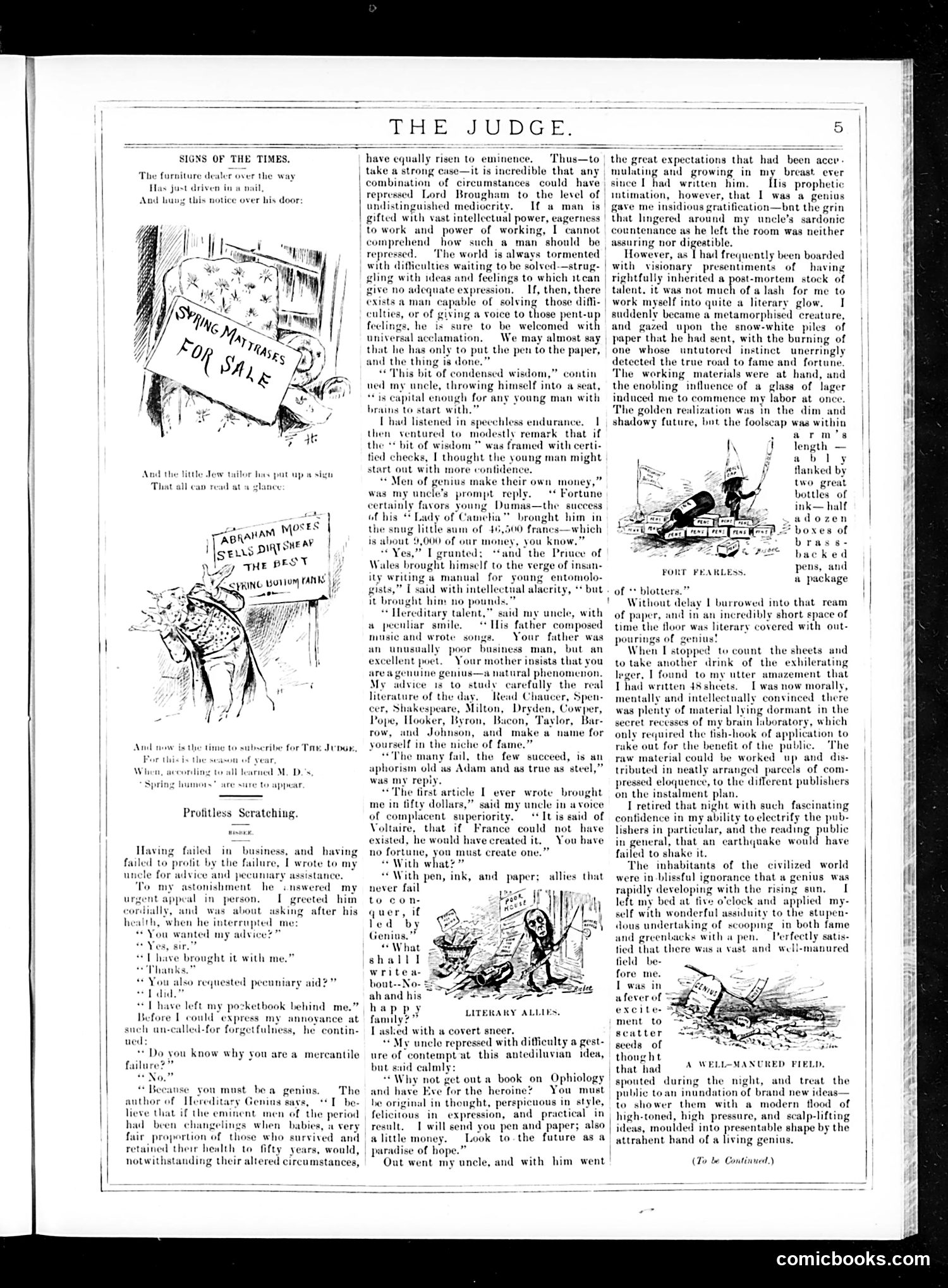
This page contains two satirical pieces mocking American society and class pretensions. **"Signs of the Times"** shows shopkeepers posting signs advertising their wares—a furniture dealer and a Jewish tailor. The joke appears to be about commercial desperation and ethnic stereotyping common to the era. **"Profitless Scratching"** is the main narrative, satirizing the gap between intellectual pretension and economic reality. A failed businessman seeks his uncle's advice. The uncle pedantically quotes theories about hereditary genius (referencing popular Victorian pseudoscience), claiming natural talent guarantees success. He cites examples like Alexandre Dumas's financial success, while the nephew deflates this with counterexamples (the Prince of Wales's entomological manual). The satire targets self-deluding relatives who dispense grandiloquent but useless advice based on romantic notions of genius, while offering no actual financial help despite the nephew's genuine need. The uncle's own modest success (fifty dollars for an article) doesn't support his sweeping claims about merit triumphing inevitably.
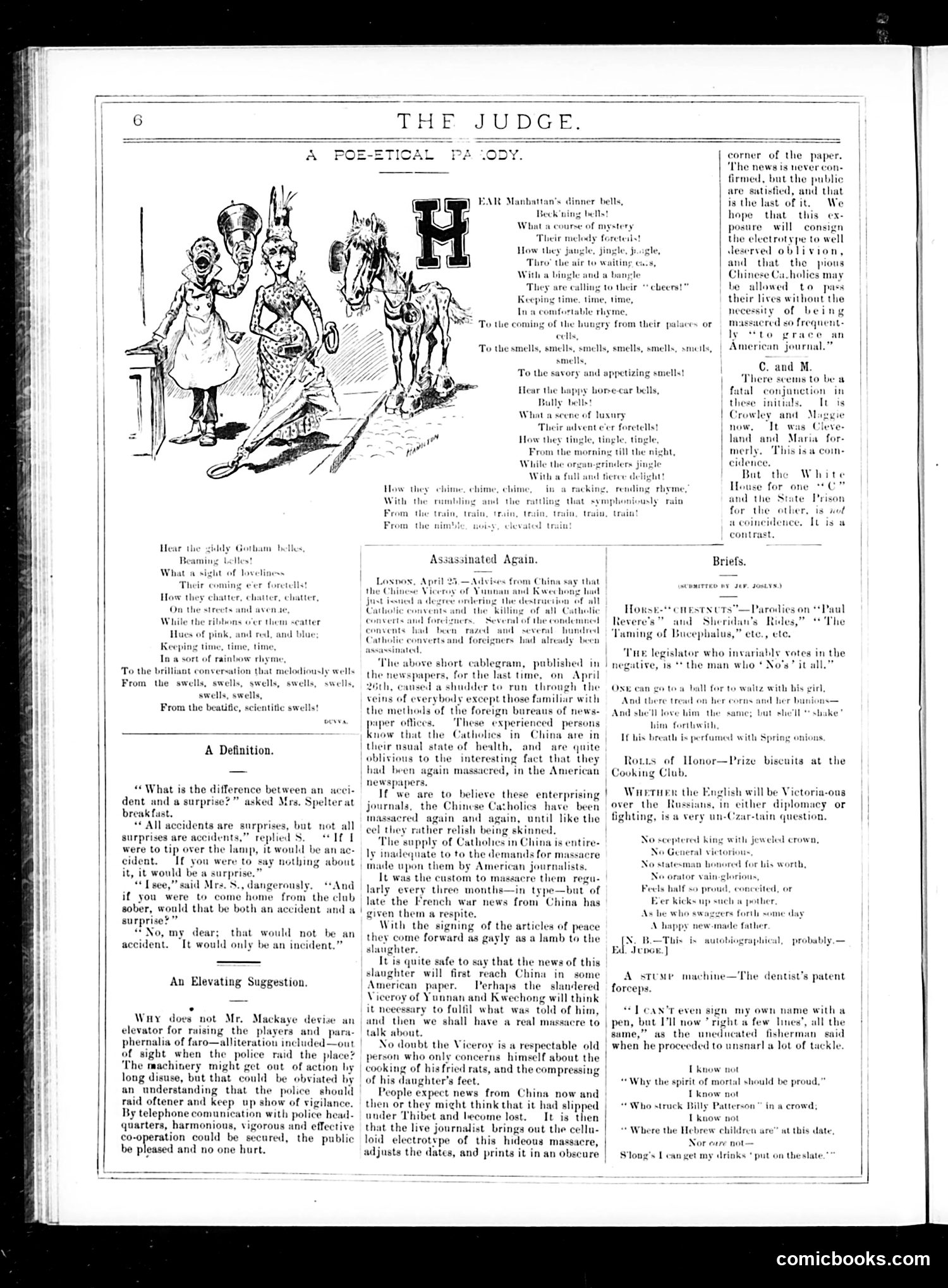
This page from *Judge* magazine contains satirical commentary on sensationalized newspaper reporting about China. **"Assassinated Again"** (main article) mocks American newspapers for repeatedly fabricating or exaggerating massacres of Chinese Catholics. The author notes that the same Catholic victims are reported killed multiple times—"like the eel they rather relish being skinned"—suggesting papers recycle old stories. He criticizes how journalists invent atrocities to fill space, especially when actual French war news from China becomes scarce. The satire targets the gap between journalistic hype and reality: papers report massacres without confirmation, the public accepts them uncritically, and the stories vanish without verification. The author suggests Chinese Catholics are being "massacred" primarily by American newspapers' pens, not by actual events. The other brief pieces ("A Definition," "An Elevating Suggestion") are unrelated satirical humor about domestic matters. The cartoon at top appears to be separate satirical illustration, though its specific subject is unclear from this reproduction.
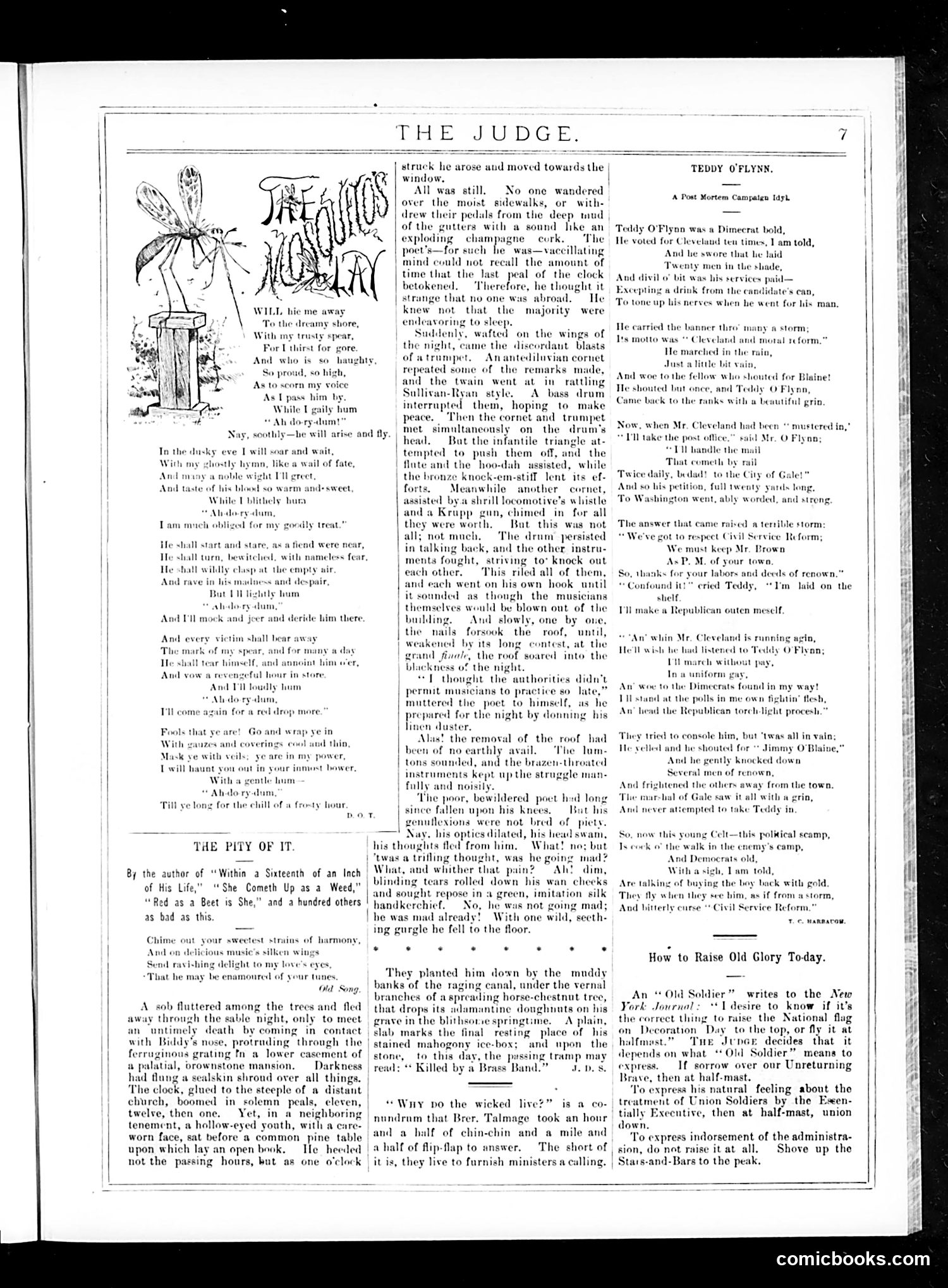
**The Main Cartoon (top left):** A fly in a lantern illustrates the poem "Creation" — a Romantic-era verse about a doomed insect. The satirical point appears to be mocking overwrought, sentimental poetry popular at the time. **"Teddy O'Flynn" (right column):** A post-mortem political satire about an Irish Democratic voter. O'Flynn, a loyal Cleveland supporter, dies and gets conscripted into a chaotic military marching band (metaphorically representing government bureaucracy). After his death, his request for a postmaster job under Cleveland is rejected due to Civil Service Reform — a late-19th-century anti-patronage policy. The joke: even a dead man's petitions can't bypass the new merit system. The story satirizes both Irish-American political machine politics and the tension between old-style patronage and Civil Service Reform. **Context:** This reflects Judge's critique of post-Civil War Democratic machine politics and Irish-American voting blocs, while also mocking the era's reformist Civil Service policies.
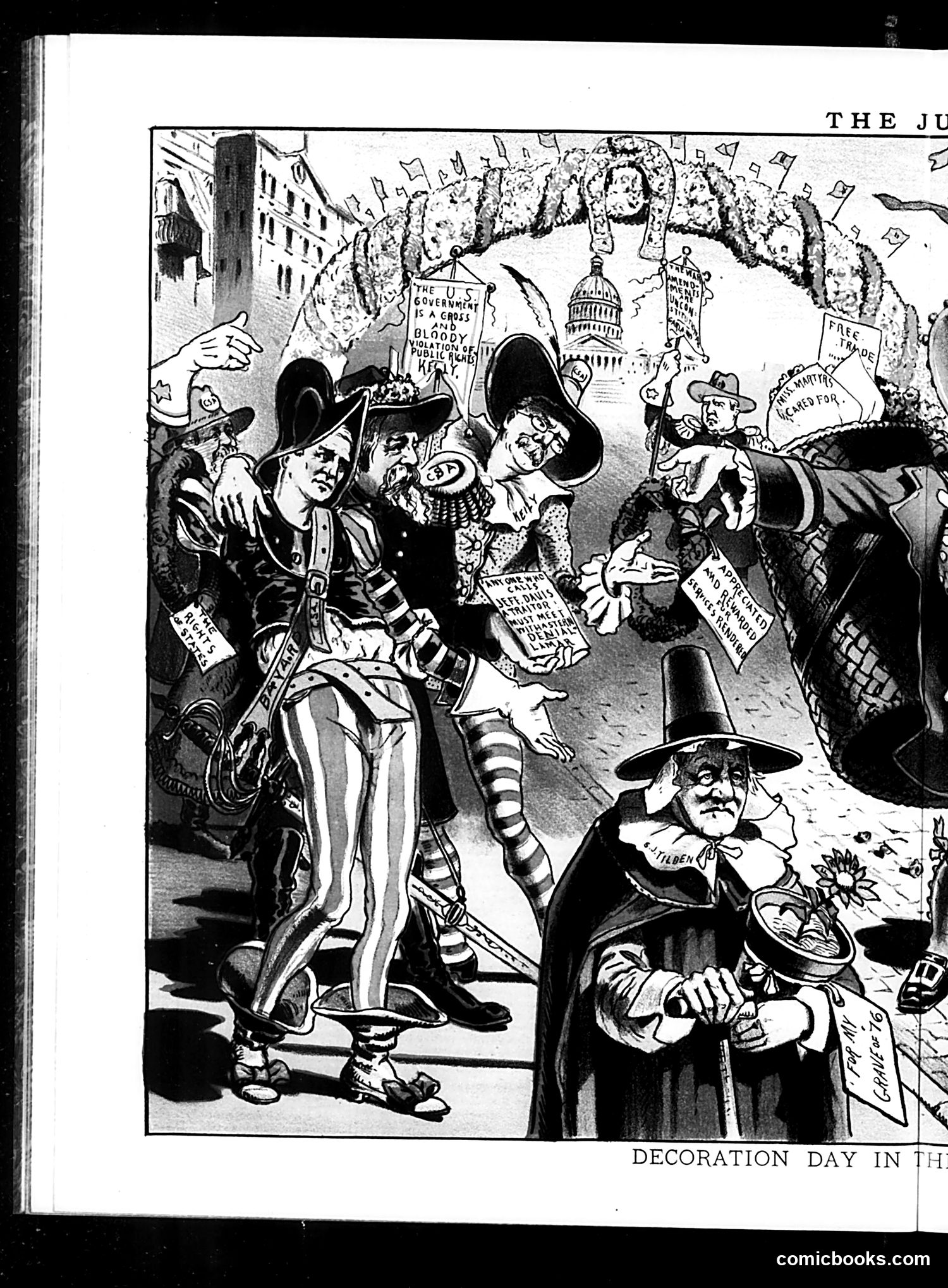
This appears to be a satirical cartoon from *Judge* magazine depicting Decoration Day (now Memorial Day) celebrations. The central figure is Lady Liberty, depicted in striped attire, surrounded by what appear to be political and military figures in formal dress and hats. The visible signs reference violations of rights and the U.S. Capitol building appears in the background. The composition suggests the cartoon criticizes how political figures and institutions exploit or misuse patriotic holidays for their own purposes, while potentially ignoring constitutional violations or other failings. The crowded scene with multiple costumed figures suggests commentary on political hypocrisy—public expressions of patriotism masking deeper governmental problems. Without seeing the complete caption or date, the specific historical context remains partially unclear.
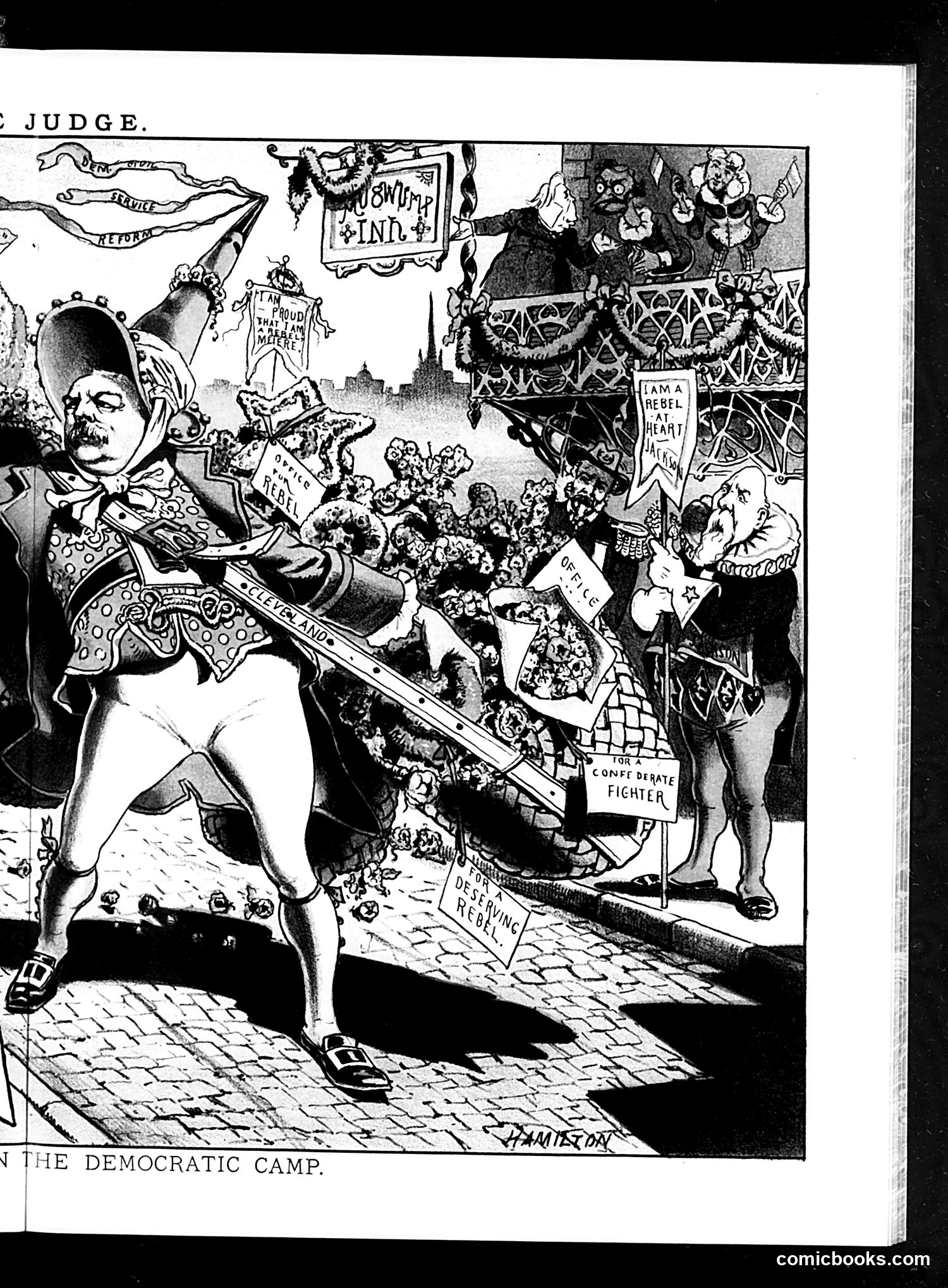
This political cartoon satirizes the Democratic Party during what appears to be a presidential campaign. The central figure is a military officer in an exaggerated pose, likely representing a Democratic candidate or military leader. Surrounding him are various caricatured figures labeled with political positions: "PROUD DEMOCRAT," "REFORM," "HONEST," and references to debate and fighting ("FOR A CONFIDENT FIGHTER"). The cartoon mocks Democratic infighting and competing factions within the party—showing them as chaotic, argumentative, and poorly unified. The carnival-like chaos and costumed figures suggest the Democrats are disorganized and theatrical rather than serious. The overall message appears critical of Democratic party coherence during an election cycle, portraying internal conflict as their defining characteristic.
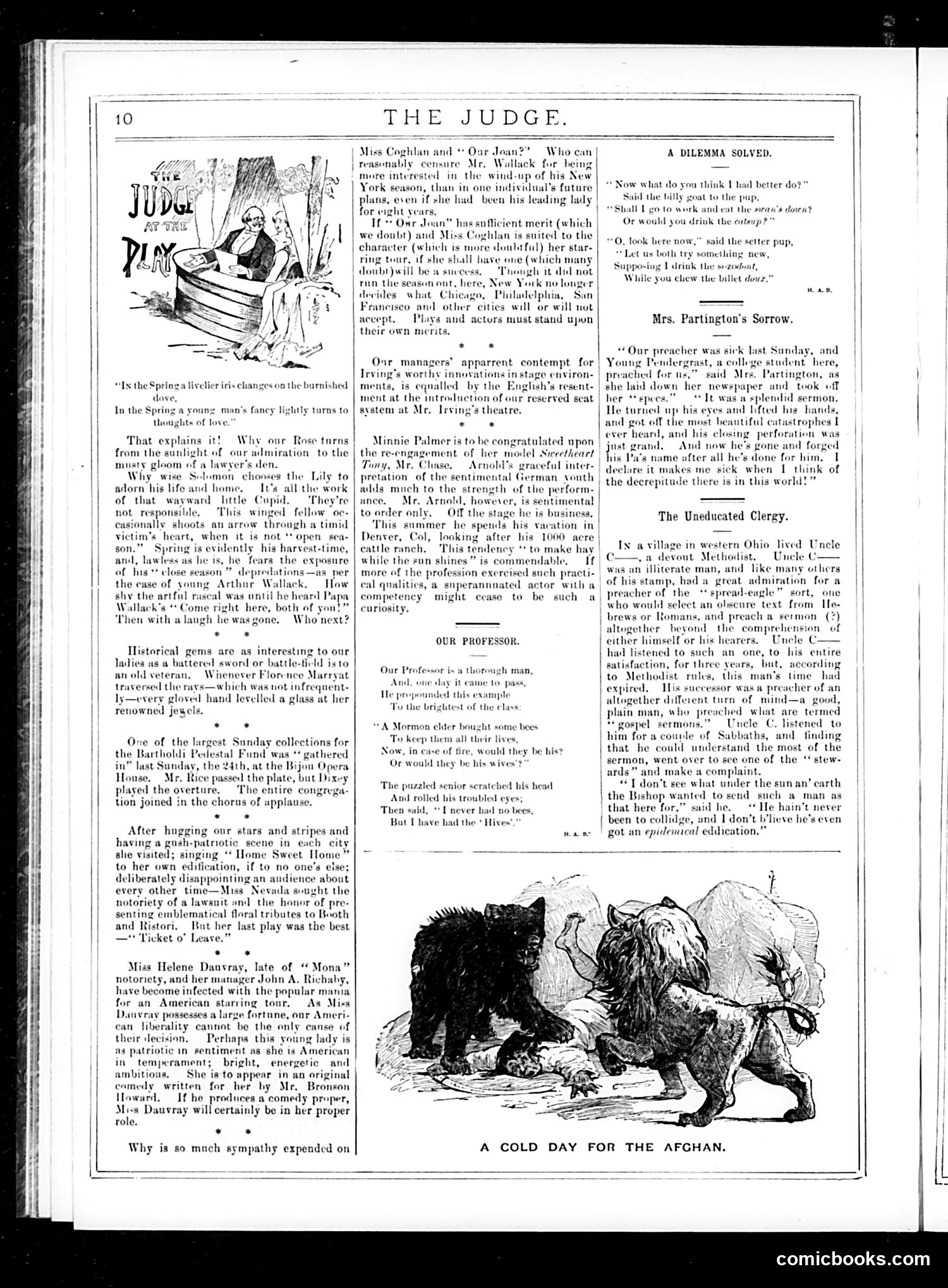
This page from *Judge* magazine contains theatrical gossip and satire typical of 1880s entertainment journalism. **Main content**: Brief commentary on various stage performers and productions, including: - **Arthur Wallack**: A young man whose romantic spring fling is satirized through the metaphor of Cupid's arrow - **Miss Nevada**: A touring actress criticized for inconsistent performances and self-serving patriotism (the "Bartholdi Pedestal Fund" reference suggests this is about fundraising for the Statue of Liberty pedestal) - **Minnie Palmer and Mr. Arnold**: Praised for theatrical work, though Arnold is mocked for his practical business interests (cattle ranching) over artistic devotion - **Miss Dauvray**: An American actress undertaking a starring tour, praised as patriotic and ambitious **The cartoon** ("A Cold Day for the Afghan"): Shows a shivering man in Afghan dress, likely satirizing sympathy for Afghan conflicts or people—a topical reference to 19th-century British-Afghan tensions. The page exemplifies *Judge's* approach: theatrical gossip mixed with social commentary, often mean-spirited toward performers' personal choices and patriotic pretensions.
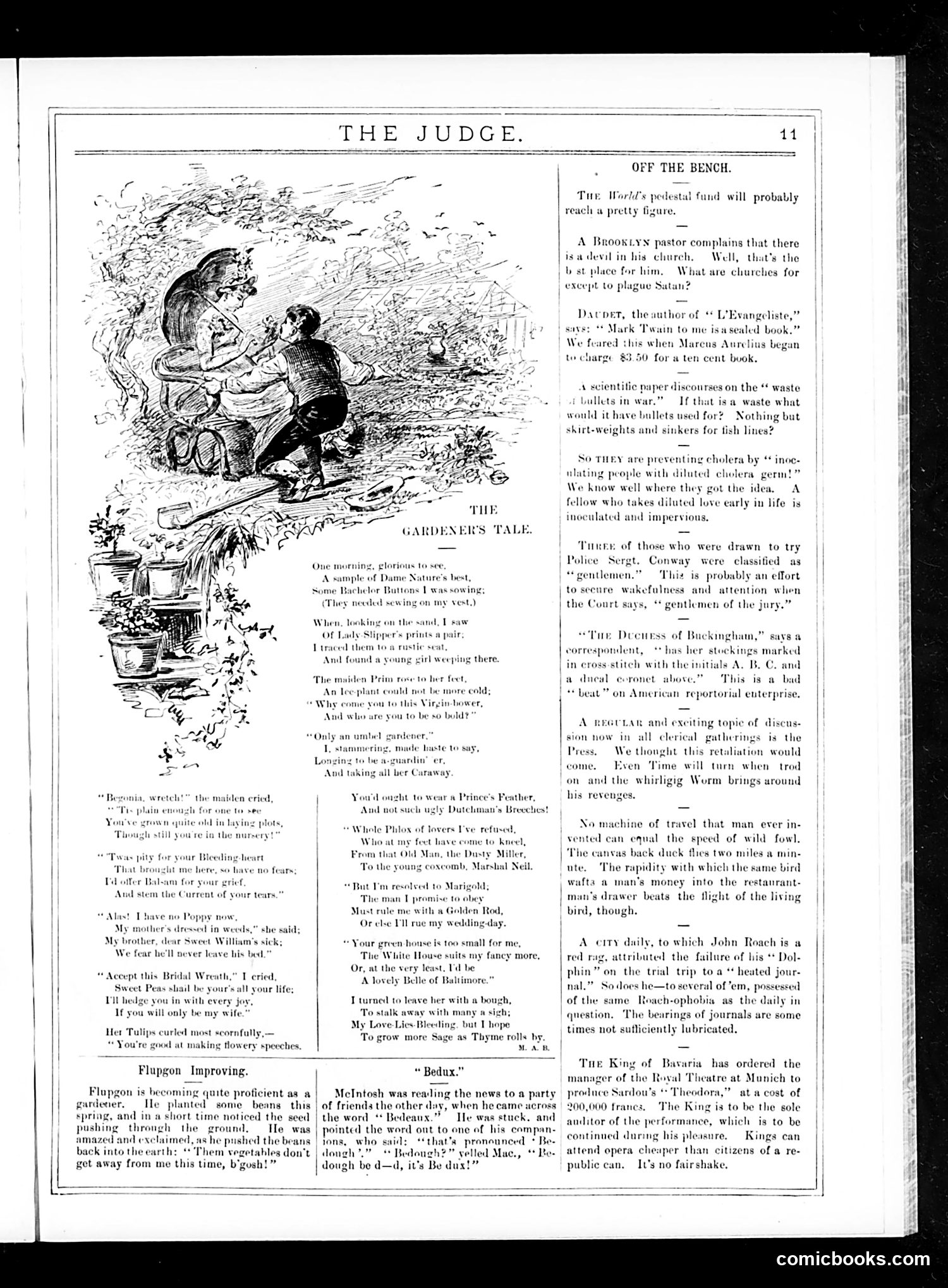
This appears to be a narrative poem illustrated with a Victorian-era sketch showing a gardener and a young woman in a garden setting. The poem tells of a gardener's romantic encounter with a maiden, using garden imagery as metaphor for courtship and seduction. The satire likely mocks sentimental Victorian romance literature and poetry—the overwrought emotional declarations and flowery language typical of period love stories. The juxtaposition of crude gardening work (shown in the illustration) with highfalutin romantic verse creates comedic contrast. The "Off the Bench" section contains unrelated satirical comments on contemporary topics (cholera prevention, church problems, etc.), typical of Judge magazine's miscellaneous humor format. Without specific historical context about which figures these reference, precise identification isn't possible from the text alone.
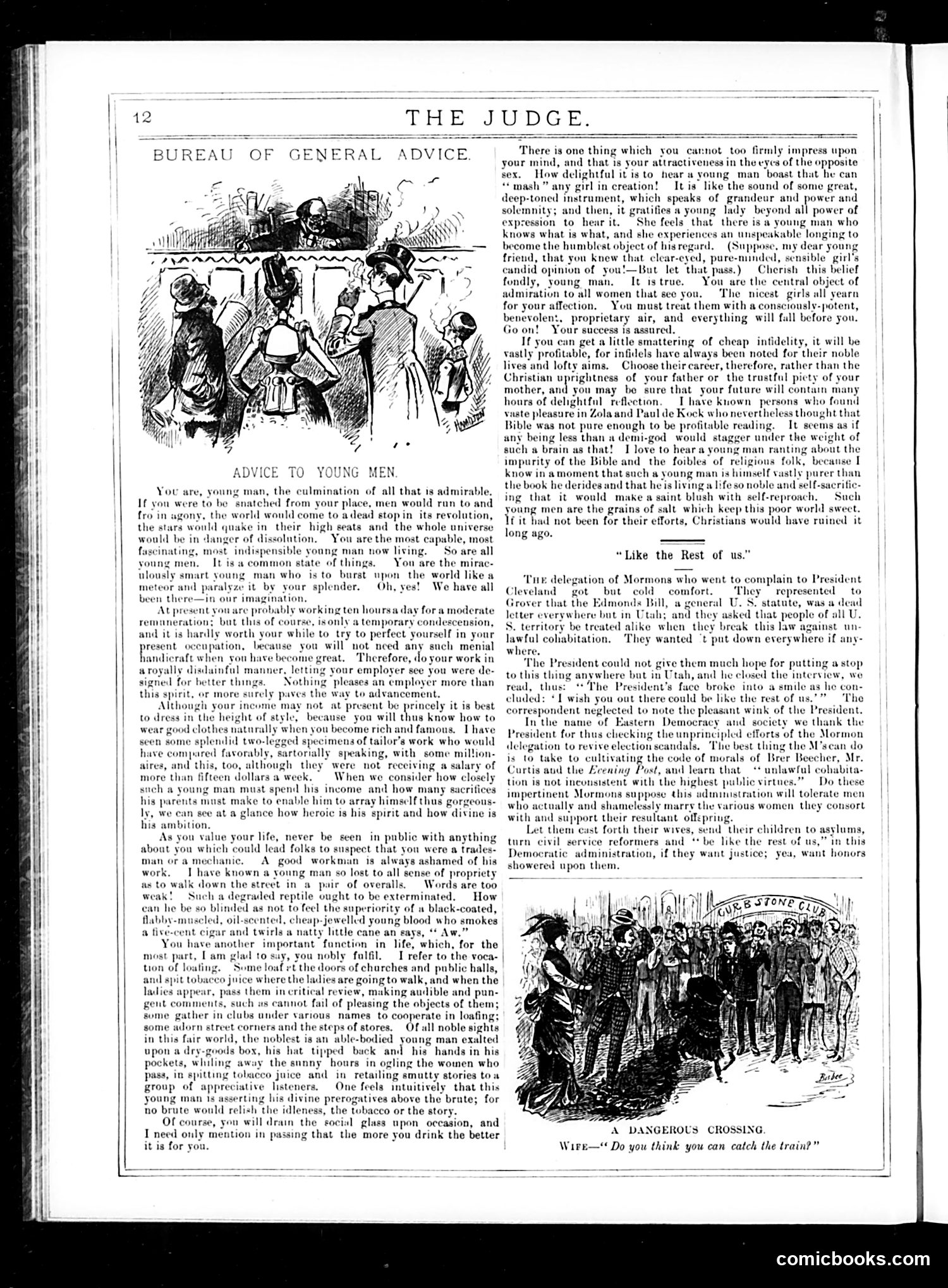
This page presents **savage ironic advice** mocking entitled young men of the era. The text uses sarcasm throughout, praising behaviors that are actually contemptible: **The satire targets:** - Young men's delusions of grandeur and refusal to apply themselves seriously to work - Dressing beyond one's means to appear wealthy while earning pittance - Ashaming manual labor and trade work as beneath them - Public loafing, harassment of women, spitting tobacco, and vulgarity - Excessive drinking **The joke:** The author appears to *praise* these behaviors as signs of nobility and superiority, when he's actually excoriating them as foolish, parasitic, and morally bankrupt. **The bottom cartoon** ("A Dangerous Crossing") shows a wife warning her husband about catching a train—likely a visual pun on the foolishness depicted in the text above. Judge used this biting mock-advice format frequently to criticize social vices and generational entitlement among young American men.
This page from Judge magazine is primarily a **humor column** consisting of short jokes and witty observations rather than political cartoons. The content reflects late 19th-century American sensibilities through satirical commentary on: **Social observations:** Jokes about gender differences (women lacking inventiveness), courtship customs, and urban life. References to "fallen women" and morality concerns typical of the era. **Political/topical references:** Brief mentions of President Cleveland, William D. Howells (a prominent author), and Professor Langley (the astronomer). A Chicago man's will provision about his widow remarrying appears to mock marital conventions. **Format:** These are brief, punchy one-liners sourced from various newspapers (St. Paul Herald, Boston Courier, etc.), typical of Judge's style—collecting humor from across America's press. **Overall tone:** Mildly satirical commentary on everyday life, relationships, and human nature rather than sharp political satire. The humor relies on puns, wordplay, and gentle social criticism accessible to general audiences of that period.
This page from Judge magazine contains satirical fiction rather than political cartoons. The main narrative pieces mock frontier rural life and urban sophistication mismatches. The lead story depicts a rural woman defending her family's poverty and violent Civil War experiences to an urban newspaper writer, using dialect humor to contrast backwoods speech with genteel sensibilities. The "Consumption Cured" section satirizes a doctor's dismissive response to a patient, suggesting the man should see a veterinary surgeon instead—mocking both rural ignorance and ineffective medical practices. "Wanted—Fancy, Not Fact" jokes about a sensational magazine editor rejecting a writer's authentic Western experiences as insufficiently dramatic—satirizing how fiction often distorts reality for entertainment. The page is primarily filled with period medical and product advertisements (whiskey, electric belts, custard powder, bitters) typical of Judge's content. These ads themselves are now humorous to modern readers, advertising treatments for serious illnesses that were likely ineffective or harmful.
This page is primarily **advertisements and humor pieces**, not a political cartoon. The main satirical content includes: 1. **"A New Employment"** — A joke about social misunderstanding: a guest asks about "Pendjeh" (likely the Pendjeh Crisis, a real 1885 British-Russian border dispute), but his host thinks he's asking about a friend's job. 2. **"Pensive"** — A longer satire about Colonel Hiram Eckleton, who formerly advocated abolition but now wants to re-enslave Black people. The story mocks his hypocrisy through a courtroom scene where a Black man (John Carpenter) sues him for refusing to pay for wood-chopping work. The justice's dialect humor underscores the irony. The page reflects post-Reconstruction racial attitudes and tensions, presenting the colonel's reversal as absurd. The remaining content is standard period advertising for pianos, trusses, and patent medicines.
This page from *Judge* magazine contains "The Judge" cartoon (title visible on right margin). The image appears to show a courtroom or judicial scene rendered upside-down on the page, requiring the reader to rotate it 90 degrees clockwise to view properly. The cartoon depicts what appears to be a judge presiding over proceedings, with other figures present in what looks like a formal legal setting. Without being able to clearly read the accompanying text or caption, I cannot definitively explain the specific political or social satire being referenced. The upside-down orientation itself may be part of the satirical joke—possibly suggesting the absurdity or topsy-turvy nature of whatever legal matter is being mocked. More context would be needed for precise interpretation.