
Judge, 1885-05-30 · page 2 of 16
Judge — May 30, 1885 — page 2: what you’re looking at
What you’re looking at
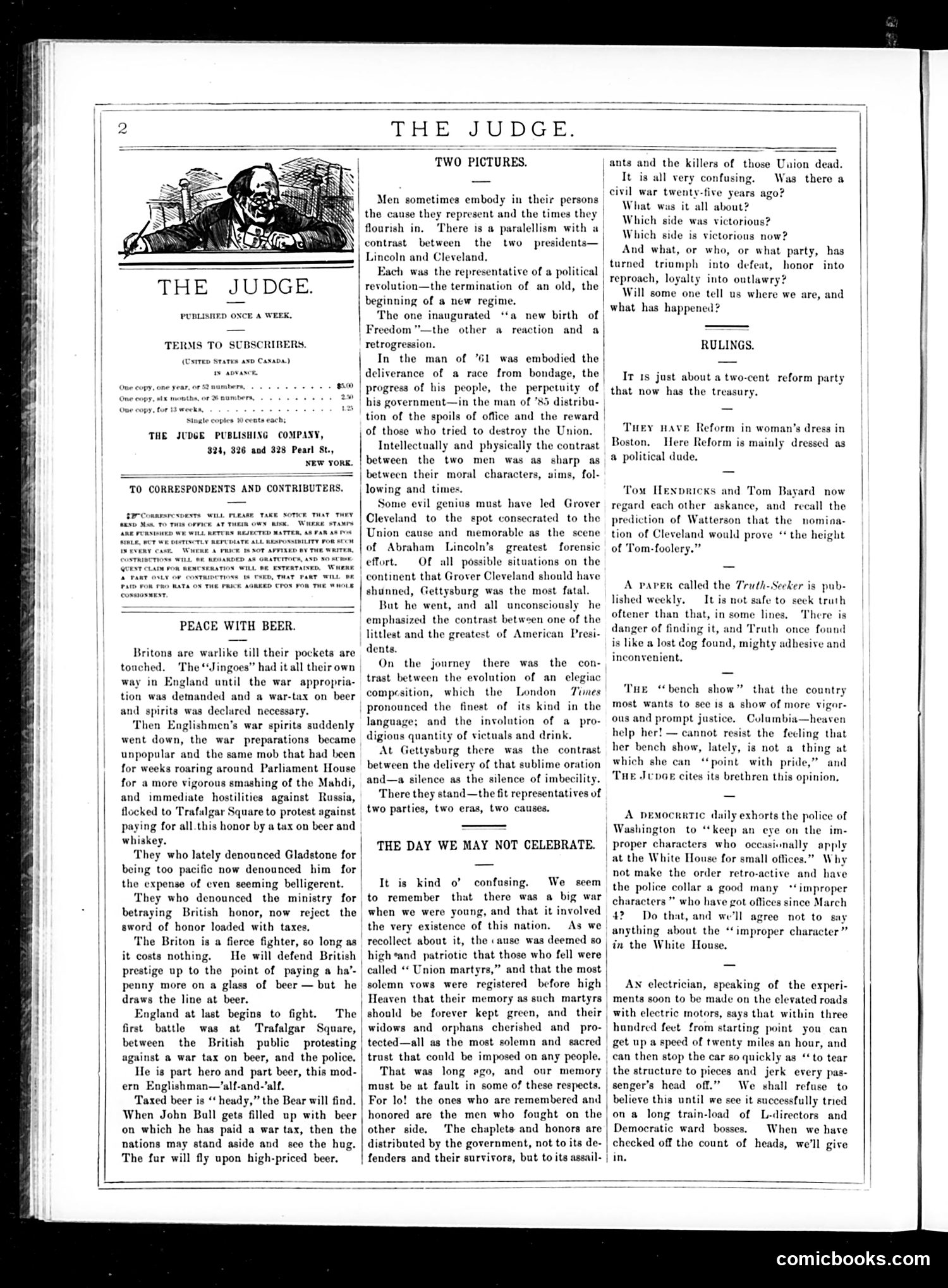
This page contains two distinct satirical pieces criticizing American and British politics: **"Peace with Beer"** mocks British inconsistency. The article satirizes how English citizens who loudly demanded aggressive military action against the Mahdi and Russia suddenly opposed war once a beer tax was implemented to fund it. Judge ridicules them as hypocritical patriots willing to fight only when it costs them nothing—reducing the English character to "part hero and part beer." **"Two Pictures"** compares Lincoln and Cleveland unfavorably. The piece contrasts Lincoln (1861)—who embodied emancipation and national unity—with Cleveland (1885), portrayed as a weak successor representing regression. Judge particularly attacks Cleveland's visit to Gettysburg as tone-deaf, emphasizing the contrast between Lincoln's sublime Gettysburg Address and Cleveland's implied mediocrity. The satire suggests Cleveland represents defeated Union causes being rehabilitated. Both pieces employ Judge's characteristic approach: using specific incidents to expose broader character flaws and political hypocrisy in leadership.
📄 Transcribed text from this page (OCR, searchable)
Machine-transcribed from the original scan — historical spelling and the odd misread are preserved.
THE “JUDGE, THE JUDGE. PUBLISHED ONCE A WEEK. TERMS TO SUBSCRIBERS. (Csiren States ayo Caxapay ste months, of aamber py. for 13 weeks, Single cop THE JUDGE PUBLISHING COMPANY $24, 326 and 328 Pearl St., NEW YORK. TO CORRESPONDENTS AND CONTRIBUTERS. STS WILL PLEARE TAKE 18 OFFICK AY THEIR OWN RINK. mick THAT THEY Wuene stats WHERE 4 RICK B6 SILL Me ENTERTAINED, W THE PRICE a Path FOR PRO RATA ¢ PEACE WITH BEER. Britons are warlike till their pockets are touched. The “Jingoes” had it all their own way in England until the war appropria- tion was demanded and a war-tax on beer and spirits was declared necessary. ‘Then Englishmen’s war spirits suddenly went down, the war preparations became unpopular and the same mob that had been for weeks roaring around Parliament House for a more vigorous smashing of the Mahdi, and immediate hostilities against Russia, flocked to Trafalgar Square to protest against paying for all.this honor by a tax on beer and whiskey. 7 hey who lately denounced Gladstone for | being too pacific now denounced him for | the expense of even seeming belligerent. They who denounced the ministry for betraying British honor, now reject the sword of honor loaded with taxes, The Briton is a fierce fighter, so long as it costs nothing. prestige up to the point of paying a ha’- penny more on a glass of beer — but he draws the line at beer. England at last begins to fight. first battle was at Trafalgar Square, between the British public protesting against a war tax on beer, and the police. He is part hero and part beer, this mod- ern Englishman—‘alf-and-alf. Taxed beer is ‘ heady,” the Bear will find. When John Bull gets filled up with beer on which he has paid a war tax, then the nations may stand aside and sce the hug. The fur will fly upon high-priced beer. He will defend British | The | “Two PICTURES. Men sometimes embody in their persons the cause they represent and the times they flourish in. There is a paralellism with contrast between the two Lincoln and Cleveland. Each was the repr presidents— beginning of a new regime. The one inaugurated ‘‘a new birth of Freedom —the other a reaction and a Tetrogression. In the man of ’61 was embodied the Jdcliverance of a race from bondage, the | progress of his people, the perpetuity of his government—in the man of ’85 distribu- of those who tried to destroy the Union. Intellectually and physically the contrast | between the two men was as sharp as | between their moral characters, fol- lowing and times. Some evil genius must have led Grover Cleveland to the spot consecrated to the Union cause and memorable as the scene of Abraham Lincoln's greatest forensic effort. Of all possible situations on the continent that Grover Cleveland should have shunned, Gettysburg was the most fatal. | But he went, and all unconsciously he emphasized the contrast between one of the littlest and the greatest of American Presi- dents. On the journ trast between th compesition, which pronounced the finest language; and the a digious quantity of victuals and drink. At Gettysburg there was the contrast between the delivery of that sublime oration and—a silence as the silence of imbecility. There they stand—the fit representatives of two parties, two eras, two uims, was the con- evolution of an elegiac the London Times of its kind in the involution of a pro- there 88. | THE DAY WE MAY NOT CELEBRATE. It is kind 0’ confusing. We seem to remember thut there was a big war when we were young, and that it involved the very existence of this nation. As we recollect about it, the «ause was deemed so high eand patriotic that those who fell were | called ‘* Union martyrs,” and that the most | solemn vows were registered before high | Heaven that their memory as such martyrs should be forever kept green, and their | widows and orphans cherished and pro- tected—all as the most solemn and sacred trust that conld be imposed on any people. | That was long ago, and our memory must be ut fault in some of these respects. For lo! the ones who are remembered and | honored are the men who fought on the| other side. The chaplets and honors are sentative of a political | revolution—the termination of an old, the | tion of the spoils of office and the reward | ants and the killers of those Union dead. It is all very confusing. Was there a civil war twenty-five years ago? What was it all about? Which side was victorious? Which side is victorious now? And what, or who, or what party, has turned triumph into defeat, honor reproach, loyalty into outlawry? Will some one tell us where we are, and what has happened? into RULINGS. Ir 1s just about a two-cent reform party that now has the treasury. Tury nave Reform in woman's dress in Boston, Here Reform is mainly dressed as a political dude, Tom Hexpricks and Tom Bayard regard each other askance, and recall the prediction of Watterson that the nomina- tion of Cleveland would prove ‘the height of Tom-foolery. now A paver called the Truth-Seeker is pub- lished wee It is not safe to seek truth oftener than that, in some lines, There is danger of finding it, and Truth once found is like a lost dog found, mighty adhesive and inconvenient. The ‘bench show” that the country most wants to see is a show of more vigor- ous and prompt justic help her! — cannot her bench show, which she can Columbia—heaven st the feeling that lately, is not a thing at “point with pride,” and Tue JcvGe cites its brethren this opinion, A pemocrrtic daily exhorts the police of Washington to “keep an eye on the im- proper characters who occasionally apply at the White House for small offices.” Why not make the order retro-active and have the police collar a good many *‘improper characters ” who have got offices since March 4? Do that, and we'll agree not to say anything about the “improper character” in the White House. Ay electrician, speaking of the experi- ments soon to be made on the elevated roads with electric motors, says that within three hundred fect from starting point you can get up a speed of twenty miles an hour, and can then stop the car so quickly as “to tear the structure to pieces and jerk every pas- senger’s head off.” We shall refuse to believe this until we see it successfully tried on a long train-load of L-directors and Democratic ward bosses. When we have | distributed by the government, not to its de- | checked off the count of heads, we'll give | fenders and their survivors, but to its assail- | in. comicbooks.com