
A complete issue · 16 pages · 1885
Judge — May 16, 1885
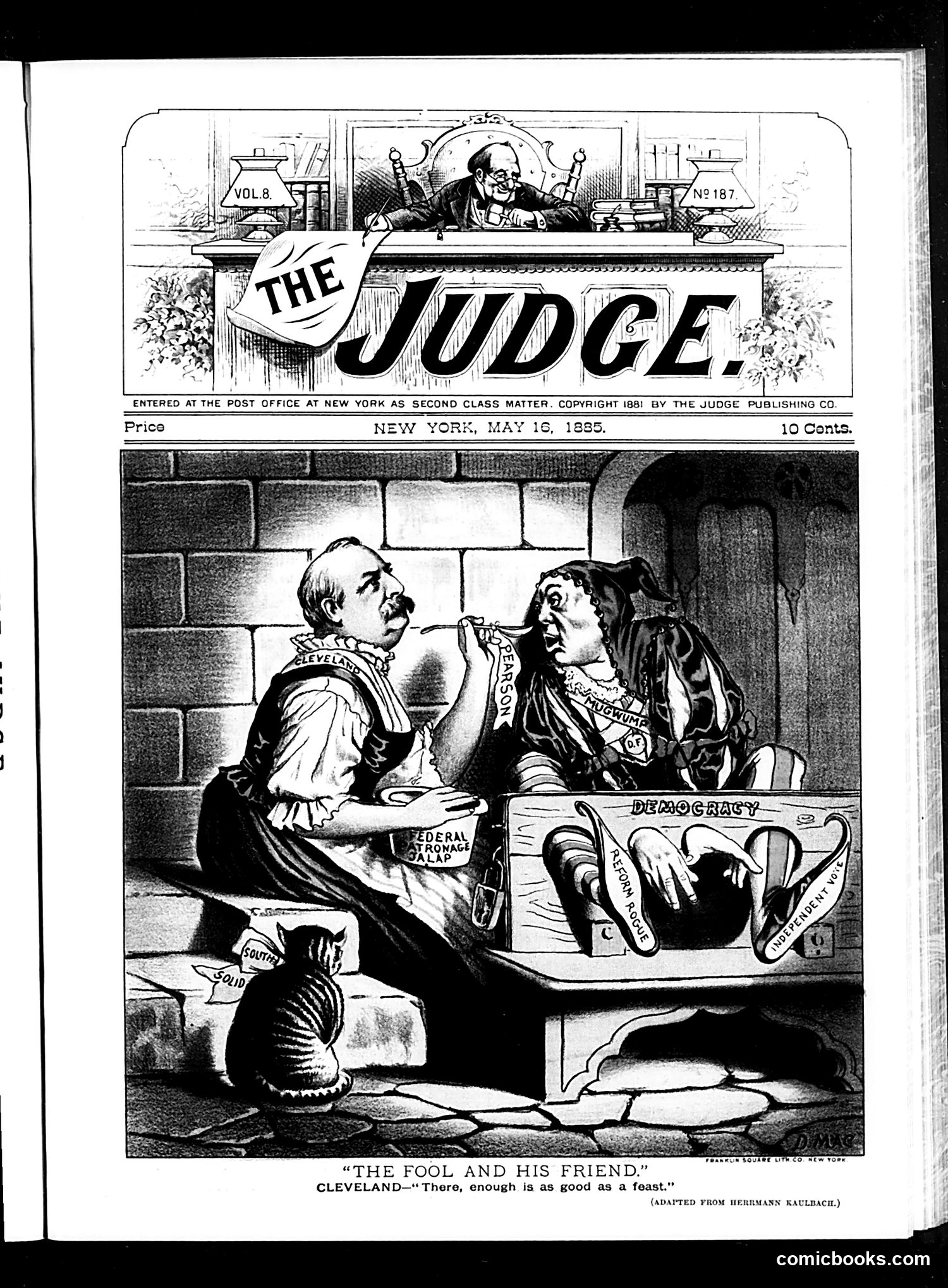
The main cartoon, titled "The Fool and His Friend," depicts Cleveland (labeled) offering food to another figure. The caption quotes: "There, enough is as good as a feast." This satirizes President Grover Cleveland's approach to something—likely his economic or patronage policies. The cartoon suggests Cleveland is providing inadequate resources or relief, with "enough" being minimal rather than sufficient. The figure receiving the offering appears skeptical or dissatisfied. The reference to "Federal Stroage Cap" and "Democracy" visible in the image suggests this concerns government spending, civil service, or Democratic Party policies during Cleveland's first term (1885-1889). The satire mocks Cleveland's restraint as insufficient for actual needs.
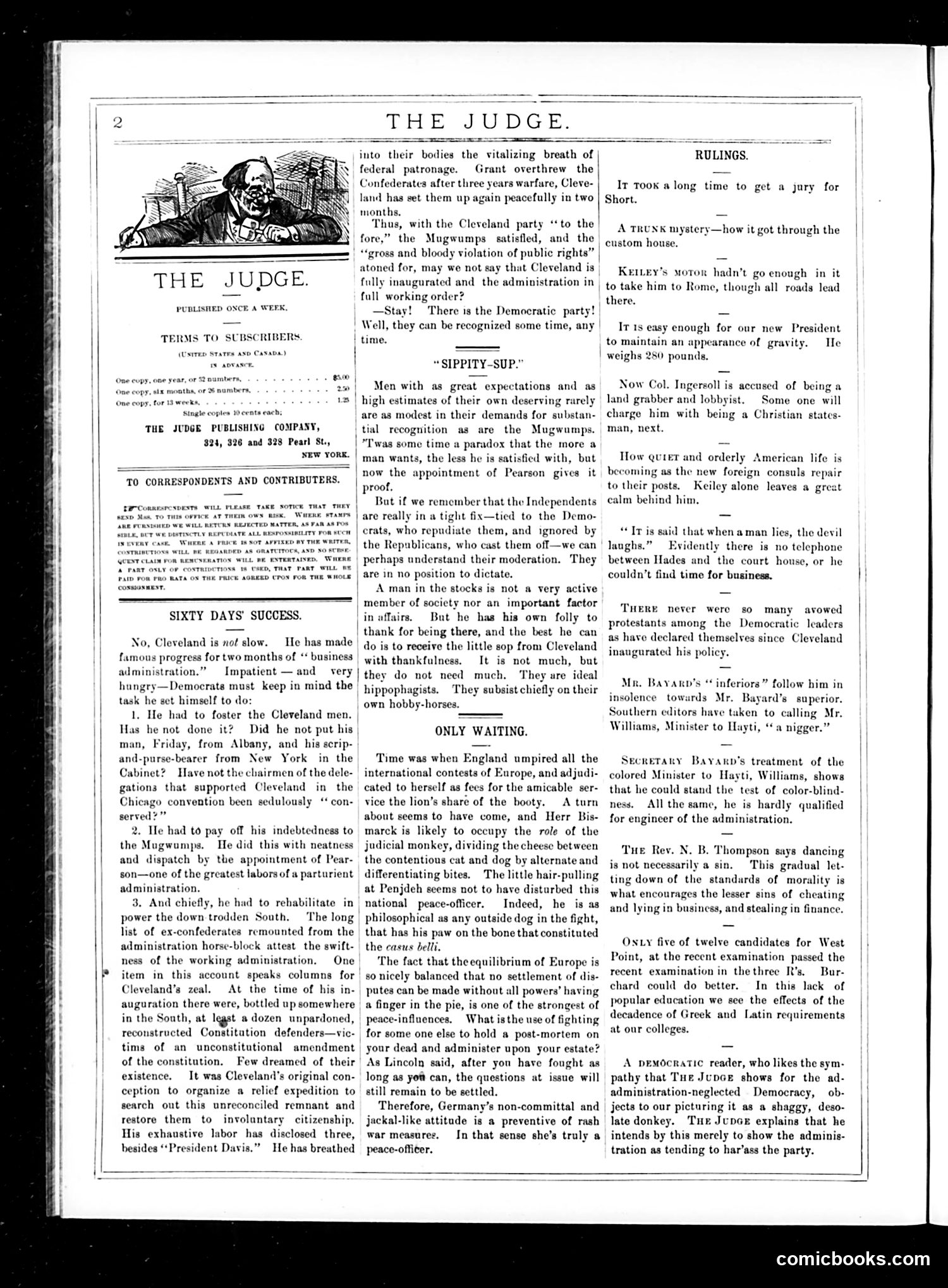
This page satirizes President Cleveland's early administration (he took office in 1885). The cartoon and text mock what Judge viewed as Cleveland's excessive catering to different factions: **Main targets:** - **The Mugwumps**: reform-minded Republicans who abandoned their party for Cleveland. Judge ridicules them as receiving only token appointments (like "Pearson") while demanding recognition. - **The South**: Cleveland is accused of pardoning Confederate sympathizers and restoring ex-rebels to power—described as giving the defeated South "the vitalizing breath of federal patronage." - **Democratic Party neglect**: Judge notes the actual Democratic party remains unrecognized and unrewarded. The satire's point: Cleveland is juggling incompatible political debts—to reformers, to Southern Democrats, to party loyalists—and failing to satisfy anyone while appearing to accomplish nothing substantive in sixty days. The tone is dismissive: comparing the administration's achievements to a man "in the stocks," suggesting Cleveland has boxed himself in politically.
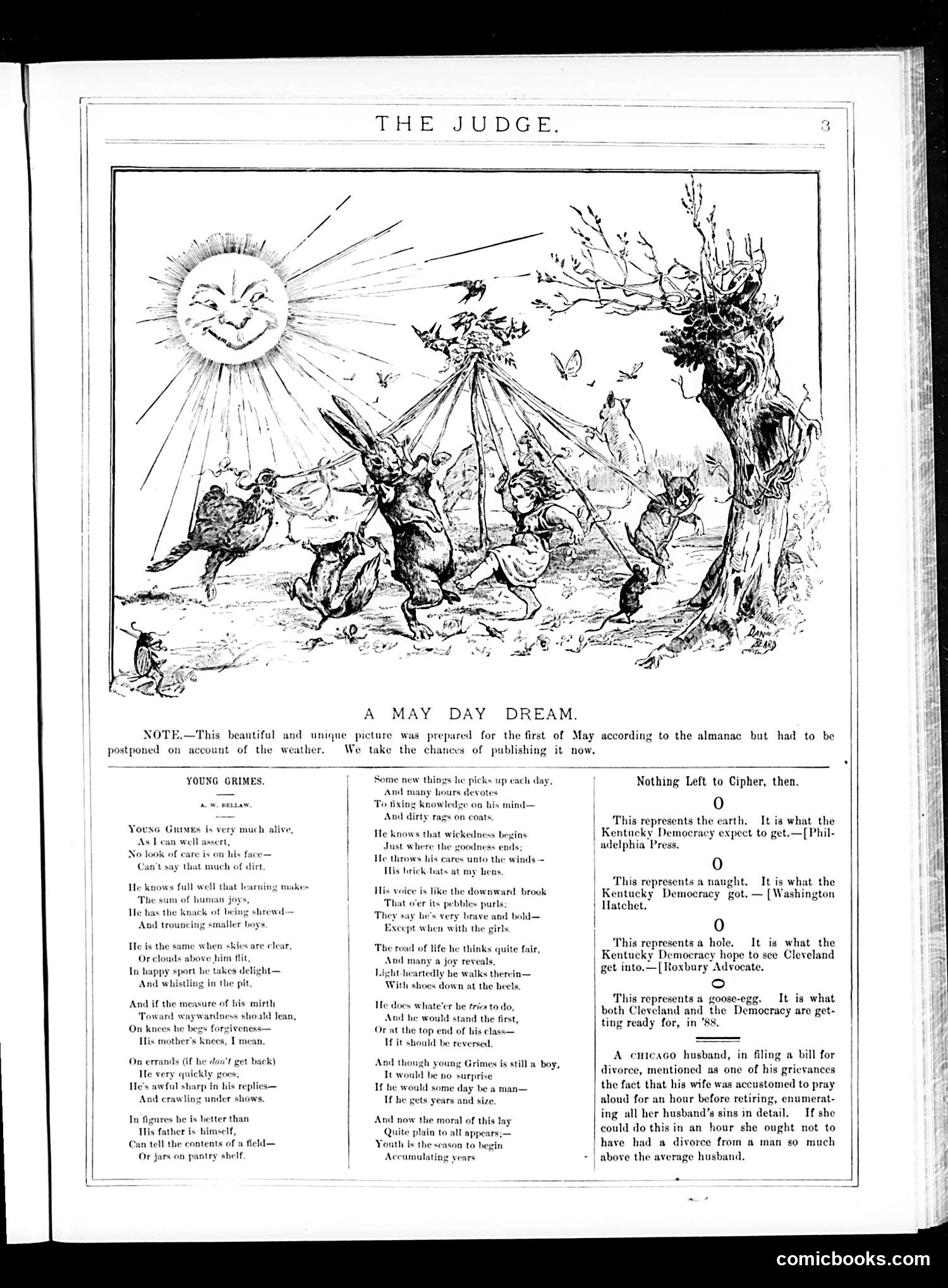
This satirical piece targets **Kentucky Democratic politics**, likely from the 1880s (references to Cleveland suggest the 1888 election era). The main illustration depicts a whimsical May Day celebration with fantastical creatures under a smiling sun—a "dream" contrasting sharply with reality. The accompanying commentary uses mathematical symbols as metaphors: Kentucky Democrats expect to "get" something (represented by "0"—zero/nothing), have actually received zero, and hope Cleveland will be reduced to zero. The phrase "Nothing Left to Cipher, then" suggests Democratic political calculations are futile—they're counting on nothing. This reflects Republican criticism of Democratic governance in Kentucky, portraying their political expectations as delusional fantasies with zero actual accomplishment or prospects. The dream-like illustration ironically frames Democratic hopes as disconnected from reality. The page also includes unrelated satirical notes about a husband's divorce complaint regarding his wife's prayer habits.
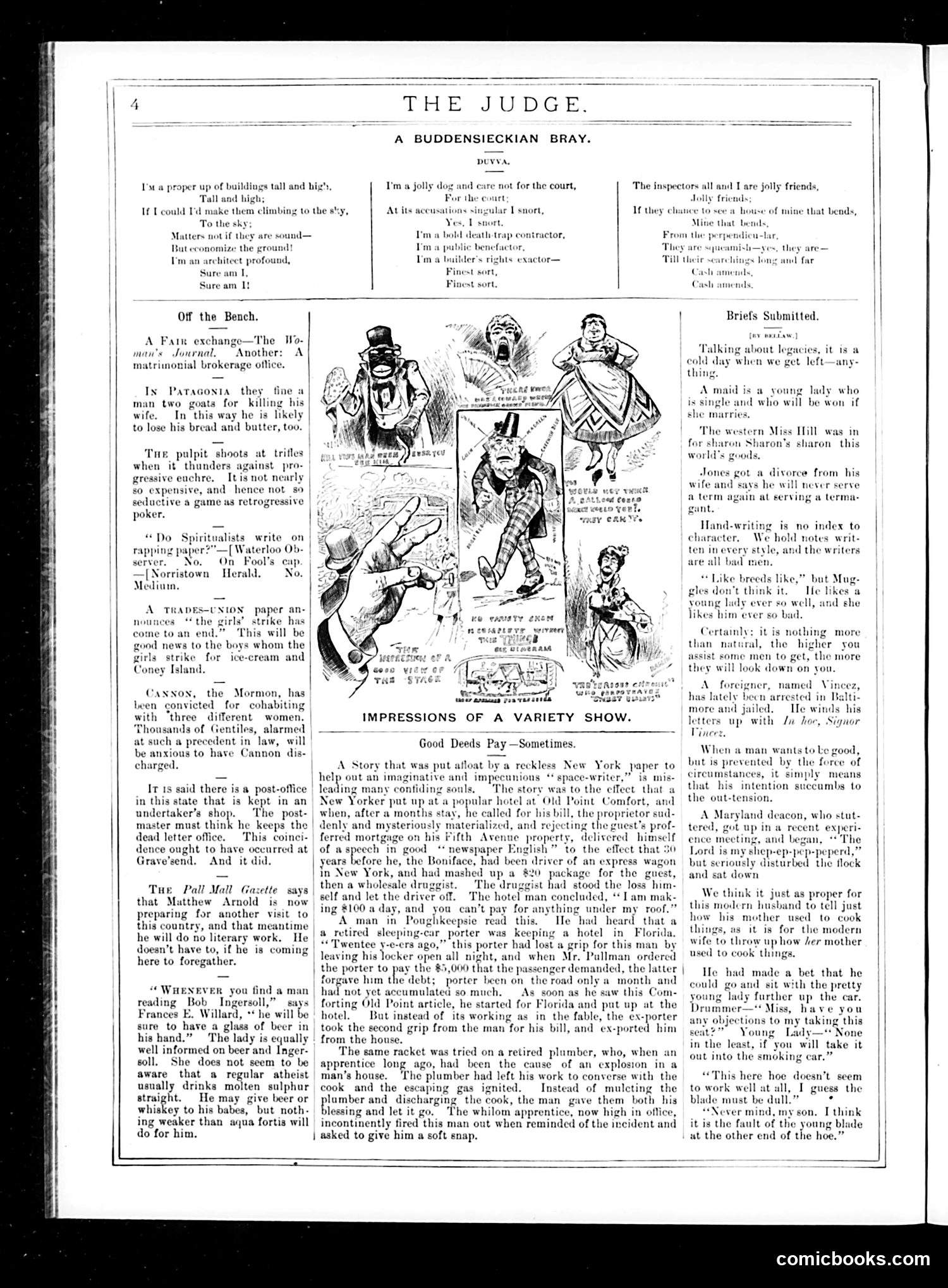
This page from **Judge** magazine contains satirical commentary on contemporary social and political issues, presented through short editorial quips and illustrations. The main cartoon depicts various character types presenting boastful self-descriptions ("A Buddensieckian Bray")—an architect, a dog, and other figures claiming superiority. The satire mocks pretentious self-promotion and exaggerated claims of importance. The "Off the Bench" section offers brief satirical news items, including mockery of: - Matrimonial brokerages - Spiritualist practices - Labor strikes (referenced via "girls' strike") - Religious hypocrisy (the Mormon polygamist Cannon's legal troubles) - Atheist Robert Ingersoll The longer story, "Good Deeds Pay—Sometimes," is satirical irony: a morality tale circulating in newspapers claims good deeds are rewarded, but when the story is actually tested with three different men performing past kindnesses, none receive reciprocal reward. The final man is actually *charged* for a room he was owed. The satire attacks both naive sentimental journalism and human selfishness.
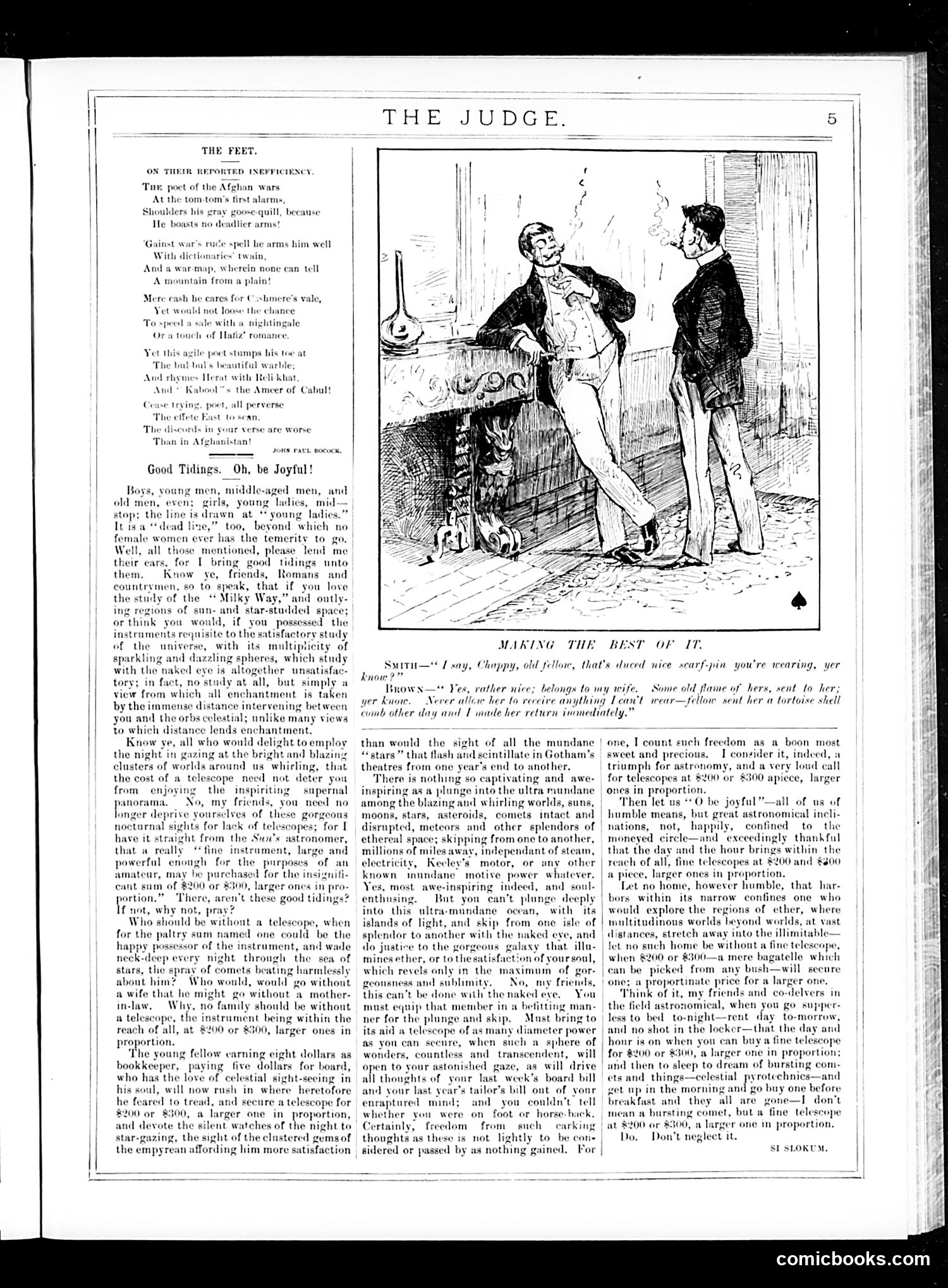
This *Judge* page contains two distinct satirical pieces: **"The Feet" (poem):** A mockery of war correspondents covering the Afghan Wars. The poet-correspondent is ridiculed for romanticizing combat through flowery verse while being geographically incompetent—unable to distinguish mountains from plains on his war map. The satire attacks journalists who aestheticize warfare rather than reporting factually. **"Good Tidings" (advertisement satire):** This appears to be satirizing aggressive telescope marketing. It mocks salesmen using pseudo-scientific enthusiasm and manipulative messaging to convince working-class men (earning $8 daily) to spend $200-$300 on telescopes they cannot afford. The humor lies in the absurdly grandiose language about celestial observation contrasted with the financial irresponsibility being encouraged. **"Making the Best of It" (cartoon & dialogue):** Two gentlemen discuss a scarf-pin gift; one husband aggressively controls what his wife receives from suitors, returning gifts immediately. This satirizes possessive Victorian husbands and marital surveillance. The page satirizes pretension, financial exploitation, and domestic control—common *Judge* targets.
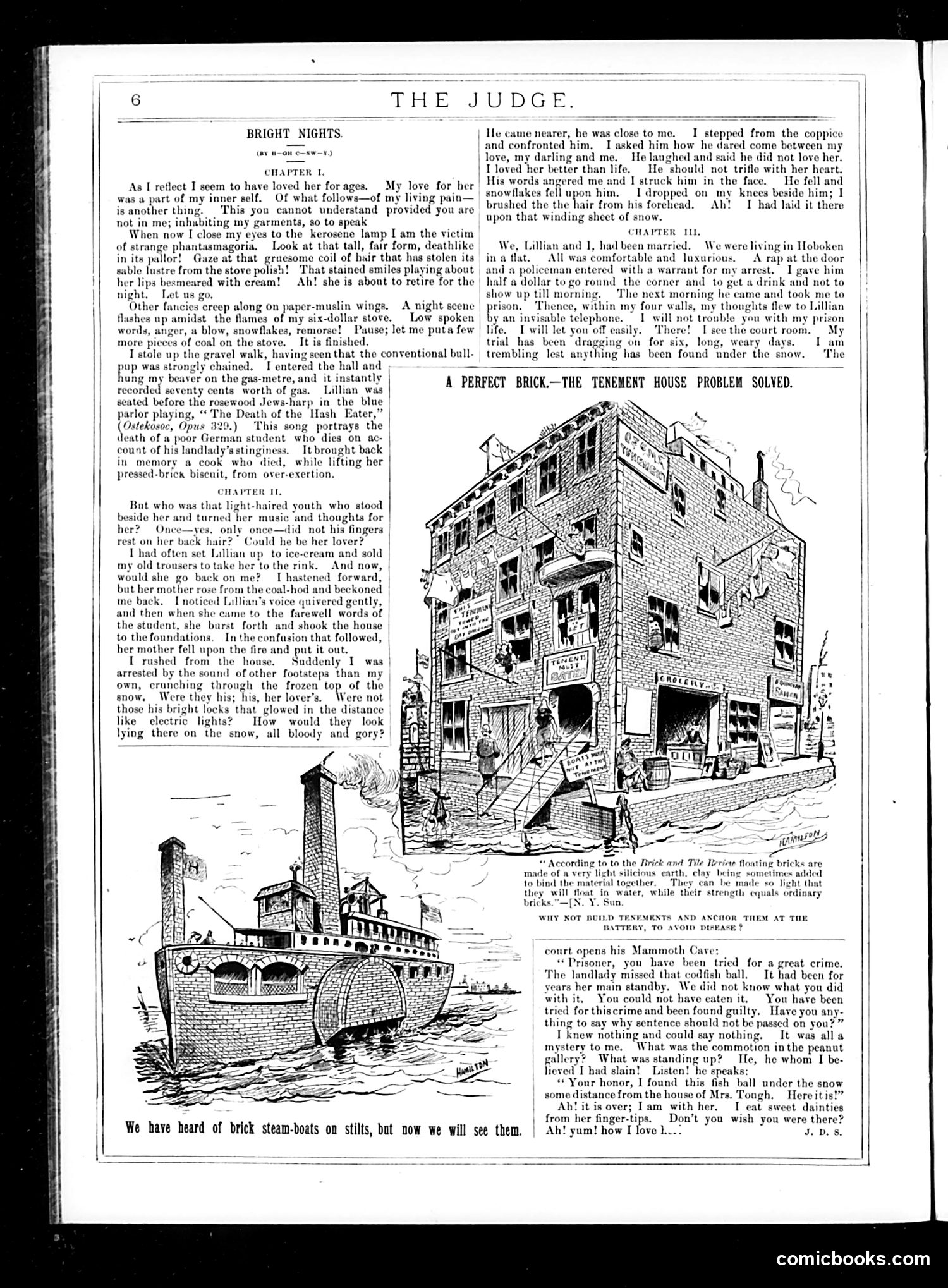
This page contains two distinct elements: a serialized melodramatic story ("Bright Nights") and a satirical cartoon about tenement housing. **The Story** is overwrought Victorian fiction—a jealous narrator's paranoid musings about his wife Lillian in Hoboken, complete with dramatic fantasies of violence and imprisonment. It's satirizing the overwrought sentimental literature popular at the time. **The Cartoon** (bottom) ridicules proposed solutions to tenement overcrowding. The illustration shows a dilapidated multi-story building labeled "A Perfect Brick—The Tenement House Problem Solved." The caption's sarcasm is clear: the article below suggests building tenements on "silicious earth" with added clay to make "light" bricks—a cheap, flimsy construction method. Judge is mocking this as inadequate, cosmetic reform that wouldn't actually solve the serious housing crisis afflicting poor urban residents. The cartoon's title and the accompanying article's headline ask why fireproof construction methods aren't used instead.
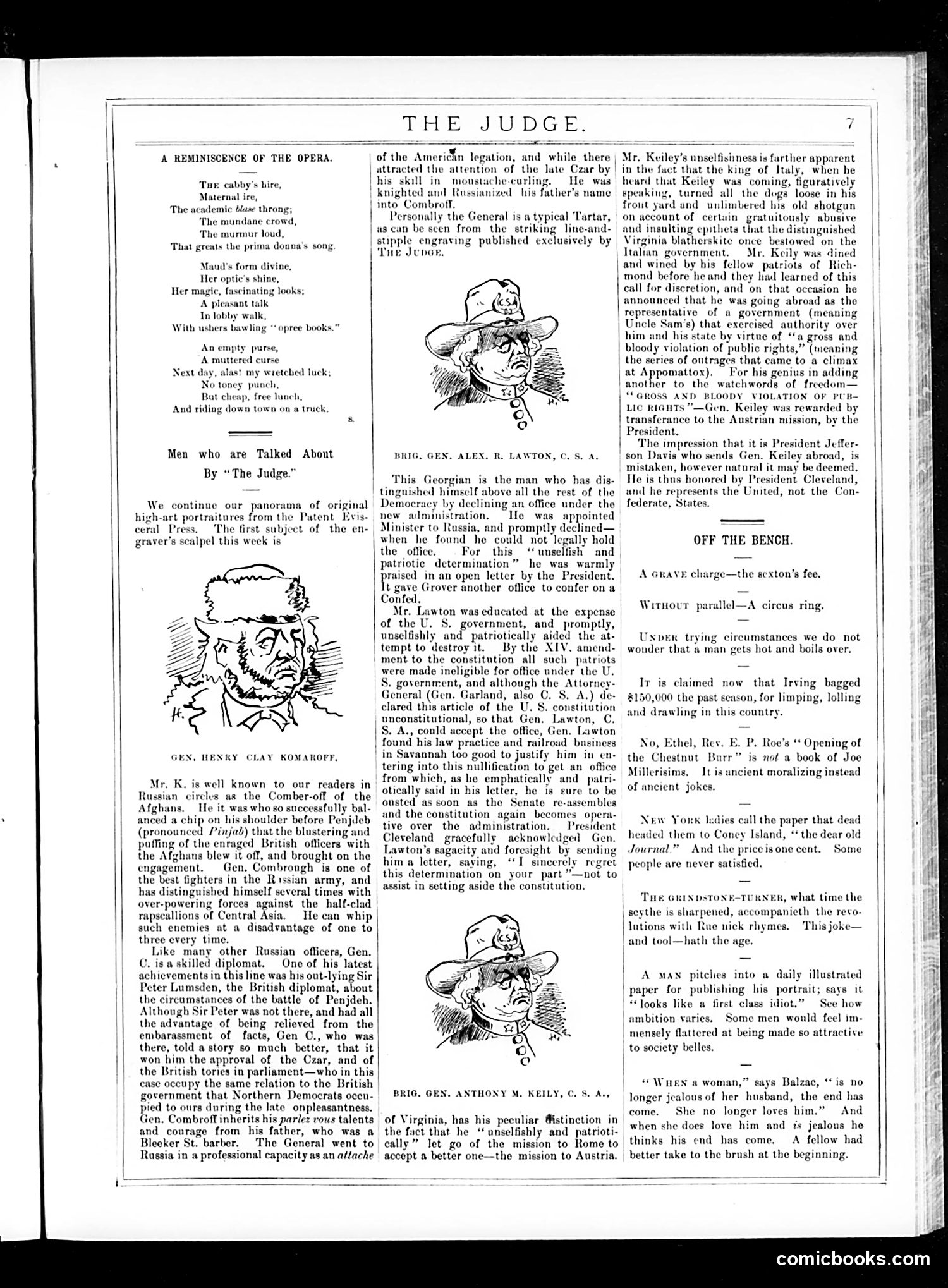
This page satirizes two post-Civil War political figures through caricature and commentary: **General Henry Clay Komaroff** (top cartoon): A Russian general of apparently American origin (his father was a barber on Bleeker Street). The satire mocks his diplomatic maneuvering around the Penjdeh incident (a Russia-Britain Central Asian conflict), suggesting he outmaneuvered British diplomat Sir Peter Lumsden through storytelling rather than facts. **General Alex R. Lawton** (bottom): A former Confederate officer whom President Cleveland appointed as Minister to Russia. The satire highlights the irony—and hypocrisy—of this appointment: the 14th Amendment explicitly barred ex-Confederates from federal office, yet the Attorney General declared it "unconstitutional." Lawton declined anyway, claiming his business was too profitable, which Judge mocks as false patriotism cloaking self-interest. Both cartoons critique post-Reconstruction political accommodation with the South and diplomatic opportunism.
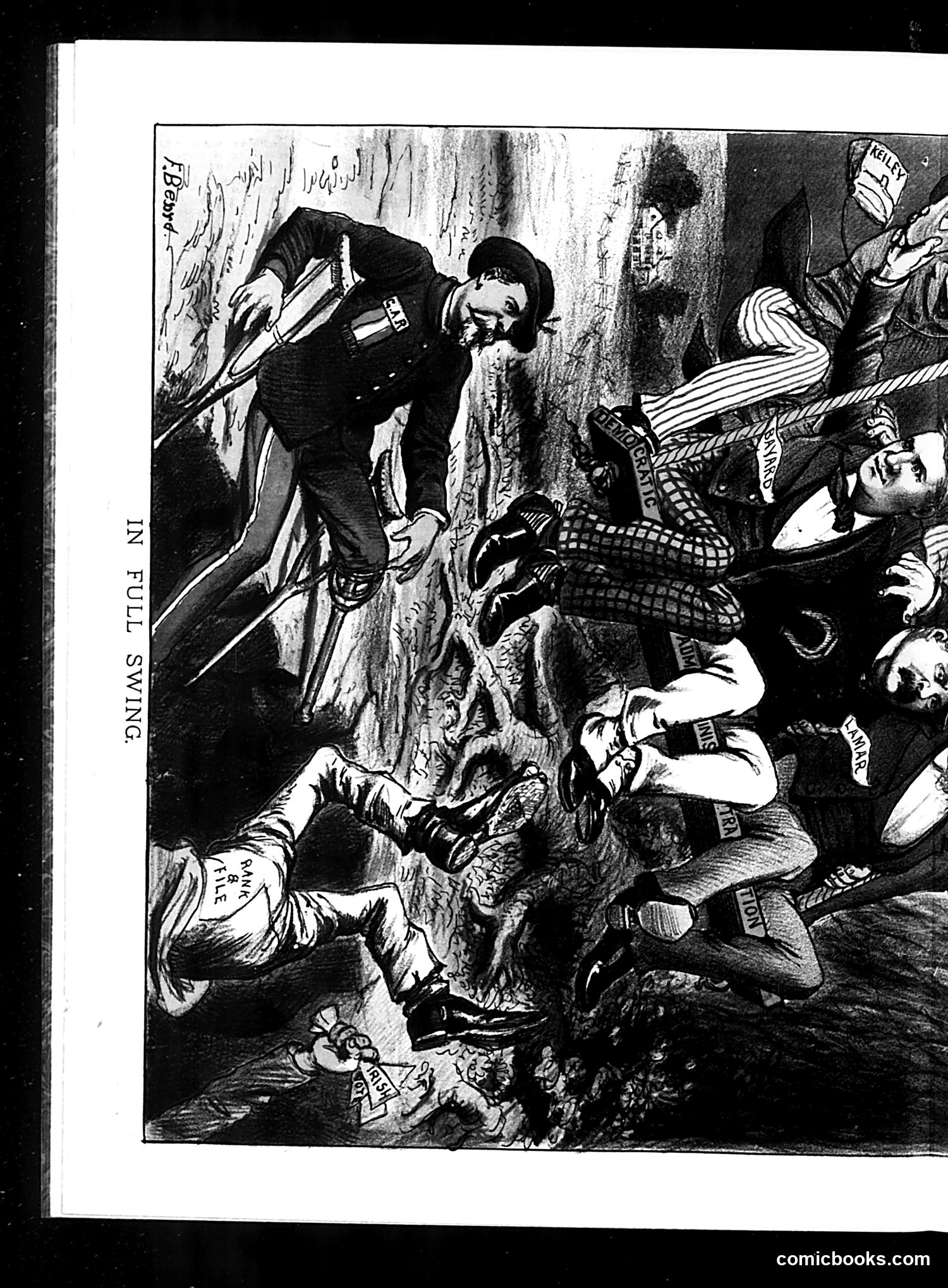
This political cartoon depicts what appears to be a chaotic street scene with multiple figures engaged in physical activity or conflict. The title "In Full Swing" suggests energetic, widespread action. The image shows figures in period clothing (appearing to be late 19th or early 20th century) in apparent disarray or struggle. Based on the Judge magazine's satirical nature, this likely comments on contemporary political turmoil or social upheaval, though the specific historical event remains unclear without additional context. The composition emphasizes chaos and disorder through the overlapping figures and dynamic positioning. Without clearer identification of the specific figures or visible text labels, the precise political or social commentary cannot be definitively determined from the image alone.
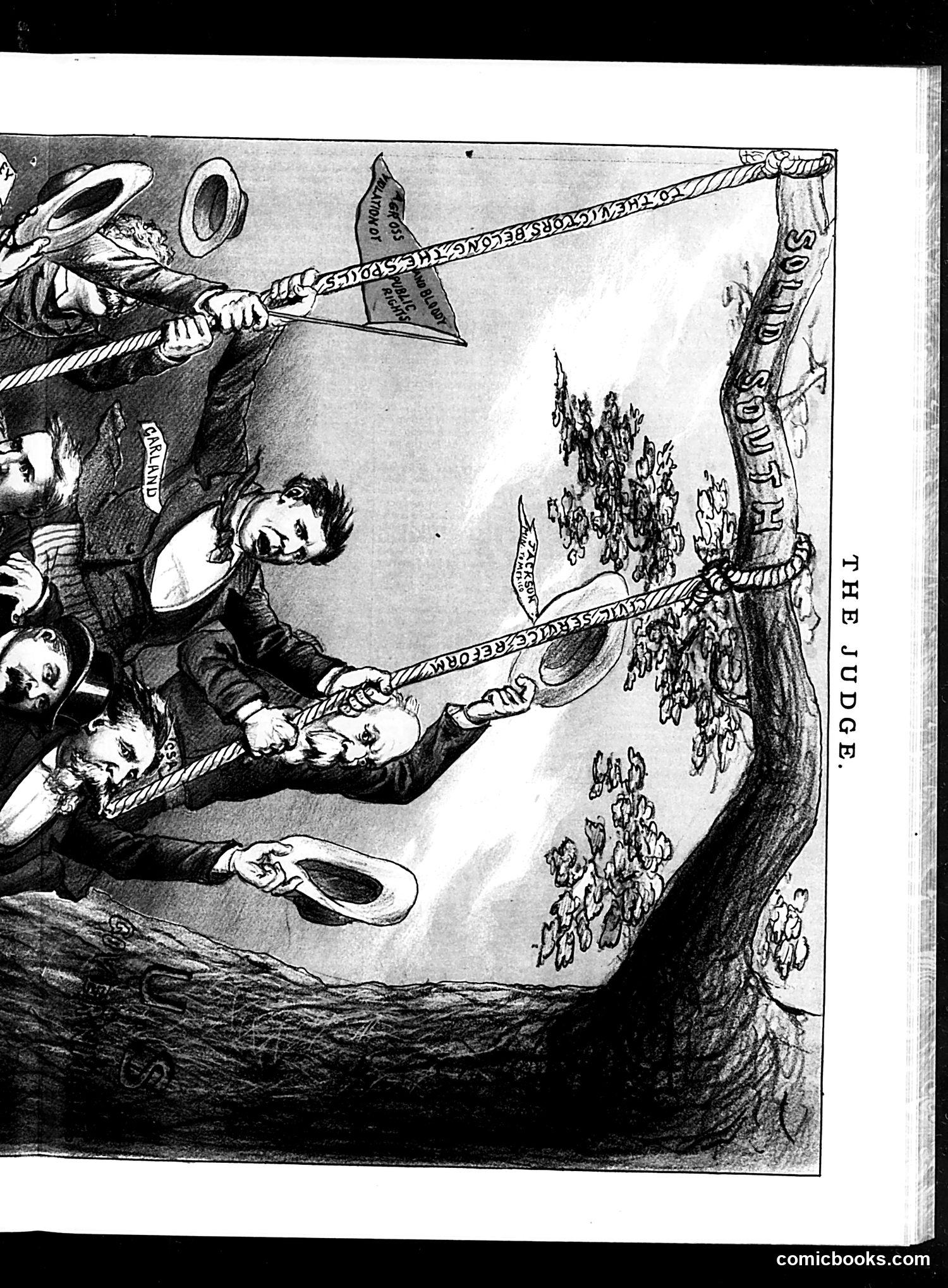
This political cartoon depicts three figures wielding long poles or rods labeled with text (difficult to read clearly in this image) toward a tree. The tree appears to represent something under judgment or scrutiny. The figures seem to represent different political or judicial entities applying pressure or force. The title "THE JUDGE" suggests commentary on judicial authority or decision-making power. Without clearer text on the poles or more context about the publication date, the specific political situation being satirized remains uncertain. The imagery suggests criticism of how power is being wielded against some entity or institution, though the exact target is unclear from the visible elements alone.
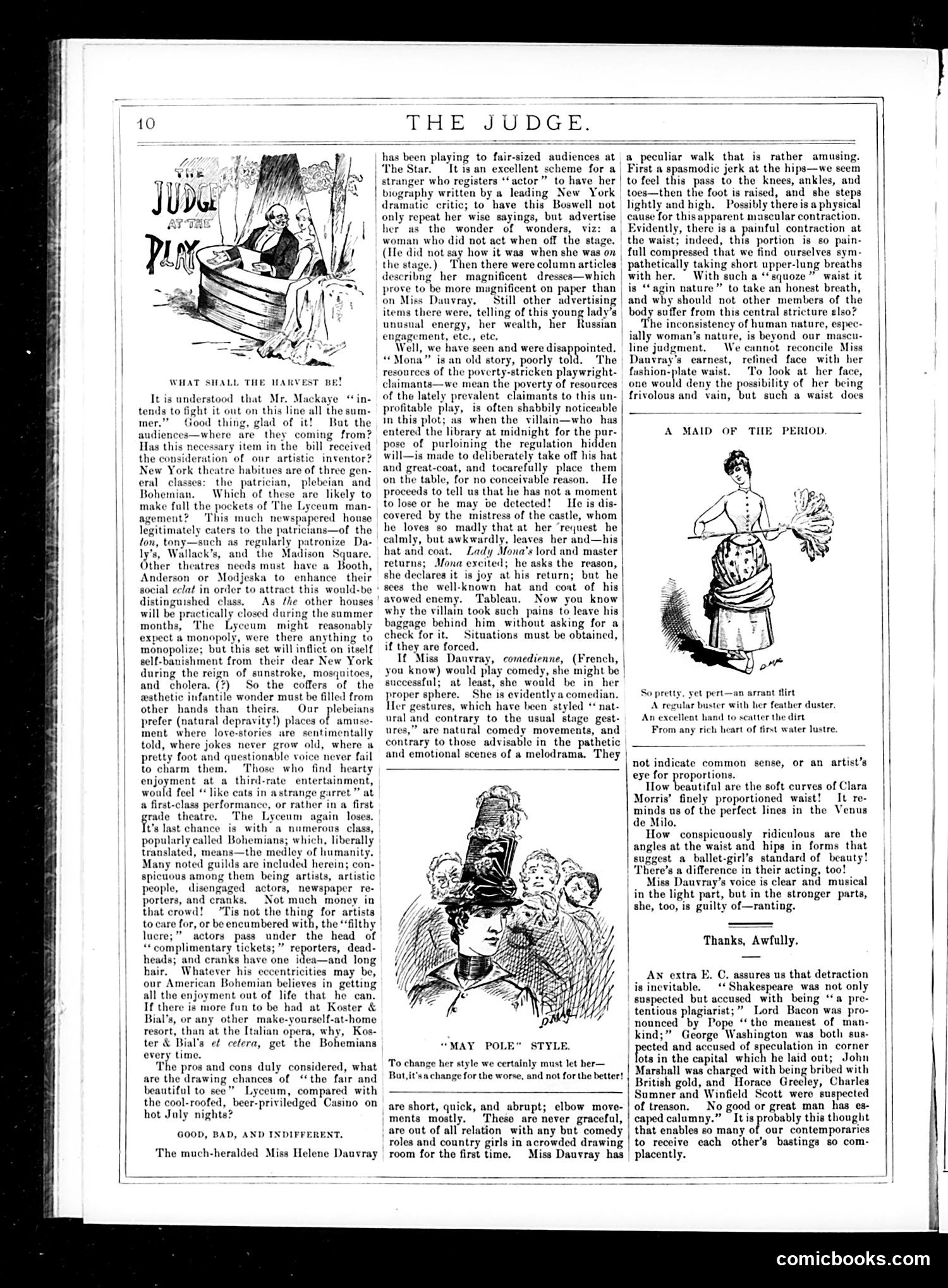
This page critiques the Lyceum Theatre's summer season strategy and reviews actress Helene Dauvray's performance in "May Pole." **The Main Cartoon/Article "What Shall the Harvest Be":** The piece satirizes theater impresario Mackaye's plan to run the Lyceum year-round during summer. The satire identifies New York's three theatergoing classes: wealthy "patricians" (who flee the city during heat), "plebeians" (who prefer sentimental melodramas), and "Bohemians" (artists, reporters, bohemian types who prioritize entertainment value over refined theater). The judge concludes Mackaye will fail because each group will avoid the Lyceum for different reasons—the wealthy leave NYC, the middle-class prefer cheaper venues like Koster & Bial's Casino, and artists seek fun elsewhere. **"May Pole" Review:** The critic harshly reviews Dauvray's performance, noting her reputation was built through favorable press coverage by a "leading dramatic critic" rather than talent. He dismisses the play as a tired poverty-stricken-playwright story and suggests her acting is mediocre despite her wealthy appearance.
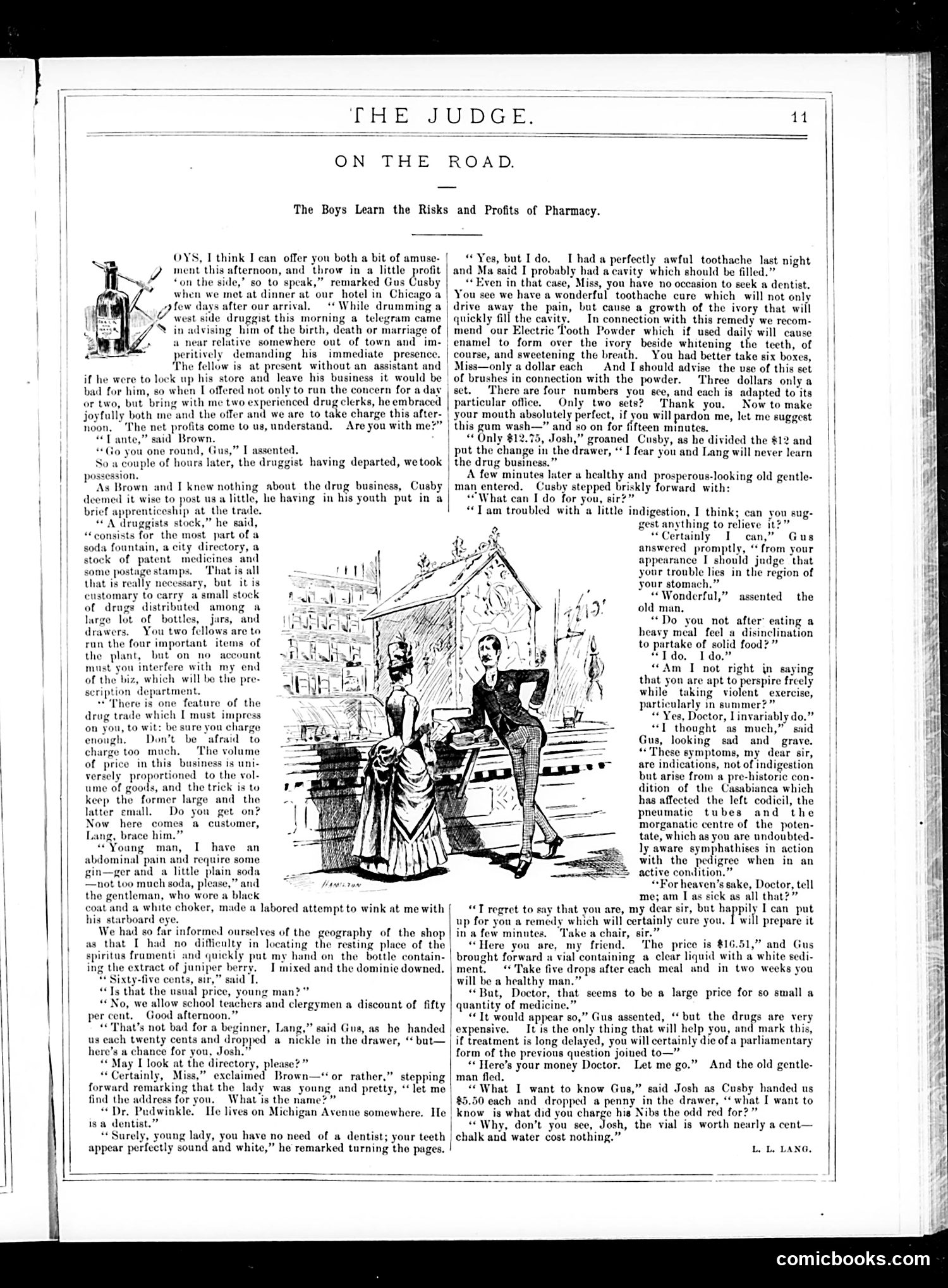
This satirical piece mocks the patent medicine industry and unethical druggists of the era. Three con men—Cusby, Brown, and Lang—take over a Chicago drugstore while the owner is away. Cusby, who has minimal pharmaceutical training, instructs his partners to overcharge customers drastically for worthless or minimally useful remedies. The cartoon illustrates their scheme: a female customer with a toothache is sold multiple expensive products (tooth powder, brushes, gum wash) that won't actually help, while an elderly man with indigestion is similarly fleeced. The satire targets how druggists exploited customers by selling overpriced, ineffective "cures" and the lack of regulation in the patent medicine trade—a widespread social problem in early 20th-century America before FDA oversight.
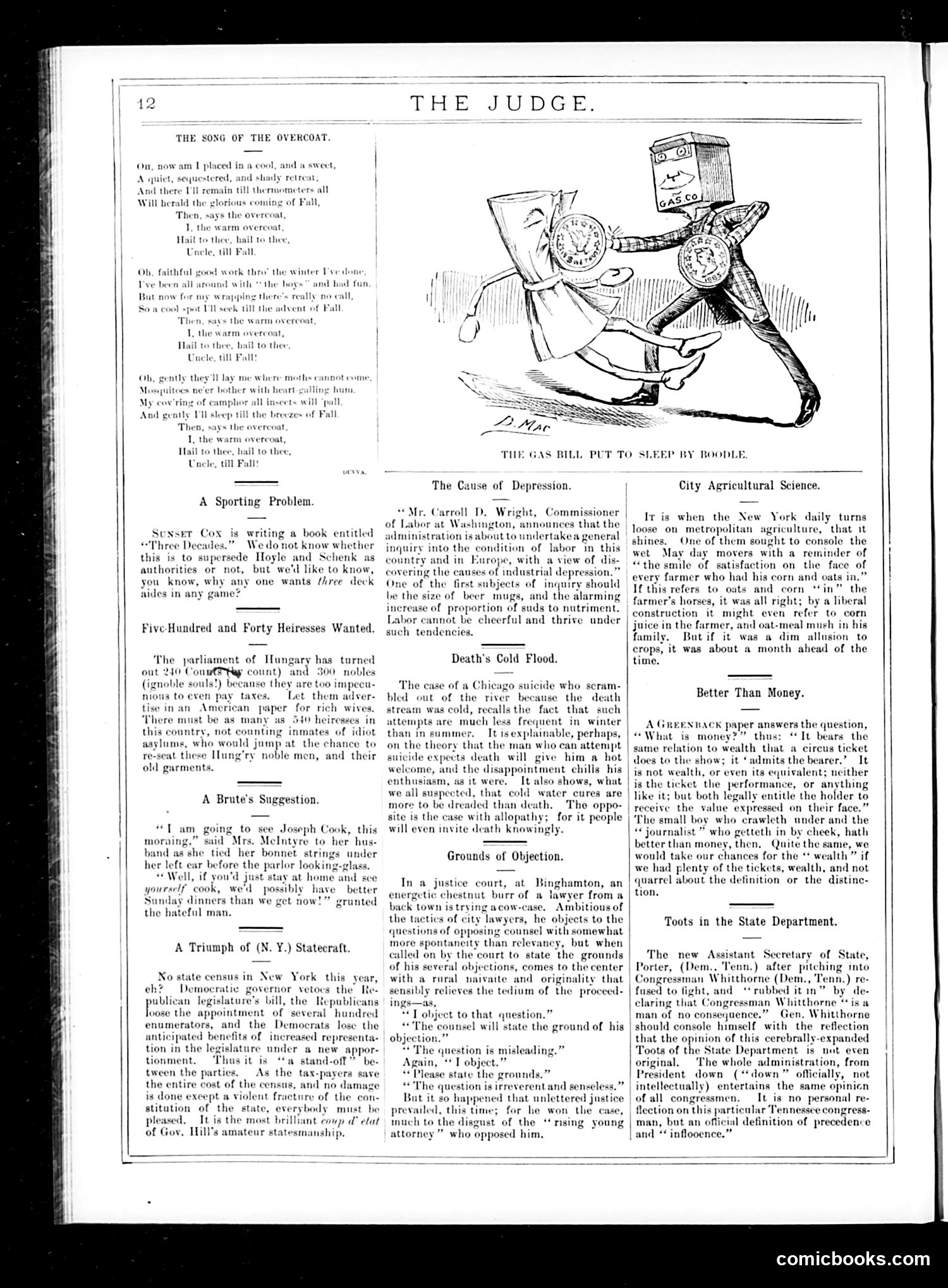
The main cartoon depicts an anthropomorphized gas bill being rocked to sleep like a baby by a figure representing political corruption ("boodle"—slang for bribes/illicit money). The image satirizes how New York City politicians were using corruption to suppress or delay passage of a gas bill, likely one regulating utility rates or company practices that threatened wealthy interests. The surrounding articles reinforce themes of social complaint: labor depression, Hungarian nobles seeking American heiresses, and a legal proceeding where a rural lawyer objects to city lawyers' tactics. The "Song of the Overcoat" is seasonal humor about winter clothing. The satire's point: *Judge* was criticizing how political money ("boodle") could literally put important legislative reforms to sleep, preventing action on issues affecting working people and consumers. The corruption kept the public from getting relief on utility costs.
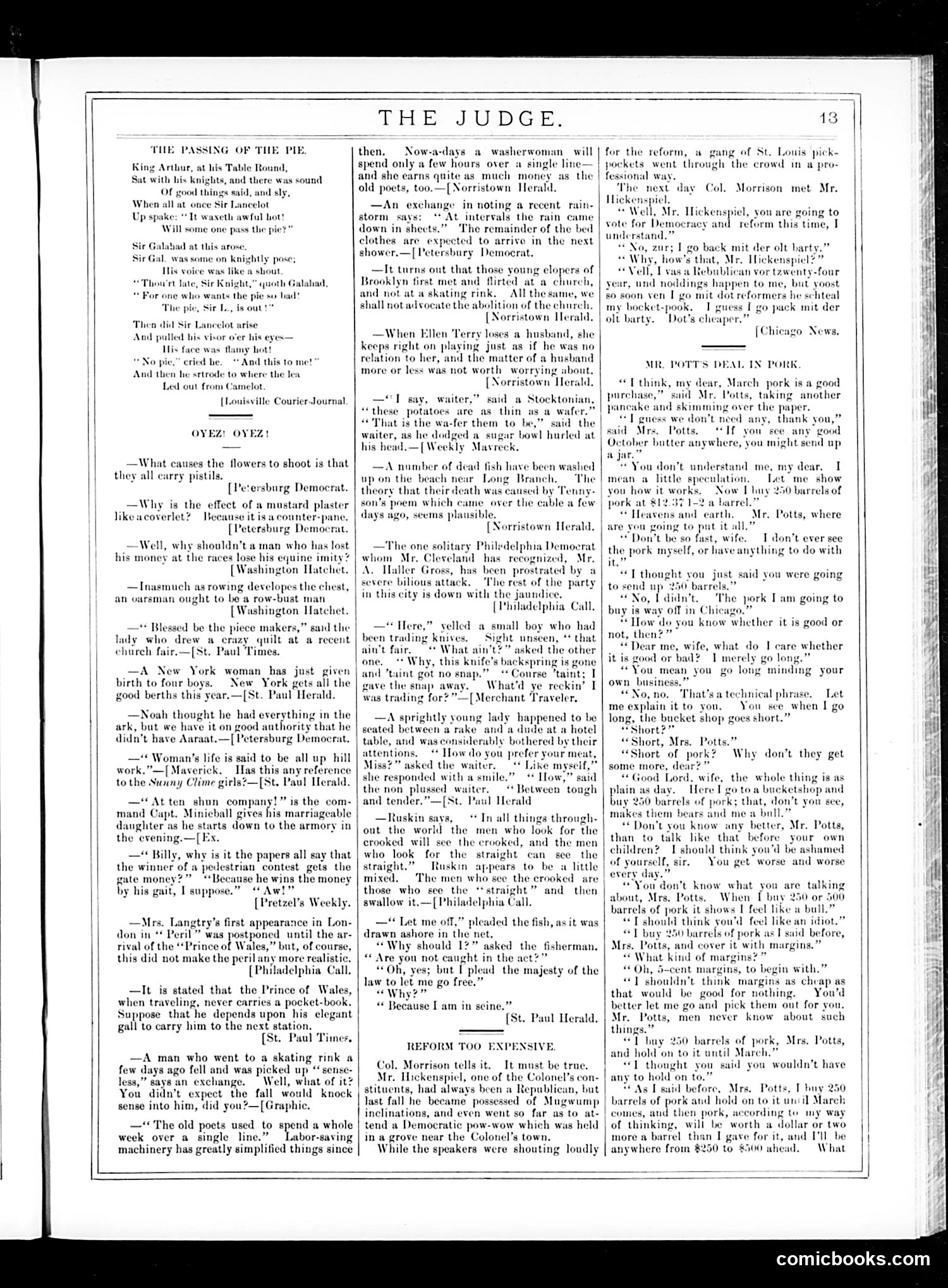
This page contains primarily **short humor pieces and jokes** rather than political cartoons, typical of Judge's satirical format. The content mixes wordplay, puns, and social commentary: - "The Passing of the Pie" is a verse satirizing the King Arthur legend's outdated formality - Multiple jokes mock contemporary topics: women's roles ("Woman's life is said to be all up hill work"), Irish immigration ("New York gets all the good berths"), and celebrity gossip (Mrs. Langtry's theatrical debut, the Prince of Wales) - One joke implies the Prince of Wales relies on "elegant gall" rather than money—satirizing aristocratic privilege - Several pieces poke fun at newspapers, poetry, and modern life The humor is **topical but not deeply political**—mostly light social satire about gender roles, travel, fashion, and popular figures of the era. The references to specific cities (St. Paul, Philadelphia) suggest these were reprinted from regional papers. Without visible illustrations on this particular page, the satire relies entirely on **wordplay and witty observation** rather than visual caricature.
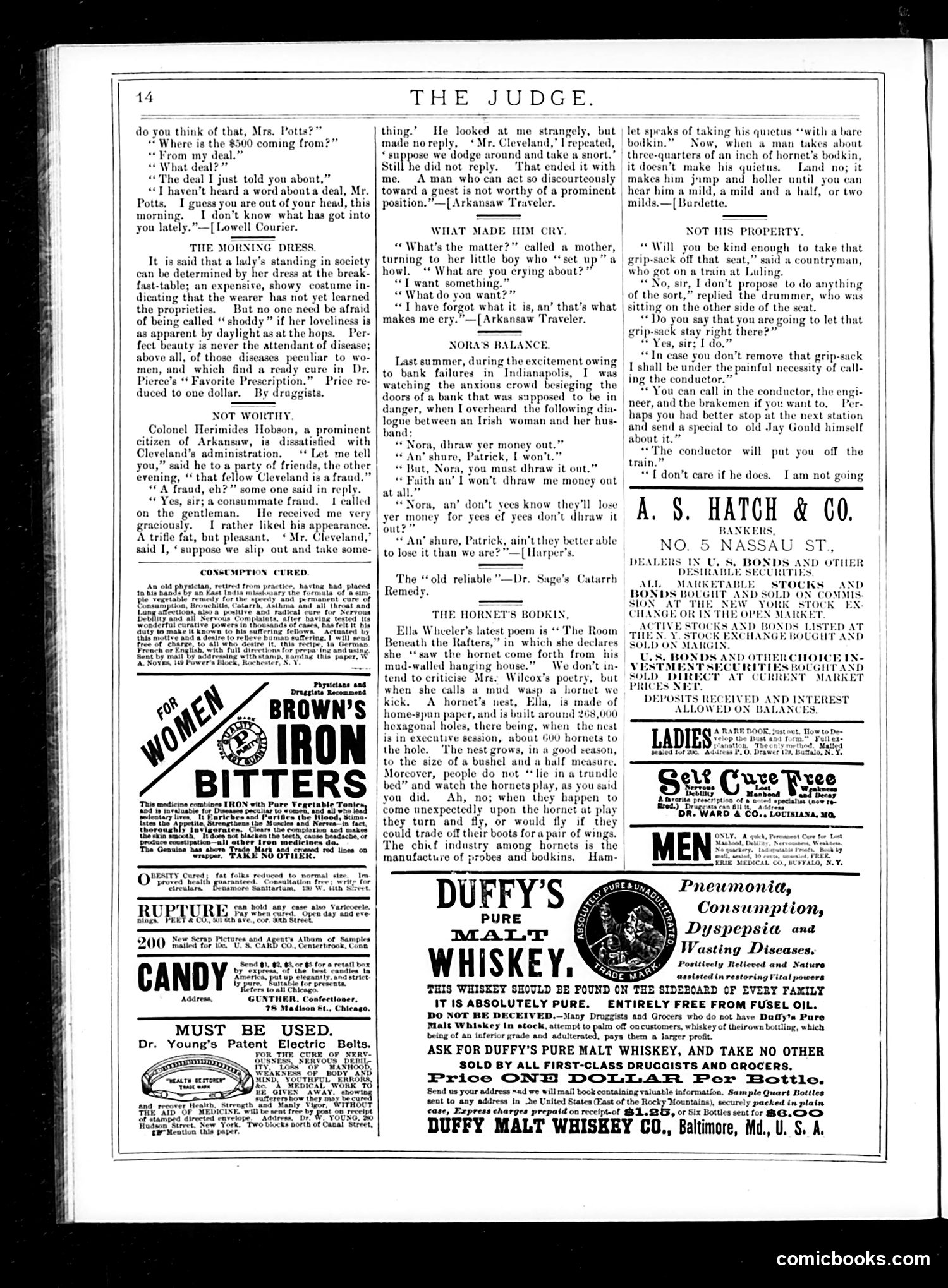
This page from *Judge* magazine contains several short humorous pieces and substantial advertising. The main satirical content includes: **"The Morning Dress"** and **"Not Worthy"**: These are brief joke columns mocking domestic life and political pretension. Colonel Hobson complains Cleveland is a "fraud" for failing basic hospitality—refusing to join him for a drink—deeming him unworthy of office. The humor lies in the absurd standard: personal rudeness disqualifies a president. **"What Made Him Cry"** and **"Nora's Balance"**: Irish dialect humor (typical of the era), featuring working-class perspectives. Nora refuses to withdraw bank deposits during financial panic, reasoning the bank needs money more than she does—a satirical jab at public anxiety during economic crises. The page is dominated by patent medicine and self-help product advertisements (electric belts, whiskey tonics, iron bitters)—common in period magazines and often fraudulent by modern standards.
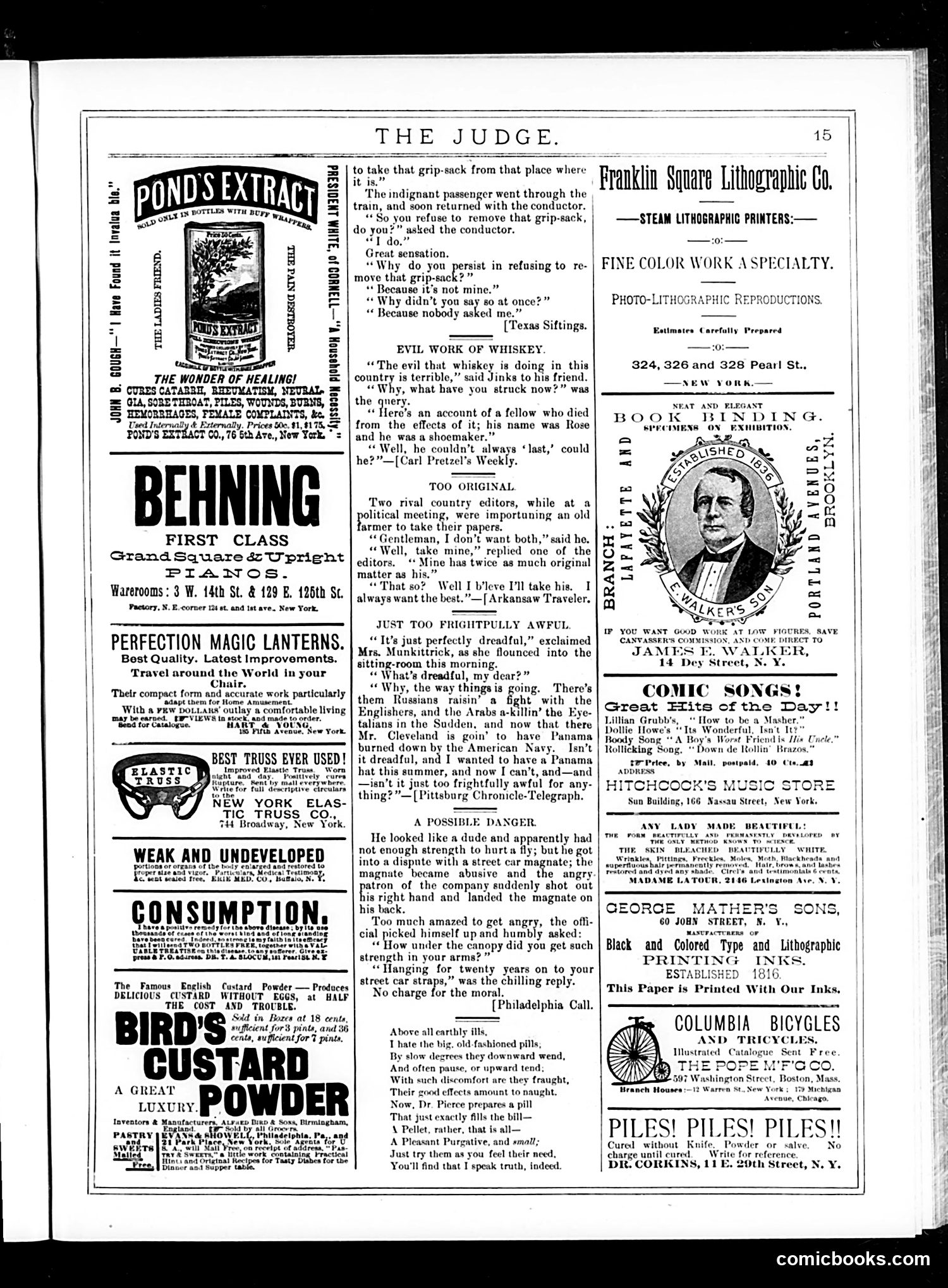
This page is primarily **advertisements with interspersed humor anecdotes**—not a unified political cartoon. The ads promote Victorian-era products (pianos, trusses, custard powder, bicycles). The short comic pieces are mild social humor rather than sharp satire: - **"Evil Work of Whiskey"**: A shoemaker named Rose dies from drinking; the punchline mocks the cliché that quality deteriorates over time. - **"Too Original"**: Two newspaper editors compete for a farmer's subscription. The farmer chooses the worse paper because he prefers "the best"—absurdist humor about rural judgment. - **"Just Too Frightfully Awful"**: Mrs. Munkittrick complains about international conflicts (Russians vs. English, Arabs vs. Italians, Cleveland threatening Panama) but ultimately cares only about not getting her desired Panama hat—satire of frivolous priorities. - **"A Possible Danger"**: A well-dressed dude surprises a streetcar official with unexpected strength, revealed to come from "hanging for twenty years"—dark gallows humor. These are lightweight, apolitical jokes typical of late-19th-century humor magazines.
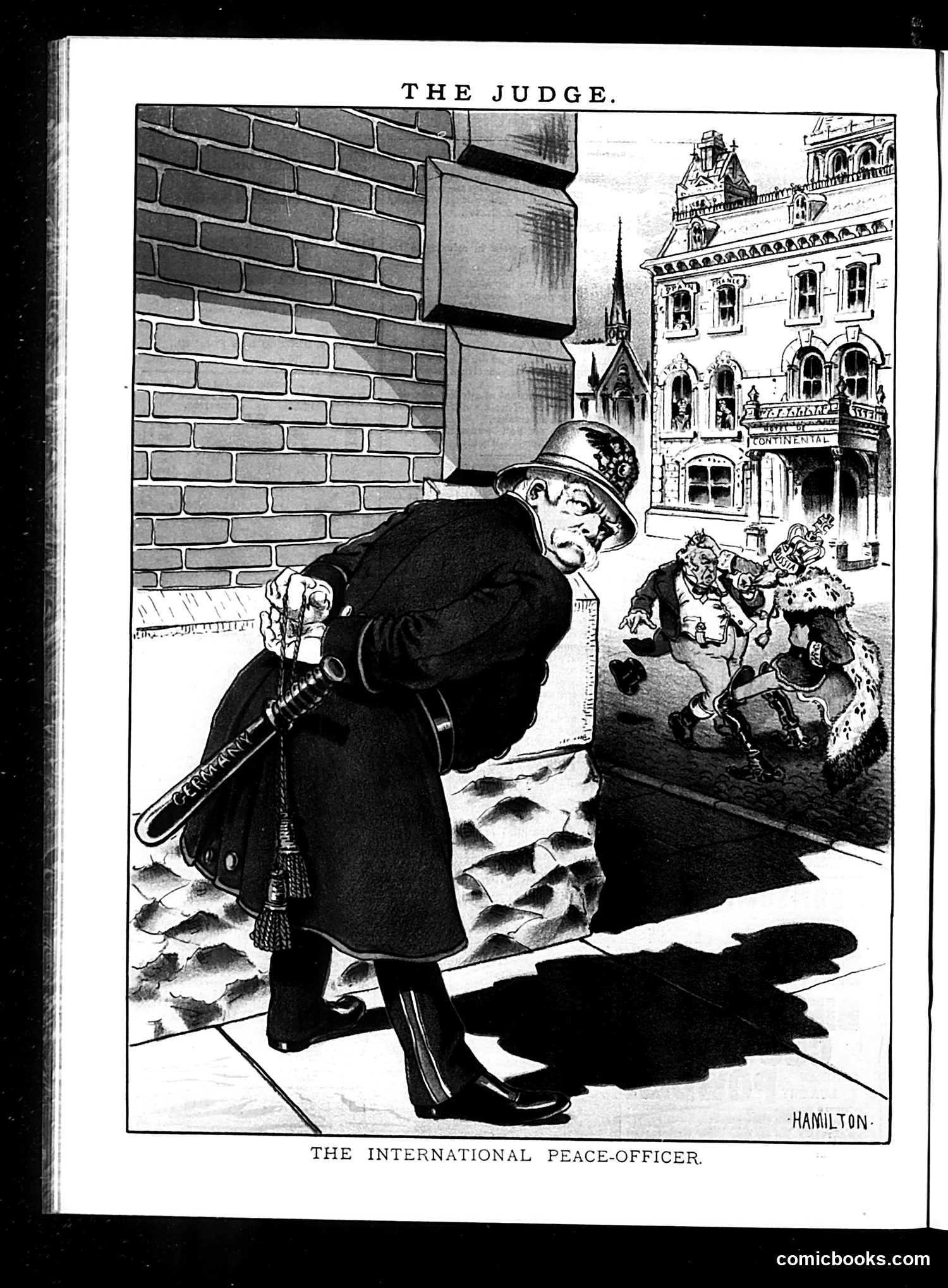
This political cartoon from *Judge* magazine depicts a military or police figure in a spiked German-style helmet (a Pickelhaube), wielding a club labeled "GERMANY" [text visible on the weapon]. He confronts a group of civilians or dignitaries on a European street. The satire critiques Germany's aggressive military posturing and interventionist role in international affairs during a period of European tension—likely the pre-World War I era, given the German military aesthetics and the cartoon's title emphasizing "international peace." The figure's ironically titled role as a "peace-officer" while brandishing weapons suggests the hypocrisy of Germany claiming to maintain peace while actually threatening it. The civilians' fearful response underscores how Germany's military presence destabilizes European stability rather than ensuring it.