
Judge, 1885-05-16 · page 10 of 16
Judge — May 16, 1885 — page 10: what you’re looking at
What you’re looking at
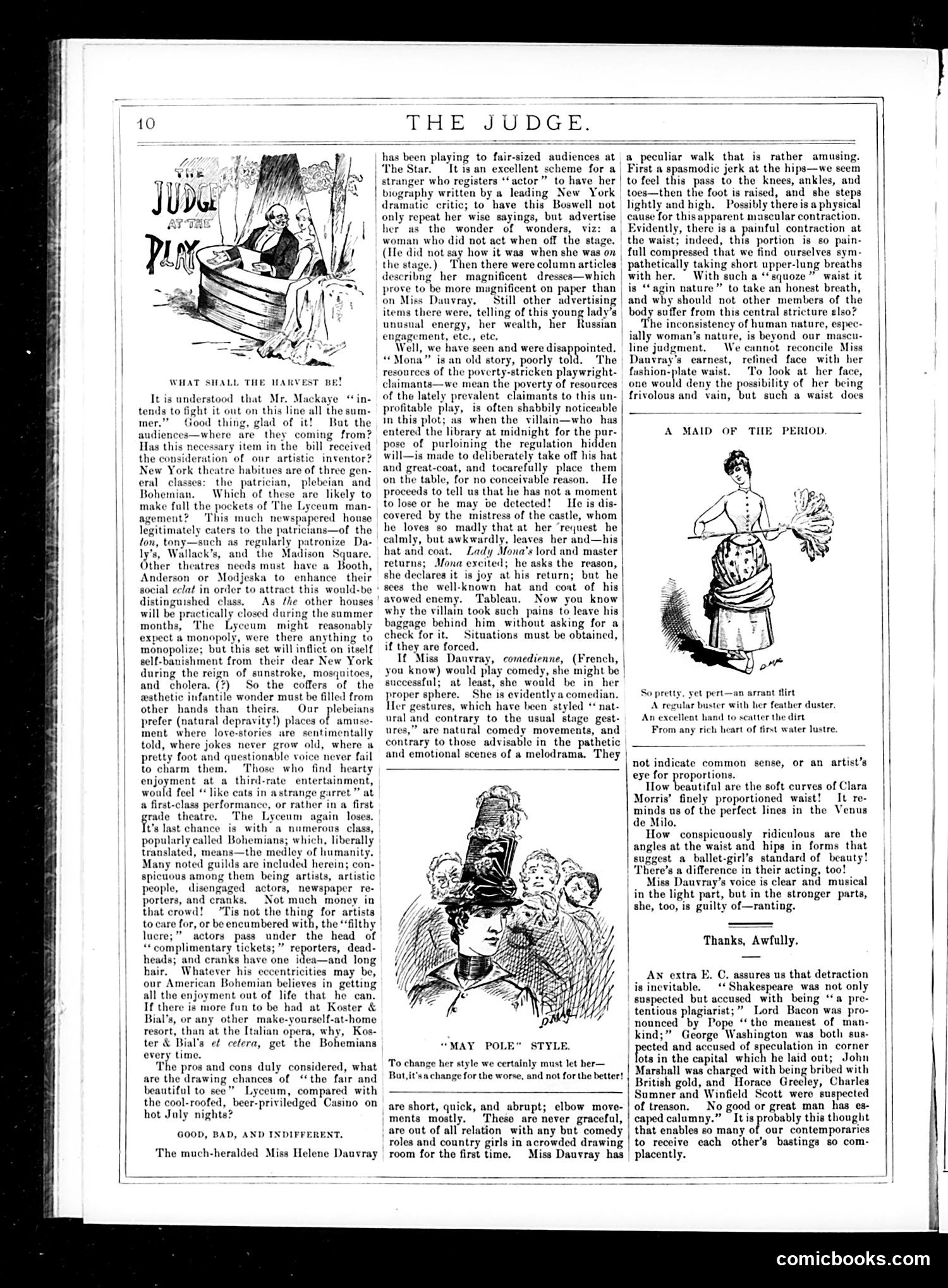
This page critiques the Lyceum Theatre's summer season strategy and reviews actress Helene Dauvray's performance in "May Pole." **The Main Cartoon/Article "What Shall the Harvest Be":** The piece satirizes theater impresario Mackaye's plan to run the Lyceum year-round during summer. The satire identifies New York's three theatergoing classes: wealthy "patricians" (who flee the city during heat), "plebeians" (who prefer sentimental melodramas), and "Bohemians" (artists, reporters, bohemian types who prioritize entertainment value over refined theater). The judge concludes Mackaye will fail because each group will avoid the Lyceum for different reasons—the wealthy leave NYC, the middle-class prefer cheaper venues like Koster & Bial's Casino, and artists seek fun elsewhere. **"May Pole" Review:** The critic harshly reviews Dauvray's performance, noting her reputation was built through favorable press coverage by a "leading dramatic critic" rather than talent. He dismisses the play as a tired poverty-stricken-playwright story and suggests her acting is mediocre despite her wealthy appearance.
📄 Transcribed text from this page (OCR, searchable)
Machine-transcribed from the original scan — historical spelling and the odd misread are preserved.
WHAT SHALL THE UARVEST BE! It is understood that Mr. Mackaye ‘in- tends to fight it out on this line all the sum- mer.” od thing, glad of it! But the audiences—where are they coming from? Has this necessary item in the bill received the consideration of our artistic inventor? New York theatre habitues are of three gen- eral classes: the patrician, plebeian and Bohemian. Which of these are likely to e full the pockets of The Lyceum man- ment? This much new pered house timately caters to the patricians—of the tony—such as regularly patronize Da- ly’s, Wallack’s, and the Madison Square. Other theatres needs must have a Booth, Anderson or Modjeska to enhance their social eclat in order to attract this would-be distinguished class. As the other houses will be practically closed during the summer | months, The Lyceum might reasonab! | expect a monopoly, were there anything to monopolize; but this set will inflict on itself || self-banishment from their dear New York during the reign of sunstroke, mosquitoes, and cholera. (7) » the fers of the wsthetic infantile wonder must be filled from other hands than thei Our plebeians prefer (natural depravity!) places of amus | ment where love-stories are sentimentally told, where jokes never grow old, where a pretty foot and questionable voice never fail | to charm them, Those who find hearty enjoyment at a third-rate entertainment, would feel “like cats in astrange gari at a first-class performance, or rather in a first rade theatre. The Lyceum 1 loses. t’s last chance is with numerous class, popularly called Bohemians; which, liberally trans means—the medley of hu Many noted guilds are included herein spicuous among them being artists, artistic | people, a ged actors, newspaper re- | porters, and crg Not much money in | thatcrowd! "Tis not the thing for artists | tocare for, or be encumbered wi fh, the filthy lucre;” pass under the head of “*complimentary tickets; reporters, dead- heads; and cranks have one idea—and long hair. Whatever his eccentricities may be, our American Bohemian believes in getting all the enjoyment out of life that he can. If there is more fun to be had at Koster & Bial’s, or any other make-yourself-at-home resort, than at the Italian opera, why, Kos- ter & Bial’s ef cetera, get the Bohemians every time. ‘The pros and cons duly considered, what are the drawing chances of “the fair and beautiful to see” Lyceum, compared with the cool-roofed, beer-priviledged Casino on hot July night seng: GOOD, BAD, AND INDIFFERENT. The much-heralded Miss Helene Dauvray THE JUDGE. been playing to fair-sized audiences at Nhe It is. an excellent scheme for a stranger who registers *‘actor” to have her biography written by a leading New York dramatic critic; to have this Boswell not only repeat her wise sayings, but advertise her as the wonder of wonders, viz: a woman who did not act when off the stage. (Ile did not say how it was when she was on ‘Then there were column articles g her magnificent dresses—which prove to be more magnificent on paper than on Miss Dauvr: Still other advertising items there were, telling of this young lady’s unusual energy, her wealth, her Russian engagement, etc., etc. Well, we have seen and were disappointed. a” is an old story, poorly told. ‘The ‘3 of the poverty-stricken playwright- imants—we mean the poverty of resources of the lately prevalent claimants to this un- profitable play, is often shabbily noticeable | in this plot; as when the villain—who has | entered the library at midnight for the pur- of purloining the regulation hidden | will—is made to deliberately take off his hat | and great-coat, and tocarefully place them on the table, for no conceivable reason. He proceeds to tell us that he has not a moment to lose or he may be detected! He is dis- covered by the mistress of the castle, whom he loves so madly that at her ‘request he calmly, but awkwardly, leaves her and—his | hat and coat. Lady Mona's lord and master returns; Mona excited; he asks the reason, | she declares it is joy at his return; but he | sces the well-known hat and coat of his | avowed enemy. Tableau. Now you know | why the villain took such pains to leave his baggage behind him without asking for a} check for it. Situations must be obtained, | if they are forced. If Miss Dauvray, comedienne, (French, you know) would play comedy, she might be | successful; at least, she would be in her proper sphere. She is evidently a comedian. Her gestures, which have been styled ‘* nat- nd contrary to the usual stage gest- ures,” are natural comedy movements, and contrary to those advisable in the pathetic and emotional scenes of a melodrama, They | a peculiar walk that is rather amusing. irst a spasmodic jerk at the hips—we seem | to feel this pass to the knees, ankles, and toes—then the foot is raised, and she steps lightly and high. Possibly there is a physical cause for this apparent mascular contraction. Evidently, there is a painful contraction at the waist; indeed, this portion is so pain- full compressed that we find ourselves sym- pathetically taking short upper-lung breaths with her. With such a “*squoze ” waist it is ‘agin nature” to take an honest breath, and why should not other members of the body suffer from this central stricture elso? ‘The inconsistency of human nature, espec ially woman's is beyond our mascu- line judgment. annot reconcile Miss Dauvray’s earnest, ined face with her fushion-plate waist. To look at her face, one would deny the possibility of her being frivolous and vain, but such a waist does A MAID OF THE PERIOD. So pretty, yet pert—an arrant flirt A regular buster with her feather duster. An excellent hand to scatter the dirt From any rich heart of first water lustre. xe not indicate common sense, or an artist’s eye for proportions. Tlow Heautifal are the soft curves of Clara Morris’ finely proportioned waist! It re- minds us of the perfect lines in the Venus de Milo, How conspicuously ridiculous are the angles at the waist and hips in forms that suggest a ballet-girl’s standard of beauty! | There’s a difference in their acting, too! Miss Dauvray’s voice is clear and musical in the light part, but in the stronger parts, she, too, is guilty of—ranting. Thanks, Awfully. “MAY POLE” STYL To change her style we certainly must let her— Bat, it'sa chan, or the worse, and not for the better: are short, quick, and abrupt; elbow move- ments mostly. | Theso are never graceful, are out of all relation with any but comedy roles and country girls in acrowded drawing room for the first time. Miss Dauvray has Aw extra E. C. assures us that detraction is inevitable. ‘Shakespeare was not only suspected but accused with being ‘a pre- tentious plagiarist;” Lord Bacon was pro- nounced by Pope ‘tho meanest of man- kind;” George Washington was both sus- ted and accused of speculation in corner | Kets in the capital which he laid out; John | Marshall was charged with being bribed with | British gold, and Horace Greeley, Charles Sumner and Winfield Scott were suspected | of treason. No good or great man has es- | caped calumny.” Ieis probably this thought | that enables 60 many of our contemporaries to receive cach other’s bastings so com- placently. comicbooks.com