
Judge, 1885-05-16 · page 7 of 16
Judge — May 16, 1885 — page 7: what you’re looking at
What you’re looking at
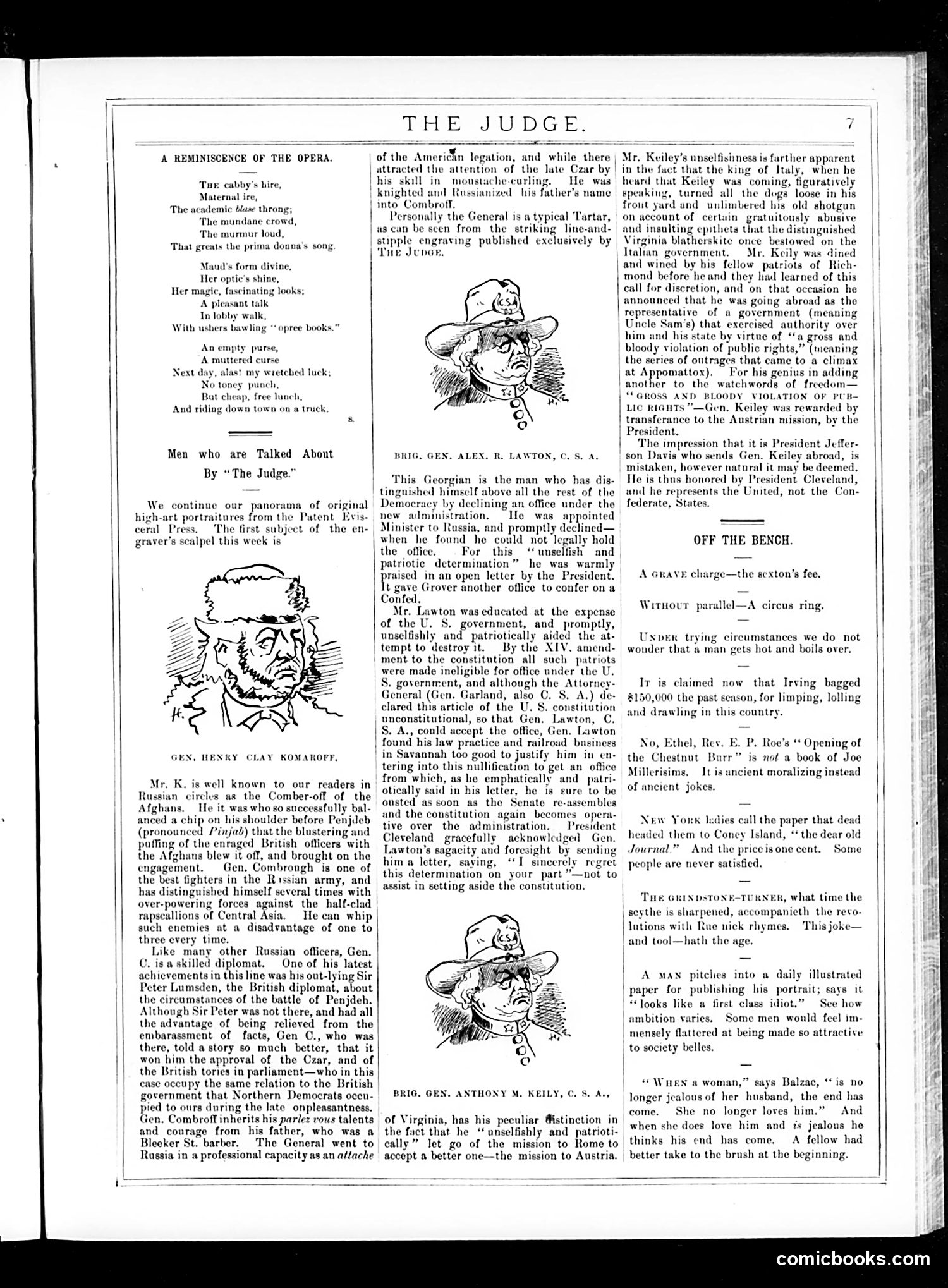
This page satirizes two post-Civil War political figures through caricature and commentary: **General Henry Clay Komaroff** (top cartoon): A Russian general of apparently American origin (his father was a barber on Bleeker Street). The satire mocks his diplomatic maneuvering around the Penjdeh incident (a Russia-Britain Central Asian conflict), suggesting he outmaneuvered British diplomat Sir Peter Lumsden through storytelling rather than facts. **General Alex R. Lawton** (bottom): A former Confederate officer whom President Cleveland appointed as Minister to Russia. The satire highlights the irony—and hypocrisy—of this appointment: the 14th Amendment explicitly barred ex-Confederates from federal office, yet the Attorney General declared it "unconstitutional." Lawton declined anyway, claiming his business was too profitable, which Judge mocks as false patriotism cloaking self-interest. Both cartoons critique post-Reconstruction political accommodation with the South and diplomatic opportunism.
📄 Transcribed text from this page (OCR, searchable)
Machine-transcribed from the original scan — historical spelling and the odd misread are preserved.
NCE OF THE OPERA. cabby’s hire, al ire, ademic Mase throng; ‘The mundane crowd, ‘The murmur loud, ‘That greats the prima douna’s song. Maud’s form divine, Her optic’s shine, In lobby wal With ushers baw li An empty pur A muttered curs Next day, alas! my wretched luck; No toney punch, But cheap, free lunch, And riding down town on a truck Men who are Talked About By “The Judge.” We continue our panorama of original high-art portraitures from the Patent Evis- ceral Press. The first subject of the en- | graver’s scalpel this week GEN. HENRY CLAY KOMAROPF, . K. is well known to our readers in circles as the Comber-off of the Ile it was who so successfully bal- chip on his shoulder before Penjdeb (pronounced Pinjad) that the blustering and puffing of the enraged British officers with the Afghans blew it off, and brought on the engagement. Gen. Combrough is one of the best fighters in the Russian army, and has distinguished himself several times with over-powering forces against the half-clad rapscallions of Central Asia. He can whip such enemies at a disadvantage of one to three every time. Like many other Russian officers, Gen. | C. is a skilled diplomat. One of his latest achievements in this line was his out-lying Sir Peter Lumsden, the British diplomat, about the circumstances of the battle of Penjdeh. Although Sir Peter was not there, and had all | the advantage of being relieved from the embarassment of facts, Gen C., who was | there, told a story so much better, that it won him the approval of the Czar, and of the British tories in parliament—who in this | case occupy the same relation to the British government that Northern Democrats occu- pied to ours during the late onpleasantness. Gen. Combroff inherits his parlez rous talents and courage from his father, who was a Bleeker St. barber. The General went to Russia in a professional capacity as an aftache THE JUDGE. of the Ar Americhn ley attracted the attention of the late his skill in moustache-curling, knighted and Russianized into Combroff. Personally the General is a typical Tartar, us can be seen from the striking line-and- supple engraving published exclusively by The Jcpor. Czar by Me was his father’s name BRIG, GEN, ALEX, R. LAWTON, € This Georgian is the man who has dis- tinguished himself above all the rest of the Democracy by declining an office under the new administration, Ife was appointed Minister to Russia, and promptly declined— when he found he could shot legally hold the office. r this ‘unselfish and patriotic determination” he was warmly ee in an open letter by the President. t gave Grover another office to confer on a Confed. Mr. Lawton was educated at the expense of the U. S. government, and promptly, unselfishly and patriotically aided the tempt to destroy it. By the XIV. amend- ment to the constitution all such patriots were made ineligible for office under the U. government, and although the A eneral (Gen. Garland, also C. S.A. clared this article of the U. constitution unconstitutional, so that ( Lawton, C. S. could accept the office, Gen. Lawton found his law practice and railroad business in Savannah too good to justify him in en- tering into this nullification to get an offic from which, as he emphatically and patri- otically said in his letter, he is eure to be ousted as soon as the $ e re-assembles and the constitution again becomes opera- tive over the administration. President Cleveland gracefully acknowledged Gen. Lawton’s sagacity and foresight by sending him a letter, saving, ‘I sincerely regret this determination on your t—not to assist in setting aside the constitution. ne BRIG. GEN. ANTHONY M. KEILY, C. 8. A., of Virginia, has his peculiar Mistinction in the fact that he ‘unselfishly and _patrioti- cally” let go of the mission to Rome to accept a better one—the mission to Austria, ion, dud ‘while tbere| Mr. Keiley’s unselfishness is farther apparent in the fact that the king of Italy, when he heard that Keiley was coming, figuratively speaking, turned all the dogs loose in his frout yard und unlimbered his old shotgun on account of certuin gratuitously abusive and insulting epithets that the distinguished Virginia blatherskite once bestowed on the Italian government. — Mr. Keily was dined | and wined by his fellow patriots of Rich- mond before he and they had learned of this call for discretion, and on that occasion he announced that he was going abroad as the representative of a government (meaning Uncle Sams) that exercised authority over him and his state by virtue of “a gross and bloody violation of public rights,” (meaning the series of outrages that came to a climax j at Appomattox). For his genius in adding lanother to the watchwords of freedom— | “anos AND BLOODY VIOLATION OF PUB- | Lic Ts ""—Gen. Keiley was rewarded by | transte rance to the Austrian mission, by the President. The impression that it is President Jeffer- son Davis who sends Gen. Keiley abroad, is mistaken, however natural it may be deemed. Te is thus honored by President Cleveland, und he represents the United, not the Con- federate, States, OFF THE BENCH. A Grave charge—the sexton’s fee. Wituovt parallel—A circus ring. Uspel wouder the trying circumstances we do not a man gets hot and boils over. is claimed now Ir 50,000 the past season, for limping, lolling that Irving bagged and drawling in this country. No, Ethel, the Chestnut Rev. E Burr” P. Roe’s “ Opening of is not a book of Joe It is ancient moralizing instead of ancient jokes. er that dead ‘the dear old And the price is one cent. people are never satisfied headed them to Coney Island, purnal.” Some THe GRINDSTON E-TURNER, What time the scythe is sharpened, accompanieth the revo- | lutions with Rue nick rhymes. This joke— and tool—hath the age. A MAN pitches into a daily illustrated aper for publishing his portrait; says it “looks like a first class idiot.” See how ambition varies. Some men would feel im- mensely flattered at being made so attractive to society bel “Wes a woman,” says Balzac, “is no longer jealous of her husband, the end has come. She no longer loves him.” And when she does love him and is jealous he thinks his end has come. A fellow had better take to the brush at the beginning. comicbooks.com