
A complete issue · 16 pages · 1885
Judge — April 4, 1885
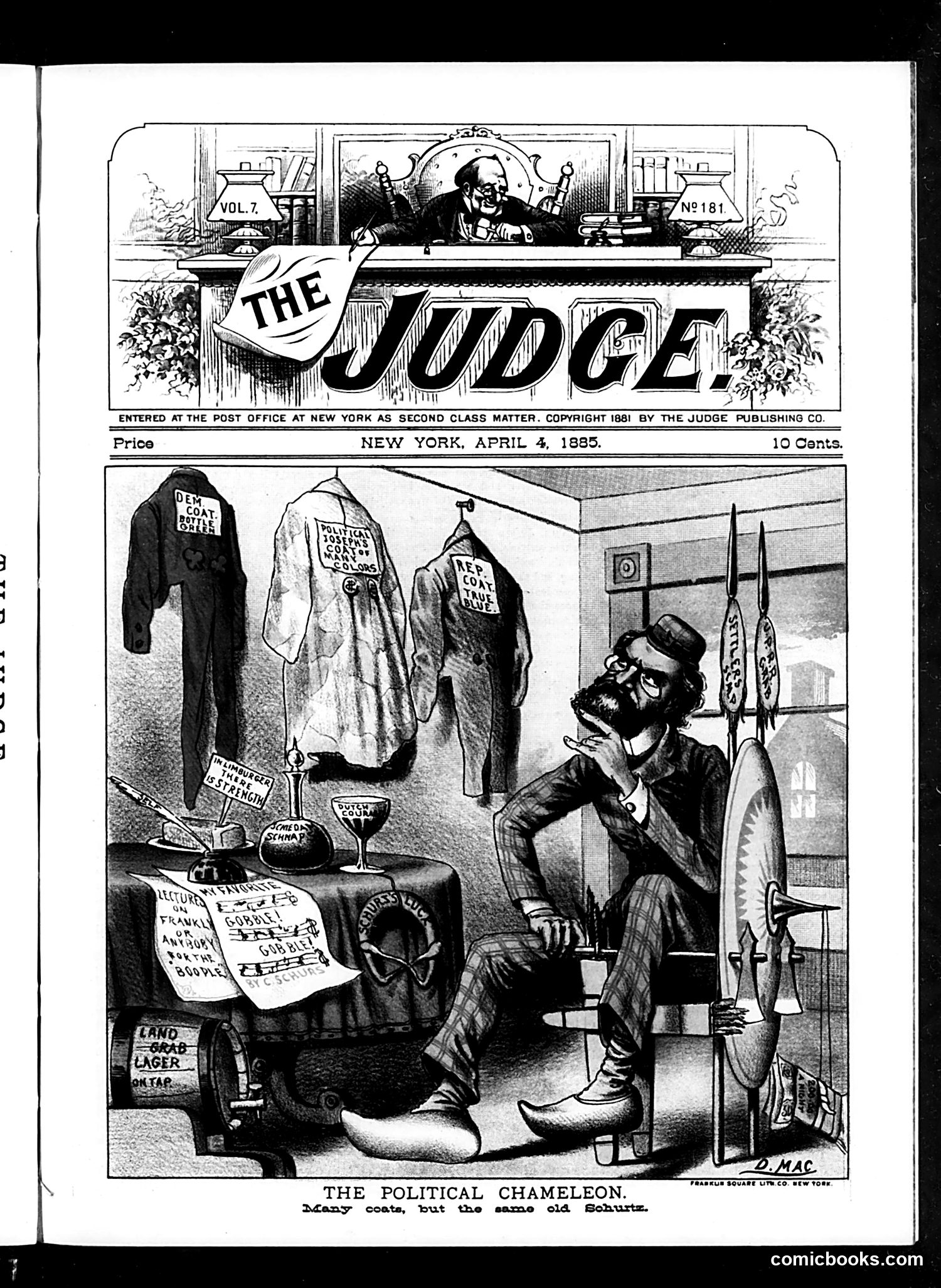
This cartoon satirizes a politician who changes his positions and appearance opportunistically—like a chameleon changing colors. The figure sits surrounded by different coats and uniforms hanging above, each labeled with different political affiliations or causes. Various vessels and items on the table appear to represent different political "flavors" or positions he's adopted. The caption reads: "Many coats, but the same old Schurtz"—likely referencing Carl Schurz, a prominent 19th-century German-American politician known for shifting between parties (Republican, Liberal Republican, Democrat) and causes throughout his career. The satire mocks inconsistency and political opportunism—the accusation that despite adopting different rhetorical positions, the underlying character remained unchanged and self-serving.
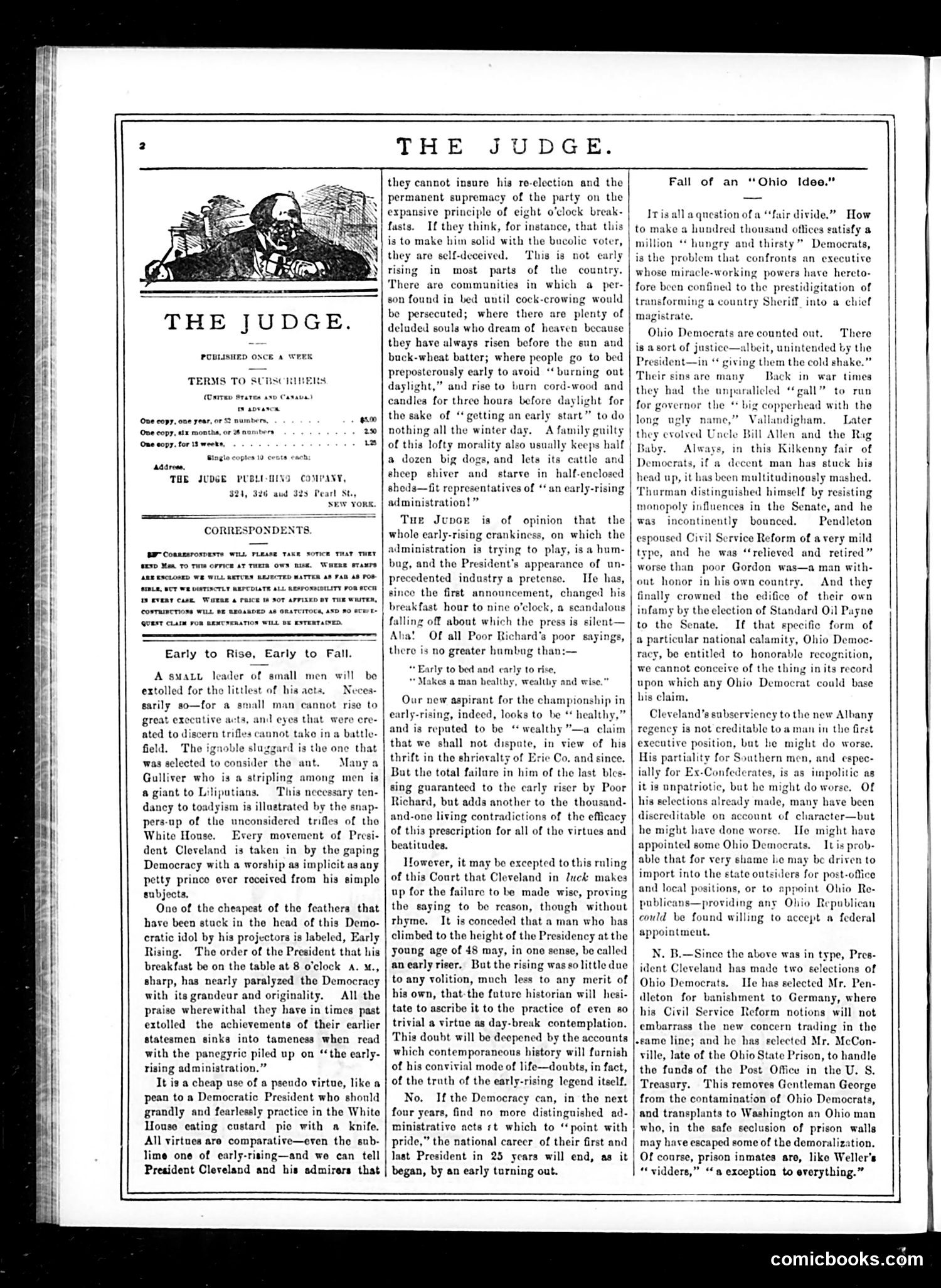
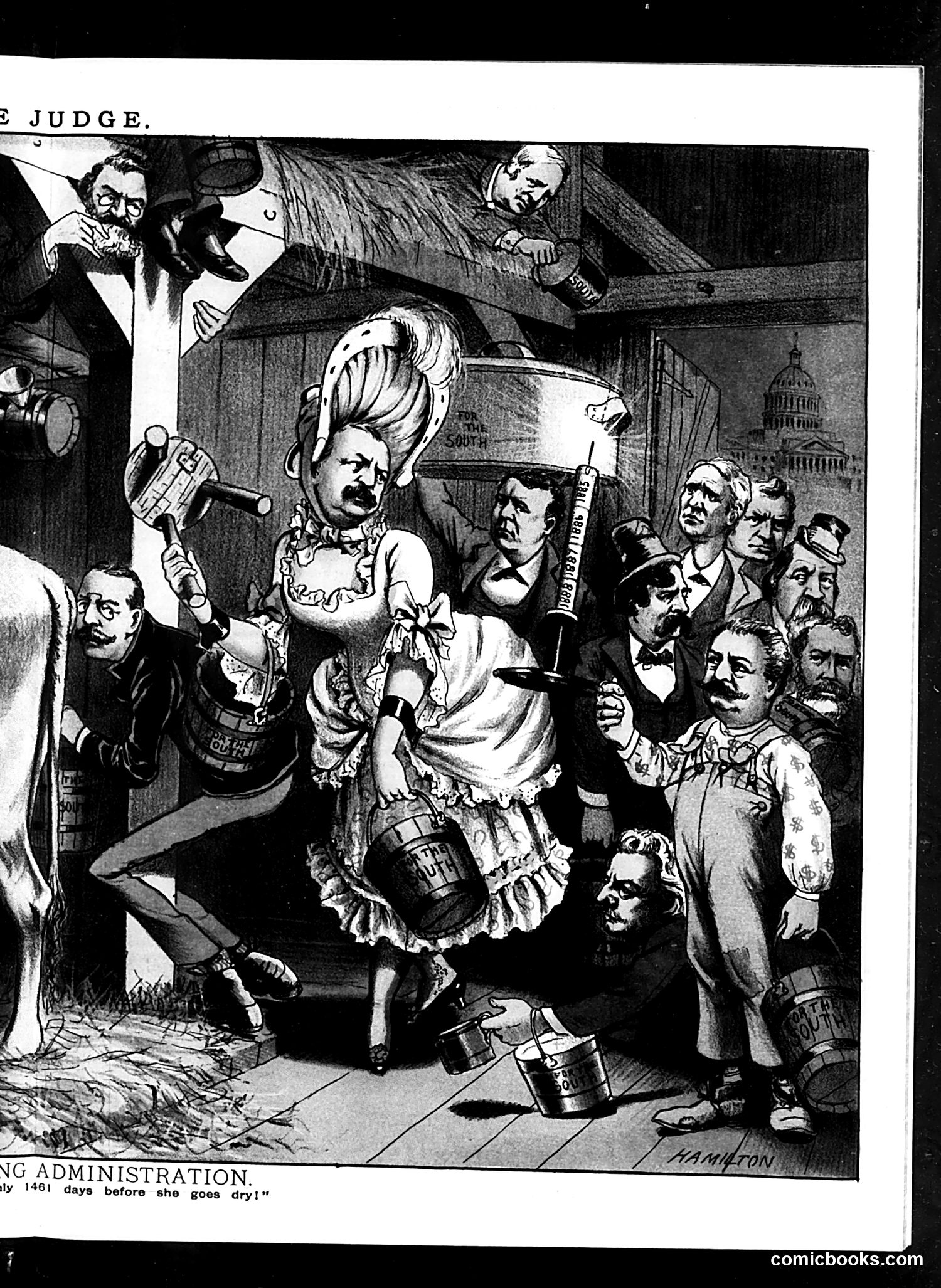
This editorial cartoon satirizes President Cleveland's Democratic supporters for praising his early-rising habits (8 a.m. breakfasts) as a major accomplishment. Judge ridicules this as absurdly trivial hero-worship—comparing it to praising a president for eating pie with a knife. The satire has two targets: First, Cleveland's supporters who treat mundane executive routines as great achievements, revealing their intellectual smallness ("small men extolled for the littlest acts"). Second, the hypocrisy of early-rising itself—the editorial notes it's meaningless virtue-signaling, especially since Cleveland later changed breakfast to 9 a.m., contradicting his own "early-rising administration" brand. The piece mocks rural communities that fetishize early rising while neglecting their animals and accomplishing nothing all day. The overall message: Democratic praise for Cleveland's modest habits exposes the bankruptcy of their political platform.
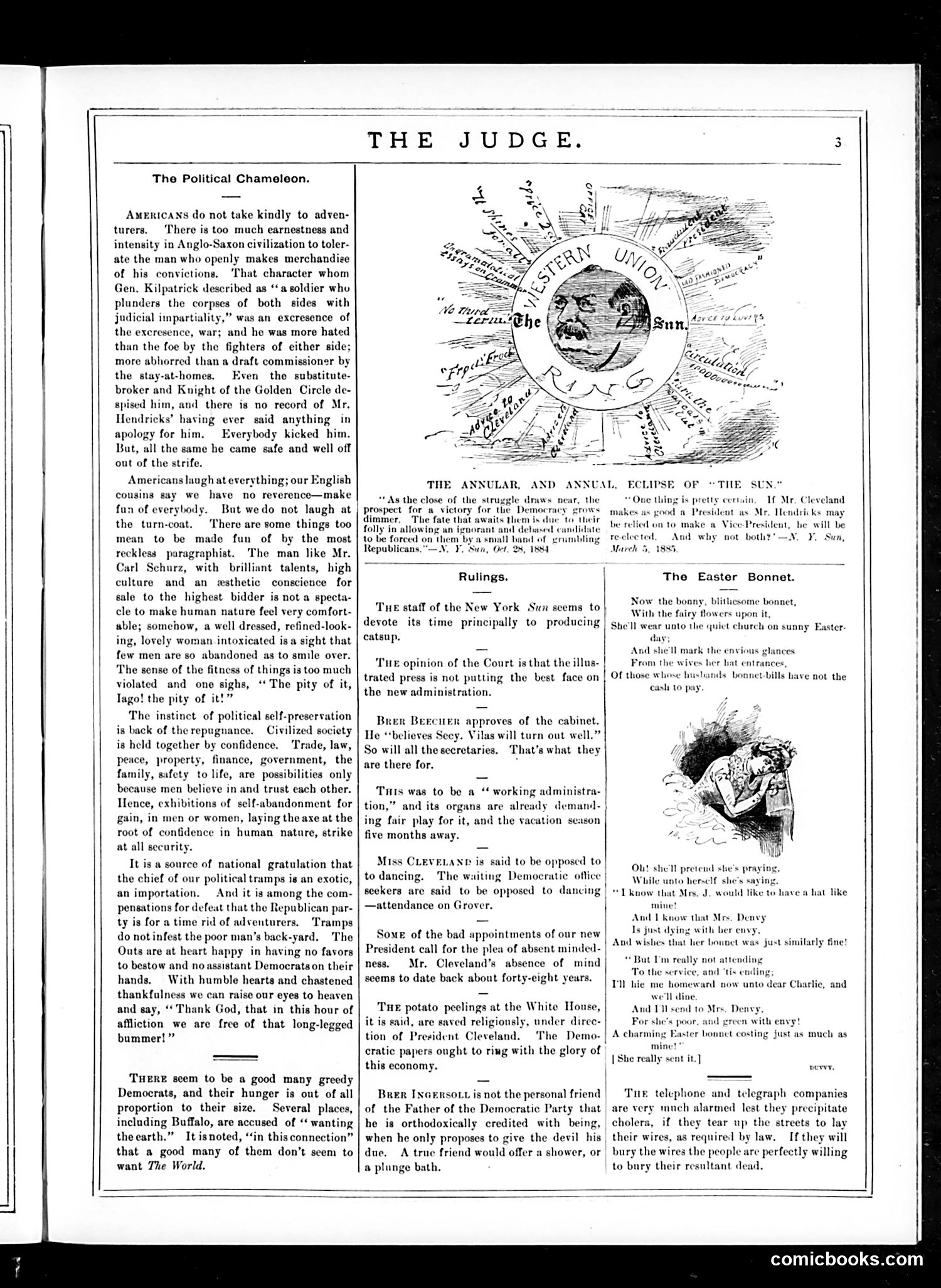
This page critiques **Carl Schurz**, a prominent Republican politician with "brilliant talents" who repeatedly changed parties and principles for political gain. The text condemns him as a mercenary "adventurer" who sold his convictions to the highest bidder—comparing such behavior to a woman "intoxicated," something civilized society finds morally repugnant. The satire argues that political opportunism undermines social trust, which holds civilization together. Judge notes relief that this "long-legged bummer" is a foreign-born exotic, not native American. The accompanying cartoons and shorter pieces mock Democratic vulnerabilities (greed, desperation) and the new Cleveland administration's already-failing efforts, while criticizing press coverage as overly sympathetic. The piece reflects 1880s-era anxieties about political integrity and partisan loyalty.
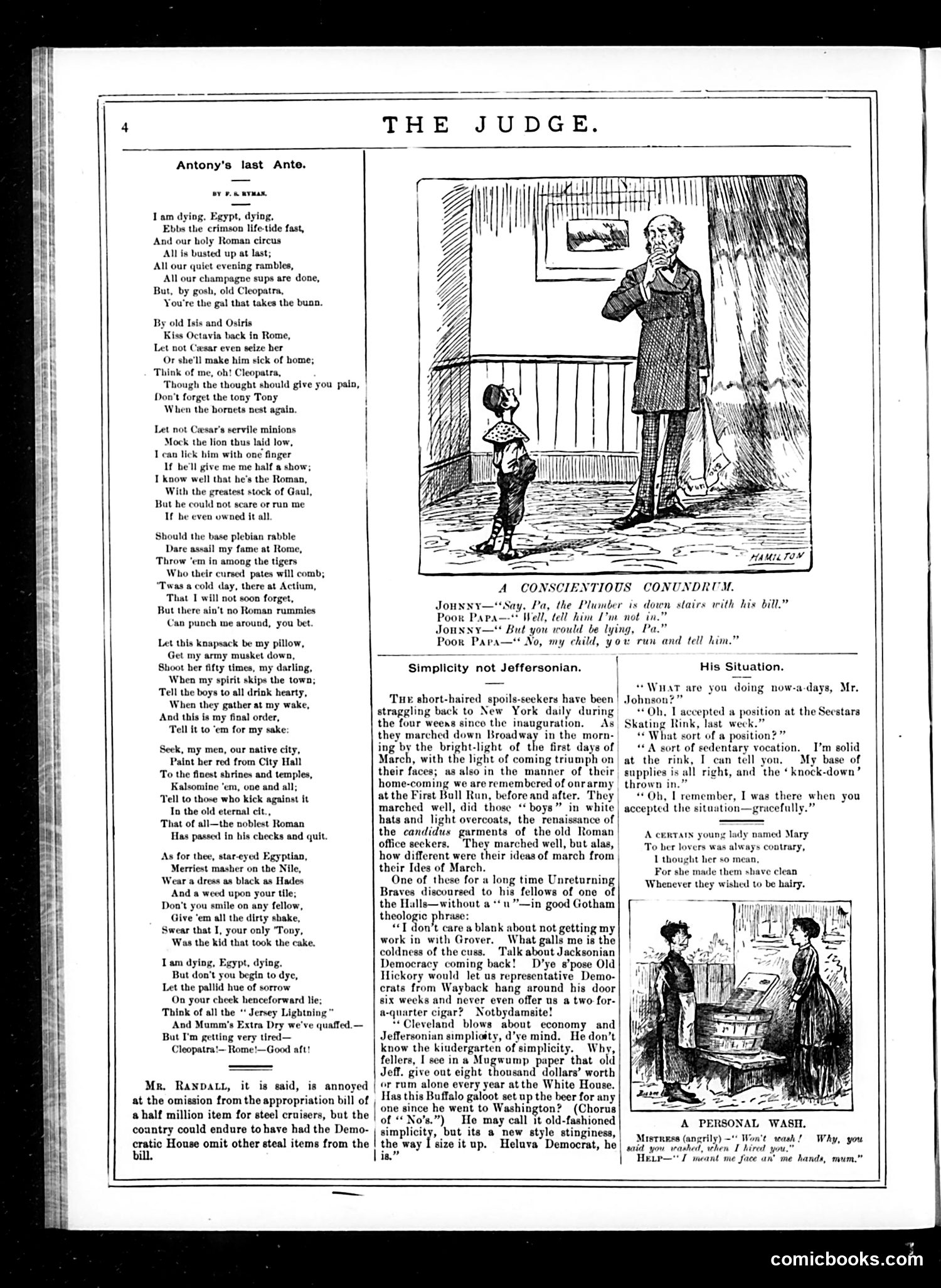
This page from *Judge* magazine contains satirical political commentary circa the 1880s-90s. **"Antony's Last Ante"** is a lengthy parody poem mimicking Shakespeare's *Antony and Cleopatra*, rewritten as vernacular American slang. It mockingly portrays a dying political figure (likely a spoilsman or corrupt politician) making grandiose final speeches—the satire lies in treating low political corruption with Shakespearean tragedy. **"Simplicity not Jeffersonian"** and **"His Situation"** are separate satirical dialogues. They mock civil service reform and patronage politics. The text references spoils-seekers returning to New York after the presidential inauguration, complaining about lack of government jobs despite their expected rewards. The jokes target the contradiction between Democratic reform rhetoric and continued backroom dealing. **"A Conscientious Conundrum"** is a brief joke about a child catching his father in a lie when avoiding a plumber's bill—mild domestic humor. The overall page satirizes post-inauguration political corruption and disappointed office-seekers expecting patronage rewards.
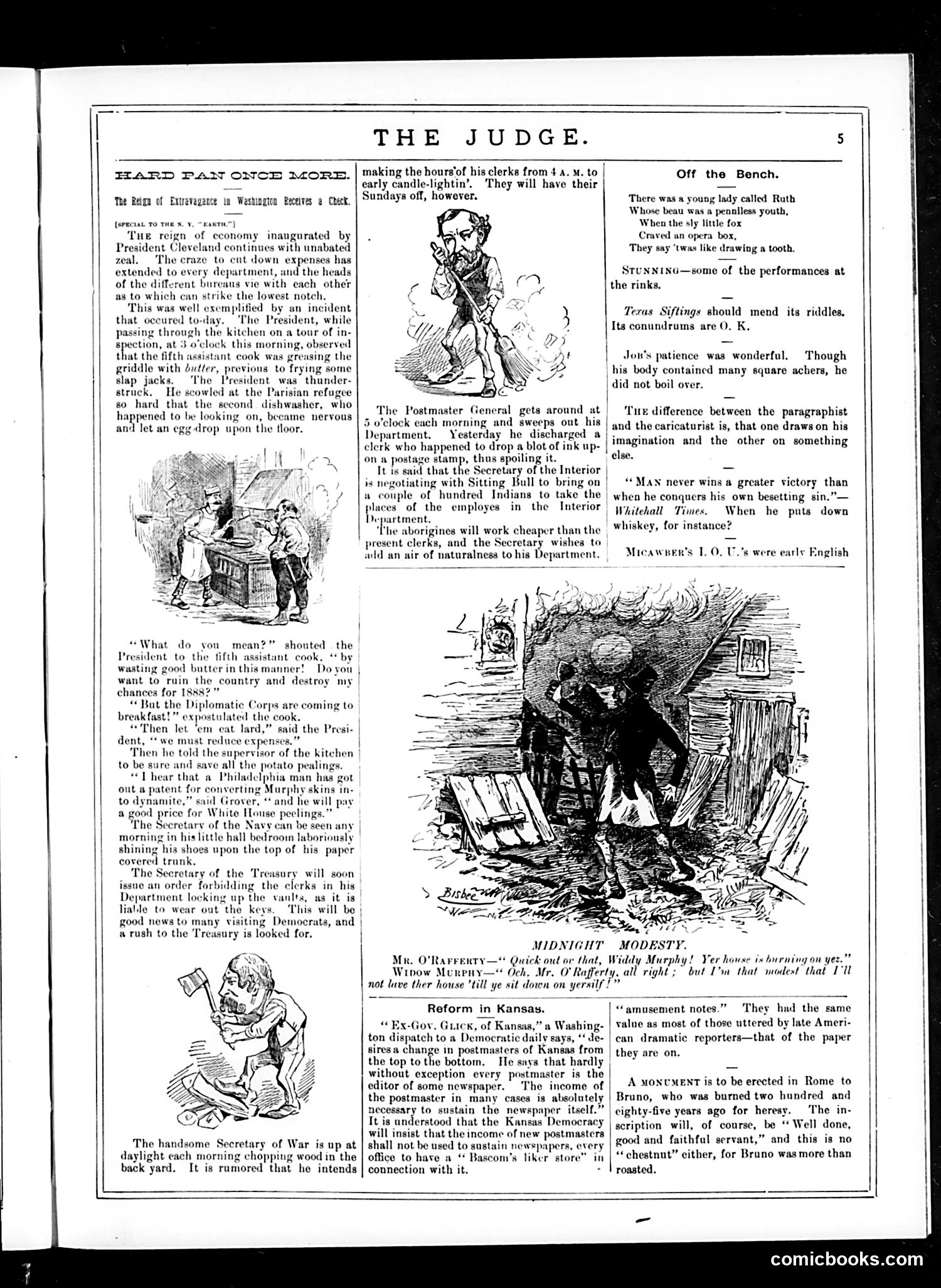
This page satirizes President Cleveland's aggressive cost-cutting measures. The main cartoon mocks his penny-pinching by depicting him obsessively eliminating minor expenses—forbidding butter use, saving potato peels, and having cabinet secretaries perform manual labor. The satire targets Cleveland's 1880s budget-reduction campaign, which Judge presents as absurdly excessive. References to specific cabinet members (Treasury, War, Interior, Navy secretaries) show the administration's department-wide belt-tightening. The joke about Secretary Interior negotiating with "Sitting Bull" to hire cheaper Native American laborers reflects contemporary attitudes toward Native Americans as disposable workforce. The secondary items—brief jokes about opera, skating, a riddle magazine, and an Irish domestic scene ("Midnight Modesty")—are typical filler content in satirical magazines. The cartoon assumes readers recognized current cabinet officials and appreciated the exaggeration of Cleveland's known economical reputation.
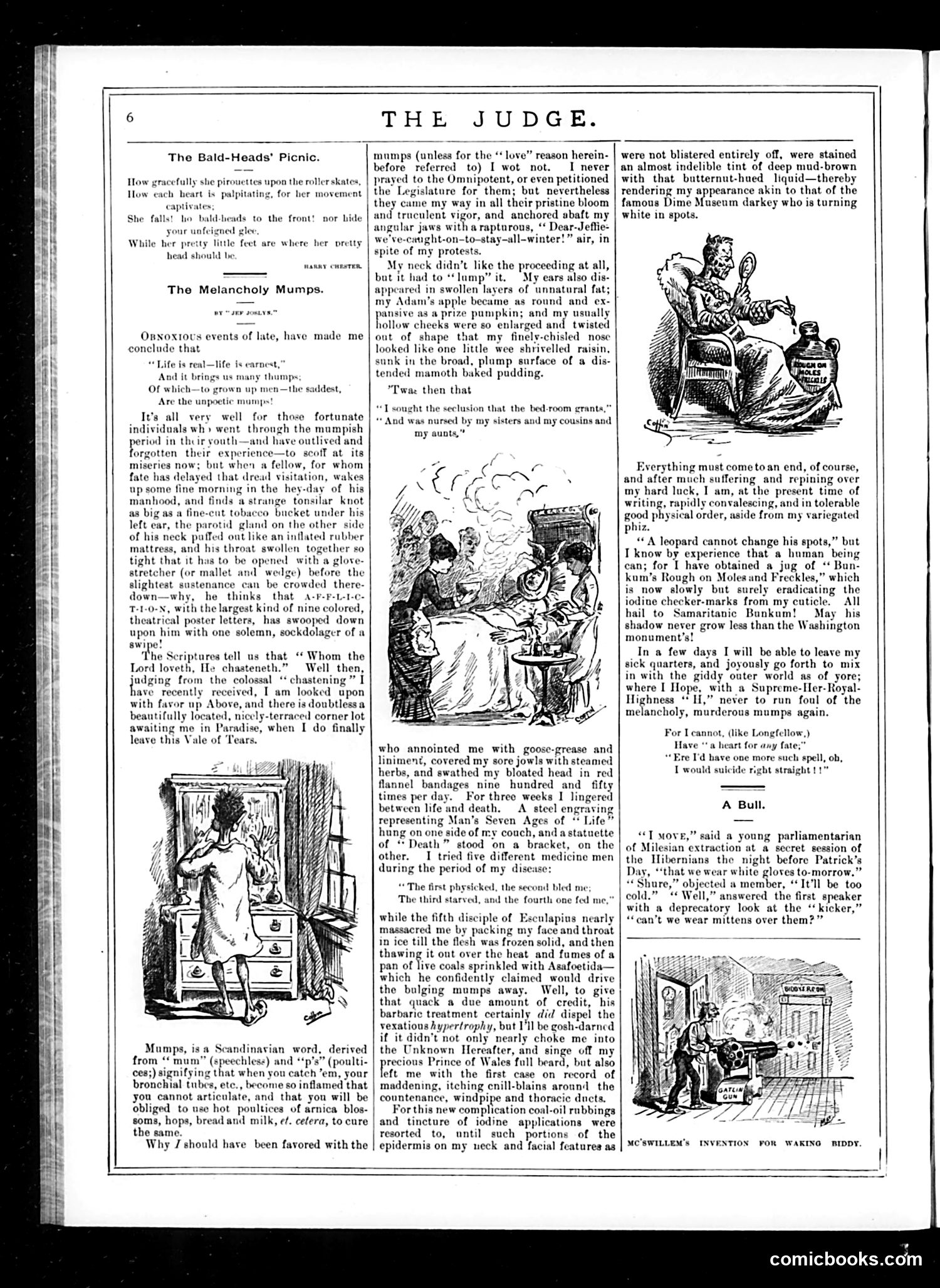
This humorous essay satirizes the adult experience of mumps, a common viral disease in the era. The author complains that while children typically recover from mumps without much fuss, contracting it as an adult—he did in his "hey-day of manhood"—constitutes a theatrical catastrophe worthy of biblical "chastening." The satire mocks both the disease's physical indignities (grotesquely swollen face, inability to eat) and the era's absurd medical treatments: doctors who bleed patients, starve them, or pack their heads in ice wrapped in flannel. The religious framing ("Whom the Lord loveth, He chasteneth") ironically suggests his suffering proves divine favor, earning him a "nicely-terraced corner lot" in Paradise. The piece gently ridicules Victorian hypochondria and the contemporary medical profession's primitive, often contradictory remedies for common illnesses.
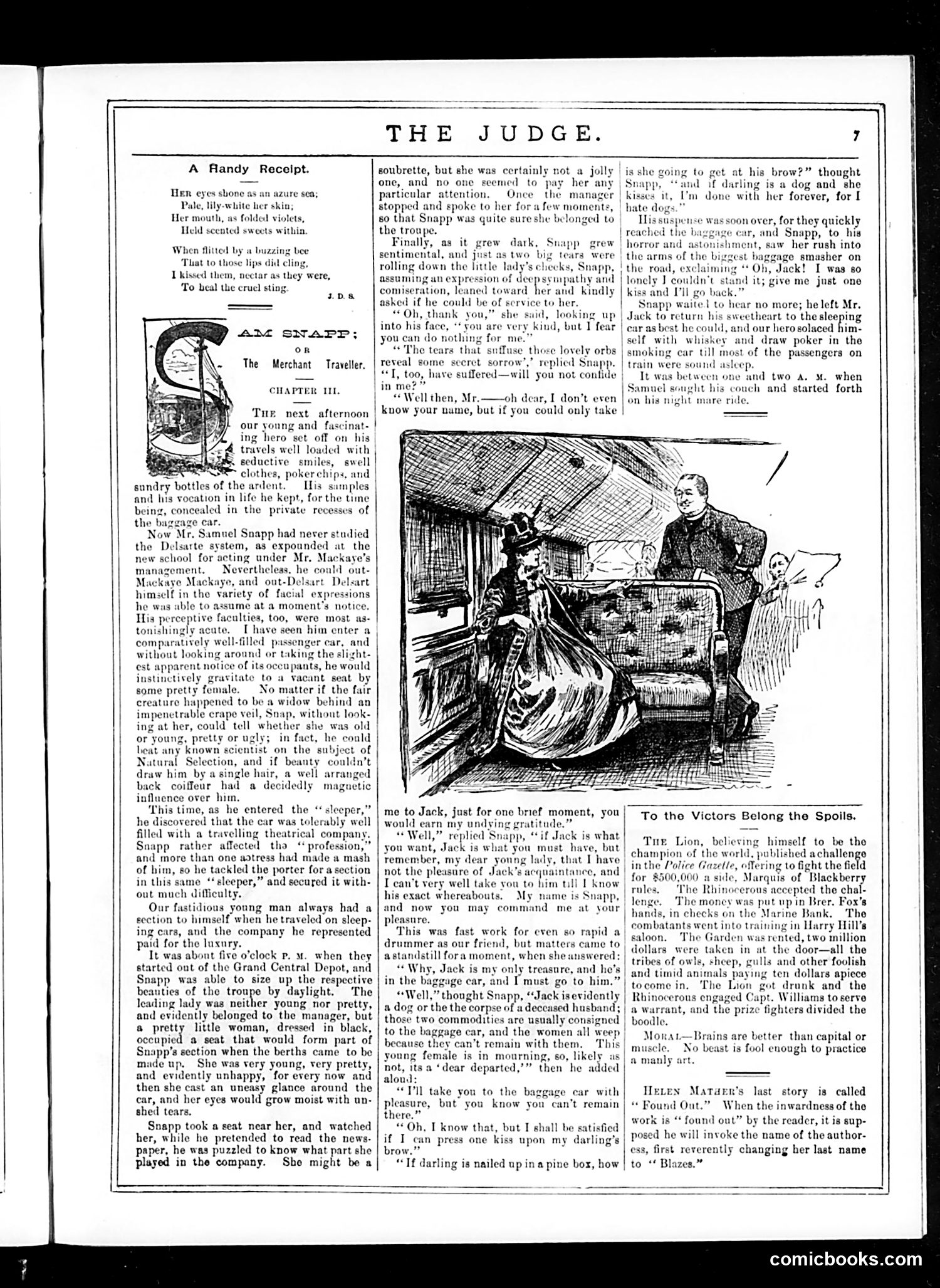
This page presents a serialized comic story titled "Sam Snapp; or The Merchant Traveller" (Chapter III). The narrative follows a con-man protagonist—a traveling salesman with "seductive smiles" and "poker chips"—who preys on lonely women during train travel. The satire targets the predatory behavior of traveling salesmen, a stock figure of late 19th-century American commerce. Snapp uses theatrical charm and false sympathy to manipulate an emotionally vulnerable young actress, claiming he understands her "secret sorrow." The punchline subverts reader expectations: rather than a tragic damsel, she reveals herself as part of a theatrical troupe and rushes into the arms of a baggage handler named Jack. The humor exposes both Snapp's manipulative tactics and his misjudgment—his vaunted ability to read women fails completely. The story mocks seduction attempts and the disposable romantic schemes of unscrupulous traveling men.
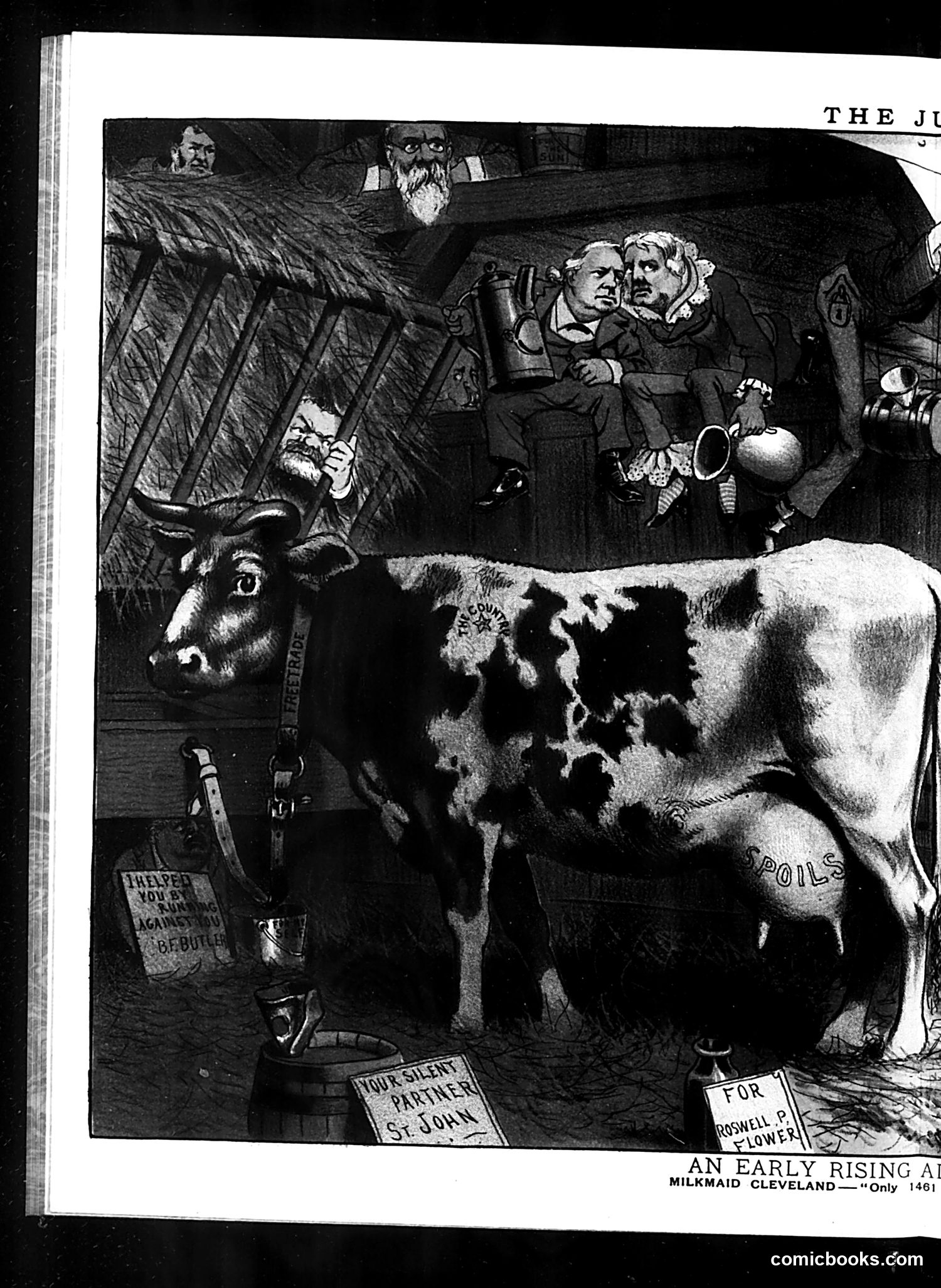
This Judge magazine cartoon satirizes President Grover Cleveland as a milkmaid. The title "An Early Rising at Milkmaid Cleveland" puns on his name while depicting him performing manual labor—milking a cow labeled "SPOILS." The figures in the barn above appear to be political figures or bureaucrats watching the proceedings. Signs visible reference "St. John" and "Roswell P. Flower," likely contemporary political figures. The satire critiques Cleveland's efforts to reform the spoils system (political patronage), presenting him as someone engaged in unglamorous, ordinary work rather than high political office. The cartoon mocks either his reform attempts as futile or presents him as diminished by having to "milk" the system for political support. The exact year remains unclear from the visible text.
This Judge magazine cartoon satirizes the **Prohibition Administration** during the enforcement of alcohol prohibition. The central figure is an exaggerated woman in elaborate dress, likely personifying **Lady Prohibition or the Anti-Saloon League**, surrounded by bureaucrats and enforcement officials holding hammers and tools. The caption "461 days before she goes dry!" suggests criticism of Prohibition's implementation timeline. The cartoon mocks the federal government's aggressive enforcement apparatus and the theatrical, overwrought nature of the Prohibition movement itself—depicted through the woman's garish costume and the crowd of officials surrounding her with destructive tools. The satire critiques both Prohibition policy and those administering it as ineffectual and excessive.
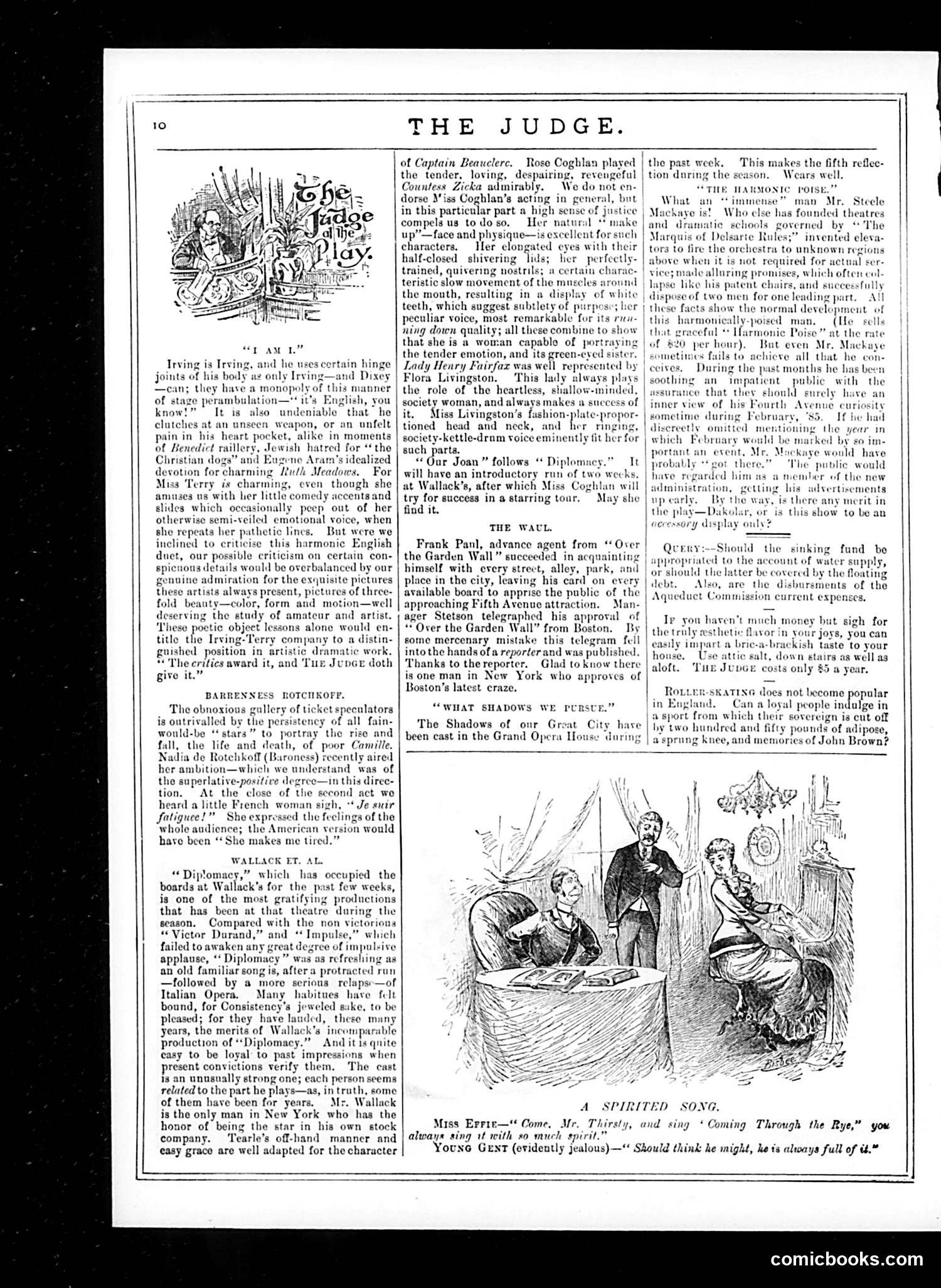
This page from *Judge* magazine contains theatrical reviews rather than political cartoons. The main content critiques stage performances from the 1880s-90s. **Key figures reviewed:** - **Henry Irving and Ellen Terry** in an unnamed play—praised for their emotional range and physical control, though their "harmonic English duet" has minor flaws - **Rosa Coghlan** as Countess Zicka—defended against general criticism for her work in this specific role - **Nadia de Rotchkoff (Baroness)** attempting to play Camille—mocked for her pretentious ambitions; the critic notes audience exhaustion - **Wallack's Theatre production of "Diplomacy"**—favorably reviewed as superior to recent failed productions **The satire:** The reviews gently mock theatrical pretension—particularly actresses pursuing prestigious tragic roles beyond their abilities, and theater-goers who must praise old productions for consistency's sake. The humor is insider theater criticism rather than political commentary. **The illustration** ("A Spirited Song") shows Miss Effie performing while an jealous Young Gent watches disapprovingly.
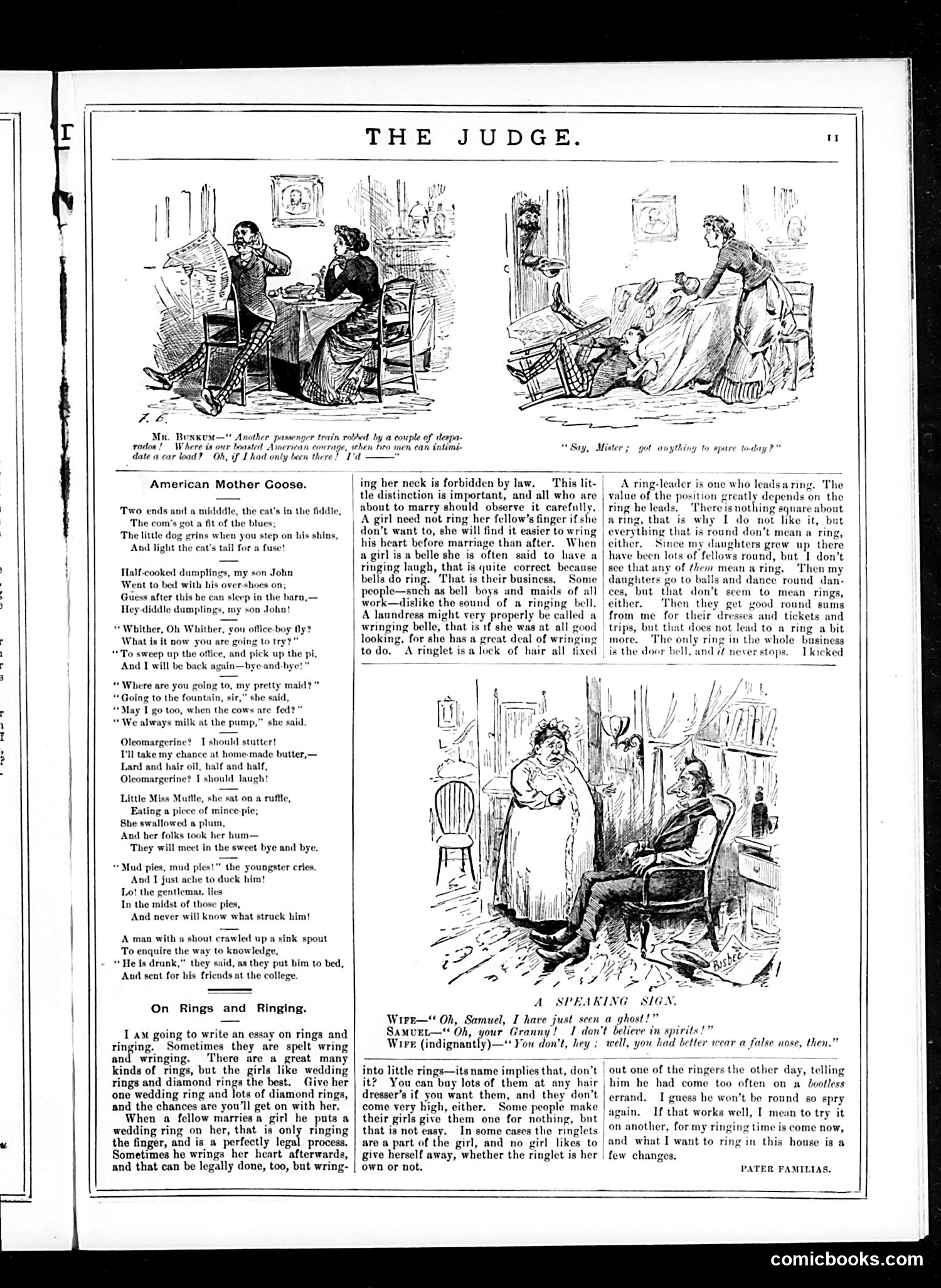
This page from *Judge* contains humorous parodies of traditional nursery rhymes under "American Mother Goose," mocking domestic life and current concerns. The verses joke about clumsy children, suspicious food ingredients (the "oleomargarine" verses satirize concerns about butter substitutes and food adulteration—a real late-19th-century scandal), and parental exasperation. The main article, "On Rings and Ringing," is a tongue-in-cheek essay playing on double meanings: wedding rings (marriage), "ringing" (legitimate), versus "wringing" (harmful—wringing a neck is illegal, but wringing a heart before marriage is acceptable). It pokes fun at courtship conventions, diamond rings as signs of status, and the commercialization of romance. The cartoons illustrate domestic scenes: a train robbery reference, and a husband caught in an awkward situation with his wife—likely satirizing marital discord or infidelity rumors. The humor relies on wordplay, exaggerated domesticity, and social commentary on emerging commercial practices around romance and marriage.
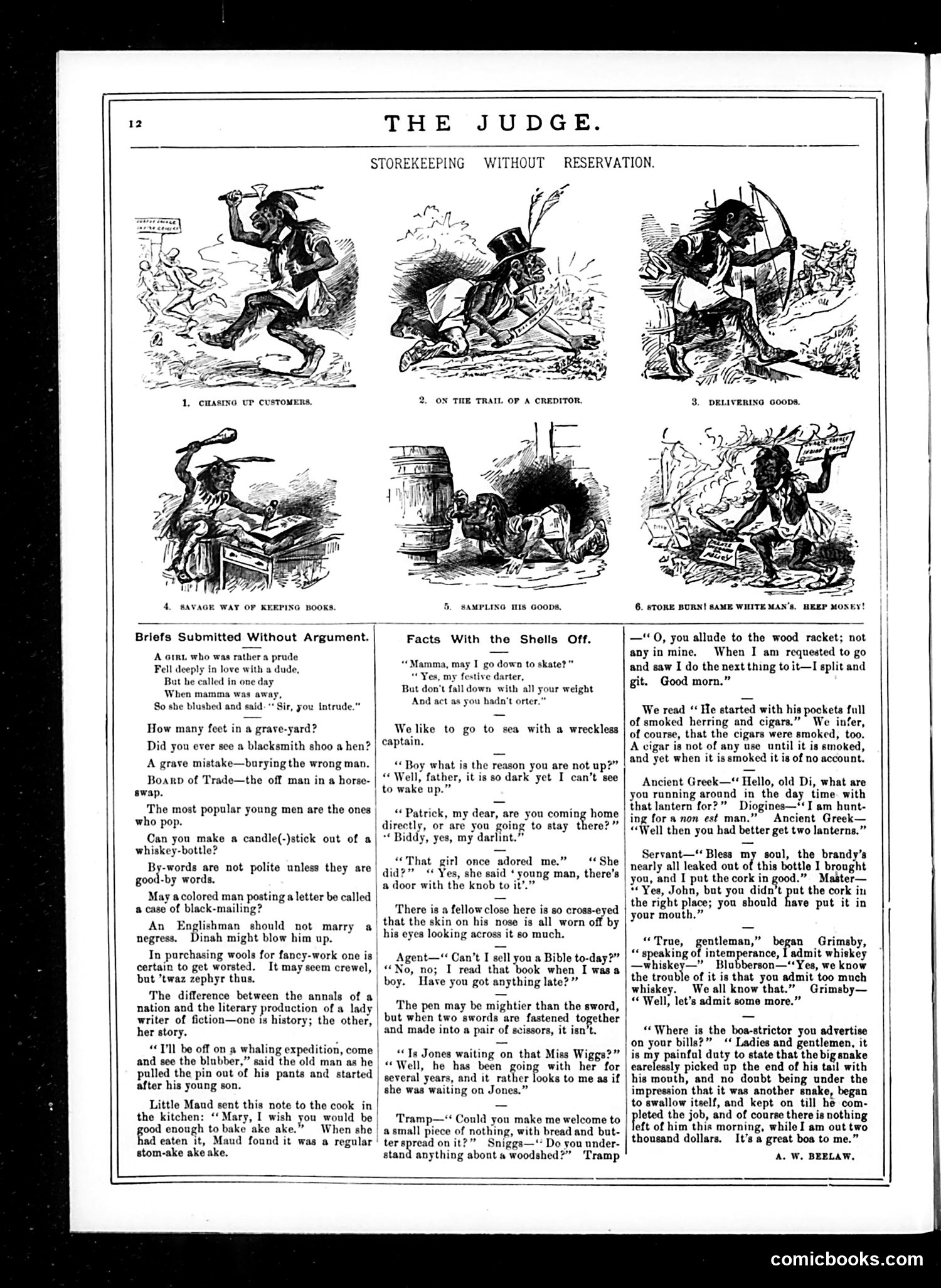
This page from *Judge* magazine presents six cartoon panels depicting a caricatured Black man engaged in various forms of petty crime or dishonest behavior—chasing customers, pursuing creditors, delivering stolen goods, falsifying records, sampling/consuming merchandise, and burning down his store for insurance money. The title "Storekeeping Without Reservation" is a bitter pun suggesting he operates a business with no ethical restraint. The surrounding text consists of joke collections typical of 19th-century humor magazines, including racist material (references to "colored men," "Dinah," and other offensive stereotypes), puns, and wordplay. The cartoons and jokes reflect the deeply racist attitudes of the era, portraying Black people as inherently dishonest and criminal. This content exemplifies how *Judge* used both visual caricature and written humor to reinforce harmful racial stereotypes for its white audience.
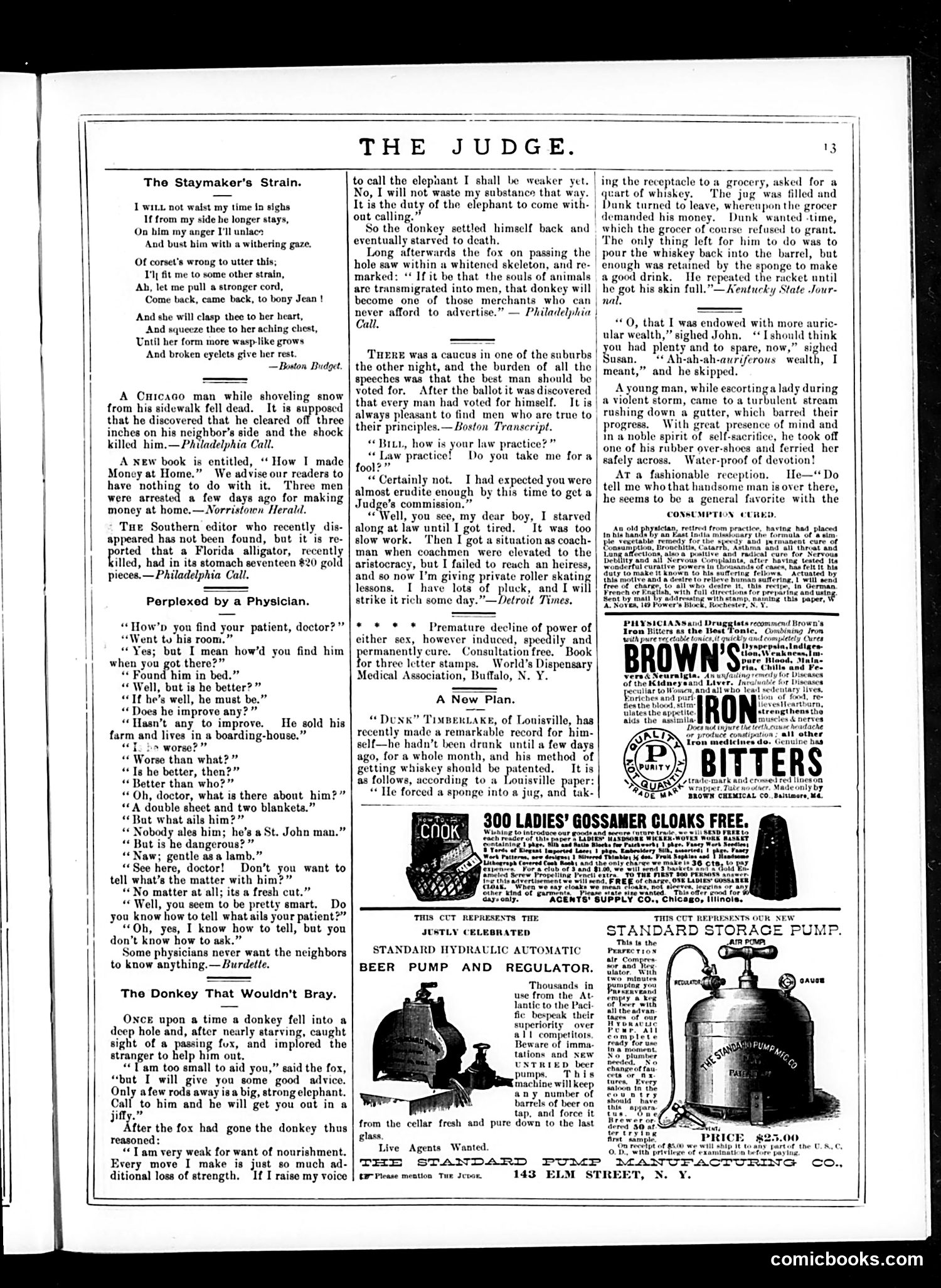
This is primarily a **humor and satire page** from Judge magazine, featuring short comedic pieces rather than political cartoons. The content includes: 1. **"The Staymaker's Strain"** — A poem mocking women's corset-wearing, satirizing the absurd physical contortions required by Victorian fashion standards. 2. **Brief anecdotes** poking fun at various social types: a Chicago man who dies from shock over his neighbor's cleared snow, a Southern editor mysteriously eaten by an alligator, and a confused physician unable to diagnose his patient. 3. **"The Donkey That Wouldn't Bray"** — A fable satirizing **stingy merchants who won't advertise**, suggesting their miserliness leads to failure (like the donkey's refusal to call for help). 4. **Political commentary** on a local caucus where every voter selfishly votes for themselves rather than "the best man." The page reflects Gilded Age concerns: **class attitudes, business practices, and social hypocrisy**. The advertising (corset treatments, patent medicines, storage pumps) provides historical context for what preoccupied readers then.
This page is primarily **advertising**, with minimal cartoon content. The visible satirical elements include: **Comic dialogue snippets** about relationships and social awkwardness—typical Judge humor mocking courtship rituals and gender dynamics of the era. One exchange jokes about a woman claiming to "hate" her suitor, implying marriage troubles. Another mocks a young woman's false teeth, suggesting vanity and deception among society women. **The substantive content** consists of patent medicine ads (Dr. Pierce's "Favorite Prescription" for female ailments, Dr. Young's Electric Belts) and book advertisements, reflecting Judge's late-19th-century market. The ads themselves are unintentionally satirical by modern standards—promoting dubious "cures" with pseudoscientific claims. No identifiable political figures or specific events appear. The humor targets universal social pretensions: vanity, failed romance, and commercial quackery—safe satirical territory for a mainstream American magazine of this period.
This page is primarily **advertisements and short humorous anecdotes**, not a political cartoon. The brief jokes include: - **Congressman Richardson of Tennessee**: A tall-tale quip about an unusually tall congressman-elect, playing on the phrase "seven up" (a card game). - **The teacher and student exchange**: A mild, suggestive joke about a student mishearing "Philip" (Alexander the Great's father) as "A kiss." - **Political convention joke**: A reference to a quiet political gathering where delegates nonetheless made a "racket." The page primarily showcases **period advertisements** for Pond's Extract (temperance lecturer John B. Gough endorses it), Dr. Pierce's "Golden Medical Discovery," Duffy's Malt Whiskey (marketed as both beverage and medicine), pianos, and medical devices—typical late-19th-century patent medicines and consumer goods. The satire, if any, is implicit in these dubious health claims rather than explicit political commentary.
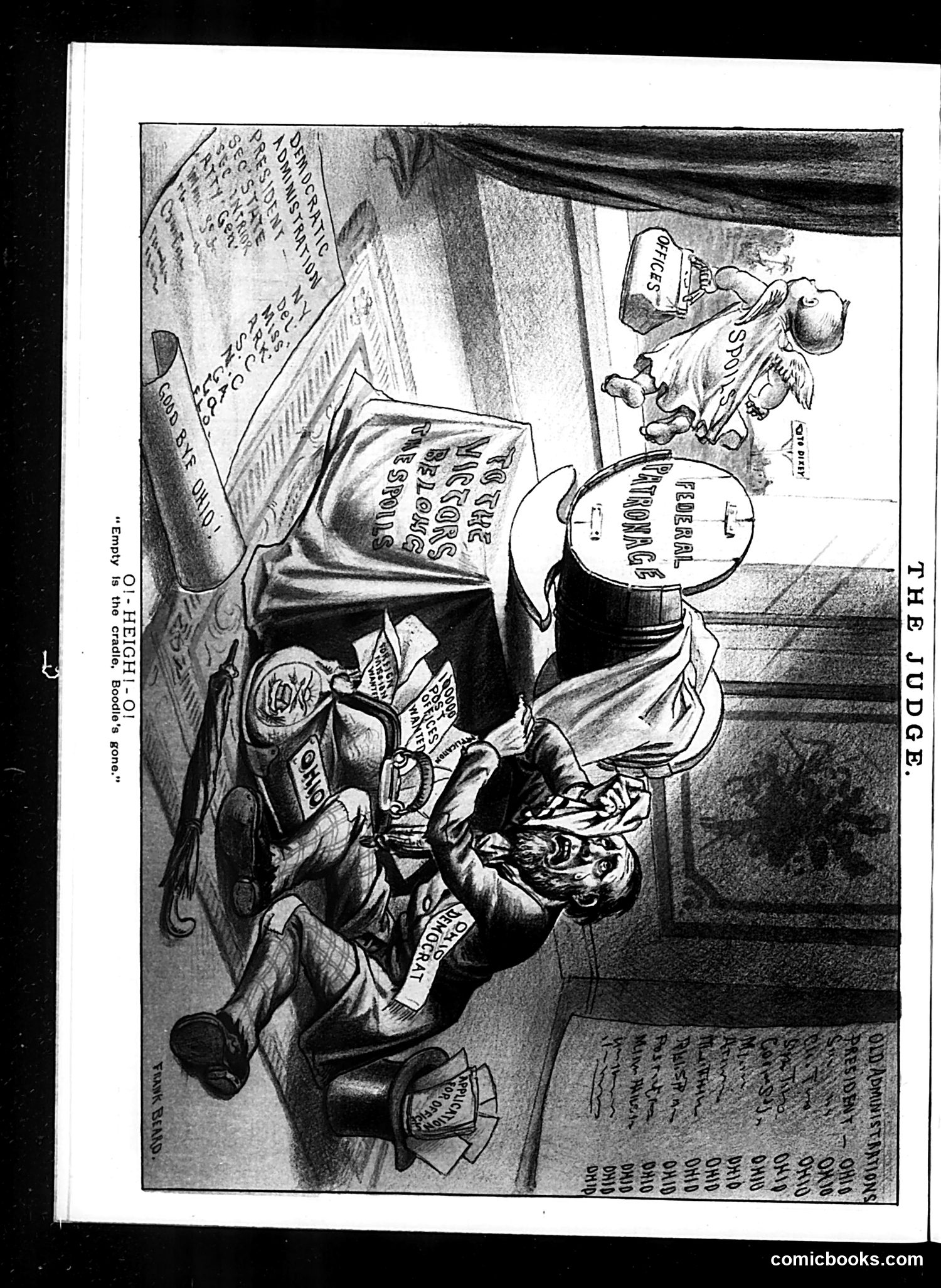
This appears to be a satirical cartoon titled "O! HEIGH! O!" with the subtitle "Empty Is the cradle, Boodle's gone." The image shows a figure labeled "THE JUDGE" examining what appears to be an empty cradle or container marked with "BOODLE" (a period term for illicit money or corruption). The surrounding architectural elements and documents suggest a courthouse or government setting. The satire targets political corruption: the "empty cradle" suggests that corruption/boodle has disappeared—either actually removed or ironically, that the source of corrupt funds has dried up. The figure of "The Judge" represents judicial oversight or accountability attempting to address governmental graft and bribery, which were common political scandals of the Gilded Age era when *Judge* magazine published such commentary.