
A complete issue · 16 pages · 1885
Judge — March 28, 1885
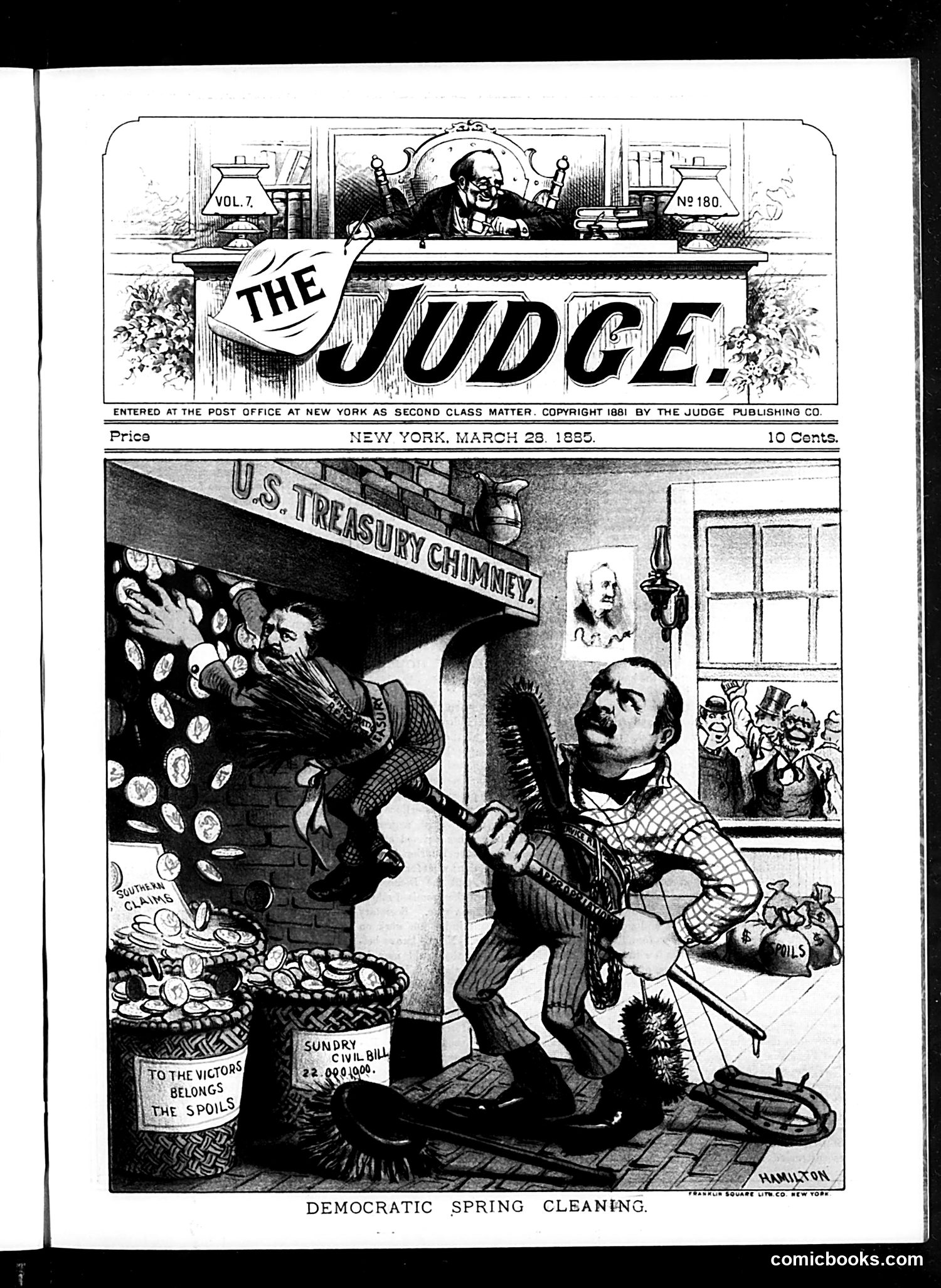
This political cartoon satirizes the Democratic Party's efforts to remove Republican appointees from federal offices following Democrat Grover Cleveland's return to the presidency in 1885. The central figure, likely representing a Democratic operative or Cleveland himself, aggressively sweeps out the "U.S. Treasury Chimney"—coins and valuables tumbling down. Labels reference "spoils" and a "sundry civil bill" ($2,000,000), suggesting the cartoon criticizes the Democratic practice of replacing Republican officeholders with party loyalists, a form of political patronage. The cartoonist's point appears critical: rather than genuine reform, the Democrats were simply replacing one corrupt system with another, exchanging Republican "spoils" for their own political appointments. The "spring cleaning" metaphor masks what the artist views as self-serving corruption.
This page from **Judge** magazine contains satirical commentary on the Cleveland administration's perceived favoritism toward the South. **Main Target:** Secretary of the Interior L.Q.C. Lamar, a former Confederate officer whom Judge attacks for hypocrisy. The satire notes that Lamar—who fought *against* the U.S. government—now serves it while allegedly sympathizing with the Confederacy. Judge points out that Lamar recently defended Jefferson Davis as no traitor. **The Argument:** The editorial sarcastically claims Democrats practice false "economy"—cutting Interior Department budgets while preparing to pension Confederate soldiers. This represents wasteful hypocrisy: "saving at the spigot and wasting at the bunghole." **The Dark Joke:** Judge suggests the South, having lost the war militarily, is now "conquering" the North politically through Cleveland's Southern-sympathizing cabinet, eventually extracting Confederate pensions and debt assumption—costing more than the war itself. The cartoon's figure (left) likely depicts Lamar or represents Northern compromise with the South.
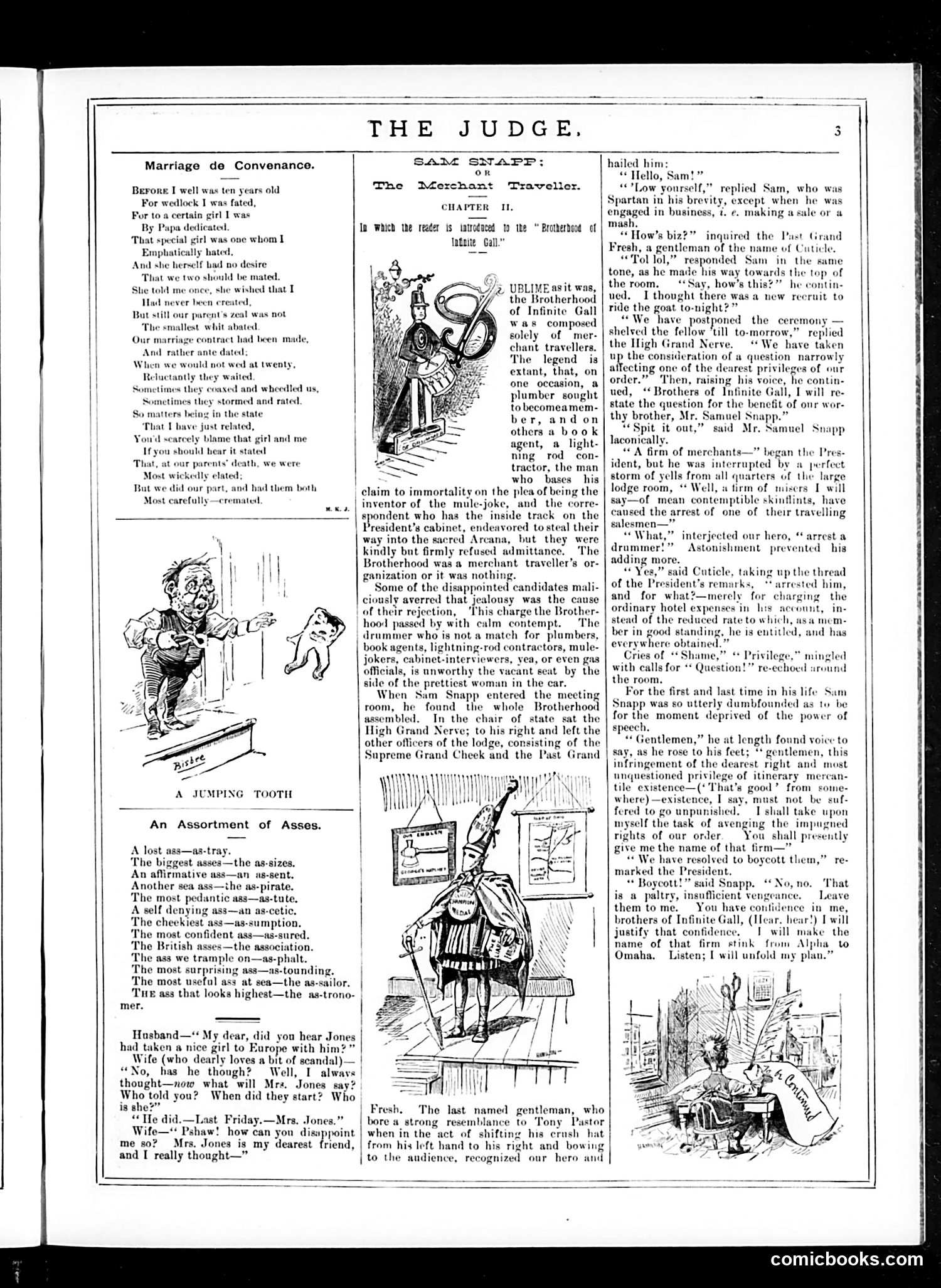
**"An Assortment of Asses"** is a clever wordplay list where each entry puns on "ass" (donkey) with homophone or near-homophone words: "as-tray" (astray), "as-sizes" (assizes—law courts), "as-sured" (assured), etc. It's lighthearted Victorian humor requiring no historical context beyond appreciating puns. **"Marriage de Convenance"** (marriage of convenience) is a poem mocking arranged marriages where unwilling young people were forced together by parents' wishes. The satire attacks the rigidity of Victorian marriage customs—the couple eventually rebels by refusing to wed until their parents die. This critiques societal pressure overriding individual choice. **"Sam Snapp: The Merchant Traveller"** begins a serialized story about traveling salesmen and their fraternal "Brotherhood of Infinite Gall." The humor targets commercial drummers (traveling salesmen) as boastful characters who formed exclusive clubs. The satirical point appears to mock their pretensions and exaggerated self-importance as a social class.
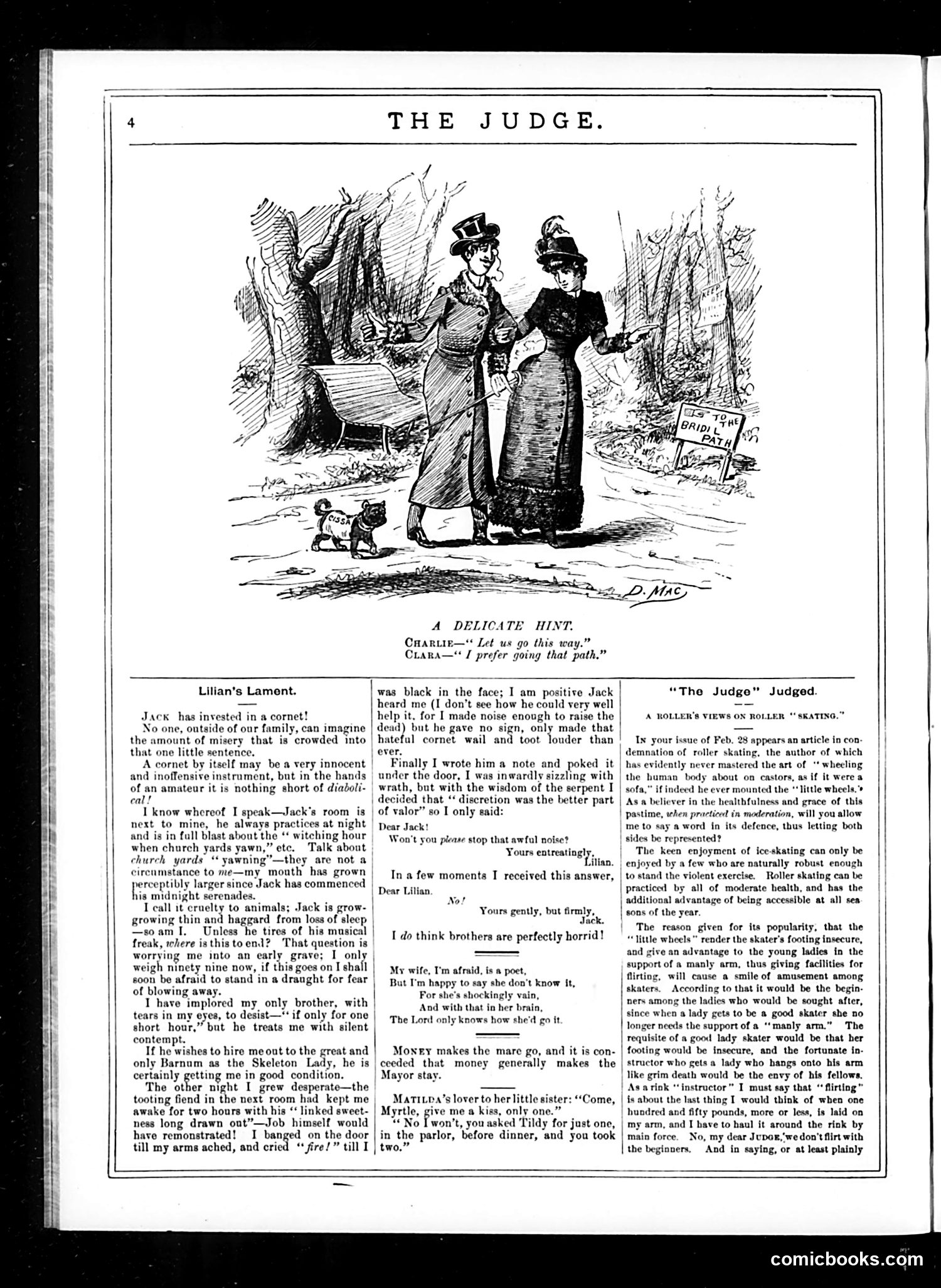
This page contains two separate pieces of Victorian-era domestic humor: **"Lilian's Lament"** depicts a woman driven to desperation by her brother Jack's amateur cornet playing at night. The satire targets the torture of living with an incompetent musician—Jack's terrible skills and inconsiderate practice hours literally drive his sister to physical exhaustion and despair. Her increasingly desperate pleas go unanswered, reducing her to comical exasperation. **"A Delicate Hint"** (top cartoon) shows two women on a path with a small dog, with a sign reading "BRIDAL PATH." The joke plays on the double meaning: one woman prefers the bridal path, the other doesn't—likely satirizing marriage prospects or romantic pursuits of unmarried women. **"The Judge Judged"** is a reader response defending roller skating against a previous article's criticism, arguing it's more accessible than ice-skating. The humor relies on recognizable Victorian domestic situations: noisy neighbors, family conflicts, and emerging leisure activities.
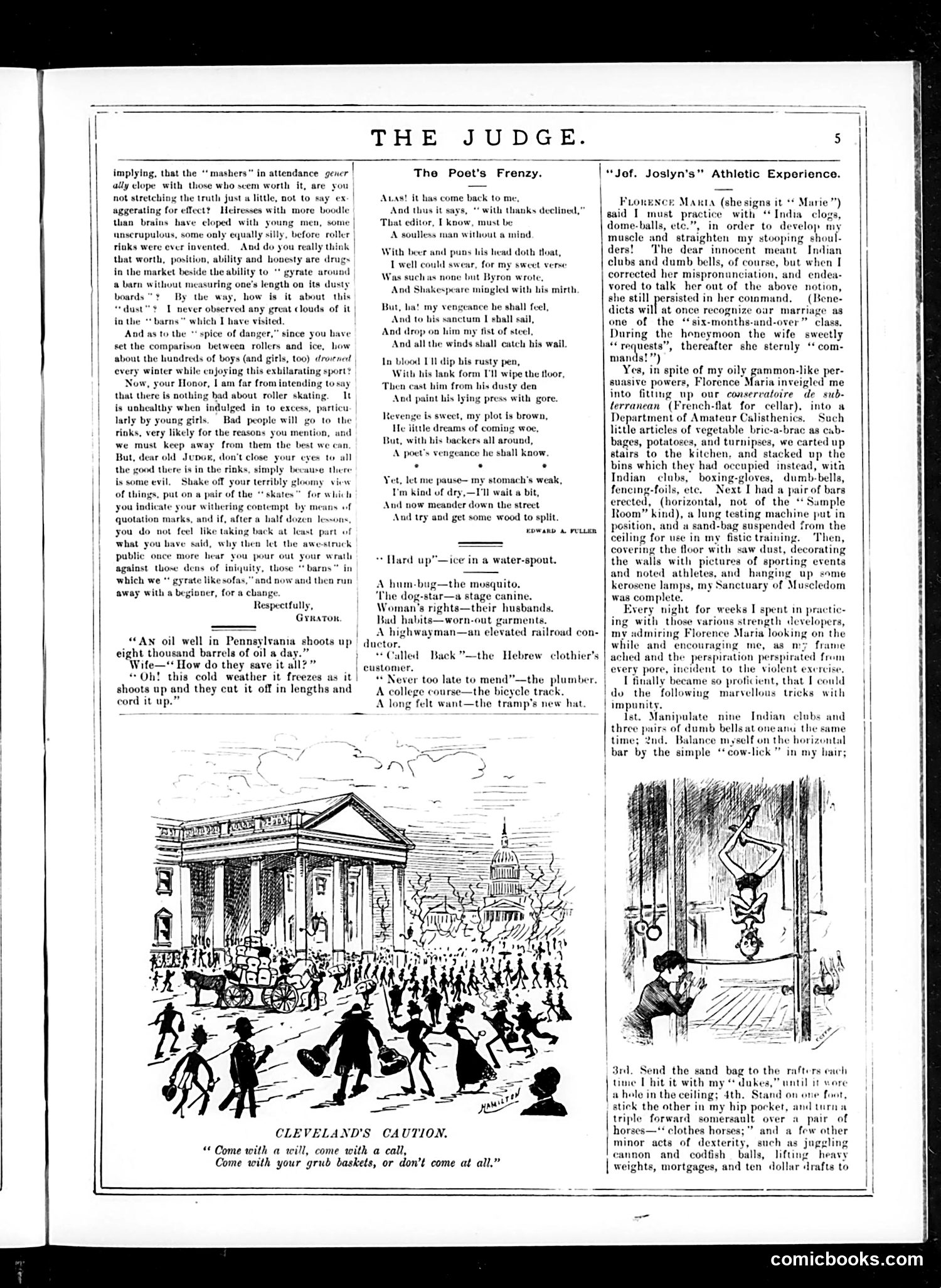
This page contains several distinct satirical pieces: **"Cleveland's Caution"** (large cartoon): Depicts President Grover Cleveland warning potential office-seekers to arrive with resources ("grub baskets") or not at all—satirizing concerns about patronage-seeking and political opportunism during his administration. **"The Poet's Frenzy"**: A humorous poem about a rejected poet fantasizing violent revenge against an editor who declined his work, but losing nerve mid-threat. It mocks overwrought artistic sensibilities and the temperamental writer stereotype. **"Jof. Joslyn's Athletic Experience"**: Describes a woman (Florence Maria/"Marie") prescribing "India clogs" and "dome-balls" for athletic training, which the male narrator realizes she means "Indian clubs" and "dumb bells." It gently ridicules women's unfamiliarity with athletic terminology. The page also includes a section of humorous definitions (mosquito as "hum-bug," etc.) and poems lampooning various social targets. Overall: typical late-19th-century satirical humor targeting politicians, sensitive artists, and gender stereotypes.
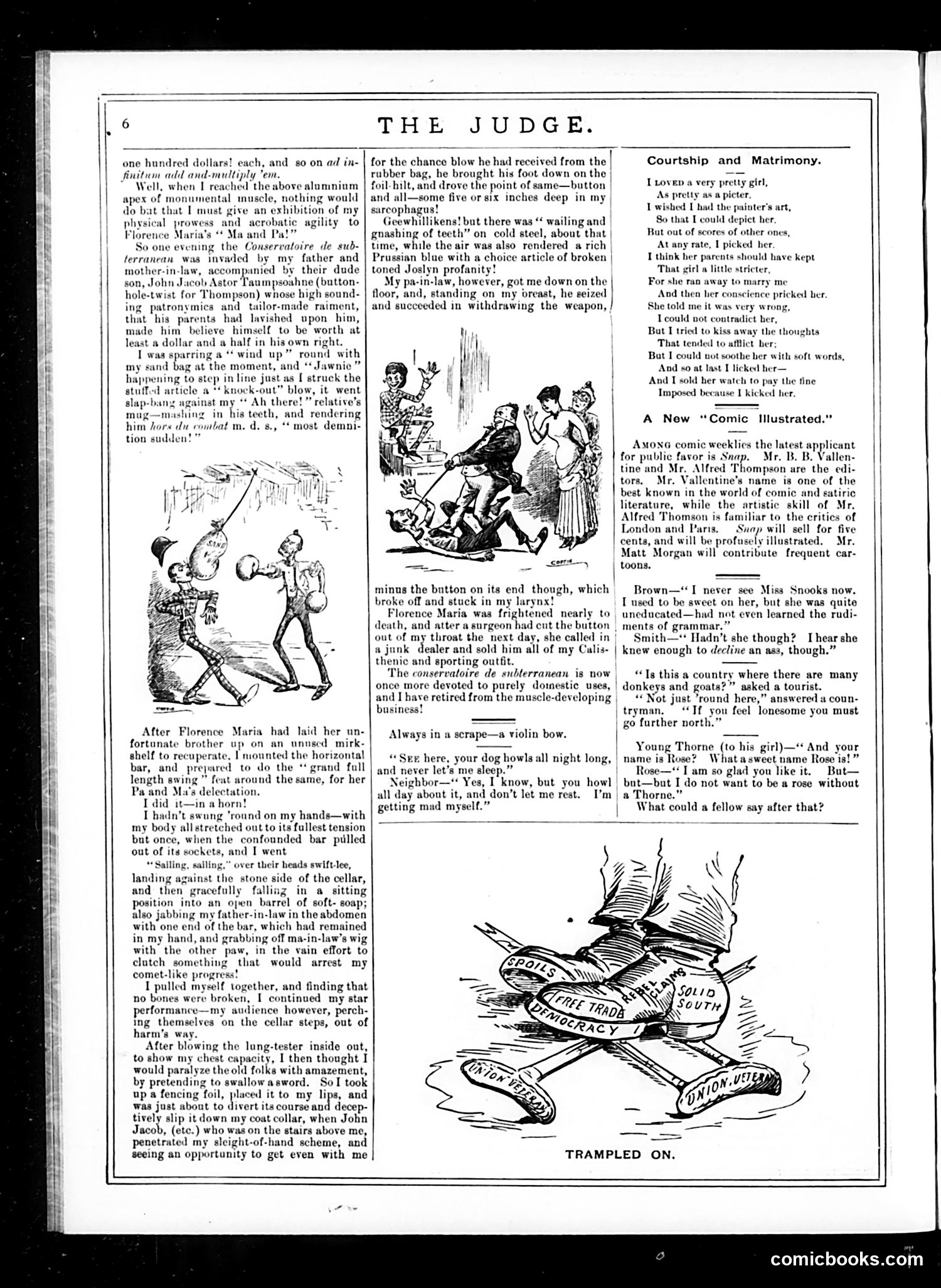
This page contains two distinct pieces of satirical content: **Left side - "The Judge" narrative:** A humorous first-person account of a man's disastrous gymnastics exhibition in his father-in-law's cellar. The narrator attempts increasingly dangerous feats (bar work, sword-swallowing) to impress his wife's family, but each backfires spectacularly—he crashes into a soap barrel, accidentally injures his father-in-law, and finally gets a fencing foil driven through his body when his dupe-like brother-in-law, "John Jacob Assouhne," retaliates for an earlier accidental punch. The satire mocks masculine bravado, class pretension (the brother-in-law's unearned self-importance despite his tailor-made clothes), and family dynamics. **Right side - "Courtship and Matrimony":** A light comic poem about a man courting a pretty girl who runs away to marry him, then regrets it morally. He attempts to "kiss away" her guilt, then resorts to physical punishment and steals her watch to pay fines—satirizing both romantic delusion and marital discord. The cartoon "Trampled On" (bottom right) shows various institutions literally crushed underfoot, likely commenting on political corruption or institutional weakness.
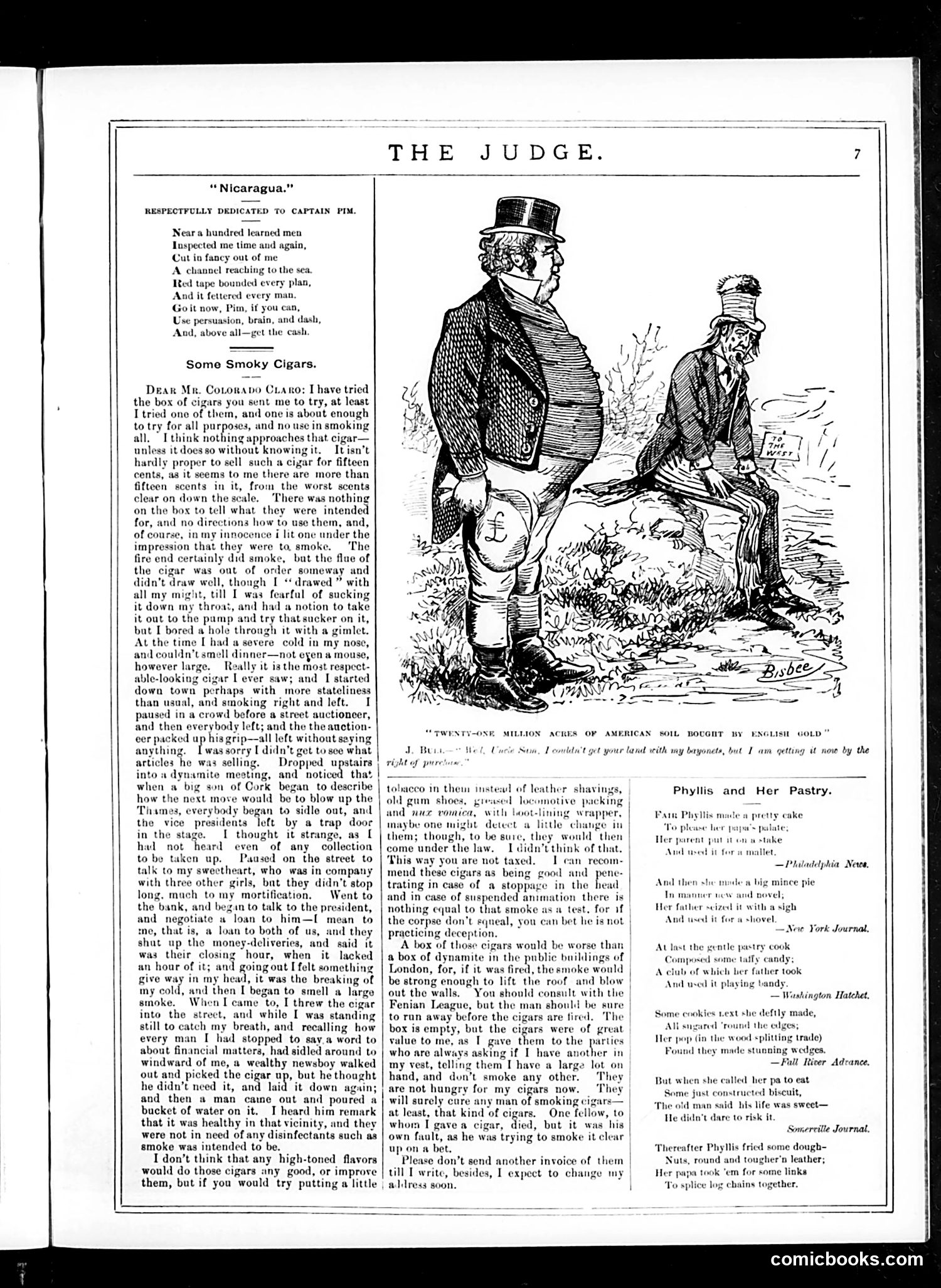
This page contains two distinct pieces of satirical content: **The "Nicaragua" Poem (top left):** A brief verse dedicated to "Captain Pim," likely referencing a real figure involved in Nicaragua canal or development projects. The satire mocks bureaucratic red tape—"Red tape bounded every plan"—that has delayed progress, now urging Pim to use "persuasion, brain, and dash" and crucially, to "get the cash." This appears to critique both governmental inefficiency and the corrupt financial maneuvering required to actually accomplish projects. **"Some Smoky Cigars" (main text):** A humorous complaint letter about a box of terrible cigars. The writer describes using one cigar and notes its offensive smell is so potent it clears rooms—people flee a street auction, a dynamite meeting, and a bank when he's smoking it. The joke satirizes both the absurdly poor quality of the product and the writer's obliviousness to causing disruption. The accompanying verses ("Phyllis and Her Pastry," etc.) continue light domestic humor unrelated to the main content.
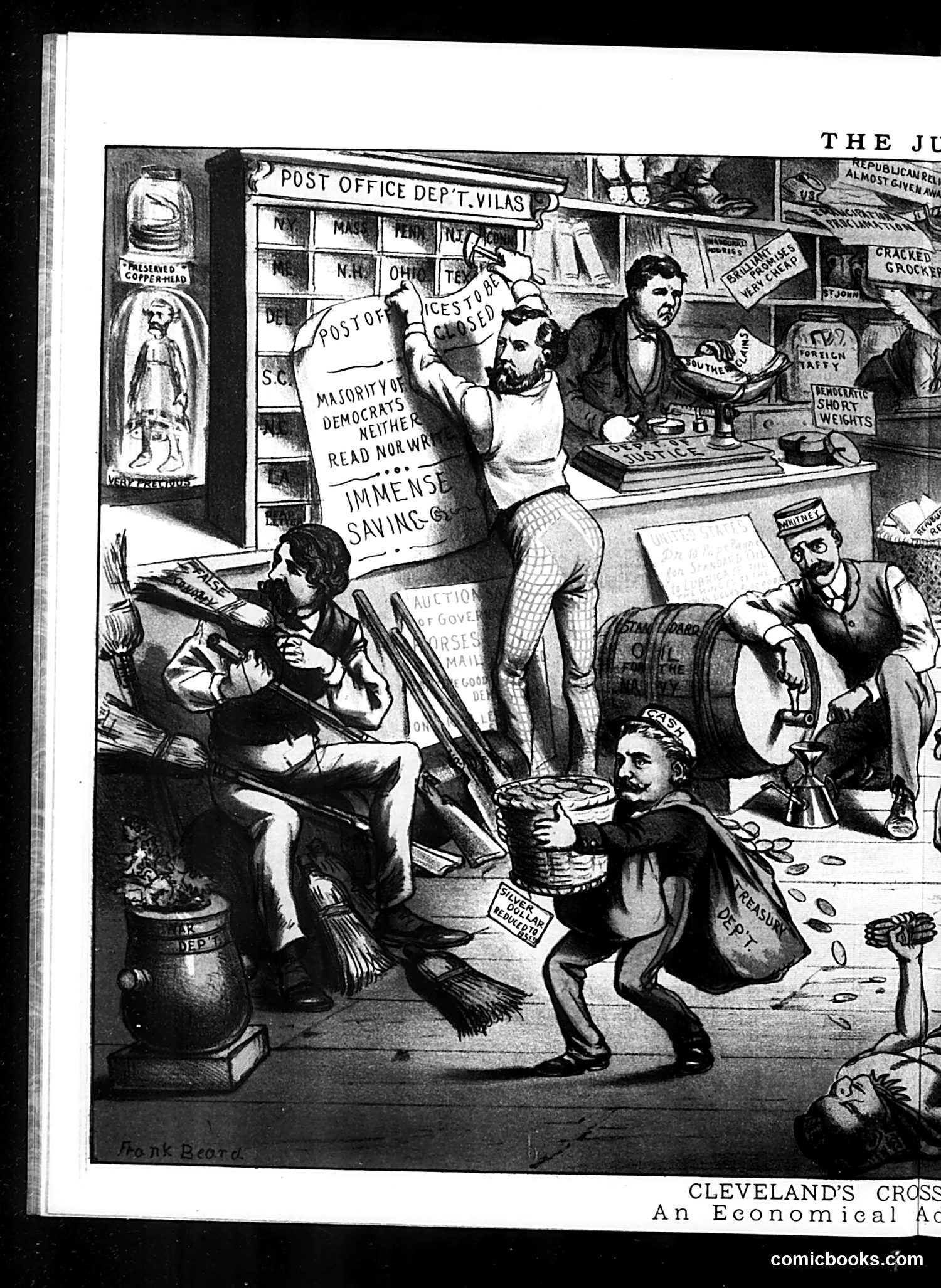
This political cartoon satirizes President Grover Cleveland's fiscal policies. The caption "Cleveland's Cross: An Economical Act" appears at the bottom. The scene depicts a chaotic post office interior where various figures engage in what appears to be bureaucratic upheaval. A man on a ladder posts notices about postal changes; others carry papers and documents. The imagery suggests Cleveland's administration was making sweeping, disruptive reforms to government operations—likely removing appointees or restructuring departments to reduce spending. The "economical act" is portrayed as burdensome and chaotic rather than beneficial. The crowded, frenetic composition conveys that Cleveland's cost-cutting measures created disorder and disruption rather than orderly efficiency. This reflects contemporary debate over Cleveland's efforts to eliminate government waste and patronage during his presidency.
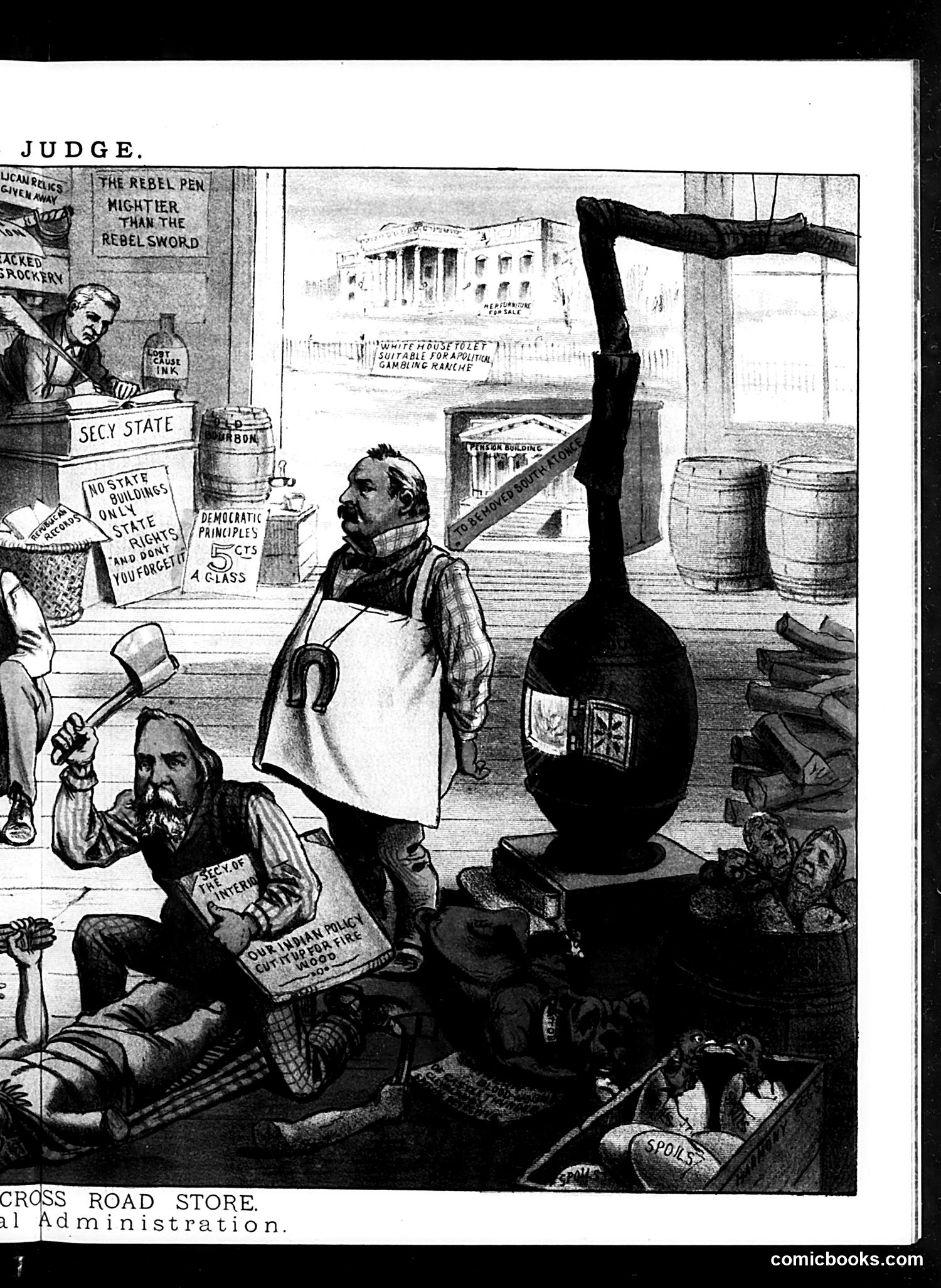
**Title:** "Judge" - appears to be a Reconstruction-era political satire **Main Scene:** A courtroom or administrative setting labeled "Cross Road Store" where figures represent different political factions during the post-Civil War period. **Key Elements:** - A judge figure at left holds "The Rebel Pen Mightier Than the Rebel Sword" - Central figure in apron appears to represent a Southern or Democratic administrator - Large bottle labeled with corrupting influences looms over the scene - White House is visible in background, labeled as "suitable for a politician gambling ranche" - Various signs reference "Democratic Principles," "State Rights," and chaos **Satire:** The cartoon criticizes the administration's handling of Reconstruction, suggesting corruption, lawlessness, and abandonment of democratic principles in favor of political manipulation and Southern interests. The "judge" implies commentary on judicial authority or governmental judgment during this contentious period.
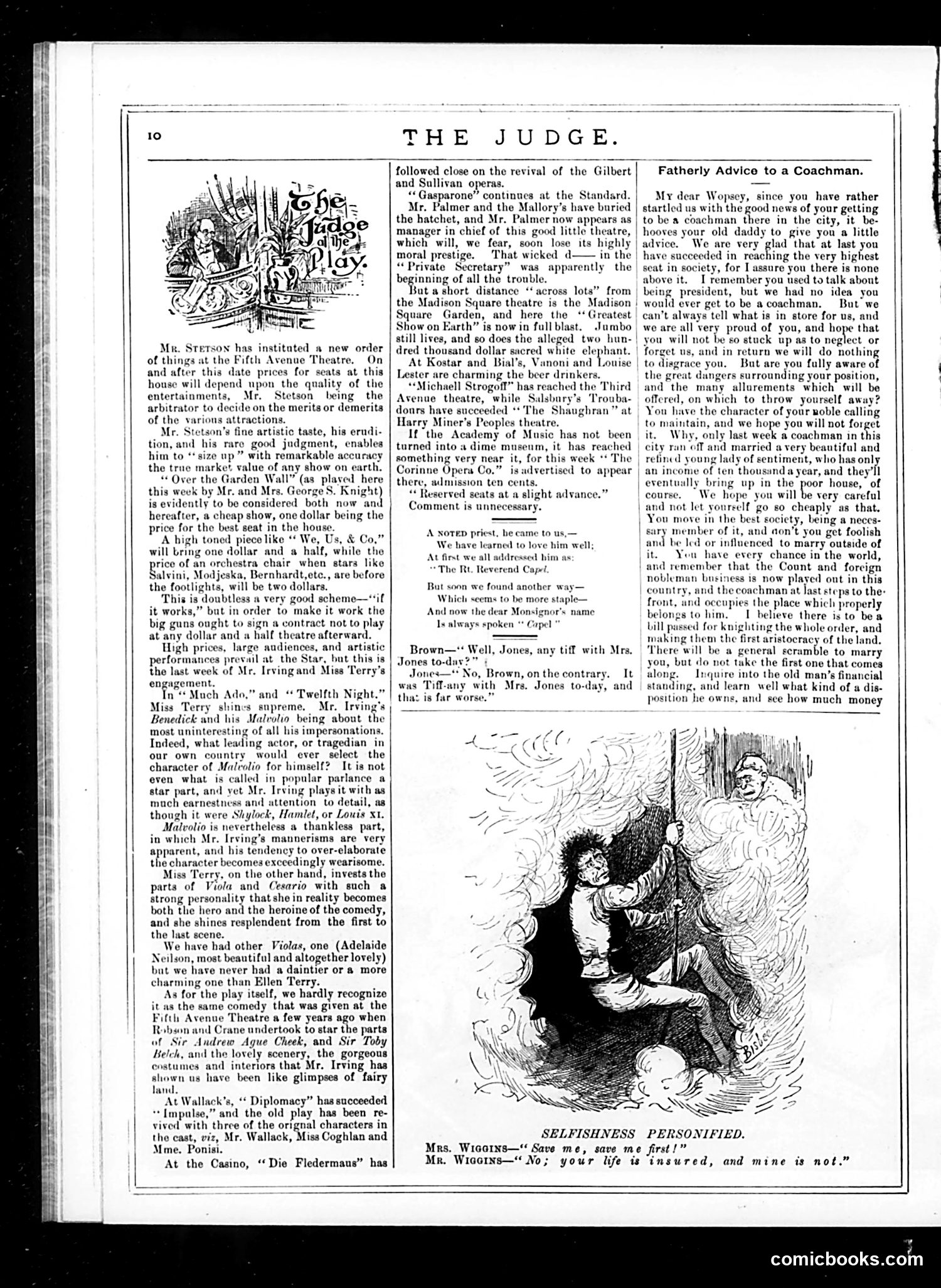
This page discusses New York theater productions and one key satirical piece: the cartoon "Selfishness Personified" at bottom. **The Main Cartoon:** depicts Mrs. Wiggins telling Mr. Wiggins "Save me, save me first!" while he responds "No; your life is insured, and mine is not." This is dark social satire about matrimonial selfishness and greed—specifically mocking a wife who values her insurance payout over her husband's life in a crisis. The joke reflects Victorian anxieties about marriage, insurance fraud, and women's financial motivations. **Theater Reviews:** The bulk of the page covers Broadway productions, praising Henry Irving and Ellen Terry's performances in *Twelfth Night* at the Star Theatre, while critiquing Irving's overacting as Malvolio. It also notes Stetson's new pricing system at the Fifth Avenue Theatre (charging based on show quality) and reviews of other productions like *Diplomacy* and *Die Fledermaus*. The satire assumes readers know these actors and theaters well—a distinctly Gilded Age New York cultural reference point.
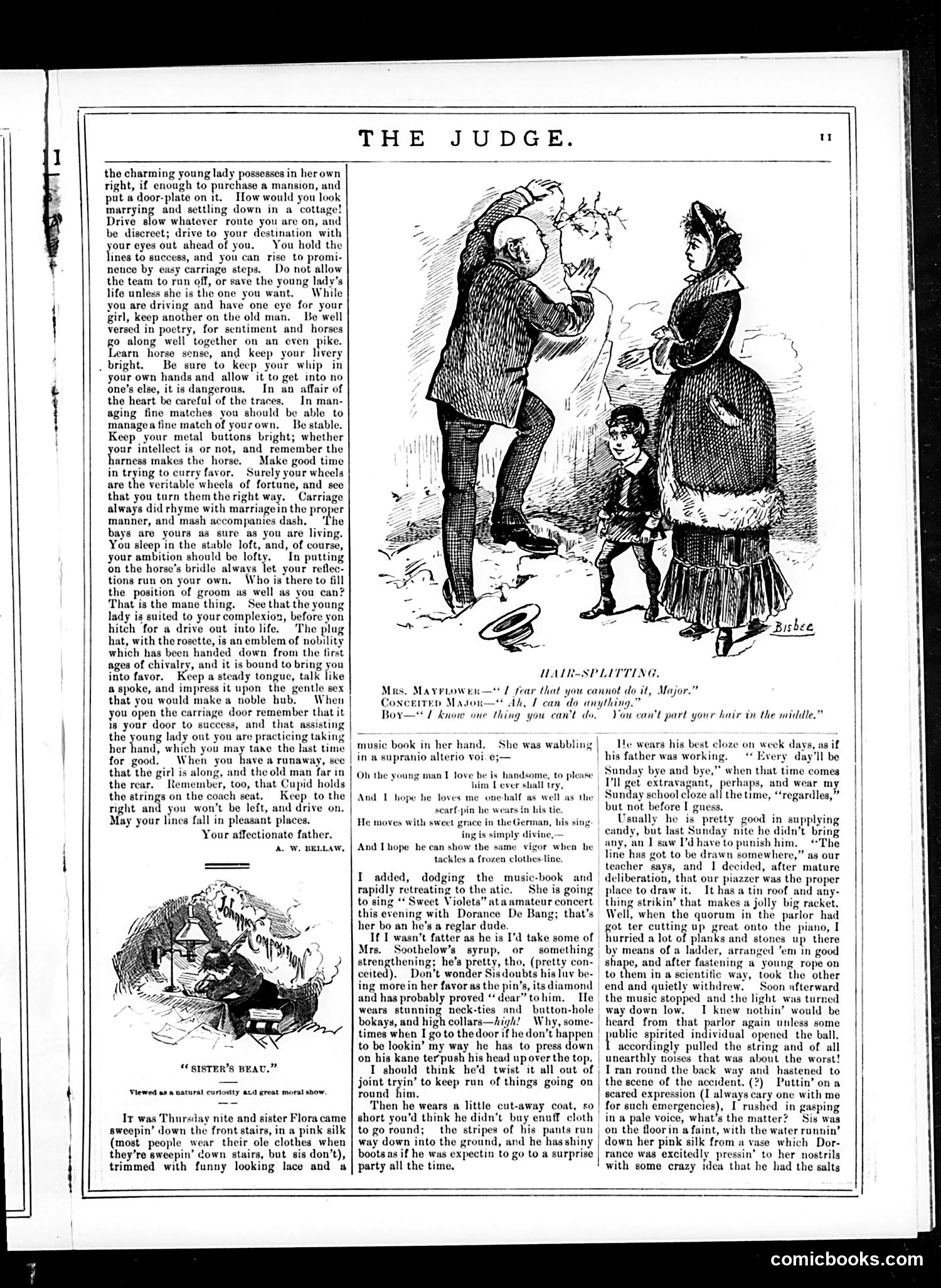
This page from *Judge* contains domestic humor mocking courtship and social pretension circa the 1880s-90s. **"Hair-Splitting"** depicts a conceited young man (labeled "Major") claiming he can do anything, while a woman skeptically counters he cannot do one thing—implied to be splitting hair. The joke plays on his pompous self-regard versus reality. **"Sister's Beau"** satirizes a vain suitor visiting the narrator's sister Flora. She practices singing "Sweet Violets" for an amateur concert with her boyfriend Dorance De Bang, described as a "regular dude"—mocking fashionable young men of the era. The narrator's jealous comments about the boyfriend's appearance and pretensions fuel the humor. The long advice column "Your Affectionate Father" humorously extends carriage-driving metaphors into marriage advice—a Victorian trope treating courtship as managing horses and vehicles. Overall, the page targets vanity, affected sophistication, and romantic pomposity among young urban Americans.
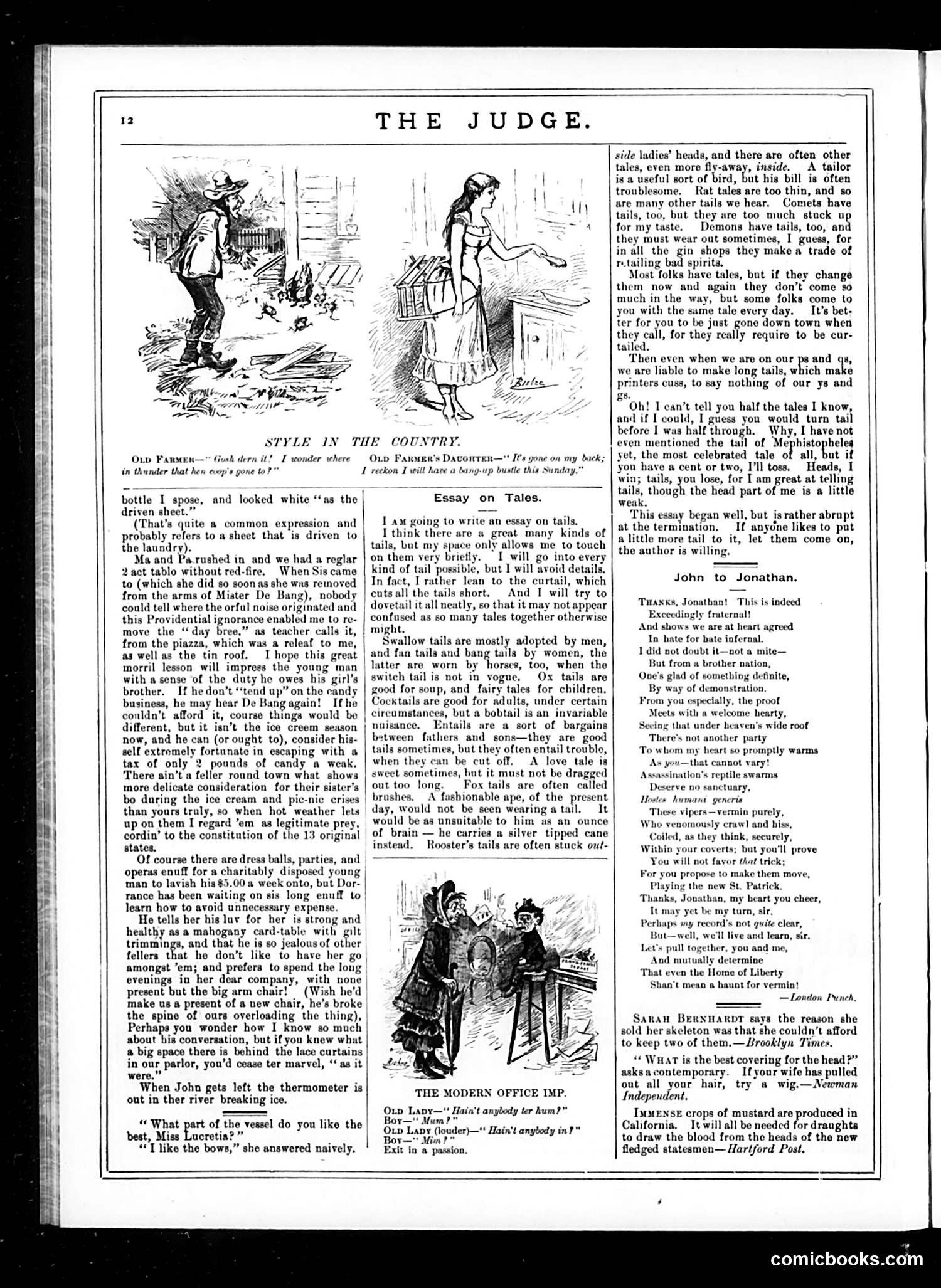
This page from *Judge* contains two main satirical cartoons about rural/country life and a humorous essay on "tails." **"Style in the Country"** depicts an old farmer discovering his daughter in what appears to be a compromising moment with a young man. The joke plays on rural courtship customs and parental protective instincts—the farmer's reaction to finding the couple suggests impropriety, though the text frames it as innocent. **"The Modern Office Imp"** (bottom illustration) shows office workers, likely satirizing contemporary workplace dynamics and behavior. **"Essay on Tales"** is a pun-heavy piece that deliberately conflates animal tails, fashion (bustles), social behaviors, and metaphorical "tales" (stories). It mocks fashionable society—particularly "a fashionable ape" who carries a silver-tipped cane instead of displaying natural attributes, implying contemporary gentlemen are superficially pretentious. The page targets rural simplicity versus urban affectation, courtship norms, and social pretension typical of Gilded Age satire. The humor relies on wordplay and gentle mockery of both country folk and city sophisticates.
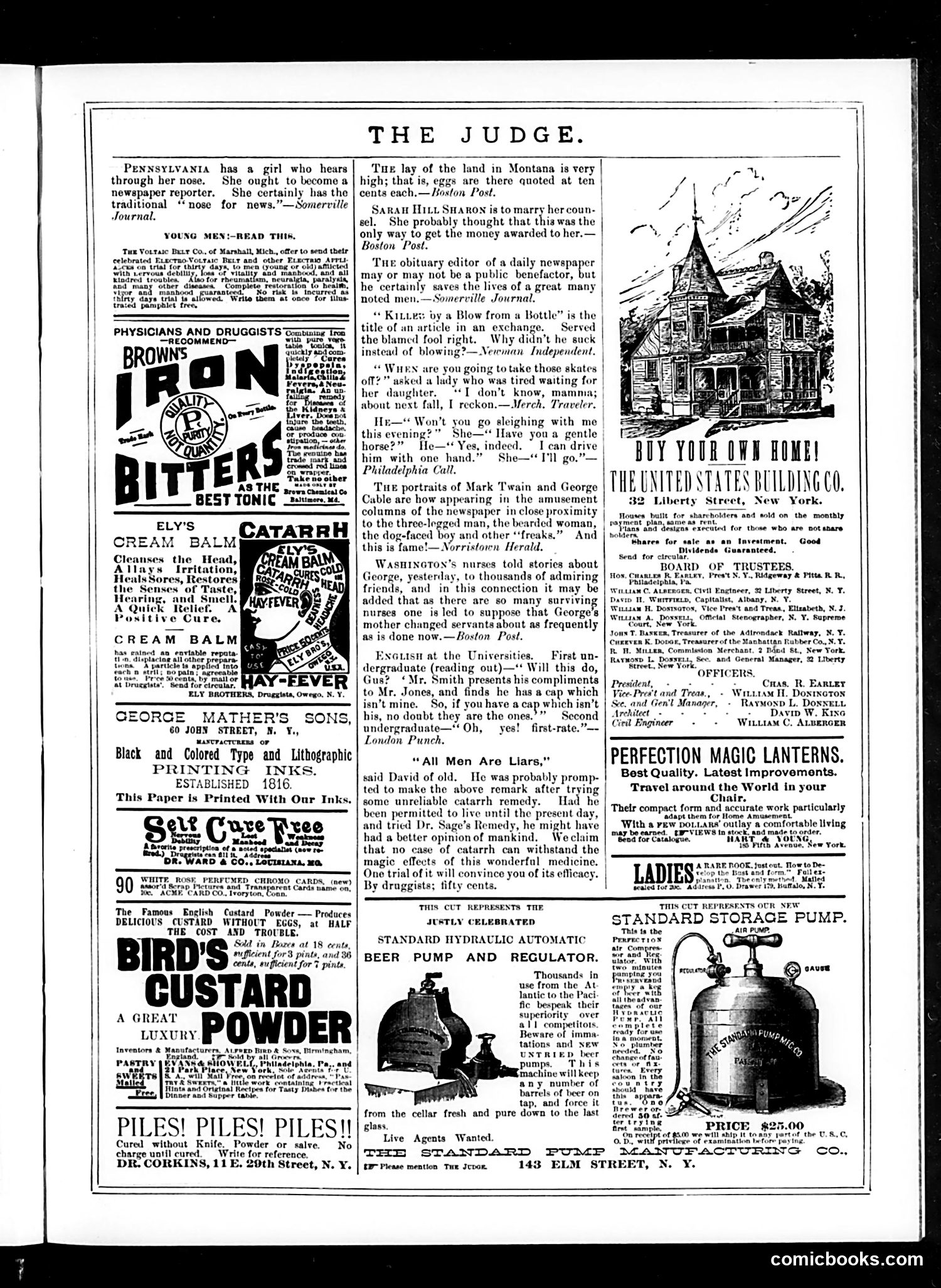
This page is primarily **advertisements and short satirical items**, not a cohesive political cartoon. The brief jokes scattered throughout mock: - **Montana egg prices** (a humorous comment on high costs) - **Sarah Hill Sharon's lawsuit settlement** (appears to reference a real legal case where a woman married her lawyer) - **Newspaper obituary editors** (darkly joking they "save lives" by reporting on notable dead men) - **Mark Twain and George Cable** (complaining they're grouped with circus "freaks" in amusement columns—a dig at how newspapers trivialized famous authors) - **Unreliable catarrh remedies** (advertising Dr. Sage's remedy by mocking competitors) The dominant content is **patent medicine advertising** (electric belts, cream balms, custard powder, etc.)—typical for *Judge* magazine of this era. These ads often made exaggerated health claims. The single illustration shows a **beer pump/regulator**—a product advertisement with technical specifications. The humor is gentle, topical satire aimed at contemporary readers who'd recognize references like the Sharon lawsuit. Most jokes rely on wordplay rather than political commentary.
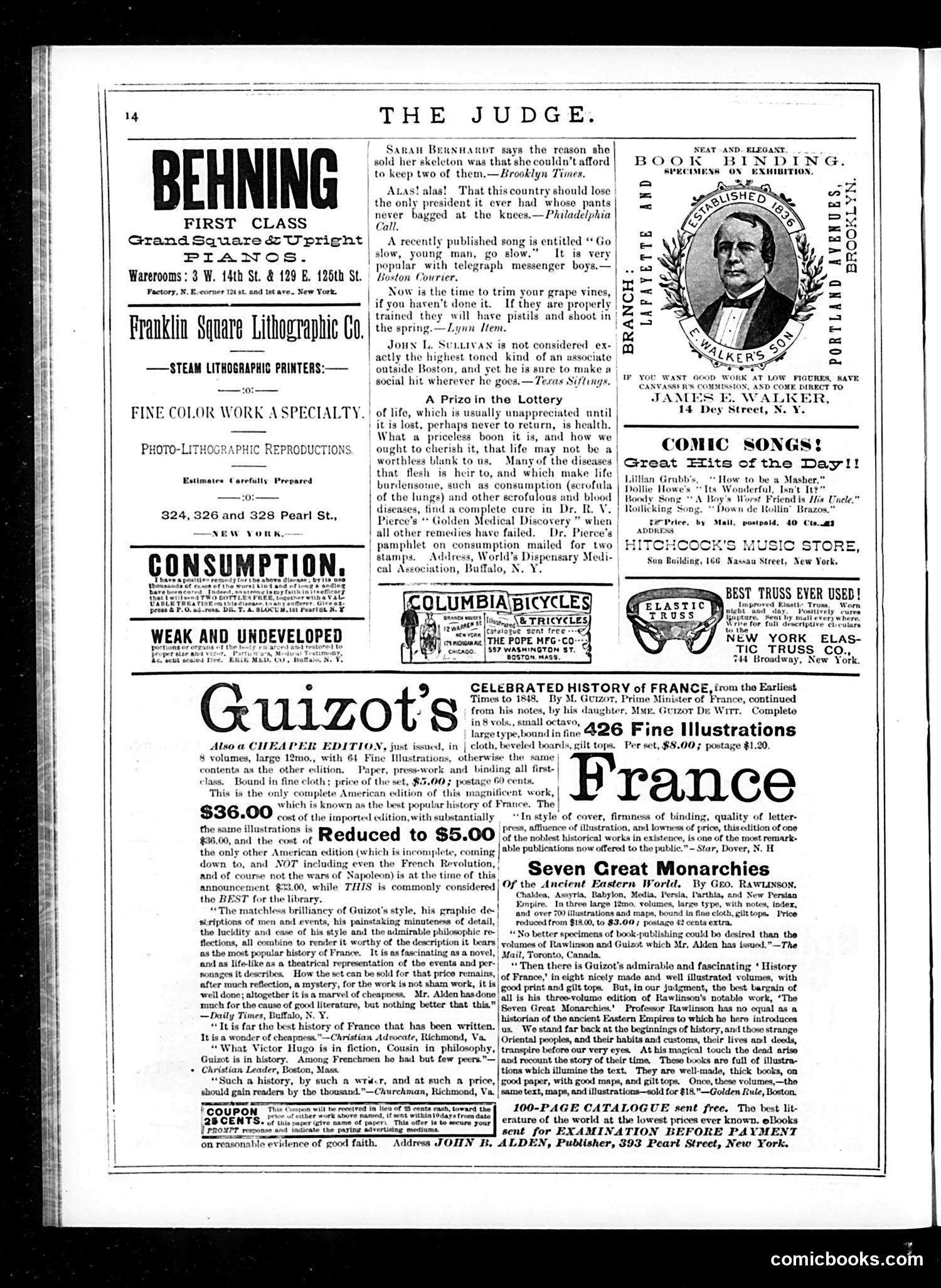
This page is primarily **advertising and filler content** rather than satirical cartoons. The main text consists of brief, disconnected quips reprinted from other publications—a common Judge feature. Notable items: **The John L. Sullivan reference**: A jab at the famous boxer, suggesting he's socially crude despite his prominence. Sullivan was a notorious bare-knuckle champion known for drinking and rough behavior—a symbol of working-class vulgarity to elite readers. **The presidential pants joke**: An obscure jab at an unnamed president whose trousers never bagged at the knees—likely mocking fastidious personal grooming as somehow ridiculous or unmanly. **The telegraph messenger boys quip**: Implies young messengers were lazy or slow-moving. The page is dominated by advertisements for pianos, medical treatments (consumption cures), bicycles, trusses, and Guizot's History of France. This mixed editorial-advertising format was typical of 19th-century magazines. No substantial political cartoons appear on this particular page.
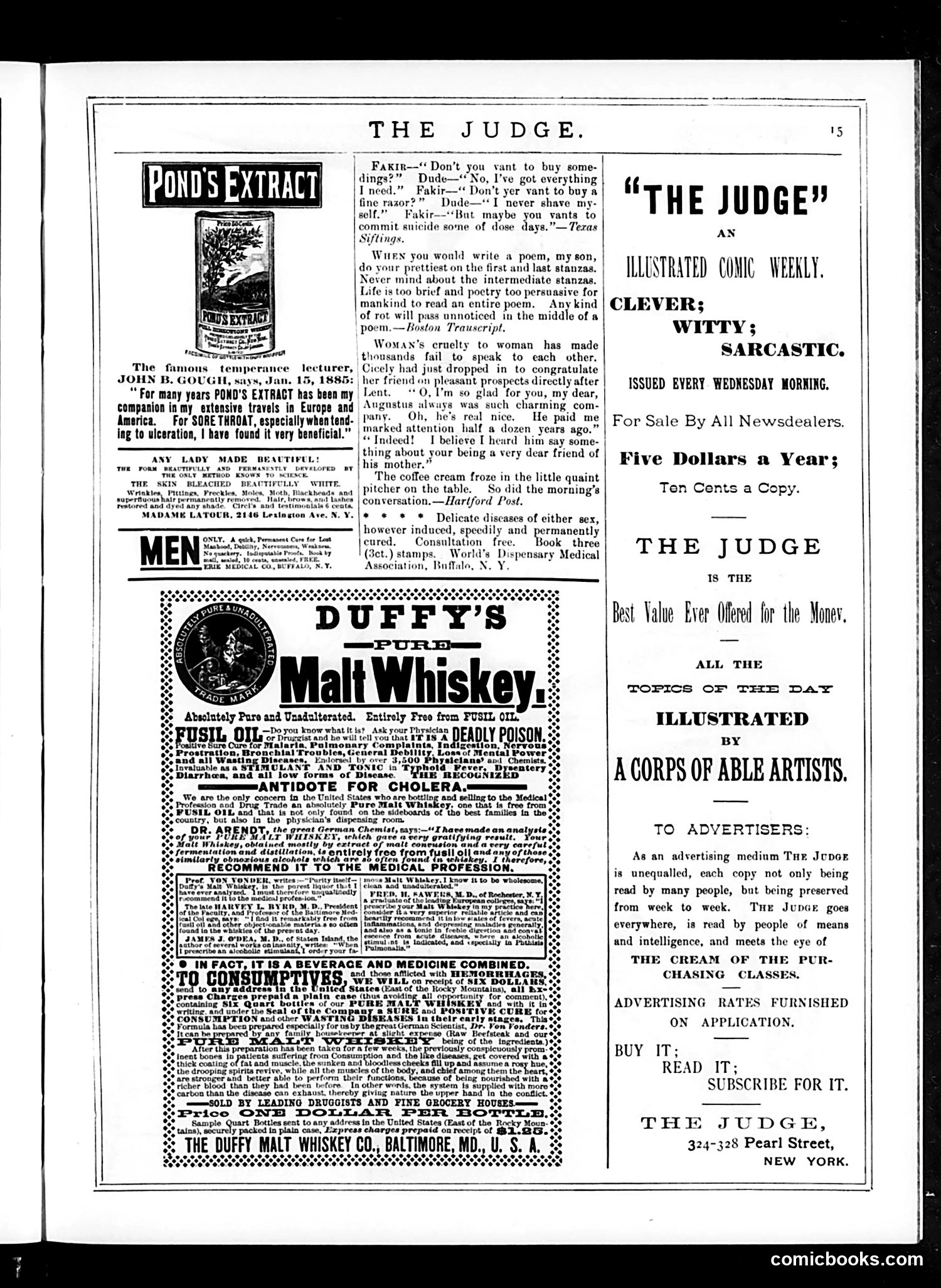
This page is primarily **advertising and promotional material** rather than editorial cartoons. The actual satirical content is minimal: ## Visible Satire: The small dialogue snippets at the top constitute the only humor: 1. **"Fakir and Dude" exchange**: A street vendor hawking razors to a wealthy, idle man ("Dude") who doesn't shave himself, with the vendor sarcastically suggesting he might need one for suicide. This mocks wealthy idleness and leisure-class uselessness. 2. **"Poetry advice" joke**: Satirizes pretentious poets and lazy readers by suggesting readers only care about opening and closing stanzas, allowing mediocre "rot" in the middle—a jab at both contemporary poetry culture and inattentive audiences. 3. **"Cicely and Augustus" vignette**: Social satire about female gossip and cattiness; a woman's congratulations freeze when she realizes her friend's husband may have been interested in *her* years ago. ## Bulk Content: The page is dominated by period **patent medicine advertisements** (Pond's Extract, Duffy's Malt Whiskey) making dubious health claims—ironically, these ads themselves became objects of satire in later decades.
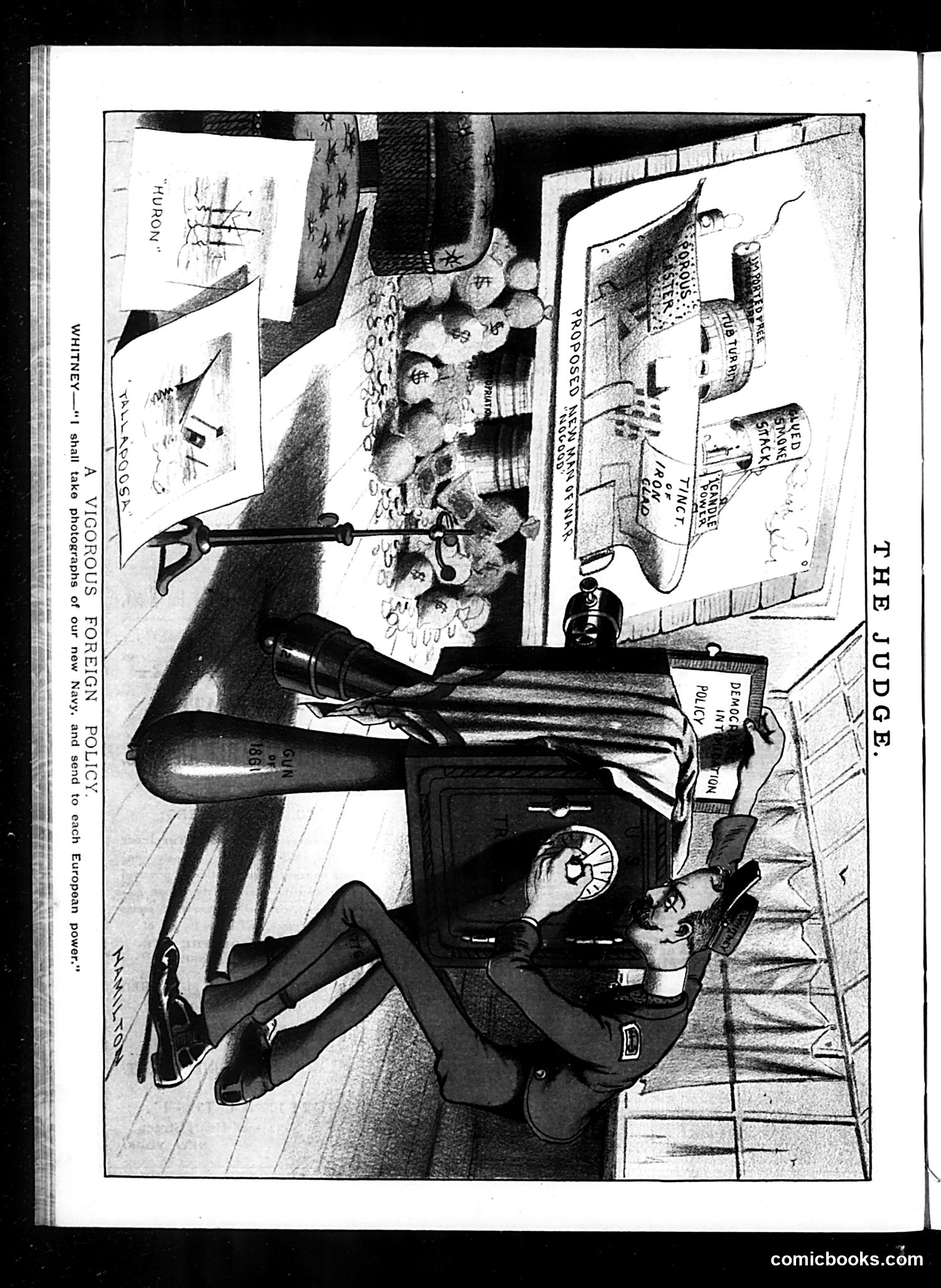
This cartoon satirizes Whitney's proposed foreign policy approach. A figure labeled Whitney stands in what appears to be an official setting, proposing to photograph the American Navy and distribute these images to European powers as a diplomatic strategy. The satire mocks this as an absurdly naive approach to international relations—suggesting that mere photographs of naval vessels could serve as effective deterrence or diplomacy. The cartoon implies the policy lacks substance, treating photographic propaganda as a substitute for actual military or diplomatic strength. The setting shows various official documents and architectural elements, emphasizing the formal governmental context. This appears to critique what the magazine viewed as a weak or ridiculous approach to maintaining America's position in foreign affairs during a period when naval power was a key component of geopolitical influence.