
Judge, 1885-03-28 · page 2 of 16
Judge — March 28, 1885 — page 2: what you’re looking at
What you’re looking at
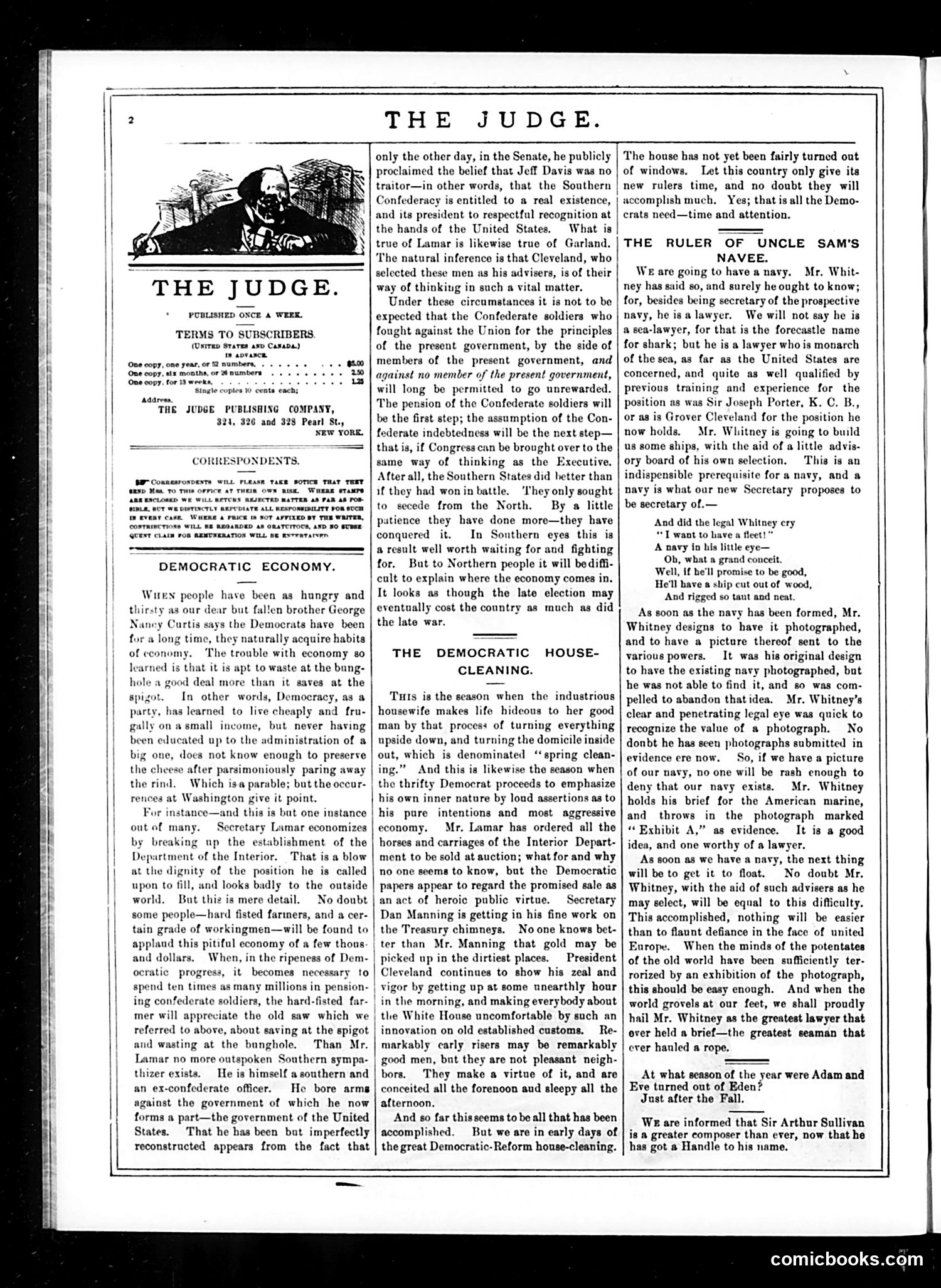
This page from **Judge** magazine contains satirical commentary on the Cleveland administration's perceived favoritism toward the South. **Main Target:** Secretary of the Interior L.Q.C. Lamar, a former Confederate officer whom Judge attacks for hypocrisy. The satire notes that Lamar—who fought *against* the U.S. government—now serves it while allegedly sympathizing with the Confederacy. Judge points out that Lamar recently defended Jefferson Davis as no traitor. **The Argument:** The editorial sarcastically claims Democrats practice false "economy"—cutting Interior Department budgets while preparing to pension Confederate soldiers. This represents wasteful hypocrisy: "saving at the spigot and wasting at the bunghole." **The Dark Joke:** Judge suggests the South, having lost the war militarily, is now "conquering" the North politically through Cleveland's Southern-sympathizing cabinet, eventually extracting Confederate pensions and debt assumption—costing more than the war itself. The cartoon's figure (left) likely depicts Lamar or represents Northern compromise with the South.
📄 Transcribed text from this page (OCR, searchable)
Machine-transcribed from the original scan — historical spelling and the odd misread are preserved.
yewat se THE JUDGE. SCRIBERS. axp Campa) i av asce ‘One copy, one year, or 2 numbers, 00 20 : 3 Single copies 10 cents cack Adarven THE JUDGE PUBLISHING COMPANY, 324, 326 and 328 Pearl St., NEW YORK. CORRESPONDENTS, Sar ComnesrospENTe WILL FLEARR TAKER BOTICE THAT THET Qasp Maa To THU orice at TwEIR OWN Rink, WHERE OTAre AREESCLORKD WH WILL RFTCNS REJECTED MATTER 48 PAR 48 FOS ULE, OCT WE DWTINCTLY REFCDIATE ALL RESPONSIBLITY POR ETCH DEMOCRATIC ECONOMY. Wires people have been as hungry and thirsty as our dear but fallen brother George Nancy Curtis says the Democrats have been for a long time, they naturally acquire habits of economy. ‘The trouble with economy 80 learned is that it is apt to waste at the bung- he good deal more than it saves at the spigot. In other words, Democracy, as a party, has learned to live cheaply and fru- gully on a small income, but never having been educated up to the administration of a big one, does not know enough to preserve the cheese after parsimoniously paring away the rind. Which is parable; but the occur- rences at Washington give it point. For instance—and this is but one instance outof many. Secretary Lamar economizes by breaking up the establishment of the Department of the Interior. That is a blow at the dignity of the position he is called upon to fill, and looks badly to the outside world. But thiz is mere detail. No doubt some people—hard fisted farmers, and a cer- tain grade of workingmen—will be found to | appland this pitiful economy of a few thous and dollars. When, in the ripeness of Dem- ocratic progress, it becomes necessary to spend ten times as many millions in pension- ing confederate soldiers, the hard-fisted far- mer will appreciate the old saw which we referred to above, about saving at the spigot | and wasting at the bunghole. Than Mr. Lamar no more outspoken Southern sympa- thizer exists. He is himself a southern and an ex-confederate officer. He bore arms against the government of which he now forms a part—the government of the United States. That he has been but imperfectly reconstructed appears from the fact that — only the other day, in the Senate, he publicly proclaimed the belief that Jeff Davis was no traitor—in other words, that the Southern Confederacy is entitled to a real existence, and its president to respectful recognition at the hands of the United States. What is true of Lamar is likewise true of Garland. The natural inference is that Cleveland, who selected these men as his advisers, is of their way of thinking in such a vital matter. Under these circumstances it is not to be expected that the Confederate soldiers who fought against the Union for the principles of the present government, by the side of members of the present government, and against no member of the present government, will long be permitted to go unrewarded. The pension of the Confederate soldiers will be the first step; the assumption of the Con- federate indebtedness will be the next step— that is, if Congress can be brought over to the same way of thinking as the Executive. After all, the Southern States did hetter than if they had won in battle. ‘hey only sought to ede from the North. By a little patience they have done more—they have conquered it. In Southern eyes this is a result well worth waiting for and fighting for. But to Northern people it will bediffi- cult to explain where the economy comes in. It looks as though the late election may eventually cost the country as much as did the late war. THE DEMOCRATIC HOUSE- CLEANING. Tuts is the season when the industrious housewife makes life hideous to her good man by that process of turning everything upside down, and turning the domicile inside out, which is denominated ‘spring clean- ing.” And this is likewise the season when the thrifty Democrat proceeds to emphasize his own inner nature by loud assertions as to his pure intentions and most aggressive economy. Mr. Lamar has ordered all the horses and carriages of the Interior Depart- ment to be sold at auction; what for and why no one seems to know, but the Democratic papers appear to regard the promised sale as an act of heroic public virtue. Secretary Dan Manning is getting in his fine work on the Treasury chimneys. No one knows bet- ter than Mr. Manning that gold may be picked up in the dirtiest places. President Cleveland continues to show his zeal and vigor by getting up at some unearthly hour in the morning, and making everybody about the White House uncomfortable by such an innovation on old established customs. Re- markably carly risers may be remarkably good men, bnt they are not pleasant neigh- bors. They make a virtue of it, and are conceited all the forenoon aud sleepy all the afternoon. And so far this seems to be all that has been accomplished. But we are in early days of the great Democratic-Reform house-cleaning. | new rulers time, and no doubt they will The house has not yet been fairly turned out of windows. Let this country only give its accomplish much, Yes; that is all the Demo- crats need—time and attention. THE RULER OF UNCLE SAM'S NAVEE. We are going to have a navy. Mr. Whit- ney has sid 80, and surely he ought to know; for, besides being secretary of the prospective navy, he isa lawyer, We will not say he is a sea-lawyer, for that is the forecastle name for shark; but he is a lawyer whois monarch of the sea, as far as the United States are concerned, and quite as well qualified by previous training and experience for the position as was Sir Joseph Porter, K. C. B., or as is Grover Cleveland for the position he now holds. Mr. Whitney is going to build us some ships, with the aid of a little advis- ory board of his own selection. This is an indispensible prerequisite for a navy, and a navy is what our new Secretary proposes to be secretary of.— And did the legal Whitney ery ** T want to have a fleet!" A navy in his little eye— Ob, what a grand conceit. Well, if he'll promise to be good, He'll have a ship cut out of wood, And rigged so taut and neat. ‘As soon as the navy has been formed, Mr. Whitney designs to have it photographed, and to have a picture thereof sent to the various powers. It was his original design to have the existing navy photographed, but he was not able to find it, and so was com- pelled to abandon thatidea. Mr. Whitney’s clear and penetrating legal eye was quick to recognize the value of a photograph. No donbt he has seen photographs submitted in evidence ere now. So, if we have a picture of our navy, no one will be rash enongh to deny that our navy exists. Mr. Whitney holds his brief for the American marine, and throws in the photograph marked ‘Exhibit A,” as evidence. It is a good idea, and one worthy of a lawyer. As soon as we have a navy, the next thing will be to get it to float. No doubt Mr. Whitney, with the aid of such advisers as he may select, will be equal to this difficulty. This accomplished, nothing will be easier than to flaunt defiance in the face of united Europe. When the minds of the potentates of the old world have been sufficiently ter- rorized by an exhibition of the photograph, this should be easy enough. And when the world grovels at our feet, we shall proudly hail Mr. Whitney as the greatest lawyer that ever held a brief—the greatest seaman that over hauled a rope. At what season of the year were Adam and Eve turned out of Eden? Just after the Fall. We are informed that Sir Arthur Sullivan is a greater composer than ever, now that he has got a Handle to his name, | comicbooks.com