
A complete issue · 16 pages · 1885
Judge — February 14, 1885
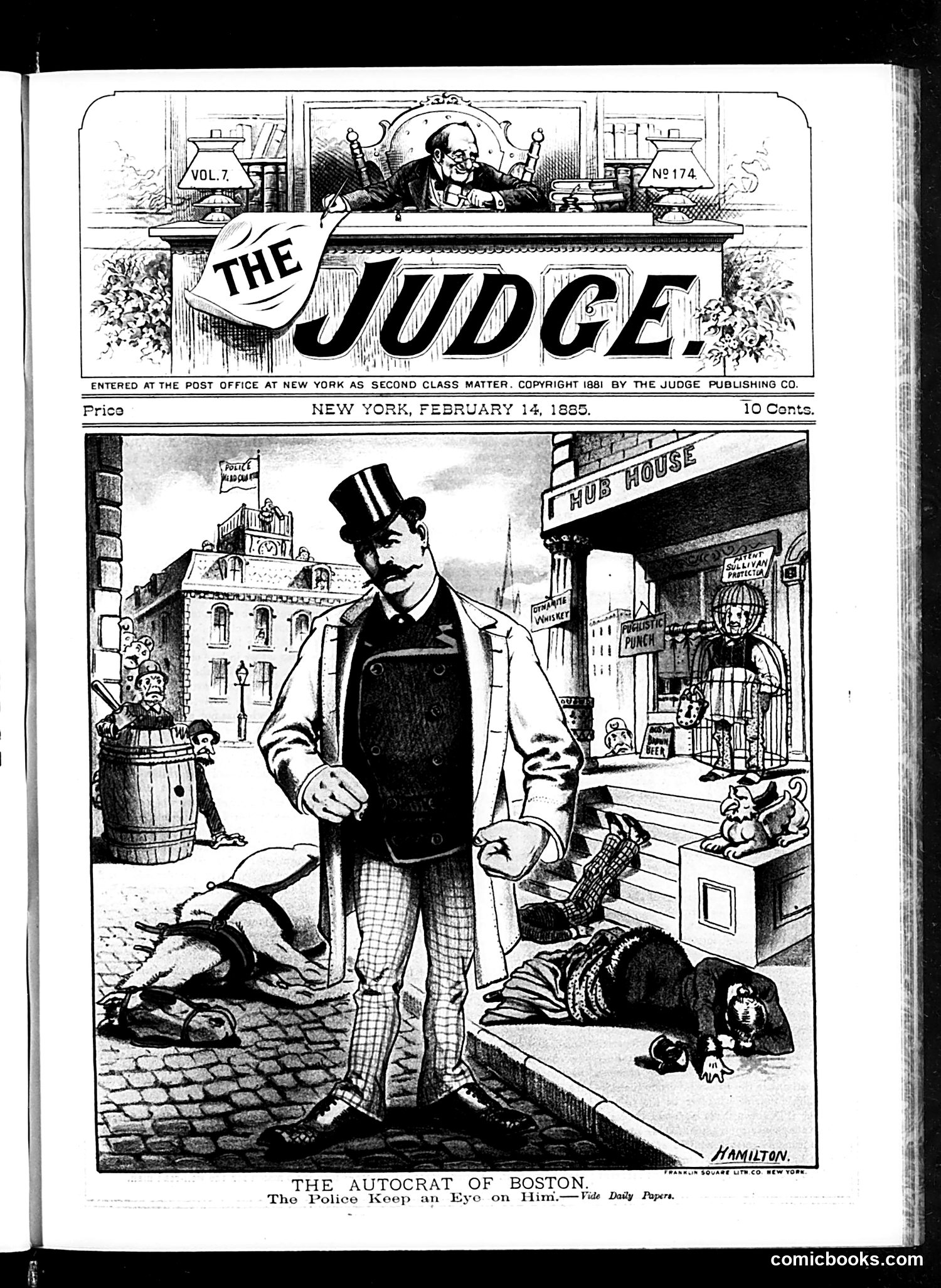
This 1885 *Judge* cartoon satirizes Boston police authority. The well-dressed police officer dominates the street scene, literally standing over a prone figure while others cower nearby. The caption reads "The Police Keep an Eye on Him"—suggesting watchful oppression. The cartoon critiques what it portrays as autocratic Boston police power: the officer's commanding posture, top hat, and formal dress ironically contrast with his violent context. The figure on the ground and frightened bystanders convey police overreach or brutality. The specific Boston incident referenced is unclear without additional context, but the satire targets perceived police abuse of authority and suggests the department operated with excessive, unchecked power—hence "autocrat."
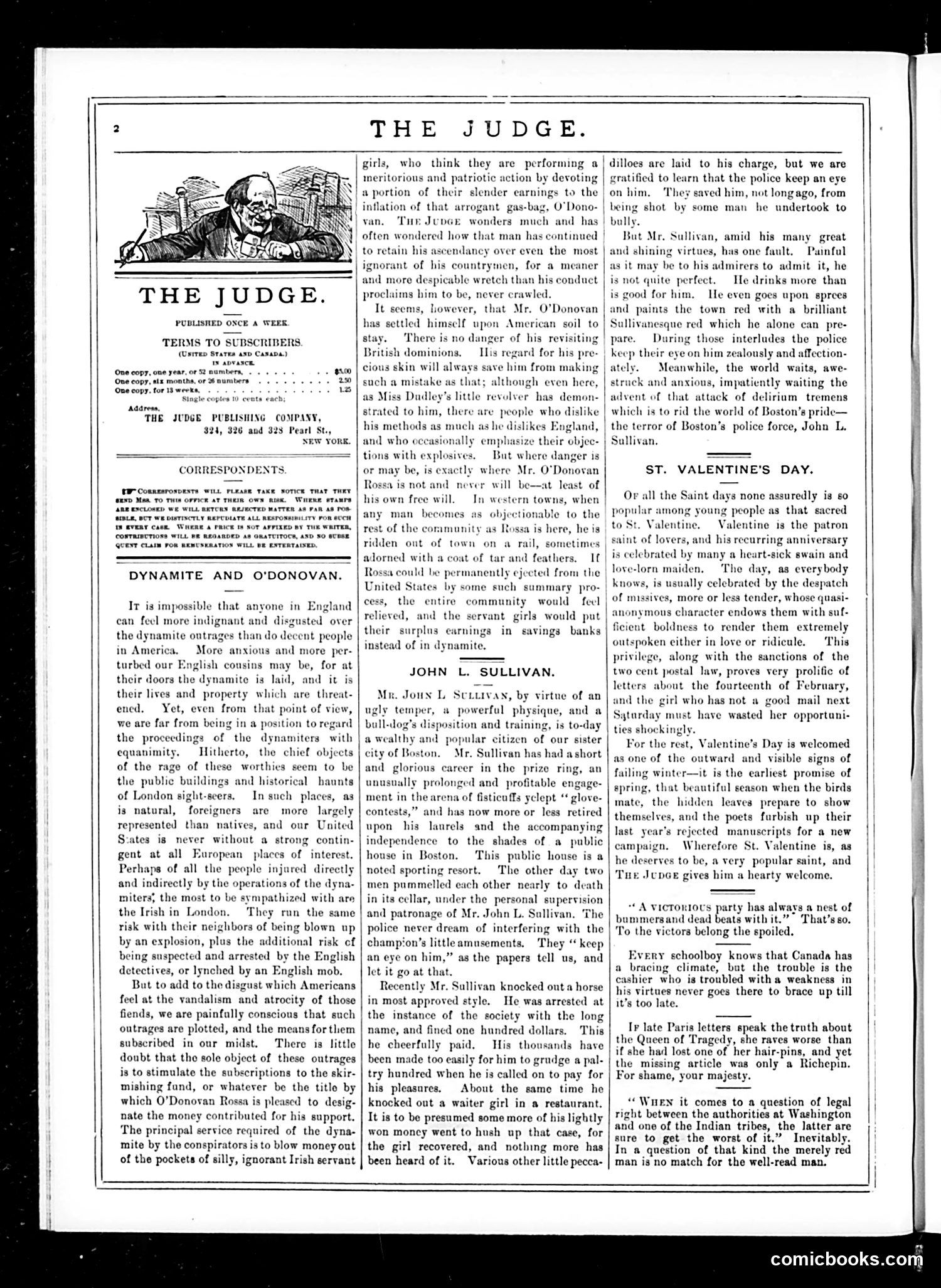
This page attacks **O'Donovan Rossa**, an Irish-American nationalist fundraiser accused of supporting dynamite bombings in London. The cartoon's central complaint: Rossa exploits poor Irish immigrant servant girls—who donate their meager wages believing they're supporting Irish independence—to line his own pockets. Judge's editors consider him a con artist and coward who safely operates in America while others risk arrest and death. The article sarcastically notes that dynamite attacks on London landmarks endanger innocent Americans and Irish residents alike. Judge suggests that in the American West, such a disreputable figure would be tarred, feathered, and expelled—implying Rossa deserves similar treatment. The satire targets both Rossa's fraudulent patriotism and the gullible donors who fund his schemes, portraying him as a bloated, self-serving demagogue exploiting ethnic sentiment for personal gain.
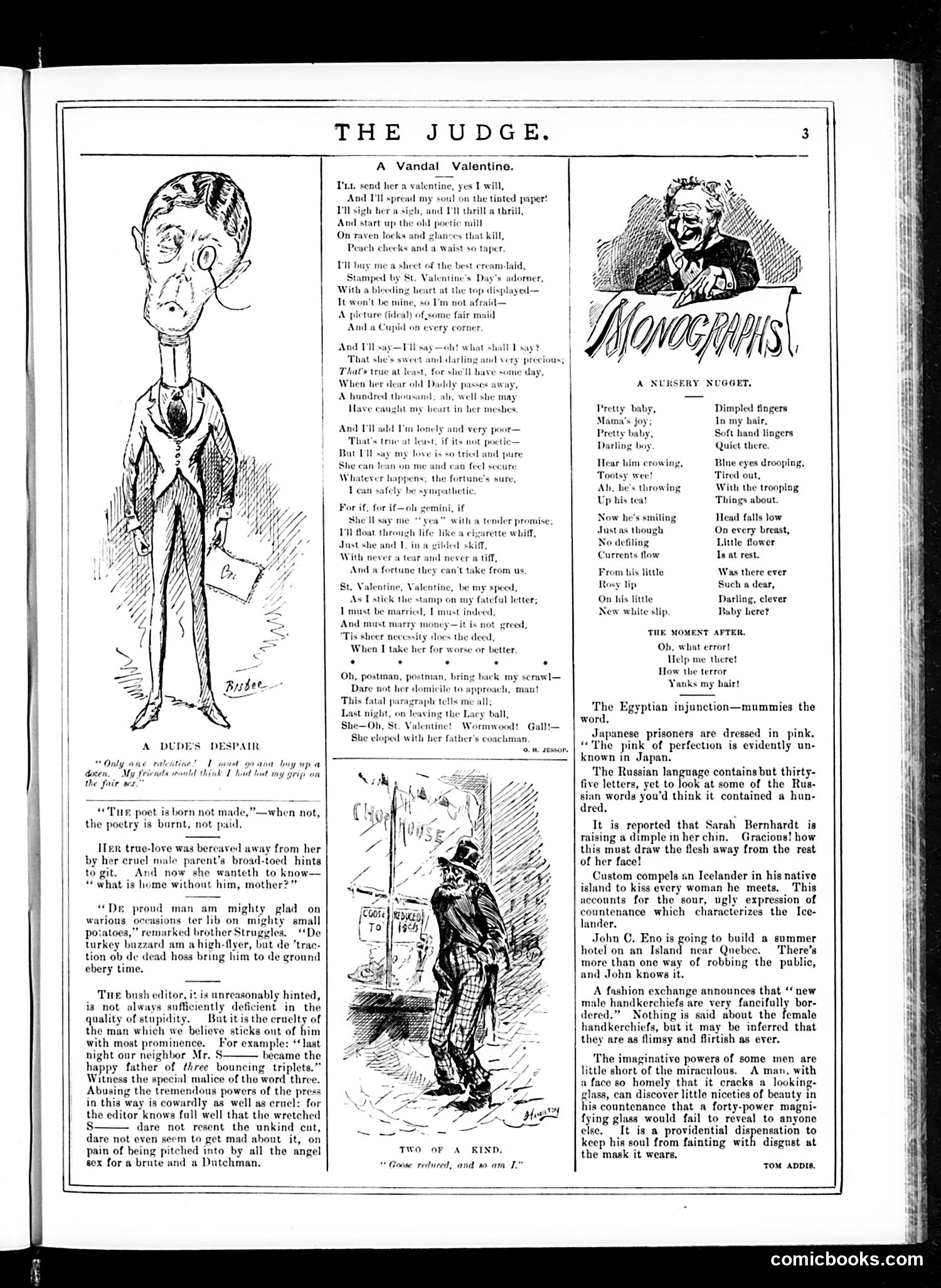
This page from *Judge* satirizes sentimental Valentine's Day verse and romantic pretension. The central cartoon shows an exaggerated "dude" (a fashionably dressed young man, recognizable by the elongated, ridiculous figure) composing an overwrought love letter. The accompanying poem "A Vandal Valentine" mocks the clichéd language of romantic correspondence—flowery declarations about "raven locks," "peach cheeks," and marriage proposals based on financial desperation rather than genuine affection. The humor targets two things: the absurdity of formulaic romantic expression and the social desperation of men seeking advantageous marriages. The poem's twist ending—where the beloved elopes with her father's coachman instead—deflates the pretentious suitor's grandiose fantasy. The smaller pieces ("A Nursery Nugget," "Two of a Kind," "The Moment After") offer additional satirical commentary on domestic life and relationships, all reflecting *Judge*'s skeptical view of romantic sentiment.
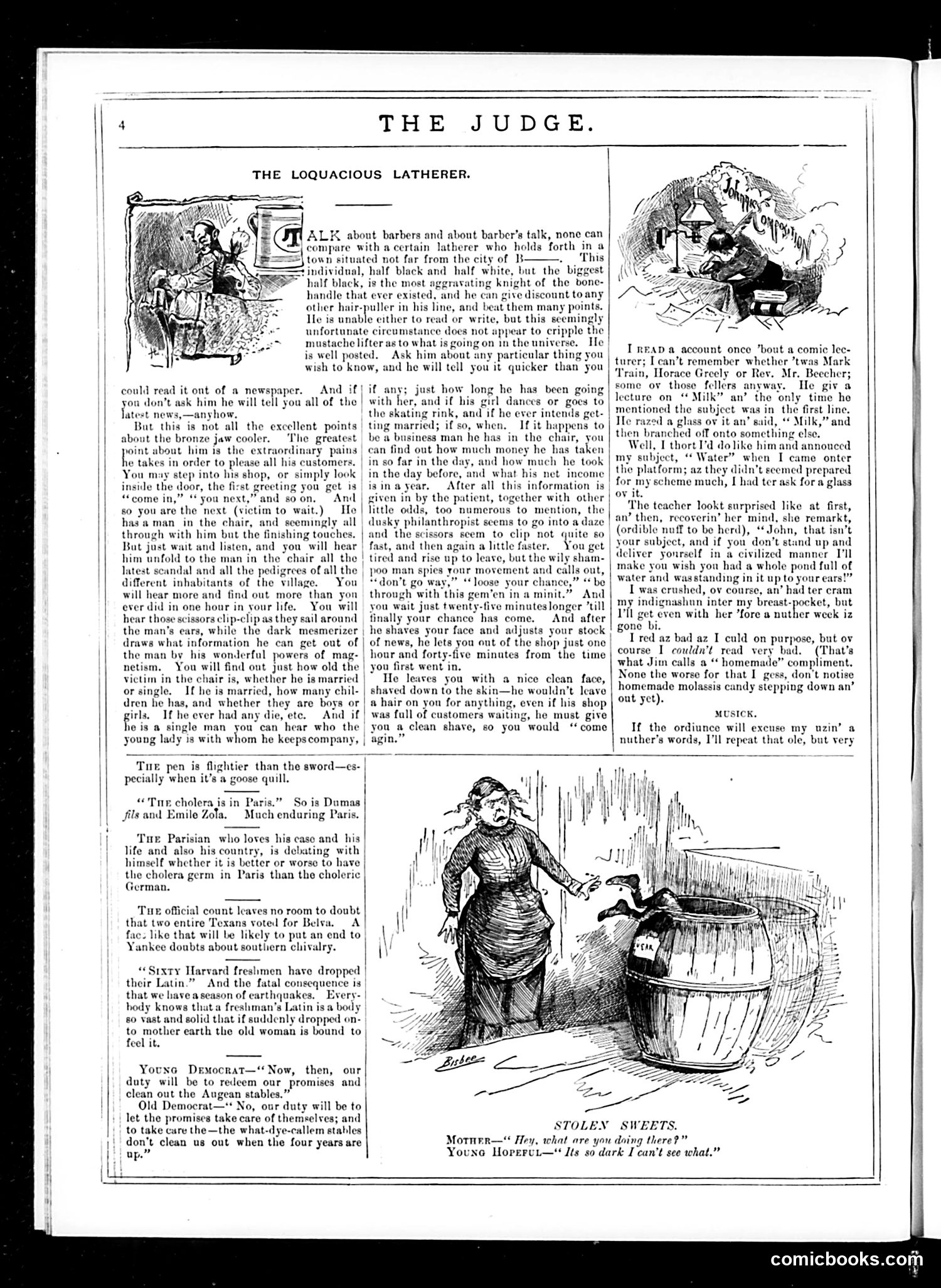
This piece satirizes a garrulous barber in an unnamed town who is characterized as an incessant talker and gossip. The central joke targets the barber's compulsive need to extract and share personal information from customers—their marital status, children, earnings, romantic relationships, and local scandals—while performing their shave, often keeping patrons waiting far longer than necessary. The barber is described as Black ("bronze jaw cooler," "half black"), and the satire emphasizes his social position as someone who, though illiterate, becomes a repository of community gossip through his interrogative powers. The accompanying illustrations show him in his shop and depict a humorous scene of a woman and young boy. The inserted anecdote about a lecturer who spent entire speeches on tangential topics reinforces the theme: verbose people who talk excessively without substantive content. The satire mocks both the barber's chattiness and, implicitly, his social pretensions despite his lack of education.
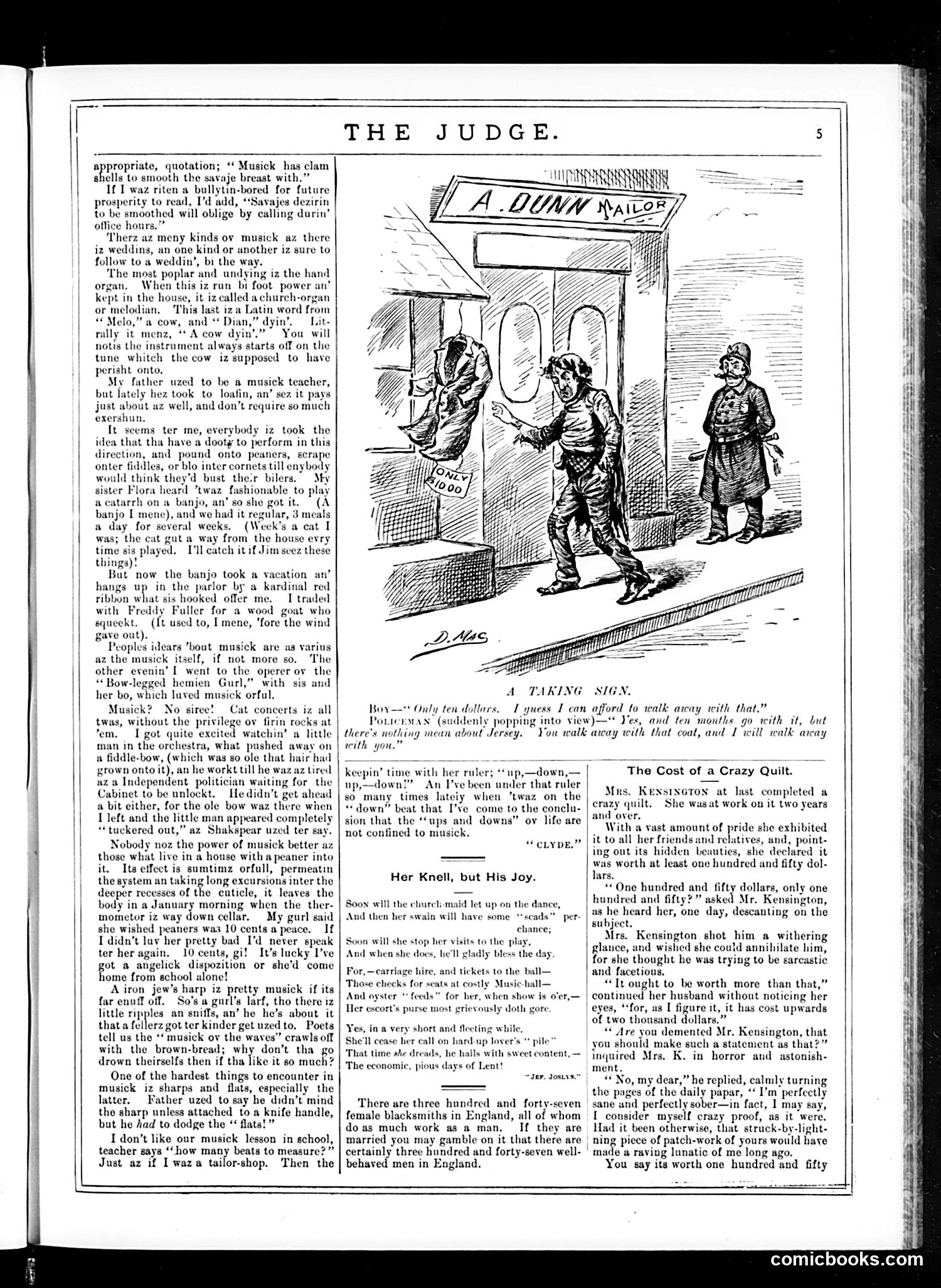
This cartoon satirizes **urban homelessness and vagrancy in the Gilded Age**. The image shows a young street urchin or vagrant offering to walk away with a well-dressed man's coat for ten dollars—a transparent attempt at extortion or panhandling disguised as a "service." The humor targets both figures: the boy's brazen audacity and the man's apparent willingness to negotiate. The dialogue ("only ten dollars... there's nothing mean about Jersey") suggests the boy is from New Jersey, invoking contemporary stereotypes about that region's unsavory reputation. The satire critiques urban poverty and street crime while mocking the casual way such petty theft and beggar culture operated in late 19th-century American cities. The "taking sign" refers to the boy's shameless proposition being transparently obvious to any observer.
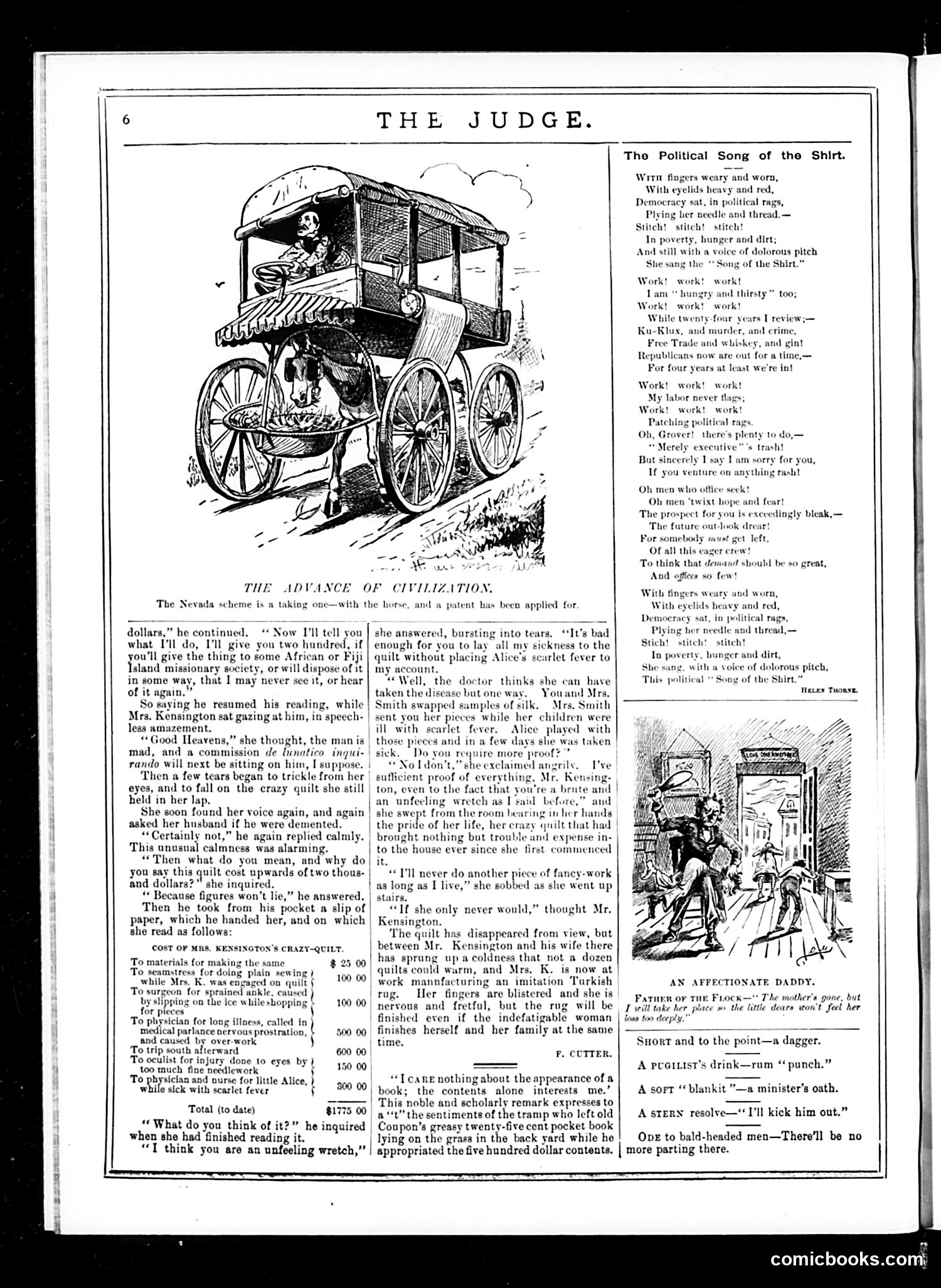
This page satirizes **women's obsession with needlework and domestic hobbies** and their social consequences. The main cartoon shows a woman in a carriage made from an elaborate crazy quilt—a visual pun on "crazy." The accompanying story mocks Mrs. Kensington's two-thousand-dollar crazy quilt, which her husband meticulously itemizes as causing medical disasters: her maid's sprained ankle, his wife's nervous breakdown, their daughter Alice's scarlet fever (from contaminated quilt pieces), and required doctor visits. He finds the hobby socially destructive and absurd. The satire targets **upper-class women's leisure pursuits** as economically wasteful and dangerously distracting from family welfare. The humor lies in the husband's literal accounting—treating emotional and physical damage as legitimate line items—suggesting women's fancy crafts represent misplaced priorities and frivolous consumption. The sidebar poem "Political Song of the Shirt" likely extends this critique to labor and social reform, though context is unclear from this excerpt.
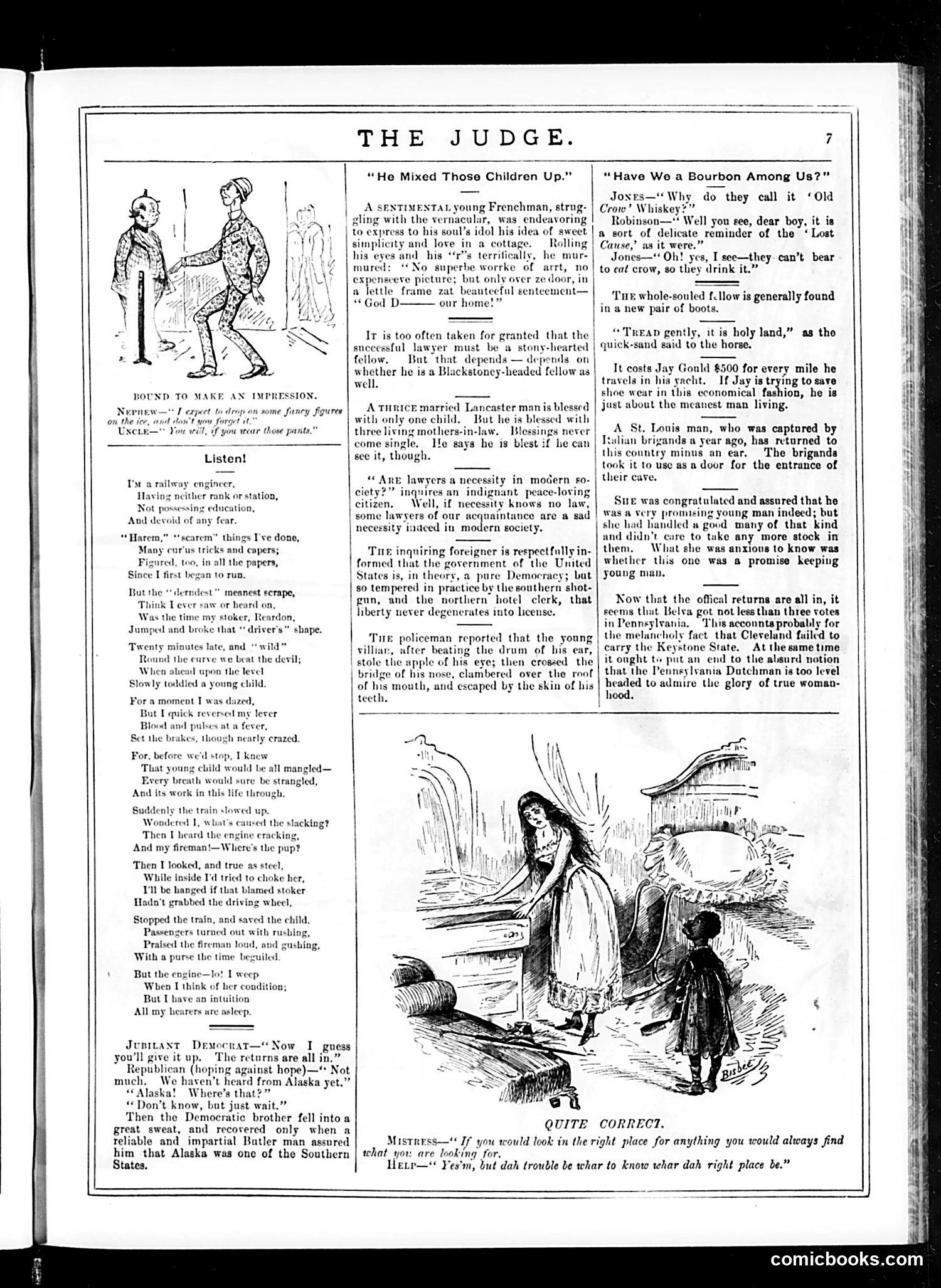
This page from Judge contains several satirical pieces typical of late 19th-century American humor: **Main cartoons:** 1. **"Bound to Make an Impression"** — A poem about a railroad engineer whose stoker heroically saves a child from being hit by a train. The satire appears to mock sentimental Victorian storytelling about working-class virtue. 2. **"Quite Correct"** — An illustration showing a woman helping someone, with dialogue about finding what you're looking for. The specific satire is unclear from context. **Text jokes** include: - A Frenchman's garbled English romantic proposal - A lawyer joke (playing on "Blackstone") - Political commentary on Alaska's status (referencing uncertainty about whether Alaska was considered part of the South or North) - Puns about facial anatomy and legal terminology The overall tone is lighthearted wordplay and gentle social observation rather than sharp political critique. The page represents Judge's mix of comic illustrations, sentimental narratives, and pun-based humor typical of 1880s-90s American periodicals.
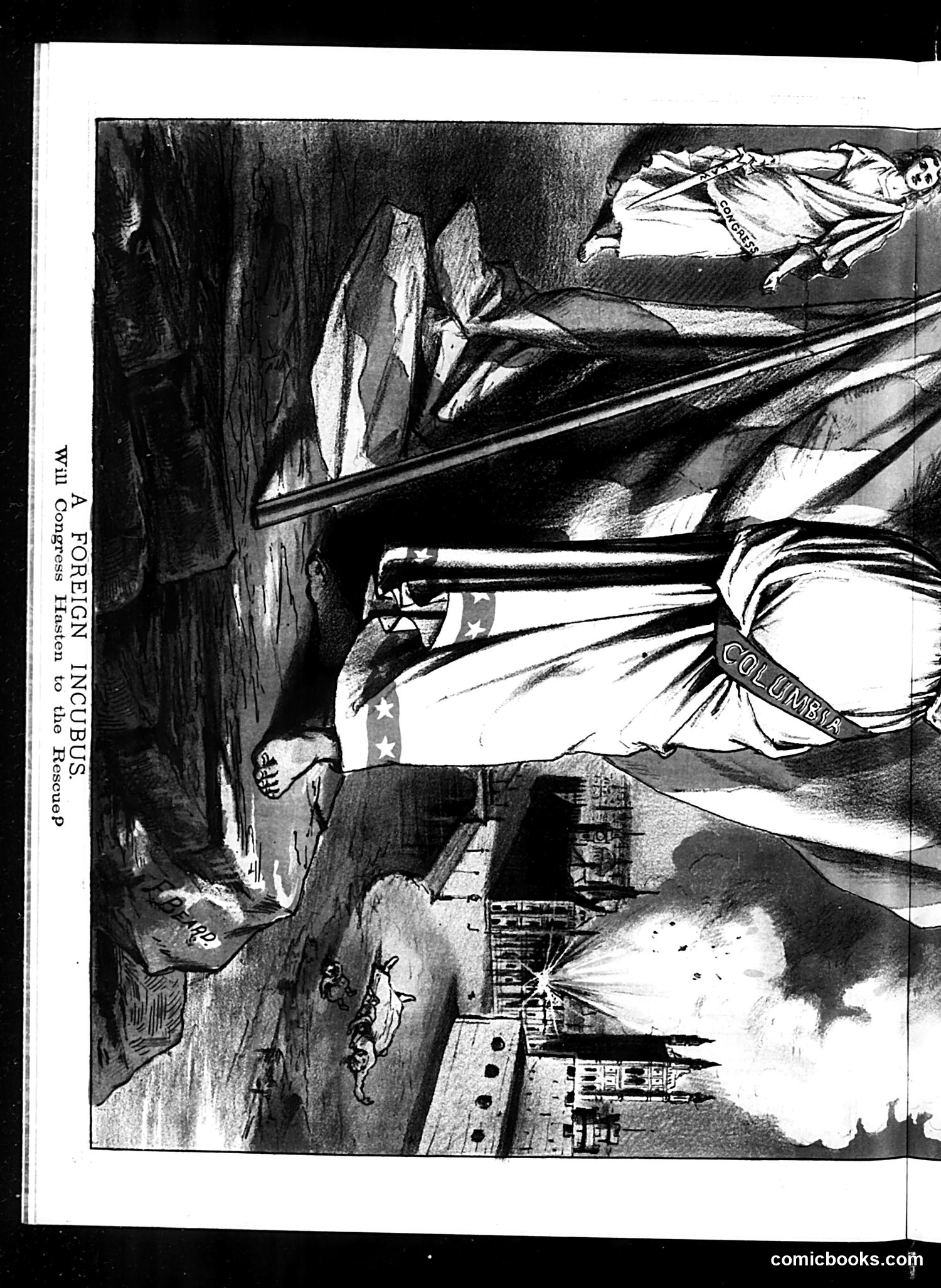
This political cartoon depicts a nightmarish scene titled "A Foreign Incubus," asking whether Congress will intervene. The image shows a demonic or monstrous figure (the "foreign incubus") threatening or attacking a woman representing Columbia (America), who appears helpless or in distress. A man labeled "COLUMBUS" stands nearby, seemingly unable to assist. The satire criticizes foreign interference or influence on American affairs, likely referencing late 19th or early 20th-century anxieties about international threats to American sovereignty. The cartoon appeals to Congress to protect the nation from this external menace. The use of Columbia as the vulnerable female figure was common in American political imagery of this era, representing the nation itself under threat.
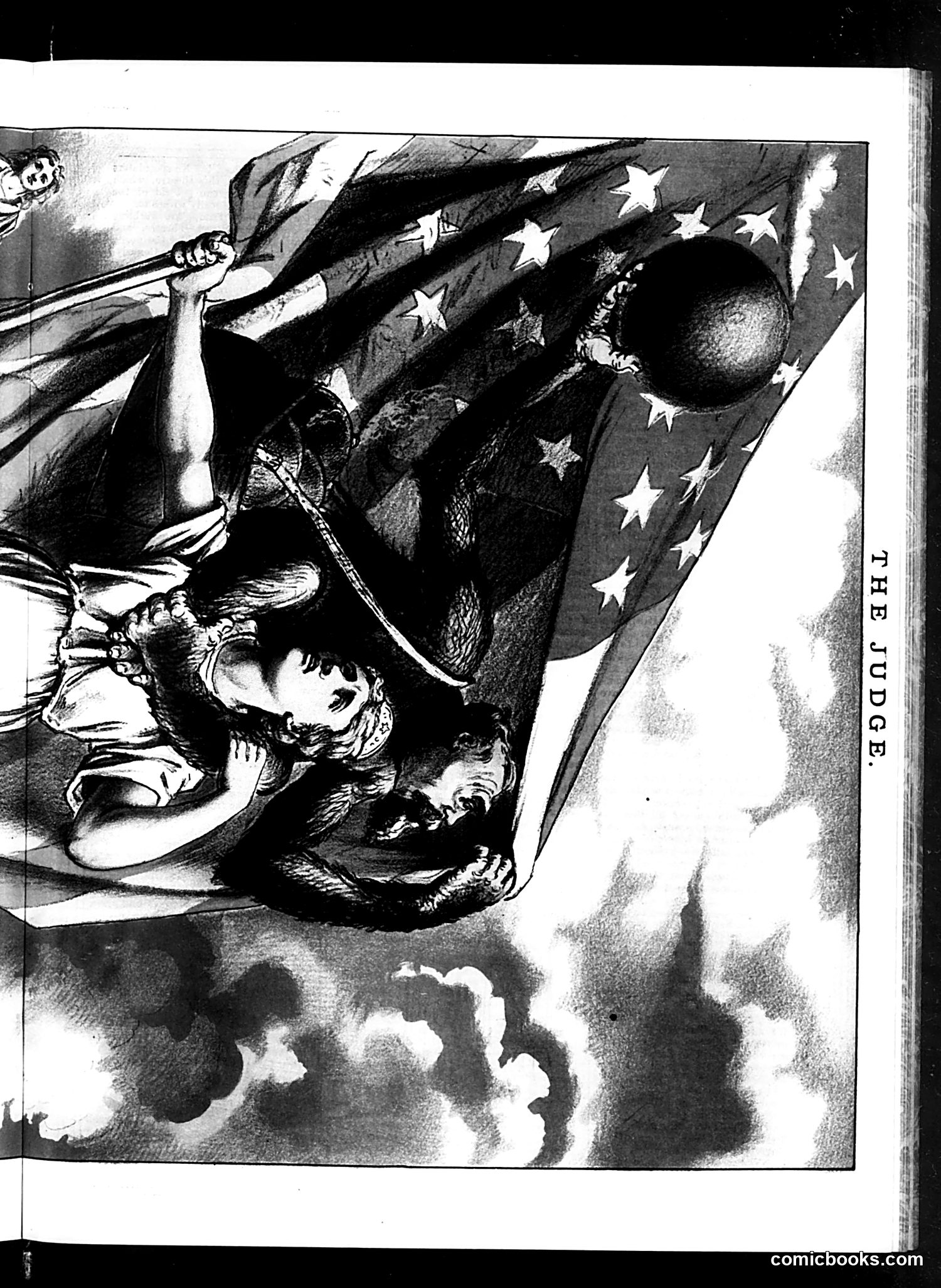
This appears to be a political cartoon titled "The Judge," though the OCR text is too corrupted to read the accompanying article clearly. The image shows a demonic or monstrous figure wielding a large club or staff, attacking what appears to be Lady Liberty or Columbia (the female allegorical figure representing America). The American flag with stars is visible in the background. A small cherub or child figure appears in the upper left corner. The cartoon likely represents a threat to American values or democracy—the "judge" figure possibly representing tyranny, judicial overreach, or a threatening political force. The attack on the Liberty figure suggests commentary on the erosion of American freedoms or principles. Without clearer text or dating information, the specific historical reference remains unclear.
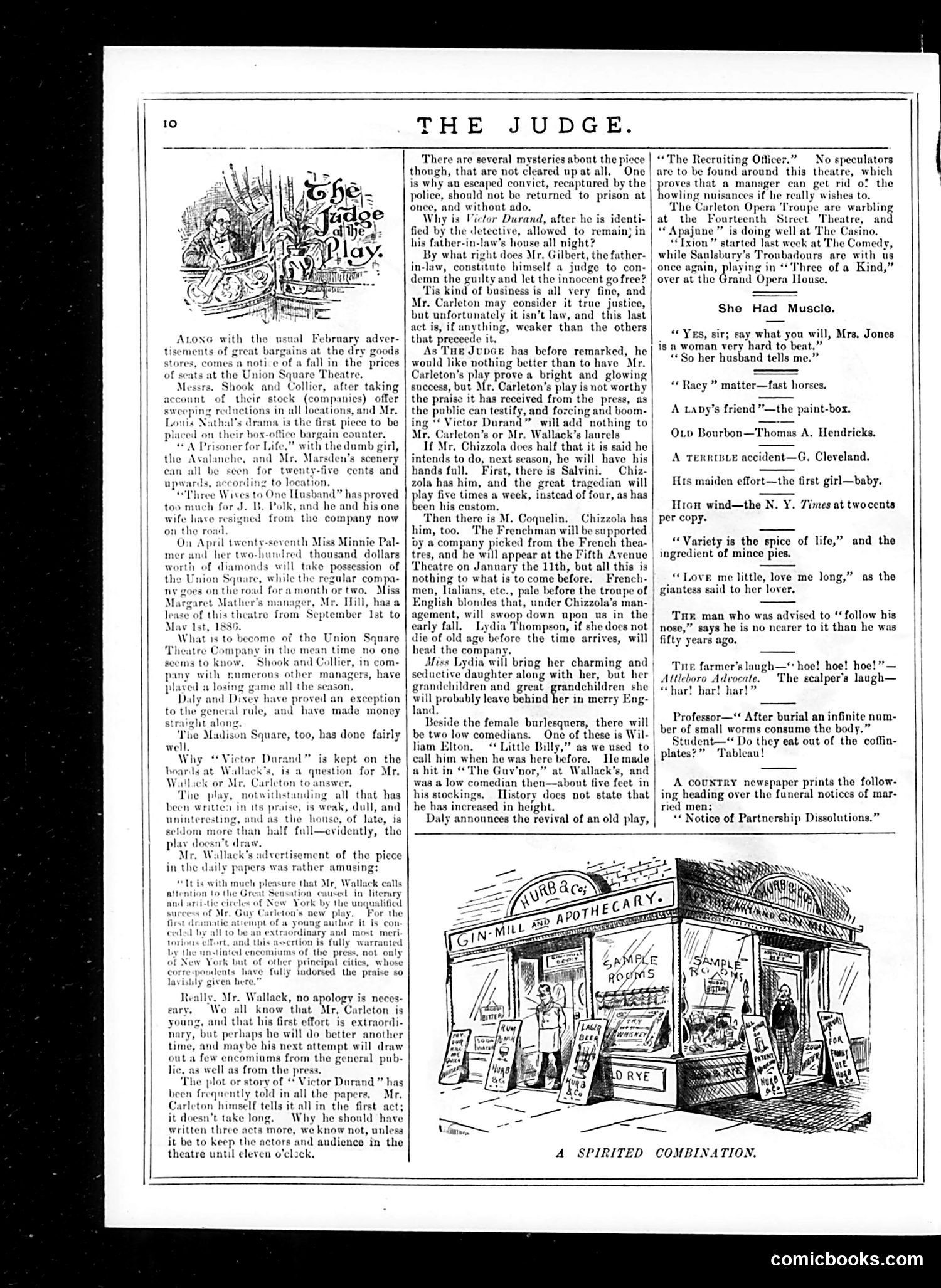
This page from *Judge* magazine critiques the Broadway theater season, particularly savaging Guy Carleton's play *"Victor Durand"* at Wallack's Theatre. **The Main Satire:** The reviewer mocks *Victor Durand* as dramatically weak and illogical despite press praise. The plot—about an escaped convict identified by a detective but allowed to remain in his father-in-law's house overnight while the father-in-law acts as judge—strains credulity. The critic argues Carleton padded three unnecessary acts and that the play doesn't actually draw audiences, despite Wallack's self-congratulatory advertisements claiming it caused sensation in "literary and artistic circles." **The Cartoon** (bottom): "A Spirited Combination" depicts an apothecary storefront, likely satirizing how theatrical companies mix ingredients—financial schemes, actor rosters, and promotional hype—to create productions. The piece reflects *Judge's* role as irreverent theater critic, puncturing pretension around mediocre plays receiving inflated praise from the press and theater management.
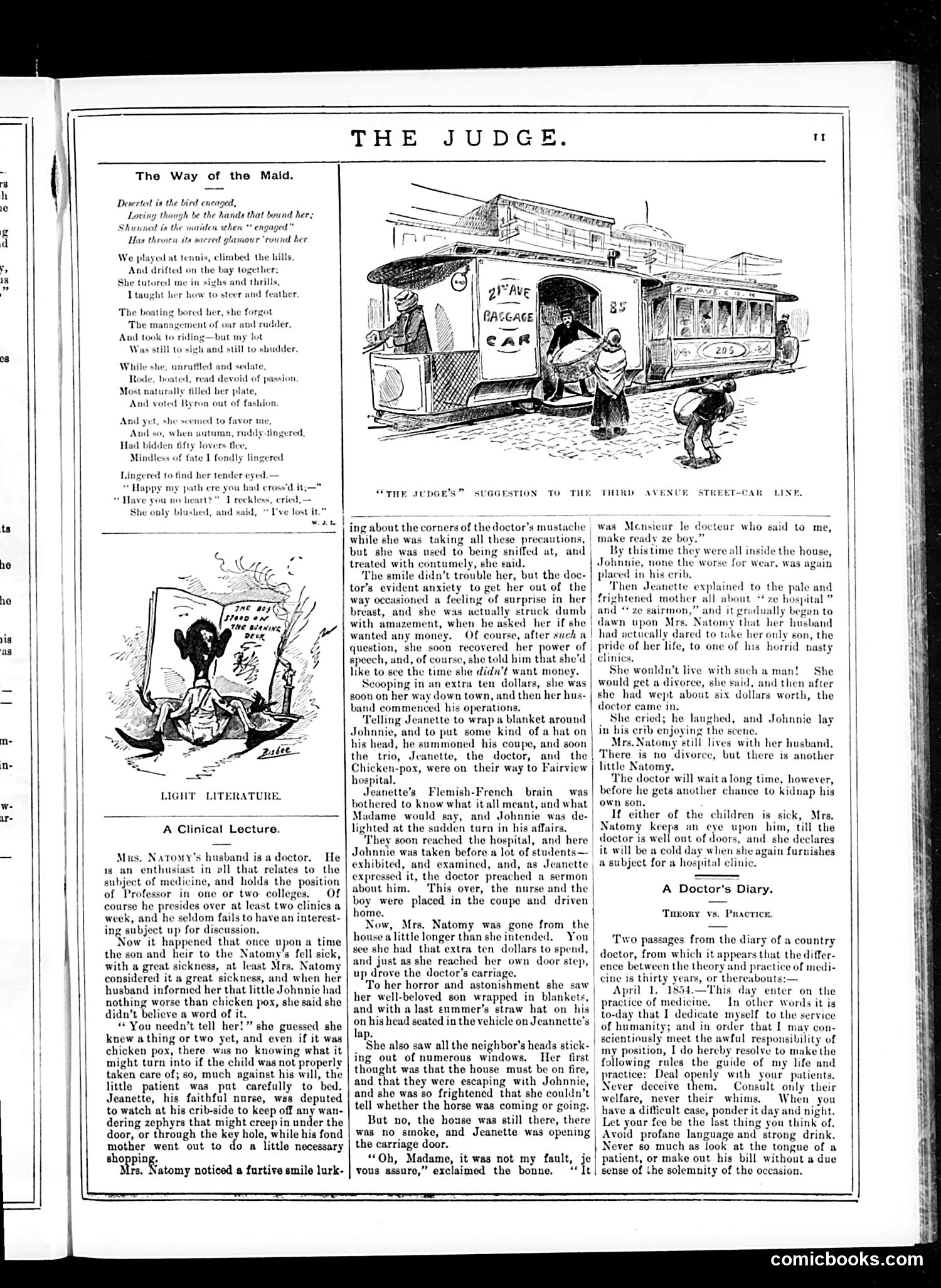
This page contains **three separate pieces of light satirical content**, typical of Judge magazine's humor format: **"The Way of the Maid"** (poem with illustration): A romantic complaint about courtship. A suitor describes pursuing a young woman through various activities (tennis, boating, riding), but she remains emotionally detached. When autumn comes and other suitors leave, he confesses his love—only to be rejected with "I've lost it," suggesting she's callous or emotionally unavailable. The satire mocks the uncertainty of romantic pursuit and female indifference. **"Light Literature / A Clinical Lecture"** (humorous anecdote): Doctor Natomy's wife becomes hysterical when their son gets chickenpox, despite her husband's medical expertise assuring her it's minor. The humor lies in her panic overriding his professional knowledge—she insists on elaborate precautions. The doctor eventually exhibits the boy to medical students at a hospital to prove the diagnosis, essentially using his own child as a teaching specimen while his wife shops. The satire targets medical pomposity and maternal anxiety. Neither piece contains overt political commentary—they're domestic humor reflecting late-19th-century social attitudes about gender, medicine, and class.
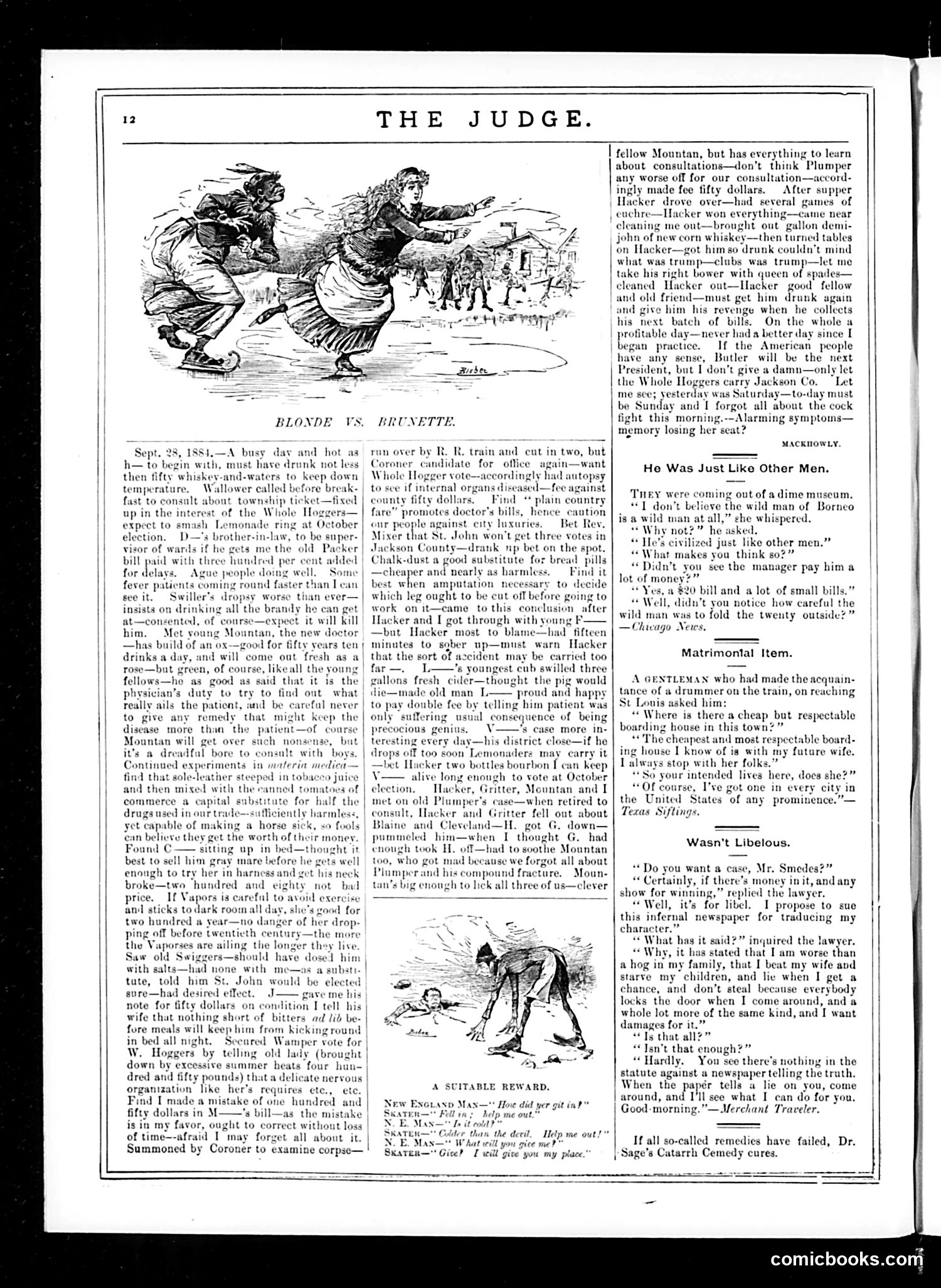
This September 28, 1884 Judge page satirizes corrupt rural American politics and medical practice during the Gilded Age. The cartoon depicts two women (representing competing political factions) in an exaggerated dance or confrontation. The accompanying text—presented as a doctor's diary—exposes the cynical machinations of a rural physician-politician. He describes brazenly trading medical services for votes ("Secured Wamper vote"), using worthless treatments (sole-leather in tomato juice), and manipulating patients through fear and misinformation. References to the "Whole Hoggers" (likely a local political faction) and electoral manipulation underscore endemic corruption. The satire targets both medical quackery and the blending of medicine with political patronage in late 19th-century America. The "Blonde vs. Brunette" title appears to reference competing political candidates or factions vying for local control, with medicine serving as their tool.
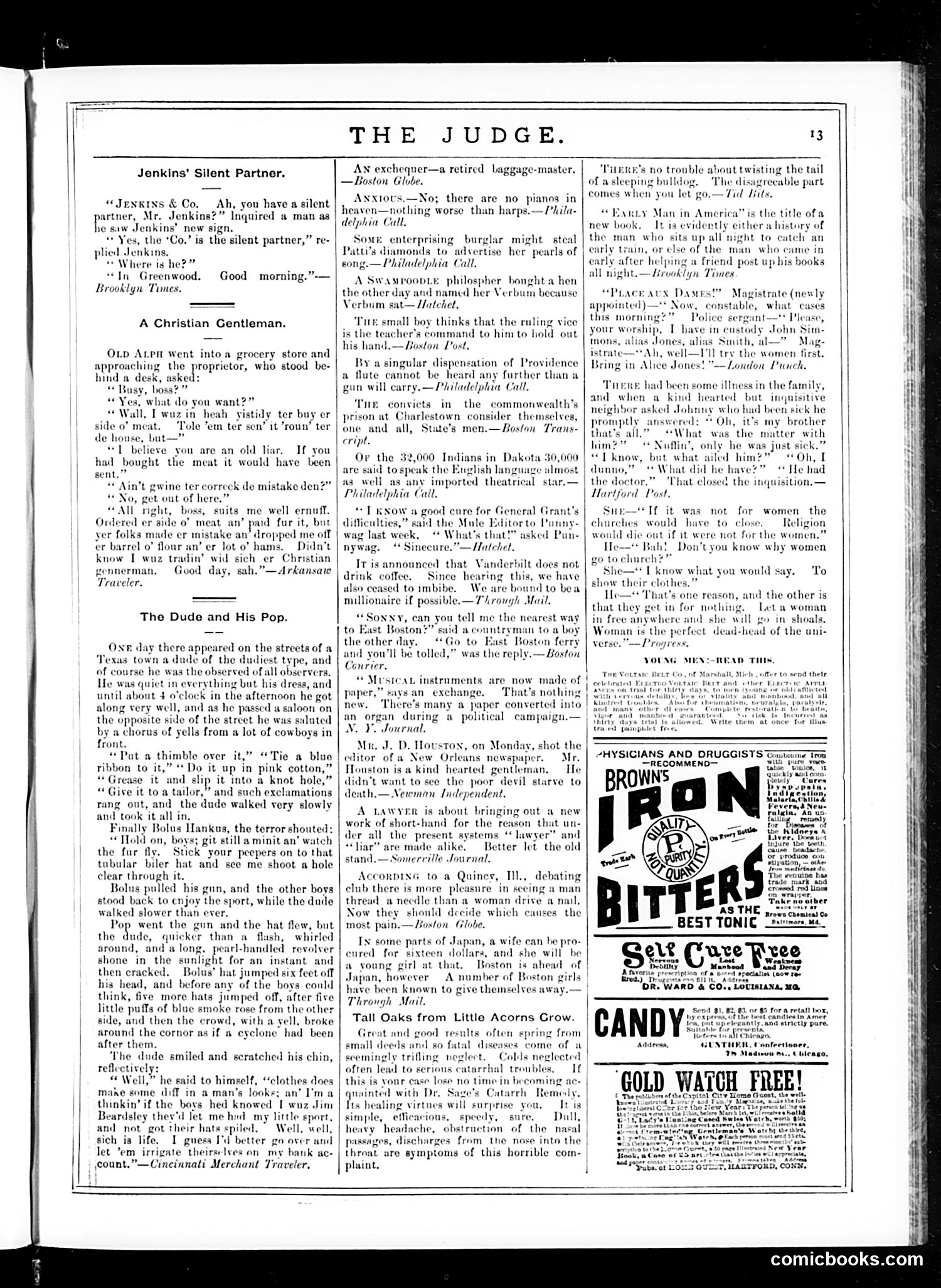
This page contains **four brief humorous anecdotes** typical of Judge magazine's satirical style, plus advertisements. The pieces mock social pretense and regional dialects: 1. **"Jenkins' Silent Partner"**: A pun on business partnerships—the "Co." partner is literally deceased and buried in Greenwood Cemetery. 2. **"A Christian Gentleman"**: An African American character (written in dialect) ironically praises a grocer's "Christian" behavior while describing being cheated on a meat order. The satire targets the grocer's hypocrisy and dishonesty. 3. **"The Dude and His Pop"**: A Eastern city dandy shoots back at cowboys who mock his fancy clothing. His reveal as "Jim Beardsley"—apparently someone dangerous—suggests frontier toughness trumps fashion. 4. Miscellaneous brief jokes about pianos in heaven, theatrical Indians, and other contemporary observations. The advertisements include patent medicines (Brown's Iron Bitters, Dr. Ward's remedies) typical of the era's dubious health claims.
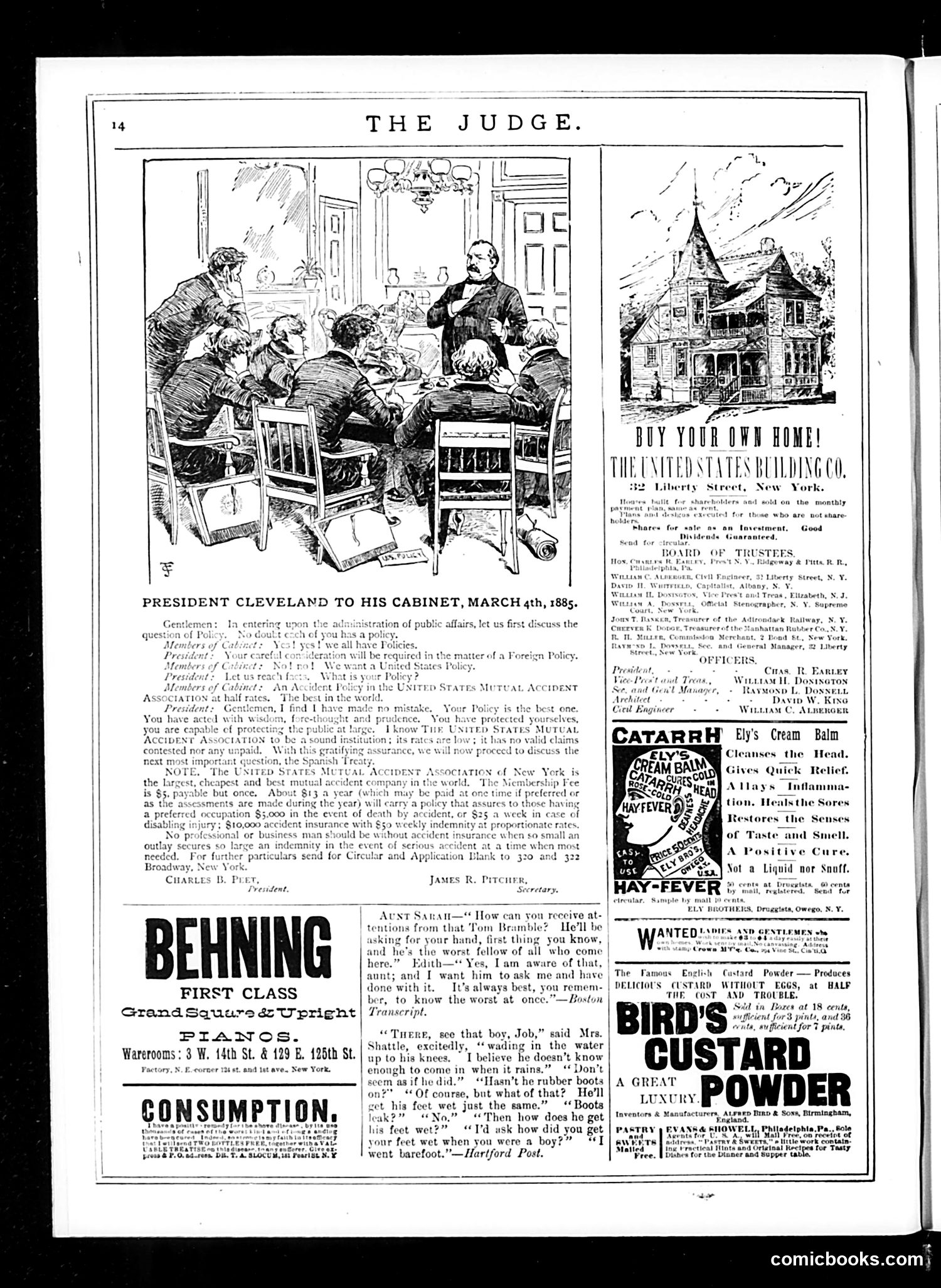
The main cartoon depicts **President Cleveland meeting with his cabinet on March 4, 1885**—his inauguration day. The satire shows Cleveland attempting to establish policy priorities, while cabinet members present competing concerns (foreign policy, the United States Mutual Accident Association, Spanish policy, etc.). The joke appears to be about **cabinet chaos and competing agendas** on the president's first day in office. Each official seems focused on different issues, suggesting the difficulty of establishing coherent governance amid conflicting departmental priorities. The page is primarily **filled with advertisements** (pianos, home-buying services, patent medicines like catarrh balm and bird's custard powder) typical of 1880s magazines, interspersed with humor snippets about children getting their feet wet. The cartoon's political point likely critiques **the inherent disorder of new administrations** and the challenge of presidential leadership—a timeless satire applicable to any new administration's opening days.
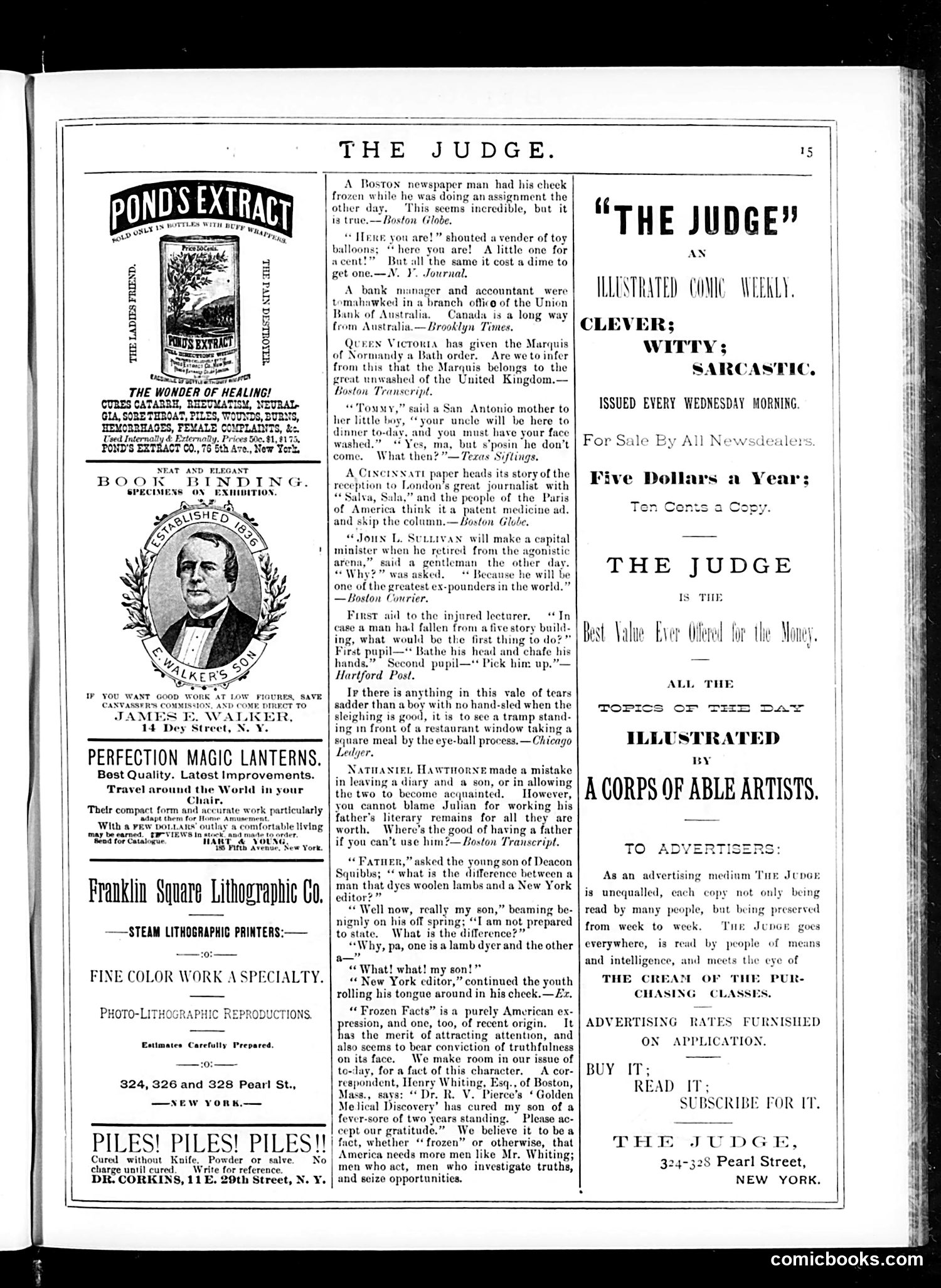
This page is primarily **advertising and editorial filler** rather than political satire. The main content consists of humorous anecdotes and brief jokes about American life, interspersed with advertisements for patent medicines (Pond's Extract, Dr. Pierce's Golden Medical Discovery) and printing services. The humor targets everyday absurdities: a Boston journalist whose paycheck literally froze, a San Antonio mother worried about unexpected relatives, and a New York editor compared unfavorably to a "lamb dyer." One joke mocks Nathaniel Hawthorne's son Julian for commercially exploiting his father's literary legacy. The page's title references "Frozen Facts"—a play on the opening anecdote about the frozen check—suggesting the magazine collects peculiar but supposedly true incidents from American newspapers. **No identifiable political figures or sustained satire** appear here. Instead, this represents Judge's typical format: light social commentary on middle-class life, medical advertising (reflecting 19th-century skepticism toward patent remedies), and gentle mockery of contemporary characters and situations.
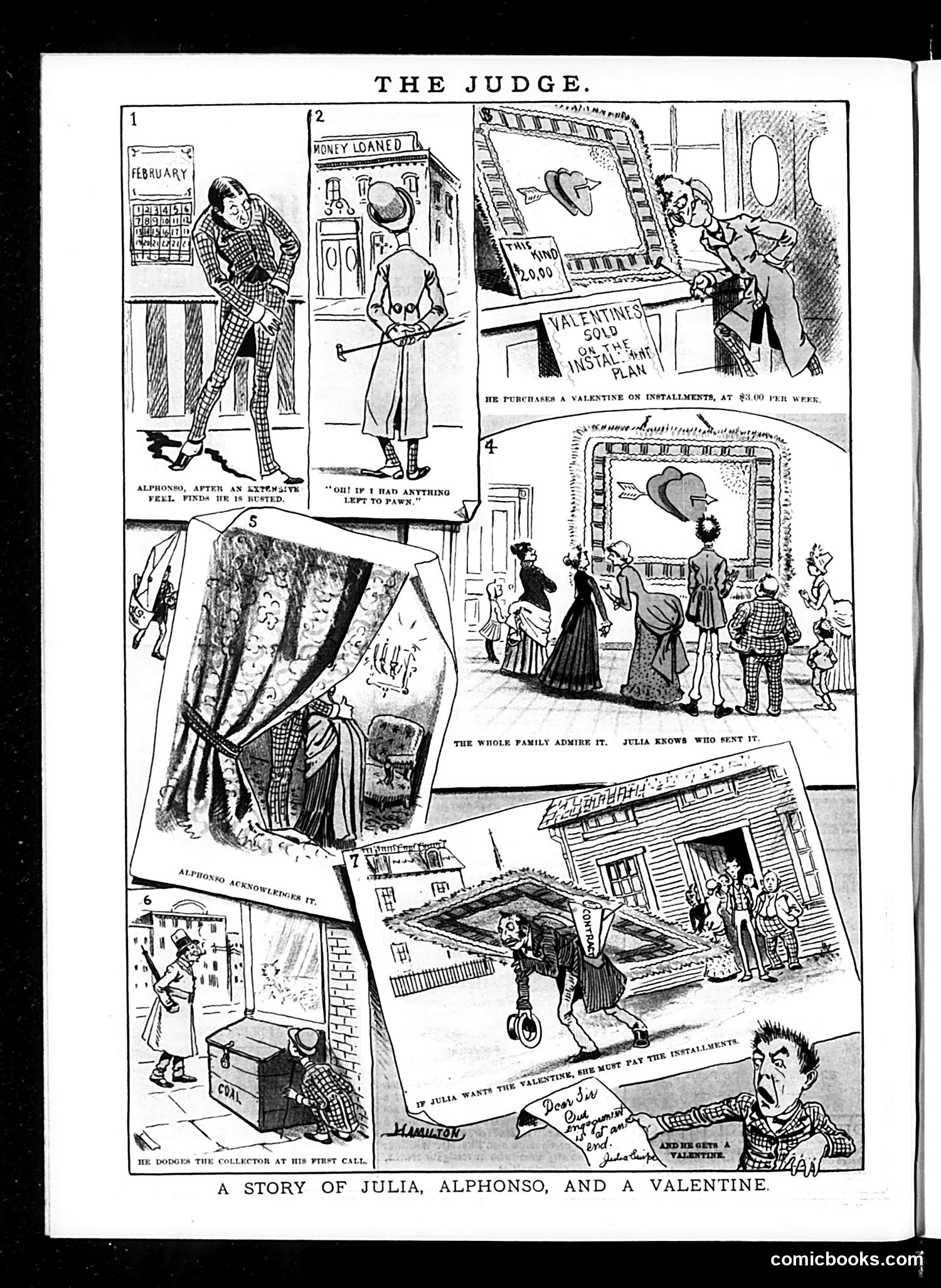
This is a satirical comic story titled "A Story of Julia, Alphonso, and a Valentine." The narrative follows Alphonso, a man who: 1. In February, discovers he's broke after an "extensive feel" 2. Attempts to avoid a debt collector 3. Purchases a Valentine on an installment plan ($3.00/week) 4. The Valentine becomes a family attraction 5. Must pay installments or face consequences The satire mocks working-class financial desperation and the installment-purchase system that allowed poor people to buy goods through weekly payments—a common practice that trapped consumers in debt cycles. Alphonso's choice to buy a luxury gift (the Valentine) despite being unable to pay debts reflects on both his poor financial judgment and the predatory nature of installment schemes that made frivolous purchases accessible to those who couldn't afford them. The humor derives from his absurd priorities and inevitable downfall.