
A complete issue · 16 pages · 1885
Judge — January 17, 1885
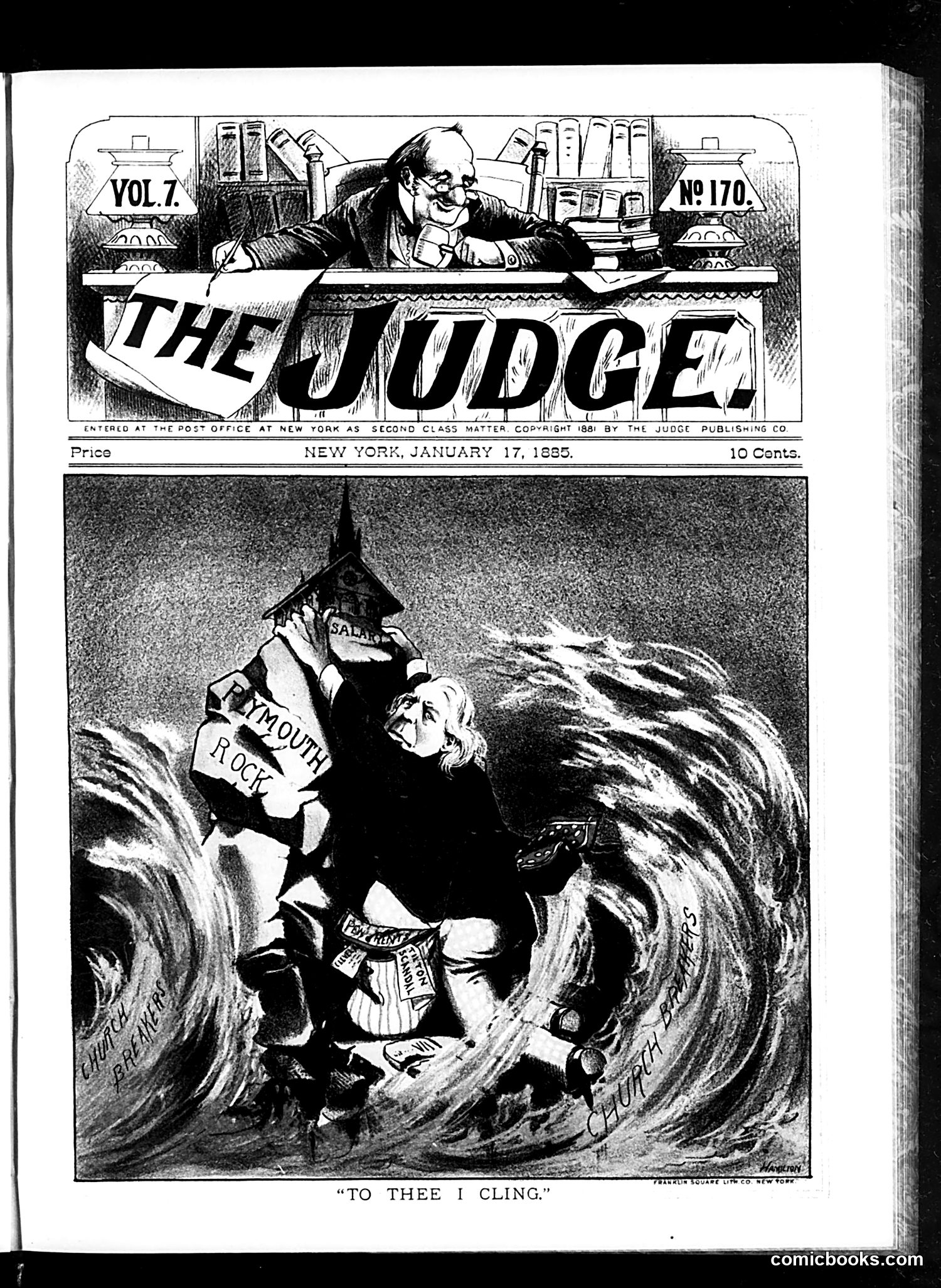
This political cartoon titled "To Thee I Cling" depicts an elderly man clinging to a rock amid turbulent waves labeled "Scylla" and "Charybdis"—references to the mythological dangers from Homer's *Odyssey*. The figure appears to represent a politician or public figure navigating dangerous political waters between two opposing forces. The man holds what appears to be a salary document, suggesting economic concerns amid political turmoil. The cartoon likely comments on a contemporary political crisis or scandal from 1885, where someone was caught between competing pressures or factions. Without identifying the specific historical event, the satire uses classical mythology to suggest an impossible situation where safety is elusive regardless of which danger one avoids.
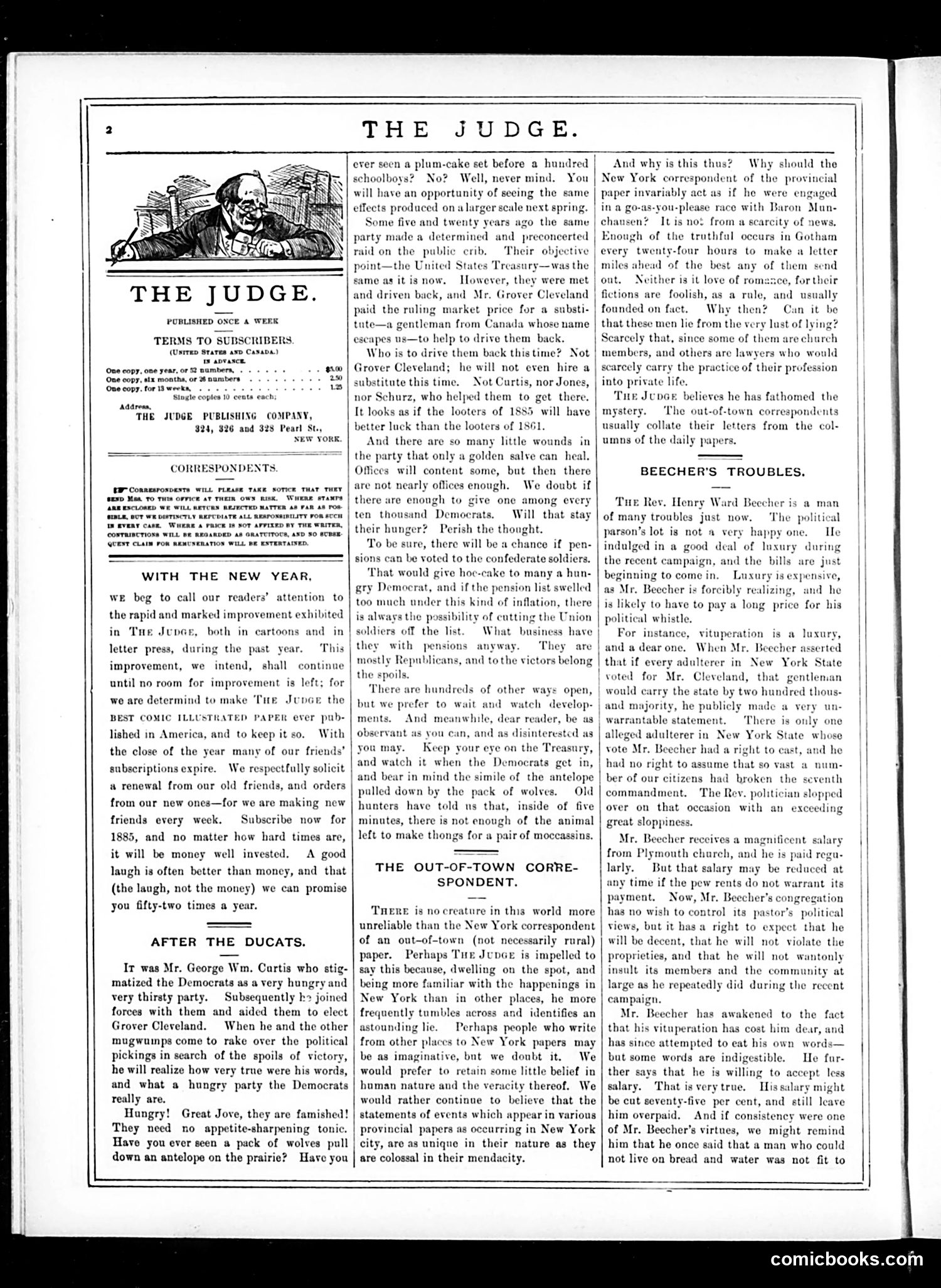
The main cartoon (top left) shows a caricatured figure—likely a Democratic politician or partisan—eagerly eyeing spoils of office after the 1884 election of Grover Cleveland. **Key satire targets:** The editorial "After the Ducats" attacks Democrats' hunger for government jobs and patronage following Cleveland's victory. It references George William Curtis (a Republican mugwump who switched to support Cleveland) and compares hungry Democrats to "a pack of wolves" raiding the Treasury—evoking their 1861 predecessor raid. The piece mocks Democratic desperation: with limited office positions available, they might resort to padding Confederate pension rolls just to feed their supporters. It warns readers to watch Treasury spending closely. **Historical context:** This reflects the spoils system era, where winning parties distributed federal jobs as political rewards. The "out-of-town correspondent" section suggests Judge relied on provincial gossip-reporting typical of 1880s periodicals. The overall message: Democrats are power-hungry parasites waiting to plunder government resources.
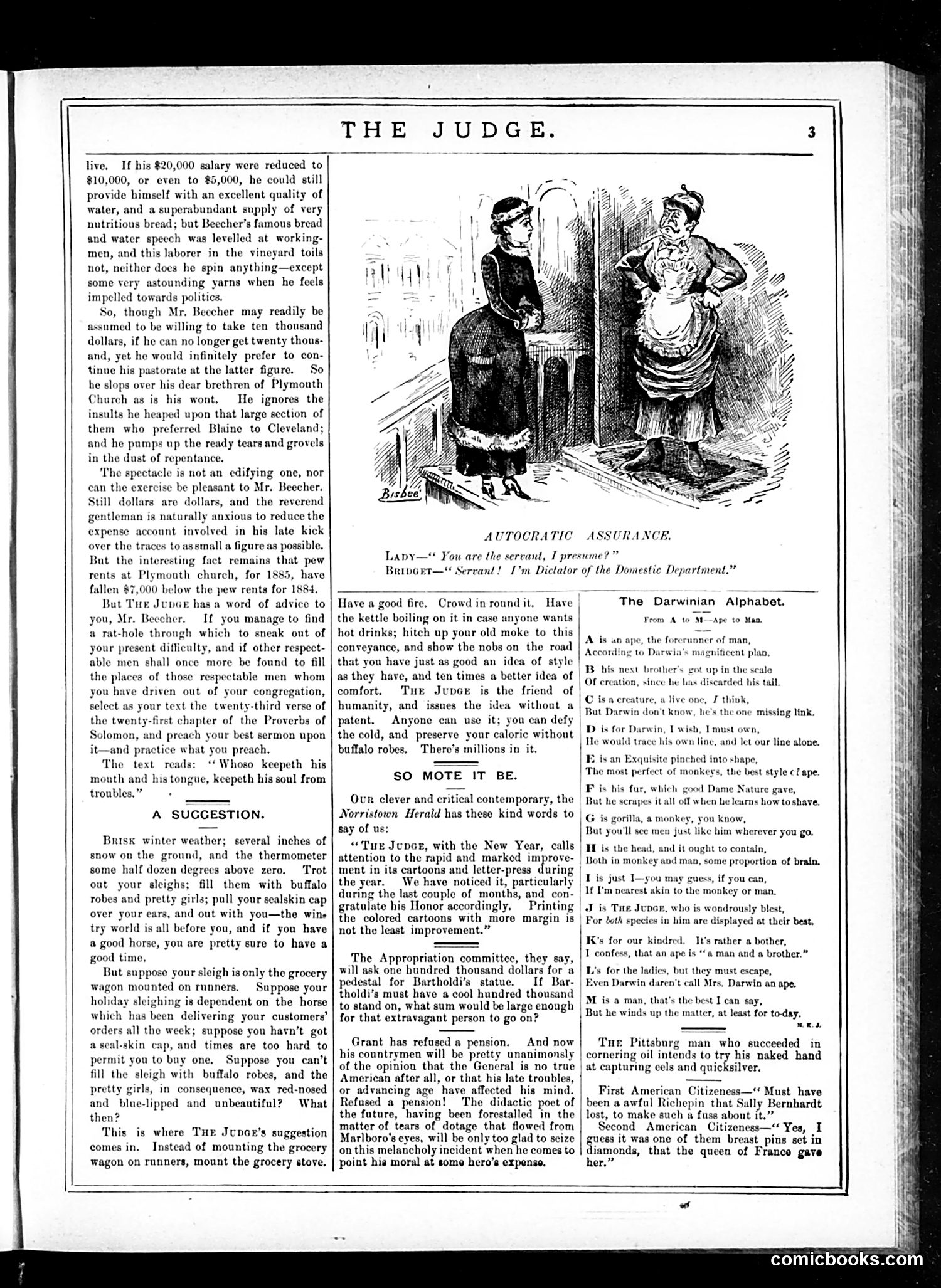
The main cartoon depicts Henry Ward Beecher, a prominent Brooklyn preacher, being confronted by a domestic servant. The woman sarcastically calls him "servant," to which Beecher pompously responds that he is "Dictator of the Domestic Department." **The satire:** Judge mocks Beecher's hypocrisy. The accompanying article reveals that Beecher—famous for sermons urging working-men to live on "bread and water"—himself refuses salary cuts and abandoned his Plymouth Church congregation after they supported James Blaine over Grover Cleveland. Church pew rents dropped $7,000 that year due to departures. **The point:** Beecher preaches austerity to laborers while demanding his full $20,000 salary and maintaining comfort. The "Dictator" caption sarcastically highlights his authoritarian moral posturing despite his self-serving actions. Judge advises him to practice what he preaches—specifically quoting Proverbs about controlling one's tongue.
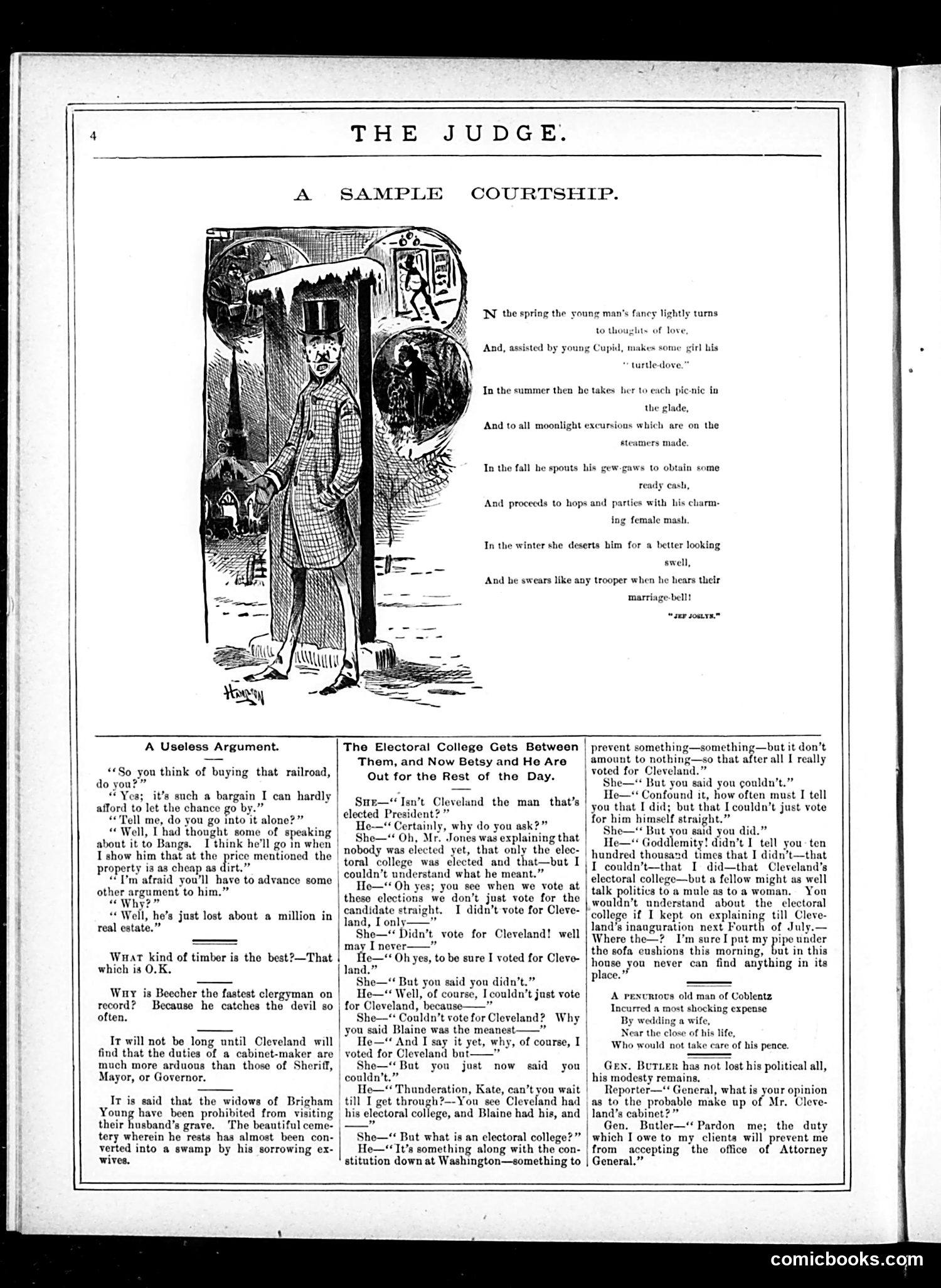
This page from *Judge* contains two distinct satirical pieces: **"A Sample Courtship"** (top): A humorous poem illustrated by a young man's romantic trajectory through the seasons—spring courtship, summer picnics, fall when he sells his possessions for cash, and winter when the woman leaves him for a wealthier suitor. The satire mocks the transactional nature of courtship and male romanticism. **"The Electoral College Gets Between Them"** (bottom): A dialogue satirizing both the Electoral College system and marital discord. A couple argues about whether the husband voted for Cleveland (the elected president, likely Grover Cleveland). The husband's confused explanation of the Electoral College—admitting he doesn't understand it himself—becomes absurdly circular. The satire targets voter confusion about the indirect election system and husbands' inability to explain themselves to wives, treating both as equally bewildering domestic/political mysteries.
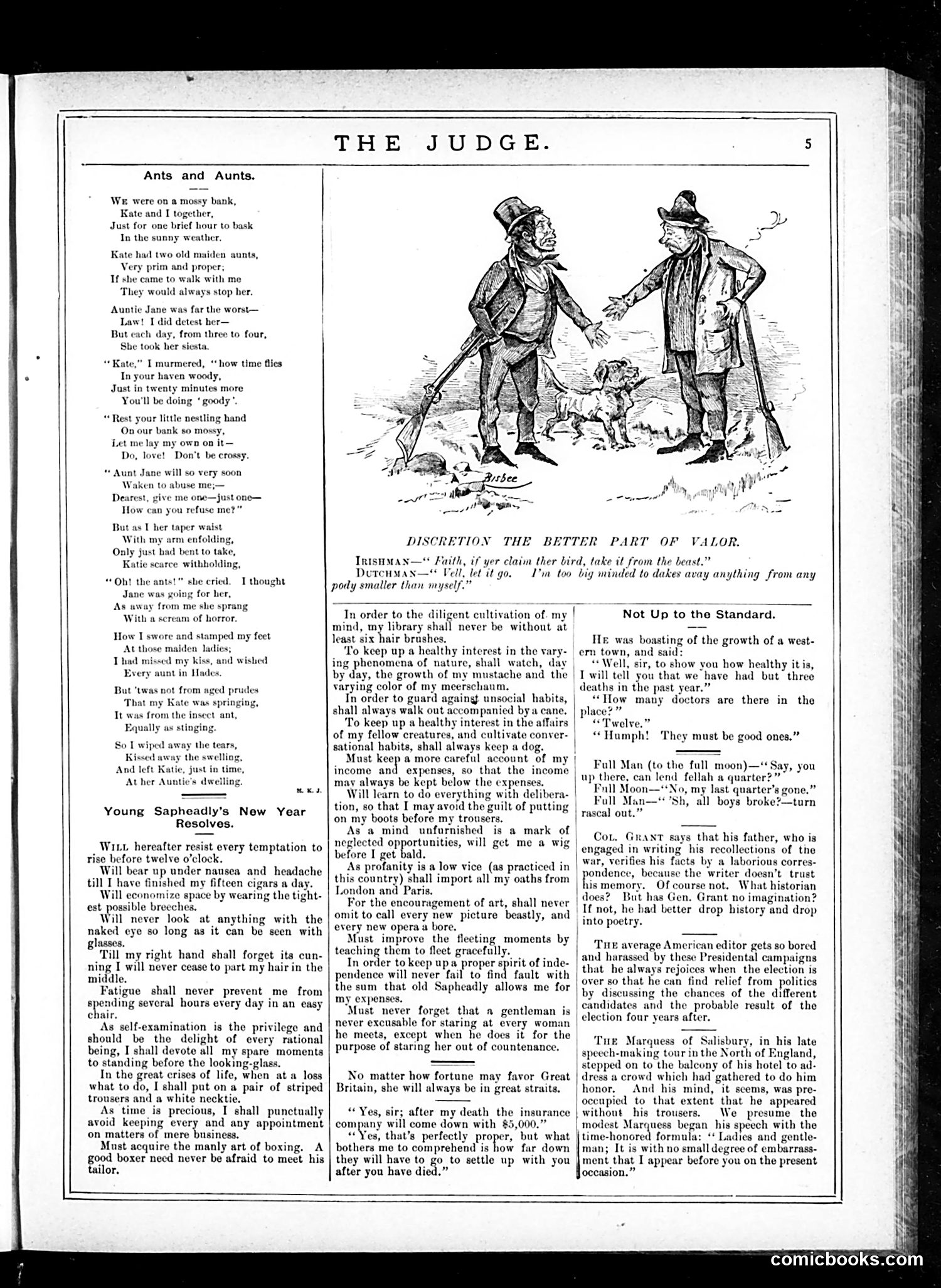
This page contains three satirical pieces typical of late 19th-century American humor: **"Ants and Aunts"** is a light romantic poem playing on the homophone of "aunts/ants"—a young man's romantic moment with Kate is interrupted when actual insects attack, not the disapproving elderly aunts he feared. **"Young Sappheady's New Year Resolves"** mocks a foolish dandy's deliberately absurd self-improvement pledges: wearing absurdly tight clothes, avoiding business appointments, importing profanity from Europe, criticizing all new art. It satirizes vain, lazy, pretentious gentlemen who prioritize appearance over substance. **"Discretion the Better Part of Valor"** (the cartoon) depicts an Irishman and Dutchman in a minor dispute over a bird, with the Dutchman backing down, saying he won't fight anyone bigger than himself—mocking cowardice disguised as prudence. These pieces reflect Judge's typical targets: romantic entanglements, male vanity, and immigrant stereotypes.
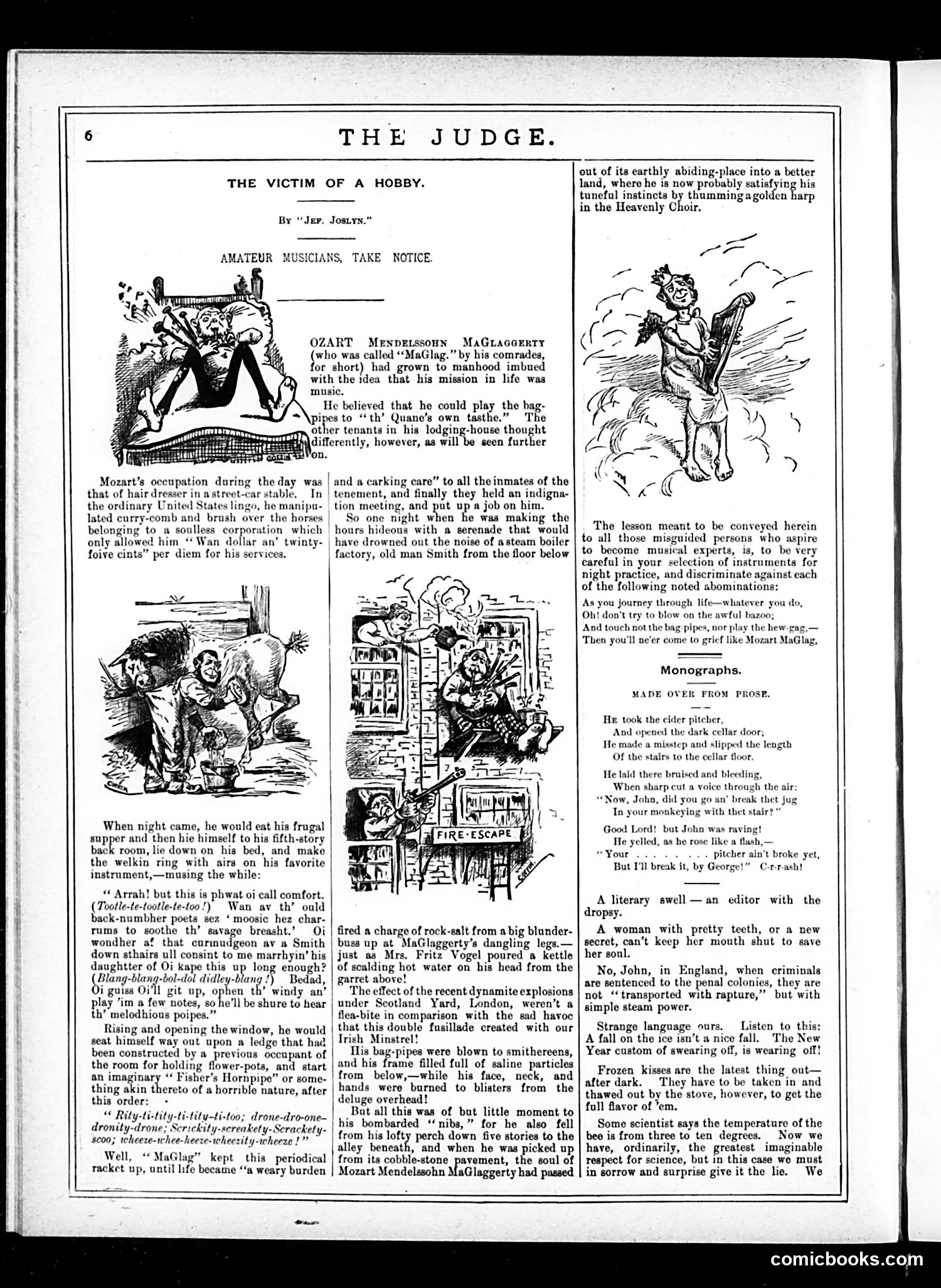
This satirical story ridicules amateur musicians who practice loudly at night, disturbing neighbors. "MaGlag" (a Irish-accented caricature) works as a horse groomer but pursues his passion: bagpipes. He practices nightly from his fifth-story tenement room, driving neighbors to fury with ear-splitting serenades. The satire climaxes when neighbors coordinate revenge: a man fires rock-salt from below while a woman dumps boiling water from above. MaGlag falls five stories to his death—bagpipes destroyed, body scalded and peppered with salt. The moral: aspiring musicians should avoid bagpipes, bazoos, and similar "noted abominations" for nighttime practice. The piece mocks both the obsessive amateur musician and tenement life's close quarters. The Irish dialect and characterization reflect period ethnic stereotyping common to Judge's humor. The exaggerated, darkly comic punishment satirizes urban neighbor conflicts and working-class living conditions.
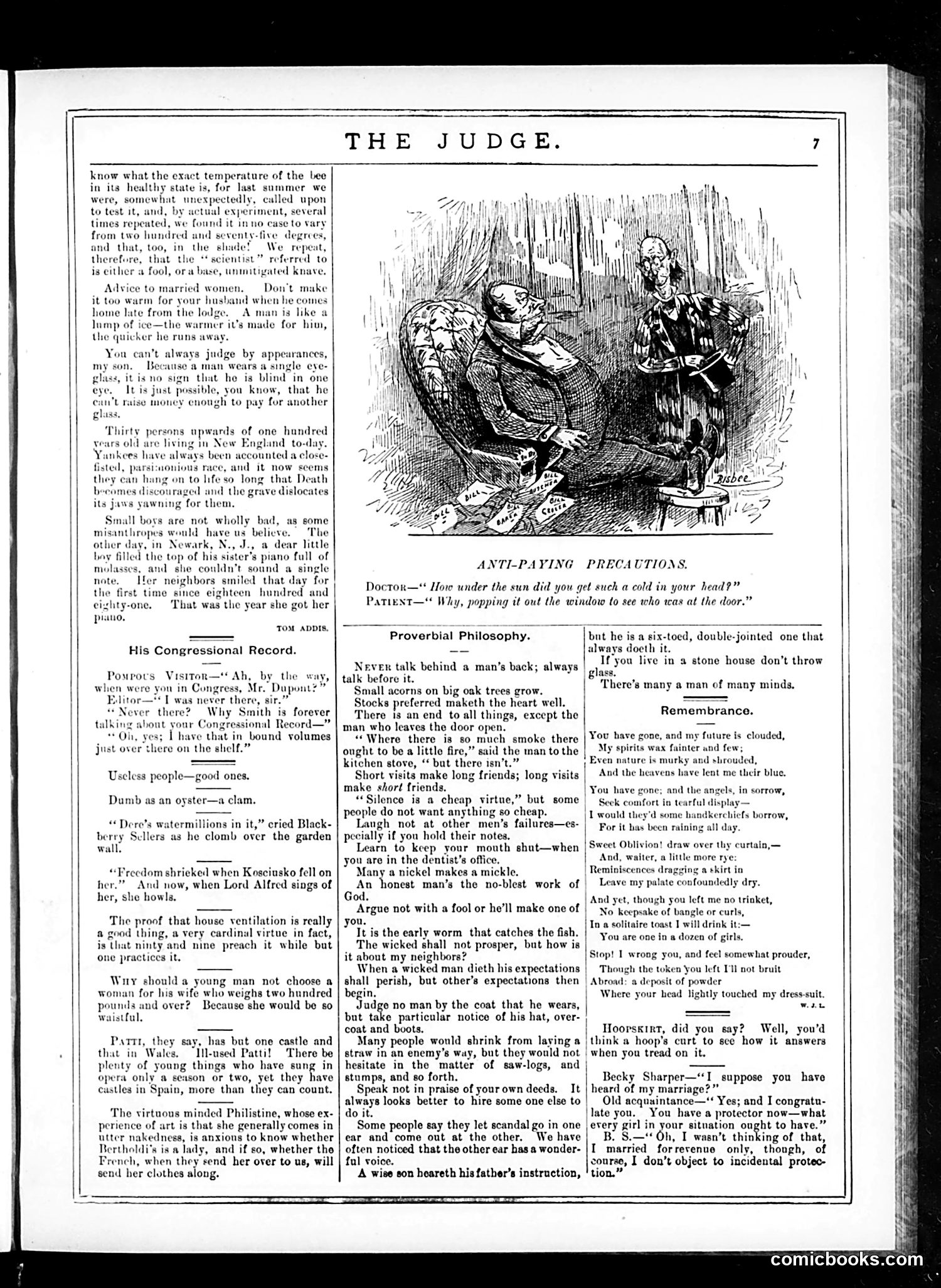
The cartoon depicts a doctor examining a patient with a severe head cold. The humor lies in the patient's absurd explanation: he stuck his head out the window to see who was at the door—and caught a cold as a result. The joke plays on Victorian-era domestic practices and the era's somewhat primitive understanding of disease transmission. It satirizes both the patient's foolish behavior (risking illness for minor curiosity) and implicitly mocks the common folk remedies and questionable logic people employed regarding health. The title "Anti-Paying Precautions" suggests irony—the patient's reckless action was hardly a precaution against anything. This appears typical of *Judge* magazine's humor: observational comedy about everyday human folly and the gaps between people's stated intentions and their actual behavior. The sketch style and composition are characteristic of 1880s-90s American satirical illustration.
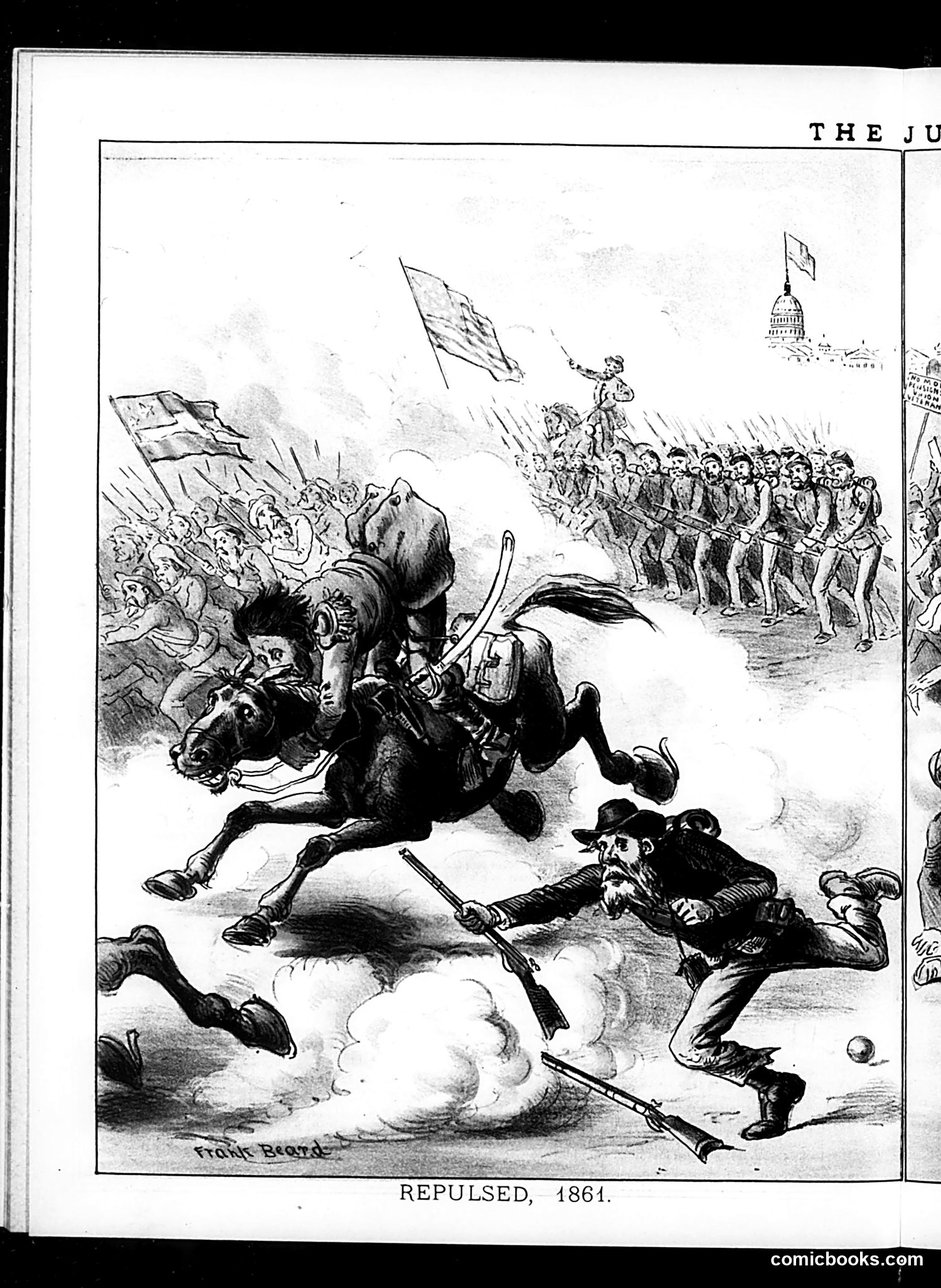
This political cartoon depicts a mounted military officer being thrown from his horse during what appears to be a cavalry charge. Soldiers with rifles and flags are visible in the background. The artist is signed "Frank Beard." The 1861 date and "Repulsed" caption suggest this satirizes an early Civil War military engagement—likely a Union defeat. The cartoon appears to mock a specific failed Union cavalry or officer action from that year, when Northern forces experienced several setbacks. The exaggerated, comedic style of the figure being unseated suggests ridicule of either the officer's incompetence or the broader Union military failure. Without more context, the specific officer or battle cannot be identified with certainty, but the cartoon clearly uses humor to criticize an early Civil War Union defeat.
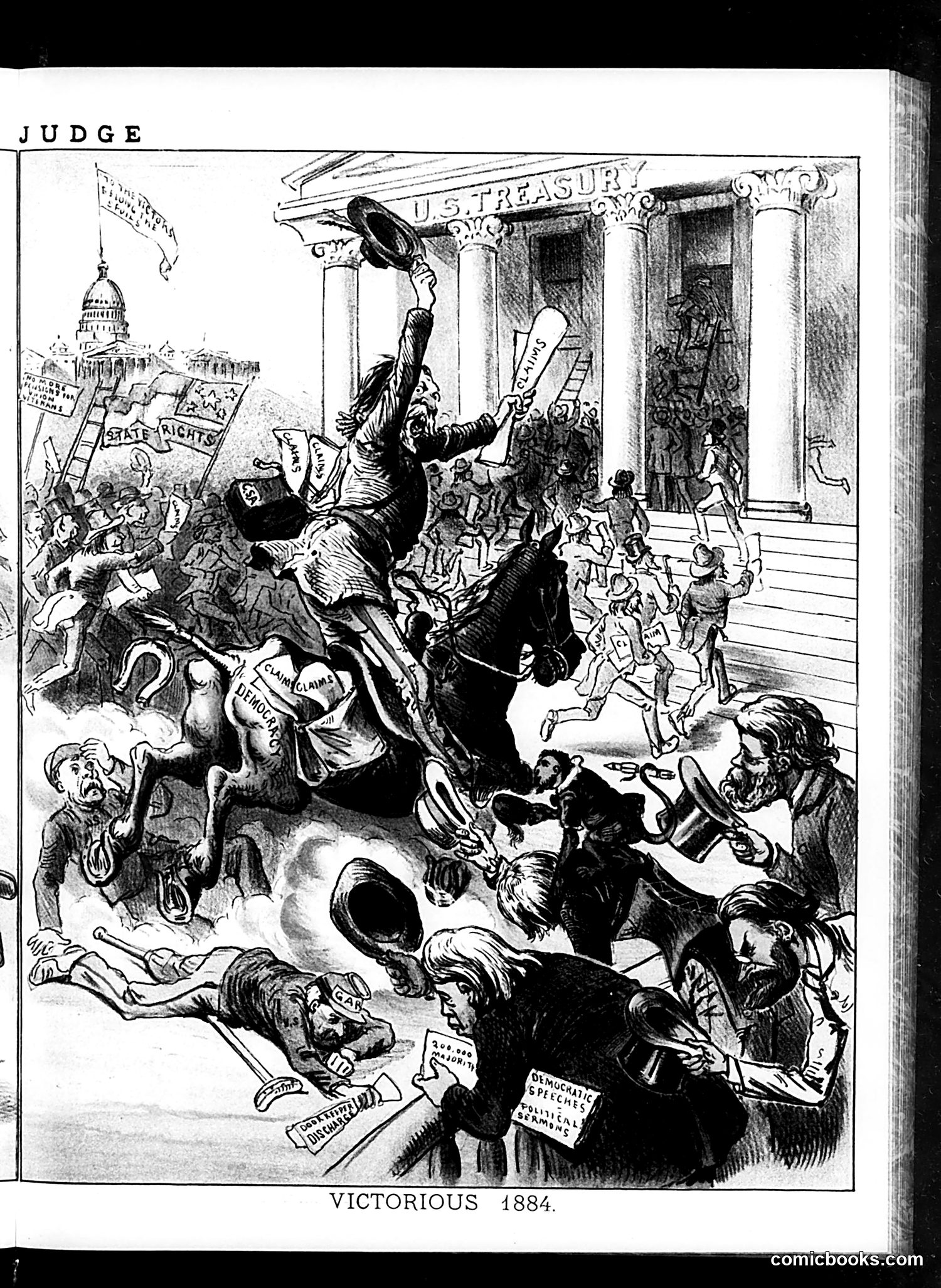
This satirical cartoon depicts the 1884 U.S. presidential election aftermath. A triumphant figure on horseback (likely representing the Democratic victor) waves a hat victoriously before the U.S. Treasury building, while crowds celebrate below. Various figures appear defeated or dismayed on the ground, including what appear to be Republican opponents. The cartoon celebrates Democratic success in 1884—when Grover Cleveland became the first Democratic president elected after the Civil War. The Capitol and Treasury imagery emphasize control of federal government and finances. Labels visible on some figures likely reference specific political opponents or factions, though the OCR text is too degraded to read clearly. The overall message: Democratic triumph over Republican dominance.
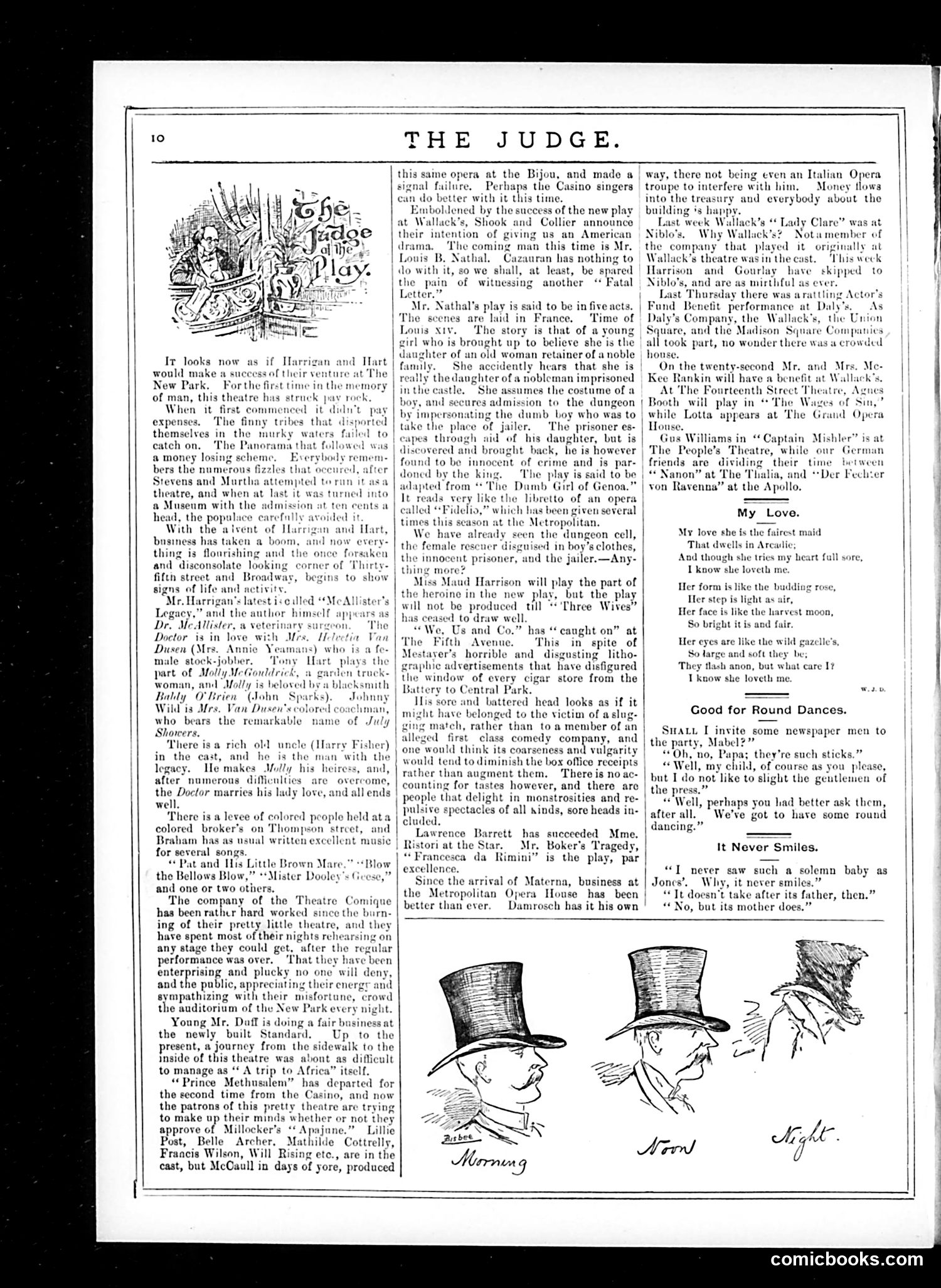
This page from Judge magazine contains theater reviews and entertainment commentary typical of the publication's satirical approach to New York's cultural scene. **Main Content:** The page discusses several theatrical productions, including operatic works at various venues (the Bijou, Casino, Metropolitan Opera House). The reviews focus on plots, cast members, and performances—notably mentioning Maud Harrison in an upcoming production and praising soprano Materna's effect on the Metropolitan Opera House's business. **The Cartoons:** Three sketched male faces labeled "Morning," "Noon," and "Night" appear at the bottom, likely satirizing changing moods or appearances throughout a day—a common Judge trope for gentle, observational humor. **Poems:** Two short poems titled "My Love" and "Good for Round Dances" offer sentimental and humorous verse, while "It Never Smiles" provides comic dialogue about a baby. **Satire Level:** This page is primarily **entertainment journalism** rather than sharp political satire. It reflects Judge's role covering Manhattan's theater world with mild mockery of theatrical conventions and audience taste—accessible to readers interested in contemporary cultural gossip.
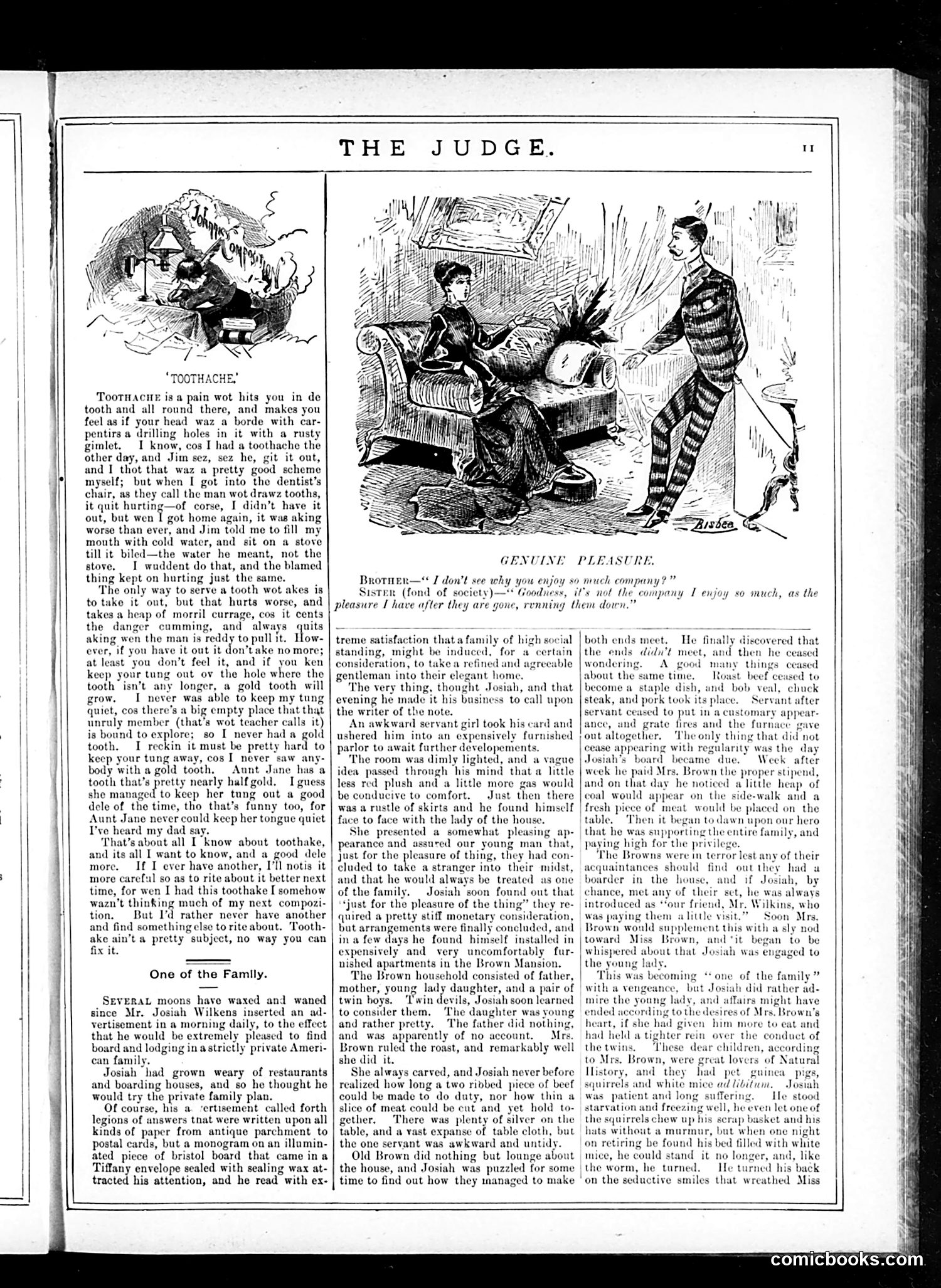
This page contains two distinct pieces: **"Toothache"** (left): A humorous first-person account in deliberately misspelled dialect about dental pain. The narrator describes visiting a dentist, then home remedies like sitting on a stove with cold water in his mouth. The joke relies on colloquial language and exaggerated physical comedy—typical of period humor. **"Genuine Pleasure"** (right cartoon and text): The cartoon shows a woman enthusiastically gesturing while seated, speaking to a male visitor. The caption reveals her joke: she enjoys company not *during* visits but *after* guests leave, when she can "run them down" (gossip critically about them). **"One of the Family"** (bottom): A story about Josiah Wilkens seeking private family lodging. The satire targets pretentious social climbing—Josiah responds to an ornate invitation from a "high social standing" family, but discovers their domestic chaos: inconsistent meals, incompetent servants, and unmet social expectations. The humor mocks both his social aspirations and the family's failure to maintain their refined appearance.
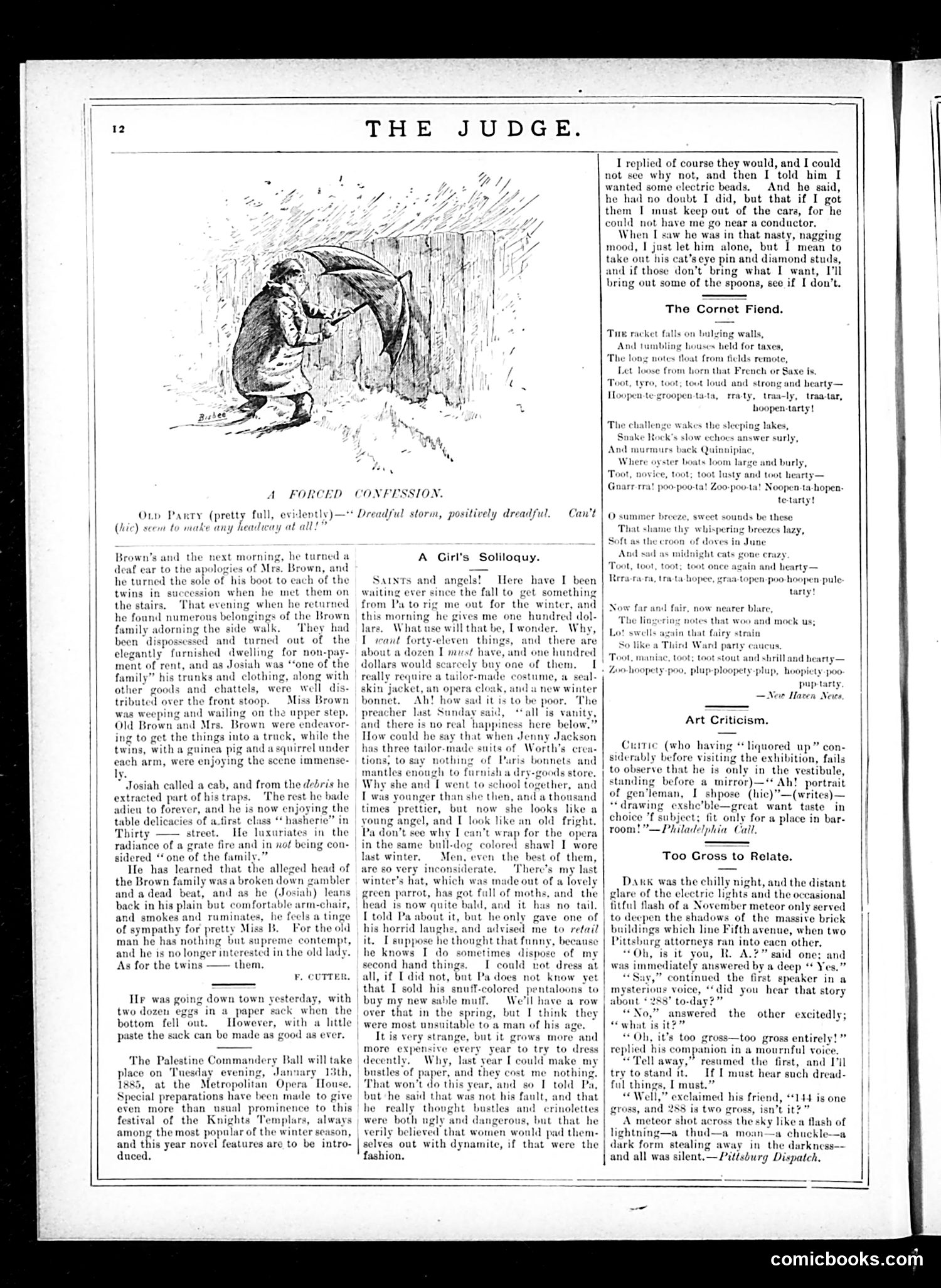
The main cartoon depicts an evicted family being thrown onto the street. The humor targets deadbeat tenants: a man named Josiah, boarding with the Brown family, discovers they haven't paid rent. When the landlord evicts everyone, Josiah extracts his belongings from the pile on the stoop and moves to cheaper lodgings, relieved to escape being considered "one of the family." The satire mocks both irresponsible renters and the financial entanglements of boarding situations. Josiah's relief at leaving—preferring a modest but independent life—satirizes the social pretension and financial chaos of the Browns, who maintained "elegant" furnishings despite inability to pay. The accompanying columns contain lighter social satire about female vanity and materialism ("A Girl's Soliloquy") and art criticism. This page represents Judge's typical mix of biting social commentary on urban working/middle-class life with humorous commentary on contemporary manners and morality.
This page from *Judge* magazine contains several brief satirical pieces typical of the publication's format: **"A Hard Winter"** jokes that a husband knows winter will be harsh because his wife still lacks a fashionable sealskin sacque (fur coat)—a status symbol suggesting economic hardship prevents luxury purchases. **"Edison's Improved Phonograph"** satirizes both Edison's invention and marital discord. The satire suggests husbands could use the phonograph to record sermons and concerts, then play them at home while avoiding tedious cultural events with their wives—a commentary on both technological skepticism and domestic friction. **"Unfulfilled Ambition"** presents a discharged porter who worked hard for advancement but was let go anyway, reflecting anxieties about social mobility and workplace instability during this era. The other pieces ("The Cause of It," "Had the Refusal of it," "At Vassar," "Stage Girls and Their Admirers") are brief anecdotes about contemporary social situations—spelling errors, property negotiations, college romance, and theater culture. Overall, the page reflects *Judge's* focus on domestic humor, technological skepticism, and gentle social observation rather than pointed political commentary.
This page from *Judge* contains brief humorous anecdotes and one-liners rather than illustrated cartoons. The content reflects late 19th-century American satirical concerns: **Key targets include:** - **Class and social pretension**: "The Professor at the Party" mocks an academic's embarrassment at being listed among "others of minor importance" at a society event. - **Will and inheritance humor**: "A Lucky Heir" jokes about a lawyer assuming a man's cheerfulness over his father's death relates to receiving property, rather than genuine mourning. - **Political corruption**: A reference to "demyerats" (Democrats) seeking patronage positions through civil service reform satirizes political favoritism, likely alluding to Post-Reconstruction era spoils system abuse. - **Gender stereotypes**: Multiple pieces mock women's supposed frivolity and physical weakness, typical of period attitudes. - **Working-class life**: Commentary on the hardships of domestic labor for women. The humor relies on wordplay, irony, and social observation rather than elaborate visual satire.
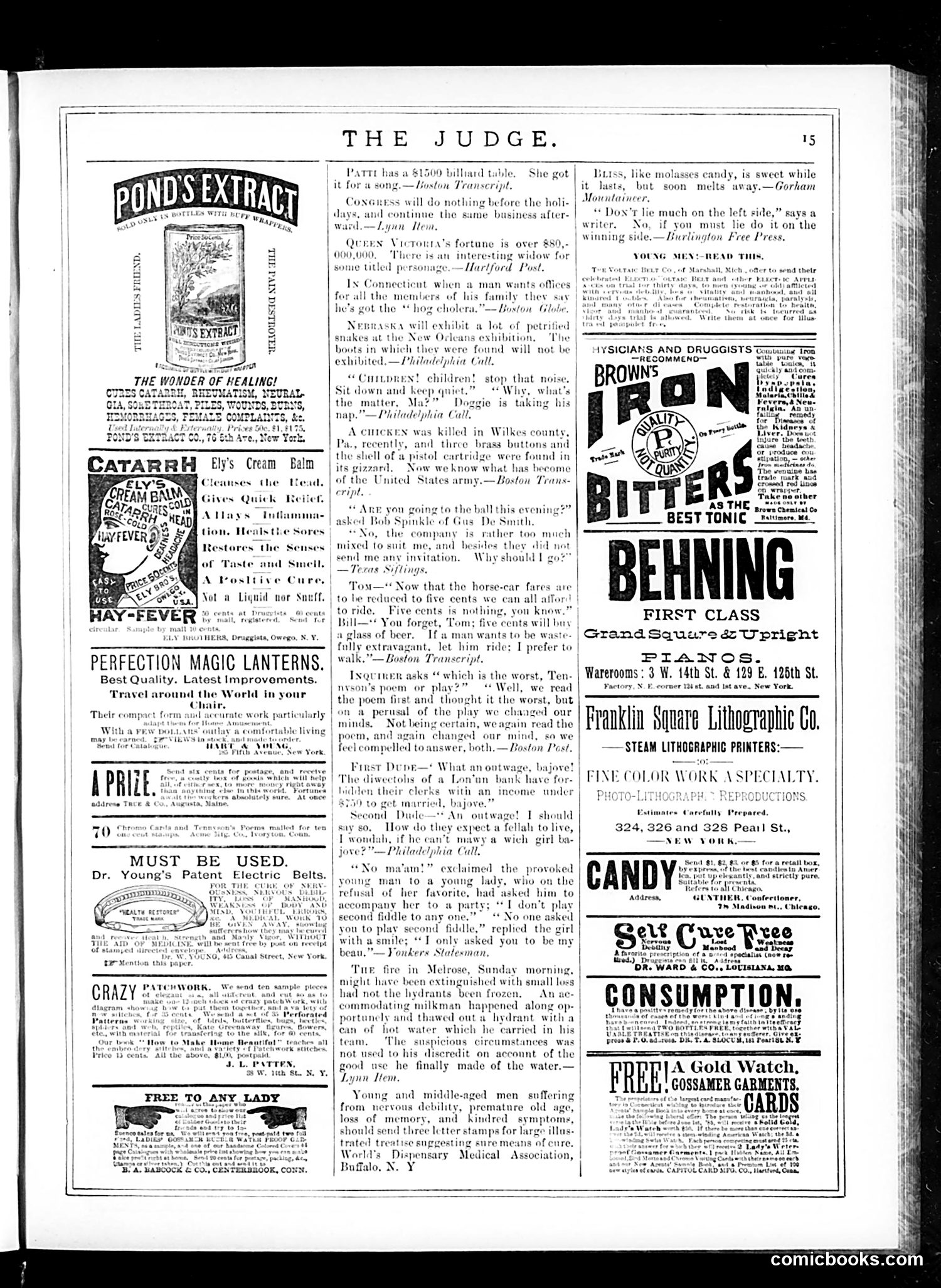
This page is **primarily advertising**, with minimal editorial cartooning. The layout consists almost entirely of patent medicine and consumer product advertisements typical of late 19th-century American magazines. The small humorous anecdotes scattered throughout (rather than political cartoons) present social satire through brief jokes: - References to contemporary urban issues: horse-car fares, frozen fire hydrants in winter, and family social dynamics - Gentle mockery of courtship customs and gender relations (men asking women to dances, "second fiddle" romantic rejection) - Satire of literary taste (Tennyson's poetry versus drama) - Dark humor about military logistics (buttons found in a chicken's stomach) The advertisements include patent medicines ("Pond's Extract," "Young's Patent Electric Belts") and products marketed toward male anxiety—typical of Judge's audience and era. There are no identifiable political figures or campaigns visible. **This page reflects Judge's dual nature**: a satirical magazine that mixed social commentary with commercial interests, targeting middle-class readers through humor while profiting from dubious product endorsements.
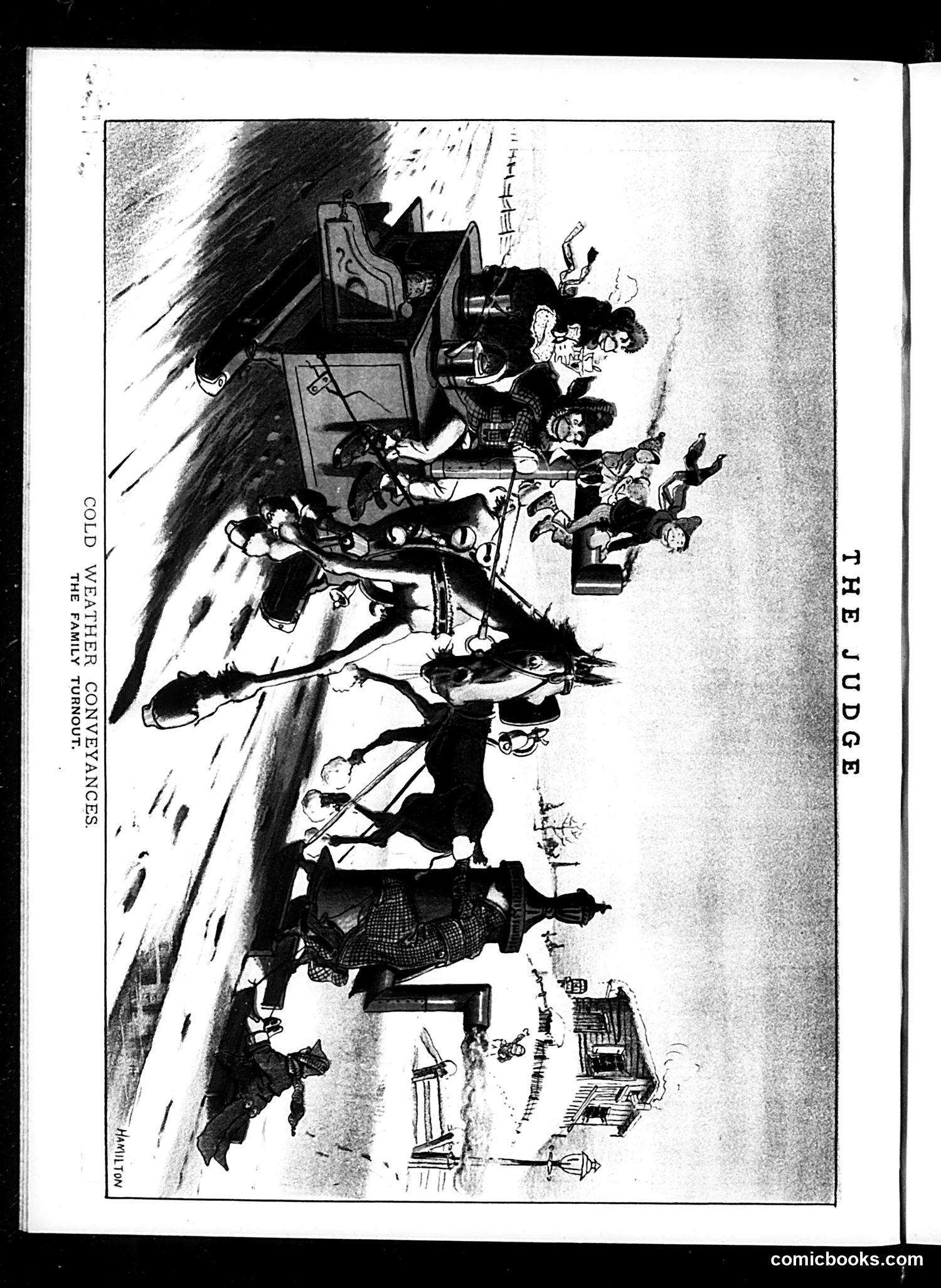
This cartoon depicts a family traveling in winter on what appears to be a sleigh or snow vehicle labeled "SS Hamilton." The title "Cold Weather Conveyances" and "The Family Turnout" suggests it's satirizing family transportation during harsh winter conditions. The figures appear to be a typical Victorian-era family (adults and children) bundled up and precariously arranged on this improvised winter transport. The humor likely derives from the awkward, crowded arrangement and the makeshift nature of their conveyance—poking fun at how families managed winter travel or how people adapted to seasonal challenges. Without additional context about the specific publication date, the exact satirical target remains unclear, though it appears to mock either family travel practices or winter preparedness of the era.