
Judge, 1885-01-17 · page 2 of 16
Judge — January 17, 1885 — page 2: what you’re looking at
What you’re looking at
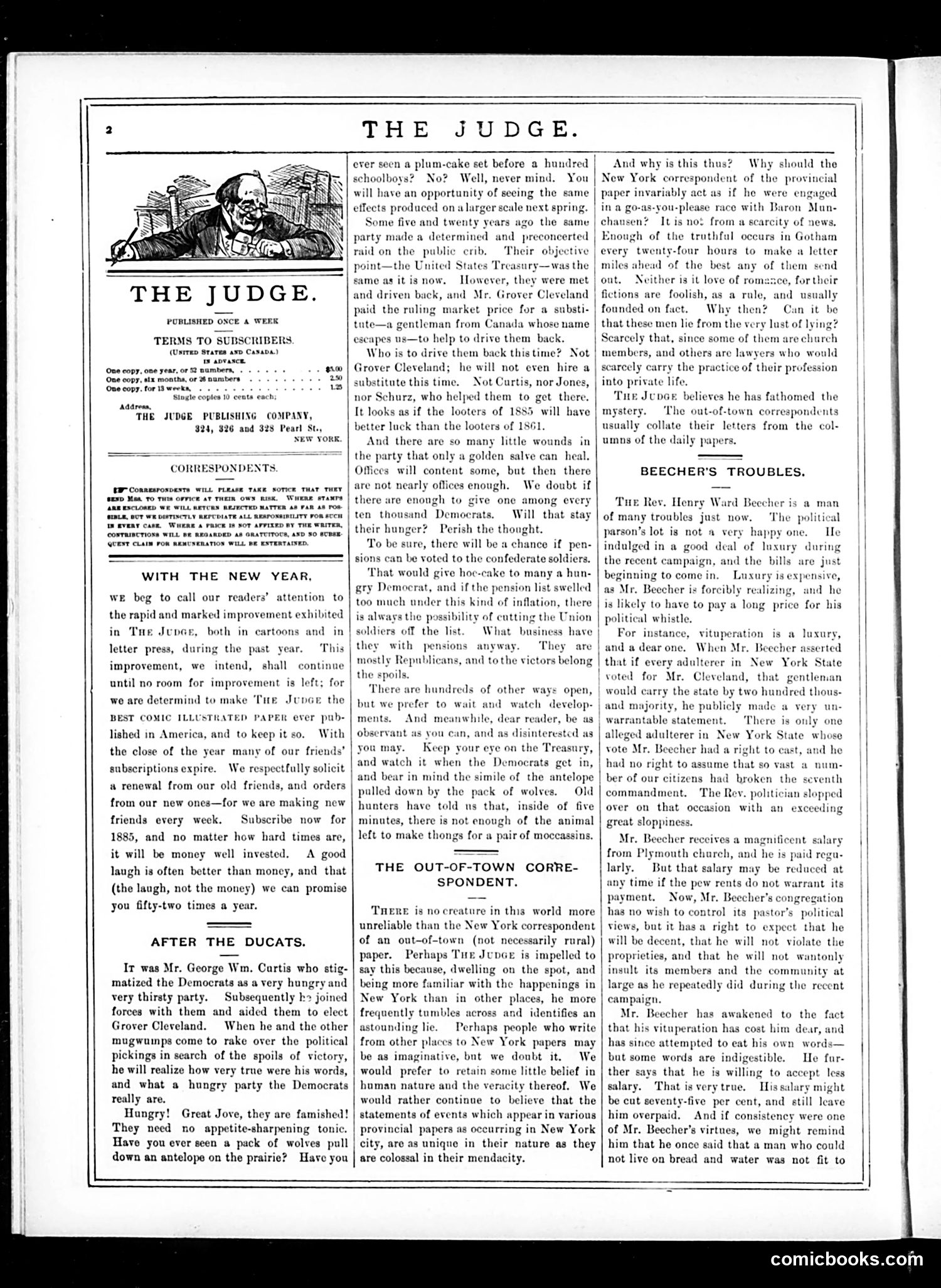
The main cartoon (top left) shows a caricatured figure—likely a Democratic politician or partisan—eagerly eyeing spoils of office after the 1884 election of Grover Cleveland. **Key satire targets:** The editorial "After the Ducats" attacks Democrats' hunger for government jobs and patronage following Cleveland's victory. It references George William Curtis (a Republican mugwump who switched to support Cleveland) and compares hungry Democrats to "a pack of wolves" raiding the Treasury—evoking their 1861 predecessor raid. The piece mocks Democratic desperation: with limited office positions available, they might resort to padding Confederate pension rolls just to feed their supporters. It warns readers to watch Treasury spending closely. **Historical context:** This reflects the spoils system era, where winning parties distributed federal jobs as political rewards. The "out-of-town correspondent" section suggests Judge relied on provincial gossip-reporting typical of 1880s periodicals. The overall message: Democrats are power-hungry parasites waiting to plunder government resources.
📄 Transcribed text from this page (OCR, searchable)
Machine-transcribed from the original scan — historical spelling and the odd misread are preserved.
THE JUDGE. THE JUDGE. PUBLISHED ONCE A WERK TERMS TO SUBSCRIBERS (UstreD Staves ap Casapa) 1 ADTANCE ‘One copy, one year, or St numbers, One copy, #1x montha, or 38 numbers One copy. for 13 weeks, THE JUDGE PUBLISHING COMPANY, $24, $26 and 328 Pearl NEW YORK. WITH THE NEW YEAR, we beg to call our readers’ attention to the rapid and marked improvement exhibited in Tne JupGe, both in cartoons and in This continue letter press, during the past year. improvement, we intend, shall until no room for improvement is left; for we are determind to make THe Junge the BEST COMIC ILLUSTRATED PAPER ever pub- With the close of the year many of our friends’ lished in America, and to keep it so. subscriptions expire. We respectfully solicit a renewal from our old friends, and orders from our new ones—for we are making new friends every week. Subscribe 1885, and no matter how hard times are, A good laugh is often better than moncy, and that now for it will be money well invested. (the langh, not the money) we can promise you fifty-two times a year. AFTER THE DUCATS. Ir was Mr. George Wm. Cartis who stig- matized the Democrats as a very hungry and very thirsty party. Subsequently hk» joined forces with them and aided them to elect Grover Cleveland. When he and the other mugwumps come to rake over the political pickings in search of the spoils of victory, he will realize how very true were his words, and what a hungry party the Democrats really are. Hungry! Great Jove, they are famished! They need no appetite-sharpening tonic. Have you ever seen a pack of wolves pull ever seen a plum-cake set before a hundred | No? Well, never mind. You will have an opportunity of seeing the same effects produced on a larger scale next spring. Some five and twenty years i schoolboy party made a determined and preconcerted raid on the public crib. Their objective point—the United States Treasury—was the same as it is now. Ilowever, they were met and driven back, and Mr. Grover Cleveland paid the ruling market price for a substi- tute—a gentleman from C: scapes 0 nada whose name to help to drive them back. Who is to drive them back this time? Not Grover Cleveland; substitute this he will not even hire a Not Curtis, nor Jones, nor Schurz, who helped them to get there. It looks as if the looters of 1885 will have better luck than the looters of 1861. time. And there are so many little wounds in the party that only a golden salve can heal. | Offices will content some, but then there are not nearly offices enough. there ure enough to ten thousand Deme their hunger? We doubt if ive one among every rats. Will that stay Perish the thought. To be sure, there will be a chance if pen- sions can be voted to the confederate soldiers. ‘That would give hoc-cake to many a hun- gry Democrat, and if the pension list swelled too much under this kind of inflation, there is always the possibility of cutting the Union soldiers off the list. What they with pensioi mostly Republicans, the spoil; Ther but we prefer to wait and watch develop- ments. And meanwhil ar reader, be you can, and as disinterested 4 Keep your eye on the Tr t when the Democrats get in, and bear in mind the simile of the antelope pulled down by the pack of wolves. Old hunters have told us that, inside of five minutes, there is not enough of the animal left to make thongs for a pair of moccassins. business have They are nd to the victors belong are hundreds of other ways open, observan you ny and watch THE OUT-OF-TOWN CORRE- SPONDENT. THERE is no creature in ths world more unreliable than the New York correspondent of an out-of-town (not necessarily rural) paper. Perhaps Tue JupGe is impelled to say this because, dwelling on the spot, and | being more familiar with the happenings in | New York than in other plac he more frequently tumbles across and identifies an astounding lie. Perhaps people who write from other places to New York papers may be as imaginative, but we doubt it. We would prefer to retain some little belief in human nature and the veracity thereof. We would rather continue to believe that the statements of events which appear in various provincial papers as occurring in New York city, are as unique in their nature as they are colossal in their mendacity. o the same | | And why is this thus? Why should the | New York correspondent of the provincial | paper invariably act as if he were engaged in a go-as-you-please race with Baron Mun- chausen? It is not from a scarcity of news, | Enough of the truthful occurs in Gotham every twenty-four hours to make a letter | miles ahead of the best any of out. Neither is it love of rom: | fictions are foolish, as a rule, and usually | founded on fact. Why then? Can it be | that these men lie from the very lust of lying? | Scarcely that, since some of them are church | members, and others scarcely carry the pra | into private li Tur Jeo mystery. rem send for their re lawyers who would ce of their profession slieves he has fathomed the The out-of-town correspondents usually collate their letters from the col- umns of the daily papers. BEECHER’S TROUBLES, Tue Rev, Henry Ward Beecher is a man of many troubles just now. ‘The political | parson’s lot is not a very happy one. He indulged in a good deal of luxury during the recent campaign, and the bills are just beginning to come in. Luxury is expensive, as Mr. Beecher is forcibly | is likely to have to pay | political whistle. For instance, vituperation and a dearone. When Mr. Bee erted that if every adulterer in New York State voted for Mr. Cleveland, that gentleman would carry the state by two hundred thous- and majority izing, and he a long price for his a luxury, ner he publicly made a very un- warrantable statement. There is only one alleged adulterer in New York State whose vote Mr. Beecher had a right to cast, and he had no right to assume that so vast a num- ber of our citizens had broken the seventh commandment. over on that o great sloppines The Rev. politician slopped sion with an ding Mr. Beecher receives a magnificent salary from Plymouth church, and he is paid regu- larly. But that salary m be reduced at any time if the pew rents do not warrant its payment. Now, Mr, Beecher’s congregation no wish to control its pastor’s political a right to expect that he will be decent, that he will not violate the proprieties, and that he will not wantonly insult its members and the community at large as he repeatedly did during the recent campaign. Mr. kened to the fact that his vituperation has cost him dear, and has since attempted to eat his own word but some words are indigestible. He fur- ther says that he is willing to accept le salary. That is very true. His salary might be cut seventy-five per cent, and still leave him overpaid. And if consistency were one of Mr. Beecher’s virtues, we might remind him that he once said that a man who could not live on bread and water was not fit to Beecher has awa down an antelope on the prairie? Have you comicbooks.co