
Judge, 1885-01-17 · page 14 of 16
Judge — January 17, 1885 — page 14: what you’re looking at
What you’re looking at
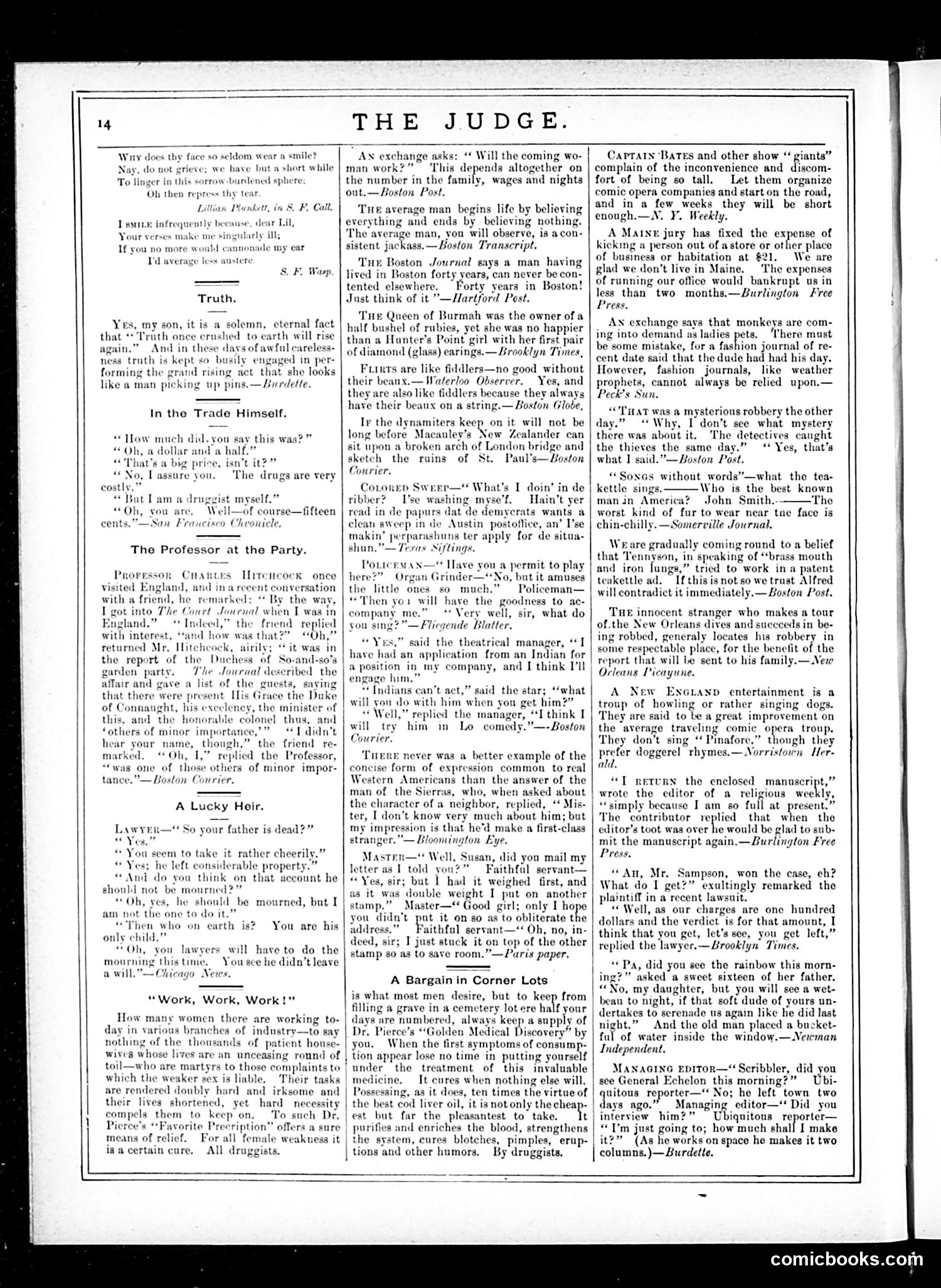
This page from *Judge* contains brief humorous anecdotes and one-liners rather than illustrated cartoons. The content reflects late 19th-century American satirical concerns: **Key targets include:** - **Class and social pretension**: "The Professor at the Party" mocks an academic's embarrassment at being listed among "others of minor importance" at a society event. - **Will and inheritance humor**: "A Lucky Heir" jokes about a lawyer assuming a man's cheerfulness over his father's death relates to receiving property, rather than genuine mourning. - **Political corruption**: A reference to "demyerats" (Democrats) seeking patronage positions through civil service reform satirizes political favoritism, likely alluding to Post-Reconstruction era spoils system abuse. - **Gender stereotypes**: Multiple pieces mock women's supposed frivolity and physical weakness, typical of period attitudes. - **Working-class life**: Commentary on the hardships of domestic labor for women. The humor relies on wordplay, irony, and social observation rather than elaborate visual satire.
📄 Transcribed text from this page (OCR, searchable)
Machine-transcribed from the original scan — historical spelling and the odd misread are preserved.
14 Wry does thy face so seldom wear a smile? Nay, do not we have but a short while To linger in this sorrow-burdened sphere thy tear, Phunk Oh then repre Littian 1, in 8. PF. Call, ly because, dear Lil, ularly ill; nonade my ear I sine infrequen Your verses If you no more w« I'd average less austere SF, Wasp. Truth. lemn, eternal fi ed to earth will ri Yes, my son, it is that ** ‘Trath once er again.” And in these days of awful carele ness truth is kept so busily en forming the grand rising like a man picking up pins. —Burdete. In the Trade Himself. “Tow mneh did. you say this wa “That's a big pr “No, [assure you. costly, Sut Lam a drug yeelf.” , vou are. Well—of course—fifteen The Professor at the Party. Ilitencoek once in a recent conversation with a friend, he remarked: “ By the way, I got into yurt Journal when T was in I 5 ‘Indeed, the friend replied with interest, 1 how was that?” “Oh,’” returned Mr, Hitchcock, airily; “it was in the report of the Duchess of So-and-so’s garden party. The Journal described the affair and gave a list of the guests, saying that there were present His Grace the Duke of Connaught, his excelency, the minister of this, and the honorable colonel thus, and ‘others of minor importance, “TP didn’t hear your name, though,” the friend re- marked. “Oh, I,” replied the Professor, “was one of those others of minor impor- tance.”— Boston Courier, Proresson CHartes Sngland, and A Lucky Heir. Lawyrer—* So your father is dead?” + You scem to take it rather cheerily. he left considerable property.” you think on that account he iid not be mourned? Oh, yes, he should am the one to do it ‘Then who on earth is? only child.” “Oh, you lawyers mourning this tin a will."—Chicayo And ¢ be mourned, but I You are his will have to do the You sce he didn’t leave “Work, Work, Work!" How many women th day in various branches of in nothing of the thousands of patient honse- wives whose lives are an unceasing round of toil—who are martyrs to those complaints to which the weaker sex is liable. Their tasks are rendered doubly hard and irksome and their lives shortened, yet hard compels them to keep on, ‘To such Dr. Pic ‘avorite Precription” offers a sure means of relief, For all female weakness it isacertain cure. All druggists. e working to- istry—to say necessity | | tions and other humors. “ Will the coming wo- This depends altogether on the number in the family, wages and nights out.—Boston Post. Tue average man begins life by believing everything and ends by believing nothing. ‘The’ average man, you will observe, is acon- sistent jackass.—Boston Transcript. Tue Boston Journal says a man having lived in Boston forty years, can never be con- tented elsewhere. “Forty years in Boston! Just think of it "—Hartford Post. ‘THe Queen of Burmah was the owner of a half bushel of rubies, yet she was no happier than a Hunter's Point girl with her first pair of diamond (glass) earings. — Brooklyn Times, Fiirts are like fiddlers—no good without their beanx.—Waterloo Observer. Yes, and they are also like fiddlers because they always have their beaux on a string.— Boston Globe, Ir the dynamiters keep on it will not be long before } alander can sit upon a broke ondon bridge and sketch the ruins Paul'’s— Boston Courier. Cotorep Sweer—“* What's I doin’ in de ribber I'se washing myse’f. Hain’t yer read in de papurs dat de demyerats wants a clean sweep in de Austin postoflice, an’ I’se makin’ perparashuns ter apply for de situa- shun.”—Teras Siftings. Poticeman—* Have you a permit to play here Organ Grinder—‘No, but it amu: the little ones so much. Policema “Then you will have the goodness to a compat ” «Very well, sir, what do you sin; —Fliegende Blatter. beg said the theatrical manager, ‘I have had an application from an Indian for position in my company, and I think I'll engage him, Indians can’t act,” said the star; “what will you do with him when you get him?” “Well,” replied the im r, “Ithink I will try him in Lo comedy."—-Boston Courier. = Tiree never was a better example of the concise form of expression common to real Western Ame ns than the answer of the man of the who, when asked about the character of a neighbor, replied, ‘ Mis- ter, I don’t know very much about him; but my impression is that he’d make a first-class stranger.”— Bloomington Eye. Master—‘ Well, Susan, did you mail my letter as 1 told yon?” Faithfal ser “Yes, sir; but I had it weighed first, and as it was double weight I put on another amp.” Master—* Good girl; only I hope ou didn’t put it on so as to obliterate the address.” — Faithful servant Oh, no, in- deed, sir; I just stuck it on top of the other stamp 80 as to save room.”—Puris paper. A Bargain in Corner Lots is what most men desire, but to kee filling a grave in a cemetery days are numbered, always keep a supply of Dr. Pierce’s ‘‘Golden Medical Discovery” by you. When the first symptoms of consump- tion appear lose no time in putting yourself under the treatment of this invaluable medicine. Possessing, as it does, ten times the virtue of the best cod liver oil, it is not only the cheap- est but far the pleasantest to take. tt purifies and enriches the blood, strengthens the system, cures blotches, pimples, erup- By druggists. lot ere half your from | It cures when nothing else will. | Cartatn ‘Bates and other show ‘“ giants” complain of the inconvenience and discom- fort of being so tall. Let them organize comic opera companies and start on the road, and in a few weeks they will be short enough.—. ¥. Weekly. A Maine jury has fixed the expense of kicking a persoty out of a store or of her place of business or habitation at $21, We are glad we don’t live in Maine. ‘The expenses of running our office would bankrupt us in less than two months.—Burlington Free Press. AN exchange says that monkeys are com- ing into demand as ladies pets. ‘There must be some mistake, for a fashion journal of re- cent date said that the dude had had his day. However, fashion journals, like weather prophets, cannot always be relied upon.— Peck’s Sun. “THAT was a mysterious robbery the other day.” “ Why, [don’t see what mystery there was about it. The detectives caught the thieves the same day.” ‘* Yes, that’s what I said.”—Boston Post. “Sonos without words"—w kettle sings. Who is the best known manin America? John Smith.-- ‘The worst kind of fur to wear near tne face is chin-chilly. —Somerville Journal. at the tea- Weare gradually coming round to a belief that Tennyson, in speaking of ‘brass mouth and iron lungs,” tried to work ina patent teakettle ad. If this is not so we trast Alfred will contradict it immediately.— Boston Post. Tue innocent stranger who makes a tour of.the New Orleans dives and suecceds in be- ing robbed, generaly locates his robbery in some respectable place, for the benefit of the | report that will Le sent to his family.— New Orleans Picayune. A New ‘GLAND entertainment is a troup of howling or rather singing dogs. They are said to Le a great improvement on the average traveling comic opera troup, They don’t sing ‘ Pinafore,” though they prefer doggerel rhymes.—orristown Her- ald. “T Rete the enclosed manuscript,” wrote the editor of a religious weekly, “simply because I am_so full at present.” The contributor replied that when the editor’s toot was over Tre would be glad to sub- mit the manuscript again.—Burlington Free Press. “An, Mr. Sampson, won the case, eh? What do I get?” exultingly remarked the plaintiff in a recent lawsuit. “Well, as our charges are one hundred dollars and the verdict is for that amount, I think that you get, let’s see, you get left,” replied the lawyer.—Brooklyn Times. “Pa, did you see the rainbow this morn- ing?” asked a sweet sixteen of her father. “No, my daughter, but you will see a wet- beau ‘to night, if that soft dude of yours un- dertakes to serenade us again like hie did last night.” And the old man placed a bucket- ful of water inside the window.—Newman Independent. NAGING EDITOR—“ Scribbler, did you neral Echelon this morning?” Ubi- qpitons reporter No; he left town two jays ago. naging editor—‘‘ Did you interview him Ubiquitous reporter— “T’'m just going to; how much shall I make it?” (As he works on space he makes it two columns, )—Burdette. | comicbooks.co