
A complete issue · 16 pages · 1885
Judge — January 3, 1885
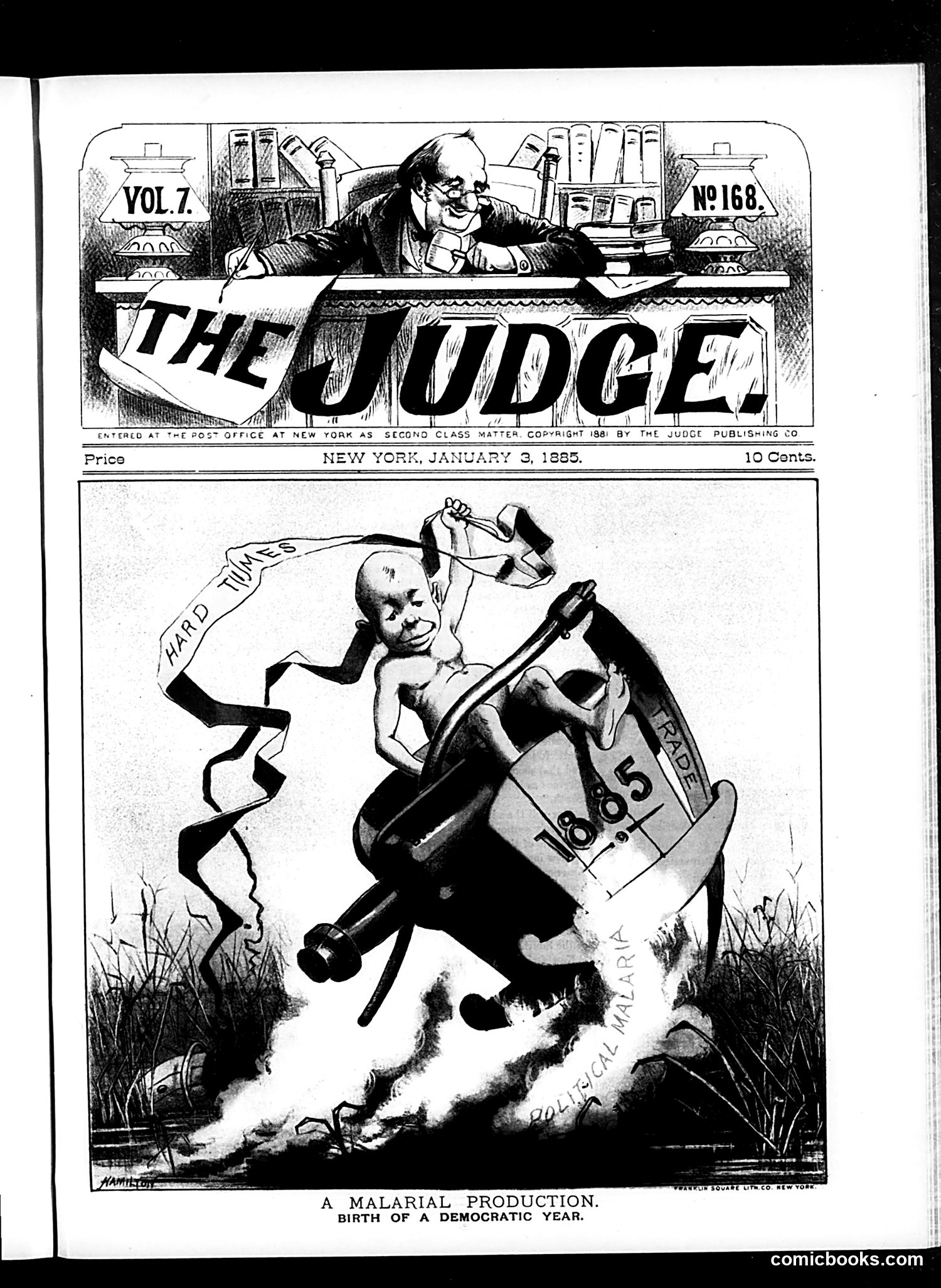
This January 1885 cartoon satirizes the Democratic Party as diseased and corrupt. The grotesque figure labeled "Hard Times" emerges from a swamp marked "Official Malarky" (pun on "malaria"), suggesting Democrats are birth-parents of economic hardship and deception. The 1885 date places this after Democrat Grover Cleveland's 1884 presidential victory—the first Democratic president elected since before the Civil War. The cartoon attacks Democratic governance as inherently toxic, using disease imagery common in Gilded Age political satire. "Malarky" (dishonesty/nonsense) substitutes for the actual disease, making the metaphor: Democratic rule produces lying and economic suffering. The swamp setting reinforces corruption imagery. Judge magazine, Republican-leaning, used such visceral attacks against political opponents.
This page contains the magazine's masthead and editorial content rather than political cartoons. The small illustration at top appears to be Judge's generic logo/mascot. The editorials promote Judge magazine itself and discuss the New Orleans Exposition—a major world's fair designed to showcase Southern industrial and agricultural recovery after the Civil War. The editors argue the exposition will attract Northern capital and investment to the economically struggling South, while also promoting education and modern thinking in the region. A secondary piece addresses the Spanish Treaty (likely concerning Cuba) and a brief note on "The Democratic New Year," suggesting concerns about Democratic political changes. The page is primarily subscription information, contributor notices, and promotional/editorial content rather than satirical commentary with identifiable caricatures or specific political targets.
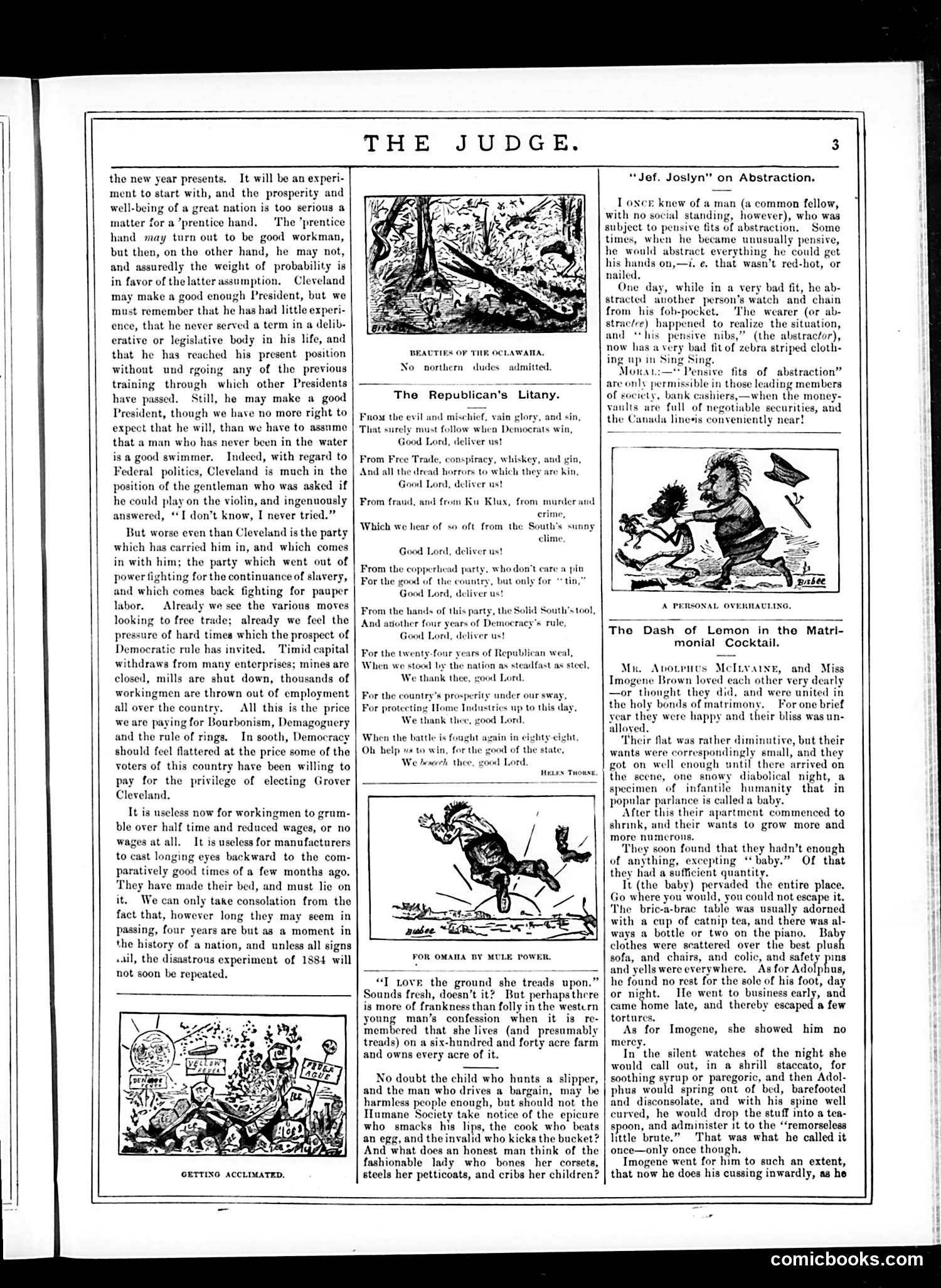
This page, likely from the 1880s, satirizes Grover Cleveland's recent election as President. The main editorial text expresses skepticism about Cleveland's inexperience—comparing him to someone who's never tried violin but claims he can play. **"The Republican's Litany"** mocks Republican fears about Democratic rule through mock-prayer format, listing anxieties: free trade, fraud, the Ku Klux Klan, and the "Solid South" (the Democratic coalition of former Confederate states). The satire suggests Republicans are using scare tactics. **"For Omaha by Mule Power"** (bottom cartoon) appears to ridicule Western crudeness or frontier behavior—the caption "I love the ground she treads upon" suggests crude frontier courtship. **"Getting Acclimated"** (bottom left) likely depicts struggles adapting to new political conditions under Democratic administration. The overall thrust critiques both Cleveland's untested leadership and the Democratic party's return to power after years of Republican dominance.
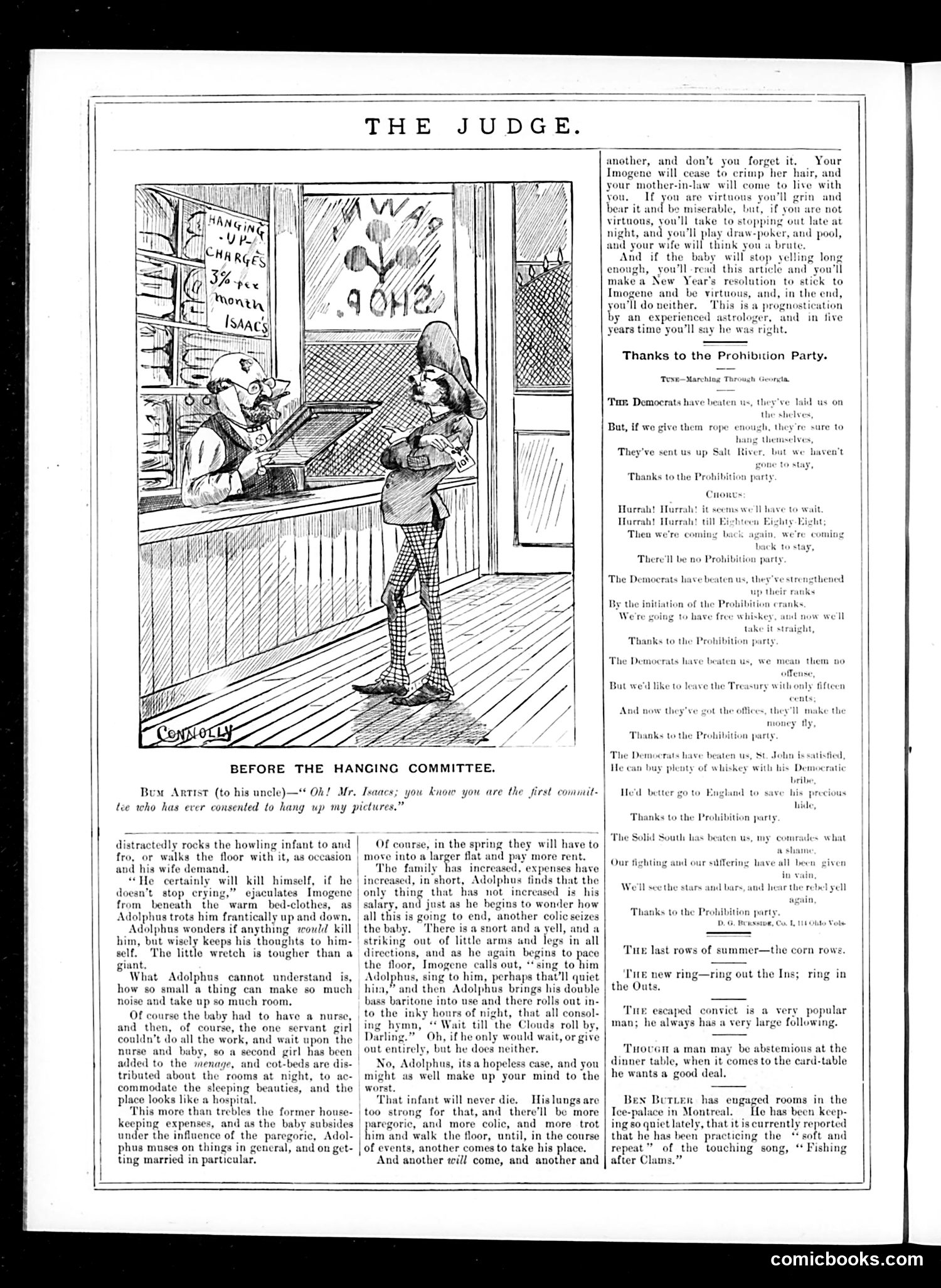
This cartoon satirizes the struggles of a married man named Adolphus after becoming a father. The title references an art committee—the "Bum Artist" (left) jokes that his uncle is the first committee willing to display his pictures, a play on "hanging" artwork. The main narrative mocks domestic life's financial and emotional toll: a crying infant forces the couple to hire additional servants and move to larger housing, drastically increasing expenses while Adolphus's salary remains unchanged. He sings lullabies ("Wait till the Clouds Roll By, Darling") to soothe the colicky baby through sleepless nights, while contemplating the endless cycle of future children. The right column contains satirical verses praising the Prohibition Party, sarcastically thanking them for Democratic electoral losses. The verses mock Prohibition supporters while suggesting liquor and gambling will follow Democratic victories—dark humor about political corruption and vice. The overall effect lambastes both domestic entrapment and contemporary politics.
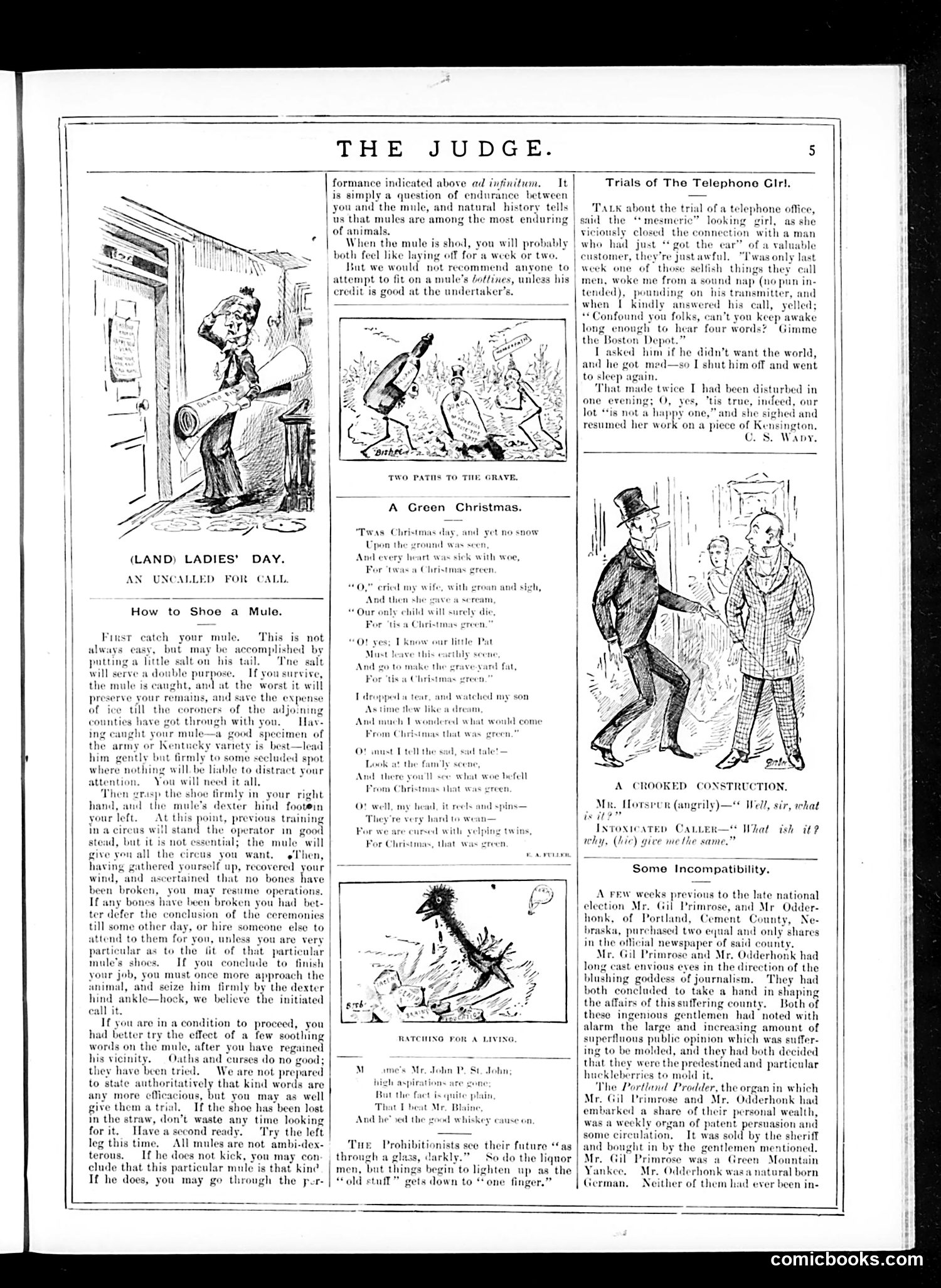
This page contains several humorous articles and cartoons typical of late 19th-century American satire: **"How to Shoe a Mule"** is deadpan comedic advice presenting the task as absurdly dangerous and futile—the mule will resist, the shoer will get injured, and the process is essentially unwinnable. It mocks rural/frontier life and the stubbornness of animals. **"A Green Christmas"** is a sentimental poem about a family's child dying before Christmas, treating mortality with dark Victorian sentimentality mixed with humor. **"Trials of The Telephone Girl"** humorously depicts the frustrations of early telephone operators—rude customers demanding connections, being awakened from naps, dealing with drunk callers. **"A Crooked Construction"** appears to be wordplay about misinterpreting language (possibly about alcohol—"whiskey" puns). **"Some Incompatibility"** references a real 1890s-era political incident involving Mr. Gil Primrose and Mr. Odderrhonk (unclear figures) and tensions between prohibitionists and liquor interests. The cartoons use exaggerated illustration styles typical of the period's satirical press.
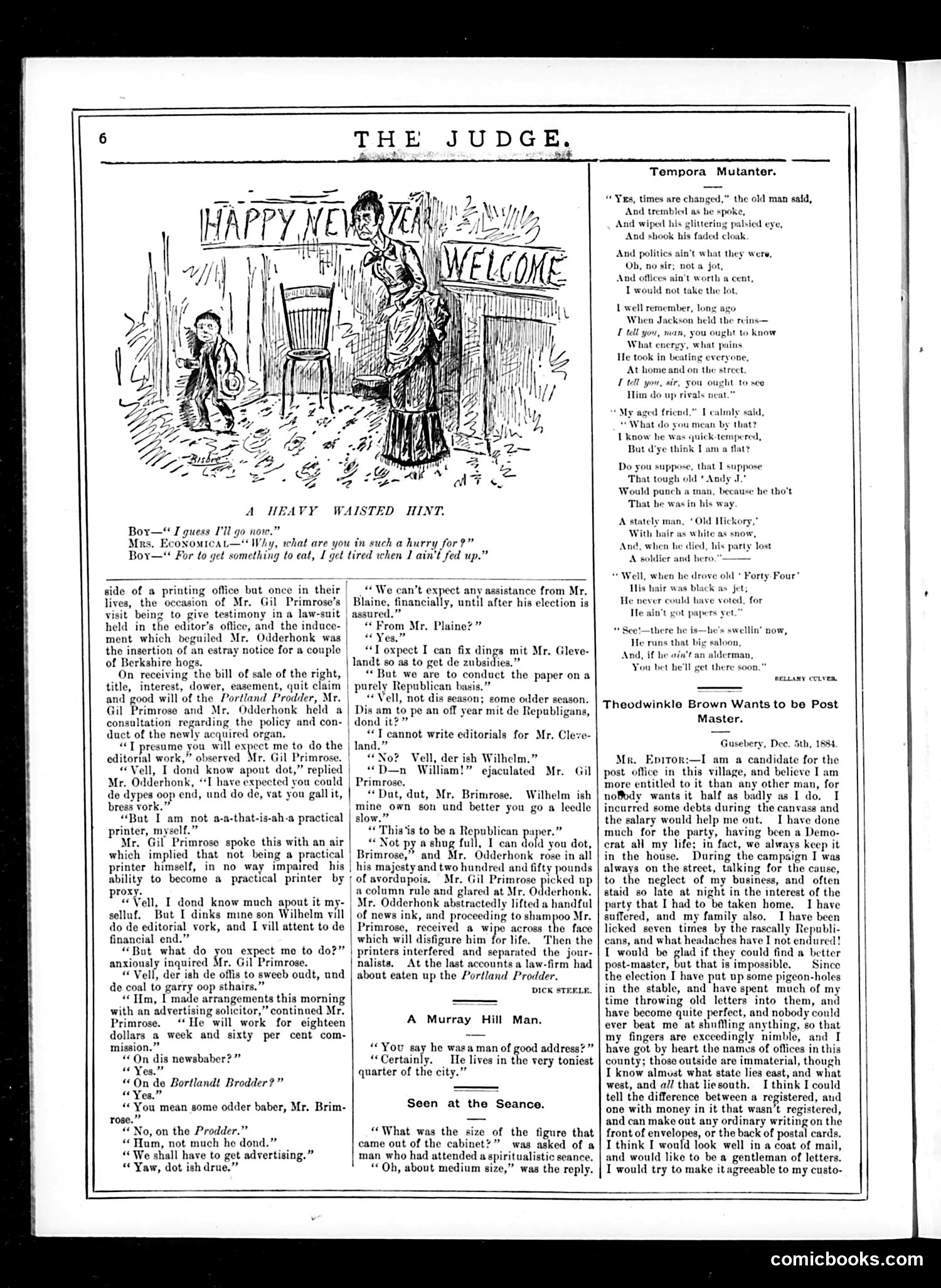
This Judge page satirizes the chaos of small-town newspaper ownership in the 1880s. The main cartoon depicts two bumbling foreigners—Gil Primrose and Mr. Odderhonk (a German caricature with heavy accent)—who've just purchased the *Portland Prodder* newspaper. The satire centers on their incompetence: Primrose expects to do editorial work despite being a non-practical printer; Odderhonk plans to have his son Wilhelm handle editorials while he sweeps and carries coal. Their editorial vision is incoherent—they claim Republican loyalty while seeking Democratic (Cleveland) subsidies. The dialogue's thick accents mock immigrant incompetence in American business. The conflict escalates when Primrose attacks Odderhonk with a "column rule" (printing equipment), requiring printers to separate them. The joke: their newspaper venture dissolves into literal violence and legal fees, destroyed before it even launches. The page also includes lighter humor pieces about spiritualist séances and society types, typical of Judge's satirical magazine format.
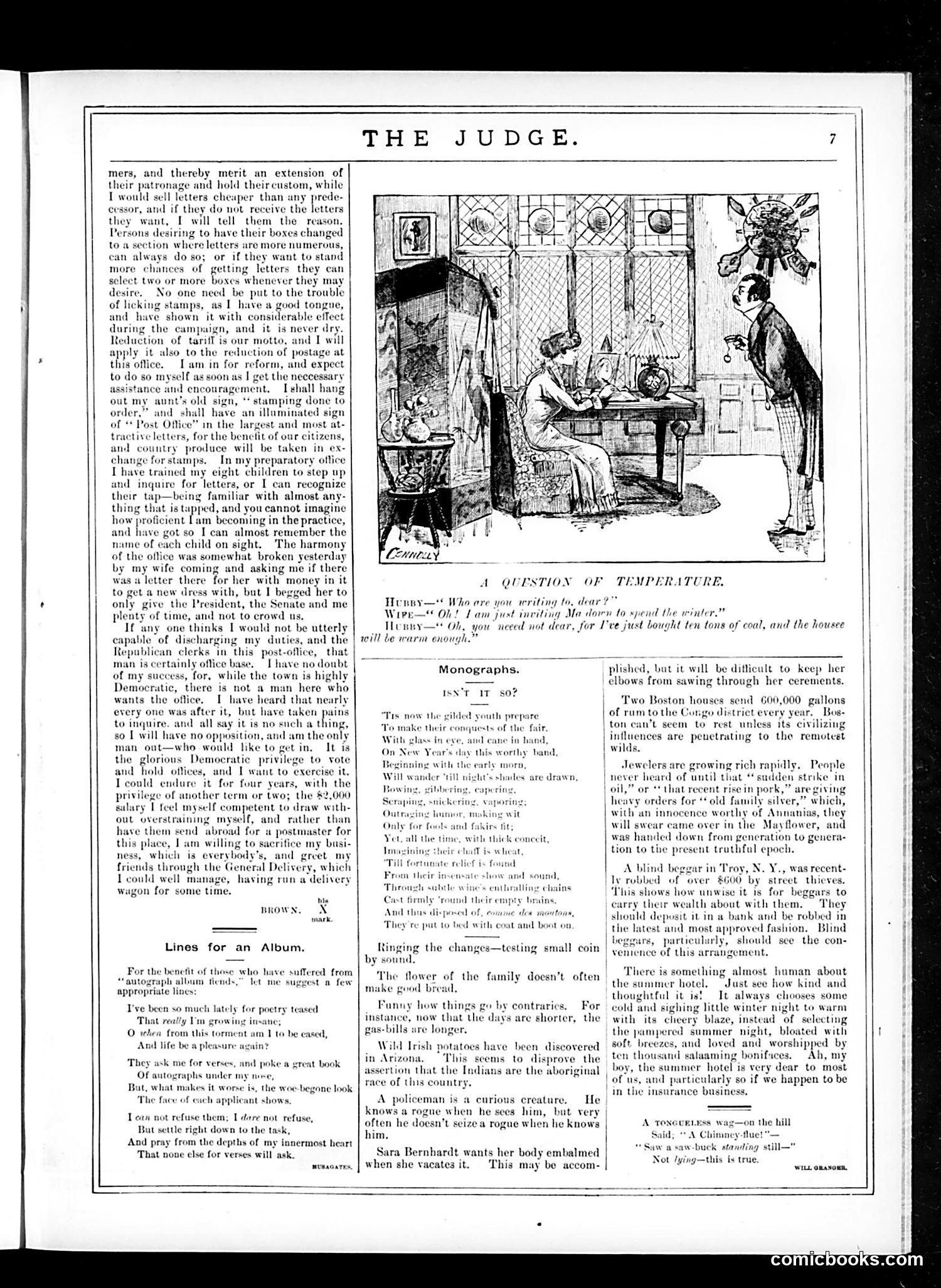
This domestic comedy cartoon satirizes **Post-Civil War prosperity and conspicuous consumption**. A husband writes inviting his mother-in-law to visit for winter, but his wife interrupts: she's just purchased ten tons of coal, making the house warm enough—an absurd overstatement of wealth and heating capacity meant as humor. The joke reflects **Gilded Age excess**: newly rich Americans (likely war profiteers or industrial magnates) ostentatiously flaunted purchases of luxury goods and fuel. The wife's casual mention of ten tons of coal signals both financial abundance and wasteful extravagance—buying far more than necessary simply to demonstrate purchasing power. The cartoon mocks the era's materialism and the anxiety about maintaining appearances of wealth during rapid economic upheaval following the Civil War.
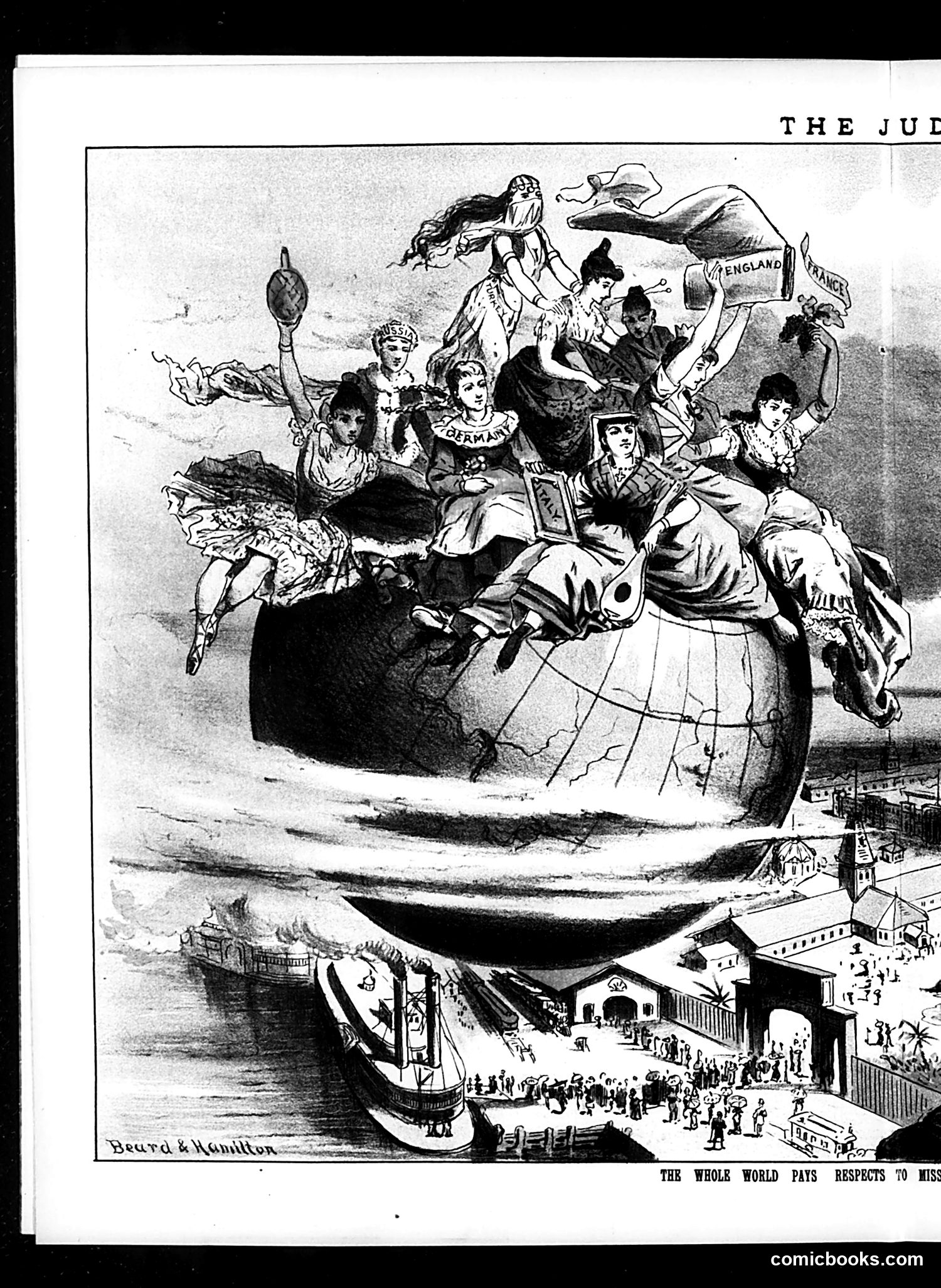
This appears to be a satirical Judge magazine cartoon titled "The Whole World Pays Respects to Miss..." (text cut off). The image depicts a large globe or spherical object surrounded by female figures representing different nations—identifiable by labels including "England," "Germany," and "France." The figures are arranged in an ornate, celebratory composition, suggesting international attention to an unnamed female subject. Below, a harbor scene shows crowds and vessels, implying a significant public event or occasion. Without the complete title or date, the specific person being satirized remains unclear. However, the cartoon appears to mock either a celebrity, socialite, or public figure receiving exaggerated worldwide attention and admiration. The artistic style and composition suggest early-to-mid twentieth-century American satire.
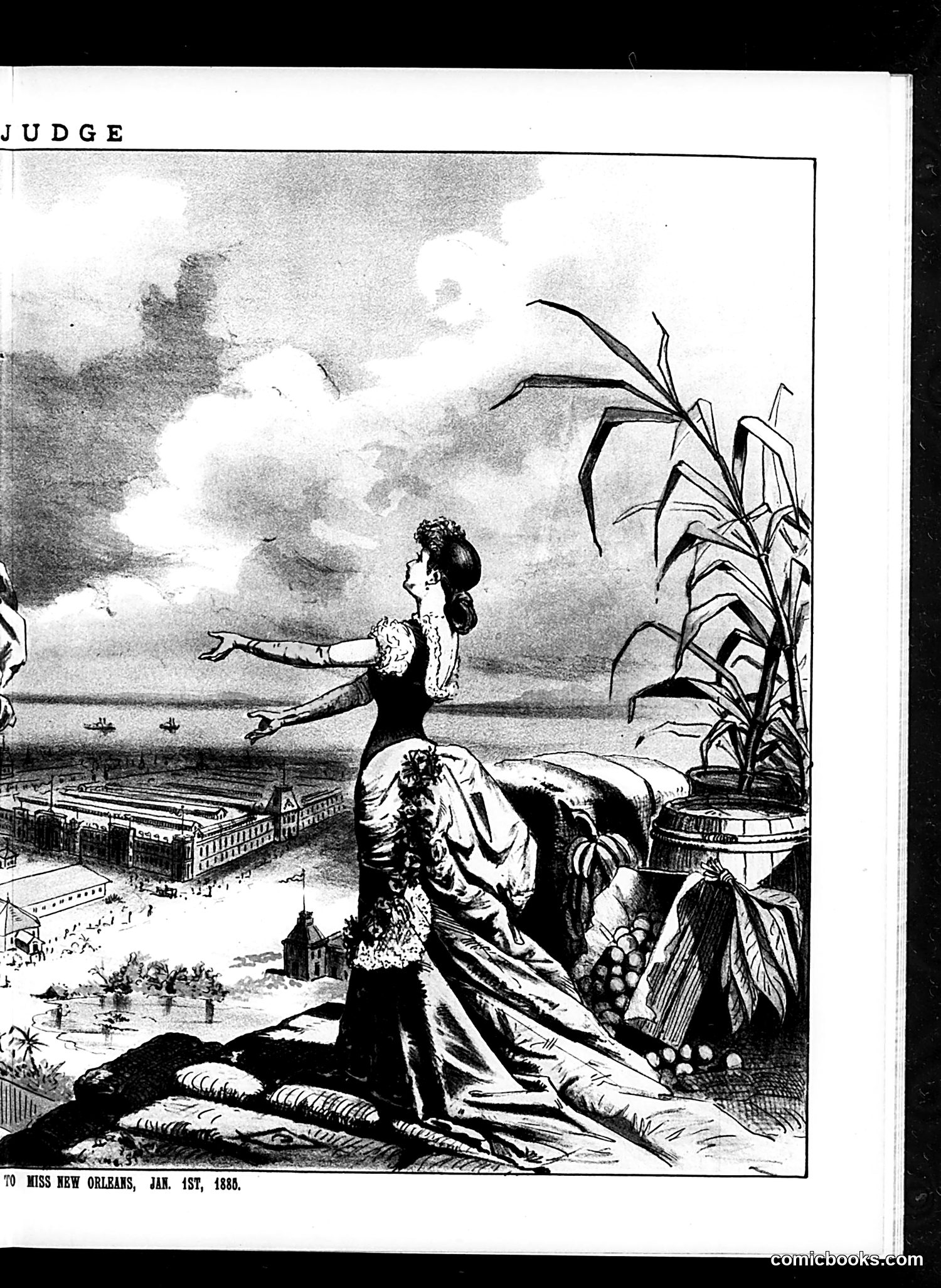
This cartoon depicts a woman personifying New Orleans on New Year's Day 1890, gesturing expansively toward the city below. She's dressed elaborately and positioned on elevated terrain, overlooking the landscape with agricultural abundance (corn, grapes) beside her. The satire likely celebrates or comments on New Orleans's status and prospects at this specific historical moment. The personification-as-woman was common in 19th-century political cartoons representing cities or nations. Her confident pose and the fertile imagery suggest optimism about the city's future, though without additional context from the magazine's surrounding text, the specific occasion or point of critique remains unclear. The date indicates New Year's resolutions or aspirations.
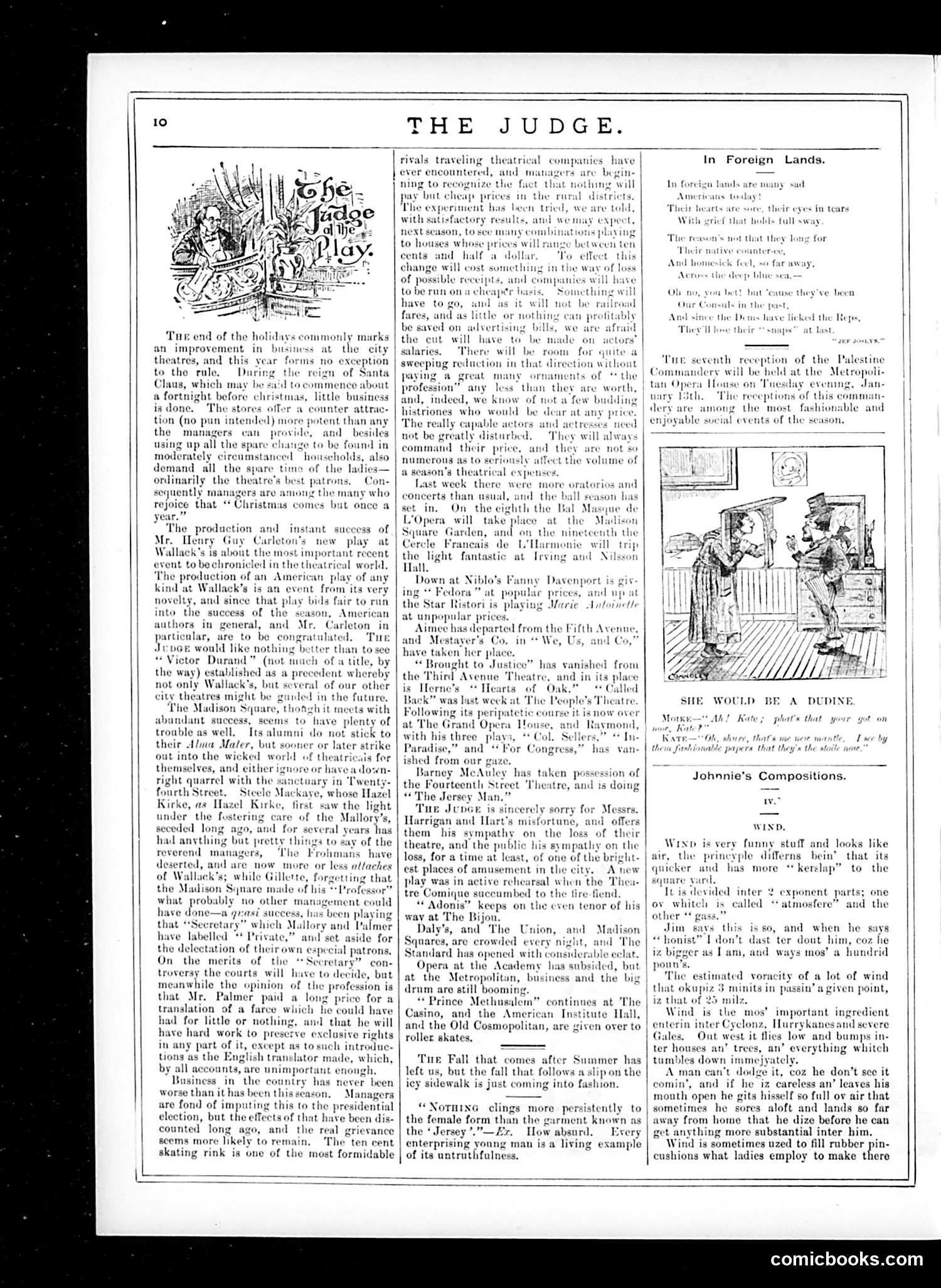
This page from *Judge* magazine discusses theatrical business conditions, primarily focused on American theater management and economics during what appears to be the post-holiday season. **Main Content:** The left column discusses how the holidays disrupt theater business, then praises Henry Guy Carleton's new American play "Victor Durand" at Wallack's Theatre as an encouraging sign for American playwrights. It critiques the Madison Square Theatre for losing alumni actors like Steele Mackaye and the Frohman brothers to competitors. **The "Secretary" Controversy:** The text references a legal dispute over a farce translation, suggesting producer Palmer paid unnecessarily for exclusive rights he likely cannot maintain. **Economic Conditions:** The article addresses theater industry recession, attributing it partly to ten-cent skating rinks—a new cheap entertainment competing with theater for working-class audiences in rural areas. Managers must reduce ticket prices and actor salaries to survive. **The Illustration:** The cartoon titled "She Would Be a Dudine" (right side) appears to satirize fashionable women, though specific details are unclear from this reproduction. The overall tone critiques theater management while acknowledging economic pressures from new competition and changing audience expectations.
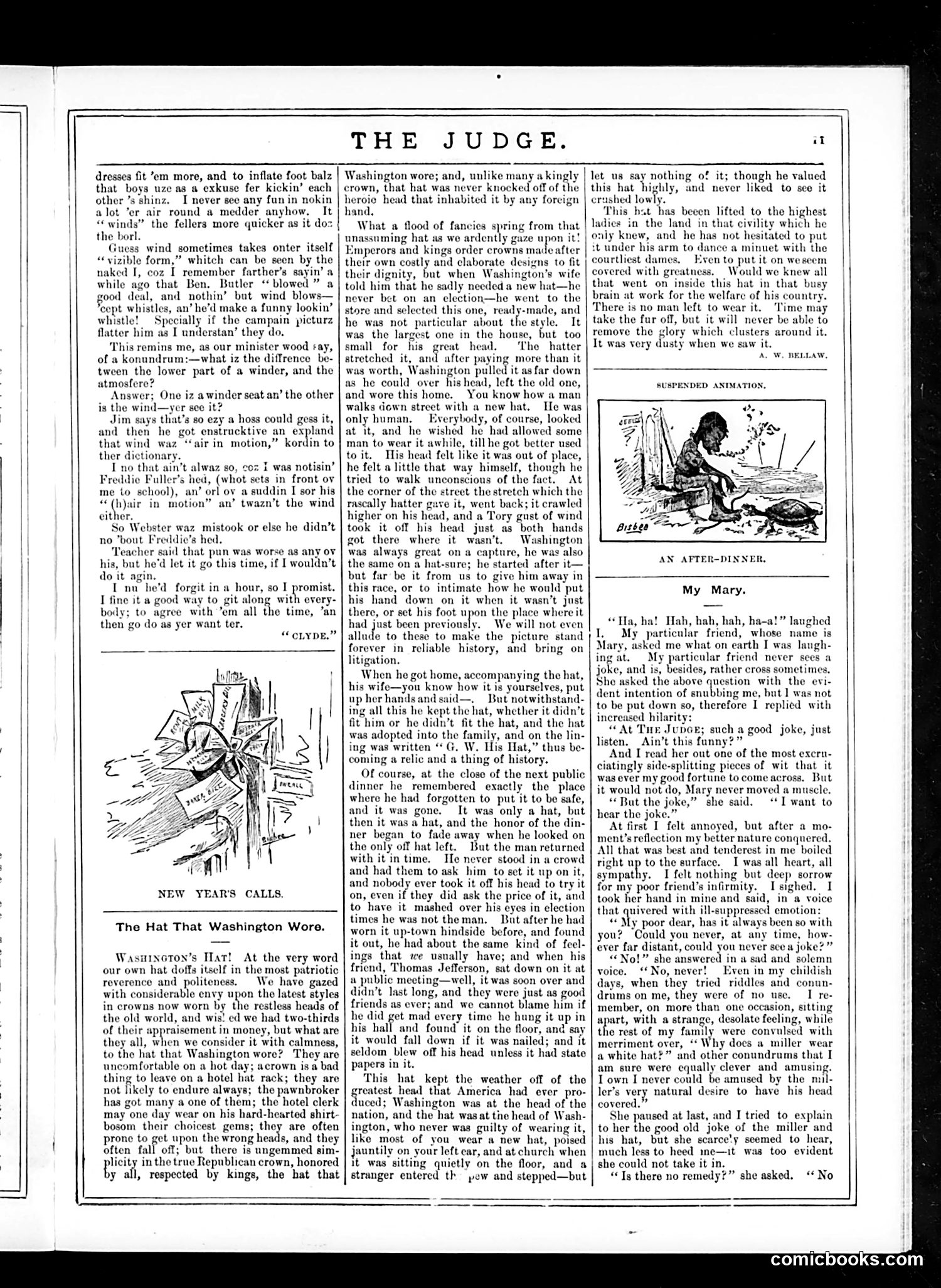
This article satirizes American reverence for George Washington through the mundane story of his hat. The piece mocks the contrast between the idealized, almost sacred status of Washington's possessions versus the reality: he simply bought an ill-fitting ready-made hat from a store because his wife said he needed one. The satire works by treating this ordinary hat with absurdly grandiose language ("ungemmed simplicity in the true Republican crown, honored by all, respected by kings"). It humorously suggests Washington struggled with the hat just like any man—it was too small, the hatter had to stretch it, it crawled up his head, and the wind blew it off. The piece critiques American patriotic excess and mythologizing of the founding fathers, implying readers project impossible nobility onto Washington when he was simply human. The humor lies in deflating this mythology with realistic, embarrassing details about an uncomfortable hat purchase.
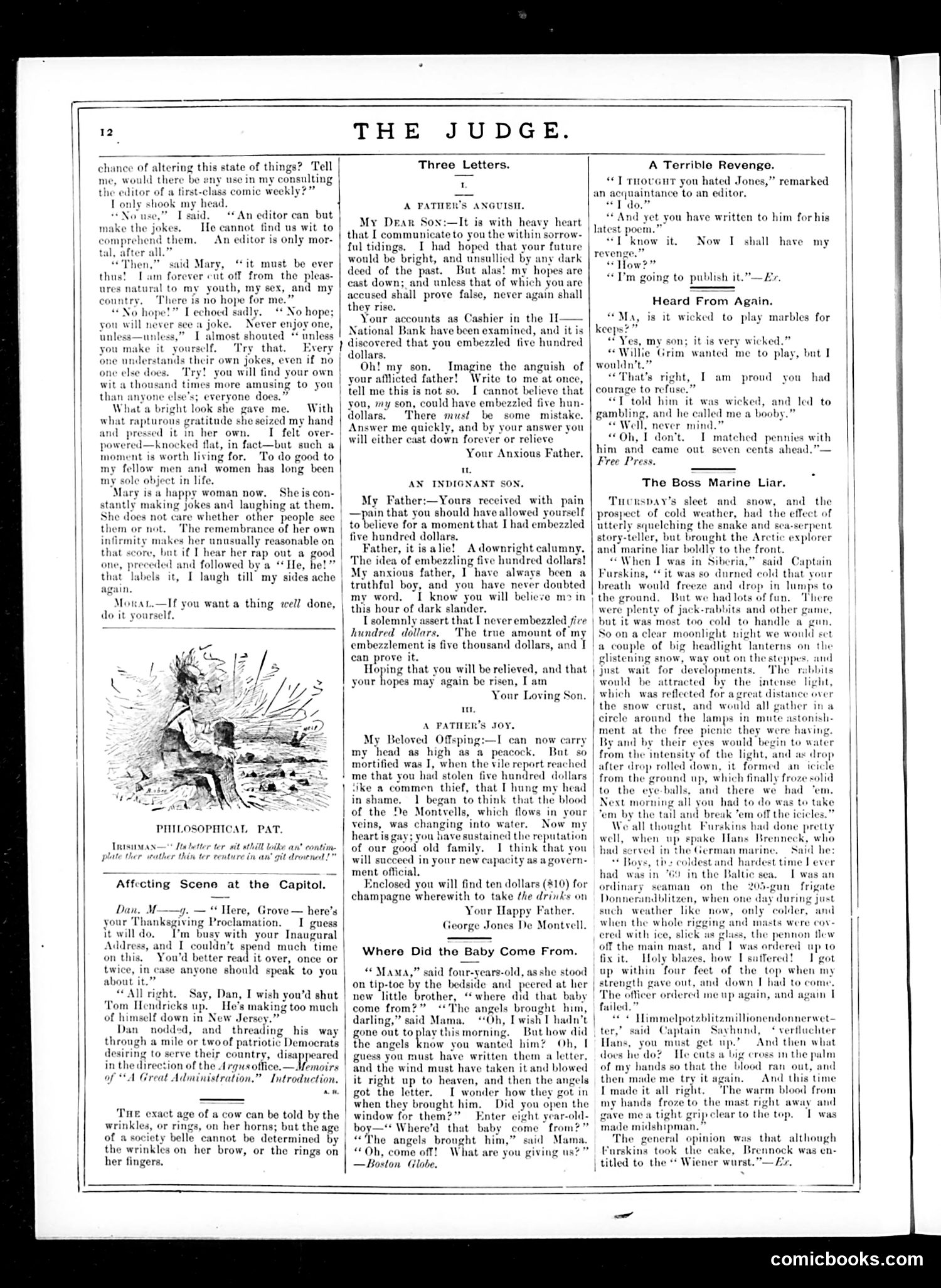
This page from *Judge* magazine contains three satirical letters—a common format for 19th-century humor. The first depicts a father devastated to learn his son embezzled $500 as a bank cashier. The son's reply indignantly denies the charge, claiming the accusation is a "downright calumny"—then reveals he actually embezzled *five thousand dollars*, not five hundred. The joke is a classic bait-and-switch: the son's righteous denial of the specific charge masks a far greater crime. The satire mocks corrupt officials and embezzlers of the Gilded Age, who often used technical denials and rhetorical sleights-of-hand to evade accountability. By having the son confess to stealing ten times more while protesting his innocence, Judge ridicules the hollow moral posturing of dishonest public figures. The other items on the page—short anecdotes and wordplay—follow similar comedic patterns typical of 19th-century satirical magazines.
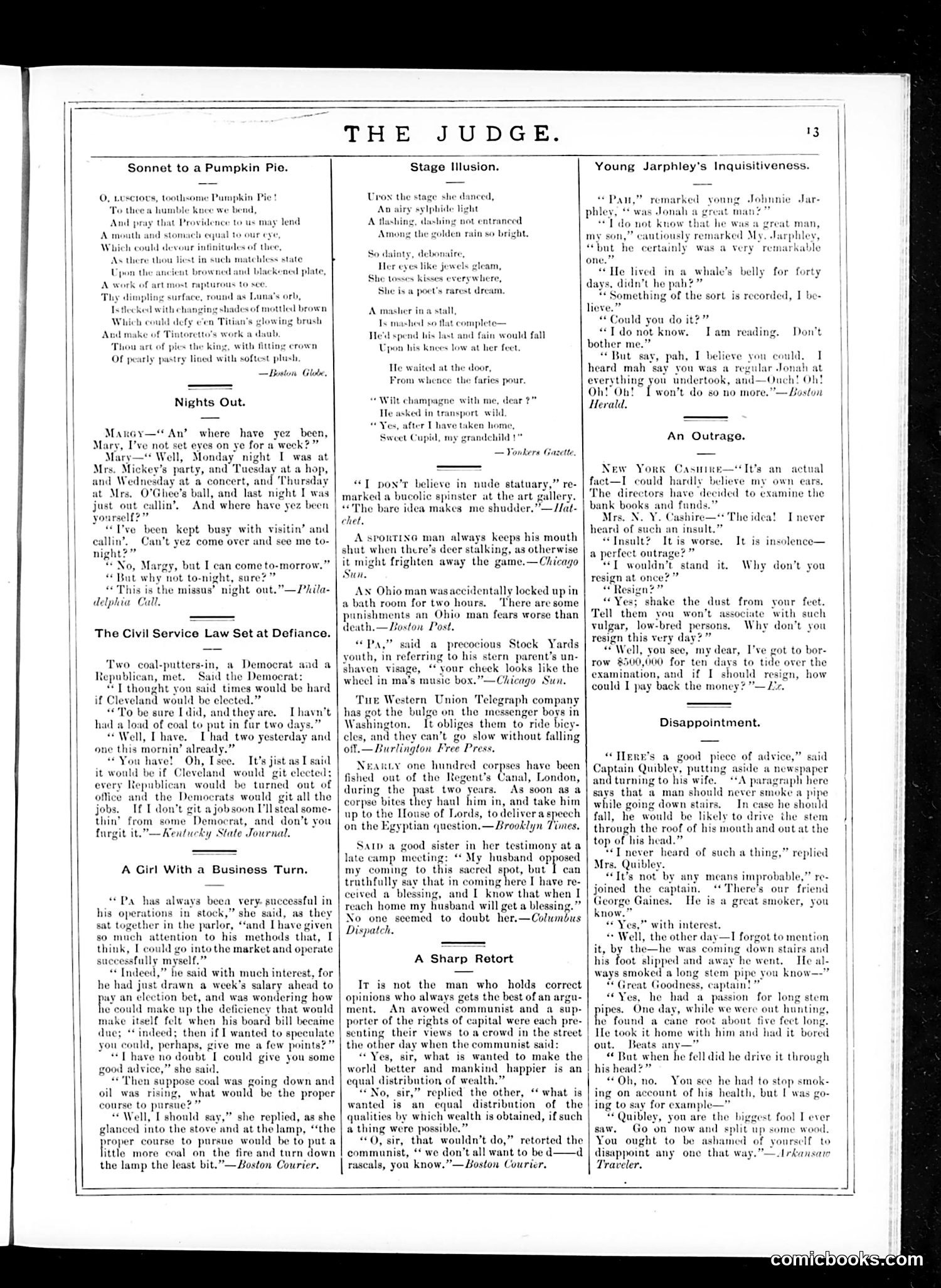
This page from **Judge** magazine (a 19th-century American satirical periodical) contains multiple brief comedic items rather than political cartoons. **Key content includes:** - **"Nights Out"**: A dialogue satirizing Irish-American working-class social life, mocking the frequency of social gatherings among women named Margy and Mary. - **"Civil Service Law Set at Defiance"**: A political satire on the spoils system. Two coal workers debate Cleveland's election; one claims times are hard but has actually received *more* work, undermining the Democratic argument. The joke targets the hypocrisy of civil service reform rhetoric versus actual patronage practices. - **"A Girl With a Business Turn"**: A gender-satire piece where a young woman claims stock-market expertise but her actual "business advice" is domestic—turn down the lamp to save coal. Other items mock art pretension, hunting etiquette, and telegraph company policies. **The satire targets**: political corruption, class stereotypes, and gender roles—typical Judge fare of the era.
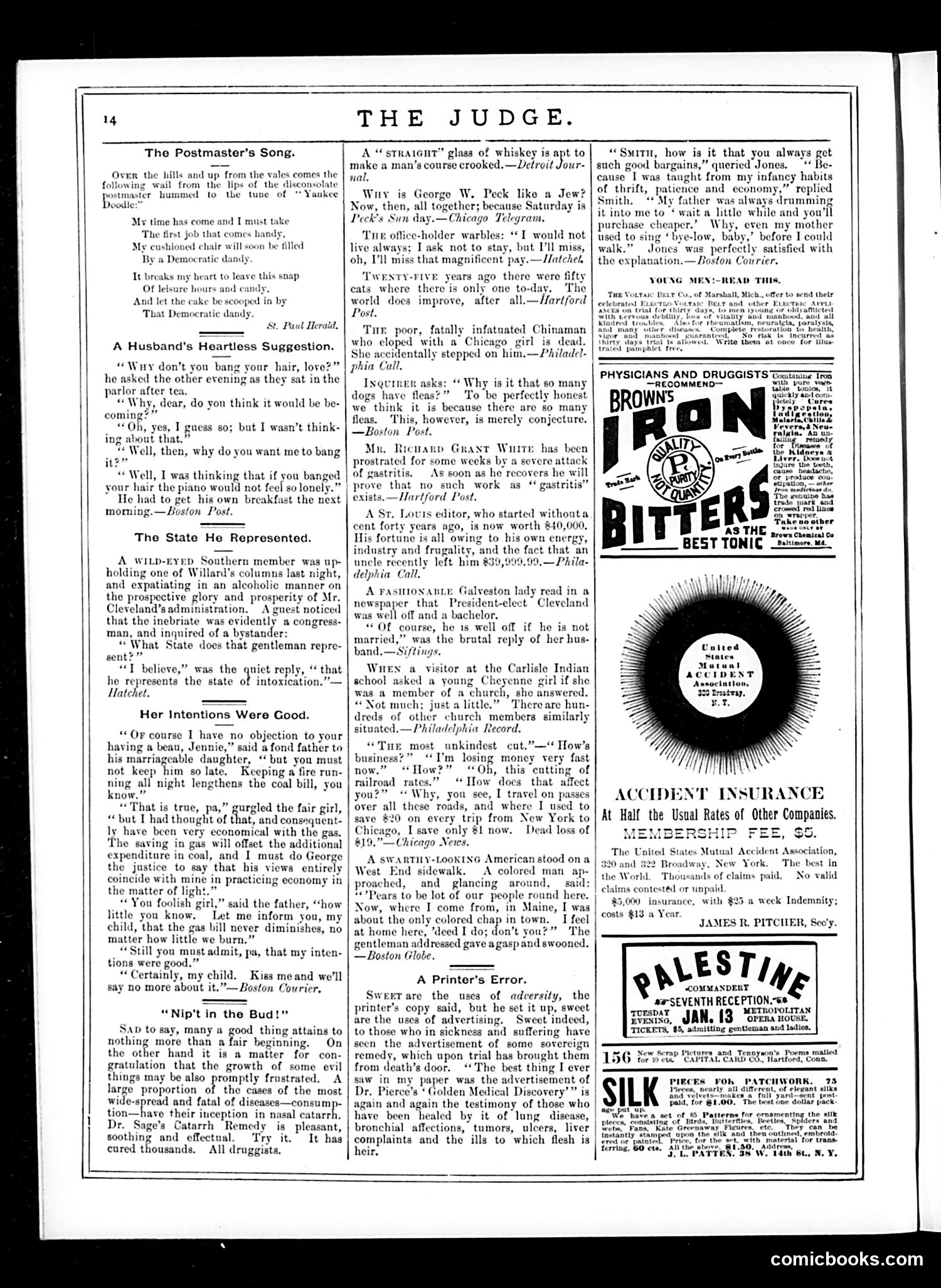
This page from Judge magazine (circa 1885-1890, based on Cleveland administration references) contains **short humorous items and advertisements** rather than political cartoons. The satirical content targets **Democratic politics and office-holders**. "The Postmaster's Song" mocks a postmaster facing removal—likely referencing the spoils system where political appointees lost jobs after administrations changed. The "State He Represented" joke ridicules a drunk Southern congressman, suggesting incompetence among Democratic politicians. Other items are **social humor**: a husband suggesting his wife bang her hair to stop the piano from feeling lonely (absurdist wit); a father catching his daughter wasting gas by keeping her beau late (domestic comedy). The advertisements for Brown's Iron Bitters, accident insurance, and patent medicines represent typical period magazine revenue. **For modern readers**: The postmaster joke references 19th-century political patronage systems where government jobs were rewards for party loyalty, not merit—a practice reformers actively opposed. The drunk congressman perpetuates stereotypes about Southern legislators.
This page is primarily **advertisements and humorous anecdotes** rather than political cartoons. The content consists of: ## Main Features: **Humor Pieces**: Short joke columns featuring everyday social situations—a boy trespassing in a yard, a student's expensive wardrobe, an apple tree producing peanuts, discussions about deception in marriage. These reflect period concerns: class differences, education costs, agricultural oddities, and gender relations. **Commercial Advertisements**: Piano manufacturers (Behning), lithography services, bicycles, candy, electric belts, and medical devices dominate the page—typical of late-19th/early-20th century magazines. ## Notable Context: The anecdotes use working-class or rural characters ("the gamin," "old Mrs. Squaggs") to deliver morals about behavior and marriage. One recurring theme: women's role in men's dishonesty—reflecting contemporary attitudes about gender and morality. The medical ads (World's Dispensary) suggest this magazine reached a broad audience seeking remedies. **This is not a political satire page** but rather a general-interest humor and advertising spread typical of Judge's format.
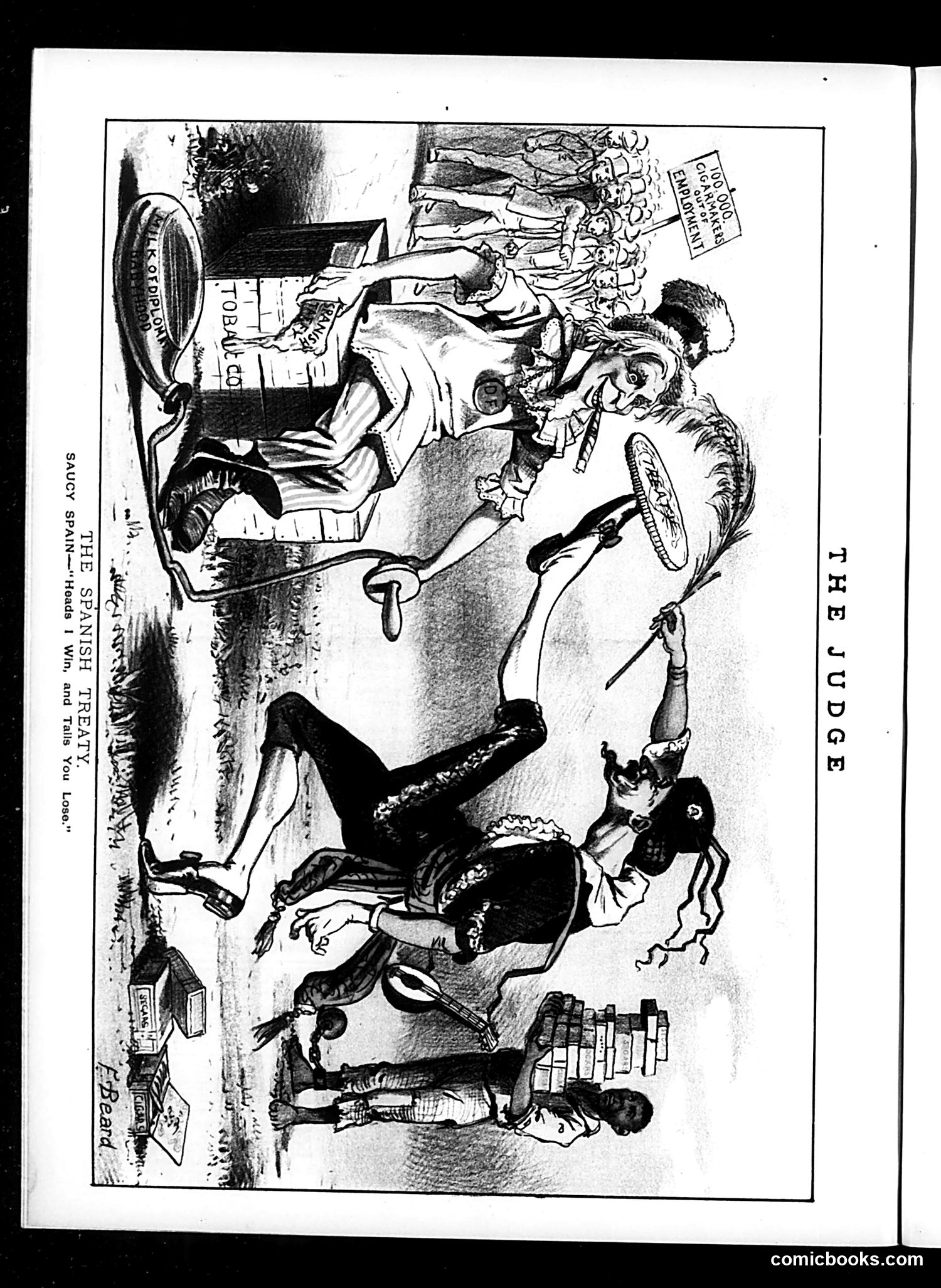
This cartoon satirizes negotiations with Spain, likely regarding colonial territories or trade disputes. The caption "Heads I Win, and Tails You Lose" suggests Spain is portrayed as unfairly advantaged in treaty discussions. The central figure labeled "SAUCY SPAIN" appears as a woman in period dress, depicted as cunning or duplicitous. The opposing American figure (likely representing the U.S. government or negotiating position) is shown in a disadvantaged or foolish posture, surrounded by what appears to be a crowd or jury. The cartoon criticizes American negotiators for accepting an unfair arrangement with Spain. The "heads or tails" phrase implies Spain manipulates outcomes regardless of the outcome, while America loses either way. This reflects contemporary frustration with American diplomatic weakness or Spanish imperial arrogance during this period of international relations.