
Judge, 1885-01-03 · page 3 of 16
Judge — January 3, 1885 — page 3: what you’re looking at
What you’re looking at
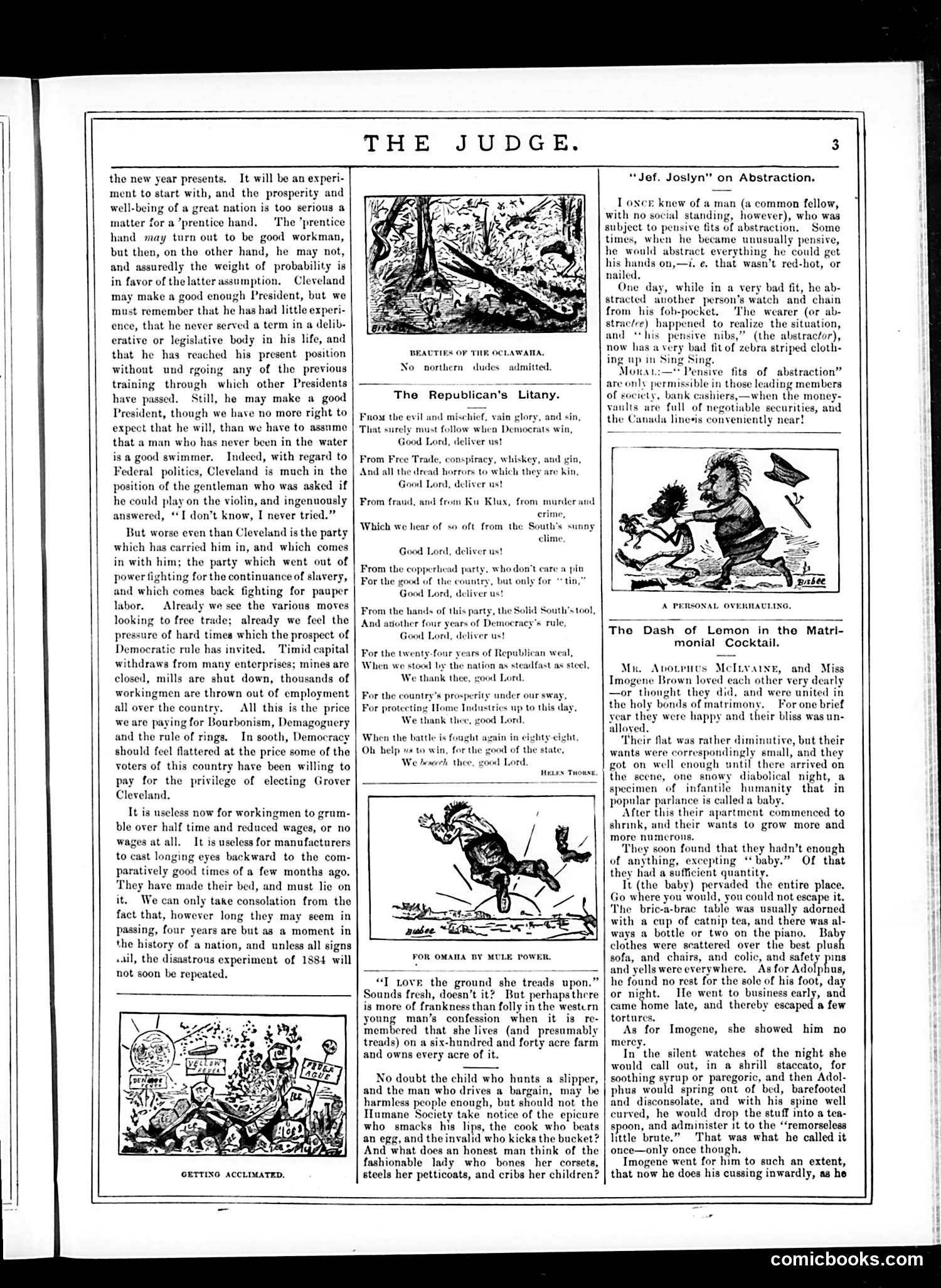
This page, likely from the 1880s, satirizes Grover Cleveland's recent election as President. The main editorial text expresses skepticism about Cleveland's inexperience—comparing him to someone who's never tried violin but claims he can play. **"The Republican's Litany"** mocks Republican fears about Democratic rule through mock-prayer format, listing anxieties: free trade, fraud, the Ku Klux Klan, and the "Solid South" (the Democratic coalition of former Confederate states). The satire suggests Republicans are using scare tactics. **"For Omaha by Mule Power"** (bottom cartoon) appears to ridicule Western crudeness or frontier behavior—the caption "I love the ground she treads upon" suggests crude frontier courtship. **"Getting Acclimated"** (bottom left) likely depicts struggles adapting to new political conditions under Democratic administration. The overall thrust critiques both Cleveland's untested leadership and the Democratic party's return to power after years of Republican dominance.
📄 Transcribed text from this page (OCR, searchable)
Machine-transcribed from the original scan — historical spelling and the odd misread are preserved.
THE JUDGE. the new year presents. It will be an experi- ment to start with, and the prosperity and well-being of a great nation is too serious a matter for a ’prentice hand. The ‘prentice hand may turn out to be good workman, but then, on the other hand, he may not, and assuredly the weight of probability is in favor of the latter assumption, Cleveland may make a good enough President, but we must remember that he has had little experi- ence, that he never served a term in a delib- erative or legislative body in his life, and that he has reached his present position without und rgoing any of the previous training through which other Presidents have passed. Still, he may make a good President, though we have no more right to ct that he will, than we have to assume man who has never been in the water is a good swimmer. Indecd, with regard to Federal politics, Cleveland is much in the position of the gentleman who was asked if he could play on the violin, and ingenuously answered, ‘I don’t know, I never tried.” But worse even than Cleveland is the party which has carried him in, and which comes in with him; the party which went out of power fighting for the continuance of slavery, and which comes back fighting for pauper labor. Already we see the various moves looking to free trade; already we feel the pressure of hard times which the prospect of Democratic rule has invited. ‘Timid capital withdraws from many enterprises; mines are closed, mills are shut down, thousands of workingmen are thrown out of employment all over the country. All this is the price we are paying for Bourbonism, Demagoguery and the rule of rings. should feel flattered at the price some of the voters of this country have been willing to pay for the privilege of electing Grover Cleveland. It is useless now for workingmen to grum- ble over half time and reduced wages, or no atall. It is useless for manufacturers to cast longing eyes backward to the com- ively good times of a few months ago. They have made their bed, and must lie on We can only take consolation from the fact that, however long they may seem passing, four years are but as a moment in the history of a nation, and unless all signs ail, the disastrous experiment of 1884 will not soon be repeated, GETTING ACCLIMATED. In sooth, Democracy | BEAUTIES OF No WE OCLAWATIA, northern dudes admitted. The Republican's Litany. Frost the evil und mischief, vain glory, and sin, That surely must follow when Democrats win, Good Lord, deliver ust From Free Trade, conspiracy, whiskey And all the dread horrors to which they are kin, Good Lord, deliver ust From fraud, and from Ku Klux, from murder and crime, Which we hear of so oft from the South's sunny clime Good Lord, deliver ust From the copperh For the good of the country, but only for Good Lord, deliver ust 1 party, whodon't c: From the hands of this party, the Solid South’st And asiother four years of Democracy’s rule, Good Lord, deliver us! For the twenty-four years of Repub! nas steadfast as stcel, weal, For the country’s prosperity under our sway, For protecting Home Industries up to this day, We thank thee, good Lord. When the battle is fough Oh help «to win, for the in in eighty-ci vd of the state, “1 Lord, Hears Thorse, FOR OMAIIA BY MULE Pow! “I Love the ground she treads upon.” Sounds fresh, doesn’t it? But. perhaps there is more of frankness than folly in the western young man’s confession when it is re- membered that she lives (and presumably treads) on a six-hundred and forty acre farm and owns every acre of it. No doubt the child who hunts a slipper, and the man who drives a bargain, may be harmless people enongh, but should not the Tlumane Society take notice of the epicure who smacks his lips, the cook who beats an egg, and the invalid who kicks the bucket? And what does an honest man think of the fashionable lady who bones her corsets, steels her petticoats, and cribs her children? “Jef. Joslyn" on Abstraction. I oxce knew of a man (a common fellow, with no social standing, however), who was subject to pensive fits of abstraction, Some times, when he became unusually pensive, he would abstract everything he could get his hands on,—i. e. that wasn’t red-hot, or nailed. One day, while in a very bad fit, hi stracted another person’s watch and ch from his fob-pocket. ‘The wearer (or ab- strac/re) happened to realize the situation, and ‘his pensive nib (the abstractor), now has a very bad fit of zebra striped cloth- ing up in Sing Sing. Morat:—** Pensive fits of abstraction” are only permissible in those leading members of society, bank cashiers,—when the money Its ure full of negotiable securities, and the ¢ ja linesis conveniently near! A PERSONAL OVERIAUL The Dash of Lemon in the Matri- monial Cocktail. Mn Apotenus MeItvaine, and Mi Imoge' Brown loved each other very dearly —or thonght they did. and were united in the holy bonds of matrimony. For one brief year they were happy and their bliss was un- alloyed. Their flat w: wants were corre rather diminutive, but their pondingly small, and they got on well enough until there arrived on the scene, one snowy diabolical night, a specimen of infantile humanity that’ in popular parlance is called a baby. After this their apartment commenced to shrink, and their wants to grow more and more numerous. They soon found that they hadn’t enough of anything, excepting “baby.” Of that they had a sufficient quantity. It (the baby) pervaded the entire place. Go where you would, you could not escape it. The bric-a-brac table was usually adorned with a cup of catnip tea, and there was al- sa bottle or two on the piano. Bab clothes were scattered over the best plush sofa, and chairs, and colic, and safety pins and yells were everywhere. As for ‘Adolphus, he found no rest for the sole of his foot, day or night. le went to business early, and came home late, and thereby escaped a few tortures, ‘As for Imogene, she showed him no mercy. In’ the silent watches of the night she would call out, in a shrill staccato, for soothing syrup or paregoric, and then Adol- phus would spring ont of ‘bed, barefooted and disconsolate, and with his spine well curved, he would drop the stuff into a tea- spoon, and administer it to the ‘remorseless little brute.” That was what he called it once—only once though. Imogene went for him to such an extent, that now he does his cussing inwardly, as he comicbooks.com