
A complete issue · 16 pages · 1884
Judge — December 27, 1884
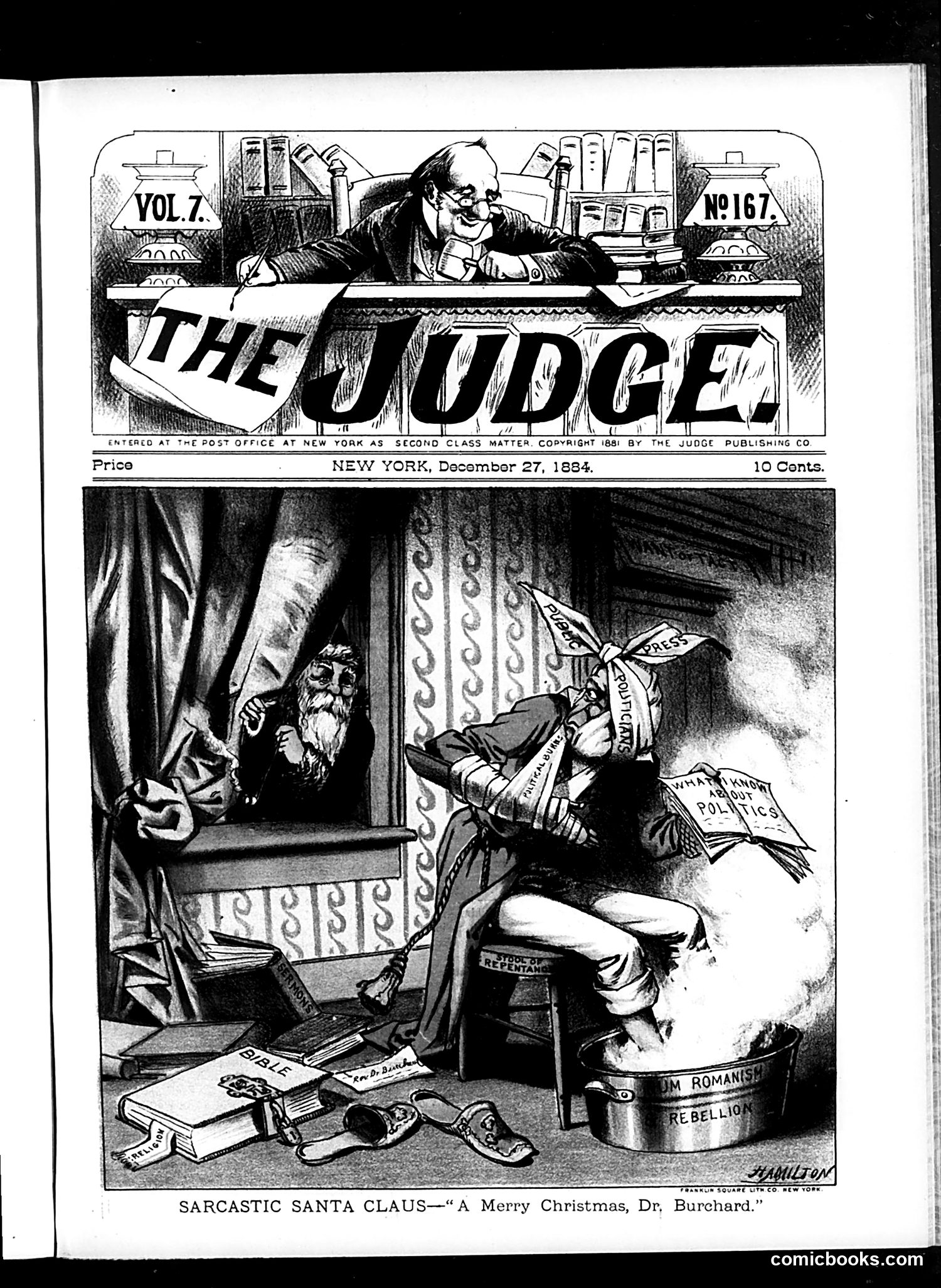
This December 27, 1884 *Judge* cartoon satirizes Dr. Burchard, a Protestant minister whose recent remarks about Republicans and Democrats apparently caused controversy. The caption's sarcastic tone suggests Burchard made inflammatory political statements. The cartoon depicts Burchard as Santa Claus, ironically delivering unwanted "gifts"—labeled items visible in the image including "Bible," "Rebellion," and "Romanism"—to a bearded man at a window. These labels likely represent divisive issues Burchard had invoked: religious doctrine, Civil War sectional tensions, and anti-Catholic sentiment (common Protestant concerns of the era). The satire mocks Burchard's politicization of religion and his inflammatory rhetoric during the election season, presenting his divisive "gifts" as anything but merry.
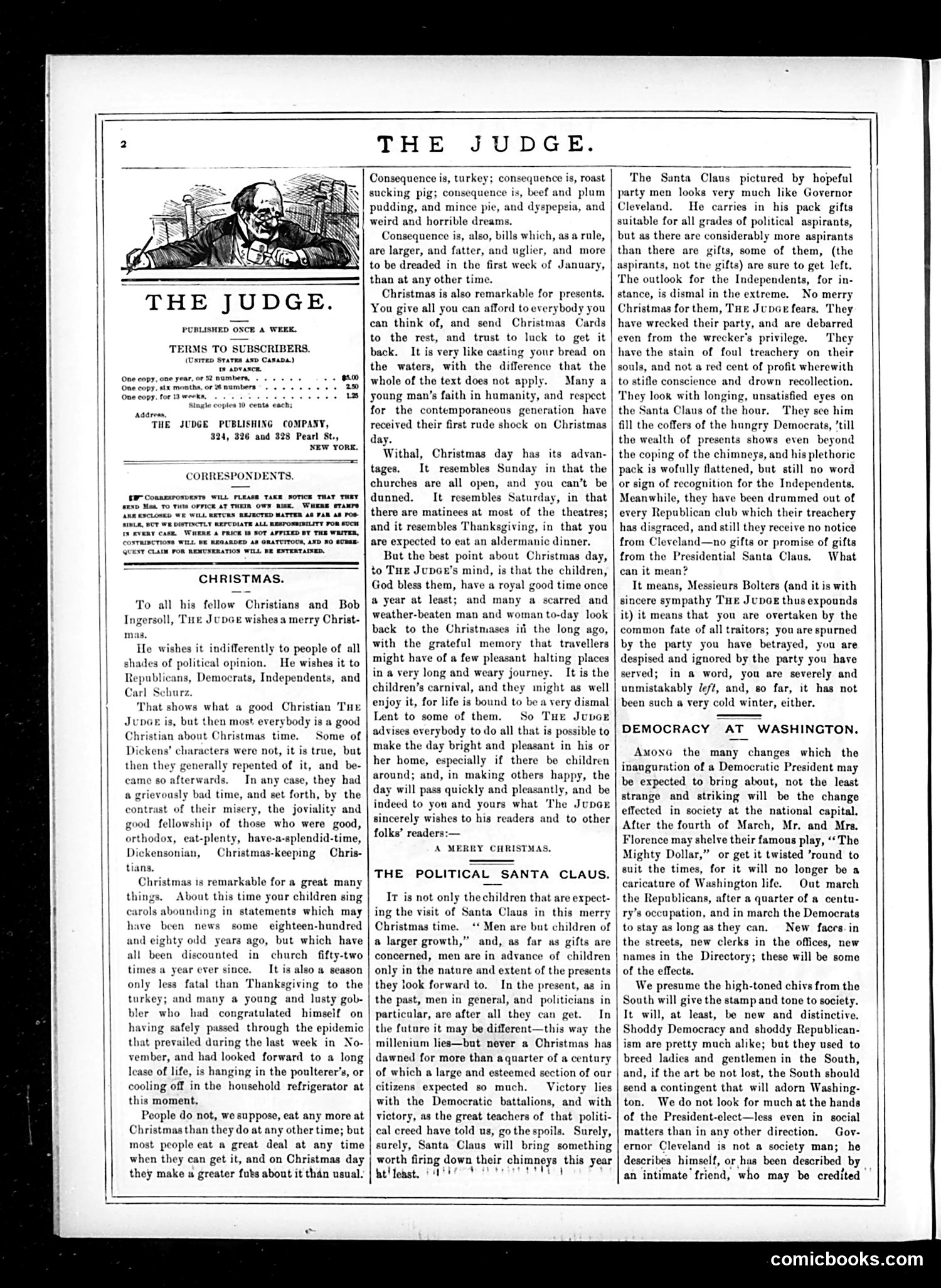
This page contains editorial content about Christmas rather than political cartoons. The main article, "Christmas," is Judge's annual holiday greeting to readers of all political persuasions—Republicans, Democrats, Independents, and even Carl Schurz (a prominent Liberal Republican politician). The satire mocks Christmas excess: excessive eating leads to dyspepsia and "weird and horrible dreams"; gift-giving, framed as "casting bread upon waters," often disappoints when generosity isn't reciprocated. The second article, "The Political Santa Claus," satirizes how politicians—particularly Republicans—cynically court voters (especially Democrats in Cleveland's Ohio) with promises of patronage and gifts, treating citizens like children expecting Santa's bounty. The humor targets the gap between Christmas charity's ideals and commercial/political self-interest.
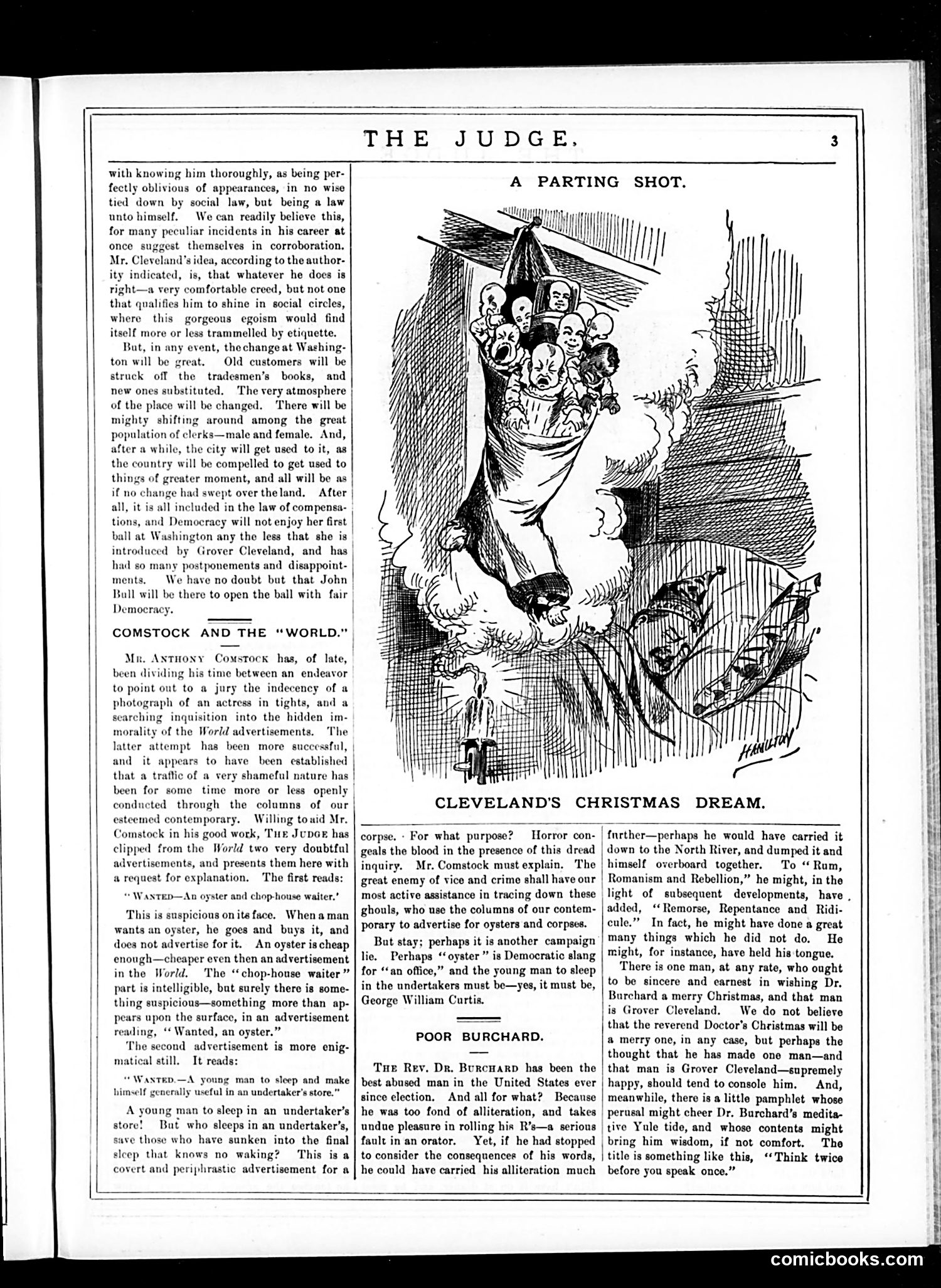
This *Judge* page ridicules incoming President Grover Cleveland and mocks his political opponents through three pieces. **"Cleveland's Christmas Dream"** (main cartoon): Shows Cleveland's head dispensing Democratic office-seekers like gifts from a cornucopia. It satirizes the inevitable patronage appointments following his election—the "spoils system" where the winning party rewards loyalists with government jobs. **"Comstock and the 'World'"**: This mocks moral crusader Anthony Comstock's attempts to suppress vice. *Judge* clips two seemingly innocent job advertisements from the *World* newspaper and pretends they're coded references to Democratic corruption—"oyster" as slang for "office," and the undertaker position as referencing George William Curtis (likely a political enemy). The satire exposes how Comstock's investigations could find scandal anywhere through interpretation. **"Poor Burchard"**: References Rev. Burchard, apparently a controversial figure post-election, though details are unclear here. The page demonstrates *Judge*'s partisan Republican mockery of Cleveland's Democratic administration and its critics' obsessions.
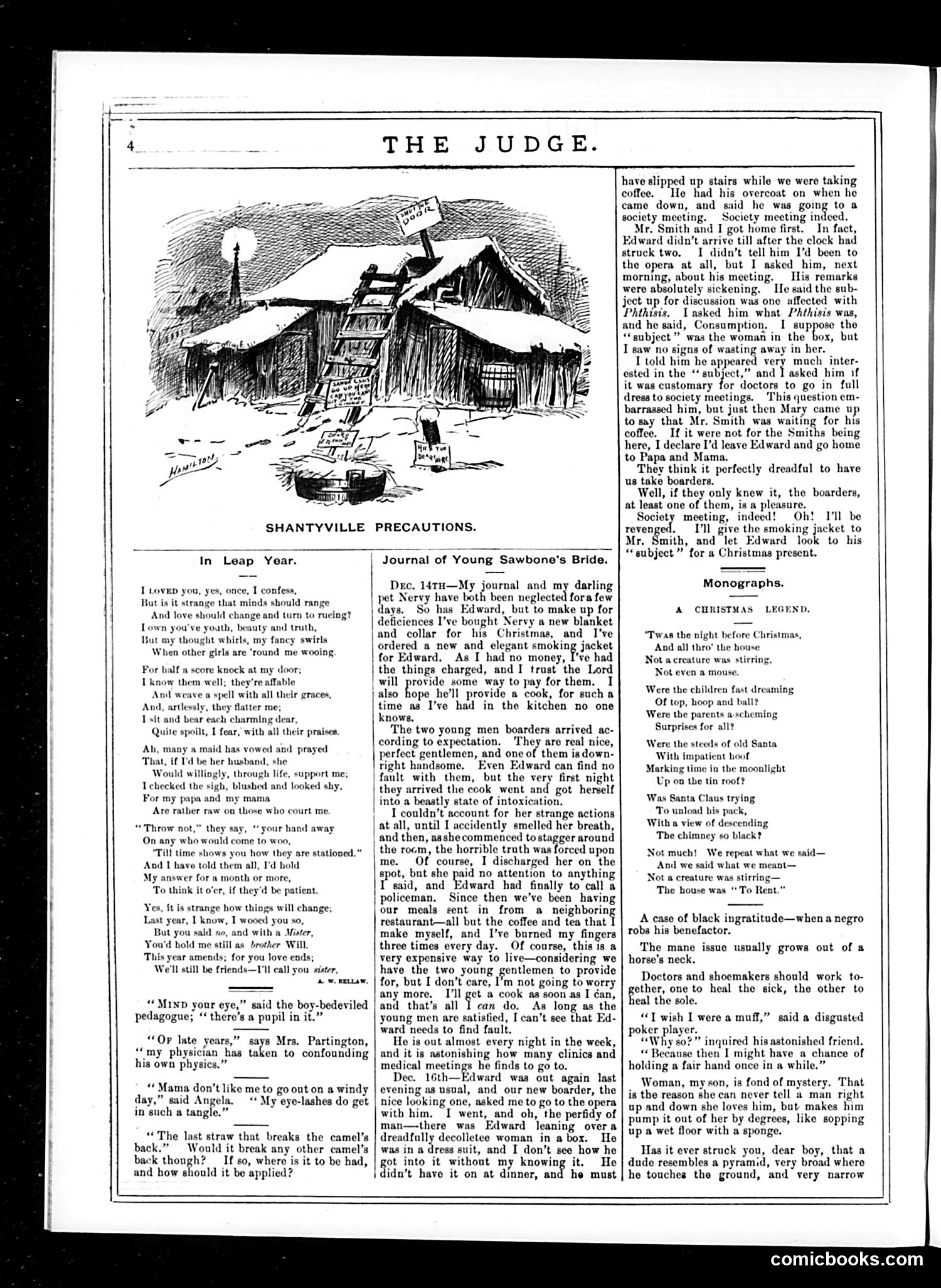
This Judge page contains three satirical pieces mocking social conventions of the era (appears to be late 1800s based on style). The main cartoon depicts a run-down shanty labeled "Shantyville Precautions," illustrating the practical hardships of poverty—likely social commentary on inadequate living conditions. The text pieces target courtship customs and domestic life: "In Leap Year" satirizes the tradition allowing women to propose, portraying a fickle suitor; "Journal of Young Sawbone's Bride" mocks a naive newlywed wife managing household chaos while her husband attends suspicious evening "clinics," culminating in her discovering him flirting with another woman at the opera. The humor relies on hypocrisy—she overlooks expenses and her cook's drunkenness to please male boarders, yet her husband's infidelity goes unremarked until observed directly. The satire targets both marital deception and women's complicity through domestic blindness.
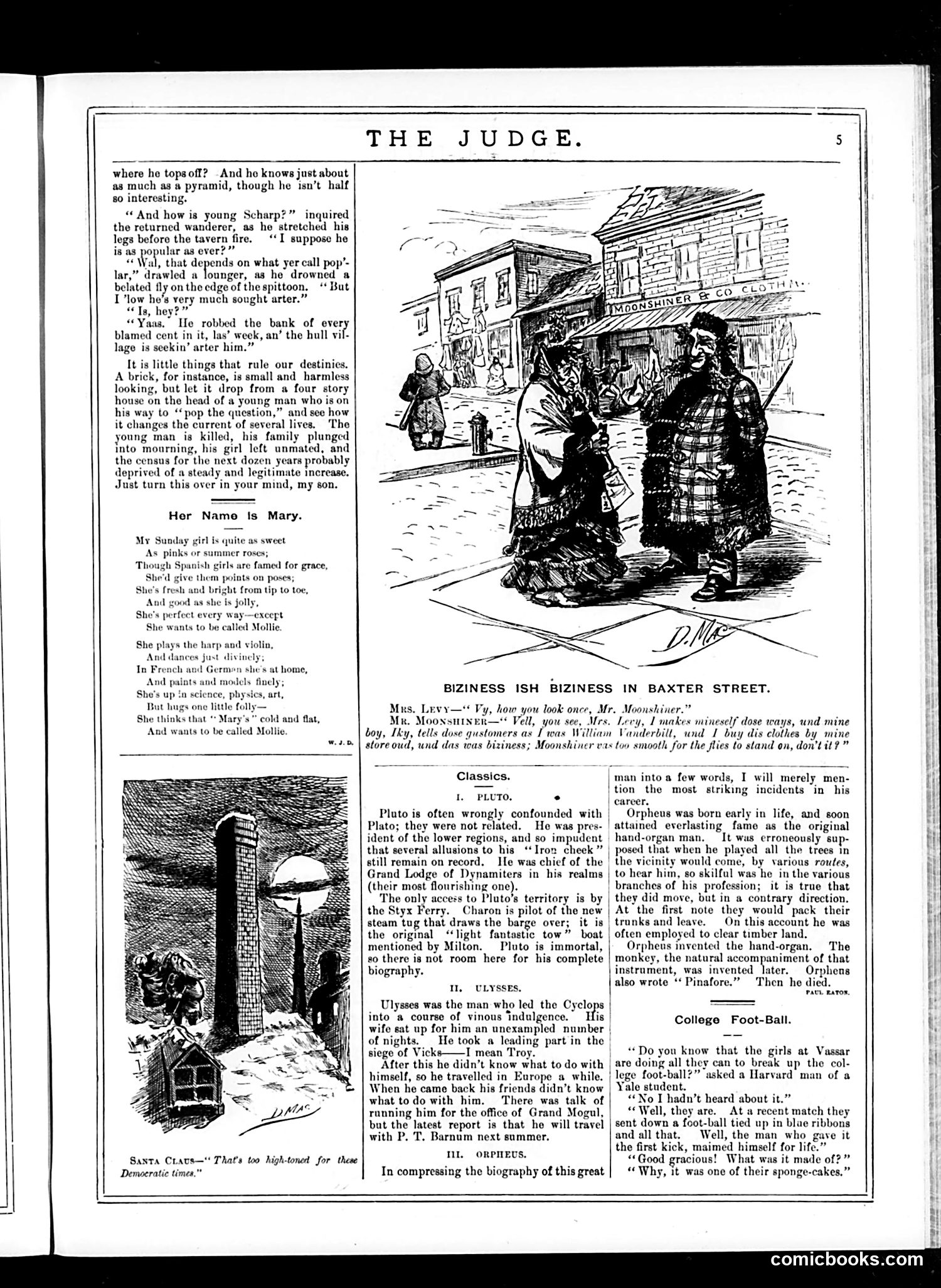
This page combines several satirical pieces typical of Judge's late 19th-century humor: **"Biziness ish Biziness in Baxter Street"** (center cartoon): A German immigrant ("Moonshiner") describes his business practices using broken English, claiming he advertised through a boy spreading rumors that he robbed a bank. The satire mocks both immigrant dialect humor and sketchy business ethics as acceptable if profitable—reflecting period xenophobia and commercial amorality. **"Her Name Is Mary"** (poem): Gentle satire on social pretension. A girl named Mary wants to be called "Mollie" because "Mary's" considered too plain/democratic for aspirational society—mocking class anxiety and affectation. **"Classics" (right column)**: Mock-scholarly definitions of Pluto, Ulysses, and Orpheus contain absurdist non-sequiturs (Pluto as "chief of the Grand Lodge of Dynamiters"; Orpheus as a hand-organ man), satirizing both pretentious classical education and American ignorance of it. The overall tone reflects Judge's tendency toward punching down at immigrants, women's vanity, and pretension while celebrating irreverent irreverence.
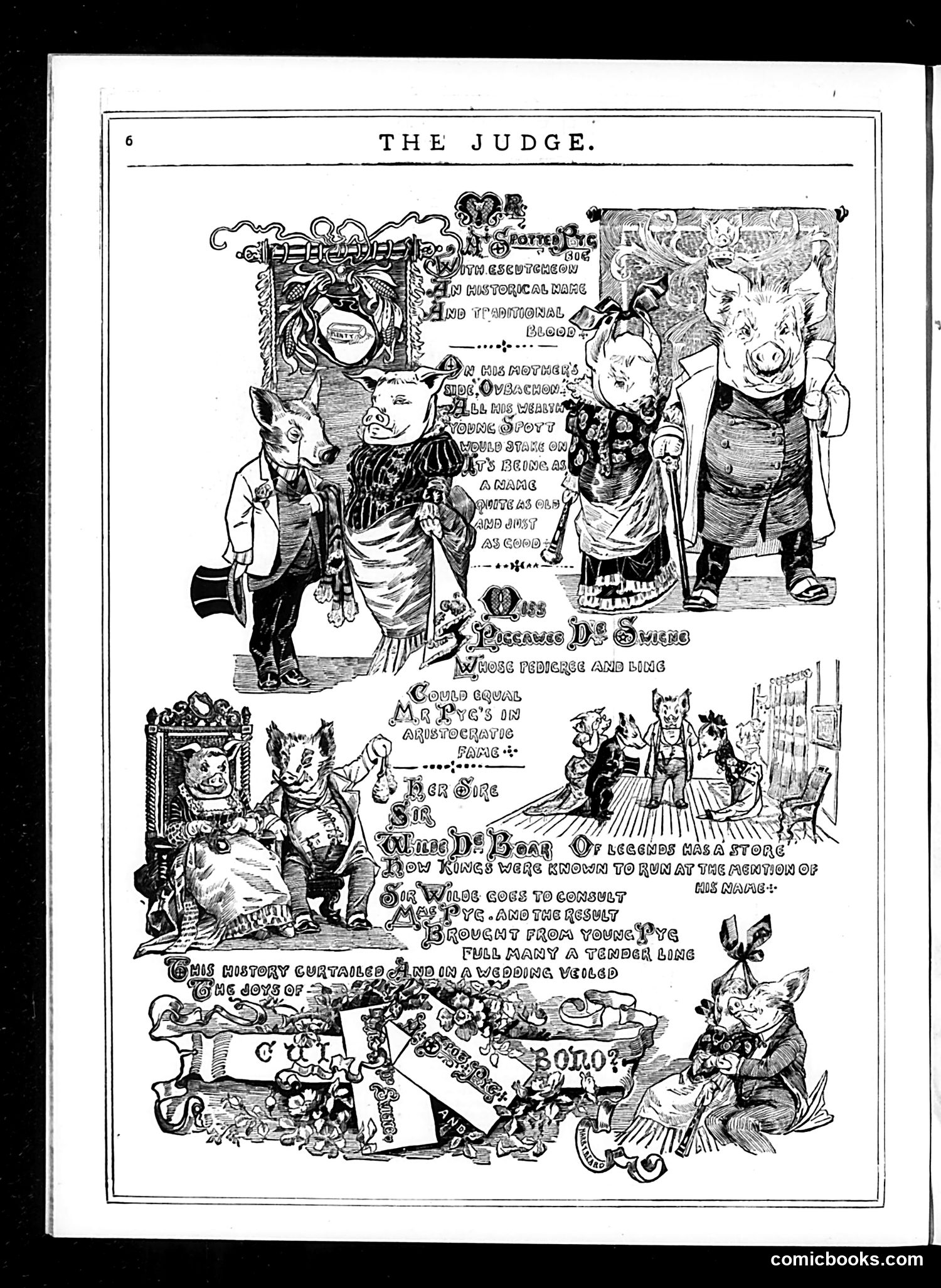
This appears to be a multi-panel satirical piece mocking aristocratic pretension and genealogy. The central figure seems to be someone (possibly labeled "Mr. Pye") claiming aristocratic credentials through dubious family lineage. The cartoon ridicules the obsession with "pedigree and lineage"—showing how people of modest means fabricate noble ancestry. The satire targets wealthy Americans who constructed fake or exaggerated family histories to gain social status. References to "legends," "kings," and noble connections suggest the cartoon mocks these invented pedigrees. The elaborate decorative border and ornate framing style itself parodies the pretentiousness being criticized. The subplot about consulting and consequent disappointment suggests exposure of fraudulent genealogical claims. This likely reflects late-19th/early-20th-century American anxieties about social climbing and class mobility during the Gilded Age.
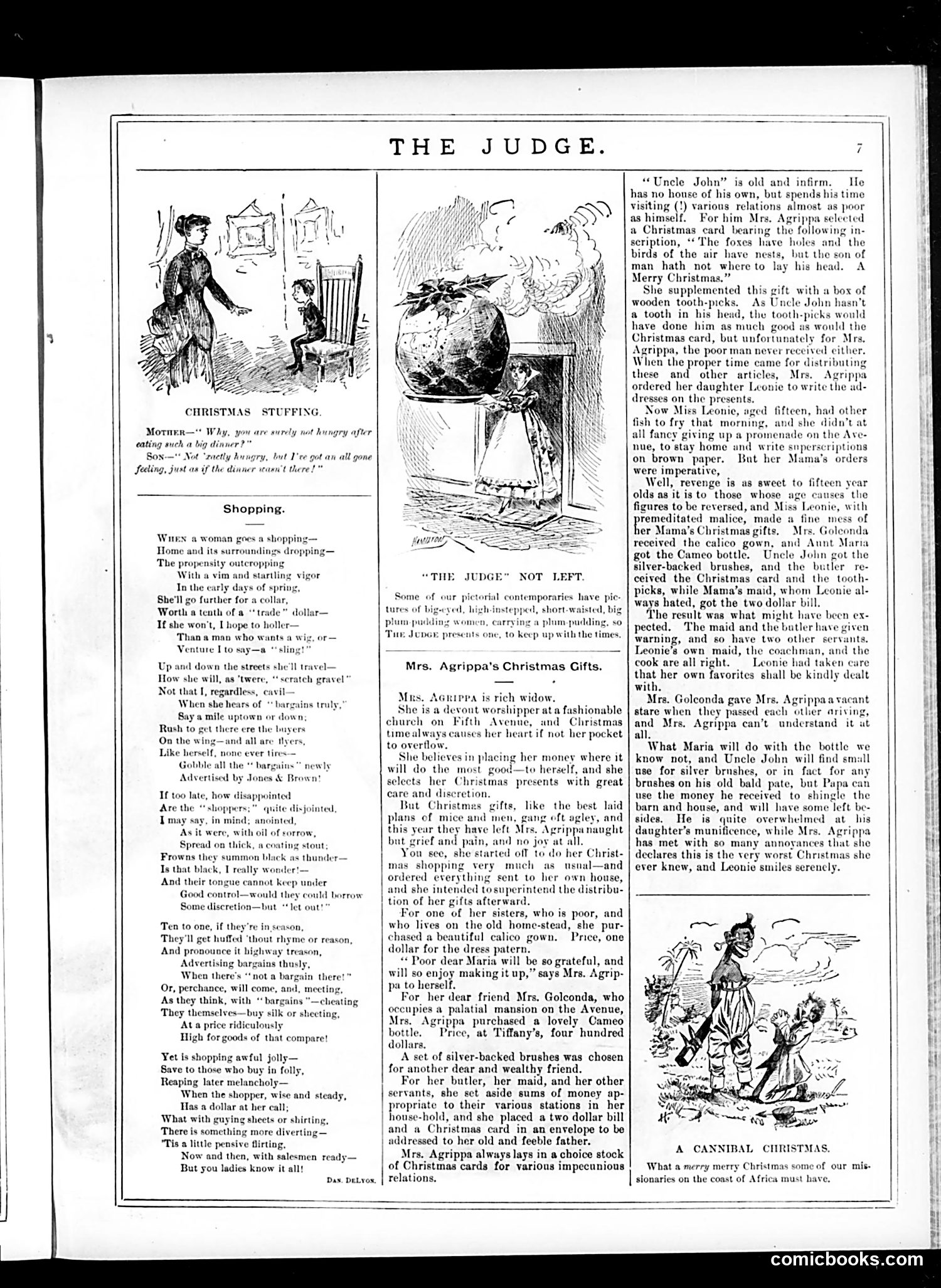
This satirical story mocks a rich widow, Mrs. Agrippa, whose Christmas gift-giving reveals her callousness toward poorer relatives. The joke hinges on glaring class disparities: she gives her poor sister Maria a $1 calico dress pattern (expecting gratitude), while her wealthy friend Mrs. Golconda receives a $400 Cameo bottle from Tiffany's. Her elderly, homeless Uncle John gets only a Christmas card—with a $2 bill. The satire exposes how Mrs. Agrippa congratulates herself for "placing her money where it will do the most good—to herself." She believes she's generous while actually showering luxury on the already-wealthy and treating poor relatives as objects of pity deserving pittances. The page also includes lighter comedic pieces about Christmas dinner and women's shopping behavior, but the main satirical target is wealthy hypocrisy disguised as Christian charity—a common Judge magazine theme.
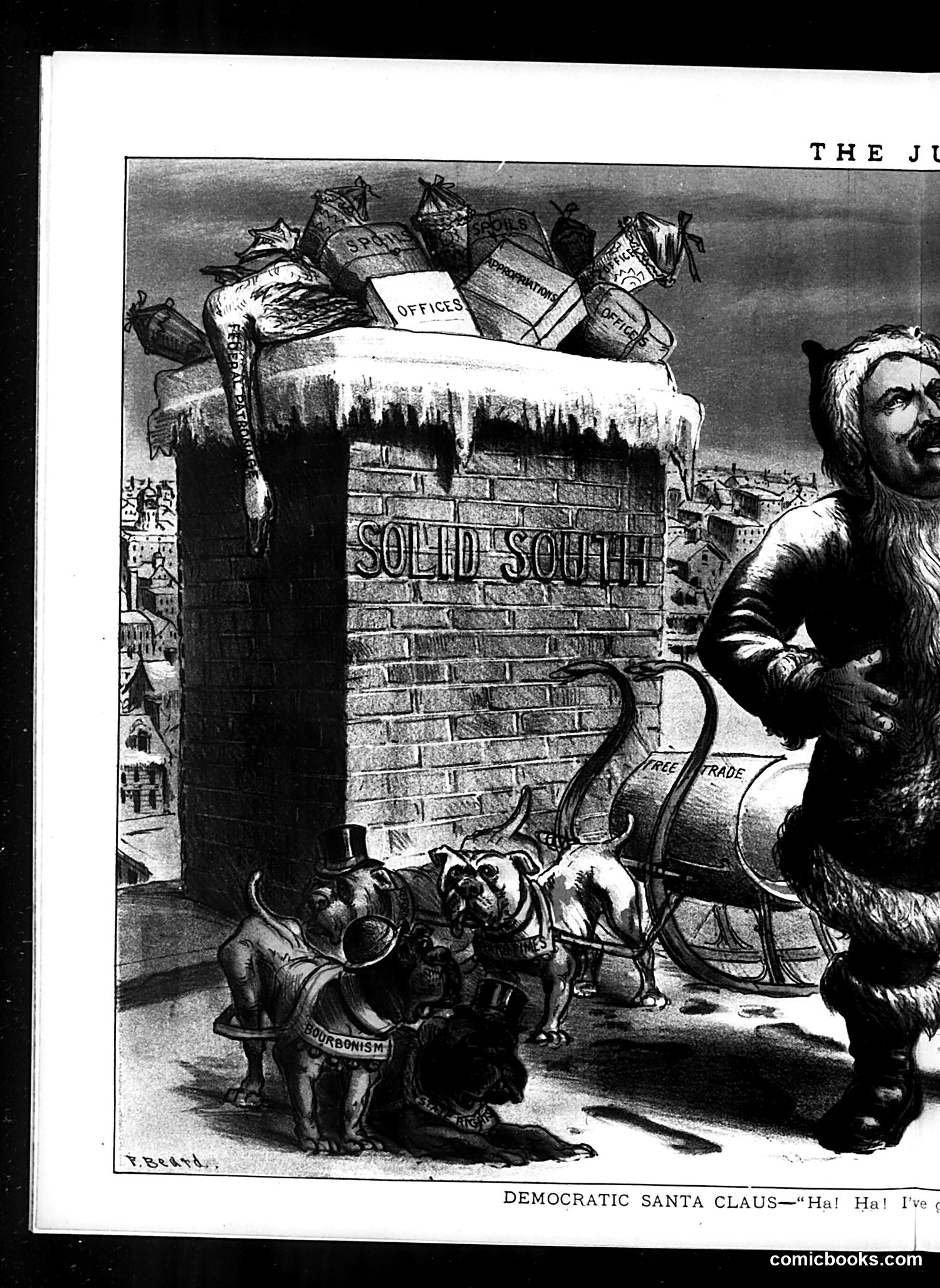
This Judge magazine cartoon satirizes the Democratic Party's approach to governance. The central figure is labeled "SOLID SOUTH" (a brick wall), representing the Democratic Party's reliable Southern voter base. A bearded figure (likely representing a Democratic politician or the party itself as "Santa Claus") pulls a cart overflowing with gifts labeled "OFFICES," "PATRONAGE," and other benefits—symbolizing political spoils and patronage. Small dogs labeled "ANARCHISM" and other radical elements pull in the opposite direction, suggesting internal party chaos or factionalism. The satire mocks Democrats for using government jobs and favors to maintain Southern political loyalty while struggling to control more radical party elements. The "Santa Claus" reference implies the party buys support through material rewards rather than principled governance.
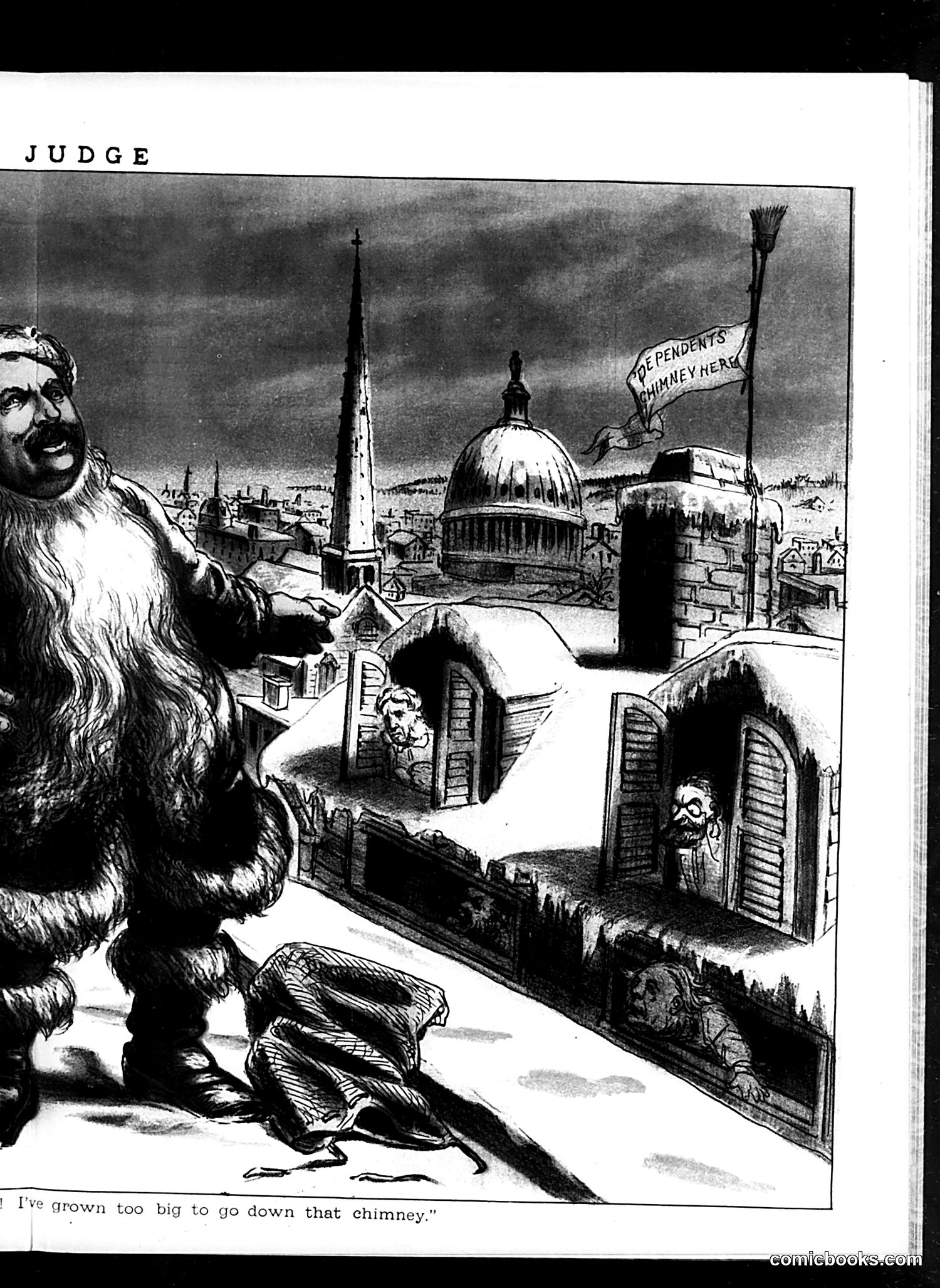
This political cartoon depicts a large, bearded figure (appearing to represent a powerful entity or monopoly) standing over London's skyline, declaring "I've grown too big to go down that chimney." The figure references the children's story of Santa Claus, but inverts it darkly—suggesting someone/something has become too enormous or powerful to fit through conventional channels (literally and metaphorically). The banner reading "DEPENDENTS CHIMNEY HERE" indicates this relates to social welfare or dependency systems. The satire likely critiques industrial monopolies or wealthy interests that have grown so large they circumvent normal legal/social mechanisms. The London setting and Victorian aesthetic suggest this addresses British economic or political conditions of that era, though the specific historical context requires additional research to pinpoint precisely.
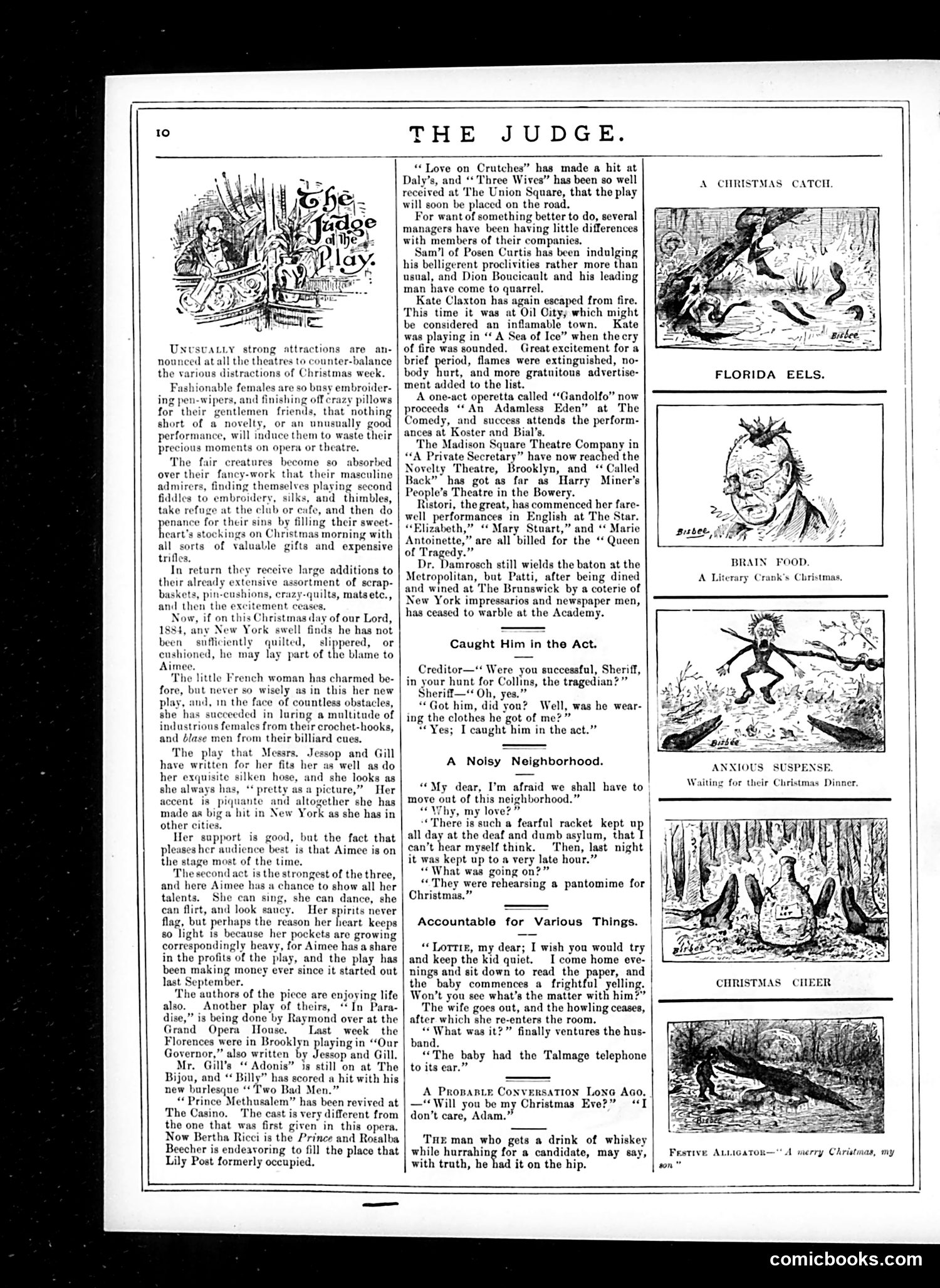
This page reviews New York theater during the Christmas season. The main article discusses **Aimee**, a French actress starring in a new play by Jessop and Gill, praising her charm and talent while noting she's drawing audiences away from holiday domestic activities (embroidery, fancy work). The piece satirizes how wealthy New York men must compensate their wives with expensive gifts (quilts, slippers, cushions) after losing them to theater—blaming the actress for disrupting the social order. It's gentle social satire about gender roles and theatrical economics. The surrounding brief items note: actress **Kate Claxton** escaped another fire (referencing her famous 1876 escape that became part of her brand); various theatrical feuds among managers; and competing productions around the city. The right side features humorous **Christmas-themed illustrations** with captions—"Florida Eels," "Brain Food," "Anxious Suspense," "Christmas Cheer," and "Festive Alligator"—typical of Judge's illustrated humor format, though their specific jokes require seeing the images clearly. This is entertainment/theater criticism combined with satirical commentary on Victorian social customs.
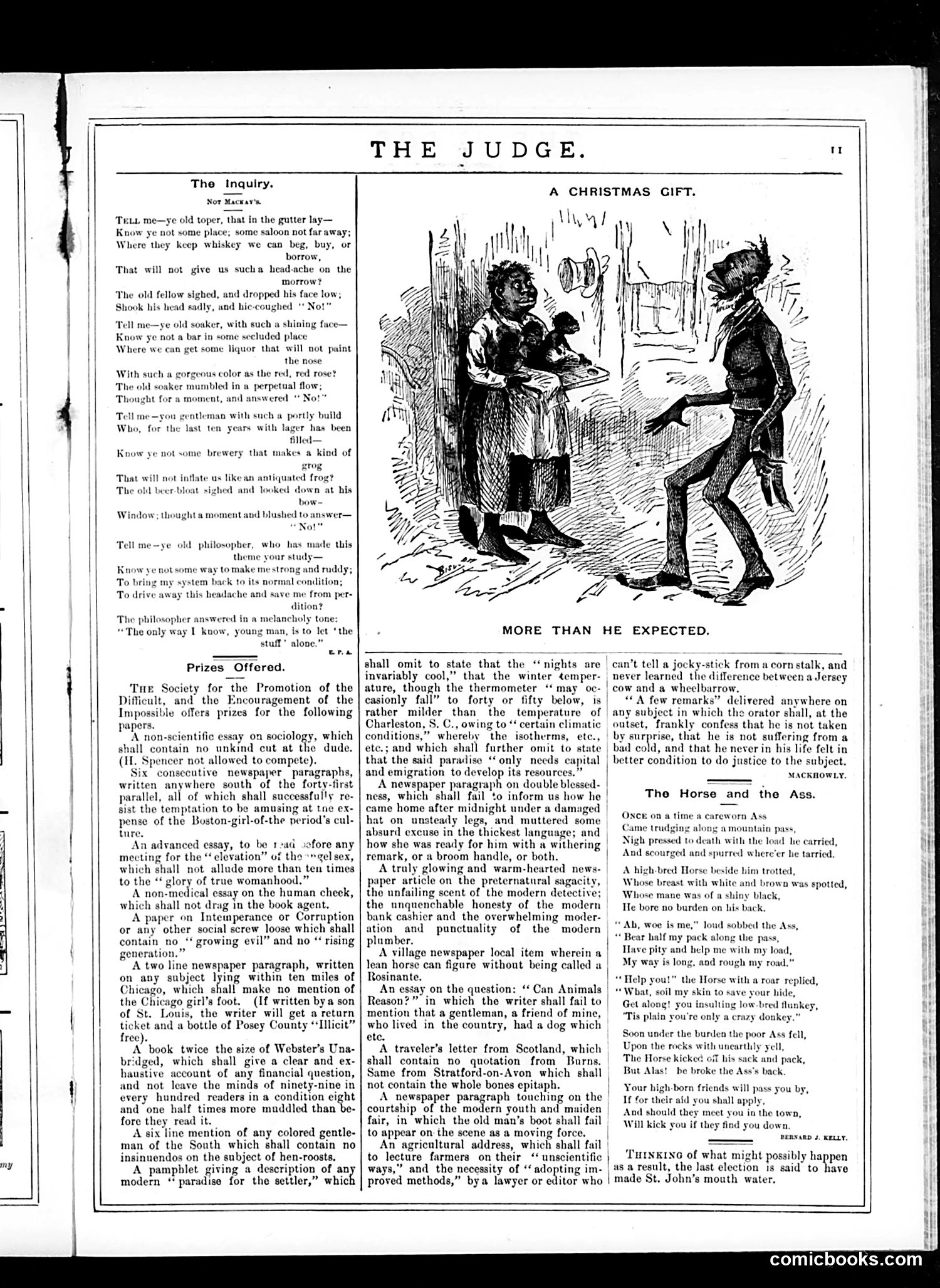
This cartoon satirizes a common Victorian scenario: a vagrant or homeless man receives an unexpected gift—likely money or assistance—from a well-dressed gentleman. The joke is in the title's irony: the poor man gets "more than he expected" because he anticipated nothing, yet receives genuine help rather than the usual dismissal or cruelty. The accompanying text "The Inquiry" mocks chronic drunks seeking advice on where to find alcohol that won't cause hangovers—a futile search. The "Prizes Offered" section is meta-satire: *Judge* humorously announces impossible writing contests, ridiculing newspaper clichés of the era (Boston girls, Chicago girls' fashions, colonial settlement propaganda, etc.). These pieces collectively lampoon both human folly and journalistic triteness.
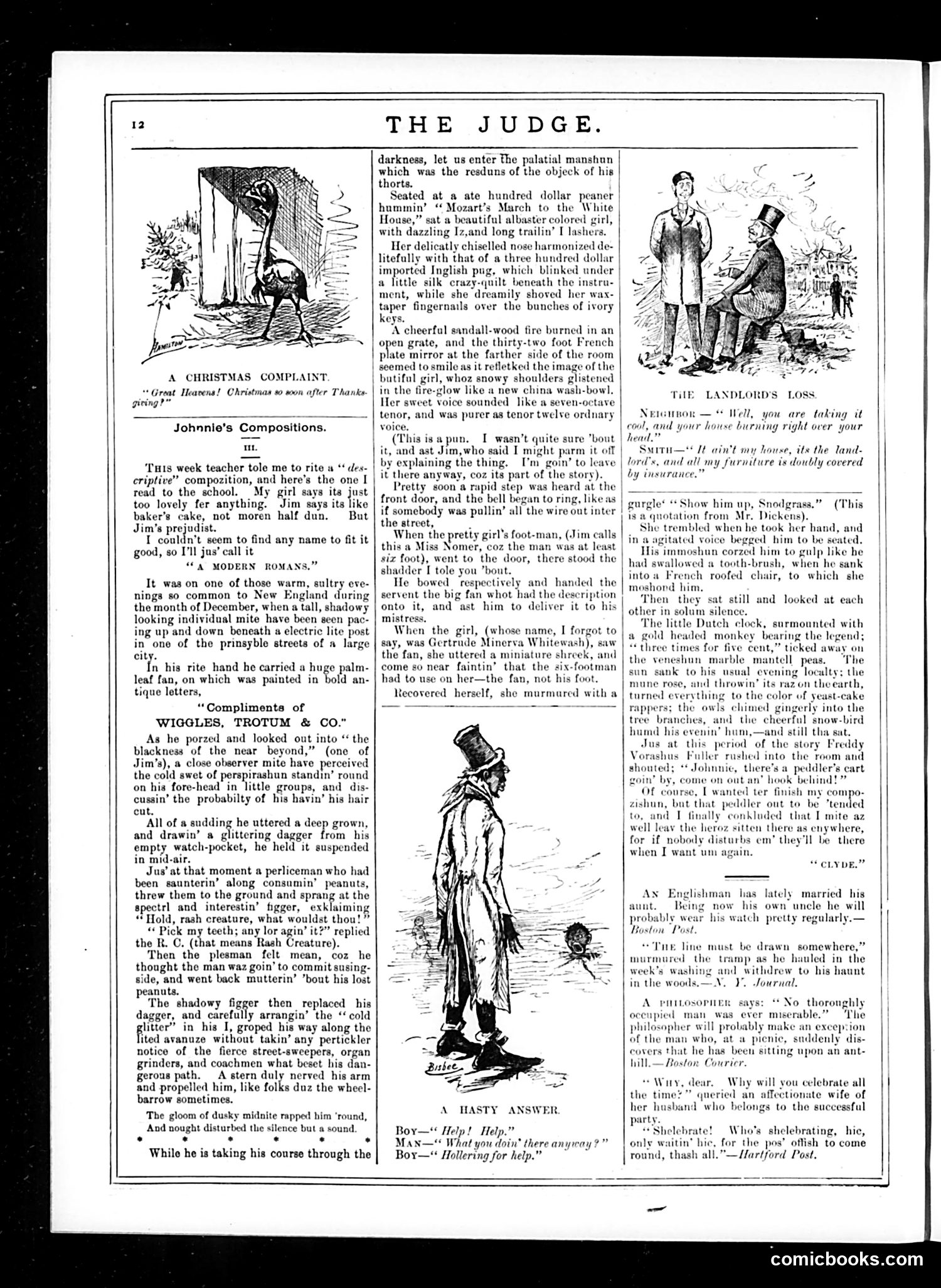
This page satirizes a schoolboy's creative writing assignment. "Johnnie's Compositions" presents an intentionally overwrought, misspelled "descriptive composition" titled "A Modern Romans"—a melodramatic story about a mysterious man contemplating suicide with a dagger near a beautiful woman's mansion. The humor operates on multiple levels: the boy's deliberate misspellings ("resduns," "butifal," "shadder"), his malapropisms ("Miss Nomer" for misnomer), forced literary pretension ("gloom of dusky midnite"), and clumsy attempts at sophistication. The accompanying sketches show comic scenes from his overwrought narrative. The satire targets both overwrought Victorian literary conventions and the earnest mediocrity of student writing. The boy's note that his girlfriend loves it while his friend Jim dismisses it adds realism—a commentary on how poorly-written drama appeals to certain audiences. This reflects late-19th-century American magazine humor mocking pretentious writing and youthful pomposity.
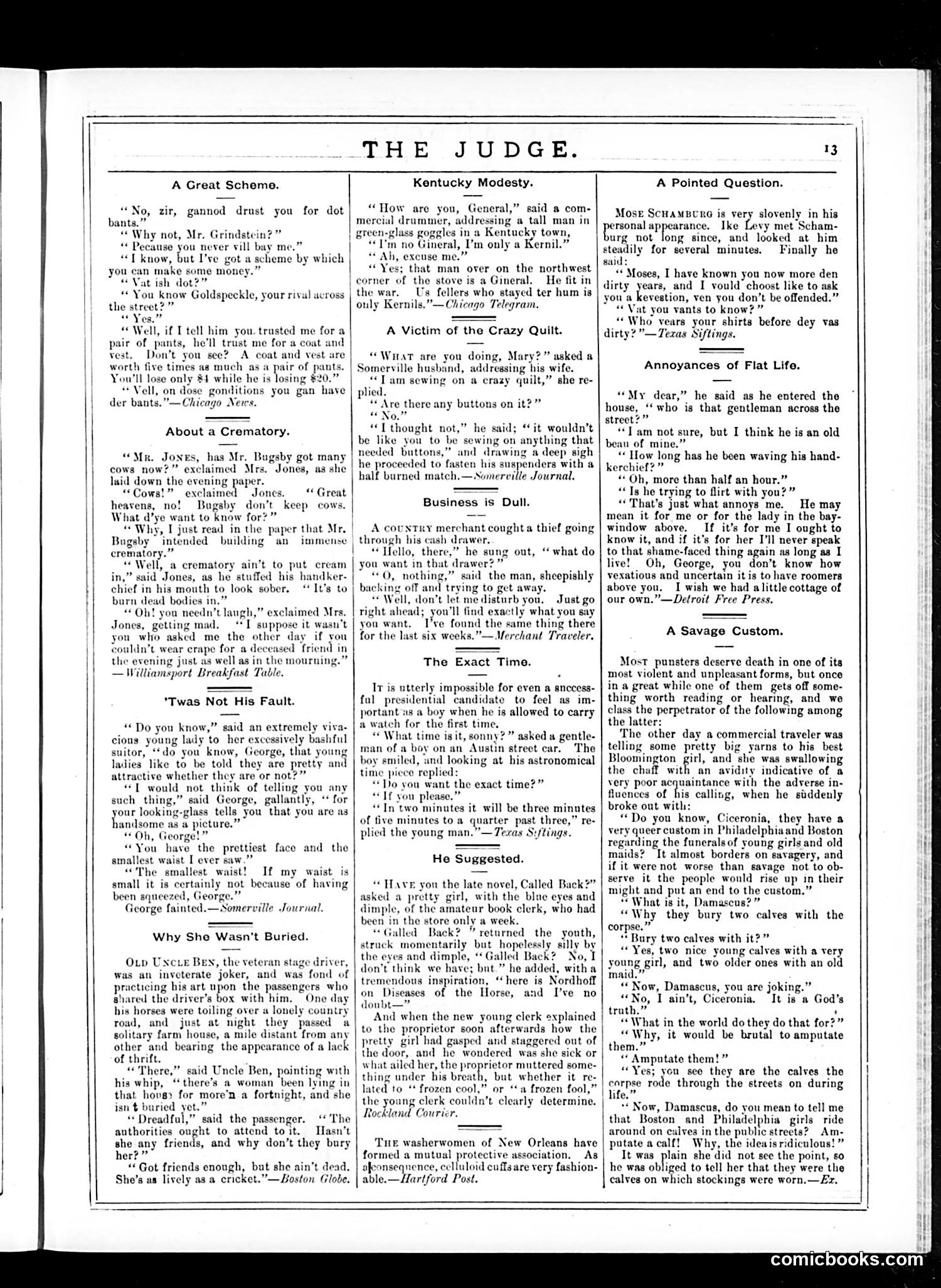
This page from *Judge* magazine contains several brief humorous anecdotes rather than political cartoons. The jokes satirize American social types and situations: **"A Great Scheme"** mocks Jewish immigrants (indicated by the Yiddish accent spelling) and their perceived dishonesty in business dealings. **"About a Crematory"** plays on a woman's misunderstanding of the word "crematory," confusing it with cream—a simple pun joke. **"Why She Wasn't Buried"** features Uncle Ben, a stock character of rural American humor, pranking a passenger by claiming a woman in a farmhouse has been dead for weeks (she's actually alive). **"Kentucky Modesty"** stereotypes rural Kentuckians as overly modest about rank. The remaining pieces mock married life, business failure, and female fashion quirks. These are genteel, domestic satires typical of *Judge*'s era—focusing on social embarrassment and wordplay rather than political critique.
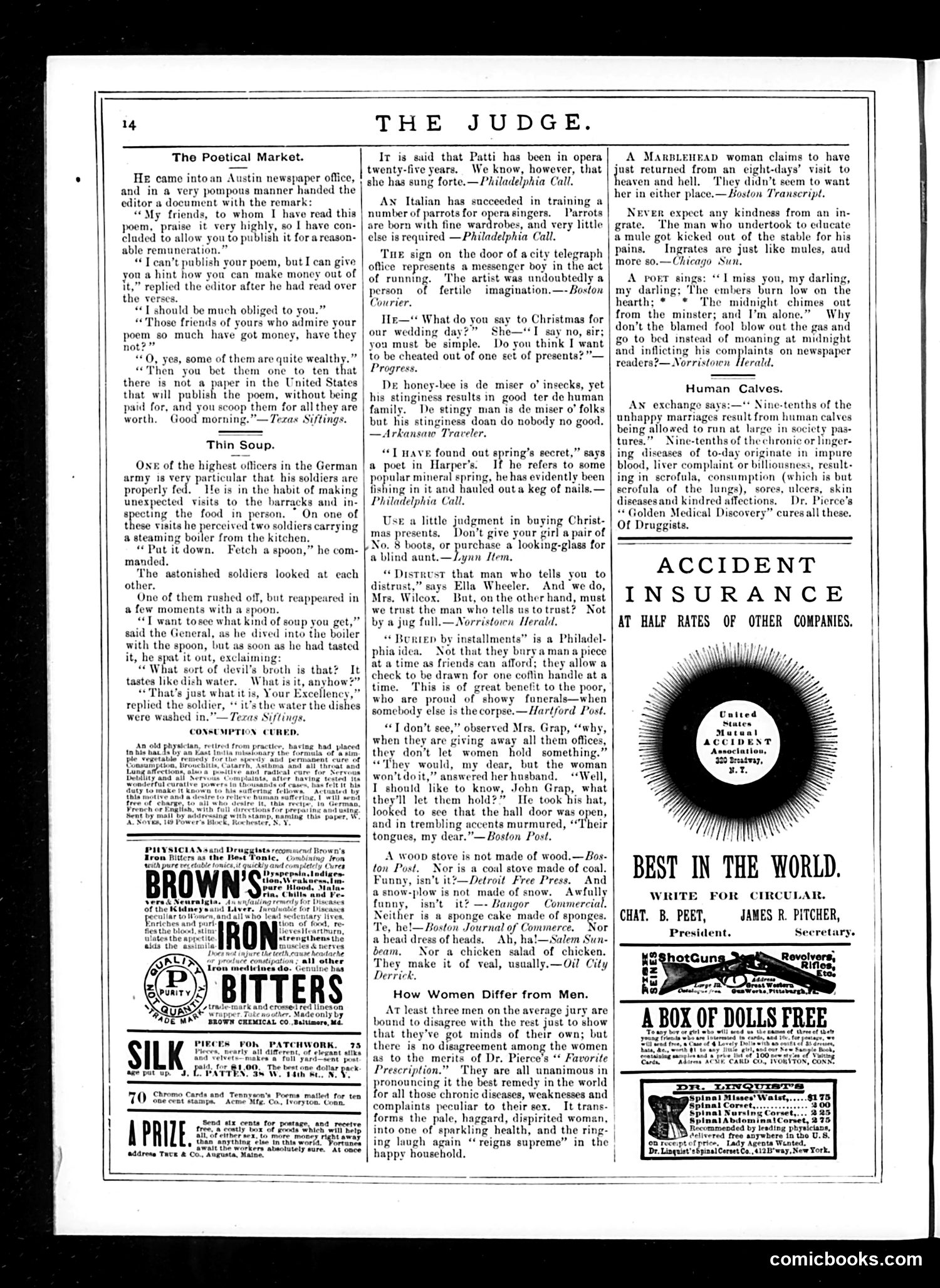
This page from *Judge* magazine consists primarily of **humorous anecdotes** rather than political cartoons. The content reflects turn-of-the-century American satirical humor: **Key pieces:** - **"The Poetical Market"**: A poet tries selling his work to a newspaper editor, who suggests betting friends the poem won't be published—a joke about the poet's poor verse and gullible wealthy friends. - **"Thin Soup"**: A German army officer inspects soldiers' food, discovers it's literally dishwater used to clean dishes—satire of military bureaucracy and poor soldier treatment. **Social commentary:** These anecdotes mock pretension (failed poets), institutional inefficiency (the military), and social climbing. The humor relies on wordplay and irony typical of late-19th-century American magazines. The page also features **advertisements** for patent medicines and products ("Brown's Iron Bitters," insurance), reflecting the magazine's commercial nature. The overall tone is lighthearted, class-conscious satire aimed at educated, middle-class readers.
This is primarily an **advertising page** from Judge magazine, with scattered short humorous items between ads. The page contains no political cartoons. The humor pieces are brief, pun-based jokes typical of 1880s periodicals: - A joke about a New England schoolteacher circling a chair before sitting (likely referencing superstition or affectation) - A quip about a Democratic getting office (political commentary suggesting corruption) - A reference to Horace Greeley (19th-century politician/editor) being unfriendly in manner - Various other mild wordplay about daily life **The advertisements** dominate: Pond's Extract (patent medicine), hay-fever remedies, magic lanterns, watches, bicycles, and a German bitterwater tonic. These ads reflect period consumer goods and the "patent medicine" era before FDA regulations. The page offers little political substance—it's primarily commercial, with lightweight humor serving as filler between ads. No major figures or satire are identifiable.
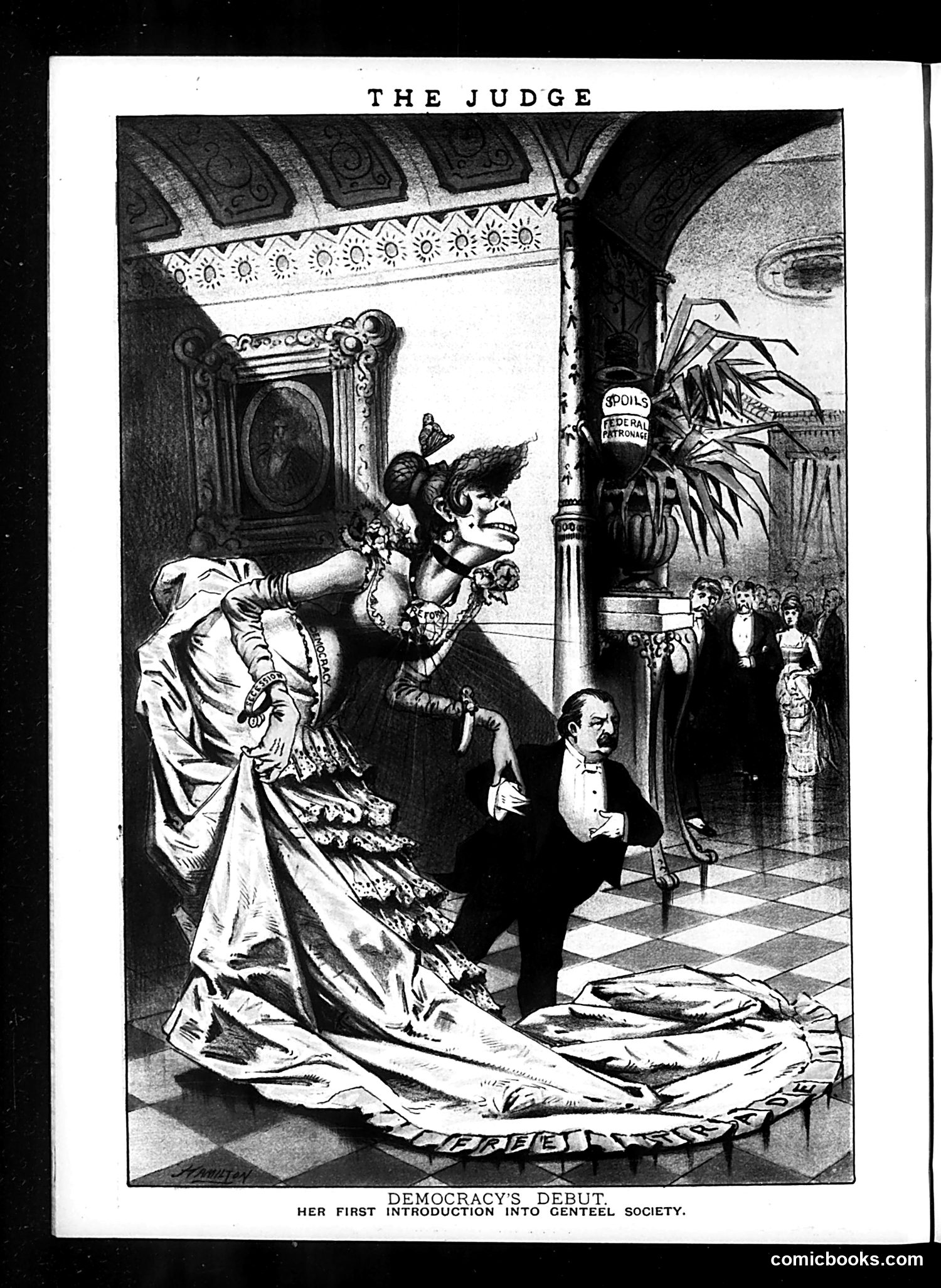
This satirical cartoon depicts **Democracy personified as a grotesque, poorly-dressed woman** being awkwardly introduced into high society—represented by the elegant interior and formally-dressed gentlemen observing her entrance. The joke critiques the clash between democratic ideals and aristocratic establishment. Democracy appears crude and uncouth (caricatured with exaggerated features), while the "genteel society" members regard her with visible discomfort and disdain. The woman's extravagant but tasteless clothing and dramatic entrance underscore the satire. The cartoon suggests skepticism about whether democracy—presented as vulgar and unrefined—truly belongs among the educated elite who govern. This reflects late-19th-century anxieties about democratic expansion and whether ordinary people could function in sophisticated political institutions.