
Judge, 1884-12-27 · page 3 of 16
Judge — December 27, 1884 — page 3: what you’re looking at
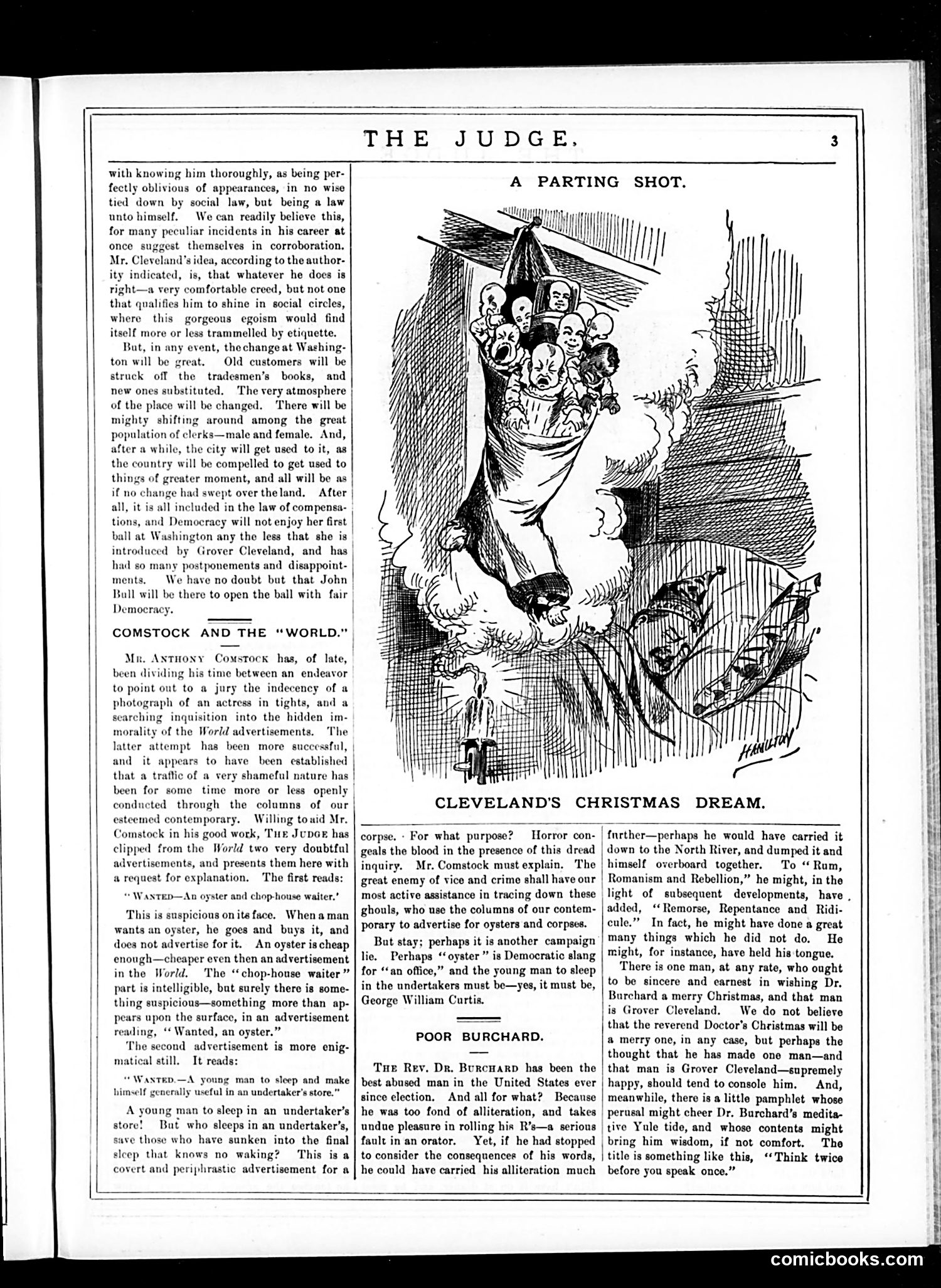
What you’re looking at
This *Judge* page ridicules incoming President Grover Cleveland and mocks his political opponents through three pieces. **"Cleveland's Christmas Dream"** (main cartoon): Shows Cleveland's head dispensing Democratic office-seekers like gifts from a cornucopia. It satirizes the inevitable patronage appointments following his election—the "spoils system" where the winning party rewards loyalists with government jobs. **"Comstock and the 'World'"**: This mocks moral crusader Anthony Comstock's attempts to suppress vice. *Judge* clips two seemingly innocent job advertisements from the *World* newspaper and pretends they're coded references to Democratic corruption—"oyster" as slang for "office," and the undertaker position as referencing George William Curtis (likely a political enemy). The satire exposes how Comstock's investigations could find scandal anywhere through interpretation. **"Poor Burchard"**: References Rev. Burchard, apparently a controversial figure post-election, though details are unclear here. The page demonstrates *Judge*'s partisan Republican mockery of Cleveland's Democratic administration and its critics' obsessions.
📄 Transcribed text from this page (OCR, searchable)
Machine-transcribed from the original scan — historical spelling and the odd misread are preserved.
THE JUDGE. with knowing him thoroughly, as being per- fectly oblivious of appearances, in no wise tied down by social law, but being a law unto himself. We can readily believe this, for many peculiar incidents in his career at once suggest themselves in corroboration, Mr. Cleveland’s idea, according to the author- ity indicated, is, that whatever he does is right—a very comfortable creed, but not one that qualifies him to shine in social circles, where this gorgeous egoism would find itself more or less trammelled by etiquette. But, in any event, thechange at Washing- ton will be great. Old customers will be struck off the tradesmen’s books, and new ones substituted. The very atmosphere of the place will be changed. There will be mighty shifting around among the great population of clerks—male and female. And, after a while, the city will get used to it, as the country will be compelled to get used to things of greater moment, and all will be as if no change had swept over theland, After all, it is all included in the law of compensa- | tions, and Democracy will not enjoy her first ball at Washington any the less that she is introduced by Grover Cleveland, and has had so many postponements and disappoint- ments, We have no doubt but that John Bull will be there to open the ball with fair Democracy. COMSTOCK AND THE “WORLD.” Mr. Antony Comstock has, of late, been dividing his time between an endeavor to point out to a jury the indecency of a photograph of an actress in tights, and a searching inquisition into the hidden im- morality of the World advertisements. The latter attempt has been more successful, | and it appears to have been established that a traflic of a very shameful nature has | been for some time more or less openly ted through the columns of our contemporary. Willing toaid Mr. Comstock in his good work, Tue JupGE has clipped from the World two very doubtful advertisements, and presents them here with a request for explanation. The first reads: “ WanTED—An oyster and chop-house waiter.” This is suspicious onite face. When aman wants an oyster, he goes and buys it, and does not advertise for it. An oyster is cheap enough—cheaper even then an advertisement inthe World. The ‘“chop-house waiter” part is intelligible, but surely there is some- thing suspicious—something more than ap- pears upon the surface, in an advertisement reading, ‘Wanted, an oyster.” he second advertisement is more enig- matical still, It reads: “Wastep.—A young man to sleep and make himself generally useful in an undertaker’s store.” A young man to sleep in an undertaker’s store! But who sleeps in an undertaker’s, save those who have sunken into the final sleep that knows no waking? This is a covert and periphrastic advertisement for a A PARTING SHOT. SAN ty i SSS Ss ¢ ~ CLEVELAND'S CH WH {I Be UZ Us, =e eI ELL CELLET EZ Ly GLEE ' ZEEE Loewe RISTMAS DREAM. corpse. - For what purpose? Horror con- geals the blood in the presence of this dread inquiry. Mr. Comstock must explain, The great enemy of vice and crime shall have our most active assistance in tracing down these ghouls, who use the columns of our contem- porary to advertise for oysters and corpses. But stay; perbaps it is another campaign lie. Perhaps “oyster” is Democratic slang for ‘‘an office,” and the young man to sleep in the undertakers must be—yes, it must be, George William Curtis. POOR BURCHARD. Tue Rev. Dr. BurcHarD has been the best abused man in the United States ever since election, And all for what? Becanse he was too fond of alliteration, and takes undue pleasure in rolling his R’s—a serious fault in an orator. Yet, if he had stopped to consider the consequences of his words, he could have carried his alliteration much | {urther—perhaps he would have carried it | down to the North River, and dumped it and | himself overboard together. To “ Rum, | Romanism and Rebellion,” he might, in the light of subsequent developments, have added, ‘Remorse, Repentance and Ridi- cule.” In fact, he might have done a great many things which he did not do. He might, for instance, have held his tongue, There is one man, at any rate, who ought to be sincere and earnest in wishing Dr. Burchard a merry Christmas, and that man is Grover Cleveland. We do not believe that the reverend Doctor’s Christmas will be @ merry one, in any case, but perhaps the thought that he has made one man—and that man is Grover Cleveland—supremely happy, should tend to console him. And, meanwhile, there is a little pamphlet whose perusal might cheer Dr. Burchard’s medita- tive Yule tide, and whose contents might bring him wisdom, if not comfort. The title is something like this, ‘Think twice before you speak once.” comicbooks.com