
Judge, 1884-12-27 · page 13 of 16
Judge — December 27, 1884 — page 13: what you’re looking at
What you’re looking at
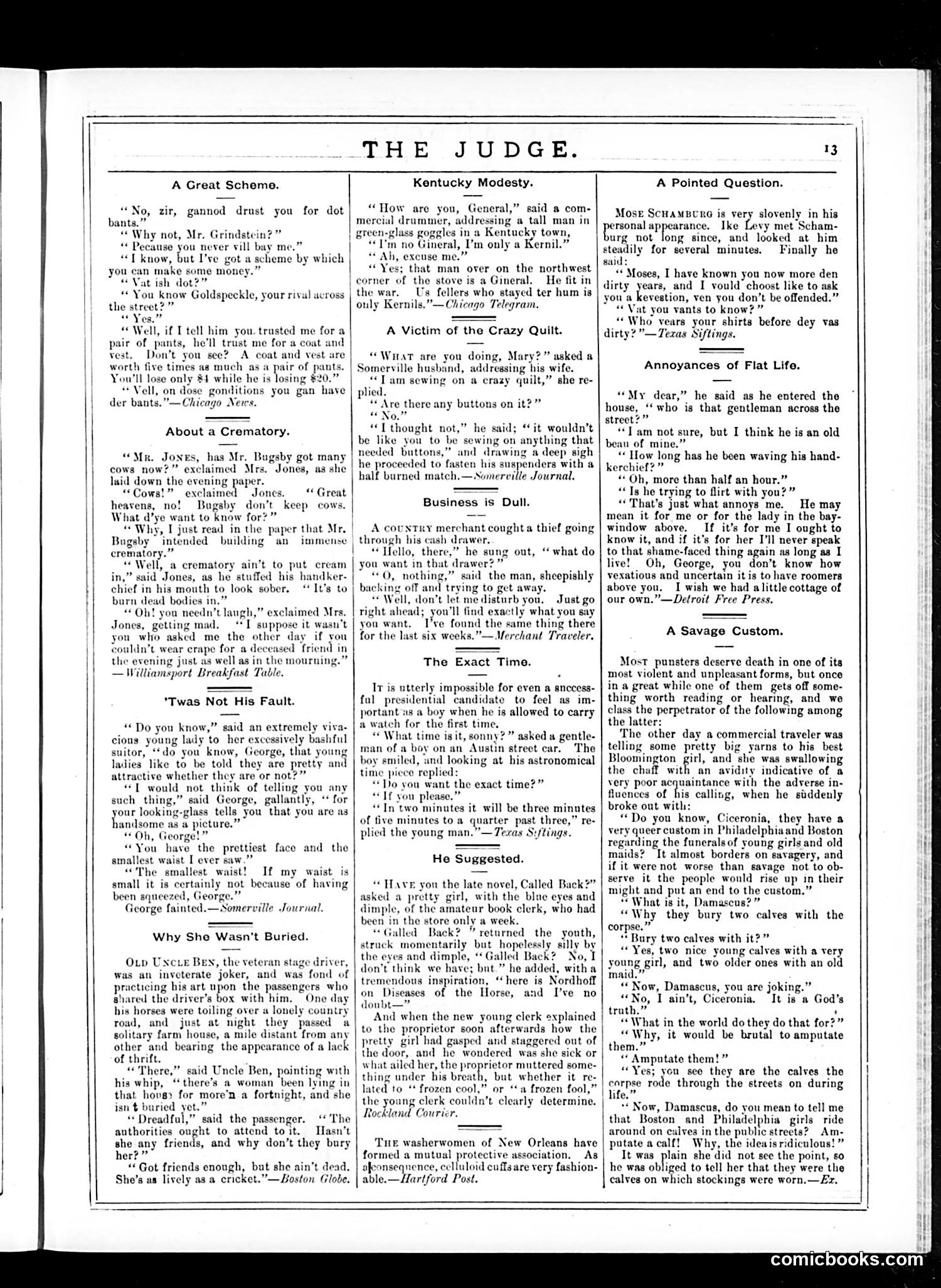
This page from *Judge* magazine contains several brief humorous anecdotes rather than political cartoons. The jokes satirize American social types and situations: **"A Great Scheme"** mocks Jewish immigrants (indicated by the Yiddish accent spelling) and their perceived dishonesty in business dealings. **"About a Crematory"** plays on a woman's misunderstanding of the word "crematory," confusing it with cream—a simple pun joke. **"Why She Wasn't Buried"** features Uncle Ben, a stock character of rural American humor, pranking a passenger by claiming a woman in a farmhouse has been dead for weeks (she's actually alive). **"Kentucky Modesty"** stereotypes rural Kentuckians as overly modest about rank. The remaining pieces mock married life, business failure, and female fashion quirks. These are genteel, domestic satires typical of *Judge*'s era—focusing on social embarrassment and wordplay rather than political critique.
📄 Transcribed text from this page (OCR, searchable)
Machine-transcribed from the original scan — historical spelling and the odd misread are preserved.
THE JUDGE. A Great Scheme. “No, zir, gannod drust you for dot ants.” hy not, Mr. Grindstein? ” “ Pecause you never vill “T know, but I’ve got a scheme by which you can make some money.” “Vat ish dot?” “ You know Goldspeckle, your rival across the street?” pair of pants, he'll trust me for a vest. Don’t you see? A coat and v worth five times ag mu air of You'll lose only $4 while he is losing “Vell, on dose gonditions you gan der bants.”—Chicago News. About a Crematory. has Mr, Bugsby got many med Mrs. Jones, as she | ning paper. ciel Poe Great heavens, no! Bugsby don’t keep cows. What d’ye want to know for?” “Why, I just read in the paper that Mr, Bugsby intended building an immense crematory.” Well, a crematory ain’t to put cream in,” said Jones, as he stuffed his handker- chief in his mouth to look sober. ‘It’s to burn dead bodies in.” “Oh! you needn’t laugh,” exclaimed Mrs. Jones, getting mad. ‘IT suppose it wasn’t you who asked me the other day if you couldn’t wear crape for a dece friend in the evening just as well as in the mourning.” — Williamsport Breakfast Table. cows now? luid down the “Cows!” ex ‘Twas Not His Fault. “Do you know,” said an extremely viva- cious young lady to her excessively bashful suitor, ‘do you know, George, that young ladies like to be told they are pretty and attractive whether they are or not?” “T would not think of telling you any such thing,” said George, gallantly, ** for your looking-glass tells you that you are as handsom “Oh, “You smallest waist I ever saw.” “The smallest waist! If my waist is small it is certainly not because of having been squeezed, George.” George fainted. —Somerville Journal. Why She Wasn't Buried. 3EN, the veteran stage driver, was an inveterate joker, and was fond of | practicing his art upon the passengers who shared the driver’s box with him, One da his horses were toiling over a lonely country road, and just at night they passed a solitary farm house, a mile distant from any other and bearing’ the appearance of a la of thrift. “There,” said Uncle Ben, pointing with his whip, ‘there’s a woman been lying in that hovs> for more'n a fortnight, and she | ; isn t buried yet.” “Dreadful,” said the passenger. “The authorities ought to attend to it. Hasn't she any friends, and why don’t they bury her?” “Got friends enough, but she ain't dead. plied. She’s as lively as a cricket.”—Boston Globe. Kentucky Modesty. “How are you, General,” said a com- mercial drammer, addressing a tall man in green-glass goggles in a Kentucky town, “I’m no Gineral, I’m only a Kernil.” * Ah, excuse me.” ay that man over on the northwest corner of the stove is a Gineral. He fit in the wi Us fellers who stayed ter hum is only Kernils.”—Chicago Telegram. A Victim of the Crazy Quilt. “Witat are you doing, Mary?” asked a Somerville husband, addressing his wife. “Tam sewing on a crazy quilt,” she re- “Are there any buttons on it?” “No.” “T thought not,” he said; it wouldn’t be like you to be sewing on anything that needed buttons,” and drawing a deep sigh he proceeded to fasten his suspenders with a half burned match.— Somerville Journal. Business is Dull. A coustny merchant coughta thief going through his 1 drawer, **Tello, there,” he sung out, ‘ what do you want in that drawer? ” “0, nothing,” said the man, sheepishly backing off and trying to get ** Well, don’t let medisturb you. Just go right ahead; you'll find exactly what you say you want. I’ve found the same thing there for the last six weeks.”— Merchant Traveler, The Exact Time. Ir is utterly impossible for even a snccess- ful presidential candidate to feel as im- portant us a boy when he is allowed to carry a watch for the first time. “* What time isit, sonny?” asked a gentle- man of a boy on an Austin street car. The boy smiled, und looking at his astronomical time piece replied: ‘Do you want the exact time?” “If you please. “In two minutes it will be three minutes of tive minutes to a quarter past three,” re- plied the young man.”—Tezas Siftings. He Suggested. “Have you the late novel, Called Back?” asked a pretty girl, with the blue eyes and dimple, of the amateur book clerk, who had been in the store only a week. “Galled Back? ” returned the youth, struck momentarily but hopelessly silly by the eyes and dimple, “Galled Back? No, T don’t think we have; but.” he added, with a tremendous inspiration, ‘here is Nordhoff on Diseases of the Horse, and I’ve no donbt—” And when the new young clerk explained to the proprietor soon afterwards how the pretty girl had gasped and staggered out of the door, and he wondered was she sick or what ailed her, the proprietor muttered some- thing under his breath, but whether it re- ated to ‘ frozen cool,” or ‘a frozen fool,” e young Rockland Courier. Tue washerwomen of New Orleans have | formed a mutual protective association. As afeonseqnence, celluloid cuffs are very fashion- able.—Hartford Post. lerk couldn’t clearly determine. | A Pointed Question. Mose Scuampere is very slovenly in his ersonal appearance. Ike Levy met Scham- urg not long since, and looked at him steadily for several minutes, Finally he said: Moses, I have known you now more den dirty years, and I vould choost like to ask you a kevestion, ven you don’t be offended.” “Vat you vants to know?” “‘Who vears your shirts before dey vas dirty? "—Tezas Siftings. Annoyances of Flat Life. “My dear,” he said as he entered the house, ‘who is that gentleman across the street?” “Tam not sure, but I think he is an old beau of mine.” “* How long has he been waving his hand- kerchief?” «Oh, more than half an hour.” “Ts he trying to flirt with you?” ‘That’s just what annoys me. He may mean it for me or for the lady in the bay- window above. If it’s for me I ought to know it, and if it’s for her I’ll never speak to that shame-faced thing again as long as I live! Oh, George, you don’t know how vexatious and uncertain it is to have roomers above you. I wish we had alittle cottage of our own.”—Detroit Free Pres A Savage Custom. Most punsters deserve death in one of its most violent and unpleasant forms, but once in a great while one of them gets off some- thing worth reading or hearing, and wo class the perpetrator of the following among the latter: The other day a commercial traveler was telling some pretty big yarns to his best Bloomington girl, and she was swallowing the chaff with an avidity indicative of a very poor acquaintance with the adverse in- fluences of his calling, when he saddenly broke out with: “Do you know, Ciceronia, they have a very queer custom in Philadelphia and Boston regarding the funerals of young girls and old maids? It almost borders on savagery, and if it were not worse than savage not to ob- serve it the people would rise up in their might and put an end to the custom.” ** What is it, Damascus?” “Why they bury two calves with the corpse.” “ Bury two calves with it?” “Yes, two nice young calves with a very young girl, and two older ones with an old maid.” ‘ow, Damascus, you are joking.” “No, I ain’t, Ciceronia, ‘It is a God’s | truth.” ‘ “What in the world do they do that for?” “Why, it would be brutal to amputate them.” “ Amputate them!” “Yes; yon seo they are the calves the corpse rode through the streets on during life.” “Now, Damascus, do you mean to tell me that Boston and Philadelphia girls ride around on culves in the public streets? Am- putate acalf! Why, the ideais ridiculous! ” It was plain she did not see the point, so he was obliged to tell her that they were the calves on which stockings were worn.—Er. comicbooks.com