
A complete issue · 17 pages · 1884
Judge — October 11, 1884
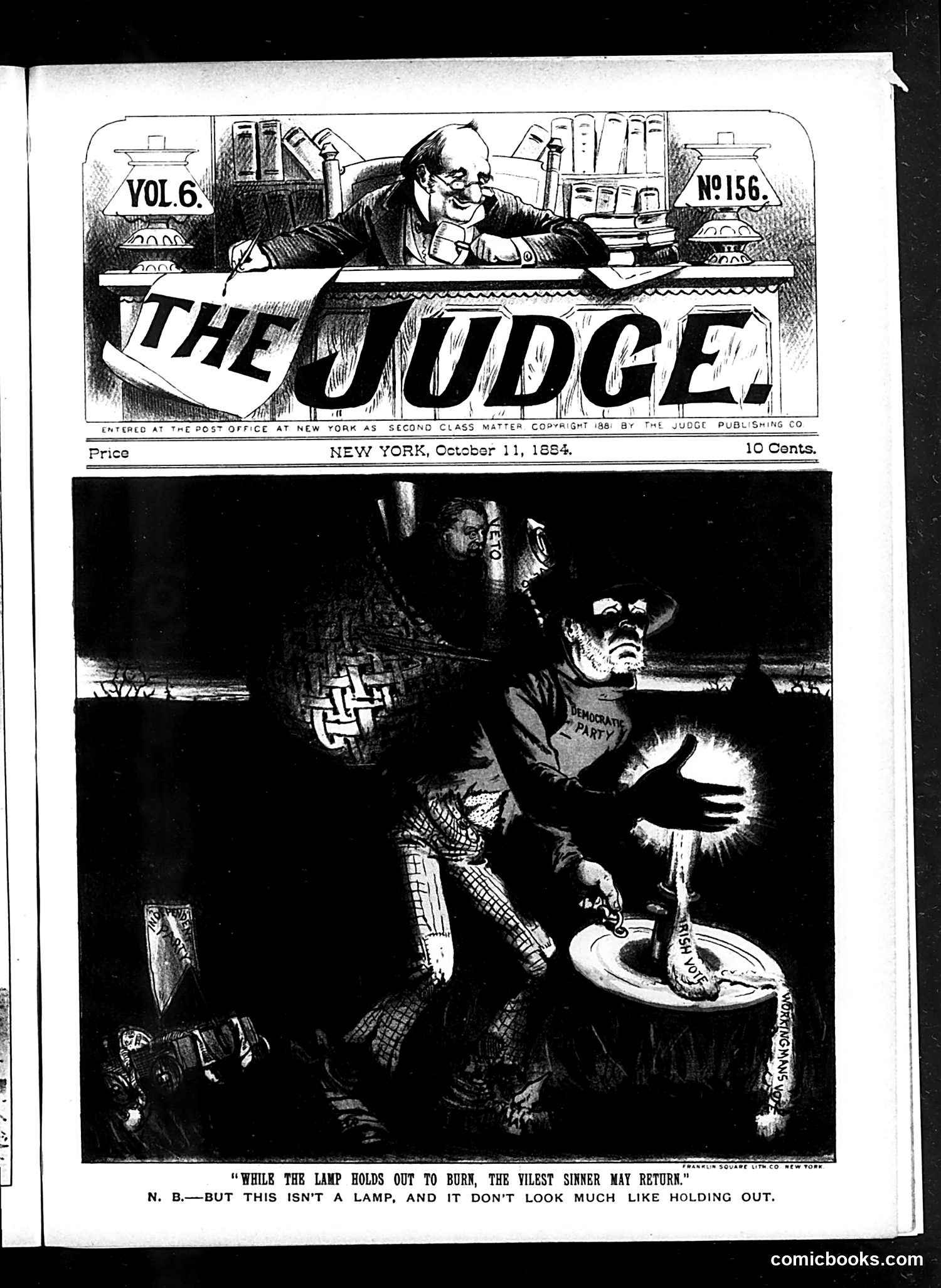
This is a political cartoon from the 1884 U.S. presidential election period. The main illustration depicts a figure labeled "Democratic Party" holding what appears to be a lamp or vessel, with ghostly or demonic figures emerging behind him. The caption reads: "While the lamp holds out to burn, the vilest sinner may return"—a religious reference suggesting redemption is possible. The N.B. (nota bene) note underneath states the vessel "isn't a lamp, and it don't look much like holding out," implying the Democratic Party's promises of reform are hollow or failing. The cartoon satirizes Democratic claims of moral renewal, suggesting their stated commitments lack substance. The dark, ominous imagery reinforces skepticism about Democratic credibility during this election year.
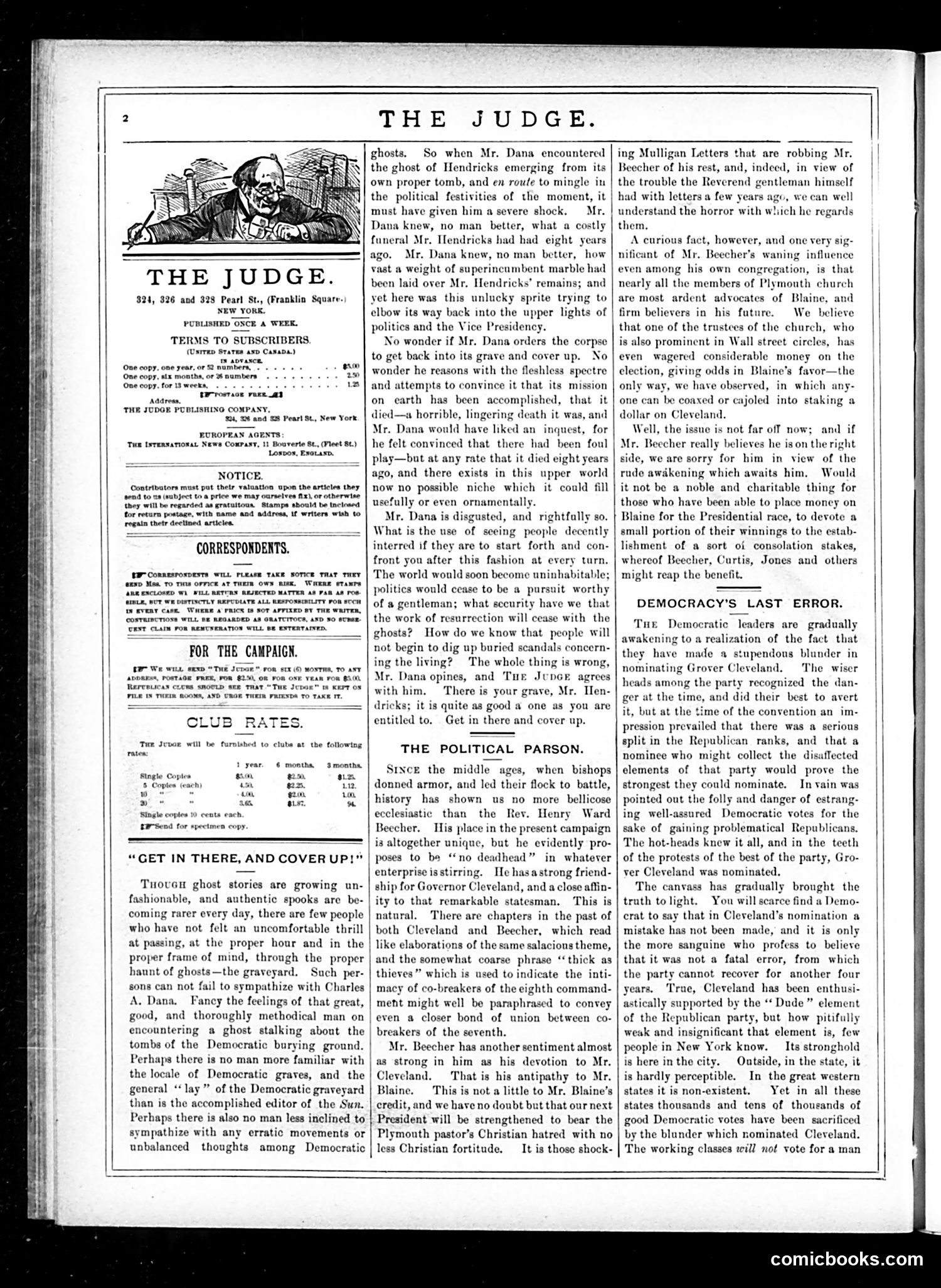
This page contains two satirical pieces attacking Democratic leadership during what appears to be the 1884 presidential campaign. **"Get in There, and Cover Up!"** is the main cartoon, using the metaphor of a ghost to criticize Charles A. Dana (editor of the Sun newspaper) for attempting to suppress the political resurrection of Thomas A. Hendricks, the late Vice President who had died eight years prior. The piece sarcastically suggests Dana is literally trying to keep Hendricks' corpse buried rather than allow Democratic revival of his legacy or memory in current politics. **"Democracy's Last Error"** criticizes Democratic leaders for nominating Grover Cleveland, arguing the party made a fatal blunder. It suggests Cleveland's nomination was a mistake that disaffected Democrats cannot repair—implying internal party damage that will cost them the election. The satire relies on readers' familiarity with recent Democratic scandals and leadership disputes. Both pieces mock Democratic dysfunction using dark, grotesque imagery (ghosts, corpses, graveyards) to suggest the party is spiritually dead or dying.
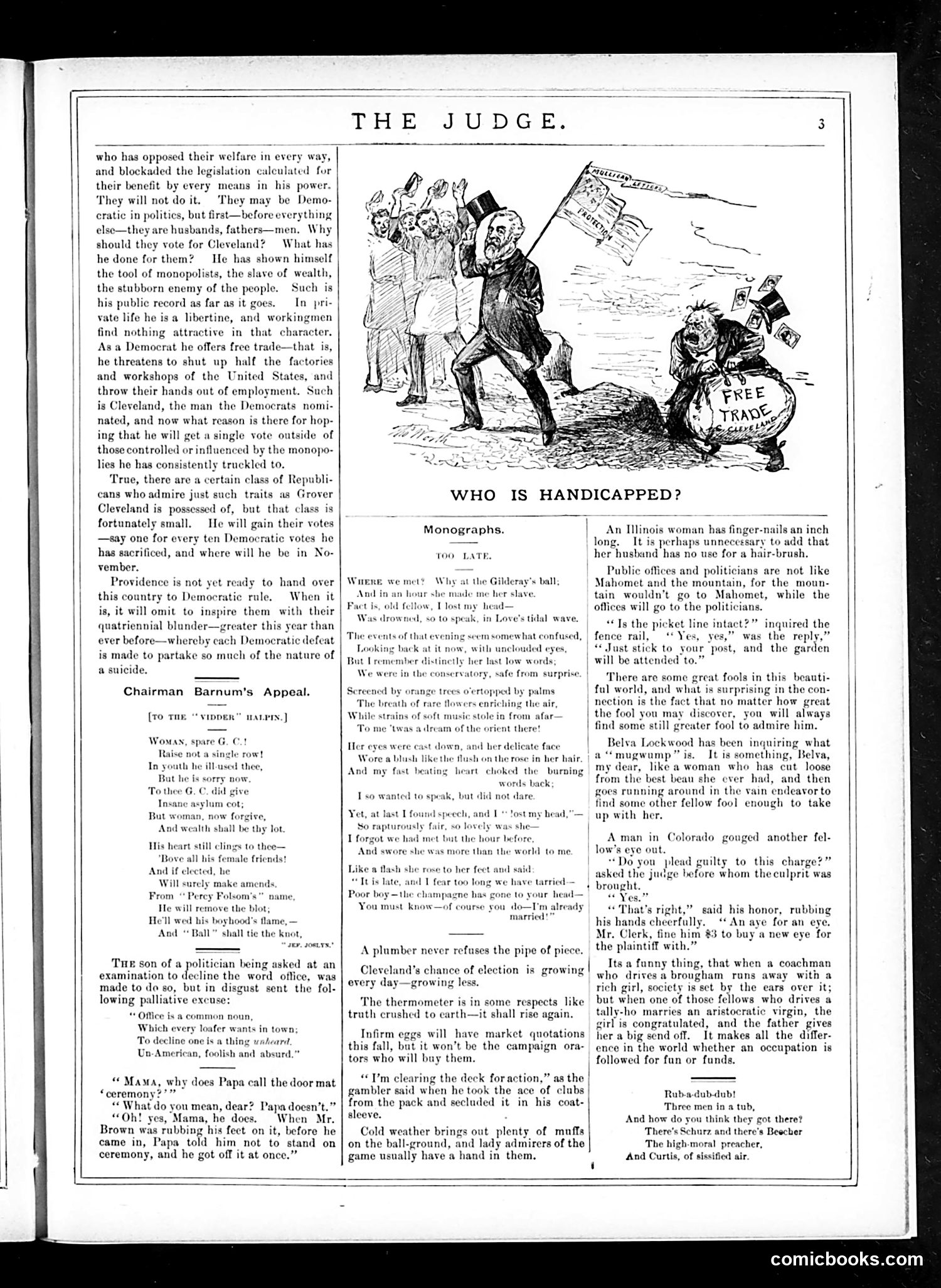
This page satirizes **Grover Cleveland's 1884 presidential campaign**. The main cartoon depicts Cleveland as literally "handicapped"—burdened by multiple weights labeled with his perceived liabilities: his opposition to protective tariffs ("Free Trade"), his personal scandals, and his ties to monopolists. The accompanying text attacks Cleveland viciously, claiming he's the "tool of monopolists" and a "libertine" who offers nothing to working men—only job-killing free trade policies that would "shut up half the factories." The article argues Republicans shouldn't fear Democratic victory because Providence won't allow it and Cleveland's own scandals will doom him. The page also includes poems and humorous anecdotes unrelated to the main political content. This reflects Judge's format as a satirical weekly mixing political commentary with general humor and lighter fare. **Context**: Judge was a Republican publication; this represents partisan anti-Cleveland propaganda from the 1884 election cycle.
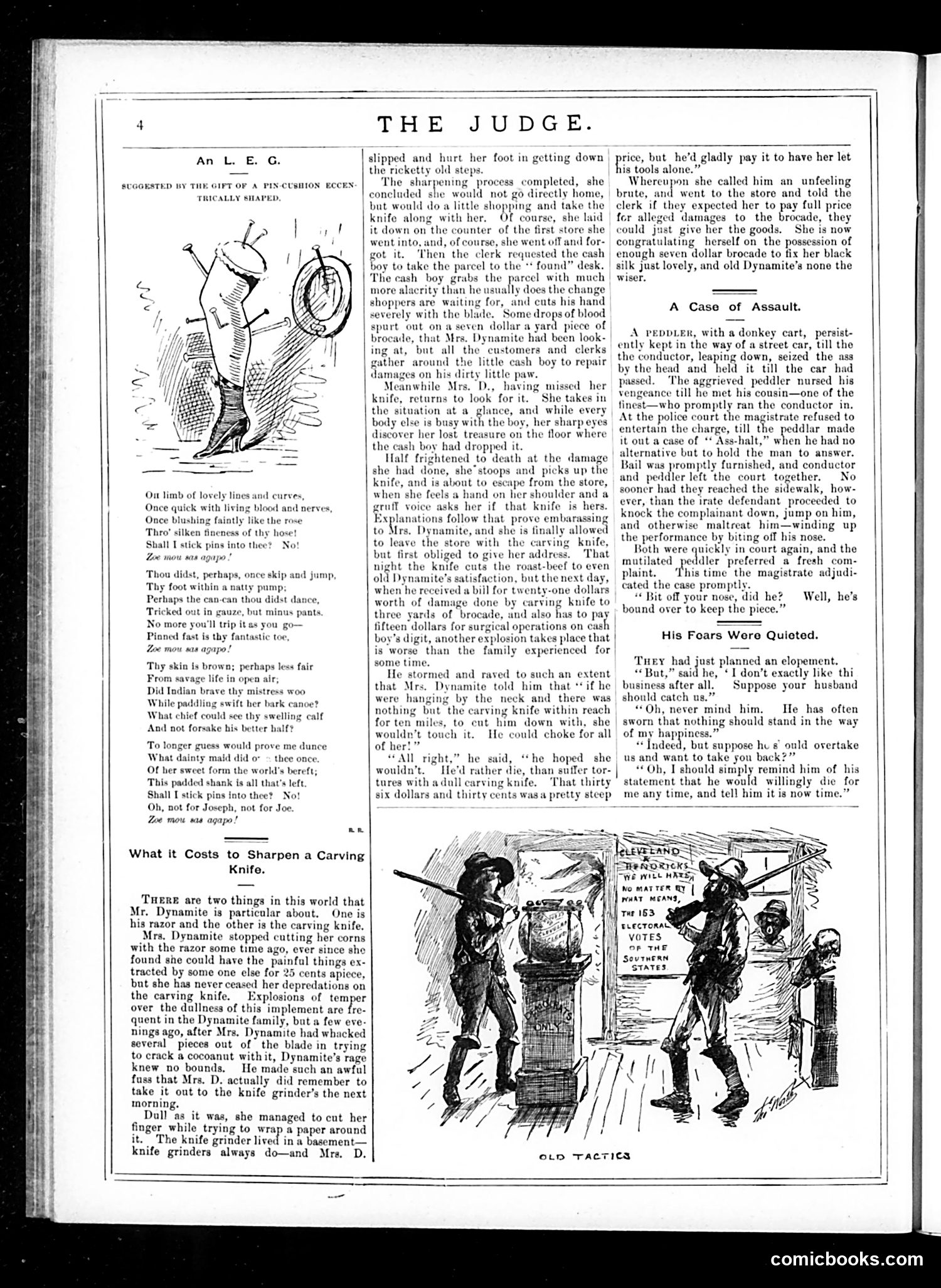
This page contains two distinct pieces of satire: **"An L.E.G." (upper left):** A humorous poem mocking a novelty pincushion shaped like a woman's leg. The satirist pretends to be tempted to stick pins into this "limb of lovely lines and curves"—the severed leg of what appears to be an exotic dancer or woman of questionable repute (references to "Indian brave," "swelling calf"). The joke targets both the absurd Victorian gift item and the objectification of women it represents. **"What It Costs to Sharpen a Carving Knife" (lower section):** A domestic comedy sketch about "Mr. Dynamite" and his particular wife. She damages a carving knife, has it sharpened, carelessly leaves it in a store where it cuts a cash boy and ruins expensive brocade. The satire mocks both her negligence and the cascading costs and complications resulting from her thoughtlessness—ultimately costing her husband significant money. The cartoons use the "Dynamite" couple as recurring satirical characters representing marital absurdity and domestic chaos.
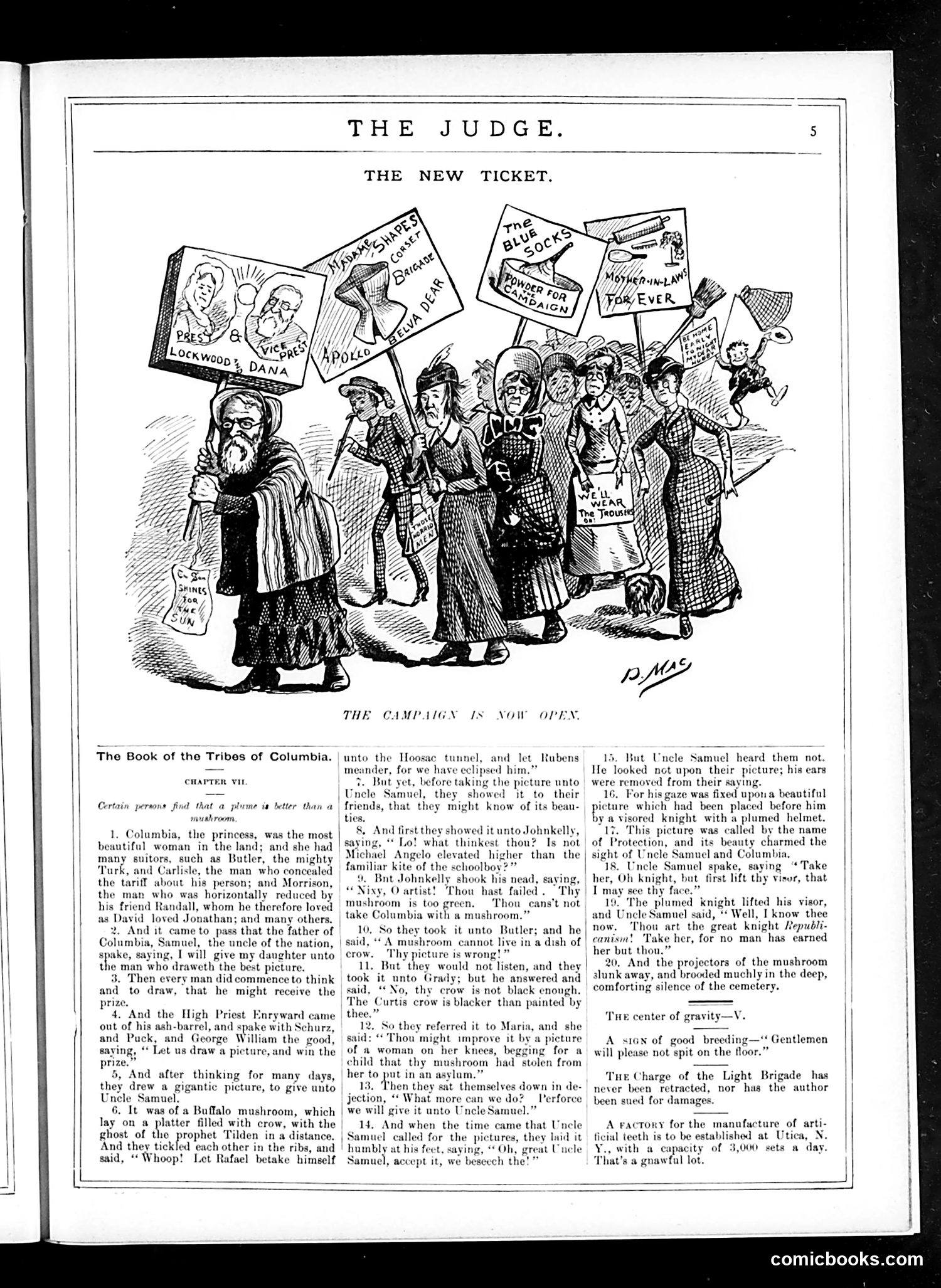
This 1884 cartoon satirizes the 1884 U.S. presidential campaign. "Columbia" (the female personification of America) is being "courted" by various political figures offering their "pictures" (platforms). **Key figures:** - "Uncle Samuel" = the American electorate/nation - "Columbia" = America itself - The rejected suitors include Butler, Carlisle, and Morrison—likely referring to competing candidates or party factions - The "plumed knight" who ultimately wins represents the Republican candidate James G. Blaine, nicknamed "the Plumed Knight" **The satire:** Democratic candidates (represented as creating a ridiculous "buffalo mushroom" picture with crow) fail to impress. Their efforts—mocked by various judges (Kelly, Grant, Curtis, Maria)—are rejected as inadequate. Meanwhile, Blaine's Republican ticket wins Uncle Samuel's favor simply by removing his visor. The joke: Blaine's popularity transcends policy; voters choose him based on personality or party loyalty rather than substantive political proposals. The final "mushroom" creators "brood muchly in the deep, comforting silence of the cemetery"—bitterly accepting defeat.
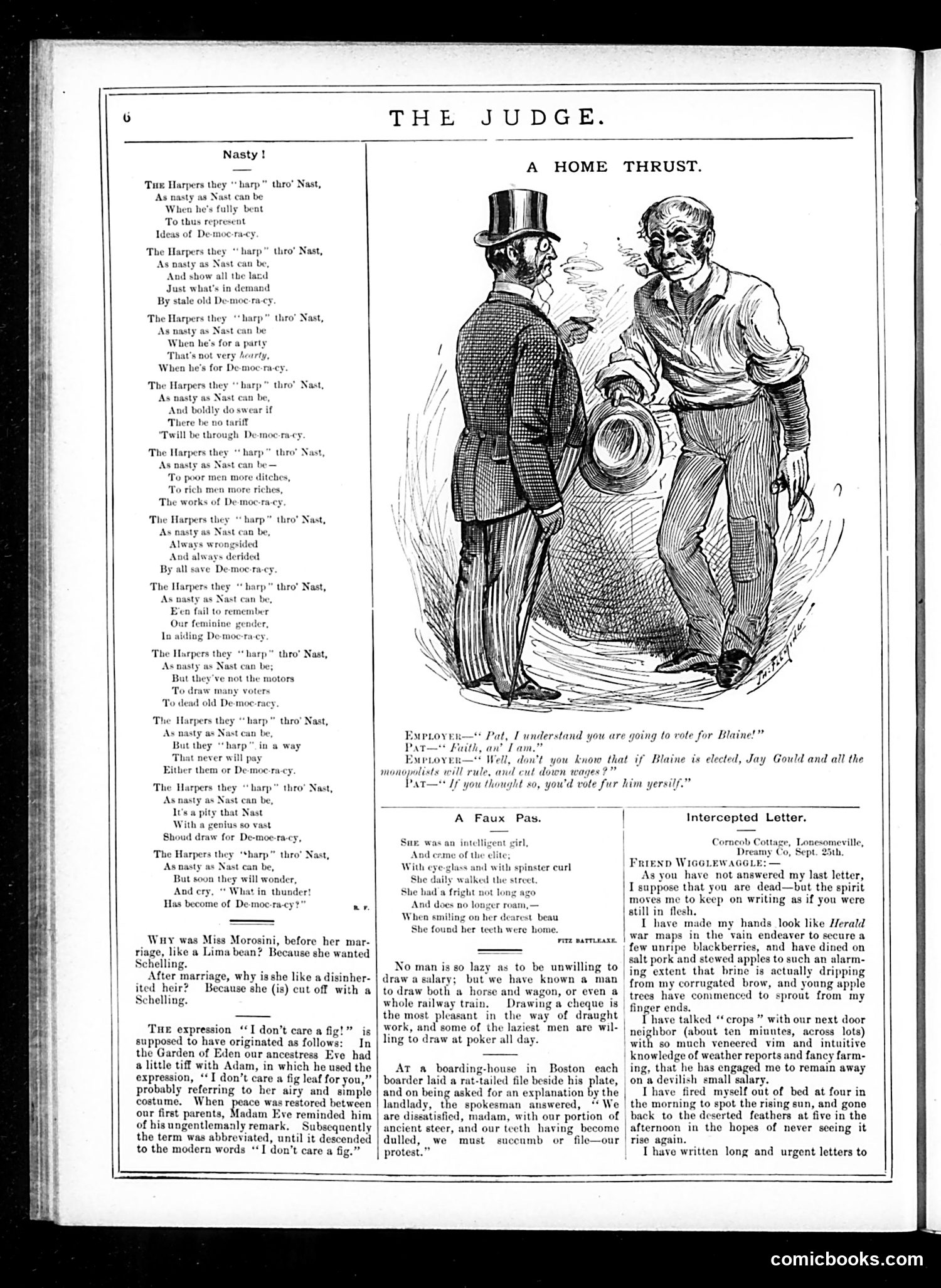
This cartoon satirizes the relationship between employers and workers during the **Blaine presidential campaign** (likely 1884). The well-dressed employer (top hat) confronts his worker (Pat, an Irish immigrant character) about voting. The employer warns that if Blaine loses, "Jay Gould and all the monopolists will rule, and cut down wages." Pat's response—"If you thought so, you'd vote for him yerself"—is the satirical punch line, exposing the employer's hypocrisy: he's trying to scare workers into voting his preferred candidate while refusing to do so himself. The cartoon mocks **wealthy industrialists' manipulation of working-class voters** through fear tactics about wages and monopolies, while revealing their self-interest. The fact that Pat sees through this transparent threat adds humor and suggests working-class political sophistication that Judge's readership may have underestimated.
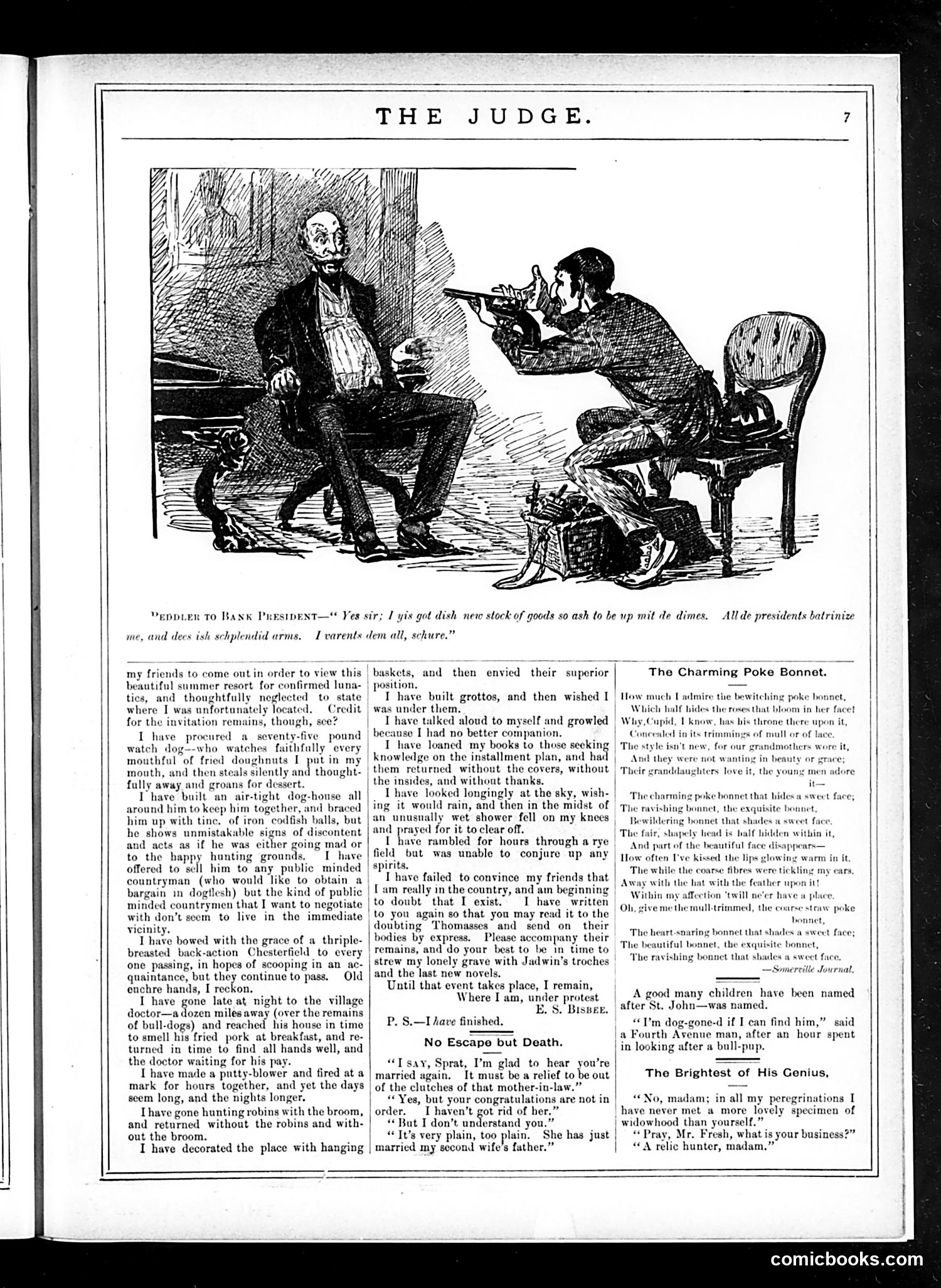
## Main Cartoon: "Peddler to Bank President" The top illustration depicts a street peddler (characterized by stereotypical dialect and appearance) attempting to sell goods to a well-dressed bank president. The peddler's speech—rendered in exaggerated immigrant accent ("dish new stock," "schplendid arms")—suggests he's hawking wares, possibly stolen or contraband goods ("arms" likely means weapons or merchandise). The satire targets both figures: the unscrupulous peddler attempting fraud and the bank president's gullibility or willingness to engage in shady dealings. The caption's reference to "all de presidents batrinize me" implies patronage corruption—that powerful men support such schemes. ## Context This appears to be late 19th-century American satire mocking both immigrant hustlers and corrupt wealthy elites. The heavy ethnic caricature was typical of Judge's editorial approach during this period. The remaining page content consists of humorous personal essays and poetry, not political commentary.
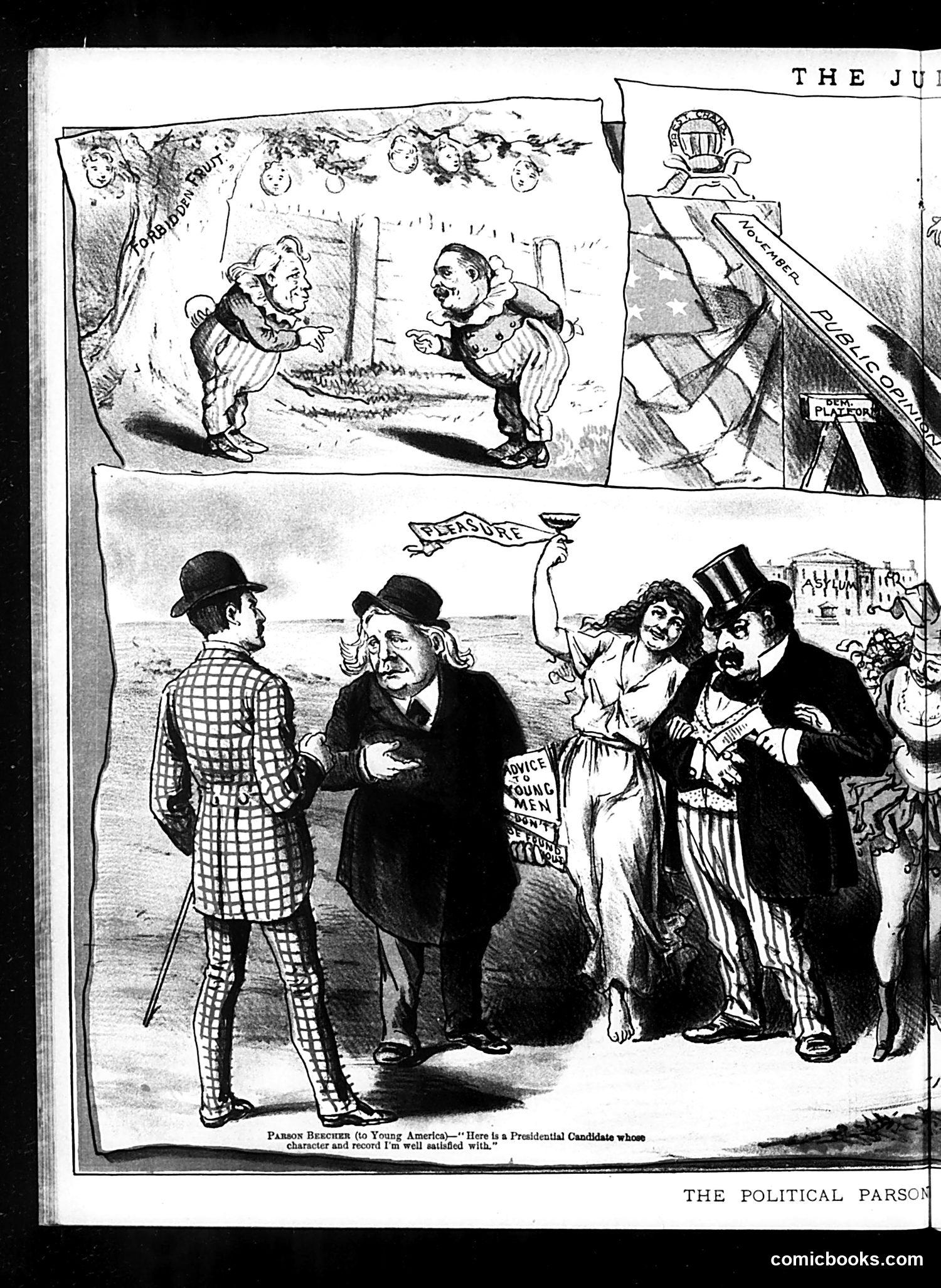
This Judge cartoon satirizes Parson Beecher (likely Henry Ward Beecher, the famous 19th-century clergyman) as a political kingmaker endorsing a presidential candidate to "Young America." The bottom panel shows Beecher presenting a well-dressed candidate to a crowd of ordinary citizens and political figures by the seaside. The satire targets clergy involvement in politics and suggests Beecher's endorsement carries outsized influence despite his religious rather than political role. The joke critiques how religious leaders lend moral authority to political candidates, implying Beecher vouches for the candidate's "character and record" based on criteria the parson considers important—a commentary on the blending of religious and political authority in American elections.
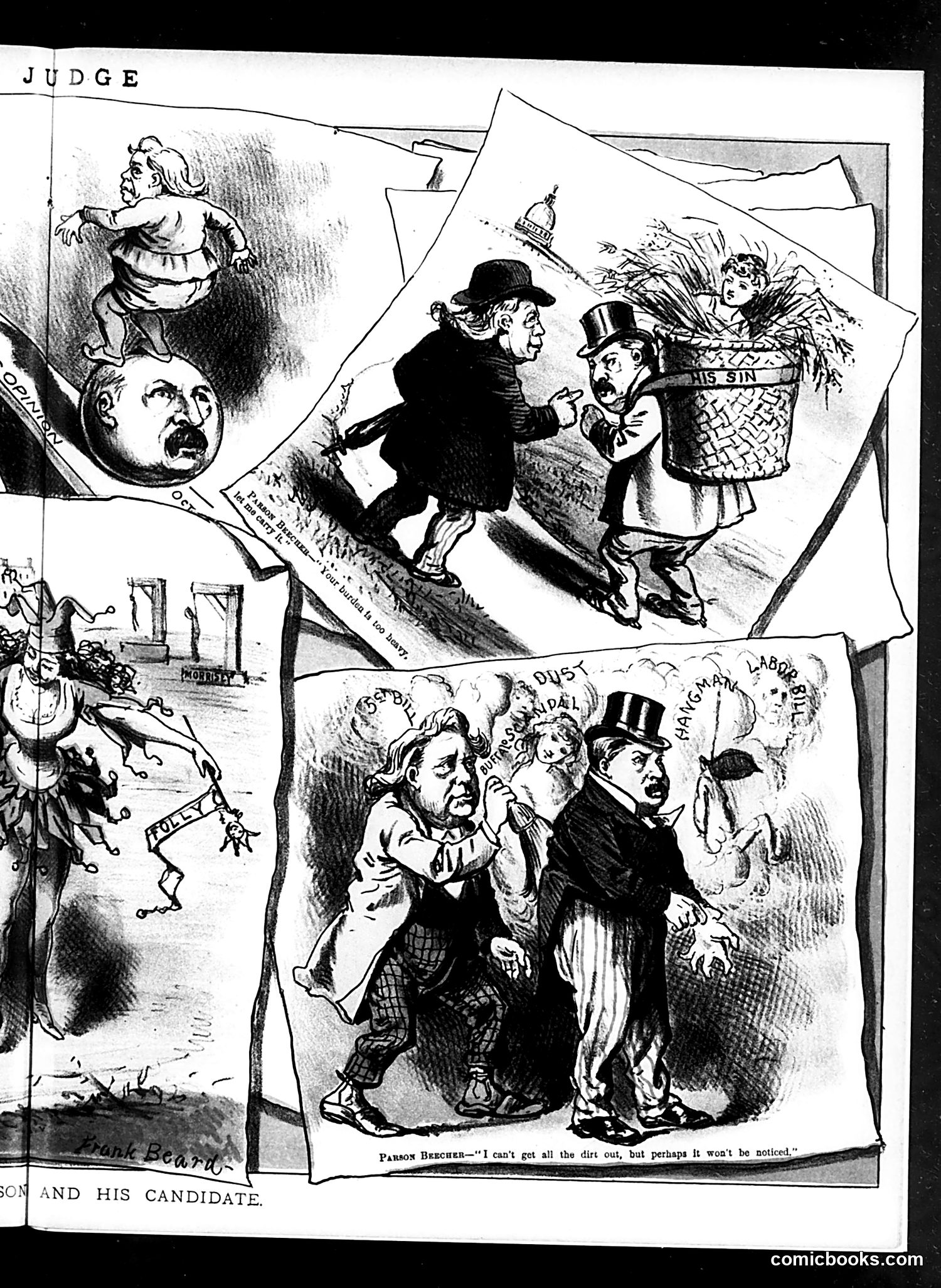
This Judge magazine page satirizes a political figure (identified as "Son and His Candidate" in the caption) and their electoral ambitions. The top panel shows a man with an exaggerated face being presented as a candidate, while demonic or mischievous figures surround him—suggesting corrupt or nefarious influences behind the candidacy. The bottom panel depicts "Parson Beecher" attempting to clean up "dirt," with the caption: "I can't get all the dirt out, but perhaps it won't be noticed." This references efforts to whitewash or obscure scandal surrounding the candidate. The overall satire mocks attempts to present a tainted political candidate as legitimate through cosmetic image rehabilitation, suggesting underlying corruption cannot truly be hidden—only concealed from public view.
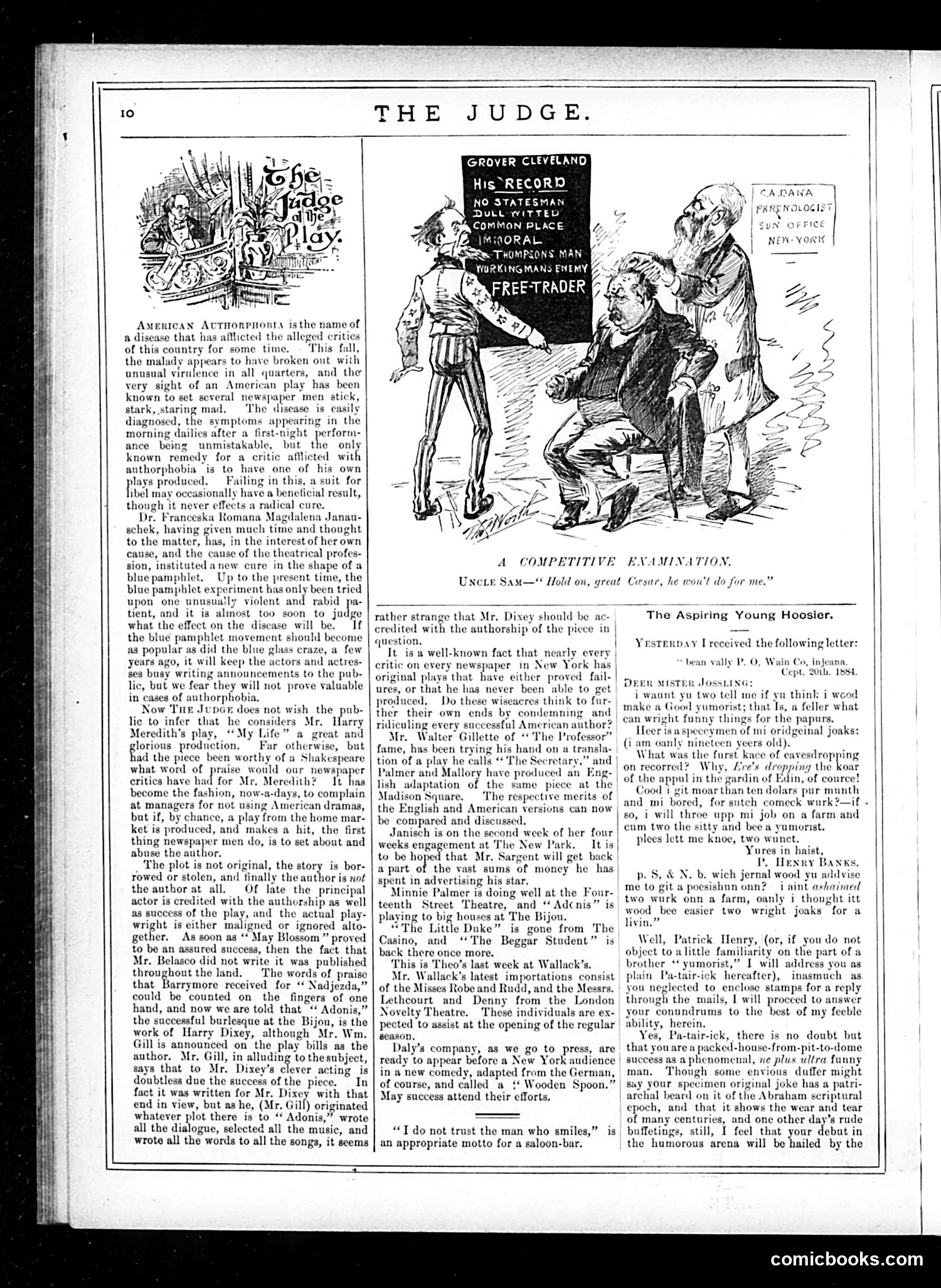
This page critiques American theater critics suffering from "Authorphobia"—an irrational hatred of American plays. The main cartoon shows a phrenologist examining Grover Cleveland's head while his assistant holds a sign listing Cleveland's alleged deficiencies: "no statesman," "dull witted," "common place," "immoral," "Thompson's man," "workingman's enemy," "free trader." The satire attacks both critics who dismiss homegrown drama and—in the Cleveland cartoon—likely mocks the 1884 presidential race. The phrenology reference ridicules pseudoscientific character assessment. The text complains that critics systematically sabotage American playwrights by denying them credit (attributing success to actors instead) while praising foreign adaptations. The article defends Harry Meredith's "My Life" and argues newspapers unfairly attack domestic productions to appear sophisticated.
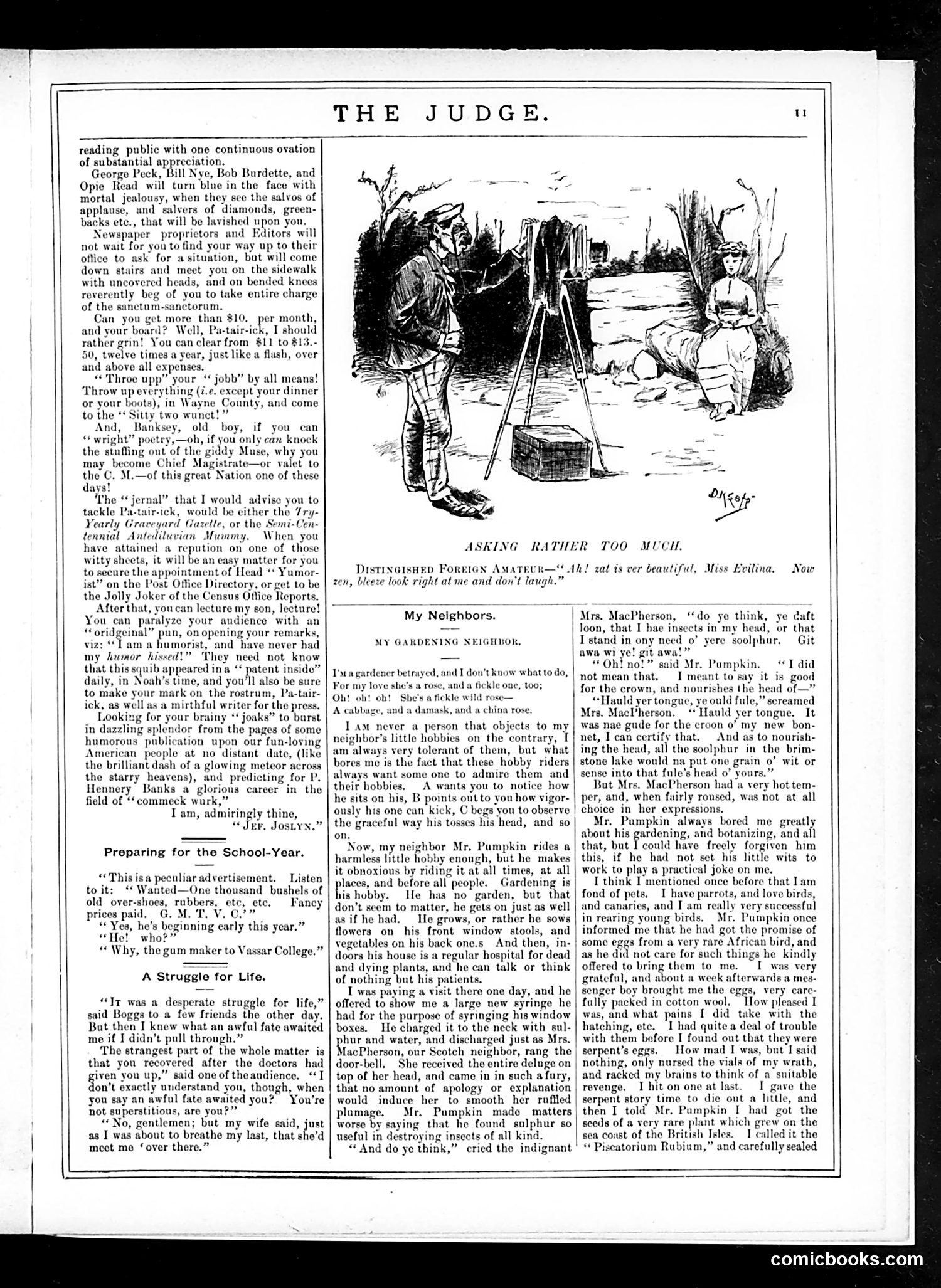
This page contains several satirical pieces typical of 1890s American humor magazines: **Main Cartoon ("Asking Rather Too Much"):** Shows a distinguished foreign amateur photographer instructing a young woman not to laugh while posing. The satire mocks pretentious European aesthetes and their exaggerated artistic demands on subjects. **Text Content:** The bulk consists of humorous short pieces mocking: - Aspiring newspaper writers and humorists seeking easy fame and fortune - The absurdity of "patent inside" humor (syndicated jokes) passed off as original - College-related humor (gum makers profiting from Vassar students) - A dark joke about marital dread (a man grateful to survive illness because his wife threatened to meet him "over there"—in the afterlife) - A gardening neighbor obsessed with his hobby roses **Overall Tone:** Satirizes American social climbing, journalistic mediocrity, and the pretensions of amateur hobbyists, while employing the genteel humor and mild cynicism characteristic of Gilded Age satire magazines.
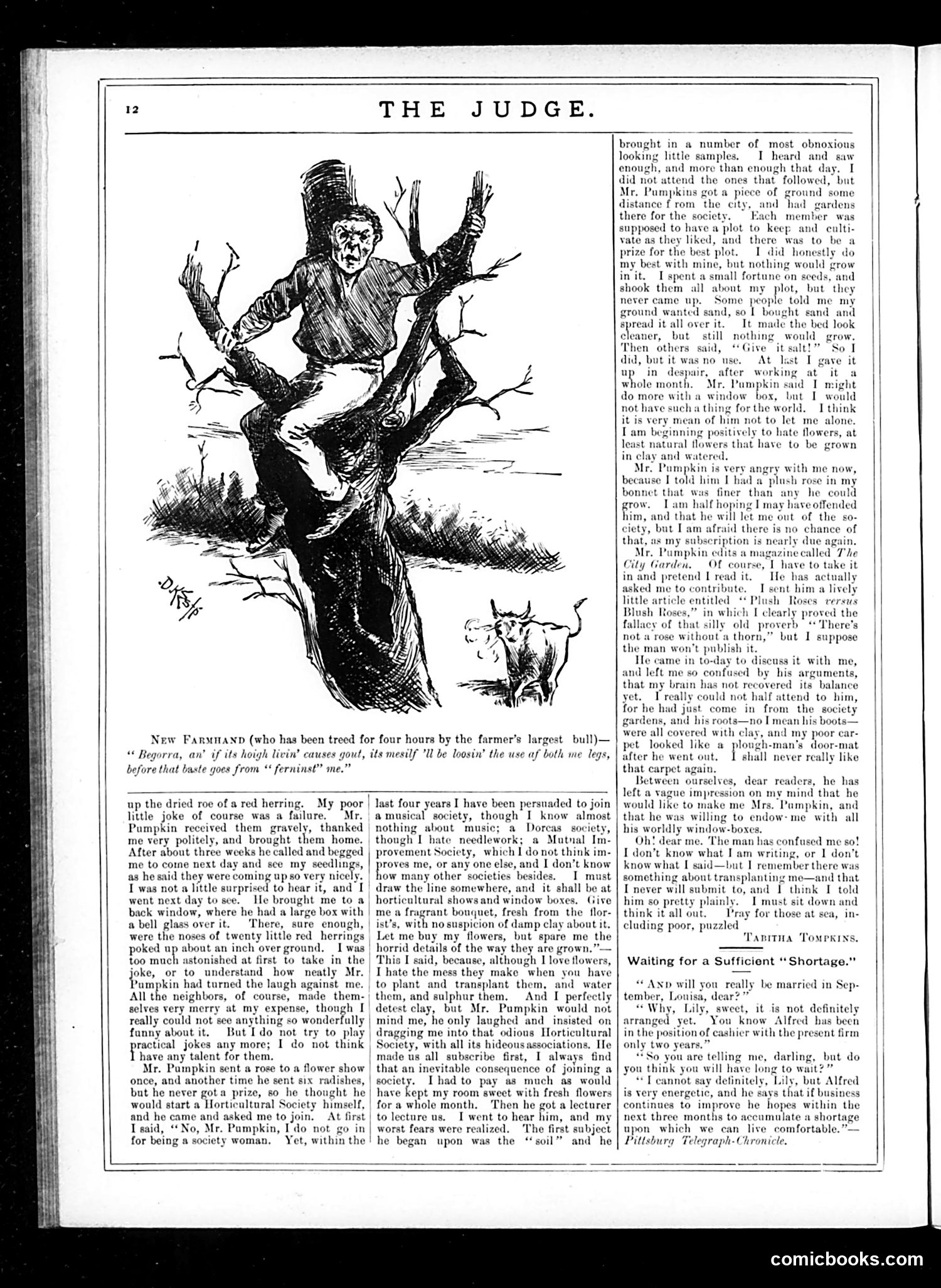
This page contains two separate satirical pieces from *Judge* magazine. **Top cartoon**: Shows a man ("New Farmhand") perched in a tree, terrified of a charging bull. The Irish dialect joke ("Begorra") mocks Irish immigrant laborers. The satire targets class anxieties—depicting manual workers in absurd, dehumanizing situations for comedic effect, reflecting period prejudices. **Bottom text**: A longer humorous essay about a character named Mr. Pumpkin and the narrator's misadventures joining a horticultural society. The satire ridicules middle-class social climbing and forced "self-improvement" through joining clubs and societies. Mr. Pumpkin plays pranks on the narrator (planting herring "noses"); she resents being pressured into unwanted social obligations, gardening, and spending money on membership dues. The satire mocks both excessive societal conformity and the pretentiousness of amateur horticulture clubs. Both pieces satirize social pretension and class-based anxiety in turn-of-the-century America.
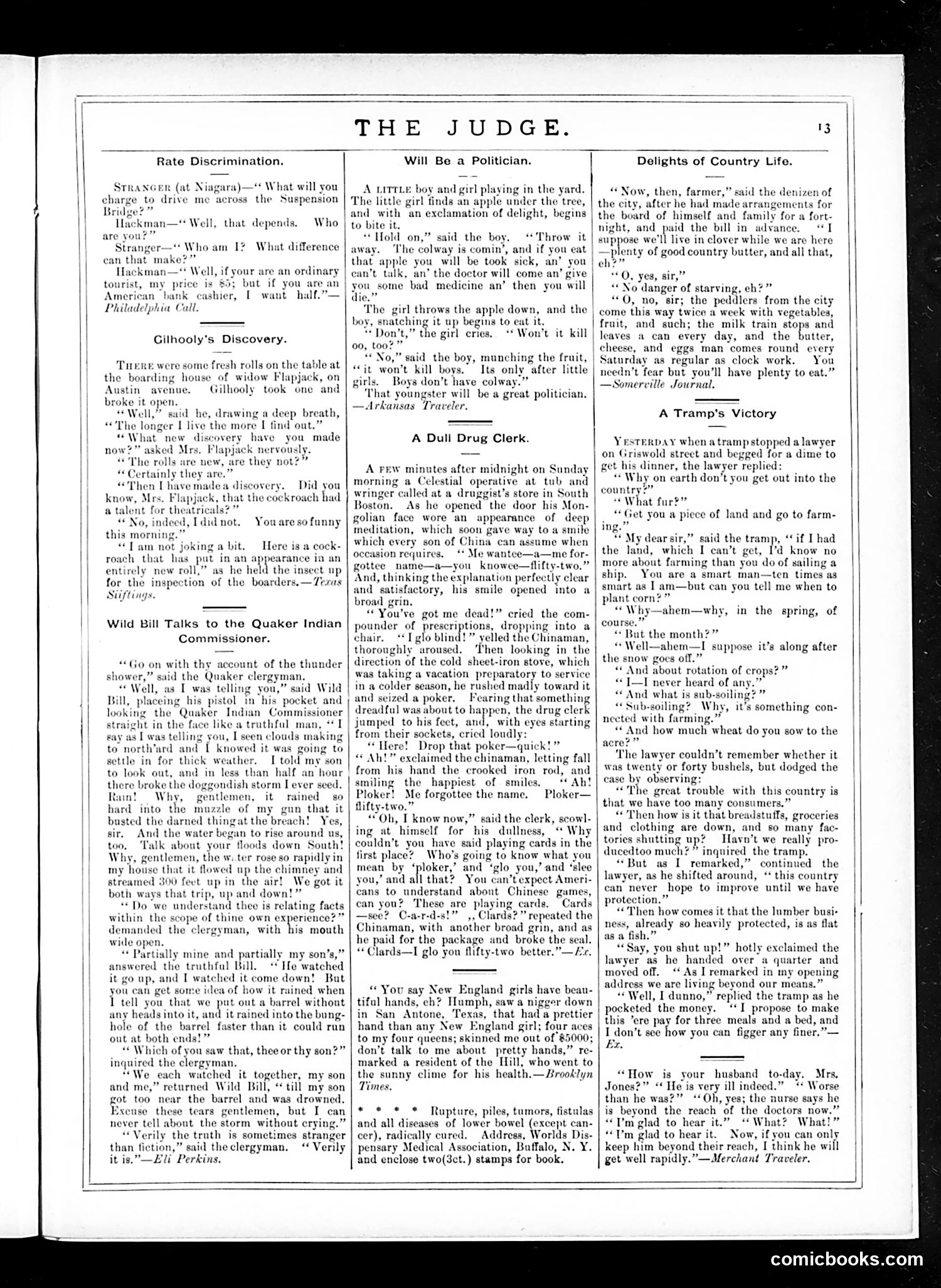
This page from the satirical magazine *Judge* contains several brief humorous sketches satirizing American life and types: **"Rate Discrimination"** mocks economic inequality: a hackman charges an ordinary tourist one price but demands double from an American banker—commentary on the perceived greed toward the wealthy. **"Gilhooly's Discovery"** is a simple boarding-house joke about finding a cockroach in a fresh roll. **"Wild Bill Talks to the Quaker Indian Commissioner"** parodies tall tales and frontier exaggeration. Wild Bill recounts an absurdly implausible rainstorm that supposedly killed his son, testing the Quaker's credulity. **"Will Be a Politician"** satirizes political dishonesty through children: a boy convinces a girl not to eat an apple by claiming it will make her sick, then eats it himself—modeling the hypocrisy and double-standards Judge associates with politicians. The other sketches employ similar gentle mockery of American social types and behaviors. The tone is lighthearted rather than biting political commentary.
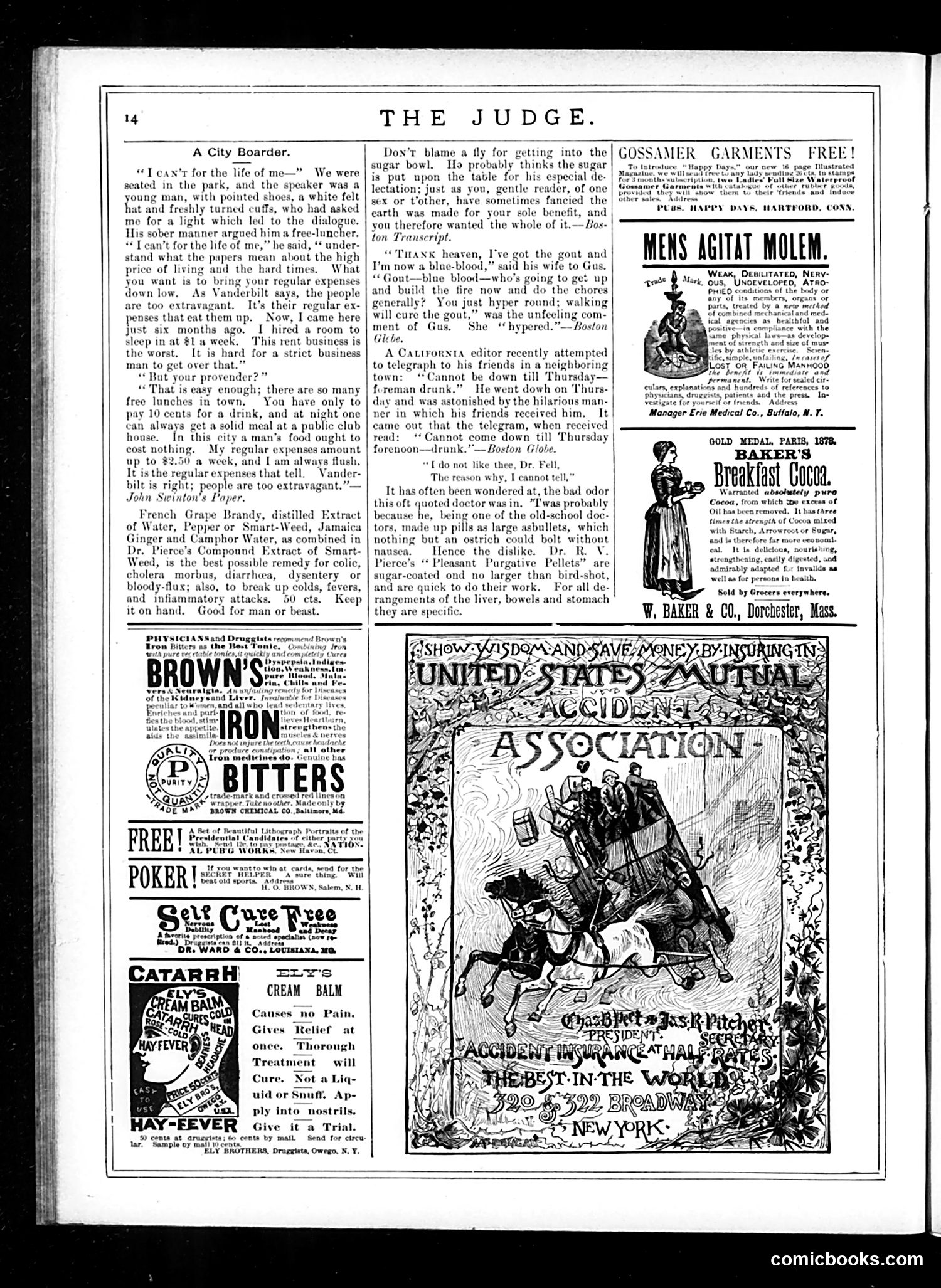
This page is primarily **advertising with one humorous short story**. The main cartoon/article is "A City Boarder," a satirical dialogue mocking a young, well-dressed man's claims about managing poverty on minimal expenses. He brags of paying only $1/week rent and spending nothing on food by exploiting "free lunches" (bars offering complimentary food with drink purchases) and public clubhouse meals—all while comparing himself to wealthy Vanderbilt and blaming poor people for extravagance rather than systemic hardship. The satire ridicules this self-deluding logic and the gap between his boasts and his actual financial precarity. The remaining content consists of patent medicine advertisements (Brown's Iron Bitters, Catarrah Cream Balm, Baker's Cocoa) and brief humorous anecdotes about Dr. Fell, telegraph mishaps, and spousal banter—typical filler for period magazines.
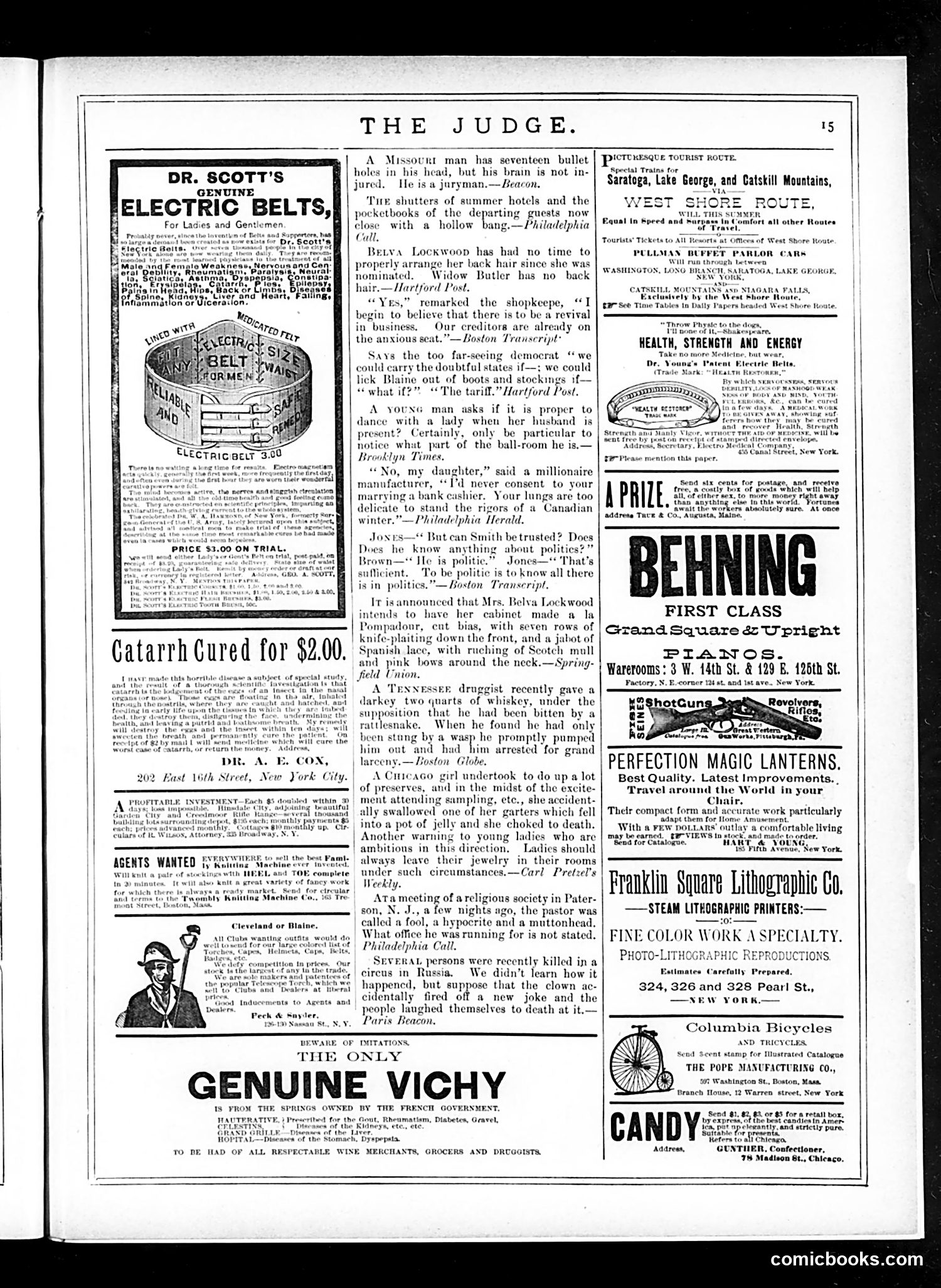
This page from **Judge** magazine is primarily an **advertisements and humor miscellany** rather than a unified political cartoon. ## Key Content: **Main Satirical Items** (brief quips): - A Missouri man with "seventeen bullet holes in his head, but his brain is not injured"—dark humor about stupidity - Jokes about **Belva Lockwood**, a real 1884 presidential candidate, mocking her appearance and ambitions - A joke about a Tennessee druggist giving whiskey to a Black man ("darkey") for a wasp sting, then arresting him for "larceny"—satirizing both medical incompetence and racist absurdity - Mockery of a pastor called "fool, hypocrite and muttonhead" at a religious meeting **Broader Context:** The humor reflects 1880s attitudes: casual racism, sexism toward female candidates, and skepticism toward Reconstruction-era political figures. **Belva Lockwood** appears frequently, suggesting contemporary debate over women's suffrage and political participation. ## Advertisements: Dr. Scott's Electric Belts, pianos, bicycles, and patent medicines dominate—typical Victorian advertising. The page offers snapshots of 1880s social anxieties and prejudices rather than sustained political argument.
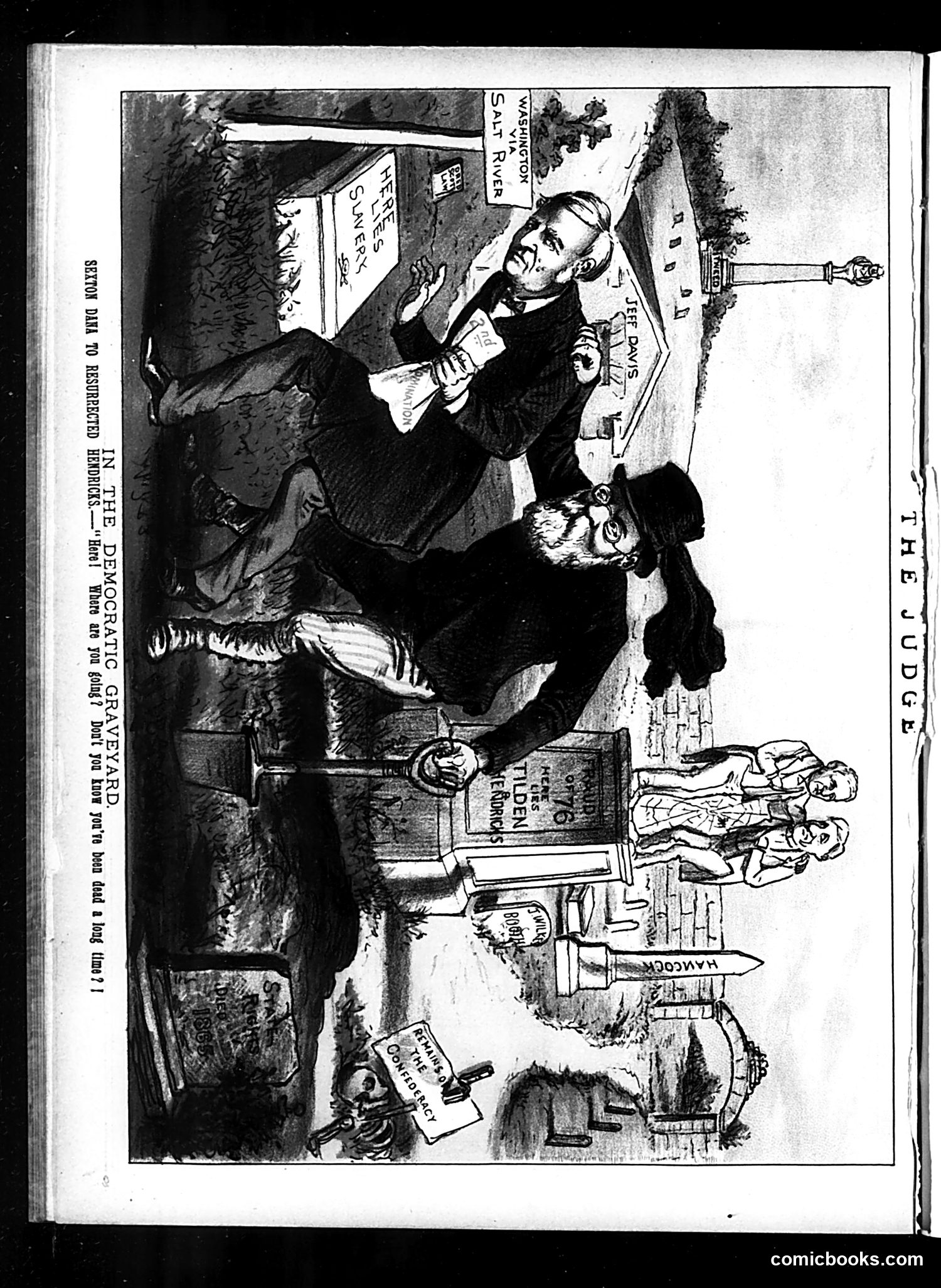
This is a satirical cartoon titled "In the Democratic Graveyard." It depicts a sexton (gravedigger) labeled "Dana" confronting a resurrected figure identified as "Hendricks," who appears to be climbing out of a grave. The text reads: "Here! Where are you going? Don't you know you've been dead a long time?" The cartoon likely references Charles A. Dana (editor of the New York Sun) and Thomas A. Hendricks, a Democratic politician. The satire suggests that Hendricks or Democratic politics generally are being revived despite being politically "dead" for an extended period. This appears to criticize either a political comeback or resurrection of outdated Democratic policies/figures, using the graveyard as metaphor for the Democratic Party's poor electoral fortunes.

I cannot meaningfully analyze this page. The image shows what appears to be a mostly blank page from Judge magazine with only fragmentary text visible along the left spine area reading "THE JUDGE" vertically. The OCR text provided consists entirely of random characters and symbols with no coherent words or readable content. Without visible cartoon artwork, legible text, or identifiable figures, I cannot explain the satire, political references, or intended meaning to a modern reader. This may be a blank page, a title page, or a scanning artifact that has rendered the content illegible.