
Judge, 1884-10-11 · page 2 of 17
Judge — October 11, 1884 — page 2: what you’re looking at
What you’re looking at
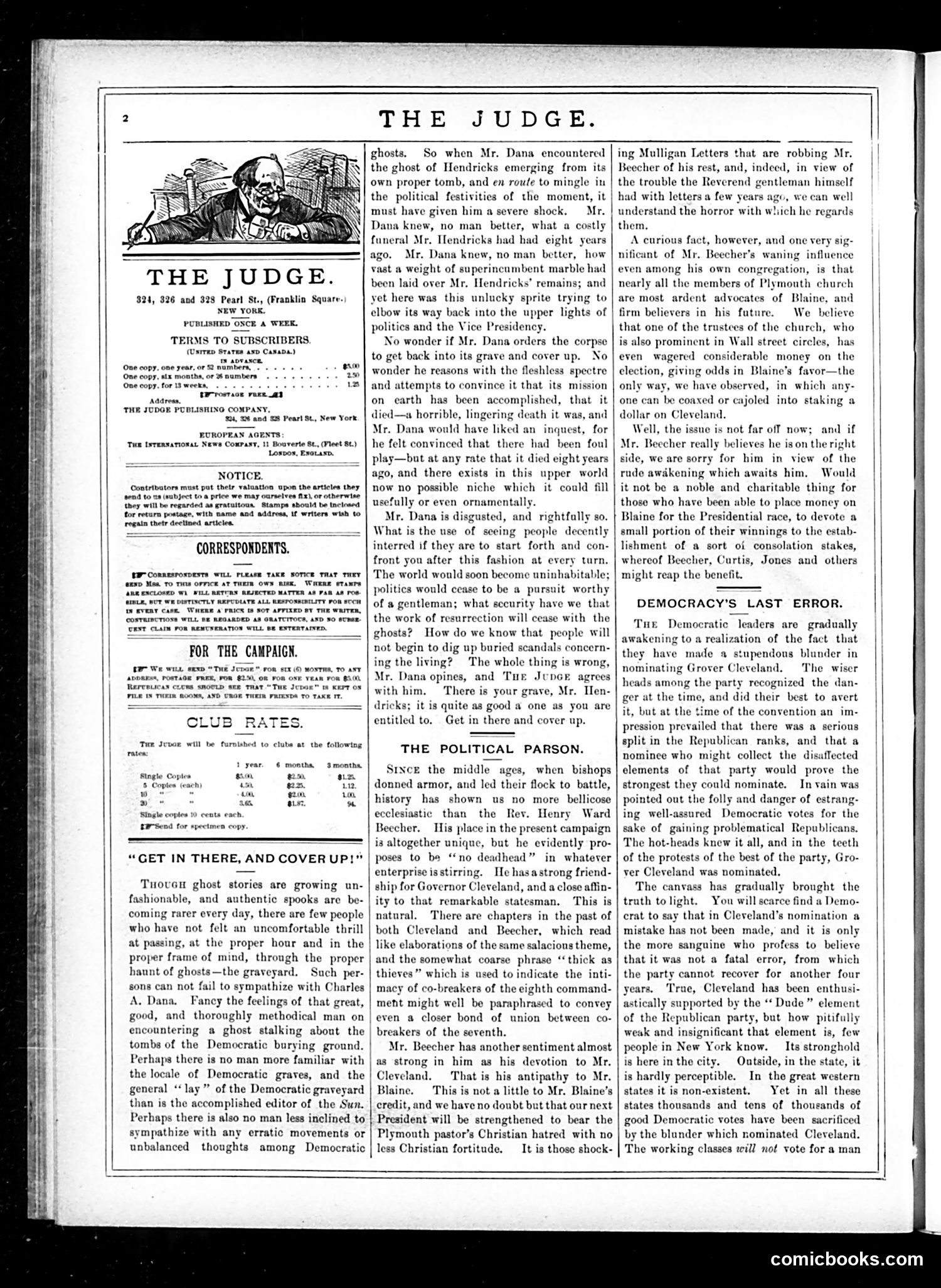
This page contains two satirical pieces attacking Democratic leadership during what appears to be the 1884 presidential campaign. **"Get in There, and Cover Up!"** is the main cartoon, using the metaphor of a ghost to criticize Charles A. Dana (editor of the Sun newspaper) for attempting to suppress the political resurrection of Thomas A. Hendricks, the late Vice President who had died eight years prior. The piece sarcastically suggests Dana is literally trying to keep Hendricks' corpse buried rather than allow Democratic revival of his legacy or memory in current politics. **"Democracy's Last Error"** criticizes Democratic leaders for nominating Grover Cleveland, arguing the party made a fatal blunder. It suggests Cleveland's nomination was a mistake that disaffected Democrats cannot repair—implying internal party damage that will cost them the election. The satire relies on readers' familiarity with recent Democratic scandals and leadership disputes. Both pieces mock Democratic dysfunction using dark, grotesque imagery (ghosts, corpses, graveyards) to suggest the party is spiritually dead or dying.
📄 Transcribed text from this page (OCR, searchable)
Machine-transcribed from the original scan — historical spelling and the odd misread are preserved.
THE JUDGE. 924, $26 and 328 Pearl St., (Franklin Square. NEW YORK. PUBLISHED ONCE A WEEK. TERMS TO SUBSCRIBERS. (Usrrep Staves axp Casapa.) One copy, one year. or 2 numberm. = One copy, ax months, or 2 numbers One copy. for 18 weeks, rrowson yarn a3 Address, ‘THE JUDGE PUBLISHING COMPANY. 4 28 Peart St., New York Tue terersarionat NOTICE. Contribators must put thetr valuation upon the articles they tend to ne (subject toa price we may ourselves Rx), or otherwise they will be regarded as gratuitous, Stamps should be tneinsed for return postage, with name and address, if writers wish to regain thetr deetined articles. * CORRESPONDENTS. EU" CORRESPONDENTS WILL FLEARE TAKE NOTICE THAT THET exxp Maa To Tins OFTICE AT THEIR OWS Rim, WHERE eTaxre ARE ENCLOSED WL ILL RETCRS REJECTED MATTER erm, WOT tw EvERY C. conTRIncTions WIL URST CLAIM FOR FOR THE CAMPAIGN, G97 We writ enxp “Te Jopar™ von sxx (f) MoNTHA, TO ANT ADDRES, POSTAGE FREE, FOR $21, On FOR OSE YEAR FOR We JEDOR™ 18 KEFT O8 ROR THEIR FRIENDS TO TAKE IT. Wie 16 THEIR ROOM, A Tue Jevar will be furnished to clut rates the following year. 6 months 3 monthe. 8 Co w » Single coples 10 cents each. ErSend for specimen copy “GET IN THERE, AND COVER UP!" Tuoven ghost stories are growing un- fashionable, and authentic spooks are be- coming rarer every day, there are few people who have not felt an uncomfortable thrill at passing, at the proper hour and in the proper frame of mind, through the proper | haunt of ghosts—the graveyard. sons can not fail to sympathize with Charles A. Dana, Fancy the feelings of that great, good, and thoroughly methodical man on encountering a ghost stalking about the tombs of the Democratic burying ground. Perhaps there is no man more familiar with the locale of Democratic graves, and the general “lay” of the Democratic graveyard than is the accomplished editor of the Sun. Perhaps there is also no man less inclined to sympathize with any erratic movements or unbalanced thoughts among Democratic Such per- | is altogether unique, but he evidently THE JUDGE. ghosts. So when Mr. Dana encountered the ghost of Hendricks emerging from its own proper tomb, and en roufe to mingle in the political festivities of the moment, it | must have given him a severe shock. Mr. Dana knew, no man better, what a costly funeral Mr, Hendricks had had eight years ago. Mr. Dana knew, no man better, how vast a weight of superincumbent marble had been laid over Mr. Hendricks’ remains; and yet here was this unlucky sprite trying to elbow its way back into the upper lights of politics and the Vice Presidency. No wonder if Mr. Dana orders the corpse to get back into its grave and cover up. No wonder he reasons with the fleshless spectre and attempts to convince it that its mission on earth has been accomplished, that it died—a horrible, lingering death it was, and Mr. Dana would have liked an inquest, for he felt convinced that there had been foul play—but at any rate that it died eight years ago, and there exists in this upper world now no possible niche which it could fill usefully or even ornamentally. Mr. Dana is disgusted, and rightfally so. What is the use of seeing people decently interred if they are to start forth and con- front you after this fashion at every turn. The world would soon become uninhabitable; politics would cease to be a pursuit worthy of a gentleman; what sccurity have we that the work of resurrection will cease with the ghosts? How do we know that people will not begin to dig up buried scandals concern- ing the living? The whole thing is wrong, Mr. Dana opines, and Tue JupGe agrees with him, There is your grave, Mr. Ien- dricks; it is quite as good a one as you are entitled to. Get in there and cover up. THE POLITICAL PARSON. Stxce the middle ages, when bishops donned armor, and led their flock to battle, history has shown us no more bellicose ecclesiastic Beecher. than the Rev. Henry Ward His place in the present campaign pro- poses to be ‘no deadhead” in whatever enterprise isstirring. Ile hasastrong friend- ship for Governor Cleveland, and a close affin- ity to that remarkable statesman. This is natural. There are chapters in the past of both Cleveland and Beecher, which read like elaborations of the same salacions theme, and the somewhat coarse phrase ‘thick as thieves” which is used to indicate the inti- macy of co-breakers of the eighth command- ment might well be paraphrased to convey even a closer bond of union between co- breakers of the seventh. Mr. Beecher has another sentiment almost as strong in him as his devotion to Mr. Cleveland. That is his antipathy to Mr. Blaine. This is not a little to Mr. Blaine’s credit, and we have no doubt but that our next President will be strengthened to bear the Plymouth pastor’s Christian hatred with no less Christian fortitude. It is those shock- ing Mulligan Letters that are robbing Mr. Beecher of his rest, and, indeed, in view of the trouble the Reverend gentleman himself had with letters a few years ago, we can well understand the horror with which he regards them, A curious fact, however, and one very sig- nificant of Mr. Beecher’s waning influence even among his own congregation, is that nearly all the members of Plymouth church are most ardent advo of Blaine, and firm believers in his future. We believe that one of the trustees of the church, who is also prominent in Wall street circles, has even wagered considerable money on the clection, giving odds in Blaine’s favor—the have observed, in which any- ‘an be coaxed or cajoled into staking a dollar on Cleveland. Well, the issue is not far off now; and if Mr. Beecher really believes he is on the right side, we are sorry for him in view of the rade awakening which awaits him, Would it not be a noble and charitable thing for those who have been able to place money on Blaine for the Presidential race, to devote a small portion of their winnings to the estab- lishment of a sort of consolation stakes, whereof Beecher, Curtis, Jones and others might reap the benefit. DEMOCRACY’S LAST ERROR. Tue Democratic leaders are gradually awakening to a realization of the fact that they have made a stupendons blunder in nominating Grover Cleveland. The wiser heads among the party recognized the dan- ger at the time, and did their best to avert it, but at the time of the convention an im- pression prevailed that there was a serious split in the Republican ranks, and that a nominee who might collect the disaffected elements of that party would prove the strongest they could nominate. In vain was pointed out the folly and danger of estrang- ing well-assured Democratic votes for the sake of gaining problematical Republicans. The hot-heads knew it all, and in the teeth of the protests of the best of the party, Gro- ver Cleveland was nominated, The canvass has gradually brought the truth tolight. You will scarce find a Demo- crat to say that in Cleveland’s nomination a mistake has not been made, and it is only the more sanguine who profess to believe that it was not a fatal error, from which the party cannot recover for another four years. True, Cleveland has been enthusi- astically supported by the ‘‘ Dude” element of the Republican party, but how pitifully weak and insignificant that element is, few people in New York know. — Its stronghold is here in the cit! Outside, in the state, it is hardly perceptible. In tho great western states it is non-existent. Yet in all these states thousands and tens of thousands of good Democratic votes have been sacrificed by the blunder which nominated Cleveland. The working classes will not vote for a man comicbooks.com