
A complete issue · 16 pages · 1884
Judge — June 14, 1884
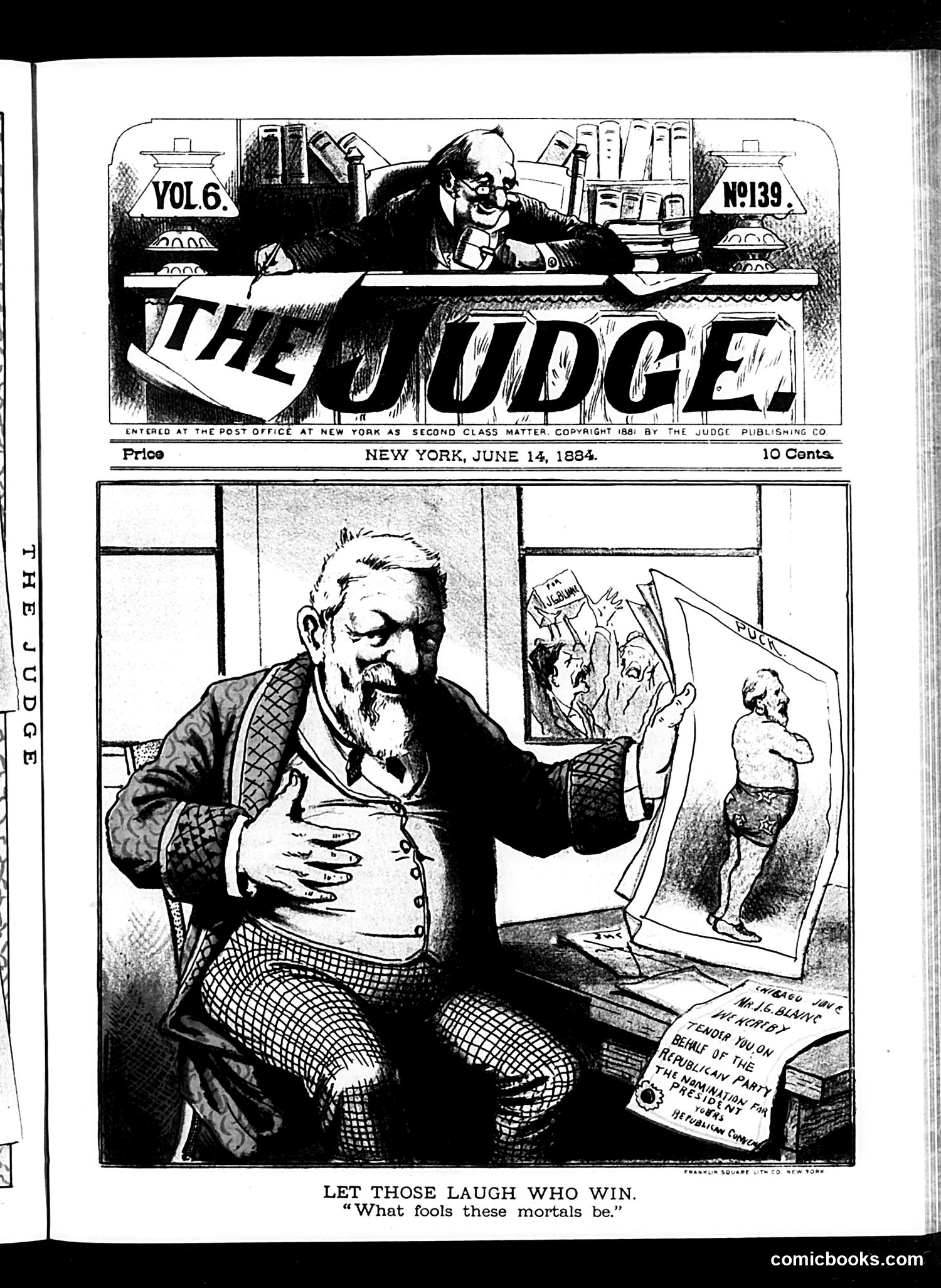
This political cartoon satirizes a prominent figure (likely a Republican politician or party leader, based on the visible "Republican" text on papers) who is laughing at his own caricature or unflattering portrayal. The main character, depicted with exaggerated facial features and a rotund physique, holds up a drawing showing a thin, muscular version of himself—a stark contrast to his actual appearance. The caption "Let those laugh who win" with the subtext "What fools these mortals be" suggests the cartoon mocks someone's self-delusion or vanity. The figure appears to be dismissing or trivializing criticism through humor. The 1884 date places this during a presidential election year, likely commenting on a political figure's response to negative campaign coverage or caricatures.
This is editorial commentary, not a cartoon. Judge magazine endorses Republican James G. Blaine's presidential nomination at the Chicago convention. The text defends Blaine against attacks from rivals and competing publications (notably Puck magazine, Judge's satirical competitor), claiming that negative charges against him have been "proven to be" false and that his nomination represents vindication. The piece dismisses Blaine's critics as "cranks" and "self-seekers" motivated by envy, comparing Puck's attacks to a "noxious insect" feeding on a superior being. Judge argues Blaine's long public career and the enthusiastic convention support prove his worthiness for the presidency. The rhetoric is fiercely partisan, framing support for Blaine as both obvious and morally justified.
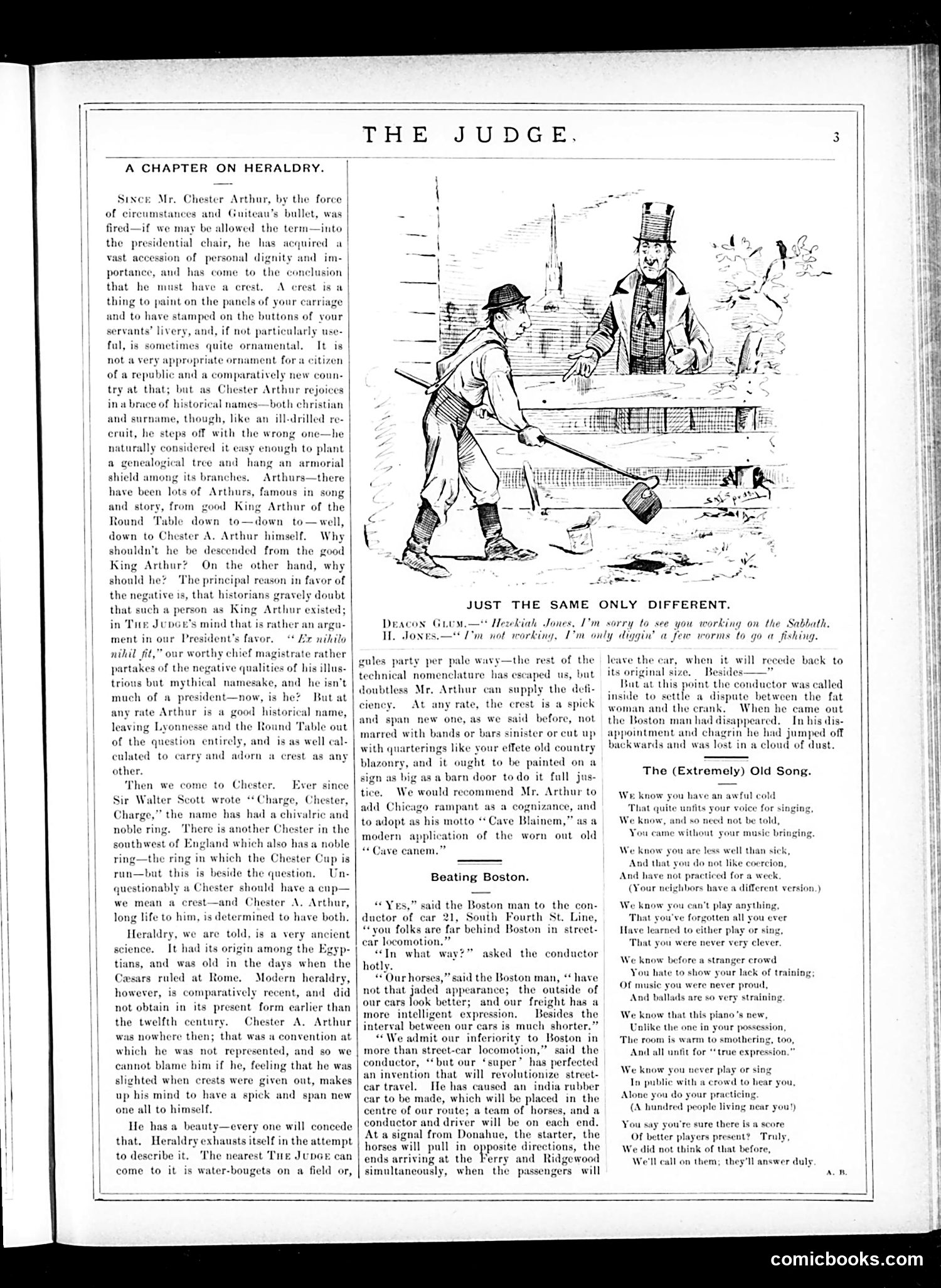
This Judge magazine page satirizes President Chester Arthur, who assumed office after James Garfield's assassination by Charles Guiteau in 1881. The main cartoon mocks Arthur's apparent desire to establish a presidential coat of arms and family crest—incongruous for a republic. The satire's point: Arthur, despite claiming descent from King Arthur (a mythical figure), has no legitimate historical pedigree. The writer notes the irony that Arthur himself is essentially fabricated ("Ex nihilo nihil fit"—"from nothing comes nothing"), making his invented genealogy doubly absurd. The secondary section, "Beating Boston," appears to be a separate humor piece about streetcar transportation. The overall thrust: Judge ridicules Arthur's pretensions to aristocratic dignity and Old World formality as fundamentally un-American and contradictory to republican values. His sudden elevation through assassination, combined with his social climbing, made him a natural satirical target.
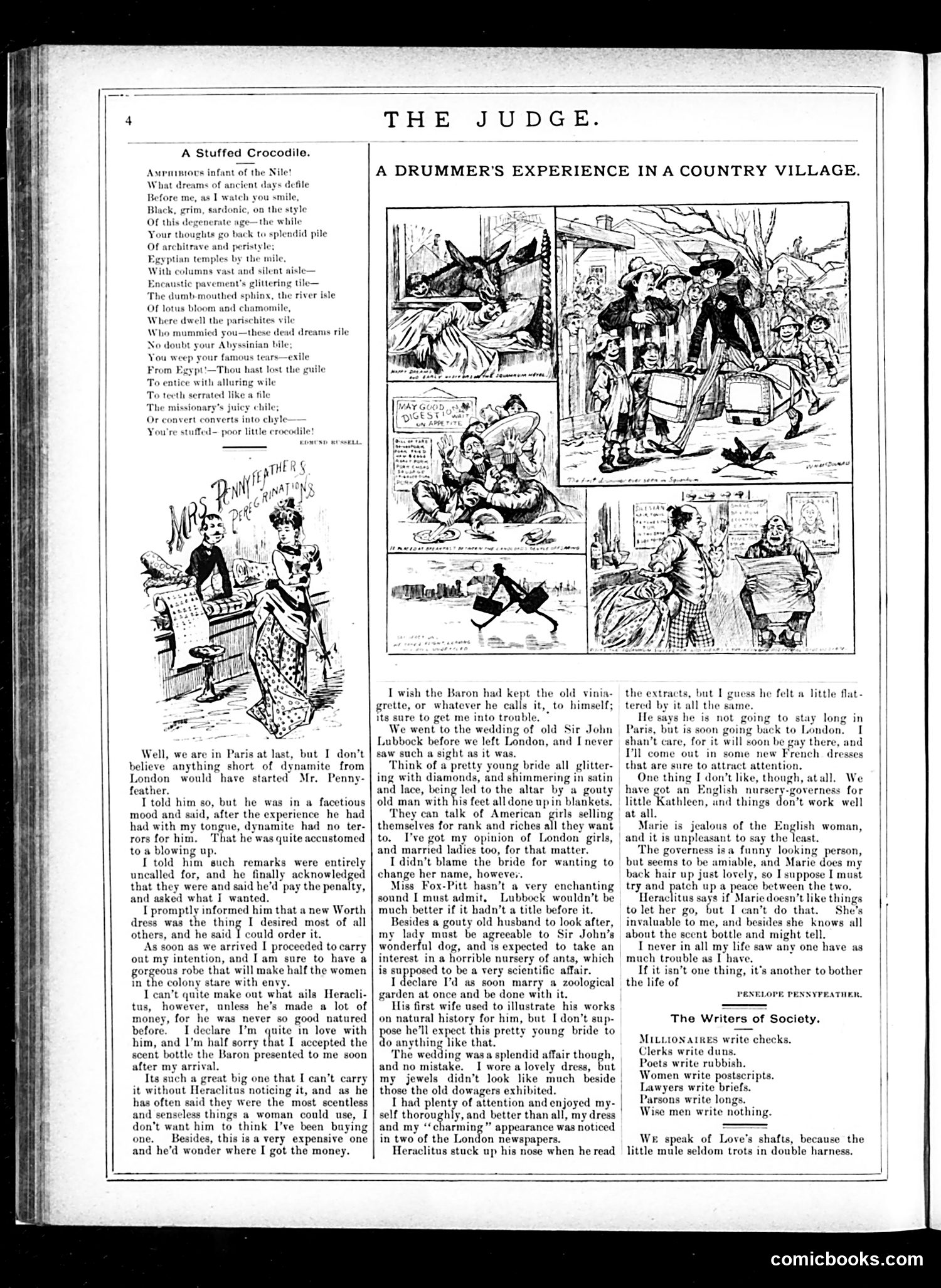
This comic strip satirizes a traveling salesman's misadventures in rural England. The sequential panels depict slapstick chaos: the drummer arrives in a sleepy village and encounters hostile locals, physical mishaps, and comic indignities. The humor relies on physical comedy and the fish-out-of-water premise of a city professional thrust into provincial hostility. The accompanying text describes a woman's account of Paris society and a London wedding, mocking both British social pretension and American aspirations. She ridicules a wealthy bride marrying an elderly, gouty nobleman (likely referencing a real figure, though unclear which), criticizing her focus on status symbols and jewelry over substance. The overall tone reflects Judge magazine's typical Victorian-era satire: mocking social climbing, marital mercenary behavior, and provincial/cosmopolitan cultural tensions. The "stuffed crocodile" poem appears to be separate satirical verse, likely referencing Egyptian tourism or affectation.
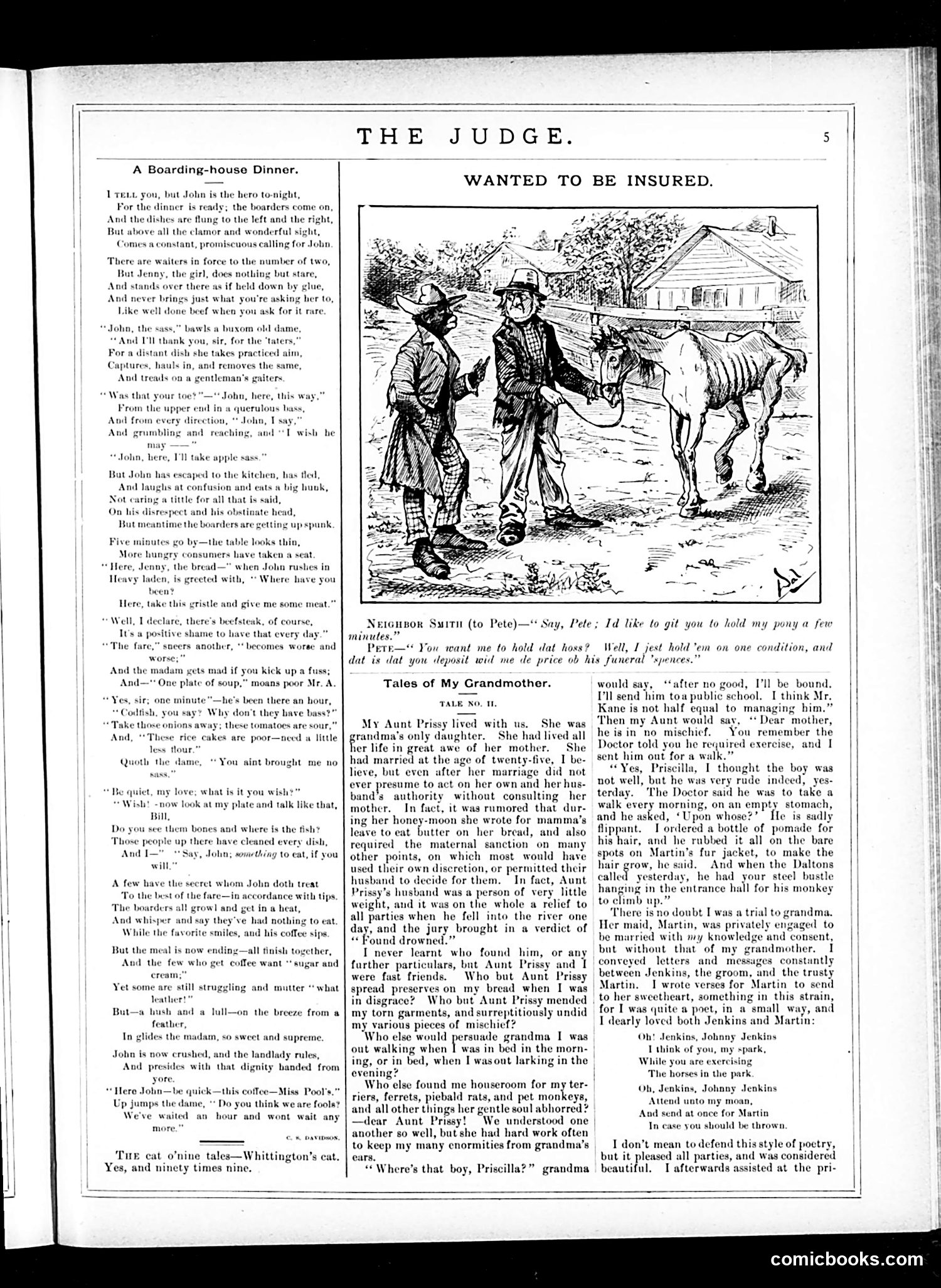
This sketch satirizes rural life insurance agents attempting to solicit a policy from a farmer with a notably poor horse. The two figures appear to be insurance salesmen approaching the farmer (Pete) about insuring his livestock—specifically the gaunt, sickly horse visible in the image. The satire lies in the absurdity: the horse is so obviously in terrible condition that insuring it would be pointless or fraudulent. The neighbor's proposition ("I'd like to git you to hold my pony a few minutes") serves as cover for the real sales pitch about the worthless animal. This reflects period skepticism about insurance schemes and rural populations' wariness of city-slicker salesmen offering dubious financial products. The joke mocks both the aggressive sales tactics and the notion that anyone would insure such a decrepit animal.
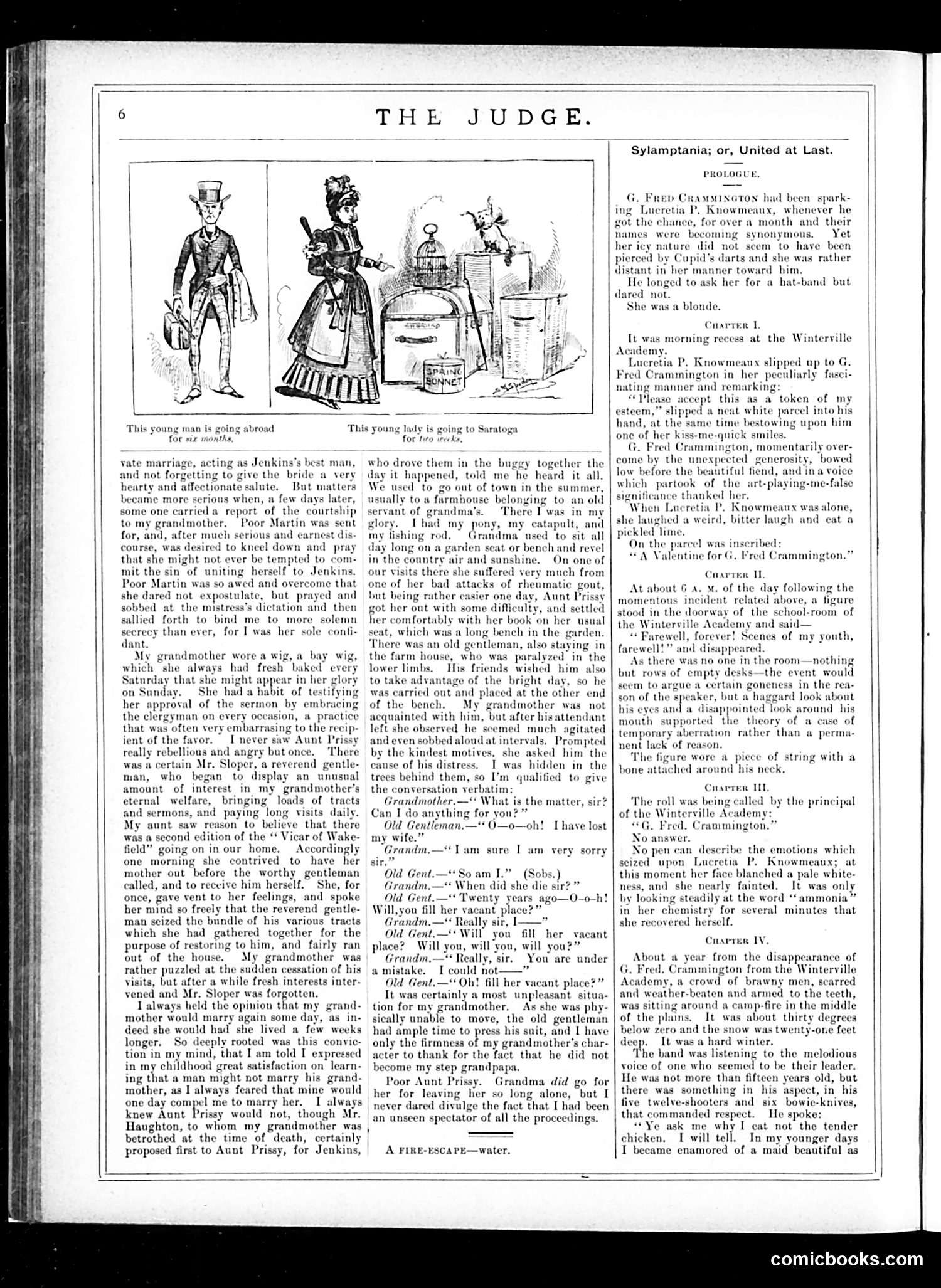
This page presents a serialized domestic comedy narrative rather than political satire. The illustration shows a young man departing ("going abroad for six months") and a young woman preparing for Saratoga, likely a fashionable resort destination. The text is a nostalgic memoir-style story about the narrator's grandmother, her servant Martin, and various domestic episodes—including a scheming suitor (Mr. Sloper), romantic entanglements, and countryside adventures. The humor derives from Victorian-era family dynamics, religious hypocrisy (the pastor's ulterior motives), and eccentric elderly characters. This appears to be serialized fiction rather than political commentary—typical of Judge magazine's mixed content format, which included both satire and entertainment narratives for its late 19th-century readership.
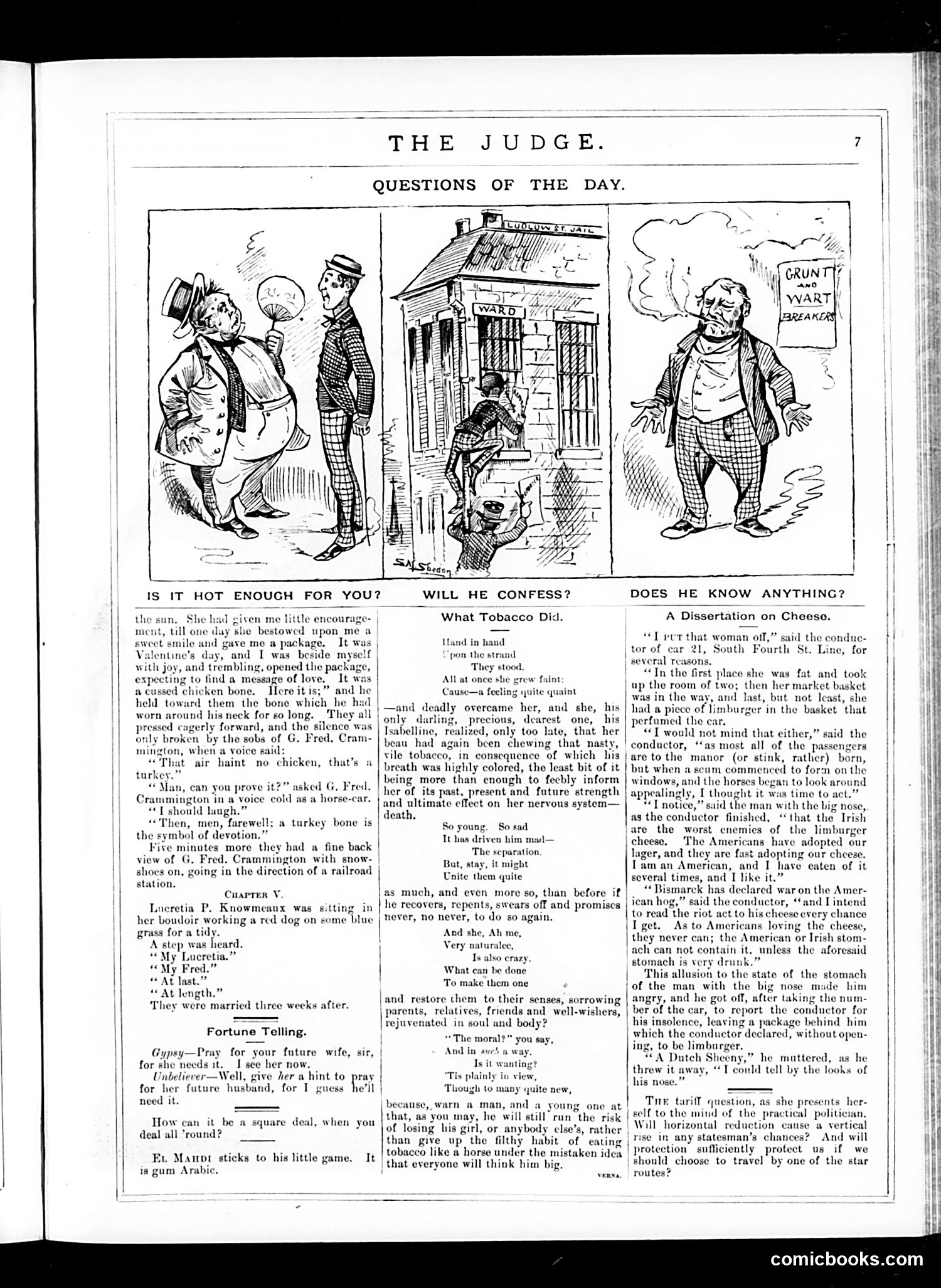
This page contains three separate satirical cartoons and humorous pieces typical of 1890s American humor: **"Is It Hot Enough for You?"** (left): A social joke about summer heat and romantic disappointment—a man presents his beloved with what he claims is a love token, but it's merely a chicken bone he'd been wearing around his neck. **"Will He Confess?"** (center): Depicts a scene at a "Ward" building, likely referencing political corruption or interrogation, though the specific reference is unclear without additional context. **"Does He Know Anything?"** (right): A conductor's monologue satirizing limburger cheese and ethnic stereotypes. The conductor complains that a passenger's pungent cheese cleared a streetcar. The dialogue mocks Irish immigrants' supposed aversion to limburger while joking about Americans and Belgians adopting it. The "big-nosed man" represents a ethnic caricature common to period satire. The cartoons reflect late-19th-century American social anxieties about immigration, urban transit, and ethnic differences rendered through crude but revealing stereotypes.
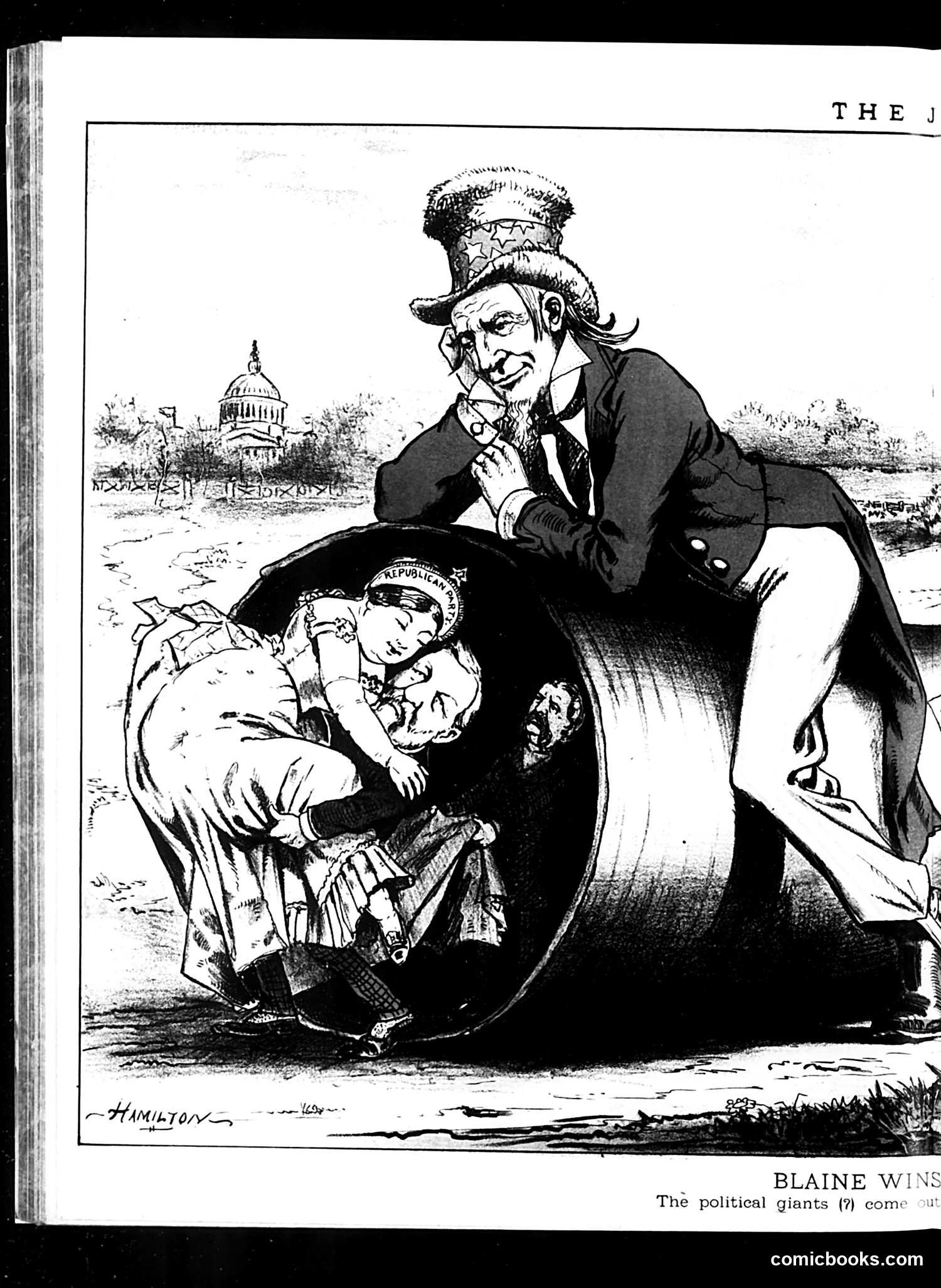
This Hamilton-signed cartoon satirizes James G. Blaine's political victory. Uncle Sam (the tall figure in top hat) appears to be pulling a baby labeled "REPUBLICAN" from a barrel or container, suggesting Blaine has "won" or claimed the Republican Party/candidacy. The caption "Blaine Wins" combined with "The political giants (?) come out" (note the sarcastic question mark) mocks Blaine as a political figure, implying he's not truly a "giant" despite his victory. The Capitol building visible in the background grounds this in American politics. The cartoon uses the barrel imagery—possibly referencing political manipulation or extraction—to suggest Blaine's triumph is absurd or undeserved. This appears to be critical commentary on Blaine's political rise or nomination.
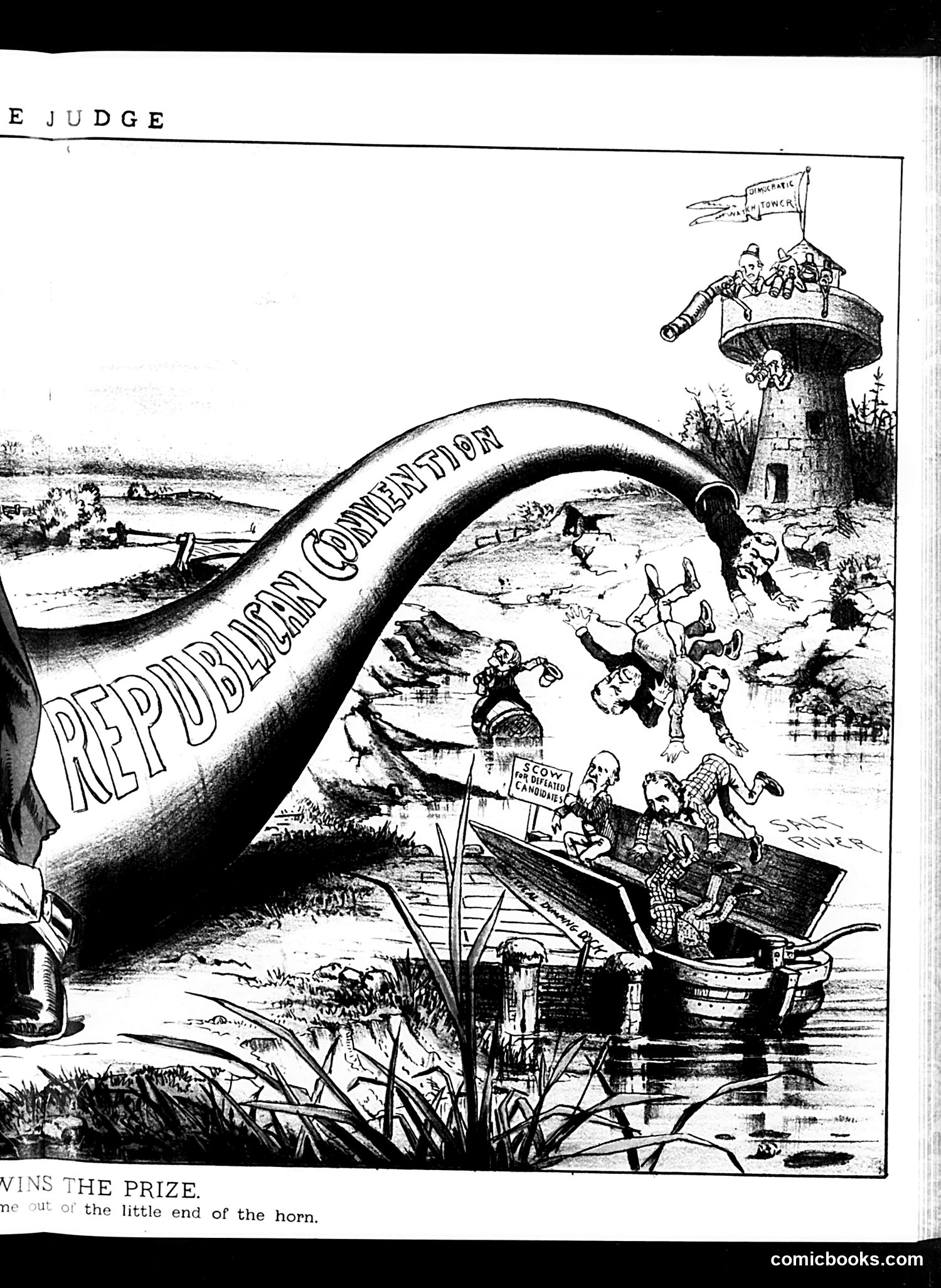
This Judge cartoon titled "The Prize" depicts a large horn labeled "REPUBLICAN CONVENTION" pouring out numerous figures into a boat on water, while a lighthouse (representing authority/oversight) stands in the background. The satire criticizes the Republican Party convention as producing numerous mediocre or undesirable candidates—shown as undistinguished figures tumbling from the horn's "little end." The phrase "out of the little end of the horn" (a period idiom meaning obtaining something of little value) reinforces the mockery: the convention supposedly yields only worthless political "prizes." The boat labeled "cow" and the water setting suggest these candidates will be distributed or must navigate uncertain political waters ahead. The cartoon mocks the Republican nomination process as producing inferior leadership material.
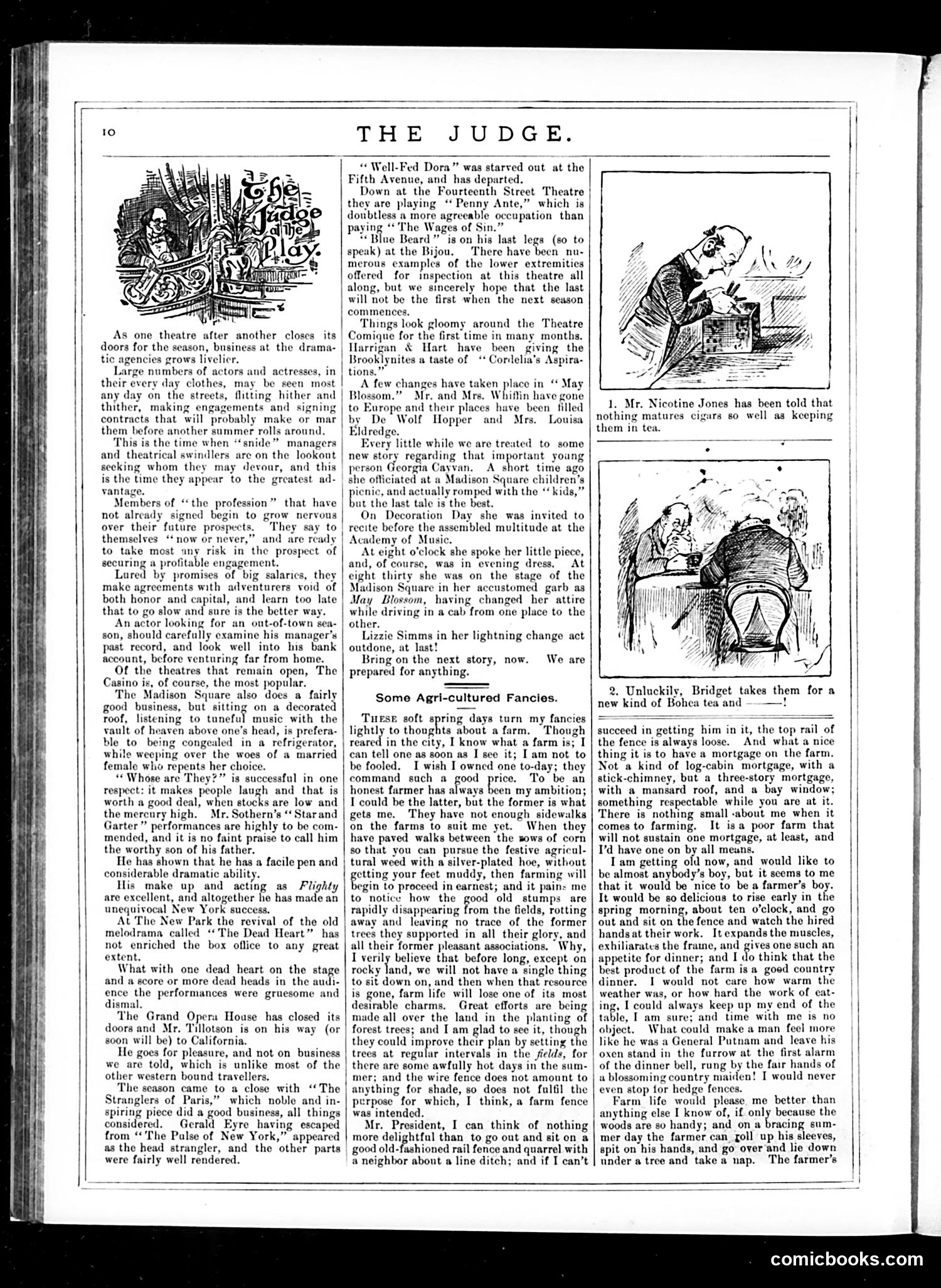
This page from the satirical magazine *Judge* discusses the theatrical season's closing and reopening, targeting theatrical practices and performers of the era. **The cartoons** show: (1) a man examining theatrical contracts/documents with a magnifying glass, and (2) "Bridget" serving tea—likely satirizing Irish servant stereotypes common in period comedy. **The satire's main points:** - Theatrical managers are predatory "swindlers" exploiting desperate actors during season transitions - Actors should scrutinize contracts and managers' financial backgrounds before signing - Several specific theaters and productions receive commentary: *The Casino* and *Madison Square* are praised; *The Dead Heart* revival is mocked; performances of *Blue Beard* are criticized for excessive leg-showing **Named performers** include Sothern (praised for "Star and Garter"), Harrigan & Hart, and De Wolf Hopper, suggesting contemporary theatrical personalities readers would recognize. The overall tone mocks both theatrical deception and period theatrical conventions while gossiping about the New York theater scene's personnel changes.
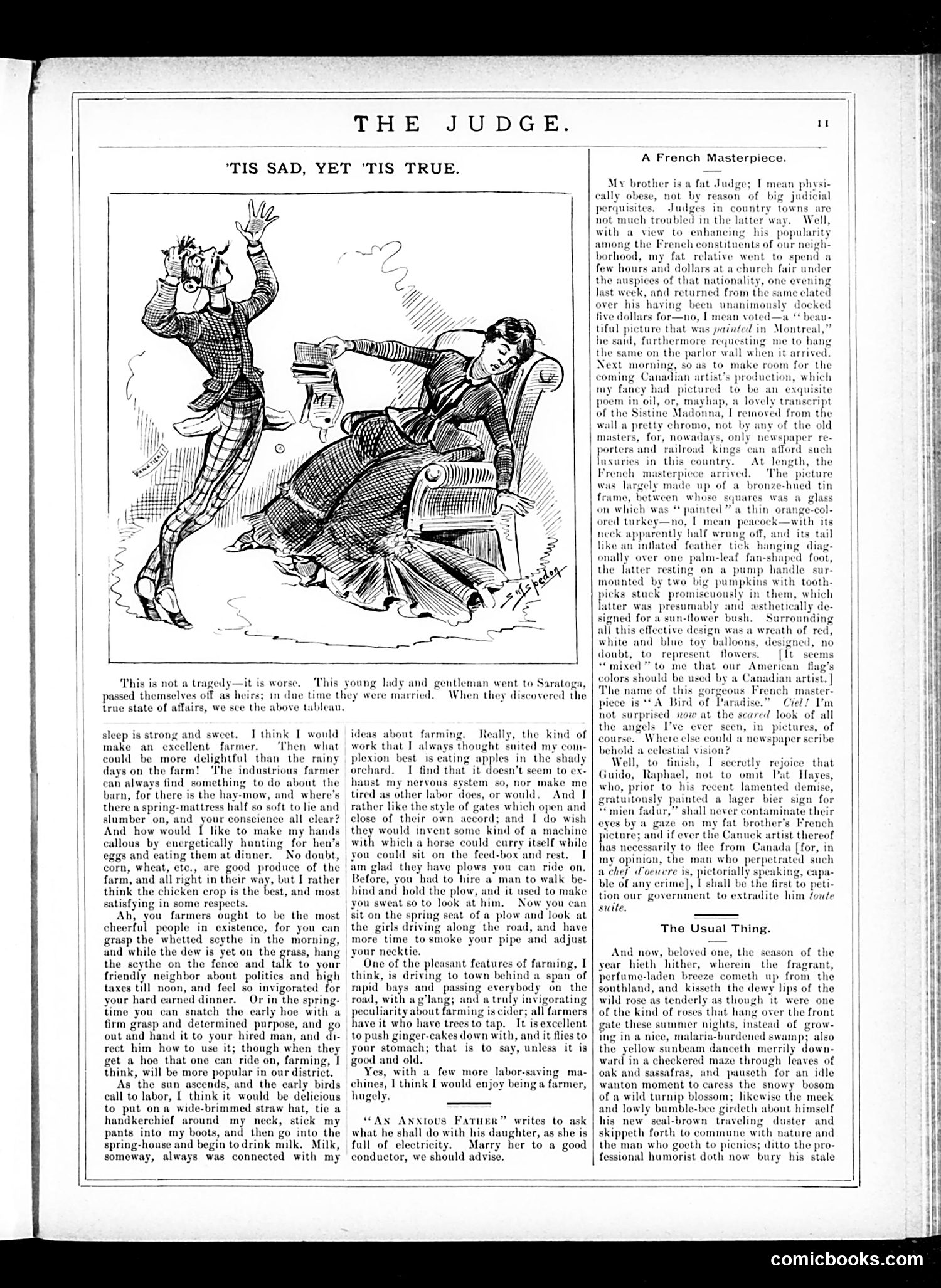
This cartoon satirizes a young couple who married after meeting at Saratoga (a fashionable resort town), only to discover financial incompatibility—the man appears to be a flamboyant spender while the woman tries to restrain him. The exaggerated poses (he gestures wildly while she reclines exhausted) mock the disconnect between romantic courtship and marital reality. The accompanying text humorously explores the author's fantasies about becoming a farmer, emphasizing leisure over labor—eating apples, riding plows, flirting with girls—revealing satirical commentary on urbanites' romantic but impractical notions of rural life. A secondary joke mocks a fat country judge who attended a French church fair seeking popularity among French constituents, only to be "docked five dollars" (possibly a financial misunderstanding or humiliation). The satire targets both rural social climbing and ethnic community relations in late 19th-century America.
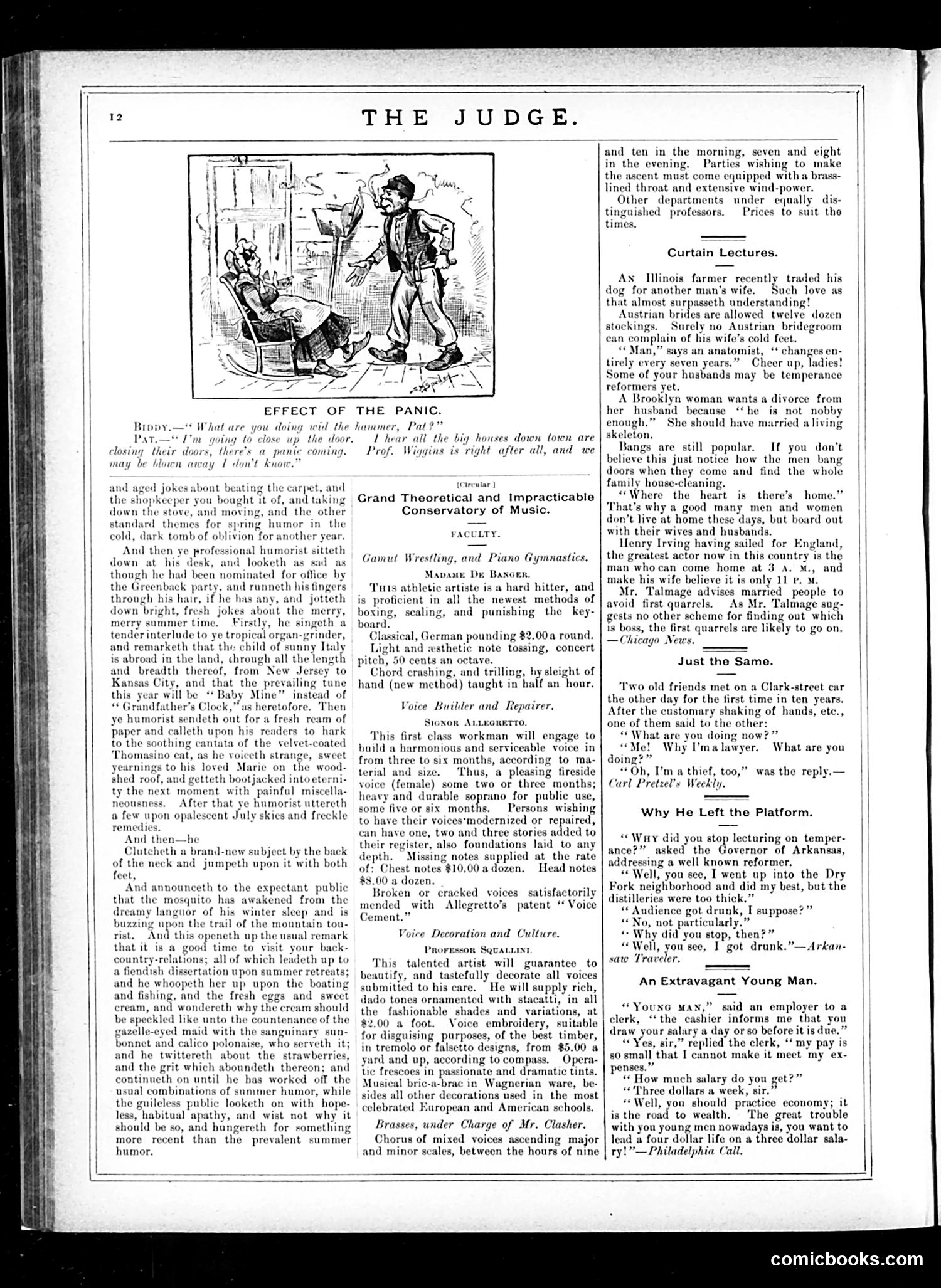
This cartoon satirizes economic panic and its ripple effects. Two men discuss a shop closure: one claims "big houses down town are closing their doors, there's a panic coming," while the other dismisses this as mere rumor-mongering. The joke targets how financial anxieties spread through society—panic itself becomes contagious, spread by gossipers like these two rather than grounded in facts. The accompanying text mocks spring-season humor writing, where journalists recycle tired jokes annually. It's meta-satire about Judge magazine itself and similar publications that lazily rehash predictable seasonal content (summer visitors, mosquitoes, mountain tourists) rather than offering fresh commentary. The "Conservatory of Music" advertisements are absurdist parodies of dubious correspondence schools—businesses promising to "build" voices, repair broken ones, or teach musical technique in impossibly short timeframes, all for specific fees per component.
This page from Judge magazine contains several short humorous anecdotes typical of 1890s American satirical journalism: **"Too Strict"** mocks German bureaucratic rigidity—a man drowns because swimming in rivers is legally forbidden, illustrating absurd rule-following over common sense. **"He Had Tried It"** presents a dyspepsia joke: a married man claims hot water "cured" him, then admits marriage itself was the actual ordeal—satirizing marriage as a digestive affliction. **"The Reporter's Revenge"** describes a rival newspaper's wedding coverage using insulting physical descriptions (orange wreath, burst gloves, red-faced groom)—humor about journalistic feuds and cattiness. **"Contrast Between East and West"** contrasts Boston's flowery academic language with Western directness, poking fun at regional communication styles. **"Patronizing a Pedler"** ironically misuses "patronize"—a girl thinks supporting street vendors prevents them becoming criminals, inverting the word's actual meaning. The remaining anecdotes include religious humor and drug-store satire. All exemplify Judge's format: brief, punchy social commentary through dialogue.
This page from the satirical magazine *Judge* contains several short humorous anecdotes typical of late 19th-century American humor. **"A Guilty Conscience"** depicts a Black farmer (rendered in period dialect) whose missing rooster troubles him because a preacher had warned that stolen chickens "come home to roost"—a moral lesson about consequences. The humor relies on the protagonist's superstitious guilt. **"Didn't Want Her Anyway"** satirizes male pride through a man claiming he rejected a woman romantically, when gossip suggests he was actually rejected. The joke exposes his transparent face-saving lie. **"Boarding House Hash"** and **"When His Wound Hurts"** are joke-setup formats common to the era, using wordplay and unexpected punchlines. The page also includes advertisements, notably **Henley's Challenge Roller Skate** at bottom right. The humor reflects period attitudes: crude racial caricature in dialect comedy, gender dynamics assuming male romantic rejection as shameful, and nostalgia for Civil War experiences. These pieces represent typical *Judge* content—light, sketch-based satirical humor for middle-class audiences.
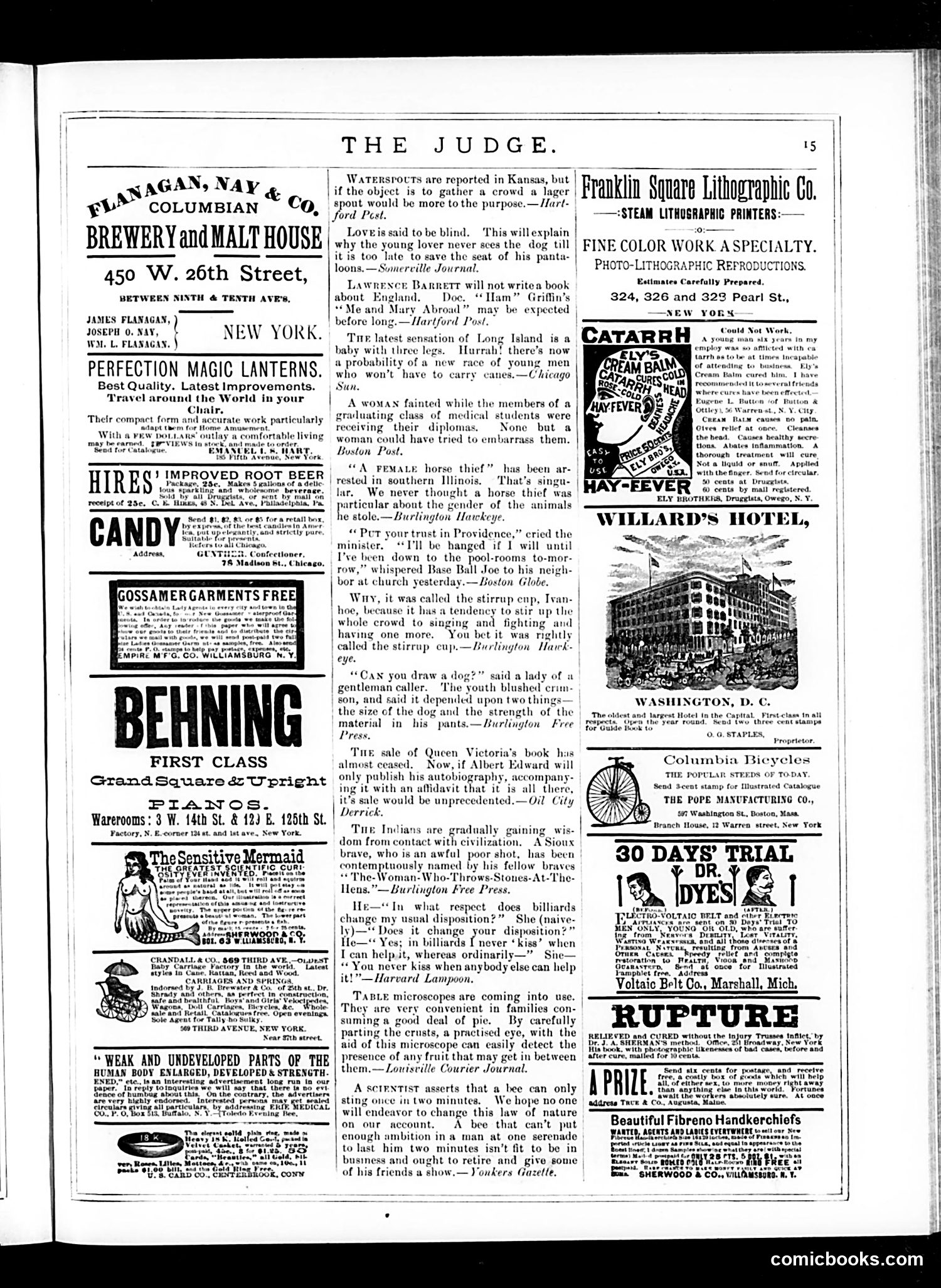
This page is primarily **advertising**, with satirical humor scattered throughout as filler content between advertisements. The advertisements promote various products (breweries, pianos, root beer, carriages, bicycles, patent medicines) typical of late 19th-century American commerce. The humor consists of brief, anonymous jokes reprinted from other newspapers. These jokes mock contemporary social attitudes: a woman fainting during medical school graduation (implying women are delicate), a horse thief's gender being "singular," a gambler at church prayer, billiards etiquette, Native Americans gaining "civilization," and microscopes detecting fruit in pie. The jokes reflect period prejudices and absurdist humor rather than organized political cartooning. There are **no identified caricatures or major political figures**—these are generic social observations meant to amuse readers through mild mockery of everyday situations and character types.
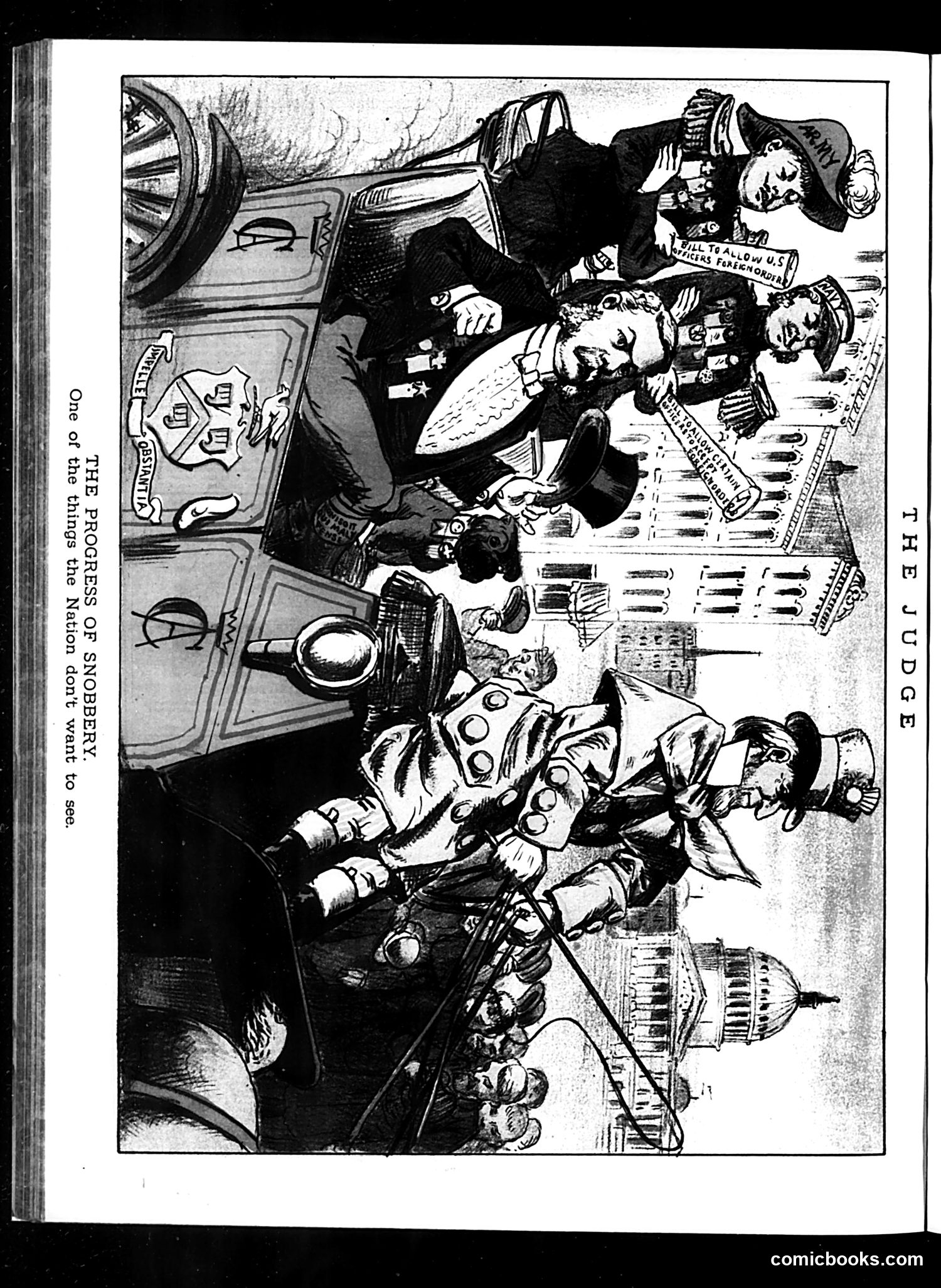
This appears to be a satirical cartoon about class pretension in early 20th-century America. The image shows figures in an automobile (then a luxury item) displaying ostentatious wealth and snobbish behavior toward pedestrians below. The cartoon is titled "The Progress of Snobbery" with the subtitle indicating this represents "one of the things the Nation don't want to see." The satire critiques newly wealthy Americans flaunting their automobiles and status symbols in ways the cartoonist views as vulgar and socially divisive. The vertical composition emphasizes class hierarchy—the privileged literally positioned above ordinary people. This reflects Judge magazine's tendency to mock nouveau riche pretension and excessive materialism during an era of rapid industrialization and wealth inequality in America.