
Judge, 1884-06-14 · page 10 of 16
Judge — June 14, 1884 — page 10: what you’re looking at
What you’re looking at
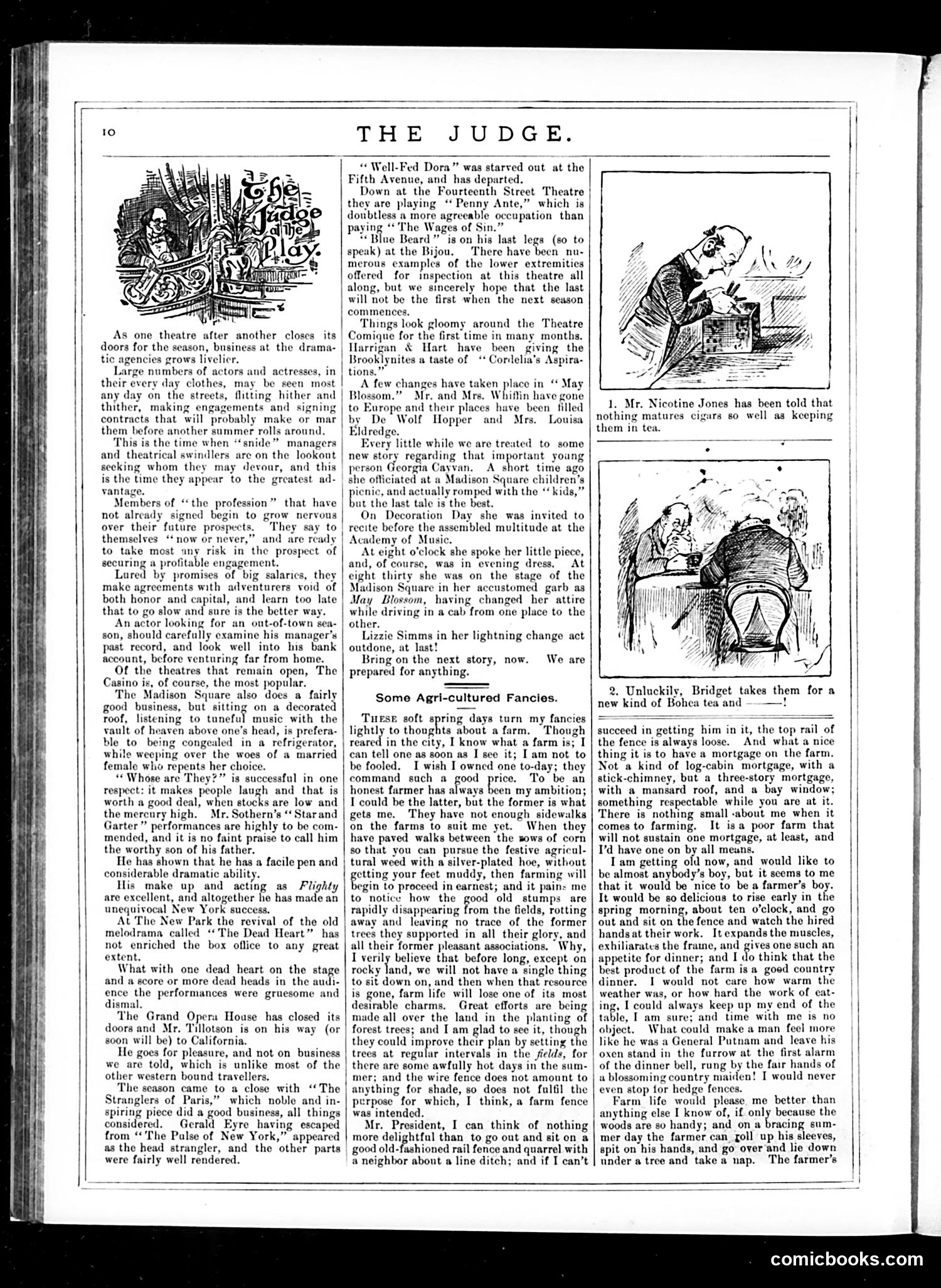
This page from the satirical magazine *Judge* discusses the theatrical season's closing and reopening, targeting theatrical practices and performers of the era. **The cartoons** show: (1) a man examining theatrical contracts/documents with a magnifying glass, and (2) "Bridget" serving tea—likely satirizing Irish servant stereotypes common in period comedy. **The satire's main points:** - Theatrical managers are predatory "swindlers" exploiting desperate actors during season transitions - Actors should scrutinize contracts and managers' financial backgrounds before signing - Several specific theaters and productions receive commentary: *The Casino* and *Madison Square* are praised; *The Dead Heart* revival is mocked; performances of *Blue Beard* are criticized for excessive leg-showing **Named performers** include Sothern (praised for "Star and Garter"), Harrigan & Hart, and De Wolf Hopper, suggesting contemporary theatrical personalities readers would recognize. The overall tone mocks both theatrical deception and period theatrical conventions while gossiping about the New York theater scene's personnel changes.
📄 Transcribed text from this page (OCR, searchable)
Machine-transcribed from the original scan — historical spelling and the odd misread are preserved.
is | ii iy q ) 4 NF THE JUDGE. doors for the season, busine tic agencies grows livelier. Large numbers of actors and actresses, in their every day clothes, may be seen most any day on the streets, flitting hither and | thither, making en, ments and signing contracts that will probably make or mar them before another summer rolls around. ‘This is the time when “snide” managers | and theatrical swindlers are on the lookont | seeking whom they may devour, and this is the time they appear to the greatest ad- vantage. Members of ‘the profession” that have not already signed begin to grow nervous over their future prospe They say to themselves ‘* now or never, vy} and are reads to take most any risk in the prospect of | securing a profitable engagement. Lured by promises of big salarics, they make agreements with adventurers void of | both honor and capital, and learn too late that to go slow and sure is the better way. An actor looking for an out-of-town sea- son, should carefully examine his manager’s past record, and look well into his bank account, before venturing far from home. Of the theatres that remain open, The Casino is, of course, the most popular. The Madison Square also does a fairly good business, but sitting on a decorated roof, listening to tuneful music with the vault of heaven above one’s head, is prefera- | ble to being congealed in a refrigerator, | while weeping over the woes of a married female who repents her choice. ‘Whose are They?” is successful in one respect: it makes people laugh and that is worth a good deal, when stocks are low and | the mercury high. Mr. Sothern’s “« Starand Garter” performances are highly to be cc mended, and it is no faint praise to call him the worthy son of his father. He has shown that he has a facile pen and | considerable dramatic ability. His make up and acting as Flighty are excellent, and altogether he has made an unequivocal New York success. At The New Park the revival of the old melodrama called ‘The Dead Heart” has not enriched the box oflice to any great extent. What with one dead heart on the stage and a score or more dead heads in the audi- ence the performances were gruesome and The Grand Opera House has closed its doors and Mr, Tillotson is on his way (or soon will be) to California. He goes for pleasure, and not on business we are told, which unlike most of the other western bound travellers, The season came to a close with ‘The | Stranglers of Paris,” which noble and in- spiring piece did a good business, all things considered. Gerald Eyre having escaped from ‘The Palse of New York,” appeared as the head strangler, and the other parts were fairly well rendered. “*Well-Fed Dora” was starved out at the Fifth Avenue, and has departed. Down at the Fourteenth Street Theatre they are playing “Penny Ante,” which is | doubtless a more agreeable occupation than paying «The Wages of Sin,” “Blue Beard” is on his last legs (so to speak) at the Bijou. There have been nu- merous examples of the lower extremities offered for inspection at this theatre all along, but we sincerely hope that the last will not be the first when the next season commences. ‘Things look gloomy around the Theatre Comigque for the first time in many months. Harrigan & Hart have been giving the Brooklynites a taste of ‘+ Cordelia’s Aspira- tions. A few changes have taken place in “ May Blossom.” Mr. and Mre. Whiffin have gone to Europe and their places have been filled by De Wolf Hopper and Mrs. Lov Eldredge. Every little while we are treated to some new story regarding that important young rerson Georgia Cayvan. short time ago she officiated at a Madison Square children’s picate, and actually romped with the ‘‘ kids,” but the last tale is the best. On Decoration recite before the as: Academy of Masi At eight o'clock she spoke her little piece, and, of course, was in evening dress. At eight thirty she was on the stage of the Madison Square in her accustomed garb as May Blossom, having changed her attire while driving in a cab from one place to the other. Lizzie Simms in her lightning change act outdone, at last! Bring on the next story, now. prepared for anything. mbled multitude at the We are Some Agri-cultured Fancies. ‘Tuese soft spring days turn my fancies lightly to thoughts about a farm. Though reared in the city, I know what a farm is; I can tell one as soon as I see it; I am not to be fooled. I wish I owned one to-day; they command such a good price. To be an honest farmer has always been my ambition; I could be the latter, but the former is what gets me. They have not enough sidewalks on the farms to suit me yet. When they have paved walks between the sows of corn so that you can pursue the festive agricul- tural weed with a silver-plated hoe, without getting your feet muddy, then farming will begin to proceed in earnest; and it pains me to notice how the good old stumps are rapidly disappearing from the fields, rotting away and leaving no trace of the former trees they supported in all their glory, and all their former pleasant associations. Why, I veri My believe that before long, except on land, we will not have a single thing to sit down on, and then when that resource is gone, farm life will lose one of its most desirable charms. Great efforts are being made all over the land in the planting of forest trees; and I am glad to see it, though they could improve their plan by setting the trees at regular intervals in the fields, for there are some awfully hot days in the sum- mer; and the wire fence does not amount to anything for shade, so does not fulfil the perpose for which, I think, a farm fence was intended. Mr. President, I can think of nothing more delightful than to go out and sit on a good old-fashioned rail fence and quarrel with a neighbor about a line ditch; and if I can’t Day she was invited to | 1. Mr. Nicotine Jones has been told that nothing matures cigars so well as keeping them in tea. 2. Unluckily, Bridget takes them for a new kind of Bohea tea and -—! succeed in getting him in it, the top rail of the fence is always loose. And what a nice thing it is to have a mortgage on the farm. Not a kind of log-cabin mortgage, with a stick-chimney, but a three-story mortgage, with a mansard roof, and a bay window; something respectable while you are at it. There is nothing small about me when it comes to farming. It isa poor farm that will not sustain one mortgage, at least, and I’d have one on by all meuns. Iam getting ofd now, and would like to be almost anybody’ boy, but it scems to me that it would be nice to be a farmer’s boy. It would be so delicious to rise early in the spring morning, about ten o’clock, and go out and sit on the fence and watch the hired handsat their work. It expands the muscles, exhiliarates the frame, and gives one such an appetite for dinner; and I do think that the best product of the farm is a goed country dinner. I would not care how warm the weather was, or how hard the work of eat- ing, I could always keep up my end of the table, I am sure; and time with me is no object. What could make a man feel more like he was a General Putnam and leave his oxen stand in the furrow at the first alarm of the dinner bell, rung by the fair hands of a blossoming country maiden! I would never even stop for hedge fences. Farm life would please me better than anything else I know of, if only because the woods are so handy; and on a bracing sum- mer day the farmer can_ oll up his sleeves, spit on his hands, and go over and lie down under a tree and take a nap. The farmer's comicbooks.com