
A complete issue · 16 pages · 1884
Judge — May 3, 1884
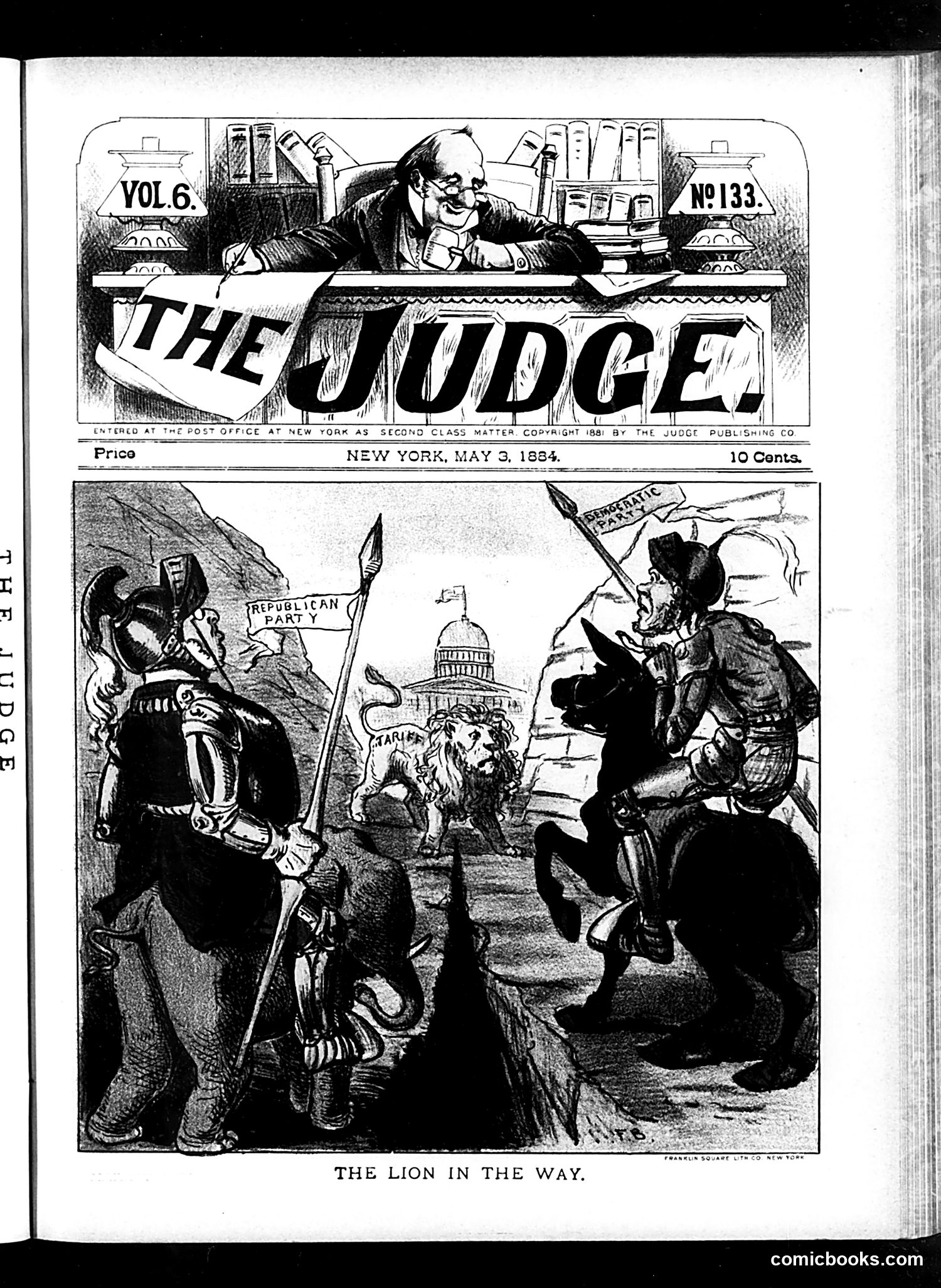
This *Judge* cover from May 3, 1884, depicts a political confrontation. The central figure labeled "Marine" appears to represent the Republican Party's position or candidate, confronted by two opposing forces: one labeled "Republican Party" on the left, and another on the right holding a "Democratic" banner. The "lion in the way" metaphor suggests an obstacle blocking political progress. The cartoonist uses animal imagery (the lion, the elephant) to represent competing political factions during what appears to be the 1884 presidential election cycle—a contentious year marked by Republican Party divisions and factional disputes. The Capitol building in the background emphasizes governmental stakes. The satire critiques internal Republican conflicts impeding their political agenda.
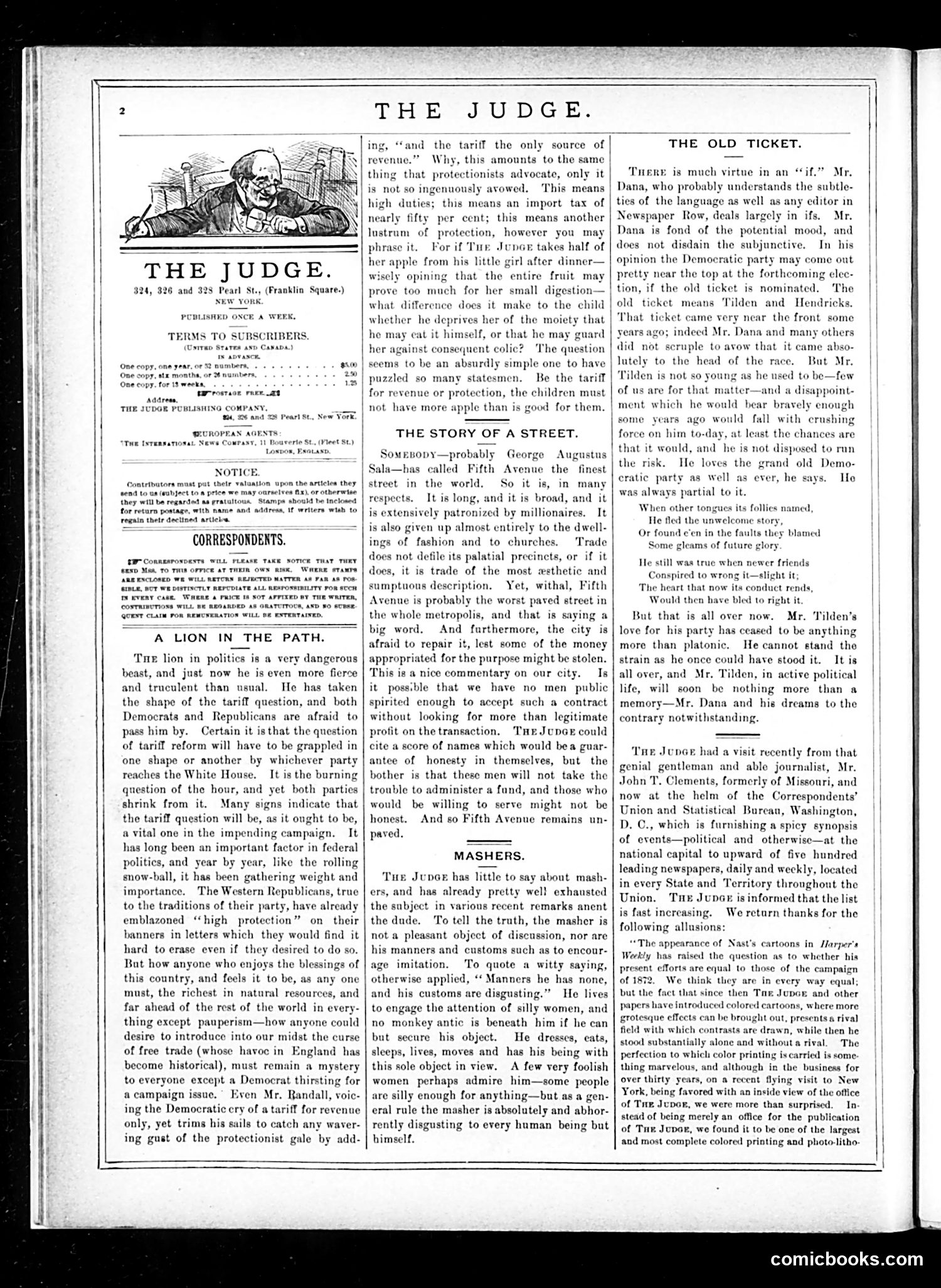
This Judge magazine page contains two main political pieces: **"A Lion in the Path"** criticizes both major parties for avoiding the tariff reform debate during an upcoming election campaign. The editorial argues that tariff policy—a major federal issue—has become politically toxic. Democrats like Samuel Randall claim to support "tariff for revenue only," but the Judge sees this as duplicitous protection under another name. The apple-eating metaphor suggests the question is simple: whether tariffs benefit the wealthy or everyone equally. **"The Story of a Street"** begins praising Fifth Avenue in New York City as the finest street in America, patronized by millionaires and devoted to fashion and churches rather than commerce. The page also includes standard magazine housekeeping: subscription rates, contributor guidelines, and agent information. The satirical tone targets political hypocrisy around protectionism versus free trade, a major late-19th-century American political controversy.
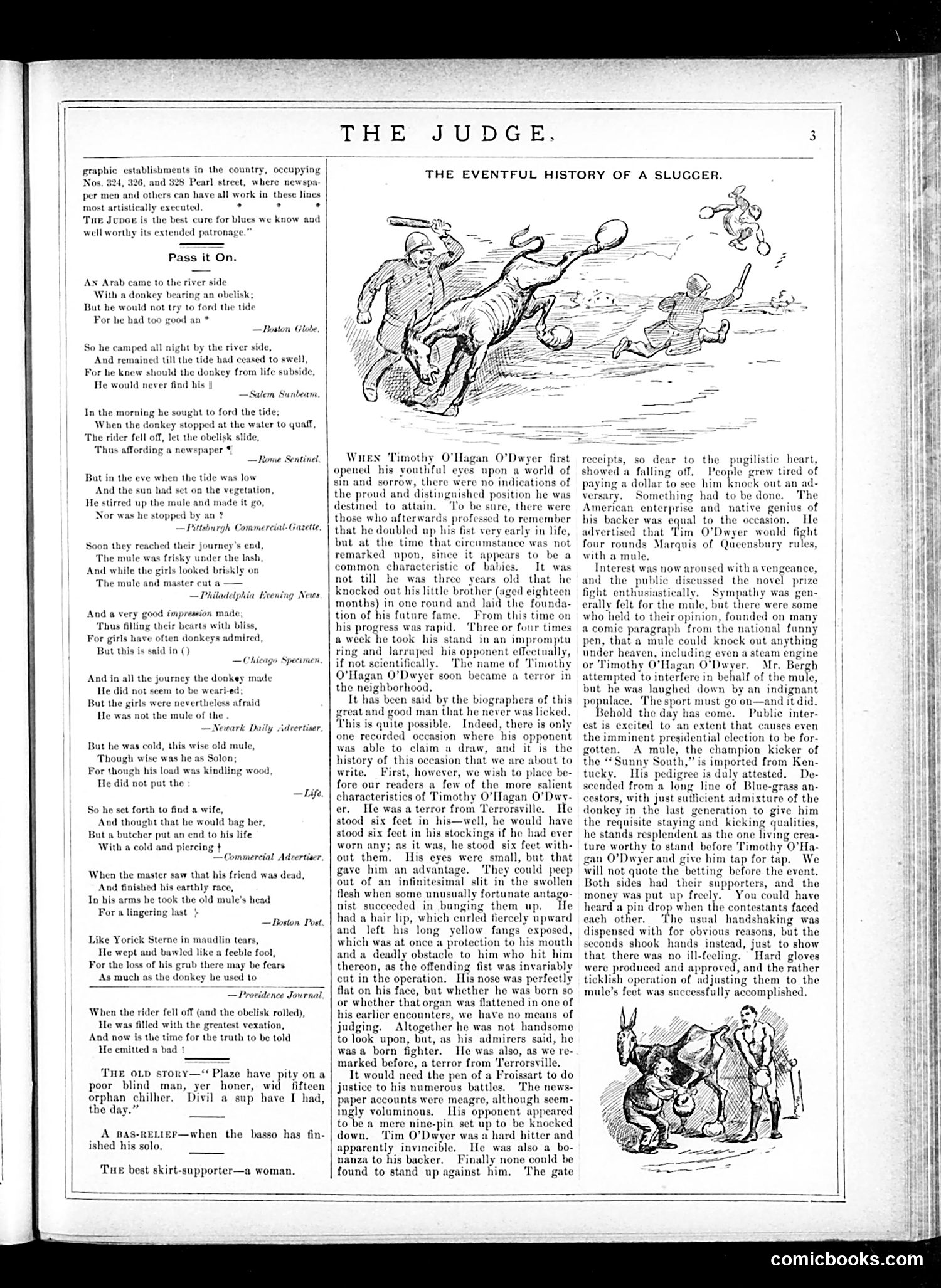
This page satirizes Timothy O'Hagan O'Dwyer, an apparently real but minor boxer whose career was flagging. The main article describes how his promoter, facing declining ticket sales, arranged a novelty fight: O'Dwyer versus a mule under Marquis of Queensberry rules (standard boxing regulations). The accompanying illustrations show the absurd spectacle—a boxer fighting a kicking, bucking mule while spectators watch. The satire mocks both the boxer's desperation and the American entertainment industry's willingness to stage ridiculous spectacles to draw crowds. By pit a professional fighter against an animal, Judge ridicules the degradation of prize-fighting while poking fun at the public's appetite for novelty over genuine sport. The numerous comic poems about a donkey scattered throughout the page appear to be filler material typical of the era's satirical magazines.
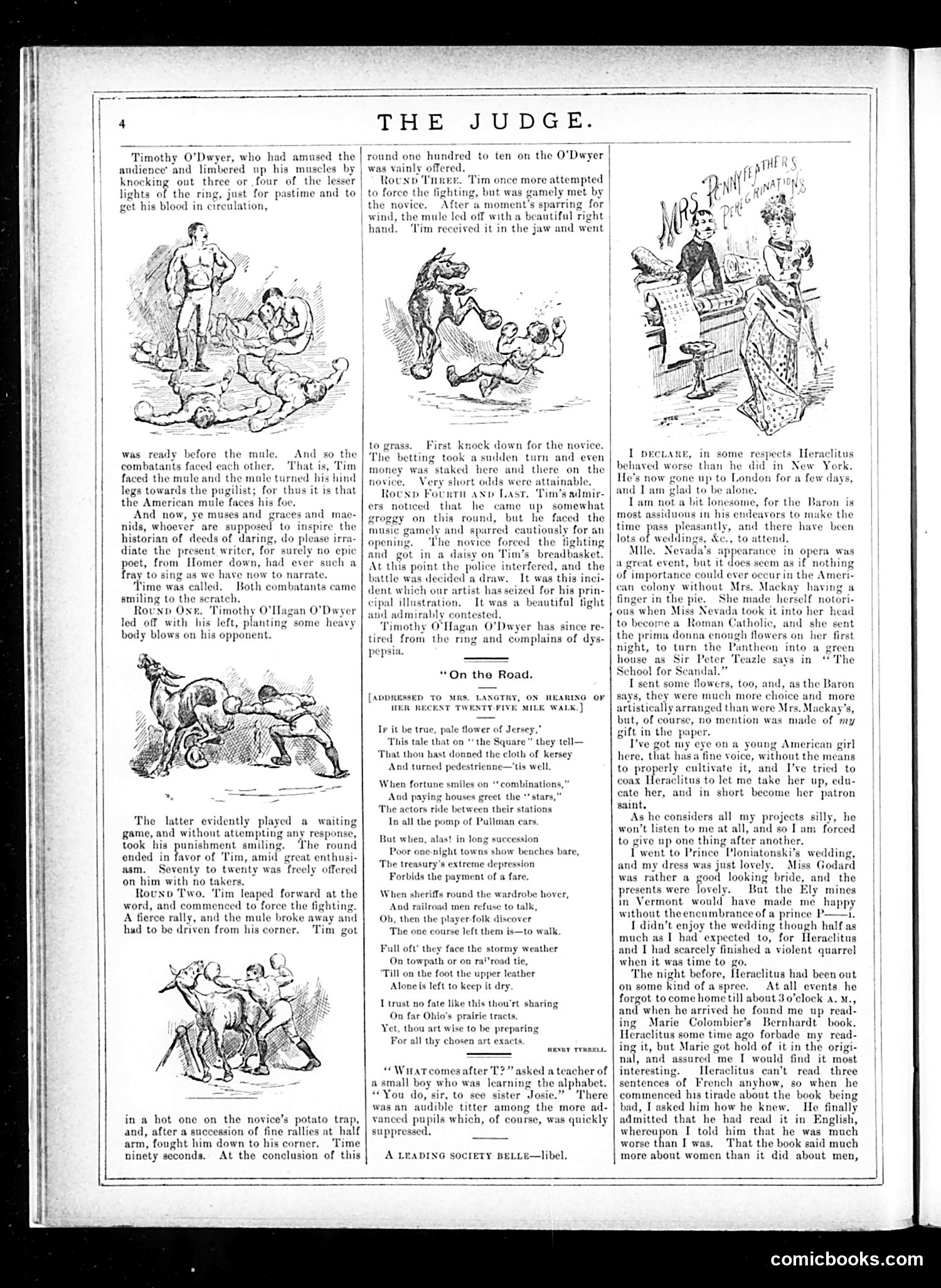
This page contains a humorous boxing match story between "Timothy O'Hagan O'Dwyer" and a mule—a satire of Irish-American bare-knuckle fighting culture. The detailed round-by-round account mocks both the sport's brutality and flowery newspaper coverage of fights. O'Dwyer's exaggerated Irish name and the mule as opponent suggest ridicule of Irish immigrant boxers and their working-class audiences who bet heavily on such matches. The second section, "On the Road," comments on actress Lillie Langtry's recent 25-mile walk, likely a publicity stunt. The verse humorously contrasts theatrical actors' usual luxury travel via Pullman cars with desperate circumstances forcing performers to walk when touring shows fail financially—a jab at the entertainment industry's economic precarity and theatrical self-promotion. A brief joke about a schoolboy follows. Overall, the page satirizes Irish-American pugilism, theater industry instability, and Victorian-era social pretension through comic verse and illustrations.
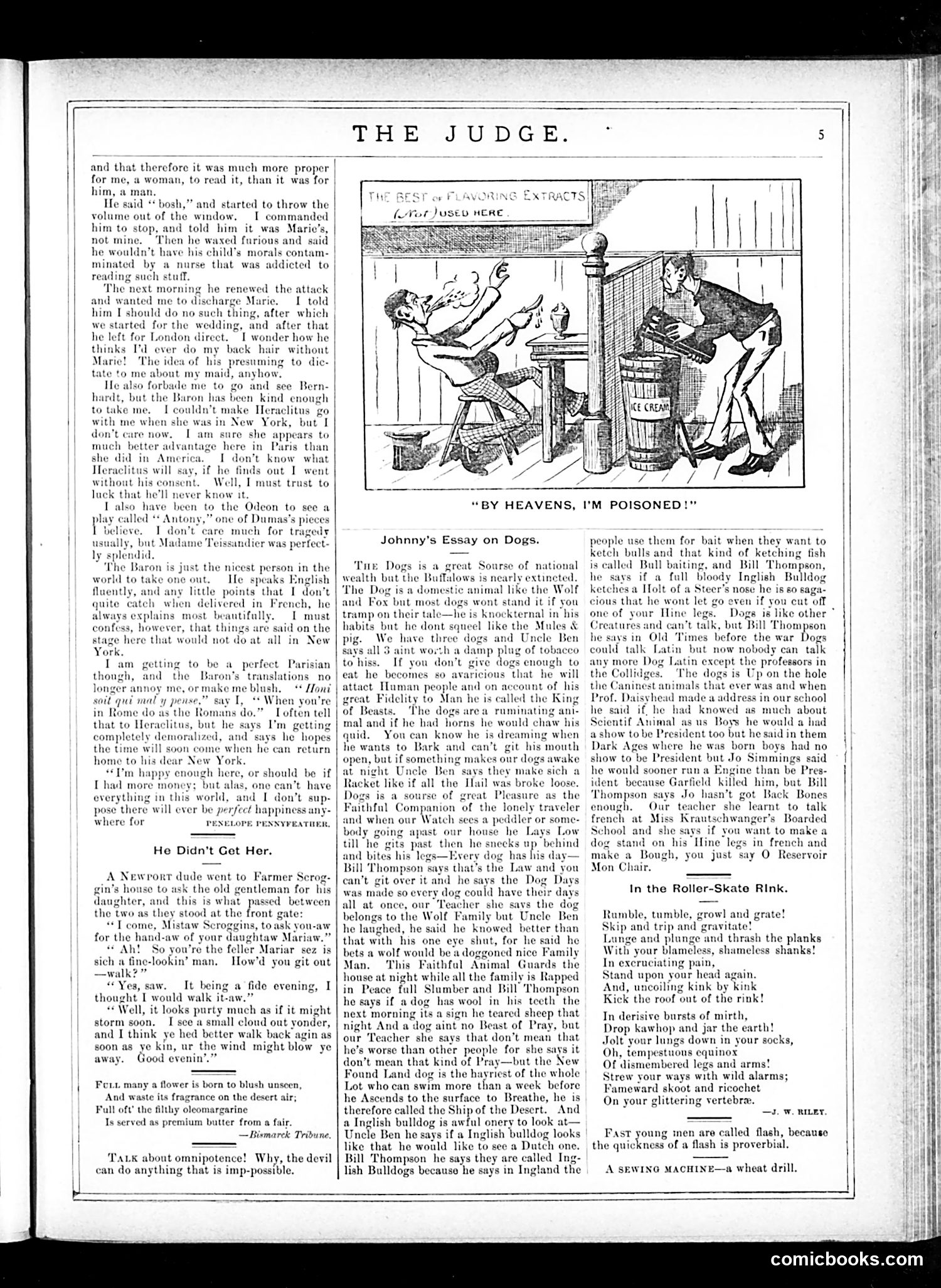
The cartoon depicts a man dramatically collapsing while reading "The Best of Flavoring Extracts" — a cookbook or culinary guide. The humor appears to target anxieties about food adulteration and questionable ingredients in commercial products, which was a genuine public concern in the late 19th/early 20th century. The surrounding text includes gossipy letters from socialites and humorous essays (like "Johnny's Essay on Dogs" — a child's misspelled, rambling composition about various dog breeds). The overall page mixes satirical commentary on consumer culture, matrimonial disputes, and literary pretension typical of Judge's irreverent tone. The "poisoning" joke likely mocks both exaggerated hypochondria and legitimate contemporary fears about food safety and bogus commercial products marketed to consumers.
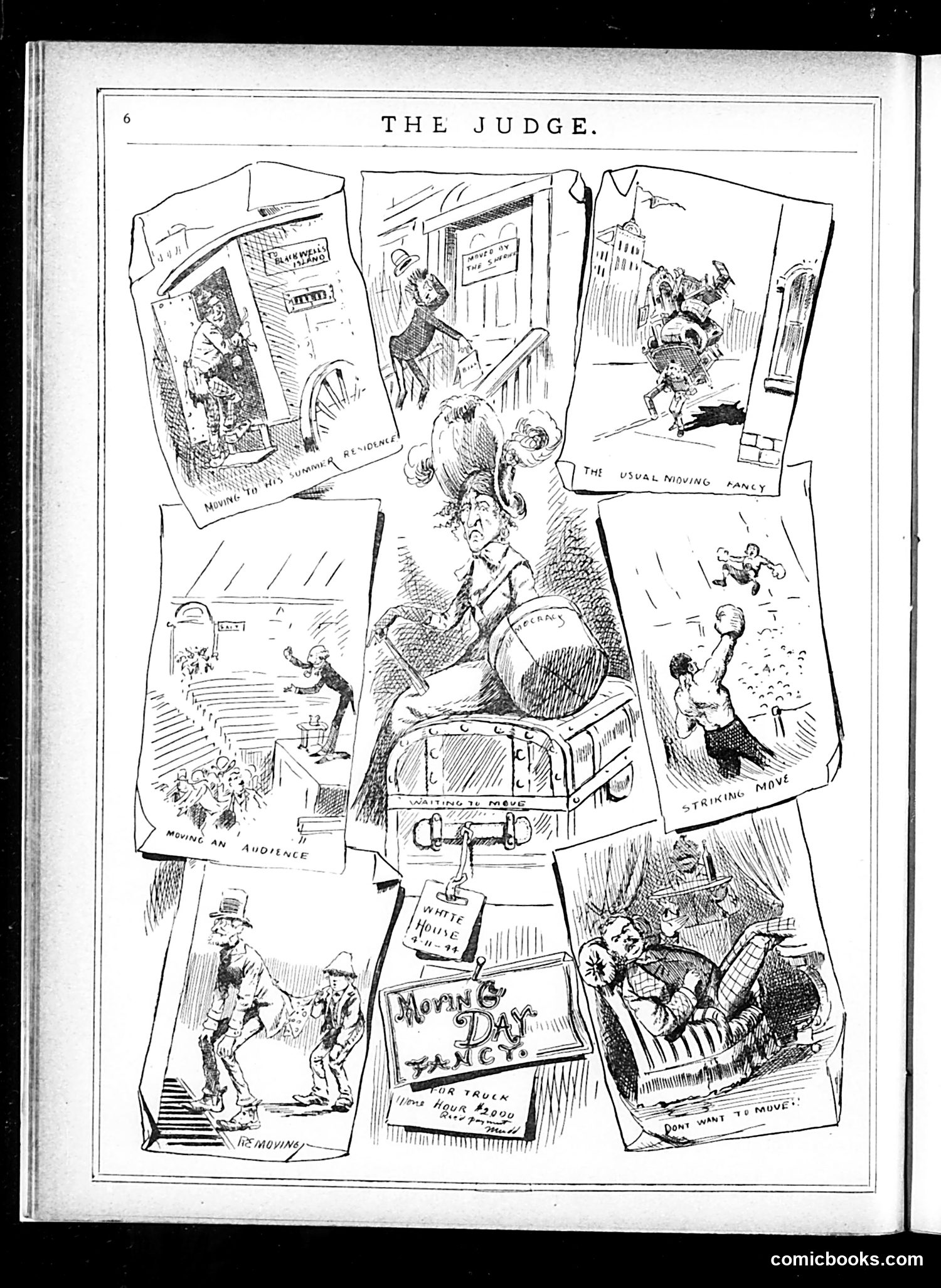
This page presents multiple satirical vignettes depicting the various duties and frustrations of a judge. The central figure is an overwhelmed judicial officer surrounded by smaller scenes showing different courtroom scenarios: hearing audiences, waiting to proceed, striking motions, moving day proceedings, morning sessions, and domestic disputes ("Don't want to move"). The cartoon satirizes the judge's workload and the mundane, repetitive nature of judicial responsibilities. It suggests judges deal with trivial matters alongside serious legal cases—evictions, squabbles, routine motions—creating chaos and frustration. The cramped, cluttered composition emphasizes the overwhelming volume of cases and the judge's exasperation with constant demands. The satire critiques both the judicial system's inefficiency and the public's tendency to litigate minor grievances.
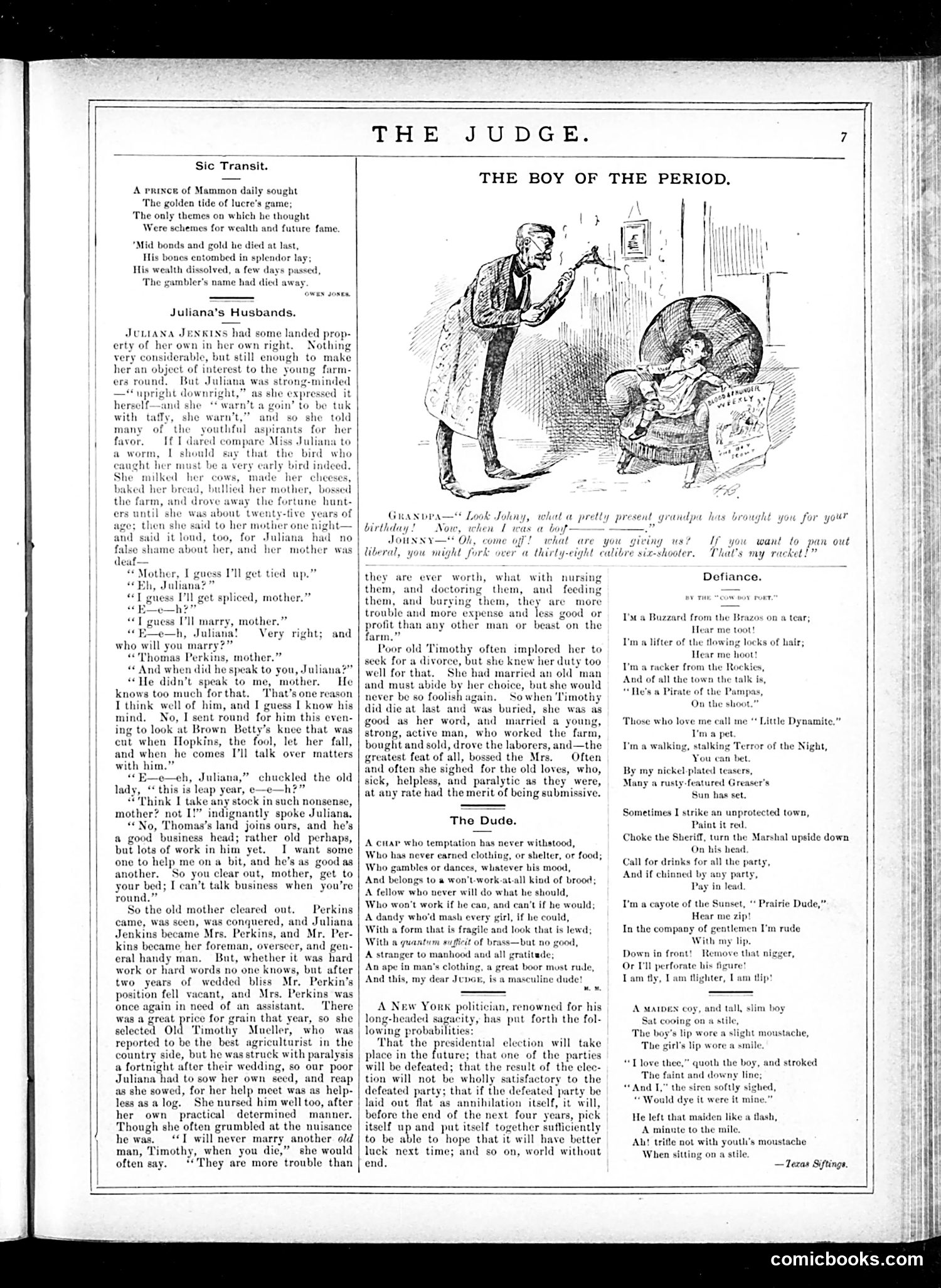
This page contains **three distinct pieces of satirical content**: 1. **"Sic Transit"** (top left): A moralistic poem about a wealthy man ("prince of Mammon") who dies and his fortune dissipates—satirizing greed and the futility of accumulating wealth. 2. **"Juliana's Husbands"** (left column): A humorous story mocking a pragmatic, no-nonsense farmer woman who sequentially marries three men based on utility rather than romance. Each husband becomes her "foreman" and farm worker. The satire targets both her mercenary attitude and 19th-century women's economic dependence on marriage—she marries to gain a "helper," not a husband. 3. **"The Boy of the Period"** (right): A cartoon showing a grandfather displaying a portrait to a young boy, with verses mocking contemporary youth as pretentious ("I'm a Buzzard," "I'm a coyote of the Sunset"). This satirizes the arrogant, affected mannerisms of modern boys, contrasting them unfavorably with the grandfather's generation. The page broadly satirizes greed, mercenary marriage, and youthful pretension—typical Judge magazine themes criticizing American social trends.
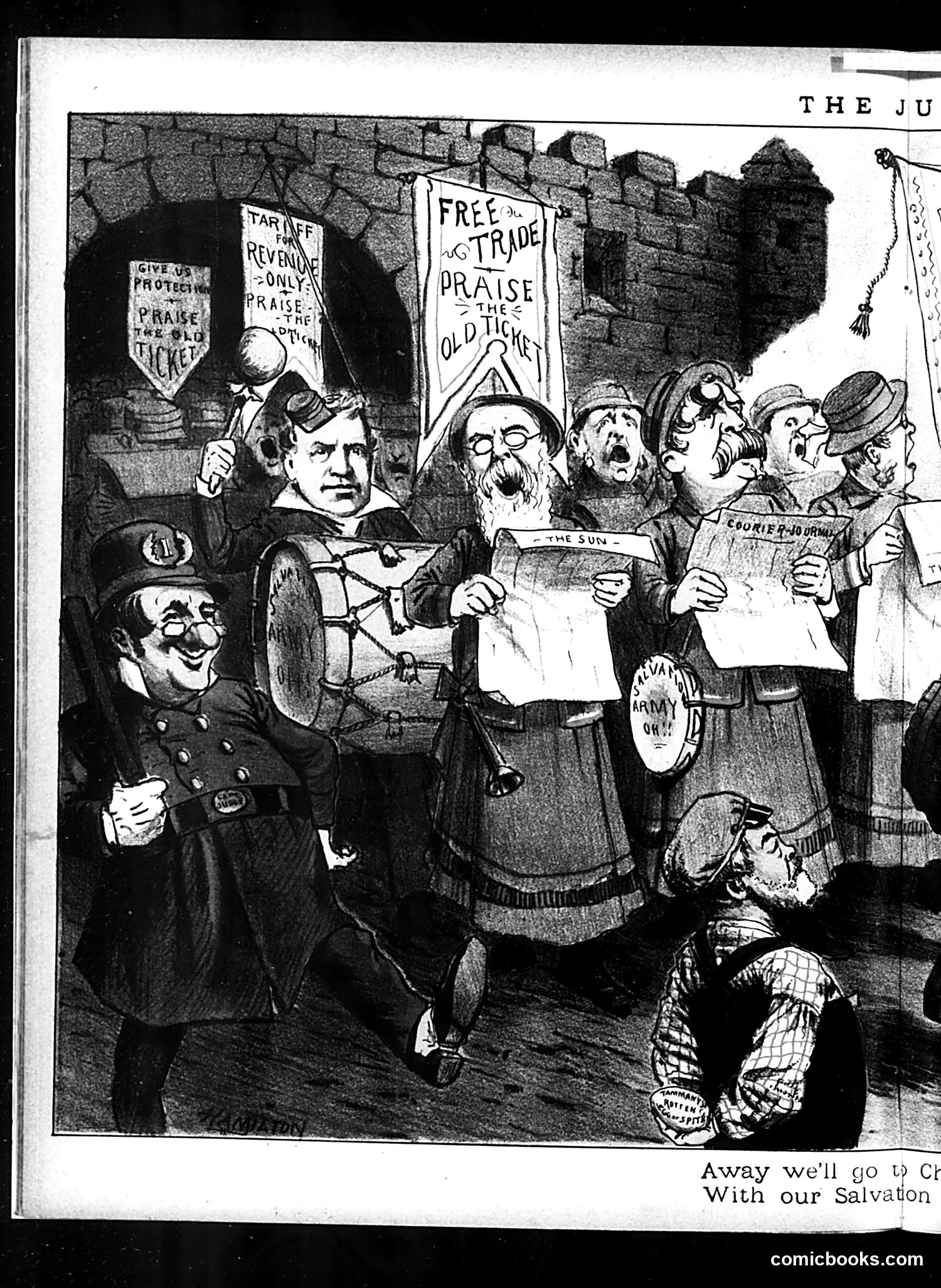
This cartoon depicts a protest scene at what appears to be a fortress or government building. The protesters hold signs advocating for "Free Trade" and "Praise the Old Ticket," while others demand "Give us Protection" and "Tariff for Revenue Only." The satire addresses late 19th-century American trade policy debates, specifically the conflict between protectionists (who wanted tariffs to shield domestic industry) and free-trade advocates. The figure on the left, wearing military insignia, appears to represent government or authority. The caption "Away we'll go to [unclear] With our Salvation" suggests ironic commentary on how trade policies were being presented as salvation or solutions. The exaggerated caricatures and the chaotic protest convey Judge magazine's satirical skepticism toward these competing economic doctrines.
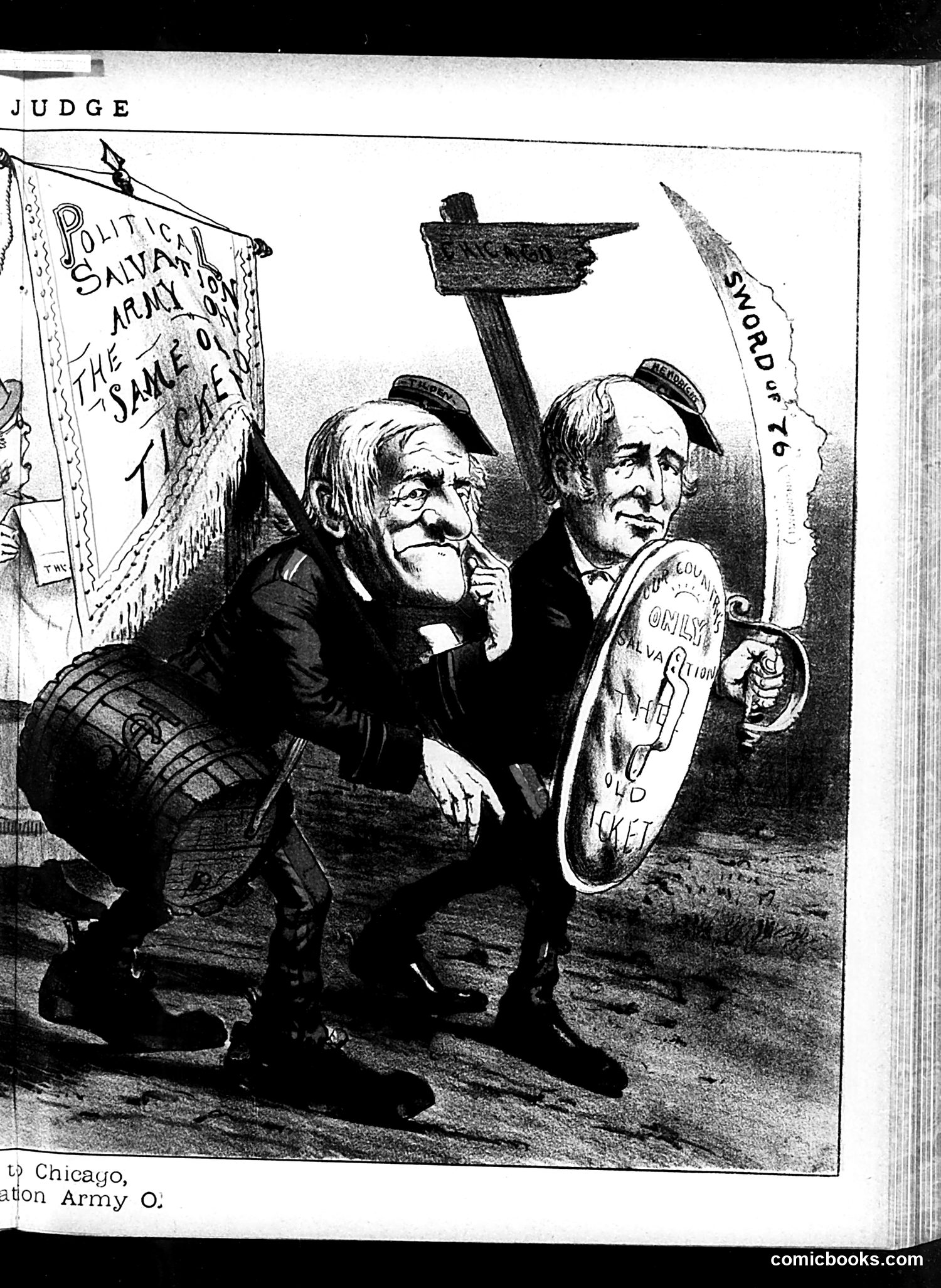
This **Judge** magazine cartoon satirizes the "Salvation Army" through caricature of two elderly men. The left figure gestures toward a sign reading "POLITICAL SALVATION ARMY" and "THE SAME OLD GAME," while the right figure holds a shield labeled with what appears to be "SALVATION ARMY" rhetoric. The satire suggests the Salvation Army—or organizations using similar charitable language—were engaged in recycled political manipulation rather than genuine reform. The "same old game" reference implies criticism that despite claiming moral or social improvement, these groups perpetuated established power structures. The exaggerated facial features and cynical poses reinforce the cartoonist's skepticism toward the organization's stated charitable mission during the Gilded Age, when such groups faced scrutiny over their actual effectiveness and motives.
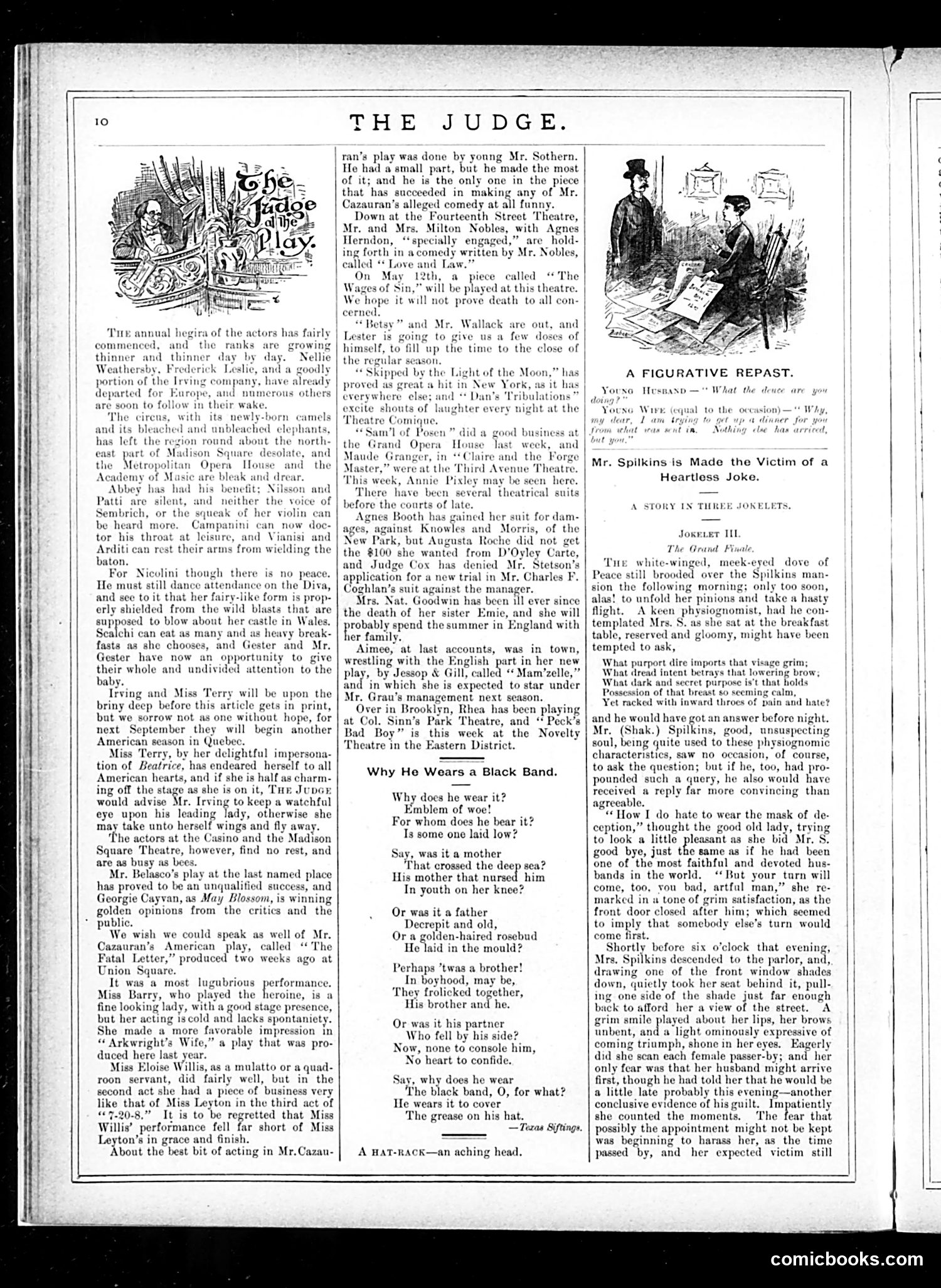
This page from *Judge* magazine contains theater reviews and gossip covering the 1880s Broadway season. The main content discusses departing actors (Nellie Weathersby, Frederick Leslie) and current theatrical productions at venues like the Metropolitan Opera House, Casino, and Madison Square Theatre. The satirical focus centers on **Henry Irving and Ellen Terry**, leading Shakespearean actors. The review warns Irving to "keep a watchful eye" on his leading lady Terry, joking that she might "take unto herself wings and fly away"—a veiled suggestion that he should monitor her fidelity while they're away from home. The page also critiques **David Belasco's play** (praised) and **Cazauran's "The Fatal Letter"** (harshly criticized as "lugubrious"). Young actor **E.A. Sothern** receives praise for salvaging scenes with humor. The accompanying jokelet about **Mr. Spilkins** and a "black band" appears to be domestic humor unrelated to theater. Overall, the page reflects *Judge's* gossipy coverage of theatrical personalities and productions.
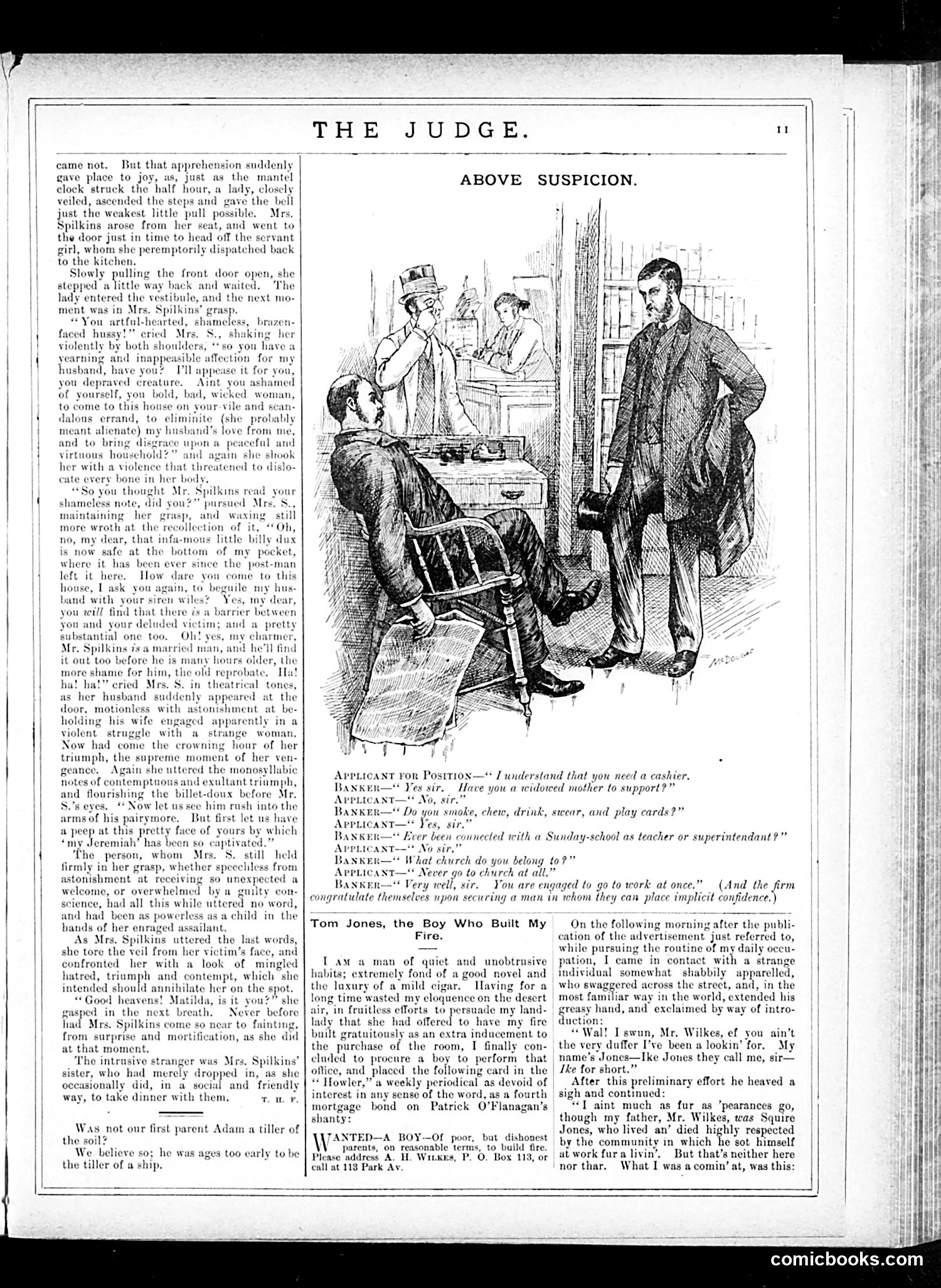
The main cartoon depicts a domestic comedy of errors. Mrs. Spilkins, suspecting her husband of infidelity, violently confronts an unexpected female visitor at her door, accusing her of seducing Mr. Spilkins. She tears away the woman's veil in triumph, only to discover it's her own sister—who merely stopped by for dinner. The satire mocks Victorian domestic jealousy and female suspicion, showing how quickly emotions escalate when propriety appears threatened. The "above suspicion" title ironically undercuts Mrs. Spilkins' confidence in her accusations. Below, an unrelated hiring interview satirizes employment practices: a banker congratulates himself for hiring an unqualified man simply because he lacks moral character traits (doesn't attend church, gambles, etc.)—suggesting employers valued obedience and moral weakness over actual competence.
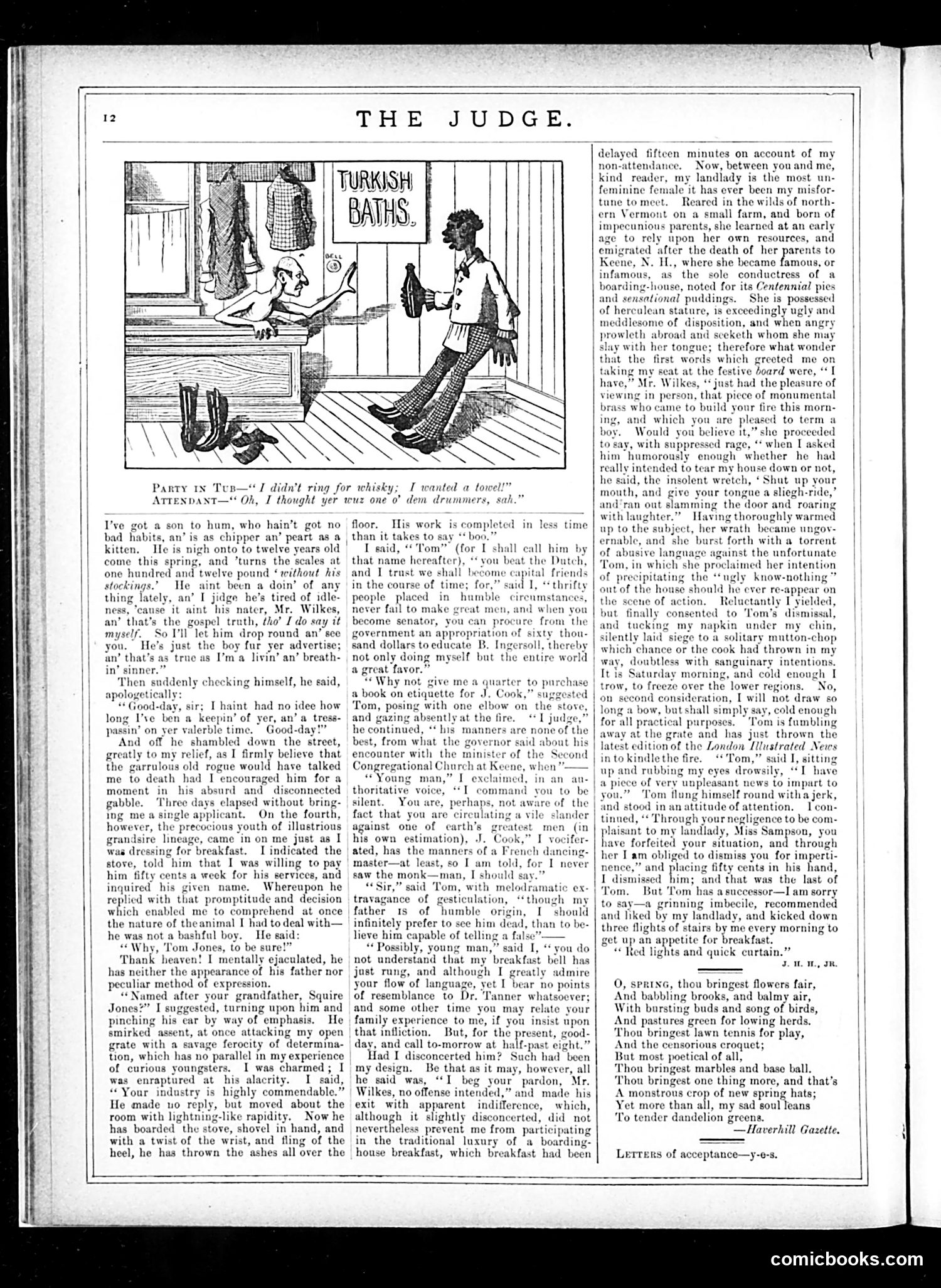
This page satirizes **pretentious social climbing and false gentility** in the Gilded Age. The cartoon shows a man at Turkish baths encountering a working-class visitor who mistakes him for someone else—a humorous case of mistaken identity. The accompanying text story mocks a pompous employer hiring a boy named "Tom Jones" for menial work. The employer condescendingly lectures Tom about becoming a "senator" and patronizingly suggests Tom should help educate agnostic Robert Ingersoll (a famous freethinker of the era). Tom responds with crude gossip about a minister, prompting the employer to angrily defend "J. Cook" (unclear who this refers to) as "one of earth's greatest men." **The satire targets**: Social pretension masquerading as benevolence, the absurdity of employers lecturing poor boys about self-improvement while treating them as inferiors, and the gap between professed values and actual condescension. The humor lies in how quickly the gentleman's moral superiority crumbles when challenged.
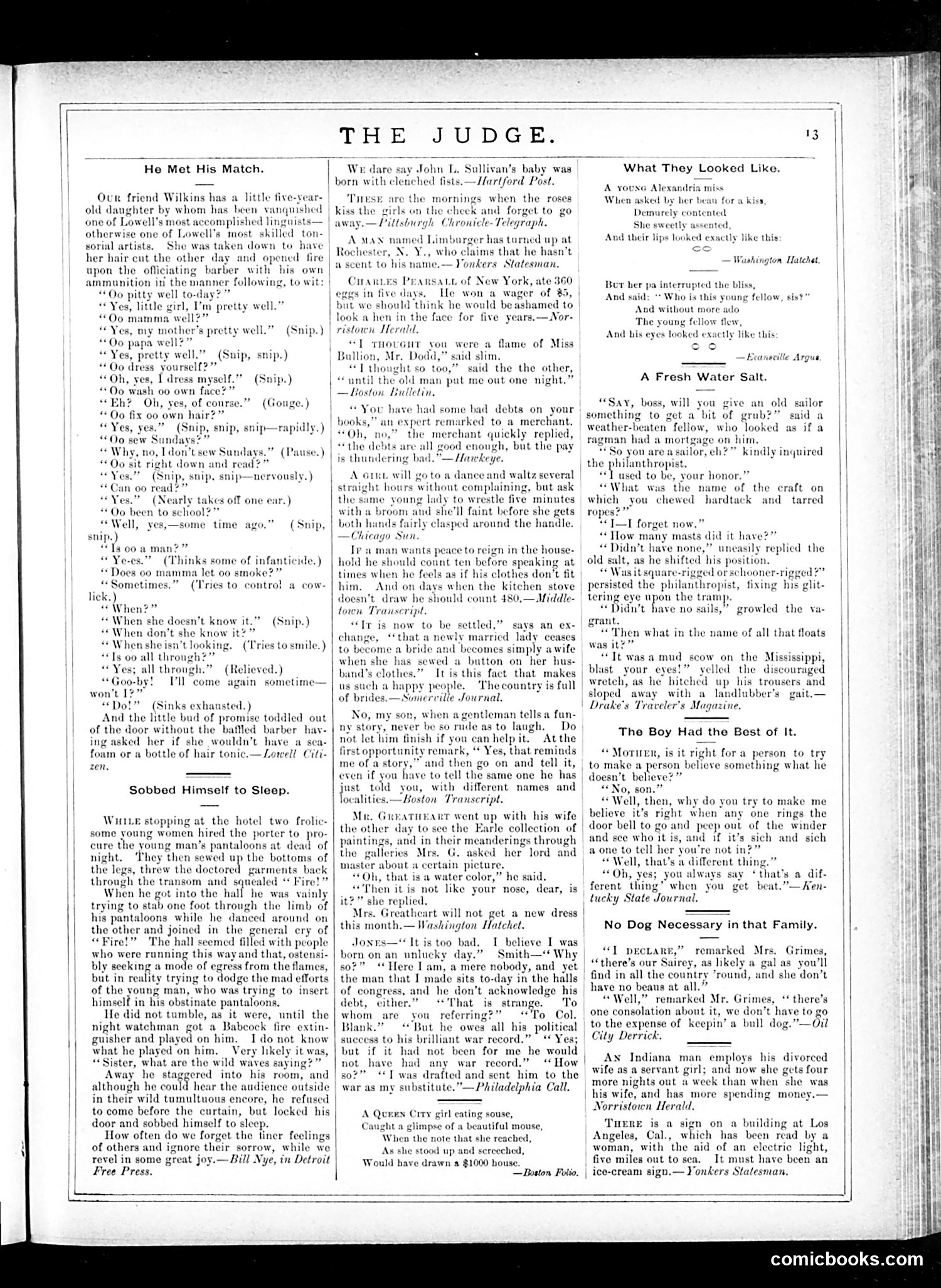
This page from **Judge** magazine contains primarily **humorous anecdotes and brief satirical items** rather than political cartoons. The main pieces include: 1. **"He Met His Match"** - A barber's dialogue with a precocious five-year-old girl, satirizing children's constant questioning. 2. **"Sobbed Himself to Sleep"** - A practical joke where young men sew up a man's trouser legs, then cry "Fire!" to embarrass him publicly. The satire critiques people's cruelty disguised as amusement. 3. **Brief witty observations** on contemporary topics: John L. Sullivan's baby, egg-eating contests, and relationship dynamics. The page demonstrates Judge's typical format: **satirizing everyday American life and social foibles** rather than grand political themes. The humor targets human nature—children's impertinence, mob mentality during pranks, and marital dynamics—reflecting late 19th-century sensibilities about propriety and social behavior.
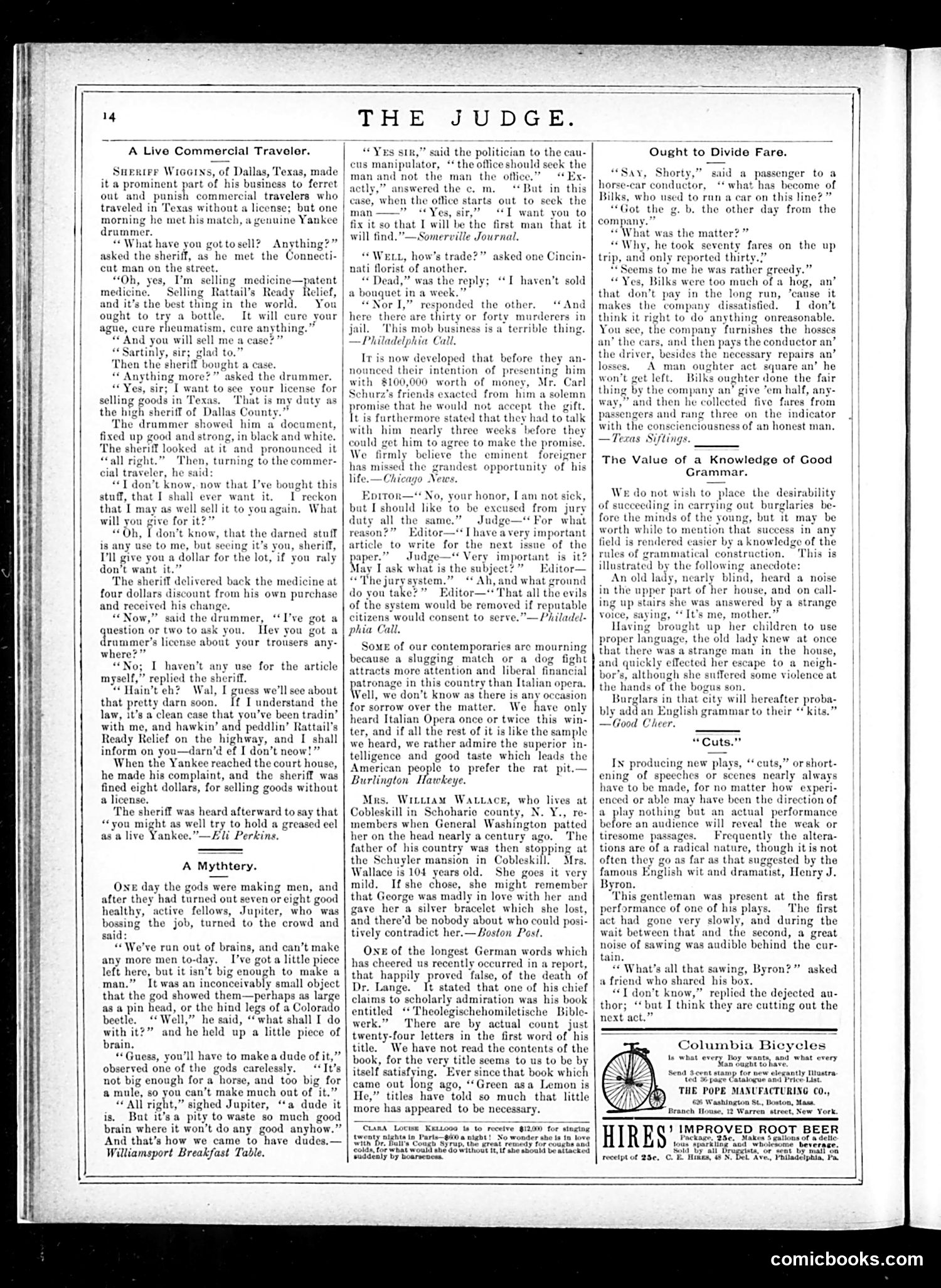
This page from *Judge* contains several brief satirical pieces typical of late 19th-century American humor magazines: **"A Live Commercial Traveler"** mocks the stereotype of shrewd, clever Yankees outwitting others. A Connecticut drummer (traveling salesman) outmaneuvers a Texas sheriff by selling him worthless patent medicine, then catching the sheriff himself breaking licensing laws—turning the tables on authority through quick thinking. **"A Mythtery"** is a jokey origin story explaining "dudes"—a contemporary term for fashionable but frivolous young men—as literally made from leftover brain material by Jupiter. It reflects period mockery of dandyish fashion-conscious men as intellectually inferior. The page also includes brief anecdotes about excused jurors, a greedy streetcar conductor, and knowledge of grammar, typical filler humor. Additionally there are advertisements for Columbia Bicycles and other products. These pieces represent *Judge*'s recurring themes: regional stereotypes (Yankees vs. Southerners), social class commentary, and gentle mockery of contemporary types.
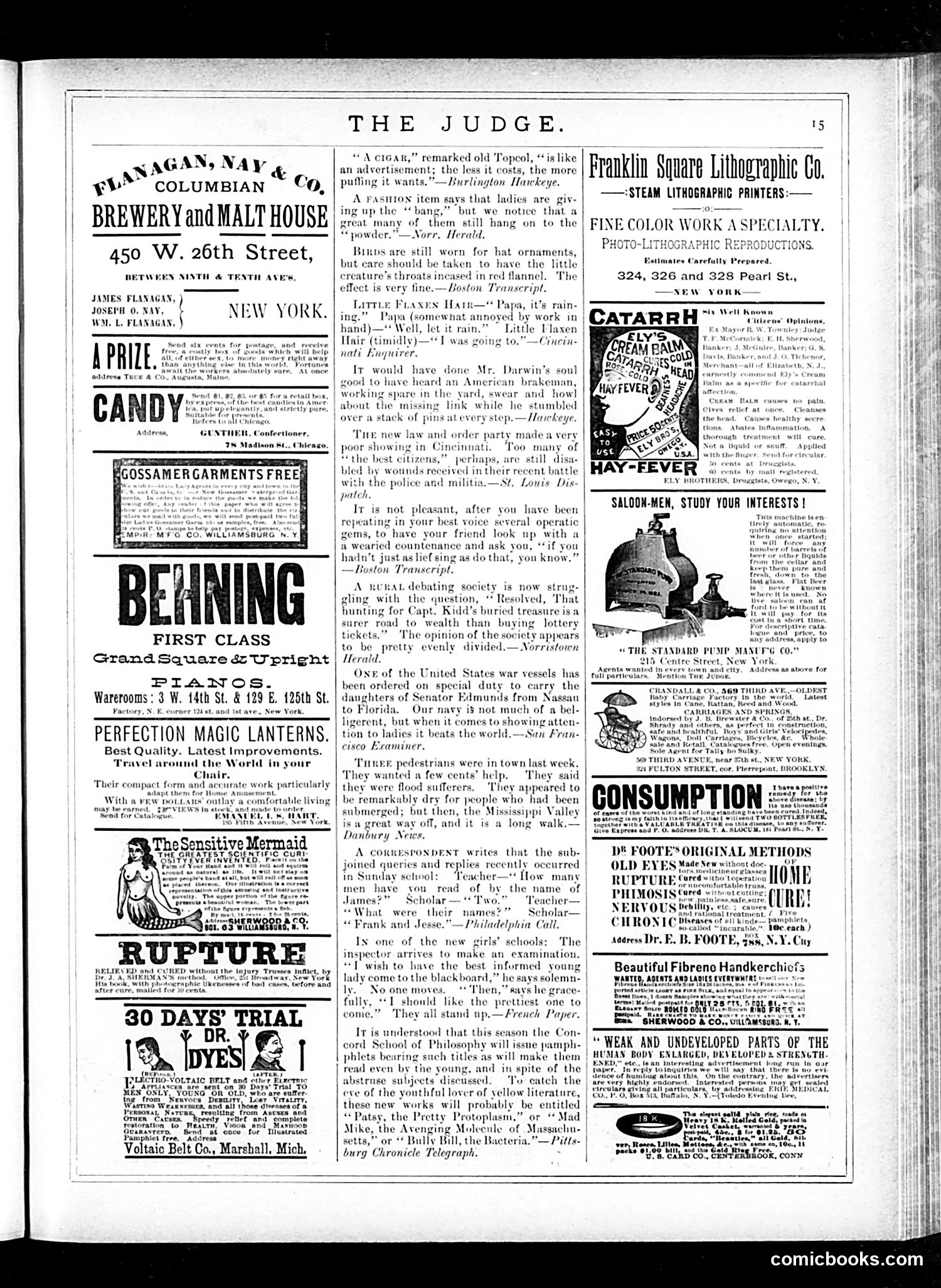
This page is primarily **advertising**, with minimal editorial cartoon content. The page showcases various Victorian-era advertisements for pianos, breweries, medical devices (including a "Voltaic Belt" for treating ailments), and lithographic services. The small editorial sections consist of brief humor quotes and anecdotes clipped from other newspapers, typical of Judge's format. These touch on social observations: ladies' fashion absurdities, the difficulty of American soldiers readjusting to civilian life, and Sunday school humor about children's confusion over biblical names. One item notes "pedestrians were in town last week...they were flood sufferers" yet appeared dry—likely referencing recent Mississippi Valley flooding, though the location remains unclear. The overall tone reflects turn-of-the-century American life: urbanization, medical pseudoscience, and genteel social commentary. No specific political figures or major satirical cartoons are visible—this is simply a typical Judge page mixing ads with light social humor.
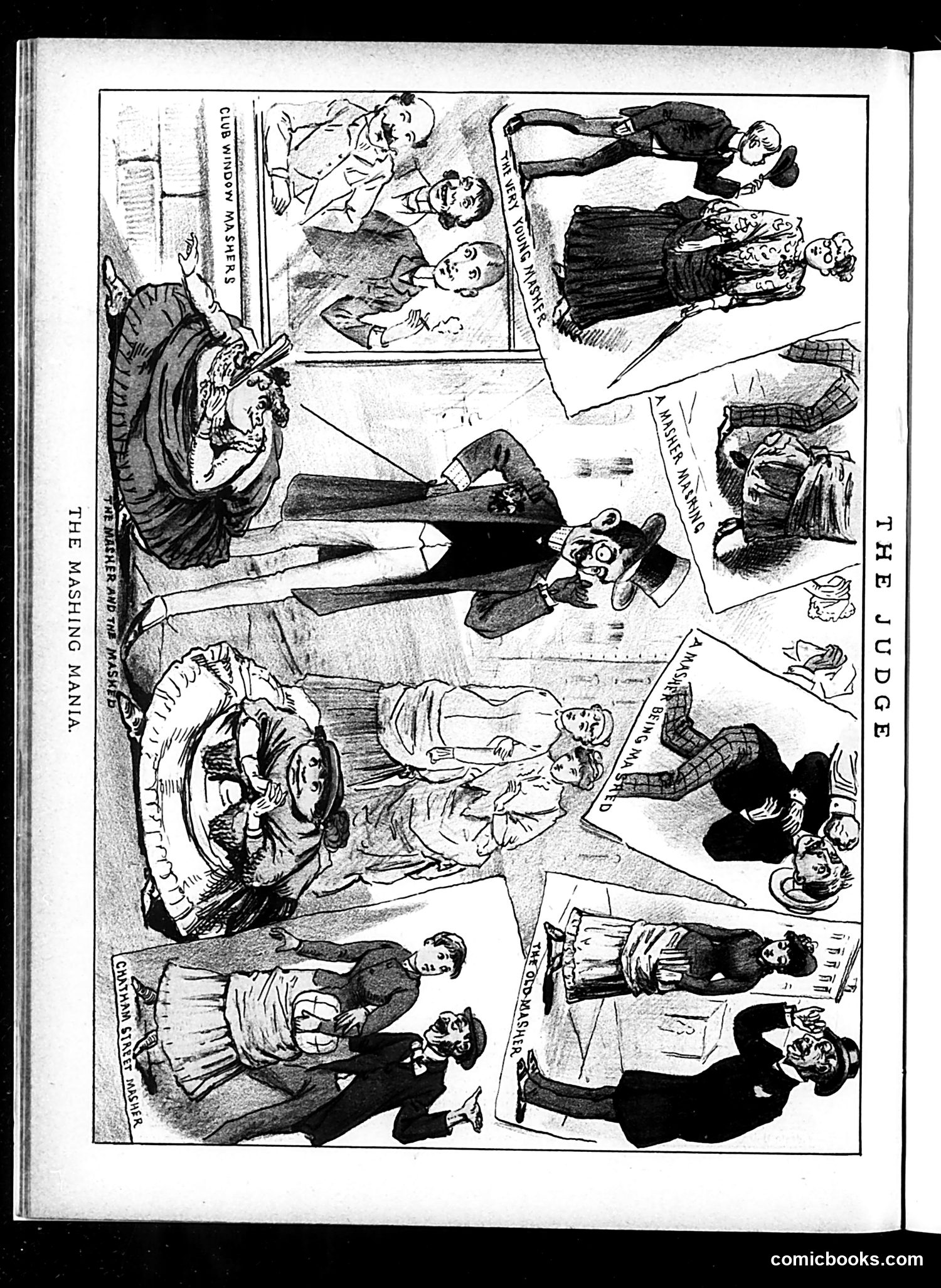
This Judge cartoon satirizes Victorian-era social behavior, specifically the figure of "the masher"—a contemporary term for an aggressive, predatory man who pestered women in public spaces. The central image shows a well-dressed man with an exaggerated, menacing expression. Surrounding him are vignettes depicting his various unsavory interactions: approaching women on streets, at social gatherings, and in other public settings where he makes unwanted advances. The title's wordplay on "mask" suggests the cartoon critiques how such men presented a respectable facade in polite society while behaving disreputably toward women. The satire exposes the gap between public propriety and private misconduct, mocking both the mashers themselves and perhaps society's tolerance of their behavior.